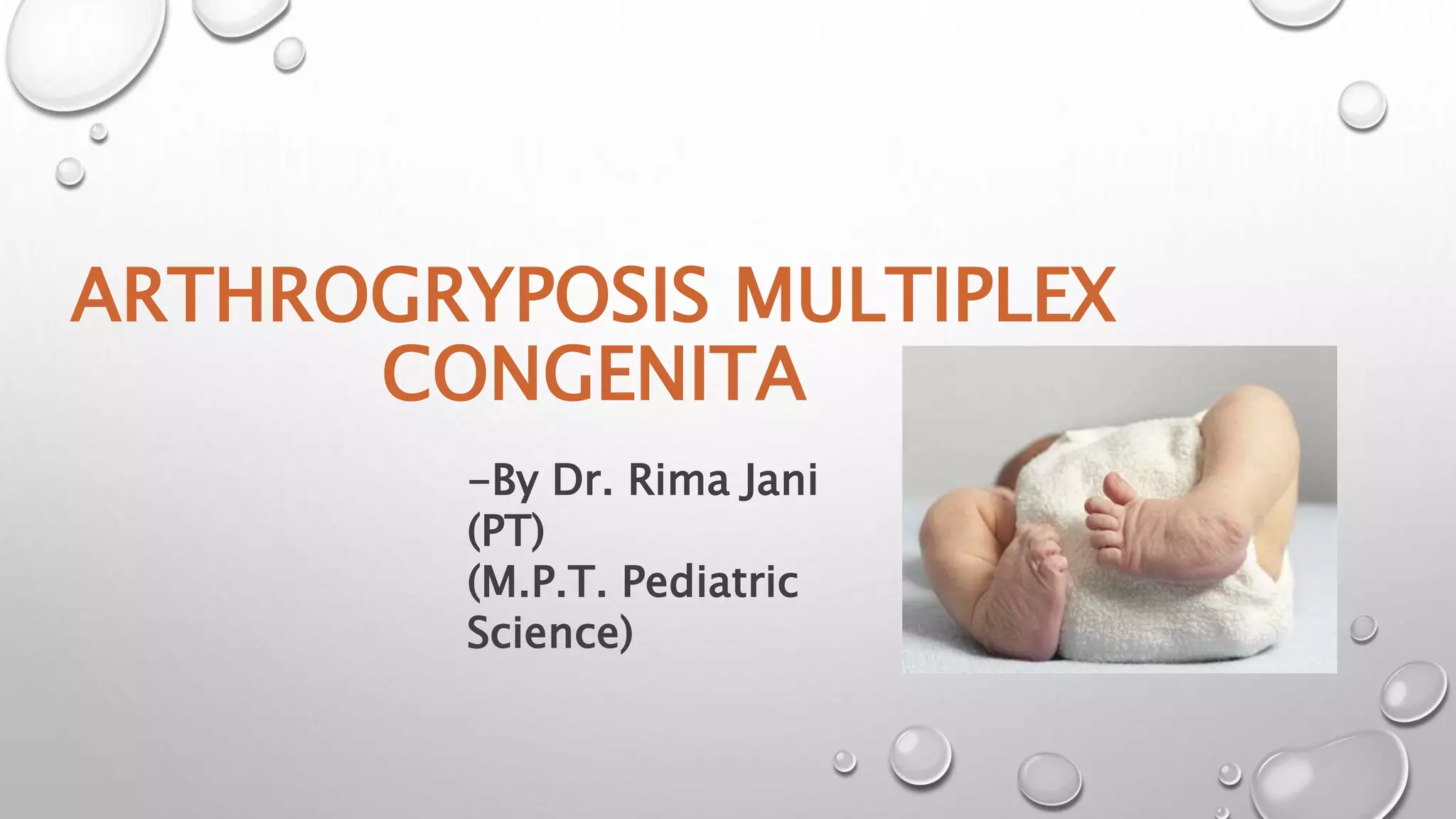

ARTHROGRYPOSIS MULTIPLEX
CONGENITA
-By Dr. Rima Jani
(PT)
(M.P.T. Pediatric
Science)
ARTHROGRYPOSIS MULTIPLEX
CONGENITA
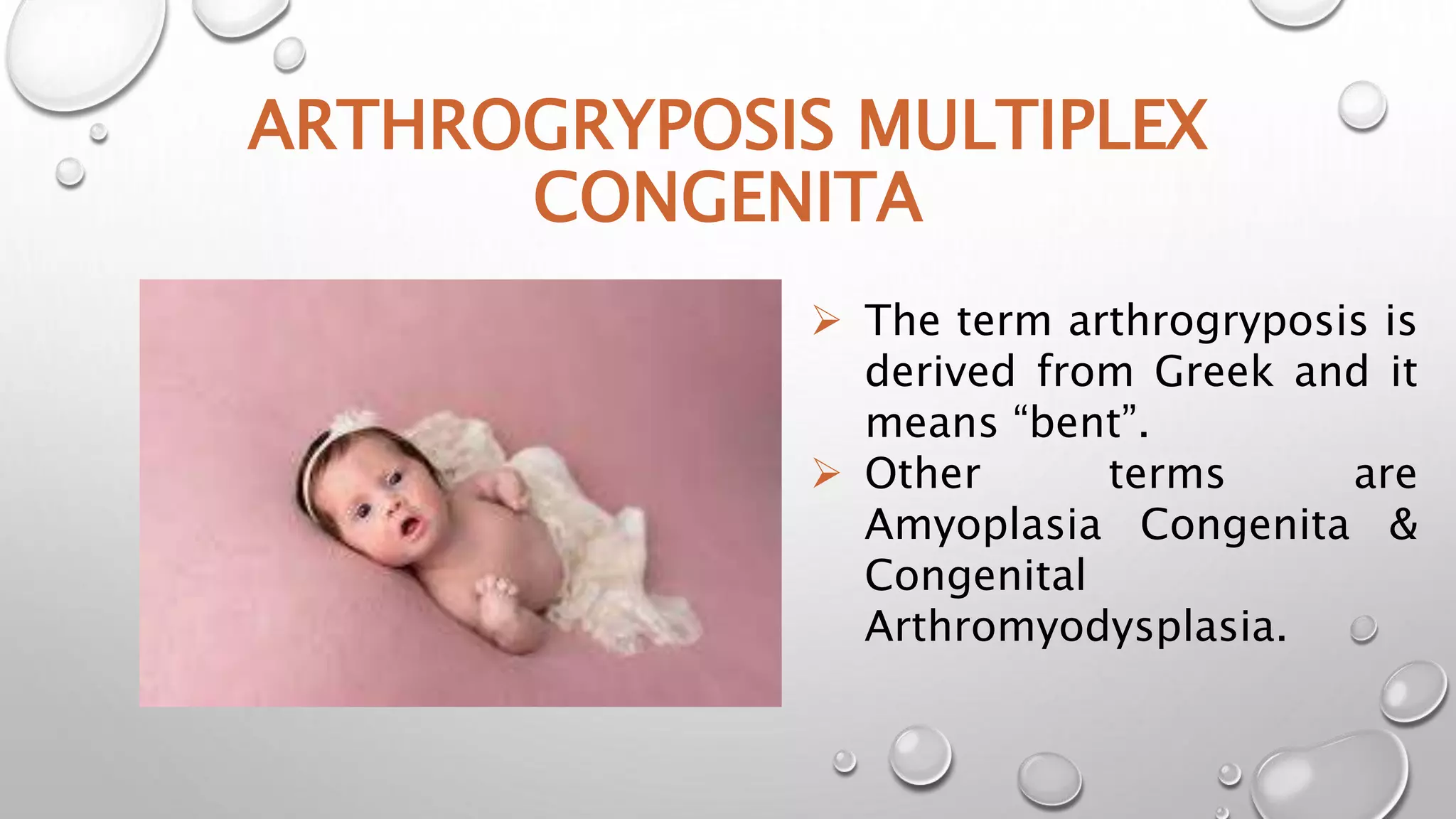
 The term arthrogryposis is
derived from Greek and it
means “bent”.
 Other terms are
Amyoplasia Congenita &
Congenital
Arthromyodysplasia.
Arthro = joint
Gryposis = twisted
Multiplex = more than one
Congenita = seen at birth
The name doesn’t even refer to muscle, but muscle is
involved.
ARTHROGRYPOSIS MULTIPLEX
CONGENITA
ARTHROGRYPOSIS MULTIPLEX
CONGENITA
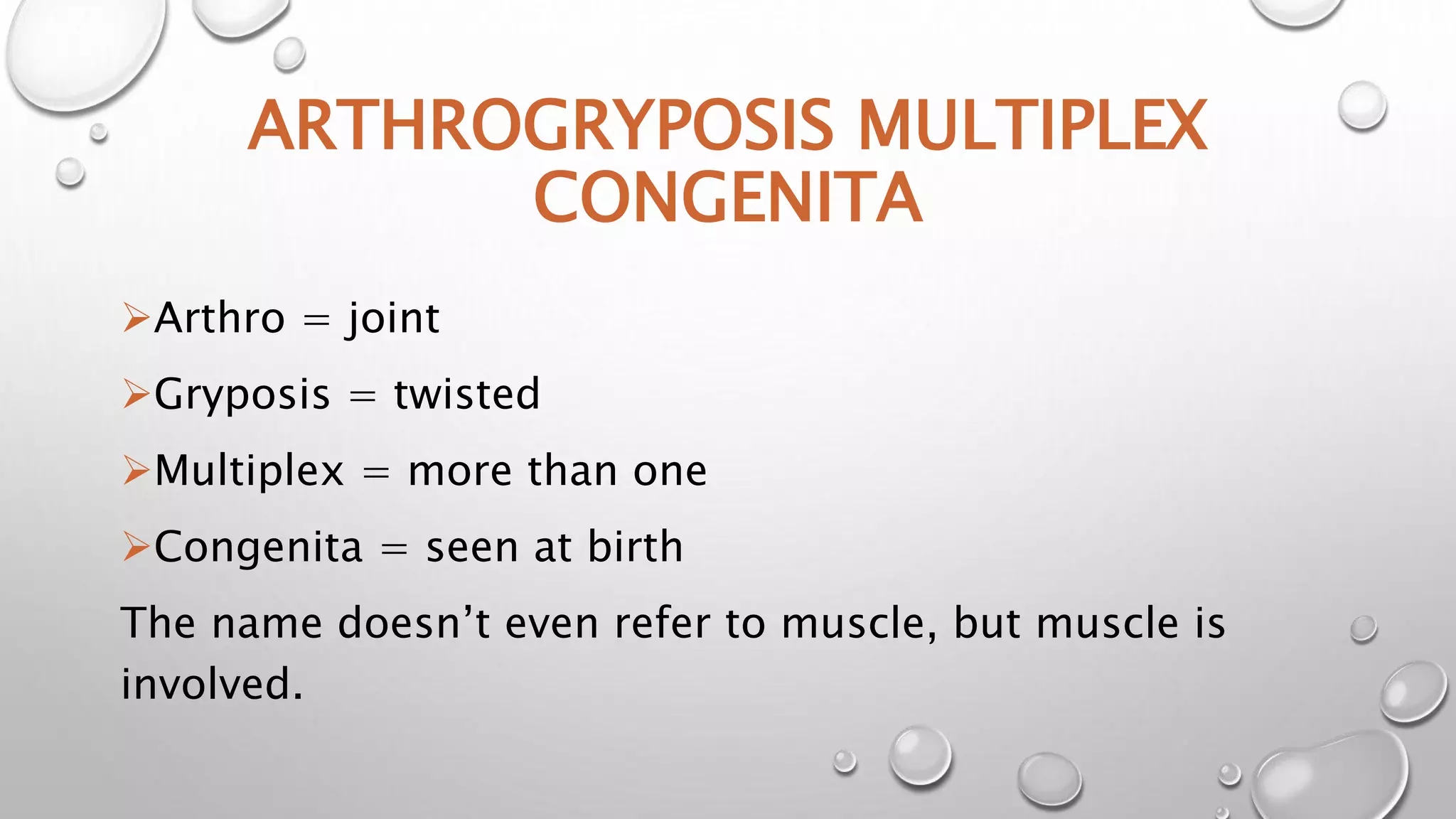
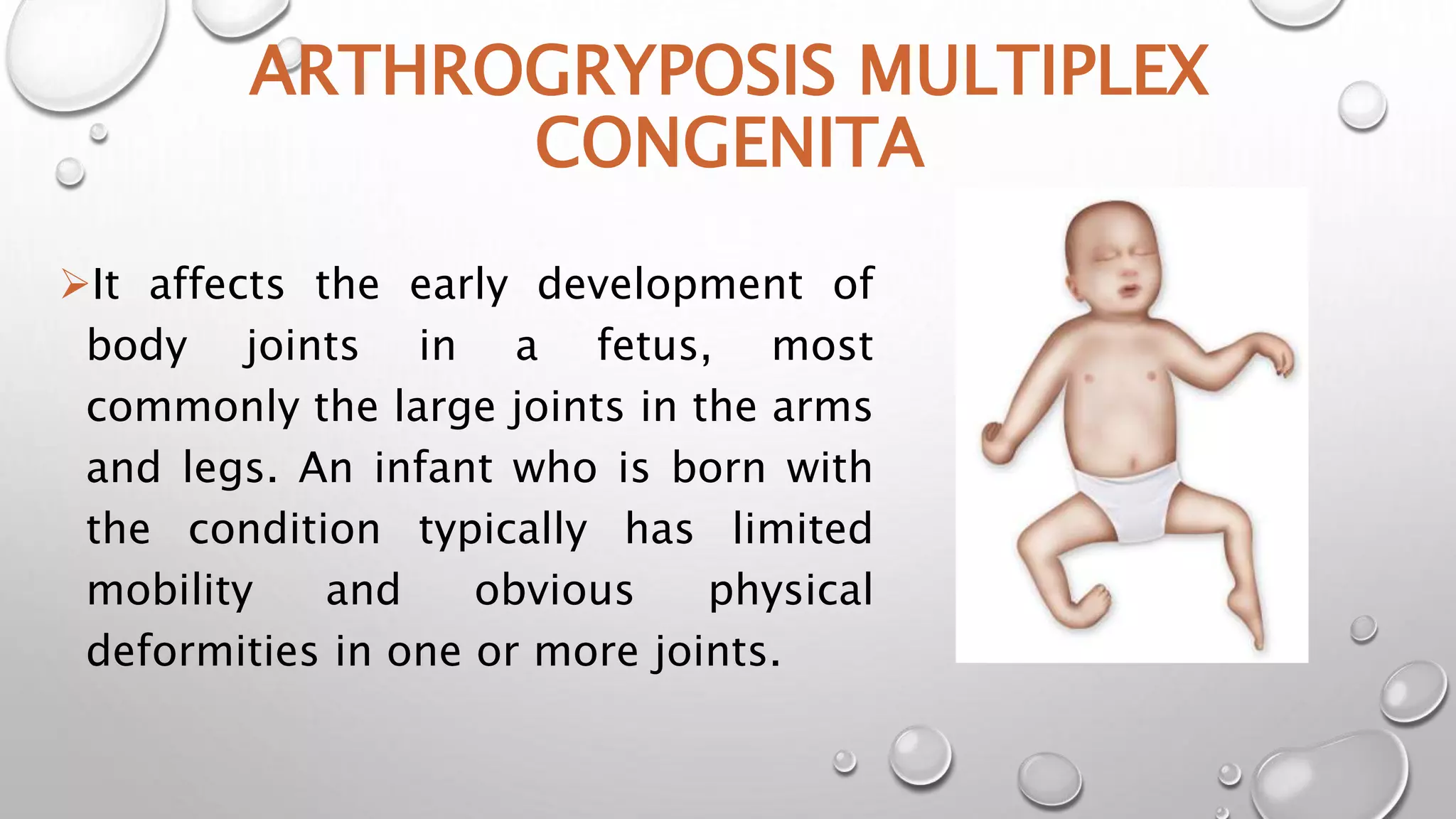
It affects the early development of
body joints in a fetus, most
commonly the large joints in the arms
and legs. An infant who is born with
the condition typically has limited
mobility and obvious physical
deformities in one or more joints.
ARTHROGRYPOSIS MULTIPLEX
CONGENITA
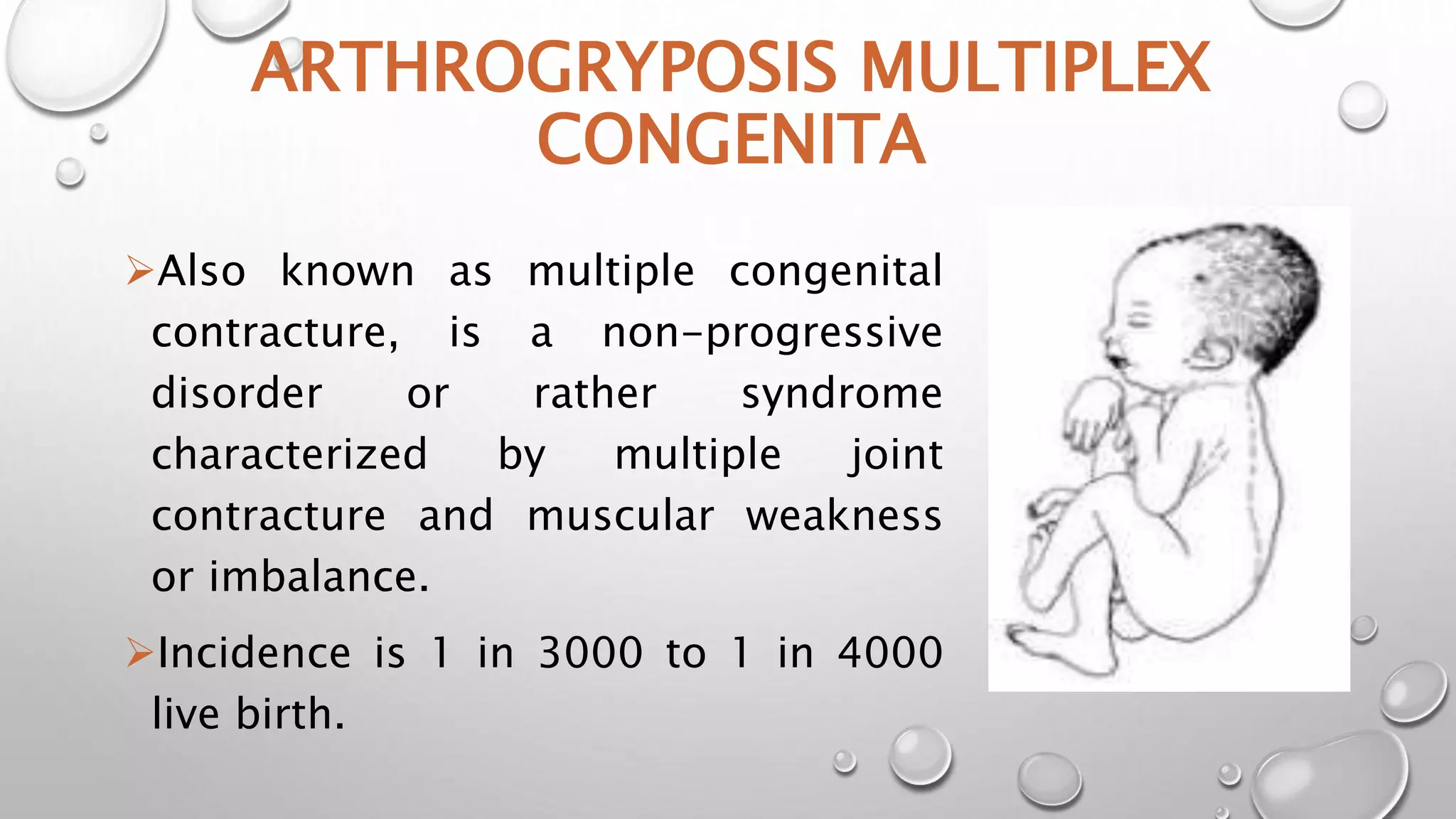
Also known as multiple congenital
contracture, is a non-progressive
disorder or rather syndrome
characterized by multiple joint
contracture and muscular weakness
or imbalance.
Incidence is 1 in 3000 to 1 in 4000
live birth.
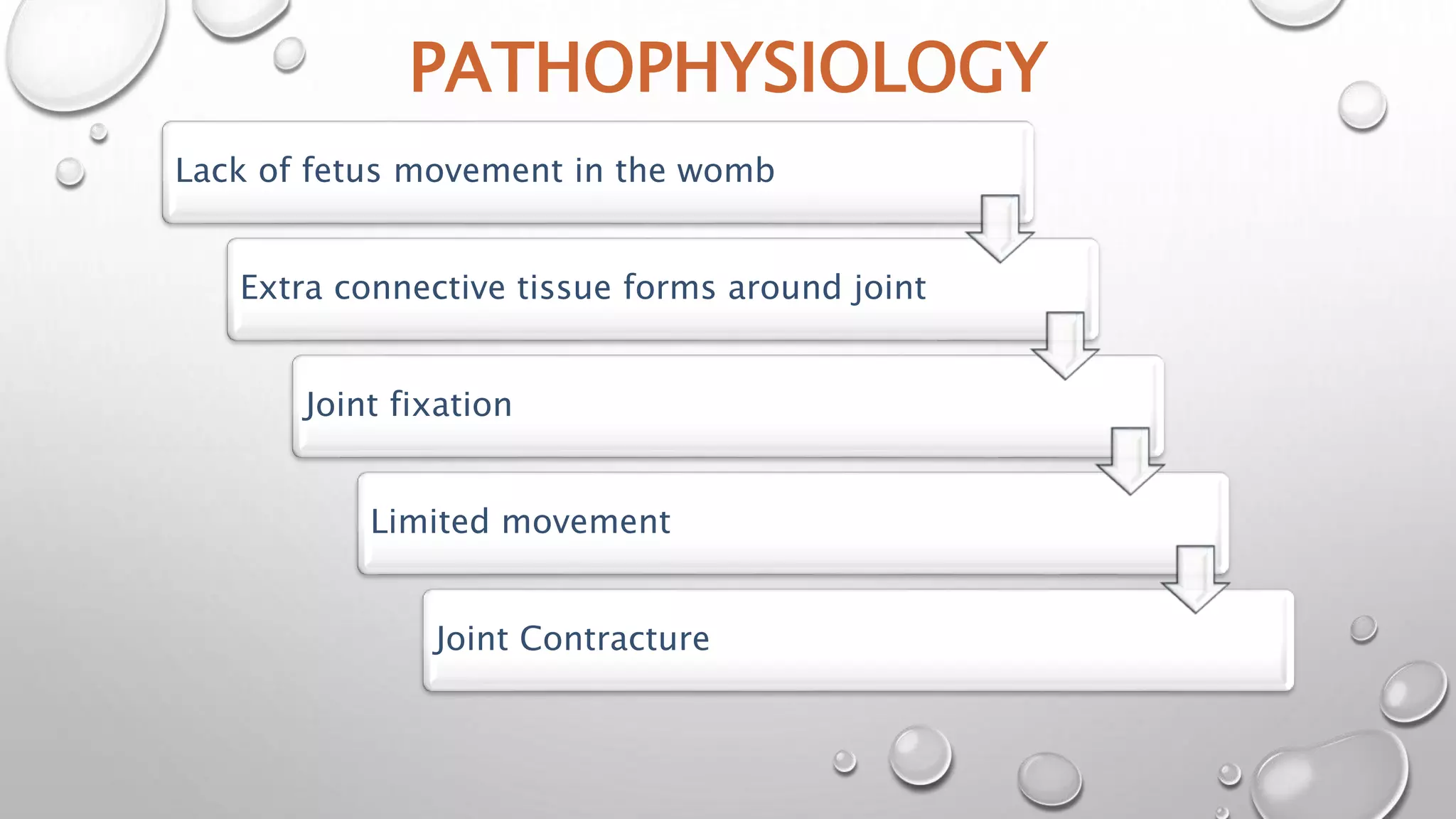
PATHOPHYSIOLOGY
Lack of fetus movement in the womb
Extra connective tissue forms around joint
Joint fixation
Limited movement
Joint Contracture
ETIOLOGY
Disorder is related to a paucity early in fetal
development, leading to multiple contracture at
birth
Genetic mutation may be etiological factor.
Fetal immobility results in multiple joint
contracture, fibrosis of muscle, and fibrosis of the
periarticular structures
ETIOLOGY
It is associated with multiple neurogenic or myopathy disorder
that exhibit a defect in motor unit, including :
 The anterior horn cells,
 Roots,
 Peripheral nerve,
 Motor end plates, or
 Muscle
resulting in weakness and decreased fetal movement early in
development.
CLINICAL FEATURES
Featureless extremities that are often cylindrical in
shape with absent skin creases
Rigid joints with significant contractures
Dislocation of joints, especially the hips
Atrophy and even absence of muscle groups
Intact sensation but deep tendon reflexes are
diminished or absent
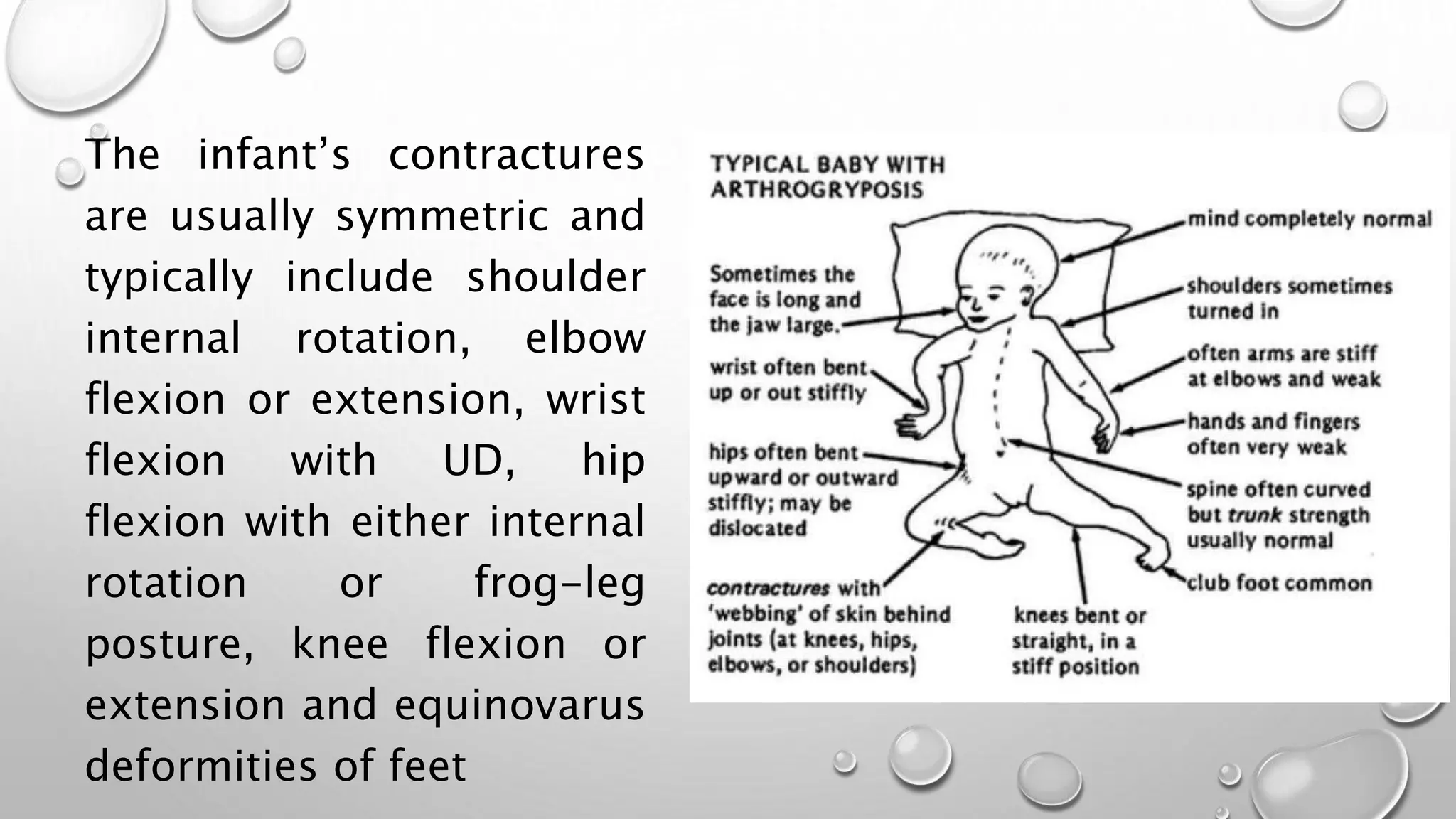
The infant’s contractures
are usually symmetric and
typically include shoulder
internal rotation, elbow
flexion or extension, wrist
flexion with UD, hip
flexion with either internal
rotation or frog-leg
posture, knee flexion or
extension and equinovarus
deformities of feet
DIAGNOSIS
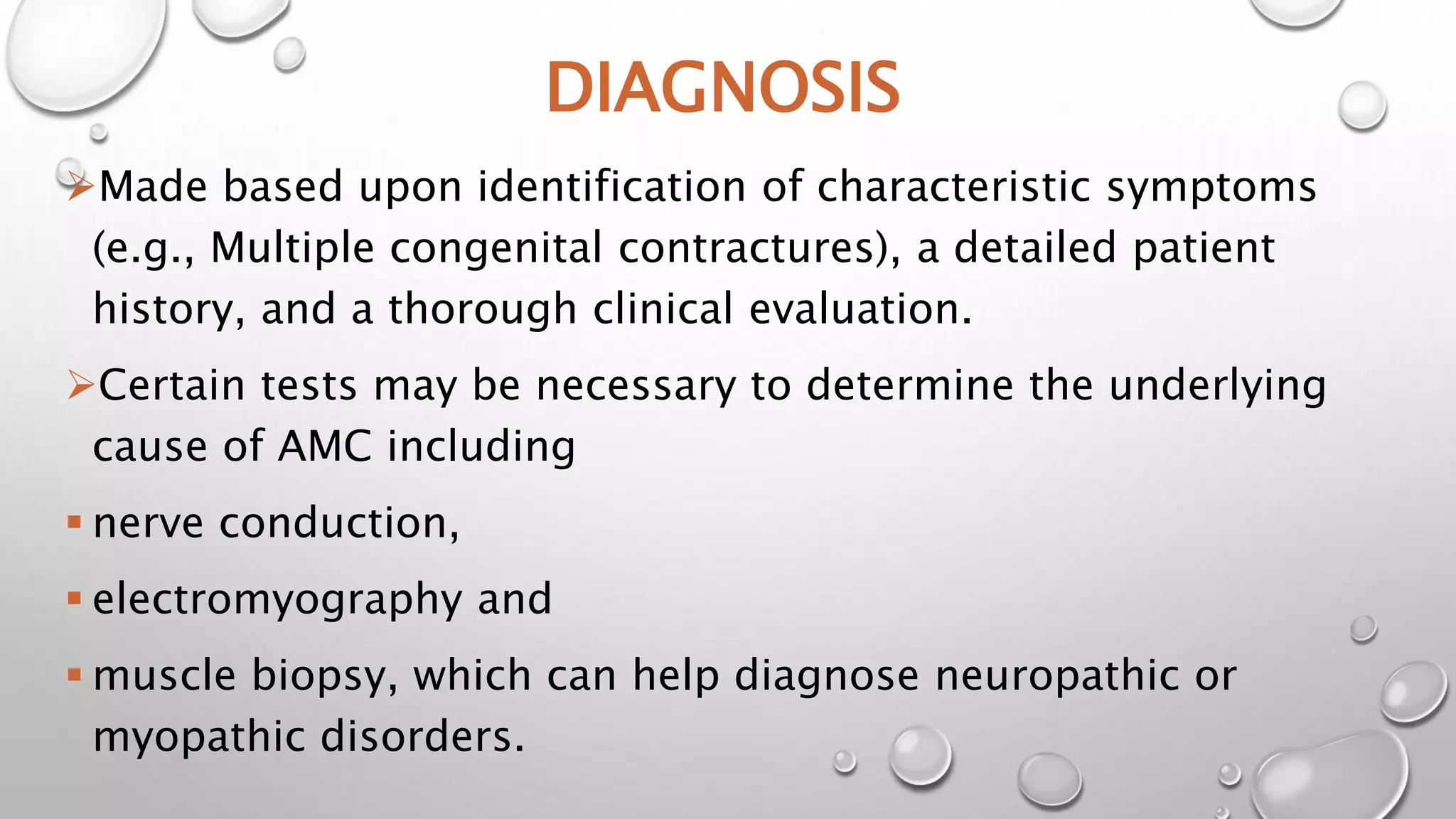
Made based upon identification of characteristic symptoms
(e.g., Multiple congenital contractures), a detailed patient
history, and a thorough clinical evaluation.
Certain tests may be necessary to determine the underlying
cause of AMC including
 nerve conduction,
 electromyography and
 muscle biopsy, which can help diagnose neuropathic or
myopathic disorders.
DIAGNOSIS
3D-4D sonography during pregnancy may
help.
Radiography before planning surgery.
DNA tests to confirm genetic cause.
MANAGEMENT
Passive stretching through positioning, casting and
splinting.
Strengthening activities.
Developmental skills.
Surgical procedures.
Use of adaptive or rehabilitation equipment.
MANAGEMENT : INFANT
Begin shortly after birth : Positioning and passive
stretching exercise.
First few months after birth : Serial casting begins for—
• foot deformities,
• knee flexion contracture and
• wrist flexion contracture
• Caution must be used to stretch only to end range and
maintain the stretch with a cast or a splint
• Forceful aggressive stretching of a rigid joint can result in
damage to the joint capsule and surrounding soft tissue
• Any gains in ROM must be maintained with a splint or
positioning device otherwise contracture will recur
MANAGEMENT : INFANT
• Usually between 6 to 12 months of age, residual
contracture at the feet and knee are surgically corrected
• It involves release of tight joint capsule and soft tissues
• Surgical correction is maintained by splinting,
strengthening exercise and active functional movement.
MANAGEMENT : INFANT
For example….
• Lower limb : A child who had a bilateral release of
posterior structures of ankle to correct equinovarus
deformity should have a splint fabricated to maintain the
ROM as well as begin a standing program with the use of
a standing device or ambulation aid.
• Upper limb : For optimum function and independence
with self-care skills, the child should have the ability to
flex and extend the elbow
MANAGEMENT : INFANT
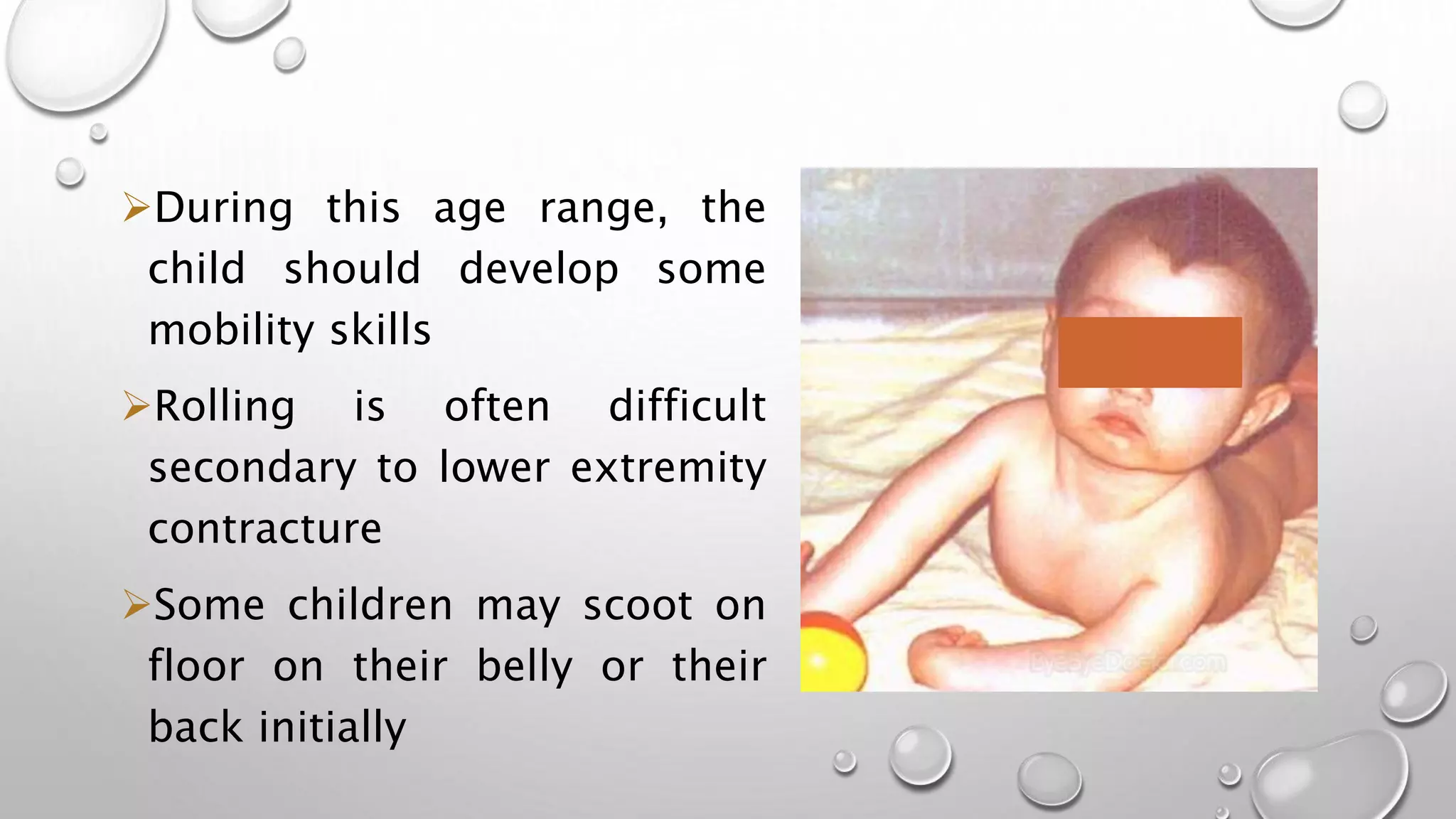
During this age range, the
child should develop some
mobility skills
Rolling is often difficult
secondary to lower extremity
contracture
Some children may scoot on
floor on their belly or their
back initially
Most children can learn to sit but
have difficulty achieving the sitting
position independently
From sitting, floor mobility should
be encouraged
Creeping on hands and knees is
often difficult and children learn to
scoot on their bottom
Pulling to stand may be limited by
contracture of lower extremity
MANAGEMENT : 1 YEAR TO PRE-
SCHOOL
• The goal at this age is to develop
the maximum level of
independence with mobility and
self-care skills.
• Ambulation is possible for many
children with Assistive Mobility
Device.
• Upper extremity skill focus on
feeding and dressing activities.
• Maintenance of acquired ROM is
crucial
• Strengthening exercise through
age-appropriate activities, as
well as specific mobility training
are incorporated in training
MANAGEMENT : 1 YEAR TO PRE-
SCHOOL
MANAGEMENT : SCHOOL AGE
• The goal is to highlight the
functional impairments that
may exist for a child with
AMC
• Child’s ambulation speed
may be slow compared with
his or her peers, and fine
motor difficulty may
interfere with his or her peer
interaction.
THANK YOU…

Arthrogryposis Multiplex Congenita

  • 1.
    ARTHROGRYPOSIS MULTIPLEX CONGENITA -By Dr.Rima Jani (PT) (M.P.T. Pediatric Science)
  • 2.
    ARTHROGRYPOSIS MULTIPLEX CONGENITA  Theterm arthrogryposis is derived from Greek and it means “bent”.  Other terms are Amyoplasia Congenita & Congenital Arthromyodysplasia.
  • 3.
    Arthro = joint Gryposis= twisted Multiplex = more than one Congenita = seen at birth The name doesn’t even refer to muscle, but muscle is involved. ARTHROGRYPOSIS MULTIPLEX CONGENITA
  • 4.
    ARTHROGRYPOSIS MULTIPLEX CONGENITA It affectsthe early development of body joints in a fetus, most commonly the large joints in the arms and legs. An infant who is born with the condition typically has limited mobility and obvious physical deformities in one or more joints.
  • 5.
    ARTHROGRYPOSIS MULTIPLEX CONGENITA Also knownas multiple congenital contracture, is a non-progressive disorder or rather syndrome characterized by multiple joint contracture and muscular weakness or imbalance. Incidence is 1 in 3000 to 1 in 4000 live birth.
  • 6.
    PATHOPHYSIOLOGY Lack of fetusmovement in the womb Extra connective tissue forms around joint Joint fixation Limited movement Joint Contracture
  • 7.
    ETIOLOGY Disorder is relatedto a paucity early in fetal development, leading to multiple contracture at birth Genetic mutation may be etiological factor. Fetal immobility results in multiple joint contracture, fibrosis of muscle, and fibrosis of the periarticular structures
  • 8.
    ETIOLOGY It is associatedwith multiple neurogenic or myopathy disorder that exhibit a defect in motor unit, including :  The anterior horn cells,  Roots,  Peripheral nerve,  Motor end plates, or  Muscle resulting in weakness and decreased fetal movement early in development.
  • 9.
    CLINICAL FEATURES Featureless extremitiesthat are often cylindrical in shape with absent skin creases Rigid joints with significant contractures Dislocation of joints, especially the hips Atrophy and even absence of muscle groups Intact sensation but deep tendon reflexes are diminished or absent
  • 10.
    The infant’s contractures areusually symmetric and typically include shoulder internal rotation, elbow flexion or extension, wrist flexion with UD, hip flexion with either internal rotation or frog-leg posture, knee flexion or extension and equinovarus deformities of feet
  • 11.
    DIAGNOSIS Made based uponidentification of characteristic symptoms (e.g., Multiple congenital contractures), a detailed patient history, and a thorough clinical evaluation. Certain tests may be necessary to determine the underlying cause of AMC including  nerve conduction,  electromyography and  muscle biopsy, which can help diagnose neuropathic or myopathic disorders.
  • 12.
    DIAGNOSIS 3D-4D sonography duringpregnancy may help. Radiography before planning surgery. DNA tests to confirm genetic cause.
  • 13.
    MANAGEMENT Passive stretching throughpositioning, casting and splinting. Strengthening activities. Developmental skills. Surgical procedures. Use of adaptive or rehabilitation equipment.
  • 14.
    MANAGEMENT : INFANT Beginshortly after birth : Positioning and passive stretching exercise. First few months after birth : Serial casting begins for— • foot deformities, • knee flexion contracture and • wrist flexion contracture
  • 15.
    • Caution mustbe used to stretch only to end range and maintain the stretch with a cast or a splint • Forceful aggressive stretching of a rigid joint can result in damage to the joint capsule and surrounding soft tissue • Any gains in ROM must be maintained with a splint or positioning device otherwise contracture will recur MANAGEMENT : INFANT
  • 16.
    • Usually between6 to 12 months of age, residual contracture at the feet and knee are surgically corrected • It involves release of tight joint capsule and soft tissues • Surgical correction is maintained by splinting, strengthening exercise and active functional movement. MANAGEMENT : INFANT
  • 17.
    For example…. • Lowerlimb : A child who had a bilateral release of posterior structures of ankle to correct equinovarus deformity should have a splint fabricated to maintain the ROM as well as begin a standing program with the use of a standing device or ambulation aid. • Upper limb : For optimum function and independence with self-care skills, the child should have the ability to flex and extend the elbow MANAGEMENT : INFANT
  • 18.
    During this agerange, the child should develop some mobility skills Rolling is often difficult secondary to lower extremity contracture Some children may scoot on floor on their belly or their back initially
  • 19.
    Most children canlearn to sit but have difficulty achieving the sitting position independently From sitting, floor mobility should be encouraged Creeping on hands and knees is often difficult and children learn to scoot on their bottom Pulling to stand may be limited by contracture of lower extremity
  • 20.
    MANAGEMENT : 1YEAR TO PRE- SCHOOL • The goal at this age is to develop the maximum level of independence with mobility and self-care skills. • Ambulation is possible for many children with Assistive Mobility Device. • Upper extremity skill focus on feeding and dressing activities.
  • 21.
    • Maintenance ofacquired ROM is crucial • Strengthening exercise through age-appropriate activities, as well as specific mobility training are incorporated in training MANAGEMENT : 1 YEAR TO PRE- SCHOOL
  • 22.
    MANAGEMENT : SCHOOLAGE • The goal is to highlight the functional impairments that may exist for a child with AMC • Child’s ambulation speed may be slow compared with his or her peers, and fine motor difficulty may interfere with his or her peer interaction.
  • 24.