CELL MEMBRANE
STRUCTURE
Anas K P
2nd yr PBBSc
GCNT
Objectives
 Define cell and cell membrane
 Functions of cell membrane
 Transport mechanisms of cell membrane
CELLS
Basic living unit of all organisms.
 Determine the form and functions of the human body.
 Are specialized to perform specific functions.
 Organelles inside the cell perform specific functions.
CELL MEMBRANE
The cell membrane (also called the plasma membrane) is a
biological membrane separating the interior of a cell from the
outside environment.
 It appears in thin sections with the electron microscope as a
double layered structure about 7.5 – 10 nanometers thick.
 It contain almost proteins called membrane proteins.
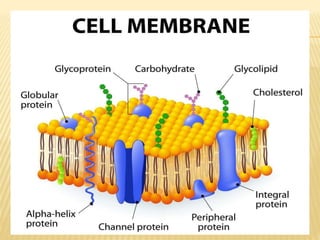
Structure of cell membrane
Lipid Bilayer - 2 leyers of phospholipids
a. Phosphate head is polar ( water loving )
b. Fatty acid tail is non polar ( hydro phobic )
c. Protein embedded in membrane
Chemical composition
1. Lipids : Four major classes of lipids are commonly present
in the plasma membrane ; Phospholipids ( most abundant )
, Spingolipids , Glycolipids , and Sterols ( eg : Cholesterol)
2. Proteins :
 Plasma membrane contains about 50% protein. Amount
and type is variable.
 Myelin cells contains about 25% protein internal membrane
of chloroplast and mitochondria contains 50% proteins.
 Protein of plasma membrane are of two type ectoproteins
and endoproteins .
 Plasma membranes contain structural proteins , transport
proteins and enzymes.
3 Carbohydrates :
They are present only in the plasma membrane and are
present exterior ( glycoprotein's ) or polar end of
phospholipids at the external surface of plasma membrane.
Phospholipids :
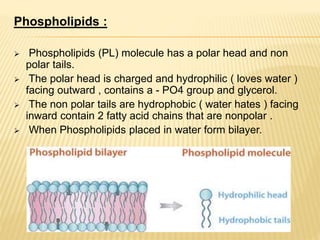
 Phospholipids (PL) molecule has a polar head and non
polar tails.
 The polar head is charged and hydrophilic ( loves water )
facing outward , contains a - PO4 group and glycerol.
 The non polar tails are hydrophobic ( water hates ) facing
inward contain 2 fatty acid chains that are nonpolar .
 When Phospholipids placed in water form bilayer.
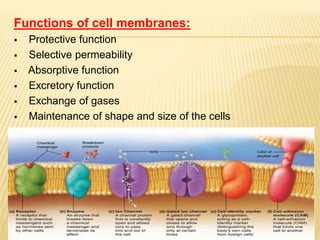
Functions of cell membranes:
 Protective function
 Selective permeability
 Absorptive function
 Excretory function
 Exchange of gases
 Maintenance of shape and size of the cells
Transport Mechanisms
 The permeability of substances across cell membranes is
dependent on their solubility in lipids and not on their
molecular size.
 Water soluble compounds are generally impermeable and
require carrier mediated transport.
 Transport mechanisms classified into :
1. Passive Transport
> Simple diffusion
> Facilitated diffusion
> Osmosis
> Bulk flow
> Filtration
2. Active Transport
3. Ion Channels
> Ligand Gated Channels
> Voltage Gated Channels
4. Vascular Transport
> Exocytosis
> Endocytosis
5. Uniport , Symport and Antiport
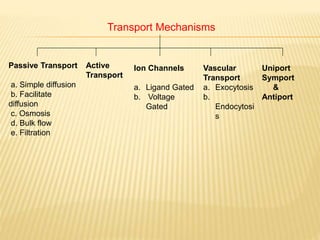
Transport Mechanisms
Passive Transport
a. Simple diffusion
b. Facilitate
diffusion
c. Osmosis
d. Bulk flow
e. Filtration
Active
Transport
Ion Channels
a. Ligand Gated
b. Voltage
Gated
Vascular
Transport
a. Exocytosis
b.
Endocytosi
s
Uniport
Symport
&
Antiport
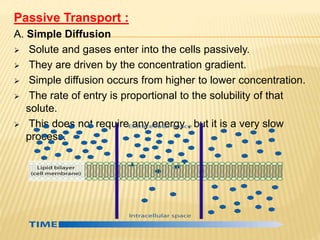
Passive Transport :
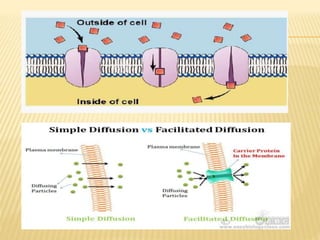
A. Simple Diffusion
 Solute and gases enter into the cells passively.
 They are driven by the concentration gradient.
 Simple diffusion occurs from higher to lower concentration.
 The rate of entry is proportional to the solubility of that
solute.
 This does not require any energy , but it is a very slow
process.
B. Facilitated Diffusion :
 It is a carrier mediated process
 Structurally similar solutes can competitively inhibit
the entry of the solute.
 This mechanism does not require energy , but the
rate of transport is more rapid than diffusion
process.
 It is dependent on concentration gradient.
 Hormones regulate the number of carrier
molecule.
 Examples of facilitated transport of glucose across
membrane is by glucose transporters.
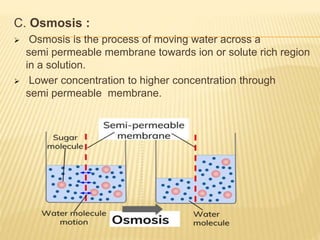
C. Osmosis :
 Osmosis is the process of moving water across a
semi permeable membrane towards ion or solute rich region
in a solution.
 Lower concentration to higher concentration through
semi permeable membrane.
Ion Channels :
 Membranes have special devices called ion channels for
quick transport of electrolyte such as Ca++, K+, Na+ and Cl-
.
 These are selective ion conductive pores.
 Ion channels are specialized protein molecules that span
the membrane.

 Cation conductive channels generally remains closed but in
response to stimulus , they open allowing rapid flux ion
down the gradient.
 This may compared to opening of the gate of a cinema
house, when people rush to enter. Hence this regulation is
named as “Gated”.
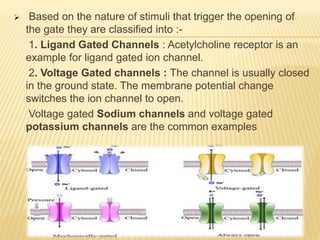
 Based on the nature of stimuli that trigger the opening of
the gate they are classified into :-
1. Ligand Gated Channels : Acetylcholine receptor is an
example for ligand gated ion channel.
2. Voltage Gated channels : The channel is usually closed
in the ground state. The membrane potential change
switches the ion channel to open.
Voltage gated Sodium channels and voltage gated
potassium channels are the common examples
Active Transport :
A. The salient features of active transport are :-
 This form of transport requires energy . About 40% of total
expenditure in a cell is used for the active transport system.
 It requires specialized integral protein called transporters.
The transporters are susceptible to inhibition by specific
organic or inorganic compounds.
B. Cell has low intracellular sodium; but concentration of
potassium inside the cell is very high
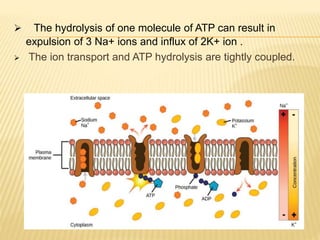
 This is maintained by the sodium- potassium activated
ATPase, generally called Sodium pump
 The ATPase as an integral protein of the membrane.
 The hydrolysis of one molecule of ATP can result in
expulsion of 3 Na+ ions and influx of 2K+ ion .
 The ion transport and ATP hydrolysis are tightly coupled.
Vesicular Transport :
It is the transport of membrane bounded bounded substances
moving across plasma membrane classified to :-
1. Endocytosis
2. Exocytosis
Endocytosis:
It is a process by which the large number of particles are
taken with forming the vesicle into the cell.
It is classified into :-
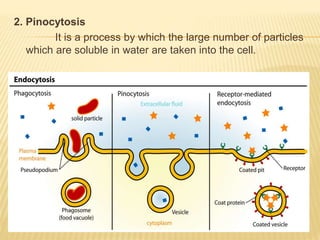
1. Phagocytosis
It is a process by which the large number of particles
are engulfed in to the cell.
2. Pinocytosis
It is a process by which the large number of particles
which are soluble in water are taken into the cell.
Exocytosis
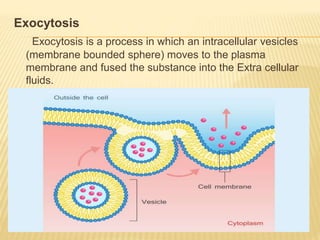
Exocytosis is a process in which an intracellular vesicles
(membrane bounded sphere) moves to the plasma
membrane and fused the substance into the Extra cellular
fluids.
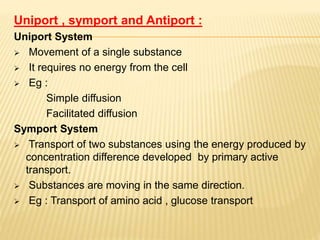
Uniport , symport and Antiport :
Uniport System
 Movement of a single substance
 It requires no energy from the cell
 Eg :
Simple diffusion
Facilitated diffusion
Symport System
 Transport of two substances using the energy produced by
concentration difference developed by primary active
transport.
 Substances are moving in the same direction.
 Eg : Transport of amino acid , glucose transport
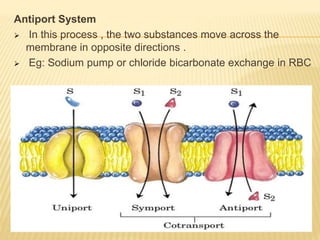
Antiport System
 In this process , the two substances move across the
membrane in opposite directions .
 Eg: Sodium pump or chloride bicarbonate exchange in RBC
Recapitulation
 What is cell ?
 What is structure of cell membrane ?
 What are the functions of cell membrane ?
 What are the type of transport mechanisms ?
Assignment
What is cell organelles and briefly explain the cell organelles ?
Bibliography
 Vasudevan D M , S Sreekumari , Kannan vaidyanathan,
Textbook of Biochemistry for Dental students , 2nd edition
2011, Jaypee brothers medical publishers (P)Ltd, Page No:
1-6.
 Nicholas sperelakis , Cell Physiology source book , 3rd
edition, Academic press , Page No: 65-77.
Cell membrane ppt

Cell membrane ppt

  • 2.
    CELL MEMBRANE STRUCTURE Anas KP 2nd yr PBBSc GCNT
  • 3.
    Objectives  Define celland cell membrane  Functions of cell membrane  Transport mechanisms of cell membrane
  • 4.
    CELLS Basic living unitof all organisms.  Determine the form and functions of the human body.  Are specialized to perform specific functions.  Organelles inside the cell perform specific functions. CELL MEMBRANE The cell membrane (also called the plasma membrane) is a biological membrane separating the interior of a cell from the outside environment.  It appears in thin sections with the electron microscope as a double layered structure about 7.5 – 10 nanometers thick.  It contain almost proteins called membrane proteins.
  • 5.
    Structure of cellmembrane Lipid Bilayer - 2 leyers of phospholipids a. Phosphate head is polar ( water loving ) b. Fatty acid tail is non polar ( hydro phobic ) c. Protein embedded in membrane Chemical composition 1. Lipids : Four major classes of lipids are commonly present in the plasma membrane ; Phospholipids ( most abundant ) , Spingolipids , Glycolipids , and Sterols ( eg : Cholesterol) 2. Proteins :  Plasma membrane contains about 50% protein. Amount and type is variable.
  • 6.
     Myelin cellscontains about 25% protein internal membrane of chloroplast and mitochondria contains 50% proteins.  Protein of plasma membrane are of two type ectoproteins and endoproteins .  Plasma membranes contain structural proteins , transport proteins and enzymes. 3 Carbohydrates : They are present only in the plasma membrane and are present exterior ( glycoprotein's ) or polar end of phospholipids at the external surface of plasma membrane.
  • 7.
    Phospholipids :  Phospholipids(PL) molecule has a polar head and non polar tails.  The polar head is charged and hydrophilic ( loves water ) facing outward , contains a - PO4 group and glycerol.  The non polar tails are hydrophobic ( water hates ) facing inward contain 2 fatty acid chains that are nonpolar .  When Phospholipids placed in water form bilayer.
  • 9.
    Functions of cellmembranes:  Protective function  Selective permeability  Absorptive function  Excretory function  Exchange of gases  Maintenance of shape and size of the cells
  • 10.
    Transport Mechanisms  Thepermeability of substances across cell membranes is dependent on their solubility in lipids and not on their molecular size.  Water soluble compounds are generally impermeable and require carrier mediated transport.  Transport mechanisms classified into : 1. Passive Transport > Simple diffusion > Facilitated diffusion > Osmosis > Bulk flow > Filtration
  • 11.
    2. Active Transport 3.Ion Channels > Ligand Gated Channels > Voltage Gated Channels 4. Vascular Transport > Exocytosis > Endocytosis 5. Uniport , Symport and Antiport
  • 12.
    Transport Mechanisms Passive Transport a.Simple diffusion b. Facilitate diffusion c. Osmosis d. Bulk flow e. Filtration Active Transport Ion Channels a. Ligand Gated b. Voltage Gated Vascular Transport a. Exocytosis b. Endocytosi s Uniport Symport & Antiport
  • 13.
    Passive Transport : A.Simple Diffusion  Solute and gases enter into the cells passively.  They are driven by the concentration gradient.  Simple diffusion occurs from higher to lower concentration.  The rate of entry is proportional to the solubility of that solute.  This does not require any energy , but it is a very slow process.
  • 14.
    B. Facilitated Diffusion:  It is a carrier mediated process  Structurally similar solutes can competitively inhibit the entry of the solute.  This mechanism does not require energy , but the rate of transport is more rapid than diffusion process.  It is dependent on concentration gradient.  Hormones regulate the number of carrier molecule.  Examples of facilitated transport of glucose across membrane is by glucose transporters.
  • 16.
    C. Osmosis : Osmosis is the process of moving water across a semi permeable membrane towards ion or solute rich region in a solution.  Lower concentration to higher concentration through semi permeable membrane.
  • 17.
    Ion Channels : Membranes have special devices called ion channels for quick transport of electrolyte such as Ca++, K+, Na+ and Cl- .  These are selective ion conductive pores.  Ion channels are specialized protein molecules that span the membrane.  Cation conductive channels generally remains closed but in response to stimulus , they open allowing rapid flux ion down the gradient.  This may compared to opening of the gate of a cinema house, when people rush to enter. Hence this regulation is named as “Gated”.
  • 18.
     Based onthe nature of stimuli that trigger the opening of the gate they are classified into :- 1. Ligand Gated Channels : Acetylcholine receptor is an example for ligand gated ion channel. 2. Voltage Gated channels : The channel is usually closed in the ground state. The membrane potential change switches the ion channel to open. Voltage gated Sodium channels and voltage gated potassium channels are the common examples
  • 19.
    Active Transport : A.The salient features of active transport are :-  This form of transport requires energy . About 40% of total expenditure in a cell is used for the active transport system.  It requires specialized integral protein called transporters. The transporters are susceptible to inhibition by specific organic or inorganic compounds. B. Cell has low intracellular sodium; but concentration of potassium inside the cell is very high  This is maintained by the sodium- potassium activated ATPase, generally called Sodium pump  The ATPase as an integral protein of the membrane.

  • 20.
     The hydrolysisof one molecule of ATP can result in expulsion of 3 Na+ ions and influx of 2K+ ion .  The ion transport and ATP hydrolysis are tightly coupled.
  • 21.
    Vesicular Transport : Itis the transport of membrane bounded bounded substances moving across plasma membrane classified to :- 1. Endocytosis 2. Exocytosis Endocytosis: It is a process by which the large number of particles are taken with forming the vesicle into the cell. It is classified into :- 1. Phagocytosis It is a process by which the large number of particles are engulfed in to the cell.
  • 22.
    2. Pinocytosis It isa process by which the large number of particles which are soluble in water are taken into the cell.
  • 23.
    Exocytosis Exocytosis is aprocess in which an intracellular vesicles (membrane bounded sphere) moves to the plasma membrane and fused the substance into the Extra cellular fluids.
  • 24.
    Uniport , symportand Antiport : Uniport System  Movement of a single substance  It requires no energy from the cell  Eg : Simple diffusion Facilitated diffusion Symport System  Transport of two substances using the energy produced by concentration difference developed by primary active transport.  Substances are moving in the same direction.  Eg : Transport of amino acid , glucose transport
  • 25.
    Antiport System  Inthis process , the two substances move across the membrane in opposite directions .  Eg: Sodium pump or chloride bicarbonate exchange in RBC
  • 27.
    Recapitulation  What iscell ?  What is structure of cell membrane ?  What are the functions of cell membrane ?  What are the type of transport mechanisms ? Assignment What is cell organelles and briefly explain the cell organelles ?
  • 28.
    Bibliography  Vasudevan DM , S Sreekumari , Kannan vaidyanathan, Textbook of Biochemistry for Dental students , 2nd edition 2011, Jaypee brothers medical publishers (P)Ltd, Page No: 1-6.  Nicholas sperelakis , Cell Physiology source book , 3rd edition, Academic press , Page No: 65-77.