Diffusion and osmosis
B M Subramanya Swamy M.Sc. B.Ed.
CIE Co ordinator & Examination Officer
Kanaan Global School
Jakarta
Indonesia
swamy@kanaanglobal.sch.id
Diffusion and osmosis
• Crossing the cell membrane
• Diffusion
• Osmosis
• Active transport
Crossing the cell membrane
• Substances can cross the membrane because
of the membrane’s property of being partially
permeable
• That is it is permeable to some substances and
not to others
• Some substances are able to move into the
cell and some are allowed out
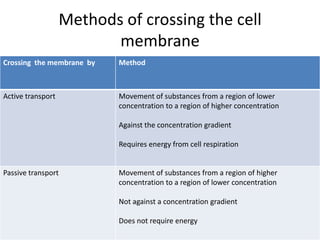
Methods of crossing the cell
membrane
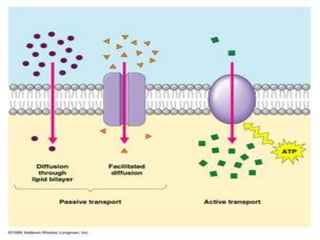
Crossing the membrane by Method
Active transport Movement of substances from a region of lower
concentration to a region of higher concentration
Against the concentration gradient
Requires energy from cell respiration
Passive transport Movement of substances from a region of higher
concentration to a region of lower concentration
Not against a concentration gradient
Does not require energy
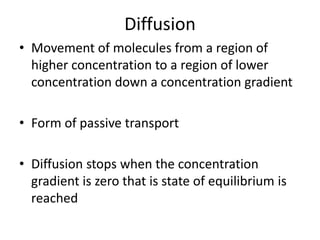
Diffusion
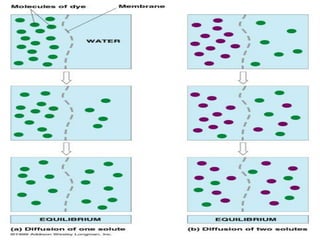
• Movement of molecules from a region of
higher concentration to a region of lower
concentration down a concentration gradient
• Form of passive transport
• Diffusion stops when the concentration
gradient is zero that is state of equilibrium is
reached
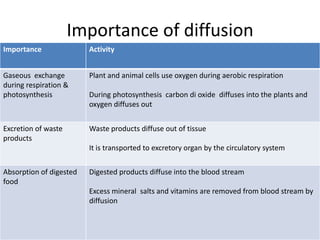
Importance of diffusion
Importance Activity
Gaseous exchange
during respiration &
photosynthesis
Plant and animal cells use oxygen during aerobic respiration
During photosynthesis carbon di oxide diffuses into the plants and
oxygen diffuses out
Excretion of waste
products
Waste products diffuse out of tissue
It is transported to excretory organ by the circulatory system
Absorption of digested
food
Digested products diffuse into the blood stream
Excess mineral salts and vitamins are removed from blood stream by
diffusion
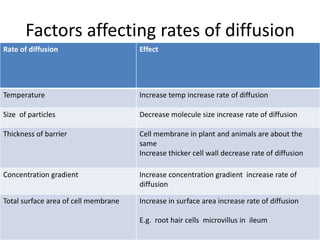
Factors affecting rates of diffusion
Rate of diffusion Effect
Temperature Increase temp increase rate of diffusion
Size of particles Decrease molecule size increase rate of diffusion
Thickness of barrier Cell membrane in plant and animals are about the
same
Increase thicker cell wall decrease rate of diffusion
Concentration gradient Increase concentration gradient increase rate of
diffusion
Total surface area of cell membrane Increase in surface area increase rate of diffusion
E.g. root hair cells microvillus in ileum
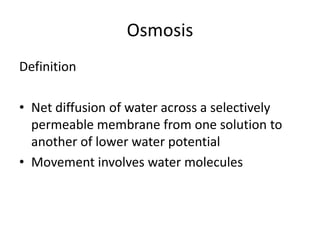
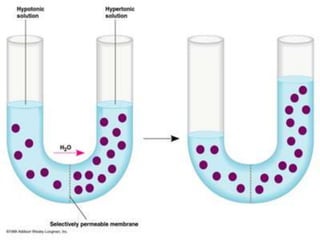
Osmosis
Definition
• Net diffusion of water across a selectively
permeable membrane from one solution to
another of lower water potential
• Movement involves water molecules
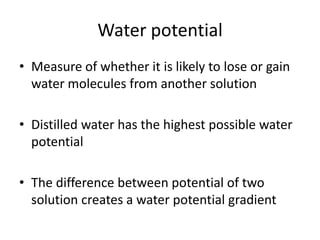
Water potential
• Measure of whether it is likely to lose or gain
water molecules from another solution
• Distilled water has the highest possible water
potential
• The difference between potential of two
solution creates a water potential gradient
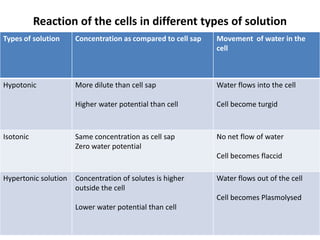
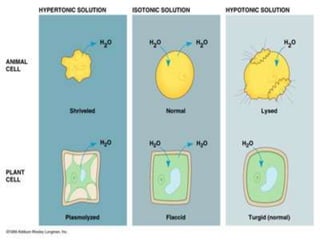
Reaction of the cells in different types of solution
Types of solution Concentration as compared to cell sap Movement of water in the
cell
Hypotonic More dilute than cell sap
Higher water potential than cell
Water flows into the cell
Cell become turgid
Isotonic Same concentration as cell sap
Zero water potential
No net flow of water
Cell becomes flaccid
Hypertonic solution Concentration of solutes is higher
outside the cell
Lower water potential than cell
Water flows out of the cell
Cell becomes Plasmolysed
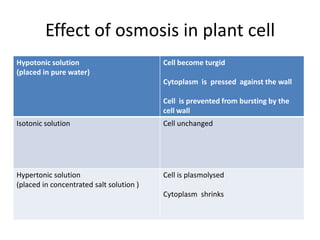
Effect of osmosis in plant cell
Hypotonic solution
(placed in pure water)
Cell become turgid
Cytoplasm is pressed against the wall
Cell is prevented from bursting by the
cell wall
Isotonic solution Cell unchanged
Hypertonic solution
(placed in concentrated salt solution )
Cell is plasmolysed
Cytoplasm shrinks
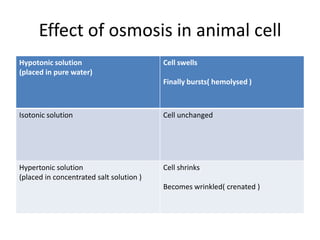
Effect of osmosis in animal cell
Hypotonic solution
(placed in pure water)
Cell swells
Finally bursts( hemolysed )
Isotonic solution Cell unchanged
Hypertonic solution
(placed in concentrated salt solution )
Cell shrinks
Becomes wrinkled( crenated )
Active transport
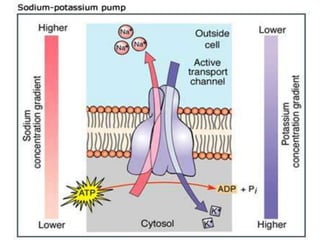
• Movement of particles(molecules & ions) through a
membrane from region of low concentration to
region of high concentration
• Against a concentration gradient
• Energy consuming ;uses oxygen from aerobic
respiration to produce energy
• Increase the speed of ions /substances moving into
cell when diffusion isn’t fast enough
• E.g. plants absorb mineral salts present as charged
ions in soil . The concentration of ions in soil is less
than vacuole therefore uptake of ions is assisted by
active transport across the root hair
Diffusion and osmosis

Diffusion and osmosis

  • 1.
    Diffusion and osmosis BM Subramanya Swamy M.Sc. B.Ed. CIE Co ordinator & Examination Officer Kanaan Global School Jakarta Indonesia swamy@kanaanglobal.sch.id
  • 2.
    Diffusion and osmosis •Crossing the cell membrane • Diffusion • Osmosis • Active transport
  • 3.
    Crossing the cellmembrane • Substances can cross the membrane because of the membrane’s property of being partially permeable • That is it is permeable to some substances and not to others • Some substances are able to move into the cell and some are allowed out
  • 5.
    Methods of crossingthe cell membrane Crossing the membrane by Method Active transport Movement of substances from a region of lower concentration to a region of higher concentration Against the concentration gradient Requires energy from cell respiration Passive transport Movement of substances from a region of higher concentration to a region of lower concentration Not against a concentration gradient Does not require energy
  • 6.
    Diffusion • Movement ofmolecules from a region of higher concentration to a region of lower concentration down a concentration gradient • Form of passive transport • Diffusion stops when the concentration gradient is zero that is state of equilibrium is reached
  • 8.
    Importance of diffusion ImportanceActivity Gaseous exchange during respiration & photosynthesis Plant and animal cells use oxygen during aerobic respiration During photosynthesis carbon di oxide diffuses into the plants and oxygen diffuses out Excretion of waste products Waste products diffuse out of tissue It is transported to excretory organ by the circulatory system Absorption of digested food Digested products diffuse into the blood stream Excess mineral salts and vitamins are removed from blood stream by diffusion
  • 9.
    Factors affecting ratesof diffusion Rate of diffusion Effect Temperature Increase temp increase rate of diffusion Size of particles Decrease molecule size increase rate of diffusion Thickness of barrier Cell membrane in plant and animals are about the same Increase thicker cell wall decrease rate of diffusion Concentration gradient Increase concentration gradient increase rate of diffusion Total surface area of cell membrane Increase in surface area increase rate of diffusion E.g. root hair cells microvillus in ileum
  • 10.
    Osmosis Definition • Net diffusionof water across a selectively permeable membrane from one solution to another of lower water potential • Movement involves water molecules
  • 12.
    Water potential • Measureof whether it is likely to lose or gain water molecules from another solution • Distilled water has the highest possible water potential • The difference between potential of two solution creates a water potential gradient
  • 13.
    Reaction of thecells in different types of solution Types of solution Concentration as compared to cell sap Movement of water in the cell Hypotonic More dilute than cell sap Higher water potential than cell Water flows into the cell Cell become turgid Isotonic Same concentration as cell sap Zero water potential No net flow of water Cell becomes flaccid Hypertonic solution Concentration of solutes is higher outside the cell Lower water potential than cell Water flows out of the cell Cell becomes Plasmolysed
  • 15.
    Effect of osmosisin plant cell Hypotonic solution (placed in pure water) Cell become turgid Cytoplasm is pressed against the wall Cell is prevented from bursting by the cell wall Isotonic solution Cell unchanged Hypertonic solution (placed in concentrated salt solution ) Cell is plasmolysed Cytoplasm shrinks
  • 16.
    Effect of osmosisin animal cell Hypotonic solution (placed in pure water) Cell swells Finally bursts( hemolysed ) Isotonic solution Cell unchanged Hypertonic solution (placed in concentrated salt solution ) Cell shrinks Becomes wrinkled( crenated )
  • 17.
    Active transport • Movementof particles(molecules & ions) through a membrane from region of low concentration to region of high concentration • Against a concentration gradient • Energy consuming ;uses oxygen from aerobic respiration to produce energy • Increase the speed of ions /substances moving into cell when diffusion isn’t fast enough • E.g. plants absorb mineral salts present as charged ions in soil . The concentration of ions in soil is less than vacuole therefore uptake of ions is assisted by active transport across the root hair