Cell Structure and Genetic Control
Human
physiology
Cell
• Basic unit of structure and function of the body.
▫ Highly organized molecular factory.
• Great diversity of function.
▫ Organ physiology derived from complex functions of
the cell.
• 3 principal parts:
▫ Plasma membrane.
▫ Cytoplasm and organelles.
▫ Nucleus.
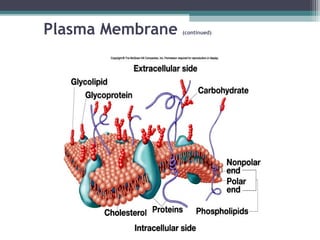
Plasma Membrane
• Is selectively permeable.
• Composition:
▫ Double layer of phospholipids due to hydrophobic/hydrophilic
parts.
 Restrict passage of H20 and H20 soluble ions.
▫ Proteins span or partially span the membrane.
 Provide structural support, transport molecules, serve as receptors.
▫ Negatively charged carbohydrates attach to the outer
surface.
 Involved with regulatory molecules.
Plasma Membrane (continued)
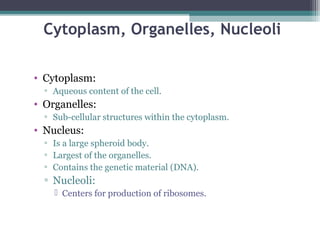
Cytoplasm, Organelles, Nucleoli
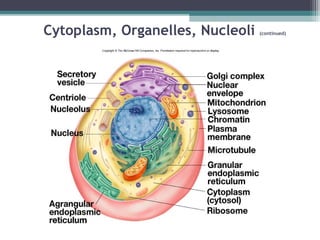
• Cytoplasm:
▫ Aqueous content of the cell.
• Organelles:
▫ Sub-cellular structures within the cytoplasm.
• Nucleus:
▫ Is a large spheroid body.
▫ Largest of the organelles.
▫ Contains the genetic material (DNA).
▫ Nucleoli:
 Centers for production of ribosomes.
Cytoplasm, Organelles, Nucleoli (continued)
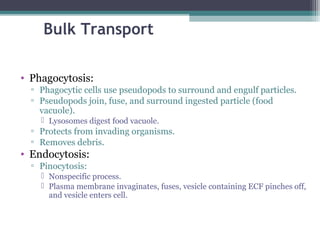
Bulk Transport
• Phagocytosis:
▫ Phagocytic cells use pseudopods to surround and engulf particles.
▫ Pseudopods join, fuse, and surround ingested particle (food
vacuole).
 Lysosomes digest food vacuole.
▫ Protects from invading organisms.
▫ Removes debris.
• Endocytosis:
▫ Pinocytosis:
 Nonspecific process.
 Plasma membrane invaginates, fuses, vesicle containing ECF pinches off,
and vesicle enters cell.
Bulk Transport (continued)
• Receptor-mediated endocytosis:
▫ Interaction of molecules in ECF with specific membrane receptor
proteins.
▫ Membrane invaginates, fuses, pinches off and forms vesicle.
▫ Vesicle enters cell.
• Exocytosis:
▫ Process by which cellular products are secreted into extracellular
environment.
▫ Proteins and other molecules to be secreted are packaged in vesicles
by Golgi complex.
▫ Vesicles fuse with plasma membrane and release contents into
extracellular environment.
Cilia, Flagella, Microvilli
• Cilia:
▫ Tiny hair-like structures that project from the
surface of the cell.
 Stroke in unison.
 Respiratory tract, uterine tube.
• Flagella:
▫ Simple whip-like structure that propels sperm
through its environment.
• Microvilli:
▫ Numerous folds (finger-like projections) increase
surface area.
 Aid absorption.
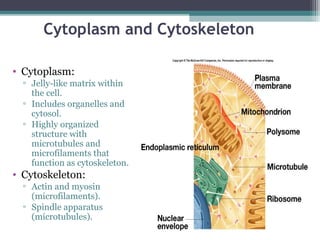
Cytoplasm and Cytoskeleton
• Cytoplasm:
▫ Jelly-like matrix within
the cell.
▫ Includes organelles and
cytosol.
▫ Highly organized
structure with
microtubules and
microfilaments that
function as cytoskeleton.
• Cytoskeleton:
▫ Actin and myosin
(microfilaments).
▫ Spindle apparatus
(microtubules).
Lysosomes
▫ Primary:
 Contain only digestive enzymes.
▫ Secondary:
 Primary lysosome fuses with food vacuole or organelle.
 Contain partially digested remnants of other organelles and organic
material.
▫ Residual body:
 Contain undigested wastes.
▫ Autophagy:
 Process that destroys worn-out organelles, so that they can be
continuously replaced.
▫ Apoptosis (programmed cell death):
 Lysosomes release digestive enzymes into the cell.
Peroxisomes
• Membrane-enclosed organelles.
▫ Contain specific enzymes that promote
oxidative reactions.
▫ Oxidize molecules and form H202.
• Catalase: converts H202 H20 + 02.
• Oxidation of toxic molecules by peroxisomes
is an important function of liver and kidney
cells.
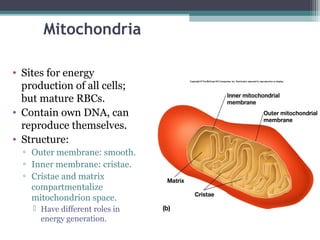
Mitochondria
• Sites for energy
production of all cells;
but mature RBCs.
• Contain own DNA, can
reproduce themselves.
• Structure:
▫ Outer membrane: smooth.
▫ Inner membrane: cristae.
▫ Cristae and matrix
compartmentalize
mitochondrion space.
 Have different roles in
energy generation.
Ribosomes
• Protein factories:
▫ Proteins produced according to genetic information
contained in mRNA.
▫ Located in cytoplasm and on the surface of
endoplasmic reticulum.
• rRNA molecules serve as enzymes (ribozymes)
required for protein synthesis.
▫ Contains 2 subunits composed of rRNA and
proteins.
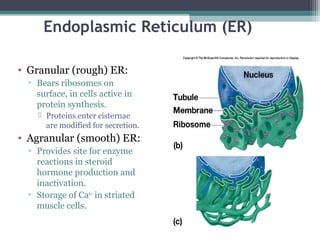
Endoplasmic Reticulum (ER)
• Granular (rough) ER:
▫ Bears ribosomes on
surface, in cells active in
protein synthesis.
 Proteins enter cisternae
are modified for secretion.
• Agranular (smooth) ER:
▫ Provides site for enzyme
reactions in steroid
hormone production and
inactivation.
▫ Storage of Ca2+
in striated
muscle cells.
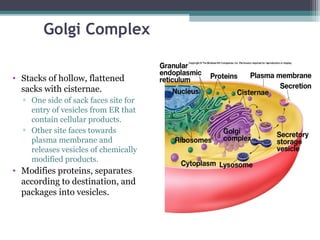
Golgi Complex
• Stacks of hollow, flattened
sacks with cisternae.
▫ One side of sack faces site for
entry of vesicles from ER that
contain cellular products.
▫ Other site faces towards
plasma membrane and
releases vesicles of chemically
modified products.
• Modifies proteins, separates
according to destination, and
packages into vesicles.
Cell Nucleus
Most cells have single nucleus.
Enclosed by inner and outer membrane
(nuclear envelope).
◦ Outer membrane is continuous with ER.
Nuclear pore complexes fuse inner and outer
membranes together.
◦ Selective active transport of proteins and RNA.
 Regulation of gene expression.
 Transport of mRNA out of nucleus to ribosomes.
Nucleoli:
◦ DNA contains the genes that code for the production
of mRNA.
Cell Death
• Pathologically:
▫ Cells deprived of blood supply swell, the membrane
ruptures, and the cell bursts (necrosis).
• Apoptosis:
▫ Cells shrink, membranes become bubbled, nuclei condense.
• Capsases (“executioner enzymes”):
▫ Mitochondria membranes become permeable to proteins
and other products.
• Programmed cell death:
▫ Physiological process responsible for remodeling of tissues
during embryonic development and tissue turnover in the
adult.

Cell structure

  • 1.
    Cell Structure andGenetic Control Human physiology
  • 2.
    Cell • Basic unitof structure and function of the body. ▫ Highly organized molecular factory. • Great diversity of function. ▫ Organ physiology derived from complex functions of the cell. • 3 principal parts: ▫ Plasma membrane. ▫ Cytoplasm and organelles. ▫ Nucleus.
  • 3.
    Plasma Membrane • Isselectively permeable. • Composition: ▫ Double layer of phospholipids due to hydrophobic/hydrophilic parts.  Restrict passage of H20 and H20 soluble ions. ▫ Proteins span or partially span the membrane.  Provide structural support, transport molecules, serve as receptors. ▫ Negatively charged carbohydrates attach to the outer surface.  Involved with regulatory molecules.
  • 4.
  • 5.
    Cytoplasm, Organelles, Nucleoli •Cytoplasm: ▫ Aqueous content of the cell. • Organelles: ▫ Sub-cellular structures within the cytoplasm. • Nucleus: ▫ Is a large spheroid body. ▫ Largest of the organelles. ▫ Contains the genetic material (DNA). ▫ Nucleoli:  Centers for production of ribosomes.
  • 6.
  • 7.
    Bulk Transport • Phagocytosis: ▫Phagocytic cells use pseudopods to surround and engulf particles. ▫ Pseudopods join, fuse, and surround ingested particle (food vacuole).  Lysosomes digest food vacuole. ▫ Protects from invading organisms. ▫ Removes debris. • Endocytosis: ▫ Pinocytosis:  Nonspecific process.  Plasma membrane invaginates, fuses, vesicle containing ECF pinches off, and vesicle enters cell.
  • 8.
    Bulk Transport (continued) •Receptor-mediated endocytosis: ▫ Interaction of molecules in ECF with specific membrane receptor proteins. ▫ Membrane invaginates, fuses, pinches off and forms vesicle. ▫ Vesicle enters cell. • Exocytosis: ▫ Process by which cellular products are secreted into extracellular environment. ▫ Proteins and other molecules to be secreted are packaged in vesicles by Golgi complex. ▫ Vesicles fuse with plasma membrane and release contents into extracellular environment.
  • 9.
    Cilia, Flagella, Microvilli •Cilia: ▫ Tiny hair-like structures that project from the surface of the cell.  Stroke in unison.  Respiratory tract, uterine tube. • Flagella: ▫ Simple whip-like structure that propels sperm through its environment. • Microvilli: ▫ Numerous folds (finger-like projections) increase surface area.  Aid absorption.
  • 10.
    Cytoplasm and Cytoskeleton •Cytoplasm: ▫ Jelly-like matrix within the cell. ▫ Includes organelles and cytosol. ▫ Highly organized structure with microtubules and microfilaments that function as cytoskeleton. • Cytoskeleton: ▫ Actin and myosin (microfilaments). ▫ Spindle apparatus (microtubules).
  • 11.
    Lysosomes ▫ Primary:  Containonly digestive enzymes. ▫ Secondary:  Primary lysosome fuses with food vacuole or organelle.  Contain partially digested remnants of other organelles and organic material. ▫ Residual body:  Contain undigested wastes. ▫ Autophagy:  Process that destroys worn-out organelles, so that they can be continuously replaced. ▫ Apoptosis (programmed cell death):  Lysosomes release digestive enzymes into the cell.
  • 12.
    Peroxisomes • Membrane-enclosed organelles. ▫Contain specific enzymes that promote oxidative reactions. ▫ Oxidize molecules and form H202. • Catalase: converts H202 H20 + 02. • Oxidation of toxic molecules by peroxisomes is an important function of liver and kidney cells.
  • 13.
    Mitochondria • Sites forenergy production of all cells; but mature RBCs. • Contain own DNA, can reproduce themselves. • Structure: ▫ Outer membrane: smooth. ▫ Inner membrane: cristae. ▫ Cristae and matrix compartmentalize mitochondrion space.  Have different roles in energy generation.
  • 14.
    Ribosomes • Protein factories: ▫Proteins produced according to genetic information contained in mRNA. ▫ Located in cytoplasm and on the surface of endoplasmic reticulum. • rRNA molecules serve as enzymes (ribozymes) required for protein synthesis. ▫ Contains 2 subunits composed of rRNA and proteins.
  • 15.
    Endoplasmic Reticulum (ER) •Granular (rough) ER: ▫ Bears ribosomes on surface, in cells active in protein synthesis.  Proteins enter cisternae are modified for secretion. • Agranular (smooth) ER: ▫ Provides site for enzyme reactions in steroid hormone production and inactivation. ▫ Storage of Ca2+ in striated muscle cells.
  • 16.
    Golgi Complex • Stacksof hollow, flattened sacks with cisternae. ▫ One side of sack faces site for entry of vesicles from ER that contain cellular products. ▫ Other site faces towards plasma membrane and releases vesicles of chemically modified products. • Modifies proteins, separates according to destination, and packages into vesicles.
  • 17.
    Cell Nucleus Most cellshave single nucleus. Enclosed by inner and outer membrane (nuclear envelope). ◦ Outer membrane is continuous with ER. Nuclear pore complexes fuse inner and outer membranes together. ◦ Selective active transport of proteins and RNA.  Regulation of gene expression.  Transport of mRNA out of nucleus to ribosomes. Nucleoli: ◦ DNA contains the genes that code for the production of mRNA.
  • 18.
    Cell Death • Pathologically: ▫Cells deprived of blood supply swell, the membrane ruptures, and the cell bursts (necrosis). • Apoptosis: ▫ Cells shrink, membranes become bubbled, nuclei condense. • Capsases (“executioner enzymes”): ▫ Mitochondria membranes become permeable to proteins and other products. • Programmed cell death: ▫ Physiological process responsible for remodeling of tissues during embryonic development and tissue turnover in the adult.