1
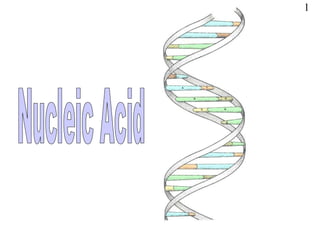
NUCLEIC ACIDS:
• Are biological molecules essential for known forms of life
on earth
• They include DNA and RNA
• Discovered by Friedrich Miescher in 1869
• They are named so because of their initial discovery in
nucleus
DNA stands for deoxyribo nucleic acid
This chemical substance is present in the nucleus
of all cells in all living organisms
DNA controls all the chemical changes which
take place in cells
The kind of cell which is formed, (muscle, blood,
nerve etc) is controlled by DNA
The kind of organism which is produced (buttercup,
giraffe, herring, human etc) is controlled by DNA
DNA 2
DNA is a very large molecule made up of a long
chain of sub-units
The sub-units are called nucleotides
Each nucleotide is made up of
a sugar called deoxyribose
a phosphate group -PO4 and
an organic base
DNA molecule 3
The deoxyribose, the phosphate and one of the bases
adenine
deoxyribose
PO4
Combine to form a nucleotide
NUCLEOTIDES
6
The most common organic bases are
Adenine (A)
Thymine (T)
Cytosine (C)
Guanine (G)
THE BASES
5
The bases always pair up in the same way
Adenine forms a bond with Thymine
and Cytosine bonds with Guanine
Bonding 1 10
Adenine Thymine
Cytosine Guanine
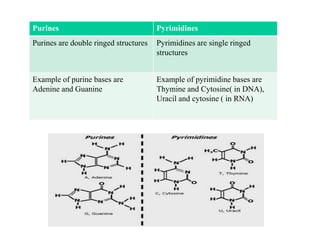
• Adenine and guanine are known as
PURINES
• Thymine and cytosine are known as
PYRIMIDINES, in RNA instead of thymine
it is Uracil
• Adenine pairs with Thymine forming two
hydrogen bonds
• Cytosine pairs with Guanine forming with
three hydrogen bonds
Purines Pyrimidines
Purines are double ringed structures Pyrimidines are single ringed
structures
Example of purine bases are
Adenine and Guanine
Example of pyrimidine bases are
Thymine and Cytosine( in DNA),
Uracil and cytosine ( in RNA)
Ribose is a sugar, like glucose, but with only five
carbon atoms in its molecule
Deoxyribose is almost the same but lacks one
oxygen atom
Both molecules may be represented by the symbol
THE SUGARS:RIBOSE & DEOXYRIBOSE
4
STRUCTURE OF DEOXYRIBONUCLEOTIDE
AND RIBONUCLEOTIDE
NUCLEOSIDE NUCLEOTIDE
Nucleoside is a component formed by
the union of a nitrogen base with a
pentose sugar
Nucleotide is a component formed
by the union of a nitrogen base, a
pentose sugar and phosphate
It is a component of nucleotide It formed after phosphorylation of
nucleoside
FUNCTIONS OF DNA:
• It is the genetic material, therefore responsible for carrying
all the hereditary information.
• It has property of replication essential for passing genetic
information from one cell to its daughters or from one
generation to next.
• Crossing over produces recombination
• Changes in sequence and no. of nucleotides causes
Mutation which is responsible for all variations and
formation of new species.
• It controls all the metabolic reaction of cells through RNAs
and RNA directed synthesis of proteins.
A molecule of
DNA is formed
by millions of
nucleotides
joined together
in a long chain
PO4
PO4
PO4
PO4
sugar-phosphate
backbone
+ bases
Joined nucleotides 7
In fact, the DNA usually consists of a double
strand of nucleotides
The sugar-phosphate chains are on the outside
and the strands are held together by chemical
bonds between the bases
8
PO4
PO4
PO4
PO4
PO4
PO4
PO4
PO4
PO4
PO4
PO4
PO4
PO4
PO4
PO4
PO4
2-stranded DNA 9
PO4
PO4
PO4
thymine
PO4
PO4
PO4
PO4
adenine
cytosine
PO4
guanine
Bonding 2 11
PO4
PO4
PO4
PO4
PO4
PO4
PO4
PO4
PO4
PO4
PO4
PO4
PO4
PO4
PO4
PO4
Pairing up 12
ROLE OF PHOSPHODIESTER
LINKAGE
• Phosphodiester Bonds Link
Successive Nucleotides in Nucleic
Acids
• The successive nucleotides of both
DNA and RNA are covalently
linked through phosphate-group
“bridges,” in which the 5’-
phosphate group of one nucleotide
unit is joined to the 3-hydroxyl
group of the next nucleotide,
creating a phosphodiester linkage .
The chain has a 5 end,
which is usually attached
to a phosphate, and a 3
end, which is usually a
free hydroxyl group
The paired strands are coiled into a spiral called
A DOUBLE HELIX
13
sugar-phosphate
chain
bases
THE DOUBLE
HELIX
14
ANTIPARALLEL NATURE
• The two strands of DNA are also antiparallel(run
in opposite directions) to one another.
• A strand of DNA can have the direction 5'-3' or 3'-
5'.
• One strand in the DNA molecule is 5'-3' and the
other strand is 3'-5'.
DNA STRUCTURE
• The two strands run antiparallely and are complimentary to each
other.
• The coiling is right handed.
• The major groove occurs where the backbones are far apart, the
minor groove occurs where they are close together.
• Two helical polynucleotide chains are coiled around a common
axis. The chains run in opposite directions.
• The sugar-phosphate backbones are on the outside and, therefore,
the purine and pyrimidine bases lie on the inside of the
helix.Adenine always pairs with Thymine, Guanine binds with
Cytosine
• The bases are nearly perpendicular to the helix axis, and adjacent
bases are separated by 3.4 Å.
• The helical structure repeats every 34 Å, so there are 10 bases (= 34
Å per repeat/3.4 Å per base) per turn of helix.
• There is a rotation of 36 degrees per base (360 degrees per full
turn/10 bases per turn).
• The diameter of the helix is 20 Å.
CHARGAFFS RULE:
• “It states that DNA from any cell of all organisms should
have a 1:1 ratio of pyrimidine and purine bases and more
specifically that the amount of guanine is equal to amount
of cytosine and amount of adenine is equal to amount of
thymine”
• %A=%T
• %G=%C
DENATURATION OR MELTING
• The hydrogen bonds between the nitrogenous bases of
complementray DNA can break due to high temperature,
low or high pH known as Melting or Denaturation of
DNA.
• A-T base pairs can go easy denaturation due to presence
of only two hydrogen bonds, whereas G-C base pairs are
comparitively more stable (high melting point) due to
presence of three hydrogen bonds.
RNA
• Like DNA, RNA is also made of a long chain of
nucleotides.
• Some RNA molecules play an active role in cells by
catalyzing biological reactions, controlling gene
expression, or sensing and communicating responses to
cellular signals.
• In RNA molecules instead of the base T, base U is found.
• Generally three types of RNA molecules are found in the
cell – mRNA, rRNA, and tRNA.
MESSENGER RNA:mRNA
• Comprise only 5% of total cellular RNA.
• Messenger RNA (mRNA) carries information about a protein
sequence to the ribosomes, the protein synthesis factories in
the cell.
• It is coded so that every three nucleotides (a codon)
correspond to one amino acid.
• The synthesis of mRNA takes place inside the nucleus and
after its synthesis, it is exported out where it attaches to
ribosomes for protein synthesis.
• After certain amount of time the message in mRNA is
degraded into its component nucleotides.
TRANSFER RNA:tRNA
• tRNA represents 15% of total RNA in the cell.
• Transfer RNA (tRNA) is a small RNA chain of about 80
nucleotides that transfers a specific amino acid to a growing
polypeptide chain at the ribosomal site of protein synthesis
during translation.
• It has sites for amino acid attachment and an anticodon region
for codon recognition that binds to a specific sequence on the
messenger RNA chain through hydrogen bonding.
STRUCTURE OF tRNA
• Anticodon arm :
• Made up of three nitrogen bases for
recognising and attaching to the
codon of mRNA
• A-A Binding Site:
It lies at the3’ end and has CCA-OH
group
• TΨC Loop:
Contains pseudouridine, site for
attaching the ribosomes
• DHU Loop:
Contains dihydrouridine, binding site
for aminoacyl synthetase enzyme.
• Variable loop:
Lies between the anticodon and TΨC
loop.
RIBOSOMAL RNA (rRNA):
• 80% of total RNA in the cells are rRNA
• Ribosomal RNA is a constituent of
Ribosomes
• rRNA are found in combination with
several proteins (about 82 proteins) as
component of the ribosome which is the site
of protein synthesis.
CENTRAL DOGMA
• The set of ideas that describes how the cell uses the information
stored in DNA is called the Central dogma
• The first step of central dogma is Transcription
• Transcription uses DNA as a template to copy genetic information
into form of RNA
• The second step of central dogma is Translation
• Translation synthesizes the protein using RNA as a template
Character RNA DNA
Nitrogenous bases RNA contains adenine,
uracil, cytosine, and
guanine.
DNA contain adenine,
thymine, cytosine,
guanine;
Strandedness RNA is single-stranded. DNA is double-stranded
Location RNA can be found in both
the nucleus and
cytoplasm.
DNA is only found in the
nucleus
Functions RNA carries out protein
synthesis.
RNA transfers the
information to other
places in the cell
DNA contains the
information for protein
synthesis.
DNA stores genetic
information
Pentose sugar Hydroxyl group present at
2 carbon of the pentose
sugar
Absence of hydroxyl
group at 2 C of the
pentose sugar

DNA RNA

  • 1.
  • 2.
    NUCLEIC ACIDS: • Arebiological molecules essential for known forms of life on earth • They include DNA and RNA • Discovered by Friedrich Miescher in 1869 • They are named so because of their initial discovery in nucleus
  • 3.
    DNA stands fordeoxyribo nucleic acid This chemical substance is present in the nucleus of all cells in all living organisms DNA controls all the chemical changes which take place in cells The kind of cell which is formed, (muscle, blood, nerve etc) is controlled by DNA The kind of organism which is produced (buttercup, giraffe, herring, human etc) is controlled by DNA DNA 2
  • 4.
    DNA is avery large molecule made up of a long chain of sub-units The sub-units are called nucleotides Each nucleotide is made up of a sugar called deoxyribose a phosphate group -PO4 and an organic base DNA molecule 3
  • 5.
    The deoxyribose, thephosphate and one of the bases adenine deoxyribose PO4 Combine to form a nucleotide NUCLEOTIDES 6
  • 6.
    The most commonorganic bases are Adenine (A) Thymine (T) Cytosine (C) Guanine (G) THE BASES 5
  • 7.
    The bases alwayspair up in the same way Adenine forms a bond with Thymine and Cytosine bonds with Guanine Bonding 1 10 Adenine Thymine Cytosine Guanine
  • 8.
    • Adenine andguanine are known as PURINES • Thymine and cytosine are known as PYRIMIDINES, in RNA instead of thymine it is Uracil • Adenine pairs with Thymine forming two hydrogen bonds • Cytosine pairs with Guanine forming with three hydrogen bonds
  • 9.
    Purines Pyrimidines Purines aredouble ringed structures Pyrimidines are single ringed structures Example of purine bases are Adenine and Guanine Example of pyrimidine bases are Thymine and Cytosine( in DNA), Uracil and cytosine ( in RNA)
  • 10.
    Ribose is asugar, like glucose, but with only five carbon atoms in its molecule Deoxyribose is almost the same but lacks one oxygen atom Both molecules may be represented by the symbol THE SUGARS:RIBOSE & DEOXYRIBOSE 4
  • 11.
  • 12.
    NUCLEOSIDE NUCLEOTIDE Nucleoside isa component formed by the union of a nitrogen base with a pentose sugar Nucleotide is a component formed by the union of a nitrogen base, a pentose sugar and phosphate It is a component of nucleotide It formed after phosphorylation of nucleoside
  • 13.
    FUNCTIONS OF DNA: •It is the genetic material, therefore responsible for carrying all the hereditary information. • It has property of replication essential for passing genetic information from one cell to its daughters or from one generation to next. • Crossing over produces recombination • Changes in sequence and no. of nucleotides causes Mutation which is responsible for all variations and formation of new species. • It controls all the metabolic reaction of cells through RNAs and RNA directed synthesis of proteins.
  • 14.
    A molecule of DNAis formed by millions of nucleotides joined together in a long chain PO4 PO4 PO4 PO4 sugar-phosphate backbone + bases Joined nucleotides 7
  • 15.
    In fact, theDNA usually consists of a double strand of nucleotides The sugar-phosphate chains are on the outside and the strands are held together by chemical bonds between the bases 8
  • 16.
  • 17.
  • 18.
  • 19.
    ROLE OF PHOSPHODIESTER LINKAGE •Phosphodiester Bonds Link Successive Nucleotides in Nucleic Acids • The successive nucleotides of both DNA and RNA are covalently linked through phosphate-group “bridges,” in which the 5’- phosphate group of one nucleotide unit is joined to the 3-hydroxyl group of the next nucleotide, creating a phosphodiester linkage .
  • 20.
    The chain hasa 5 end, which is usually attached to a phosphate, and a 3 end, which is usually a free hydroxyl group
  • 21.
    The paired strandsare coiled into a spiral called A DOUBLE HELIX 13
  • 22.
  • 23.
    ANTIPARALLEL NATURE • Thetwo strands of DNA are also antiparallel(run in opposite directions) to one another. • A strand of DNA can have the direction 5'-3' or 3'- 5'. • One strand in the DNA molecule is 5'-3' and the other strand is 3'-5'.
  • 24.
  • 25.
    • The twostrands run antiparallely and are complimentary to each other. • The coiling is right handed. • The major groove occurs where the backbones are far apart, the minor groove occurs where they are close together. • Two helical polynucleotide chains are coiled around a common axis. The chains run in opposite directions. • The sugar-phosphate backbones are on the outside and, therefore, the purine and pyrimidine bases lie on the inside of the helix.Adenine always pairs with Thymine, Guanine binds with Cytosine • The bases are nearly perpendicular to the helix axis, and adjacent bases are separated by 3.4 Å. • The helical structure repeats every 34 Å, so there are 10 bases (= 34 Å per repeat/3.4 Å per base) per turn of helix. • There is a rotation of 36 degrees per base (360 degrees per full turn/10 bases per turn). • The diameter of the helix is 20 Å.
  • 27.
    CHARGAFFS RULE: • “Itstates that DNA from any cell of all organisms should have a 1:1 ratio of pyrimidine and purine bases and more specifically that the amount of guanine is equal to amount of cytosine and amount of adenine is equal to amount of thymine” • %A=%T • %G=%C
  • 28.
    DENATURATION OR MELTING •The hydrogen bonds between the nitrogenous bases of complementray DNA can break due to high temperature, low or high pH known as Melting or Denaturation of DNA. • A-T base pairs can go easy denaturation due to presence of only two hydrogen bonds, whereas G-C base pairs are comparitively more stable (high melting point) due to presence of three hydrogen bonds.
  • 29.
    RNA • Like DNA,RNA is also made of a long chain of nucleotides. • Some RNA molecules play an active role in cells by catalyzing biological reactions, controlling gene expression, or sensing and communicating responses to cellular signals. • In RNA molecules instead of the base T, base U is found. • Generally three types of RNA molecules are found in the cell – mRNA, rRNA, and tRNA.
  • 30.
    MESSENGER RNA:mRNA • Compriseonly 5% of total cellular RNA. • Messenger RNA (mRNA) carries information about a protein sequence to the ribosomes, the protein synthesis factories in the cell. • It is coded so that every three nucleotides (a codon) correspond to one amino acid. • The synthesis of mRNA takes place inside the nucleus and after its synthesis, it is exported out where it attaches to ribosomes for protein synthesis. • After certain amount of time the message in mRNA is degraded into its component nucleotides.
  • 31.
    TRANSFER RNA:tRNA • tRNArepresents 15% of total RNA in the cell. • Transfer RNA (tRNA) is a small RNA chain of about 80 nucleotides that transfers a specific amino acid to a growing polypeptide chain at the ribosomal site of protein synthesis during translation. • It has sites for amino acid attachment and an anticodon region for codon recognition that binds to a specific sequence on the messenger RNA chain through hydrogen bonding.
  • 32.
    STRUCTURE OF tRNA •Anticodon arm : • Made up of three nitrogen bases for recognising and attaching to the codon of mRNA • A-A Binding Site: It lies at the3’ end and has CCA-OH group • TΨC Loop: Contains pseudouridine, site for attaching the ribosomes • DHU Loop: Contains dihydrouridine, binding site for aminoacyl synthetase enzyme. • Variable loop: Lies between the anticodon and TΨC loop.
  • 34.
    RIBOSOMAL RNA (rRNA): •80% of total RNA in the cells are rRNA • Ribosomal RNA is a constituent of Ribosomes • rRNA are found in combination with several proteins (about 82 proteins) as component of the ribosome which is the site of protein synthesis.
  • 35.
    CENTRAL DOGMA • Theset of ideas that describes how the cell uses the information stored in DNA is called the Central dogma • The first step of central dogma is Transcription • Transcription uses DNA as a template to copy genetic information into form of RNA • The second step of central dogma is Translation • Translation synthesizes the protein using RNA as a template
  • 36.
    Character RNA DNA Nitrogenousbases RNA contains adenine, uracil, cytosine, and guanine. DNA contain adenine, thymine, cytosine, guanine; Strandedness RNA is single-stranded. DNA is double-stranded Location RNA can be found in both the nucleus and cytoplasm. DNA is only found in the nucleus Functions RNA carries out protein synthesis. RNA transfers the information to other places in the cell DNA contains the information for protein synthesis. DNA stores genetic information Pentose sugar Hydroxyl group present at 2 carbon of the pentose sugar Absence of hydroxyl group at 2 C of the pentose sugar