Cell Biology
Zoljargal Chinbat
Plant biology

Cell biology is the study of cell structure and function,
and it revolves around the concept that the cell is the
fundamental unit of life.
Discovery of Cells
 1665- English Scientist, Robert Hooke, discovered cells
while looking at a thin slice of cork.
 He described the cells as tiny boxes or a honeycomb.
 He thought that cells only existed in plants and fungi.
Anton van Leuwenhoek
 1673- Used a handmade microscope to observe pond scum
& discovered single-celled organisms
 He called them “animalcules”
 He also observed blood cells from fish, birds, frogs, dogs,
and humans
 Therefore, it was known that cells are found in animals as
well as plants
Development of Cell Theory
 1838- German Botanist, Matthias Schleiden,
concluded that all plant parts are made of cells.
 1839- German physiologist, Theodor Schwann,
who was a close friend of Schleiden, stated that all
animal tissues are composed of cells.
Development of Cell Theory
 1858- Rudolf Virchow, German physician, after
extensive study of cellular pathology,
concluded that cells must arise from preexisting
cells.
The Cell Theory Complete
The 3 Basic Components of the Cell Theory were
now complete:
 1. All organisms are composed of one or more
cells. (Schleiden & Schwann)(1838-39)
 2. The cell is the basic unit of life in all living things.
(Schleiden & Schwann)(1838-39)
 3. All cells are produced by the division of
preexisting cells. (Virchow)(1858)
Modern Cell Theory
Modern Cell Theory contains 4 statements, in addition to
the original Cell Theory:
 The cell contains hereditary information(DNA) which is
passed on from cell to cell during cell division.
 All cells are basically the same in chemical composition and
metabolic activities.
 All basic chemical & physiological functions are carried out
inside the cells.(movement, digestion,etc)
 Cell activity depends on the activities of sub-cellular
structures within the cell(organelles, nucleus, plasma
membrane)
Characteristics of all cells
 Surrounded by cell membrane (plasma)
 Contain DNA – genetic material.
 Contain cytoplasm
Examples of Cells
Amoeba Proteus
Plant Stem
Red Blood Cell
Nerve Cell
Bacteria
Prokaryotic
 No nucleus (nucleoid
region).
 Few internal
structures - have
simple ribosomes.
 Smaller & simpler
than eukaryotic cells.
 One-celled
organisms
 Ex. Bacteria
Prokaryotic Cells
 Some use flagellum for locomotion
 threadlike structures protruding from cell
surface Bacterial cell wall
Flagellin
Rotary
motor
Sheath
Eukaryotic
 Have a membrane bound nucleus,
control center that holds DNA (genetic
material)
 Contain organelles surrounded by
membranes (small organs)
 Most living organisms – lots of variety
 Larger & more complex than prokaryotic
cells
Eukaryotic cells
Diversity of Life
 Unicellular
Organisms
 1 cell
 Ex. Bacteria,
Amoeba
 Multicellular
Organisms
 2 or more cells
 Ex. Plants & Animals
 Levels of
Organization
 Cells
 Tissues
 Organs
 Organ Systems
Plant Cells vs. Animal Cells
 Plant Cells
 Chloroplasts
 Large Central
Vacuole
 Cell Wall
 Animal Cells
 Lysosome
 Centrioles
Organelles
Cell Membrane / Plasma
 Outer membrane of cell that
controls movement in & out
of the cell
 Double layer (Lipid Bilayer)
 Plasma Membrane
 Selectively permeable
boundary between the cell
and the environment
 All cells have this!!
Cell Membrane / Plasma
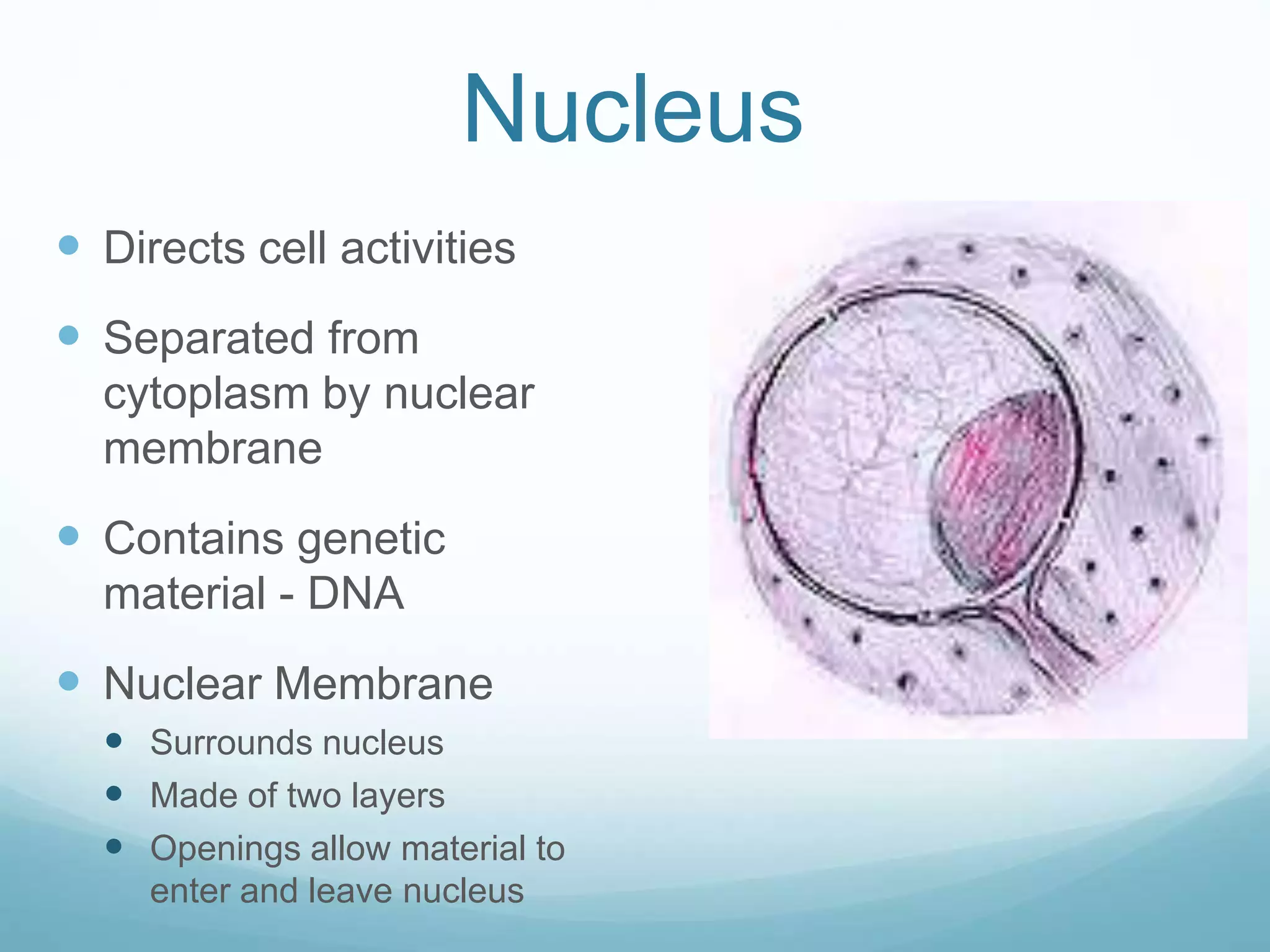
Nucleus
 Directs cell activities
 Separated from
cytoplasm by nuclear
membrane
 Contains genetic
material - DNA
 Nuclear Membrane
 Surrounds nucleus
 Made of two layers
 Openings allow material to
enter and leave nucleus
Chromosomes/Chromatin
 In nucleus
 Made of DNA &
protein
 Contain instructions
for traits &
characteristics
 Contains instructions
for making proteins
Nucleolus
 Inside nucleus
 Makes ribosomes
which then leave
the nucleus
Ribosomes
 Each cell contains
thousands
 Make proteins (site
for protein
synthesis)
 Found on Rough
ER & floating
throughout the cell
Endoplasmic Reticulum
 A system of tubes & sacs
formed by membranes (an
enclosed space)
 Moves materials around
inside of the cell
 Smooth: lacks ribosomes
 Lipid synthesis, drug
detoxifcation
 Rough type (pictured):
ribosomes embedded in
surface
 Transports proteins to the
Golgi body
Golgi Bodies
 Protein “packaging
plant”
 Modifies protein
 Attach lipids &
carbohydrates to
the protein
Vesicles move from ER to Golgi
Mitochondria
 Produces energy
through chemical
reactions – cellular
respiration
 Converts glucose
into ATP
 Cristae – inner
membrane
 Matrix – inner
membrane space
What is ATP?
 Nucleotides
 “Carry” chemical energy
from easily hydrolyzed
phosphoanhydride bonds
• Combine to form coenzymes (coenzyme A (CoA)
• Used as signaling molecules (cyclic AMP)
Lysosome
 Digestive sac for
proteins, fats, &
carbohydrates
 Transports undigested
material to cell
membrane for
removal
 Cell breaks down if
lysosome explodes(A)
Cytoskeleton
 Network of protein fibers supporting cell shape and
anchoring organelles
 Microfilaments
 Actin
 Cell movement
 Support of cell
 Microtubules
 Hollow tubes
 Movement of organelles
 Forms cilia, flagella, centrioles
Cell membrane
Endoplasmic
reticulum
Microtubule
Microfilament
Ribosomes Michondrion
Cytoskeleton
Actin
Microtubules
Intermediate
filaments
Centrioles
 Assemble
microtubules during
cell division
 Barrel shaped –
pairs
 Found In animal
cells (used during
cell reproduction)
Cell Wall
 Most commonly
found in plant cells
& bacteria
 Supports & protects
cells
Chloroplast
 Found in plant cells
 Contains green
chlorophyll
 Location where
photosynthesis
takes place in the
cell
Vacuoles
 Membrane-bound
sacs for storage,
digestion, and waste
removal
 Contains water
solution
 Help plants maintain
shape- large central
vacuole
“Typical” Animal Cell
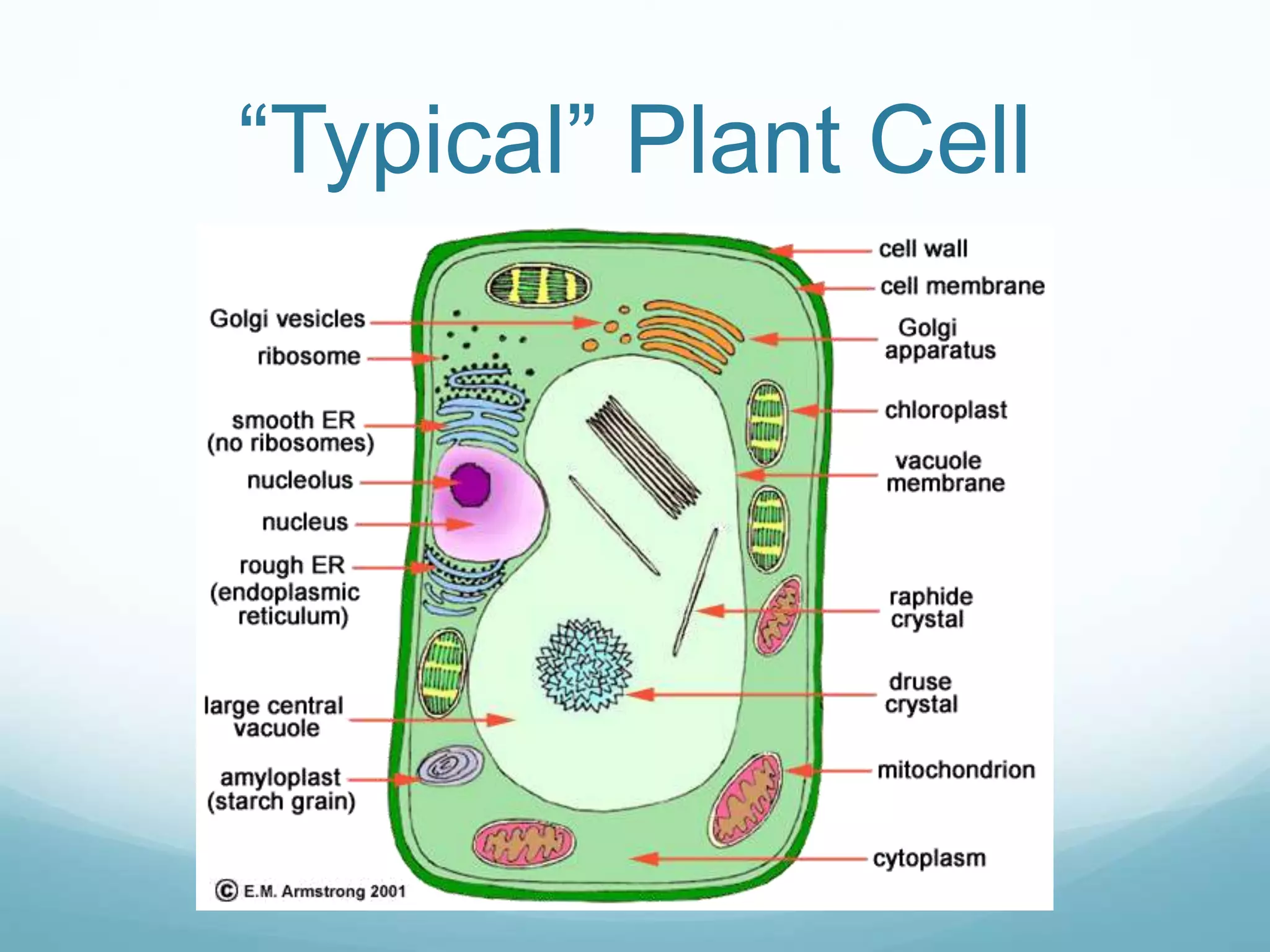
“Typical” Plant Cell
Cell biology
Cell biology
Cell biology

Cell biology

  • 1.
  • 2.
     Cell biology isthe study of cell structure and function, and it revolves around the concept that the cell is the fundamental unit of life.
  • 3.
    Discovery of Cells 1665- English Scientist, Robert Hooke, discovered cells while looking at a thin slice of cork.  He described the cells as tiny boxes or a honeycomb.  He thought that cells only existed in plants and fungi.
  • 4.
    Anton van Leuwenhoek 1673- Used a handmade microscope to observe pond scum & discovered single-celled organisms  He called them “animalcules”  He also observed blood cells from fish, birds, frogs, dogs, and humans  Therefore, it was known that cells are found in animals as well as plants
  • 5.
    Development of CellTheory  1838- German Botanist, Matthias Schleiden, concluded that all plant parts are made of cells.  1839- German physiologist, Theodor Schwann, who was a close friend of Schleiden, stated that all animal tissues are composed of cells.
  • 6.
    Development of CellTheory  1858- Rudolf Virchow, German physician, after extensive study of cellular pathology, concluded that cells must arise from preexisting cells.
  • 7.
    The Cell TheoryComplete The 3 Basic Components of the Cell Theory were now complete:  1. All organisms are composed of one or more cells. (Schleiden & Schwann)(1838-39)  2. The cell is the basic unit of life in all living things. (Schleiden & Schwann)(1838-39)  3. All cells are produced by the division of preexisting cells. (Virchow)(1858)
  • 8.
    Modern Cell Theory ModernCell Theory contains 4 statements, in addition to the original Cell Theory:  The cell contains hereditary information(DNA) which is passed on from cell to cell during cell division.  All cells are basically the same in chemical composition and metabolic activities.  All basic chemical & physiological functions are carried out inside the cells.(movement, digestion,etc)  Cell activity depends on the activities of sub-cellular structures within the cell(organelles, nucleus, plasma membrane)
  • 9.
    Characteristics of allcells  Surrounded by cell membrane (plasma)  Contain DNA – genetic material.  Contain cytoplasm
  • 10.
    Examples of Cells AmoebaProteus Plant Stem Red Blood Cell Nerve Cell Bacteria
  • 11.
    Prokaryotic  No nucleus(nucleoid region).  Few internal structures - have simple ribosomes.  Smaller & simpler than eukaryotic cells.  One-celled organisms  Ex. Bacteria
  • 12.
    Prokaryotic Cells  Someuse flagellum for locomotion  threadlike structures protruding from cell surface Bacterial cell wall Flagellin Rotary motor Sheath
  • 13.
    Eukaryotic  Have amembrane bound nucleus, control center that holds DNA (genetic material)  Contain organelles surrounded by membranes (small organs)  Most living organisms – lots of variety  Larger & more complex than prokaryotic cells
  • 14.
  • 15.
    Diversity of Life Unicellular Organisms  1 cell  Ex. Bacteria, Amoeba  Multicellular Organisms  2 or more cells  Ex. Plants & Animals  Levels of Organization  Cells  Tissues  Organs  Organ Systems
  • 16.
    Plant Cells vs.Animal Cells  Plant Cells  Chloroplasts  Large Central Vacuole  Cell Wall  Animal Cells  Lysosome  Centrioles
  • 17.
  • 18.
    Cell Membrane /Plasma  Outer membrane of cell that controls movement in & out of the cell  Double layer (Lipid Bilayer)  Plasma Membrane  Selectively permeable boundary between the cell and the environment  All cells have this!!
  • 19.
  • 20.
    Nucleus  Directs cellactivities  Separated from cytoplasm by nuclear membrane  Contains genetic material - DNA  Nuclear Membrane  Surrounds nucleus  Made of two layers  Openings allow material to enter and leave nucleus
  • 21.
    Chromosomes/Chromatin  In nucleus Made of DNA & protein  Contain instructions for traits & characteristics  Contains instructions for making proteins
  • 22.
    Nucleolus  Inside nucleus Makes ribosomes which then leave the nucleus
  • 23.
    Ribosomes  Each cellcontains thousands  Make proteins (site for protein synthesis)  Found on Rough ER & floating throughout the cell
  • 24.
    Endoplasmic Reticulum  Asystem of tubes & sacs formed by membranes (an enclosed space)  Moves materials around inside of the cell  Smooth: lacks ribosomes  Lipid synthesis, drug detoxifcation  Rough type (pictured): ribosomes embedded in surface  Transports proteins to the Golgi body
  • 25.
    Golgi Bodies  Protein“packaging plant”  Modifies protein  Attach lipids & carbohydrates to the protein
  • 26.
    Vesicles move fromER to Golgi
  • 27.
    Mitochondria  Produces energy throughchemical reactions – cellular respiration  Converts glucose into ATP  Cristae – inner membrane  Matrix – inner membrane space
  • 28.
    What is ATP? Nucleotides  “Carry” chemical energy from easily hydrolyzed phosphoanhydride bonds • Combine to form coenzymes (coenzyme A (CoA) • Used as signaling molecules (cyclic AMP)
  • 29.
    Lysosome  Digestive sacfor proteins, fats, & carbohydrates  Transports undigested material to cell membrane for removal  Cell breaks down if lysosome explodes(A)
  • 30.
    Cytoskeleton  Network ofprotein fibers supporting cell shape and anchoring organelles  Microfilaments  Actin  Cell movement  Support of cell  Microtubules  Hollow tubes  Movement of organelles  Forms cilia, flagella, centrioles Cell membrane Endoplasmic reticulum Microtubule Microfilament Ribosomes Michondrion
  • 31.
  • 32.
    Centrioles  Assemble microtubules during celldivision  Barrel shaped – pairs  Found In animal cells (used during cell reproduction)
  • 33.
    Cell Wall  Mostcommonly found in plant cells & bacteria  Supports & protects cells
  • 34.
    Chloroplast  Found inplant cells  Contains green chlorophyll  Location where photosynthesis takes place in the cell
  • 35.
    Vacuoles  Membrane-bound sacs forstorage, digestion, and waste removal  Contains water solution  Help plants maintain shape- large central vacuole
  • 36.
  • 37.