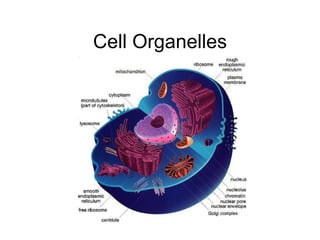
Cell Organelles
Why are there Organelles? Specialized Functions Act as containers (separate parts of the cell from other parts) Sites for chemical reactions (ex. Chloroplasts and Mitochondria)
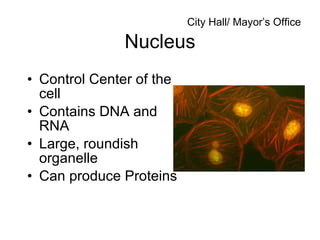
Nucleus Control Center of the cell Contains DNA and RNA Large, roundish organelle Can produce Proteins City Hall/ Mayor’s Office
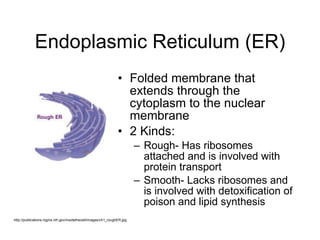
Endoplasmic Reticulum (ER) Folded membrane that extends through the cytoplasm to the nuclear membrane 2 Kinds: Rough- Has ribosomes attached and is involved with protein transport Smooth- Lacks ribosomes and is involved with detoxification of poison and lipid synthesis http://publications.nigms.nih.gov/insidethecell/images/ch1_roughER.jpg
Ribosomes Dot-like structures produced in the nucleus Site of protein synthesis Each ribosome is composed of 2 sub-units: small and large 2 type of ribosomes: Free: floating in the cytoplasm Attached: associated with the ER Protein Factory
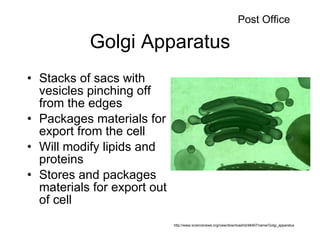
Golgi Apparatus Stacks of sacs with vesicles pinching off from the edges Packages materials for export from the cell Will modify lipids and proteins Stores and packages materials for export out of cell http://www.sciencenews.org/view/download/id/48467/name/Golgi_apparatus Post Office
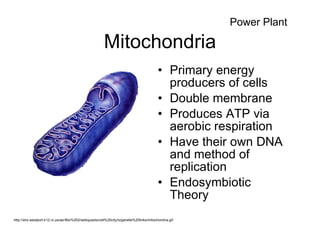
Mitochondria Primary energy producers of cells Double membrane Produces ATP via aerobic respiration Have their own DNA and method of replication Endosymbiotic Theory Power Plant http://shs.westport.k12.ct.us/asr/Bio%202/webquests/cell%20city/organelle%20links/mitochondria.gif
Chloroplasts Site of photosynthesis Chlorophyll = Green Color Endosymbiotic Theory http://www.cbs.dtu.dk/staff/dave/roanoke/chloroplast.gif
Microtubules Made from proteins within eukaryotic cells Provide the structure for the cell- cytoskeleton Tracks for transporting organelles & vesicles Pull apart chromosomes during division Ex: Cillia and flagella
Centrioles Found in eukaryotic cells Come in pairs Made from short microtubules Assist the cell with cell division
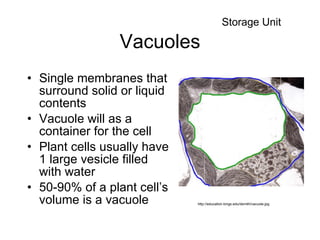
Vacuoles Single membranes that surround solid or liquid contents Vacuole will as a container for the cell Plant cells usually have 1 large vesicle filled with water 50-90% of a plant cell’s volume is a vacuole Storage Unit http://education.kings.edu/dsmith/vacuole.jpg
Vesicles Sac surrounded by a single membrane Endocytotic- will bring contents into cell Exocytotic- takes materials out of cell UPS/Delivery Service
Lysosomes Sacs within the cell that contains digestive enzymes Encased within a single membrane Used to digest/breakdown complex organic molecules Lysosome will merge with the “food” & the contents will begin the digestion Dump or Garbage Truck
Peroxisomes Resemble Lysosomes with structure and function  Sac with a single membrane that break down amino acids, alcohol and fatty acids Unique because it produces and disposes of Hydrogen Peroxide, which is fatal to cells
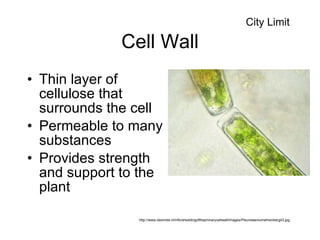
Cell Wall Thin layer of cellulose that surrounds the cell Permeable to many substances Provides strength and support to the plant http://www.desmids.nl/info/sheddingoftheprimarycellwall/images/Pleurotaeniumehrenbergii3.jpg City Limit
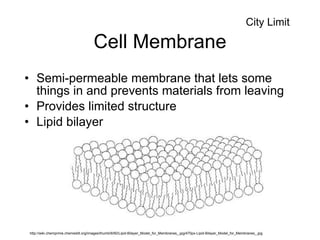
Cell Membrane Semi-permeable membrane that lets some things in and prevents materials from leaving Provides limited structure Lipid bilayer http://wiki.chemprime.chemeddl.org/images/thumb/6/60/Lipid-Bilayer_Model_for_Membranes_.jpg/470px-Lipid-Bilayer_Model_for_Membranes_.jpg City Limit

Cell Organelles Power Point

  • 1.
  • 2.
    Why are thereOrganelles? Specialized Functions Act as containers (separate parts of the cell from other parts) Sites for chemical reactions (ex. Chloroplasts and Mitochondria)
  • 3.
    Nucleus Control Centerof the cell Contains DNA and RNA Large, roundish organelle Can produce Proteins City Hall/ Mayor’s Office
  • 4.
    Endoplasmic Reticulum (ER)Folded membrane that extends through the cytoplasm to the nuclear membrane 2 Kinds: Rough- Has ribosomes attached and is involved with protein transport Smooth- Lacks ribosomes and is involved with detoxification of poison and lipid synthesis http://publications.nigms.nih.gov/insidethecell/images/ch1_roughER.jpg
  • 5.
    Ribosomes Dot-like structuresproduced in the nucleus Site of protein synthesis Each ribosome is composed of 2 sub-units: small and large 2 type of ribosomes: Free: floating in the cytoplasm Attached: associated with the ER Protein Factory
  • 6.
    Golgi Apparatus Stacksof sacs with vesicles pinching off from the edges Packages materials for export from the cell Will modify lipids and proteins Stores and packages materials for export out of cell http://www.sciencenews.org/view/download/id/48467/name/Golgi_apparatus Post Office
  • 7.
    Mitochondria Primary energyproducers of cells Double membrane Produces ATP via aerobic respiration Have their own DNA and method of replication Endosymbiotic Theory Power Plant http://shs.westport.k12.ct.us/asr/Bio%202/webquests/cell%20city/organelle%20links/mitochondria.gif
  • 8.
    Chloroplasts Site ofphotosynthesis Chlorophyll = Green Color Endosymbiotic Theory http://www.cbs.dtu.dk/staff/dave/roanoke/chloroplast.gif
  • 9.
    Microtubules Made fromproteins within eukaryotic cells Provide the structure for the cell- cytoskeleton Tracks for transporting organelles & vesicles Pull apart chromosomes during division Ex: Cillia and flagella
  • 10.
    Centrioles Found ineukaryotic cells Come in pairs Made from short microtubules Assist the cell with cell division
  • 11.
    Vacuoles Single membranesthat surround solid or liquid contents Vacuole will as a container for the cell Plant cells usually have 1 large vesicle filled with water 50-90% of a plant cell’s volume is a vacuole Storage Unit http://education.kings.edu/dsmith/vacuole.jpg
  • 12.
    Vesicles Sac surroundedby a single membrane Endocytotic- will bring contents into cell Exocytotic- takes materials out of cell UPS/Delivery Service
  • 13.
    Lysosomes Sacs withinthe cell that contains digestive enzymes Encased within a single membrane Used to digest/breakdown complex organic molecules Lysosome will merge with the “food” & the contents will begin the digestion Dump or Garbage Truck
  • 14.
    Peroxisomes Resemble Lysosomeswith structure and function Sac with a single membrane that break down amino acids, alcohol and fatty acids Unique because it produces and disposes of Hydrogen Peroxide, which is fatal to cells
  • 15.
    Cell Wall Thinlayer of cellulose that surrounds the cell Permeable to many substances Provides strength and support to the plant http://www.desmids.nl/info/sheddingoftheprimarycellwall/images/Pleurotaeniumehrenbergii3.jpg City Limit
  • 16.
    Cell Membrane Semi-permeablemembrane that lets some things in and prevents materials from leaving Provides limited structure Lipid bilayer http://wiki.chemprime.chemeddl.org/images/thumb/6/60/Lipid-Bilayer_Model_for_Membranes_.jpg/470px-Lipid-Bilayer_Model_for_Membranes_.jpg City Limit