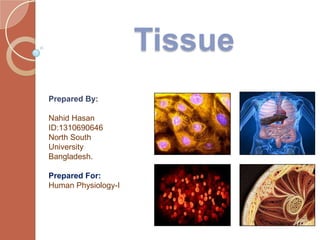
Tissue
Prepared By:
Nahid Hasan
ID:1310690646
North South
University
Bangladesh.
Prepared For:
Human Physiology-I
Definition of Tissues
Biological tissue is a collection of interconnected
cells that perform a similar function within an
organism.
In other words, it is a group of cells working
together mainly inside an organ.
Classification of Tissues
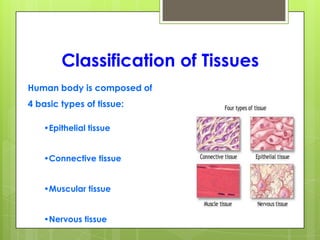
Human body is composed of
4 basic types of tissue:
•Epithelial tissue
•Connective tissue
•Muscular tissue
•Nervous tissue
Origin of Tissue
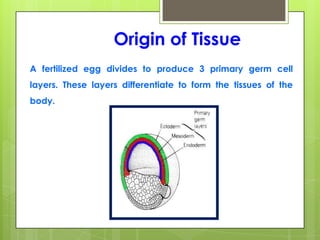
A fertilized egg divides to produce 3 primary germ cell
layers. These layers differentiate to form the tissues of the
body.
Epithelial Tissue
Epithelial cells cover or line all body surfaces, cavities and
tubes. So, These are called covering epithelia.
Epithelial cells form the functional units of secretory glands.
So, These are called glandular epithelia.
General Characteristic
 Closely attached to each other forming a protective barrier.
 Always has one free (apical) surface open to outside the body or
inside (cavity) an internal organ.
 Always has one fixed (basal) section attached to underlying
connective tissue.
 Has no blood vessels but can soak up nutrients from blood vessels
in connective tissue underneath.
 Can have lots of nerves in it (innervated).
 Very good at regenerating (fixing itself). i.e. sunburn, skinned
knee.
Functions
 To protect the tissues that lie beneath it
from radiation, desiccation, toxins, invasion by pathogens, and
physical trauma.
 The regulation and exchange of chemicals between the underlying
tissues and a body cavity.
 The secretion of hormones into the blood vascular system, and/or
the secretion of sweat, mucus, enzymes, and other products that are
delivered by ducts glandular epithelium.
 To provide sensation.
 Absorbs stomach and intestinal lining (gut).
 Filters the kidney.
Classification of Epithelia
According to thickness
 “simple” - one cell layer
 “stratified” – more than one layer of cells (which are
named according to the shape of the cells in the
apical layer)
According to shape
 “squamous” – wider than tall
 “cuboidal” – as tall as wide
 “columnar” - taller than wide
Simple squamous epithelium
Description: Single layer of
flattened cells with disc-shaped
central nuclei and sparse
cytoplasm; the simplest of the
epithelia.
Function: Passive transport of gases
and fluids.
Location:Alveoli of lungs, lining
body cavities (mesothelium), lining
blood vessels (endothelium)
Simple cuboidal epithelia
Description : Single layer of
cubelike cells with large,
spherical central nuclei.
Function : Secretion and
absorption.
Location: Kidney tubules;
ducts and secretory portions
of small glands; ovary
surface.
Simple columnar epithelia
Description: Single layer of tall
cells with round to oval
nuclei.
Types: (i)Ciliated columnar
epithelia.
(ii)Non-ciliated
columnar epithelia.
Function: Absorption;
secretion of mucus,
Enzymes and other
substances.
Location: Digestive tract, gall
bladder etc.
Stratified squamous epithelia
Description:
Multilayered, surface cell are
squamous, basal cells are
cuboidal and divided
constantly.
Function: Protection.
Location: Oral
cavity, cervix, anal canal.
Stratified cuboidal epithelia
Description: Generally two
layers of cube-like cells.
Function: Protection.
Location: Large ducts of sweat
glands, mammary glands,
and salivary glands.
Stratified columnar epithelia
Description:
Multilayered, superficial cells
elongated and columnar.
Function: Protection;
secretion.
Location: Rare in the body;
small amount in the male
urethra.
Pseudo stratified columnar
epithelia
Description: Single cell layered,
all cell attach to the basement
membrane but not all reach the
free surface. Nuclei at varying
depth.
Function: Secretion of mucus,
propulsion of mucus by ciliary
action.
Location: Lines of trachea.
Transitional epithelia
Description: Characterized by
domelike cells that are neither
squamous nor columnar. The
form of the cells changes.
Function: Stretching and
protection.
Location: Bladder and part of
urethra.
Connective Tissues
The tissues that connect the different parts of the
body together are called connective tissues.
General characteristic
 The intercellular material is maximum where as the
cellular component is minimum.
 Unlike the other tissues, (e.g. epithelium, muscle and
nerve) which are formed mainly by cells, the major
constituent of connective tissue is ECM (Extra-cellular
matrix).
 Possess cells, fibers and ground substances.
Basic Functions
 Support and binding of other tissues
 Holding body fluids
 Defending the body against infection
 macrophages, plasma cells, mast cells, WBCs
 Storing nutrients as fat
Classification of connective
tissues
Connective tissue proper :
Loose CT ; Areolar
Description: Gel like matrix with
all three fiber types ; cells:
fibroblasts, macrophages, mast
cells, and white blood cells.
Function: Its macrophages
phagocytize bacteria ; plays
important role in inflammation ;
holds and conveys tissue fluid.
Location: Distributed under
epithelia of body; surrounds
capillaries.
CT proper : Loose CT ; Adipose
Description: Matrix as in areolar,
but very sparse; closely packed
adipocytes, or fat cells , have
nucleus pushed to the side by
large fat droplet.
Function: Provides reverse food
fuel; insulates against heat loss;
supports and protects organs.
Location: Under skin; around
kidneys and eyeballs; within
abdomen; in breasts.
Fat droplets
Nucleus
CT proper: Loose CT; reticular
Description: Network of reticular
fibers in a typical loose ground
substance; reticular cells lie on
the network.
Function: Fibers form a soft internal
skeleton that supports other cell
types including white blood
cells, mast cells, and
macrophages.
Location: Lymphoid organs(lymph
nodes, bone marrow, and
macrophages.
CT proper: dense CT; Irregular
Description: Primarily irregularly
arranged collagen fibers; some
elastic fibers; major cell type is
the fibroblast.
Function: Elasticity and structural
support.
Location: Dermis of the skin;
submucosa of digestive tract and
joints.
Collagen
fibers
CT proper: dense CT; Regular
Description: Primarily parallel
collagen fibers; a few elastin
fibers; major cell type is the
fibroblast.
Function: Attaches muscles to
bones and bones to bones.
Location: Tendons and in most
ligaments.
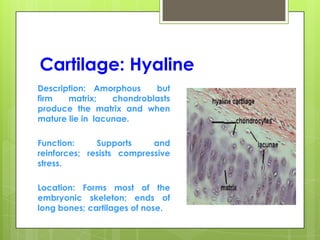
Cartilage: Hyaline
Description: Amorphous but
firm matrix; chondroblasts
produce the matrix and when
mature lie in lacunae.
Function: Supports and
reinforces; resists compressive
stress.
Location: Forms most of the
embryonic skeleton; ends of
long bones; cartilages of nose.
Cartilage: Elastic
Description: Similar to hyaline
cartilage, but more elastic
fibers in matrix.
Function: Maintains the shape
and allows flexibility.
Location: Supports the external
ear(pinna).
Cartilage : Fibrocartilage
Description : Collagen fibers
are predominant ; matrix is
as hyaline but less firm.
Function: High tensile
strength, absorb
compressive shock.
Location: Intervertebral disc;
discs of knee joint.
Bone
Description: Hard, calcified
matrix containing many
collagen fibers. Very well
vascularized.
Function: Bone supports and
protects; provides levers for
the muscles to act on; stores
calcium and other minerals
and fat; bone marrow is the
site of blood cell formation.
Location: Skeleton.
Blood
Description: Liquid connective
tissue, red and white blood
cells in fluid matrix.
Function: Transport respiratory
gases, nutrients, wastes and
other substances.
Location: In the blood vessels.
Muscle Tissue
 Muscle is one of our 4 tissue types and muscle tissue
combined with nerves, blood vessels, and various
connective tissues.
 Muscles are quite complex and as we’ll find out, they
are a marvel of both biology and physics.
General characteristics
1. Excitability
 The ability to receive and respond to a stimulus
 In skeletal muscle, the stimulus is a neurotransmitter
(chemical signal) release by a neuron (nerve cell).
 In smooth muscle, the stimulus could be a
neurotransmitter, a hormone, stretch, pH, Pco2, or
Po2.
 In cardiac muscle, the stimulus could be a
neurotransmitter, a hormone, or stretch.
 The response is the generation of an electrical impulse
that travels along the plasma membrane of the muscle
cell.
2. Contractility
 The ability to shorten forcibly when adequately
stimulated.
 This is the defining property of muscle tissue.
2. Extensibility
 The ability to be stretched (Extended)
4. Elasticity
 The ability to recoil and resume original length
after being stretched.
Functions
 Movement
 Locomotion
 Maintains posture
 Produces heat
 Facial expressions
 Pumps blood
 Peristalsis
3 Types of Muscle Tissue
Skeletal Muscle Tissue
Description: Long striated cells
with multiple nuclei.
Function: Contraction for
voluntary movements.
Location: In skeletal muscle.
Smooth Muscle Tissue
Description: Long, spindle-
shaped cells, each with a
single nucleus.
Function: Propulsion of
substances along internal
passageways.
Location: In hollow organs(e.g.
stomach)
Cardiac Muscle tissue
Description:
Branching, striated cells
fused at plasma
membranes.
Function: Pumping of
blood in the circulatory
system.
Location: Wall of heart.
Nerve Tissue
By far the most complex tissue in the human body is
nerve tissue.
Formed by a network of more than 100 million nerve
cells, assisted by many more glial cells.
Each neuron has, on an average , at least a
thousand interconnection with other neurons forming
a very complex nervous system.
Functions
 Regulates & controls body functions
 Generates & transmits nerve impulses
 Supports, insulates and protects impulse
generating neurons.
Composition of Nerve Tissue
The nerve tissue is composed of two elements:
1. The nerve cell or neuron
2. The neuroglia
Neuron
Description: Neurons are
branching cells; cell processes
that may be quite long extend
from the nucleus-containing cell
body.
Function: Transmit electrical
signals from sensory receptors
and to effectors(muscles and
glands) that control their
activity.
Location: Brain, spinal cord and
nerves.
Glial cells
Glia carry nutrients, speed
repair, provide myelin for
axons, support the blood-
brain barrier, and may form
their own communication
network. They are also
involved in neurogenesis.
References:
1. Gray's Anatomy, 40th Edition
By Susan Standring, PhD, DSc, FKC
2.http://www.highlands.edu/academics/divisions/scipe/biology/labs/rome/
histology
3.http://krupp.wcc.hawaii.edu/BIOL100L/powerpoint/tissues
4. http://www.iteachbio.com/Anatomy-Physiology/BodyTissues
5. http://www.lavc.edu/instructor/watson_k/docs/Tissues
6. http://www.nakedscience.org/mrg/Anatomy%20Unit%204%20-
%20Tissue%20Types
Thank
You ALL

Human tissues

  • 1.
    Tissue Prepared By: Nahid Hasan ID:1310690646 NorthSouth University Bangladesh. Prepared For: Human Physiology-I
  • 2.
    Definition of Tissues Biologicaltissue is a collection of interconnected cells that perform a similar function within an organism. In other words, it is a group of cells working together mainly inside an organ.
  • 3.
    Classification of Tissues Humanbody is composed of 4 basic types of tissue: •Epithelial tissue •Connective tissue •Muscular tissue •Nervous tissue
  • 4.
    Origin of Tissue Afertilized egg divides to produce 3 primary germ cell layers. These layers differentiate to form the tissues of the body.
  • 5.
    Epithelial Tissue Epithelial cellscover or line all body surfaces, cavities and tubes. So, These are called covering epithelia. Epithelial cells form the functional units of secretory glands. So, These are called glandular epithelia.
  • 6.
    General Characteristic  Closelyattached to each other forming a protective barrier.  Always has one free (apical) surface open to outside the body or inside (cavity) an internal organ.  Always has one fixed (basal) section attached to underlying connective tissue.  Has no blood vessels but can soak up nutrients from blood vessels in connective tissue underneath.  Can have lots of nerves in it (innervated).  Very good at regenerating (fixing itself). i.e. sunburn, skinned knee.
  • 7.
    Functions  To protectthe tissues that lie beneath it from radiation, desiccation, toxins, invasion by pathogens, and physical trauma.  The regulation and exchange of chemicals between the underlying tissues and a body cavity.  The secretion of hormones into the blood vascular system, and/or the secretion of sweat, mucus, enzymes, and other products that are delivered by ducts glandular epithelium.  To provide sensation.  Absorbs stomach and intestinal lining (gut).  Filters the kidney.
  • 8.
    Classification of Epithelia Accordingto thickness  “simple” - one cell layer  “stratified” – more than one layer of cells (which are named according to the shape of the cells in the apical layer) According to shape  “squamous” – wider than tall  “cuboidal” – as tall as wide  “columnar” - taller than wide
  • 10.
    Simple squamous epithelium Description:Single layer of flattened cells with disc-shaped central nuclei and sparse cytoplasm; the simplest of the epithelia. Function: Passive transport of gases and fluids. Location:Alveoli of lungs, lining body cavities (mesothelium), lining blood vessels (endothelium)
  • 11.
    Simple cuboidal epithelia Description: Single layer of cubelike cells with large, spherical central nuclei. Function : Secretion and absorption. Location: Kidney tubules; ducts and secretory portions of small glands; ovary surface.
  • 12.
    Simple columnar epithelia Description:Single layer of tall cells with round to oval nuclei. Types: (i)Ciliated columnar epithelia. (ii)Non-ciliated columnar epithelia. Function: Absorption; secretion of mucus, Enzymes and other substances. Location: Digestive tract, gall bladder etc.
  • 13.
    Stratified squamous epithelia Description: Multilayered,surface cell are squamous, basal cells are cuboidal and divided constantly. Function: Protection. Location: Oral cavity, cervix, anal canal.
  • 14.
    Stratified cuboidal epithelia Description:Generally two layers of cube-like cells. Function: Protection. Location: Large ducts of sweat glands, mammary glands, and salivary glands.
  • 15.
    Stratified columnar epithelia Description: Multilayered,superficial cells elongated and columnar. Function: Protection; secretion. Location: Rare in the body; small amount in the male urethra.
  • 16.
    Pseudo stratified columnar epithelia Description:Single cell layered, all cell attach to the basement membrane but not all reach the free surface. Nuclei at varying depth. Function: Secretion of mucus, propulsion of mucus by ciliary action. Location: Lines of trachea.
  • 17.
    Transitional epithelia Description: Characterizedby domelike cells that are neither squamous nor columnar. The form of the cells changes. Function: Stretching and protection. Location: Bladder and part of urethra.
  • 18.
    Connective Tissues The tissuesthat connect the different parts of the body together are called connective tissues.
  • 19.
    General characteristic  Theintercellular material is maximum where as the cellular component is minimum.  Unlike the other tissues, (e.g. epithelium, muscle and nerve) which are formed mainly by cells, the major constituent of connective tissue is ECM (Extra-cellular matrix).  Possess cells, fibers and ground substances.
  • 20.
    Basic Functions  Supportand binding of other tissues  Holding body fluids  Defending the body against infection  macrophages, plasma cells, mast cells, WBCs  Storing nutrients as fat
  • 21.
  • 22.
    Connective tissue proper: Loose CT ; Areolar Description: Gel like matrix with all three fiber types ; cells: fibroblasts, macrophages, mast cells, and white blood cells. Function: Its macrophages phagocytize bacteria ; plays important role in inflammation ; holds and conveys tissue fluid. Location: Distributed under epithelia of body; surrounds capillaries.
  • 23.
    CT proper :Loose CT ; Adipose Description: Matrix as in areolar, but very sparse; closely packed adipocytes, or fat cells , have nucleus pushed to the side by large fat droplet. Function: Provides reverse food fuel; insulates against heat loss; supports and protects organs. Location: Under skin; around kidneys and eyeballs; within abdomen; in breasts. Fat droplets Nucleus
  • 24.
    CT proper: LooseCT; reticular Description: Network of reticular fibers in a typical loose ground substance; reticular cells lie on the network. Function: Fibers form a soft internal skeleton that supports other cell types including white blood cells, mast cells, and macrophages. Location: Lymphoid organs(lymph nodes, bone marrow, and macrophages.
  • 25.
    CT proper: denseCT; Irregular Description: Primarily irregularly arranged collagen fibers; some elastic fibers; major cell type is the fibroblast. Function: Elasticity and structural support. Location: Dermis of the skin; submucosa of digestive tract and joints. Collagen fibers
  • 26.
    CT proper: denseCT; Regular Description: Primarily parallel collagen fibers; a few elastin fibers; major cell type is the fibroblast. Function: Attaches muscles to bones and bones to bones. Location: Tendons and in most ligaments.
  • 27.
    Cartilage: Hyaline Description: Amorphousbut firm matrix; chondroblasts produce the matrix and when mature lie in lacunae. Function: Supports and reinforces; resists compressive stress. Location: Forms most of the embryonic skeleton; ends of long bones; cartilages of nose.
  • 28.
    Cartilage: Elastic Description: Similarto hyaline cartilage, but more elastic fibers in matrix. Function: Maintains the shape and allows flexibility. Location: Supports the external ear(pinna).
  • 29.
    Cartilage : Fibrocartilage Description: Collagen fibers are predominant ; matrix is as hyaline but less firm. Function: High tensile strength, absorb compressive shock. Location: Intervertebral disc; discs of knee joint.
  • 30.
    Bone Description: Hard, calcified matrixcontaining many collagen fibers. Very well vascularized. Function: Bone supports and protects; provides levers for the muscles to act on; stores calcium and other minerals and fat; bone marrow is the site of blood cell formation. Location: Skeleton.
  • 31.
    Blood Description: Liquid connective tissue,red and white blood cells in fluid matrix. Function: Transport respiratory gases, nutrients, wastes and other substances. Location: In the blood vessels.
  • 32.
    Muscle Tissue  Muscleis one of our 4 tissue types and muscle tissue combined with nerves, blood vessels, and various connective tissues.  Muscles are quite complex and as we’ll find out, they are a marvel of both biology and physics.
  • 33.
    General characteristics 1. Excitability The ability to receive and respond to a stimulus  In skeletal muscle, the stimulus is a neurotransmitter (chemical signal) release by a neuron (nerve cell).  In smooth muscle, the stimulus could be a neurotransmitter, a hormone, stretch, pH, Pco2, or Po2.  In cardiac muscle, the stimulus could be a neurotransmitter, a hormone, or stretch.  The response is the generation of an electrical impulse that travels along the plasma membrane of the muscle cell.
  • 34.
    2. Contractility  Theability to shorten forcibly when adequately stimulated.  This is the defining property of muscle tissue. 2. Extensibility  The ability to be stretched (Extended) 4. Elasticity  The ability to recoil and resume original length after being stretched.
  • 35.
    Functions  Movement  Locomotion Maintains posture  Produces heat  Facial expressions  Pumps blood  Peristalsis
  • 36.
    3 Types ofMuscle Tissue
  • 37.
    Skeletal Muscle Tissue Description:Long striated cells with multiple nuclei. Function: Contraction for voluntary movements. Location: In skeletal muscle.
  • 38.
    Smooth Muscle Tissue Description:Long, spindle- shaped cells, each with a single nucleus. Function: Propulsion of substances along internal passageways. Location: In hollow organs(e.g. stomach)
  • 39.
    Cardiac Muscle tissue Description: Branching,striated cells fused at plasma membranes. Function: Pumping of blood in the circulatory system. Location: Wall of heart.
  • 40.
    Nerve Tissue By farthe most complex tissue in the human body is nerve tissue. Formed by a network of more than 100 million nerve cells, assisted by many more glial cells. Each neuron has, on an average , at least a thousand interconnection with other neurons forming a very complex nervous system.
  • 41.
    Functions  Regulates &controls body functions  Generates & transmits nerve impulses  Supports, insulates and protects impulse generating neurons.
  • 42.
    Composition of NerveTissue The nerve tissue is composed of two elements: 1. The nerve cell or neuron 2. The neuroglia
  • 43.
    Neuron Description: Neurons are branchingcells; cell processes that may be quite long extend from the nucleus-containing cell body. Function: Transmit electrical signals from sensory receptors and to effectors(muscles and glands) that control their activity. Location: Brain, spinal cord and nerves.
  • 44.
    Glial cells Glia carrynutrients, speed repair, provide myelin for axons, support the blood- brain barrier, and may form their own communication network. They are also involved in neurogenesis.
  • 45.
    References: 1. Gray's Anatomy,40th Edition By Susan Standring, PhD, DSc, FKC 2.http://www.highlands.edu/academics/divisions/scipe/biology/labs/rome/ histology 3.http://krupp.wcc.hawaii.edu/BIOL100L/powerpoint/tissues 4. http://www.iteachbio.com/Anatomy-Physiology/BodyTissues 5. http://www.lavc.edu/instructor/watson_k/docs/Tissues 6. http://www.nakedscience.org/mrg/Anatomy%20Unit%204%20- %20Tissue%20Types
  • 46.