

Capital Rationing
Prepared By:
Mohammed Jasir PV
Asst. Professor
MIIMS, Puthanangadi
Contact: 9605 693 266
Capital Rationing
 Related to Capital Budgeting
 Related to Investment
 When
 More investment options are available
 But limited resources are available (Shortage of Finance)
 Need to choose the best options
 Helps to prioritise the options based on profitability
 Helping to select the appropriate projects
Capital Rationing
• Capital rationing situation refers to the choice of investment
proposal under financial constraints.
• Capital rationing is applied when a firm has a number of
acceptable investment proposal but the resource available
is restricted to certain extend
Capital Rationing providing answers to
 The required fund?
 Available Fund?
 How to assign the available fund?
Steps in Capital Rationing
1. Ranking projects (By use of any profitability measures)
(NPV,IRR,PI)
2. Selecting projects in descanting order of profitability until
the budget exhausted
Factors Leading to Capital Rationing
 Internal Factors
 Restriction by management
 Top mgt. Philosophy towards capital
spending
 Fear about current commitments
 Fund from current operations
 Feasibility of acquiring new fund
 External Factors
External Factors
Imperfection of capital market
Govt. Regulations
Types of capital rationing
1. Soft capital rationing
 It is when restriction is imposed by the Management (Internal
Factors)
2. Hard capital Rationing
 It is when capital infusion is limited by external sources
(External Factors)
Advantages of capital rationing
1. Budget
2. No wastage
3. Fewer projects
4. Higher returns
5. More stability
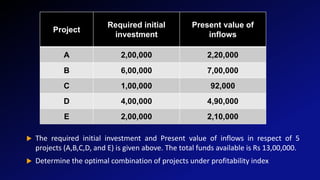
 The required initial investment and Present value of inflows in respect of 5
projects (A,B,C,D, and E) is given above. The total funds available is Rs 13,00,000.
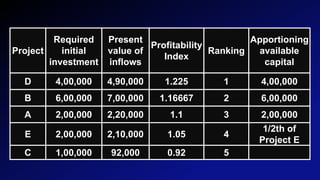
 Determine the optimal combination of projects under profitability index
Project
Required initial
investment
Present value of
inflows
A 2,00,000 2,20,000
B 6,00,000 7,00,000
C 1,00,000 92,000
D 4,00,000 4,90,000
E 2,00,000 2,10,000
Project
Required
initial
investment
Present
value of
inflows
Profitability
Index
Ranking
Apportioning
available
capital
D 4,00,000 4,90,000 1.225 1 4,00,000
B 6,00,000 7,00,000 1.16667 2 6,00,000
A 2,00,000 2,20,000 1.1 3 2,00,000
E 2,00,000 2,10,000 1.05 4
1/2th of
Project E
C 1,00,000 92,000 0.92 5
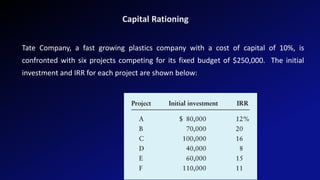
Tate Company, a fast growing plastics company with a cost of capital of 10%, is
confronted with six projects competing for its fixed budget of $250,000. The initial
investment and IRR for each project are shown below:
Capital Rationing
Thank You

Capital rationing

  • 1.
    Capital Rationing Prepared By: MohammedJasir PV Asst. Professor MIIMS, Puthanangadi Contact: 9605 693 266
  • 2.
    Capital Rationing  Relatedto Capital Budgeting  Related to Investment  When  More investment options are available  But limited resources are available (Shortage of Finance)  Need to choose the best options  Helps to prioritise the options based on profitability  Helping to select the appropriate projects
  • 3.
    Capital Rationing • Capitalrationing situation refers to the choice of investment proposal under financial constraints. • Capital rationing is applied when a firm has a number of acceptable investment proposal but the resource available is restricted to certain extend
  • 4.
    Capital Rationing providinganswers to  The required fund?  Available Fund?  How to assign the available fund?
  • 5.
    Steps in CapitalRationing 1. Ranking projects (By use of any profitability measures) (NPV,IRR,PI) 2. Selecting projects in descanting order of profitability until the budget exhausted
  • 6.
    Factors Leading toCapital Rationing  Internal Factors  Restriction by management  Top mgt. Philosophy towards capital spending  Fear about current commitments  Fund from current operations  Feasibility of acquiring new fund  External Factors External Factors Imperfection of capital market Govt. Regulations
  • 7.
    Types of capitalrationing 1. Soft capital rationing  It is when restriction is imposed by the Management (Internal Factors) 2. Hard capital Rationing  It is when capital infusion is limited by external sources (External Factors)
  • 8.
    Advantages of capitalrationing 1. Budget 2. No wastage 3. Fewer projects 4. Higher returns 5. More stability
  • 9.
     The requiredinitial investment and Present value of inflows in respect of 5 projects (A,B,C,D, and E) is given above. The total funds available is Rs 13,00,000.  Determine the optimal combination of projects under profitability index Project Required initial investment Present value of inflows A 2,00,000 2,20,000 B 6,00,000 7,00,000 C 1,00,000 92,000 D 4,00,000 4,90,000 E 2,00,000 2,10,000
  • 10.
    Project Required initial investment Present value of inflows Profitability Index Ranking Apportioning available capital D 4,00,0004,90,000 1.225 1 4,00,000 B 6,00,000 7,00,000 1.16667 2 6,00,000 A 2,00,000 2,20,000 1.1 3 2,00,000 E 2,00,000 2,10,000 1.05 4 1/2th of Project E C 1,00,000 92,000 0.92 5
  • 11.
    Tate Company, afast growing plastics company with a cost of capital of 10%, is confronted with six projects competing for its fixed budget of $250,000. The initial investment and IRR for each project are shown below: Capital Rationing
  • 12.