
































Capital
Budgeting
Techniques
Group
Name ID
Souman Guha 16241002
Sazzad Hossain Khan 16241008
Mourin Rahman 16241022
Arafat Alam Khan 16241054
Tamzid Hossain 16241042
Mourshed Alam Zoha 16241032
Rasheek Tabassum
Mondira
16241040
What is Capital Budgeting??
• Capital budgeting: the
process of evaluating &
selecting long-term
investments that are
consistent with the
firm’s goal of
maximizing owner’s
wealth.
• For example, for manufacturing firms, they
will invest in fixed assets.
• These assets are known as earning assets, it
is the basis of a firm’s earning power & value.
• Capital Expenditure: an outlay of funds by the
firm that is expected to produce benefits over
a period of time greater than 1 year.
• Operating expenditure:
an outlay of funds by the
firm resulting in
benefits received within
1 year
• Reasons for capital
expenditure are to:
• Expand
• Replace
• Renew fixed assets
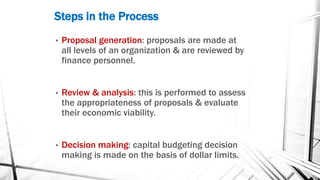
Steps in the Process
• Proposal generation: proposals are made at
all levels of an organization & are reviewed by
finance personnel.
• Review & analysis: this is performed to assess
the appropriateness of proposals & evaluate
their economic viability.
• Decision making: capital budgeting decision
making is made on the basis of dollar limits.
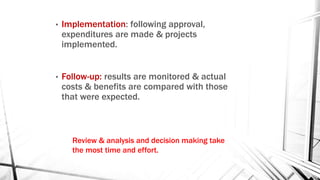
• Implementation: following approval,
expenditures are made & projects
implemented.
• Follow-up: results are monitored & actual
costs & benefits are compared with those
that were expected.
Review & analysis and decision making take
the most time and effort.
Basic terminology
• Independent projects: projects whose cash
flows are unrelated or independent of one
another; the acceptance of one does not
eliminate the others from further
consideration.
• Mutually exclusive projects: projects that
compete with one another; so that the
acceptance of one eliminates from further
consideration all other projects that serve a
similar function.
Risk of a Single Asset
• For example, a firm that needs increased production capacity
could obtain it by:
• Expanding its plant
• Acquiring another company
• Contracting with another company for production
• The availability of funds affects firm’s
decisions
• Unlimited funds: the financial situation in which a firm
is able to accept all independent projects that provide
an acceptable return.
• Capital rationing: the financial situation in which a
firm has only a fixed number of dollars available for
capital expenditures, and numerous projects compete
for these dollars.
• There are 2 approaches to
capital budgeting decisions:
oAccept-reject approach: the
evaluation of capital
expenditure proposals to
determine whether they meet
the firm’s minimum
acceptance criterion.
Ranking approach: the ranking of capital expenditure
projects on the basis of some predetermined
measure, such as the rate of return.
Only acceptable projects should be ranked.
Ranking is useful in selecting the “best” of a group of
mutually exclusive projects and in evaluating projects
with a view to capital rationing.
CASH FLOW PATTERN
• Cash flow patterns can be classified as either conventional or
nonconventional.
• Conventional cash flow pattern: An initial outflow followed only by a
series of inflows.
 Nonconventional Cash Flow pattern : An initial outflow
followed by a series of cash inflows and outflows
Payback period
• PAYBACK PERIOD: An unsophisticated capital
budgeting technique.
• The amount of time required for a firm to recover
its initial investment in a project as calculated
from cash inflows
• Decision Criteria:
• Payback period< Maximum acceptable period-
Accept the project
• Payback period> Maximum acceptable period-
Reject the project
Pros:
• Relatively easy to calculate
• Has simple intuitive appeal
• Considers timing of cash flows
• Quick evaluation of projects
• Measure’s risk exposure
Cons:
• Lack of linkage to the wealth maximization
• Failure to consider time factor in the value of money
• Ignores cash inflows that occur after payback period
• Ignores complexity of cash flow occur with capital investment
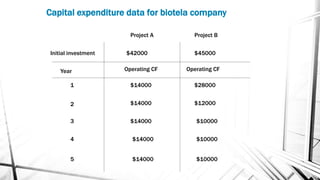
Capital expenditure data for biotela company
Project A Project B
Initial investment $42000 $45000
Year Operating CF Operating CF
1 $14000
3
2
4
5
$14000
$14000
$14000
$28000
$14000
$12000
$10000
$10000
$10000
• Payback period calculation for annuity cash inflows 42000/14000= 3
years
• Formula for Payback period calculation of mixed stream cash inflows:
• A +
A= The year in which CCF is nearer but smaller than initial outlay
NC= initial outlay of cash
C= CCF of year A
D= CF of following year A
NCo - C
D
Relevant Cash flows of Yeaman Company
$50000 $50000
Year Operating CF Operating CF
1 $5000
3
2
4
5
$5000
$40000
$10000
$40000
$10000
$2000
$10000
$8000
$10000
Project A Project B
3 years 3 years
Initial investment
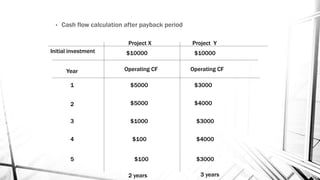
• Cash flow calculation after payback period
$10000 $10000
Year Operating CF
1 $5000
3
2
4
5
$5000
$1000
$100
$3000
$100
$4000
$4000
$3000
$3000
2 years 3 years
Operating CF
Project X Project Y
Initial investment
NET PRESENT VALUE
• NPV is considered a sophisticated capital budgeting technique.
• NPV measures the amount of value created by a given projects
• NPV is found by subtracting a project’s initial investment from the
present value of its cash inflows discounted at a rate equal to the firm’s
cost of capital
Characteristics
• A very important capital budgeting tool.
• Helps firm assess the level of importance various capital budgeting projects have. Why
doing such a thing is important?
• Capital budgeting projects normally requires expenditures in millions and billions of
dollars, before embarking on any such project they want to be reasonably sure that the
cash inflows generated from the project will pay off project’s costs within a reasonable
amount of time. Firms generally can carry out multiple projects, capital budgeting tools
like NPV help firms choose the best among them.
• NPV= present value of cash inflows- initial investment
Decision Criteria:
Npv> 0 , accept the project
Npv<0 , reject the project
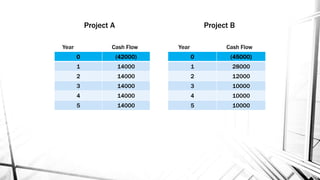
Project A Project B
Year Cash Flow Year Cash Flow
0 (42000)
1 14000
2 14000
3 14000
4 14000
5 14000
0 (45000)
1 28000
2 12000
3 10000
4 10000
5 10000
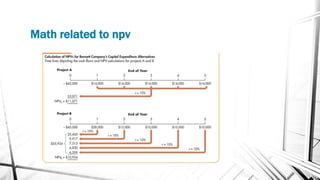
Math related to npv
NPV(A) = 11071
NPV(B) = 10924
NPV at 10% discount rate
Advantages
o With the NPV method, the advantage is that it is a direct measure of the
dollar contribution to the stockholders.
o Considers time value of money
o Considers all cash flows
Disadvantage:
o It is based on estimated future cash flows of the project and estimates
may be far from actual results.
profitability index
• A variation of the NPV rule is called profitability index
• PI is simply equal to the present value of cash inflows divided by the initial cash outflow.
• NPV and PI methods will always come to the same conclusion regarding whether a particular
investment is worth doing or not
• Decision Criteria:
• PI>1 - Accept the project
• PI< 1- Reject the project
• PI=1 - Indifferent
Advantages of PI
1.it considers time value of money.
2.It takes into account the cash inflows and outflows throughout the economic
life of the project.
3.Though PI method is almost similar to NPV method and has got the same
advantages, the former is still a better measure because PI measures the
relative profitability and NPV, being an absolute measure.
4.PI ascertains the exact rate of return of the project.
Disadvantages of PI
It is difficult to understand interest rate or discount rate.
It is difficult to calculate profitability index if two projects having different useful
life.
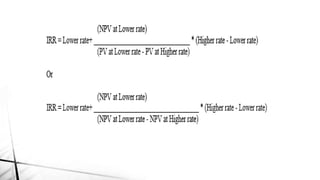
Internal rate of return (irr)
• The internal rate of return is the discount rate that equates the NPV of an
investment with $0 (because the present value of cash inflows equals the
initial investment)
• It is the rate of return the the firm will earn if it invests in the project and
receives the given cash flows
 Decision criteria:
 IRR> Cost of capital- Accept the project
 IRR< Cost of capital- Reject the project
Pros
• Considers time value of money
• Considers all cash inflows
• Gives percentage result whether to accept or reject the project
• Don’t give misguiding result
Cons
• Percentage result which is easier for average manager
• Projects with non conventional cash flow produces multiple IRR problem
• Don’t provide information regarding maximizing wealth
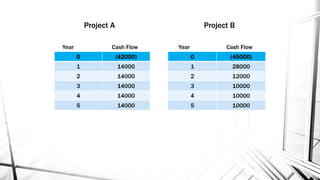
Project A Project B
Year Cash Flow Year Cash Flow
0 (42000)
1 14000
2 14000
3 14000
4 14000
5 14000
0 (45000)
1 28000
2 12000
3 10000
4 10000
5 10000
NPV(A) = 28000
NPV(B) = 25000
NPV(A) = 11071
NPV(B) = 10924
IRR(A) = 19.9%
IRR(B) = 21.7%
NPV at 0% discount rate
NPV at 10% discount rate
Internal Rate of Return
Findings
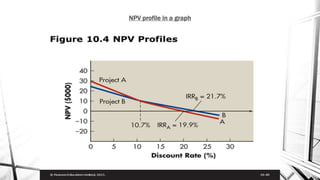
1. The IRR of project B is greater Than the IRR of project A. If manager uses the
IRR method to rank project will always choose B over A when both projects
are acceptable.
2. The NPV of project A is sometimes higher and sometimes lower than the NPV
of project B. So NPV method cannot ensure about its consistency. Actually
NPV method depends on the cost of capital.
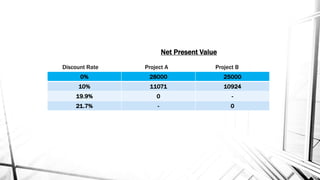
0% 28000 25000
10% 11071 10924
19.9% 0 -
21.7% - 0
Net Present Value
Discount Rate Project A Project B
NPV profile in a graph
Conflicting Rankings
• Ranking different investment opportunities is an important
consideration when projects are mutually exclusive or when capital
rationing is necessary. When projects are mutually exclusive,
ranking enables the firm to determine which project is best from a
financial standpoint.
Which Approach is Better?
Thanks
For Your Attention
42

Capital budgeting

  • 1.
  • 2.
    Group Name ID Souman Guha16241002 Sazzad Hossain Khan 16241008 Mourin Rahman 16241022 Arafat Alam Khan 16241054 Tamzid Hossain 16241042 Mourshed Alam Zoha 16241032 Rasheek Tabassum Mondira 16241040
  • 3.
    What is CapitalBudgeting??
  • 4.
    • Capital budgeting:the process of evaluating & selecting long-term investments that are consistent with the firm’s goal of maximizing owner’s wealth.
  • 5.
    • For example,for manufacturing firms, they will invest in fixed assets. • These assets are known as earning assets, it is the basis of a firm’s earning power & value. • Capital Expenditure: an outlay of funds by the firm that is expected to produce benefits over a period of time greater than 1 year.
  • 6.
    • Operating expenditure: anoutlay of funds by the firm resulting in benefits received within 1 year • Reasons for capital expenditure are to: • Expand • Replace • Renew fixed assets
  • 7.
    Steps in theProcess • Proposal generation: proposals are made at all levels of an organization & are reviewed by finance personnel. • Review & analysis: this is performed to assess the appropriateness of proposals & evaluate their economic viability. • Decision making: capital budgeting decision making is made on the basis of dollar limits.
  • 8.
    • Implementation: followingapproval, expenditures are made & projects implemented. • Follow-up: results are monitored & actual costs & benefits are compared with those that were expected. Review & analysis and decision making take the most time and effort.
  • 9.
    Basic terminology • Independentprojects: projects whose cash flows are unrelated or independent of one another; the acceptance of one does not eliminate the others from further consideration. • Mutually exclusive projects: projects that compete with one another; so that the acceptance of one eliminates from further consideration all other projects that serve a similar function.
  • 10.
    Risk of aSingle Asset • For example, a firm that needs increased production capacity could obtain it by: • Expanding its plant • Acquiring another company • Contracting with another company for production
  • 11.
    • The availabilityof funds affects firm’s decisions • Unlimited funds: the financial situation in which a firm is able to accept all independent projects that provide an acceptable return. • Capital rationing: the financial situation in which a firm has only a fixed number of dollars available for capital expenditures, and numerous projects compete for these dollars.
  • 12.
    • There are2 approaches to capital budgeting decisions: oAccept-reject approach: the evaluation of capital expenditure proposals to determine whether they meet the firm’s minimum acceptance criterion.
  • 13.
    Ranking approach: theranking of capital expenditure projects on the basis of some predetermined measure, such as the rate of return. Only acceptable projects should be ranked. Ranking is useful in selecting the “best” of a group of mutually exclusive projects and in evaluating projects with a view to capital rationing.
  • 14.
    CASH FLOW PATTERN •Cash flow patterns can be classified as either conventional or nonconventional. • Conventional cash flow pattern: An initial outflow followed only by a series of inflows.  Nonconventional Cash Flow pattern : An initial outflow followed by a series of cash inflows and outflows
  • 15.
  • 16.
    • PAYBACK PERIOD:An unsophisticated capital budgeting technique. • The amount of time required for a firm to recover its initial investment in a project as calculated from cash inflows • Decision Criteria: • Payback period< Maximum acceptable period- Accept the project • Payback period> Maximum acceptable period- Reject the project
  • 17.
    Pros: • Relatively easyto calculate • Has simple intuitive appeal • Considers timing of cash flows • Quick evaluation of projects • Measure’s risk exposure Cons: • Lack of linkage to the wealth maximization • Failure to consider time factor in the value of money • Ignores cash inflows that occur after payback period • Ignores complexity of cash flow occur with capital investment
  • 18.
    Capital expenditure datafor biotela company Project A Project B Initial investment $42000 $45000 Year Operating CF Operating CF 1 $14000 3 2 4 5 $14000 $14000 $14000 $28000 $14000 $12000 $10000 $10000 $10000
  • 19.
    • Payback periodcalculation for annuity cash inflows 42000/14000= 3 years • Formula for Payback period calculation of mixed stream cash inflows: • A + A= The year in which CCF is nearer but smaller than initial outlay NC= initial outlay of cash C= CCF of year A D= CF of following year A NCo - C D
  • 20.
    Relevant Cash flowsof Yeaman Company $50000 $50000 Year Operating CF Operating CF 1 $5000 3 2 4 5 $5000 $40000 $10000 $40000 $10000 $2000 $10000 $8000 $10000 Project A Project B 3 years 3 years Initial investment
  • 21.
    • Cash flowcalculation after payback period $10000 $10000 Year Operating CF 1 $5000 3 2 4 5 $5000 $1000 $100 $3000 $100 $4000 $4000 $3000 $3000 2 years 3 years Operating CF Project X Project Y Initial investment
  • 22.
    NET PRESENT VALUE •NPV is considered a sophisticated capital budgeting technique. • NPV measures the amount of value created by a given projects • NPV is found by subtracting a project’s initial investment from the present value of its cash inflows discounted at a rate equal to the firm’s cost of capital Characteristics • A very important capital budgeting tool. • Helps firm assess the level of importance various capital budgeting projects have. Why doing such a thing is important? • Capital budgeting projects normally requires expenditures in millions and billions of dollars, before embarking on any such project they want to be reasonably sure that the cash inflows generated from the project will pay off project’s costs within a reasonable amount of time. Firms generally can carry out multiple projects, capital budgeting tools like NPV help firms choose the best among them.
  • 23.
    • NPV= presentvalue of cash inflows- initial investment Decision Criteria: Npv> 0 , accept the project Npv<0 , reject the project
  • 24.
    Project A ProjectB Year Cash Flow Year Cash Flow 0 (42000) 1 14000 2 14000 3 14000 4 14000 5 14000 0 (45000) 1 28000 2 12000 3 10000 4 10000 5 10000
  • 25.
  • 26.
    NPV(A) = 11071 NPV(B)= 10924 NPV at 10% discount rate
  • 27.
    Advantages o With theNPV method, the advantage is that it is a direct measure of the dollar contribution to the stockholders. o Considers time value of money o Considers all cash flows Disadvantage: o It is based on estimated future cash flows of the project and estimates may be far from actual results.
  • 28.
    profitability index • Avariation of the NPV rule is called profitability index • PI is simply equal to the present value of cash inflows divided by the initial cash outflow. • NPV and PI methods will always come to the same conclusion regarding whether a particular investment is worth doing or not • Decision Criteria: • PI>1 - Accept the project • PI< 1- Reject the project • PI=1 - Indifferent
  • 29.
    Advantages of PI 1.itconsiders time value of money. 2.It takes into account the cash inflows and outflows throughout the economic life of the project. 3.Though PI method is almost similar to NPV method and has got the same advantages, the former is still a better measure because PI measures the relative profitability and NPV, being an absolute measure. 4.PI ascertains the exact rate of return of the project. Disadvantages of PI It is difficult to understand interest rate or discount rate. It is difficult to calculate profitability index if two projects having different useful life.
  • 30.
    Internal rate ofreturn (irr) • The internal rate of return is the discount rate that equates the NPV of an investment with $0 (because the present value of cash inflows equals the initial investment) • It is the rate of return the the firm will earn if it invests in the project and receives the given cash flows
  • 31.
     Decision criteria: IRR> Cost of capital- Accept the project  IRR< Cost of capital- Reject the project
  • 32.
    Pros • Considers timevalue of money • Considers all cash inflows • Gives percentage result whether to accept or reject the project • Don’t give misguiding result
  • 33.
    Cons • Percentage resultwhich is easier for average manager • Projects with non conventional cash flow produces multiple IRR problem • Don’t provide information regarding maximizing wealth
  • 35.
    Project A ProjectB Year Cash Flow Year Cash Flow 0 (42000) 1 14000 2 14000 3 14000 4 14000 5 14000 0 (45000) 1 28000 2 12000 3 10000 4 10000 5 10000
  • 36.
    NPV(A) = 28000 NPV(B)= 25000 NPV(A) = 11071 NPV(B) = 10924 IRR(A) = 19.9% IRR(B) = 21.7% NPV at 0% discount rate NPV at 10% discount rate Internal Rate of Return
  • 37.
    Findings 1. The IRRof project B is greater Than the IRR of project A. If manager uses the IRR method to rank project will always choose B over A when both projects are acceptable. 2. The NPV of project A is sometimes higher and sometimes lower than the NPV of project B. So NPV method cannot ensure about its consistency. Actually NPV method depends on the cost of capital.
  • 38.
    0% 28000 25000 10%11071 10924 19.9% 0 - 21.7% - 0 Net Present Value Discount Rate Project A Project B
  • 39.
  • 40.
    Conflicting Rankings • Rankingdifferent investment opportunities is an important consideration when projects are mutually exclusive or when capital rationing is necessary. When projects are mutually exclusive, ranking enables the firm to determine which project is best from a financial standpoint.
  • 41.
  • 42.