






FINANCE DECISIONS
By:
Smt.UMA MINAJIGI REUR
HEAD, DEPT. OF COMMERCE & Management
Smt. V G Degree College for Women, Kalaburagi
FOUR FINANCE DECISIONS
 FUNDS REQUIRED DECISION (Working Capital Decisions)
 FINANCING DECISION (procurement of fund)
 INVESTMENT DECISION (utilization of fund)
 DIVIDEND DECISION (distribution of fund)
FUNDS REQUIRED
DECISION
Funds required decision is also known as
financial forecasting.
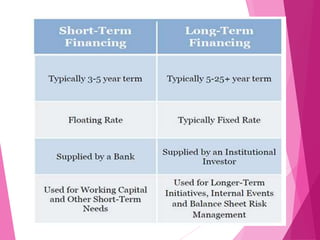
Fund requirement decision is to estimate
the different types of fund required for the
business, i.e, short term and long term.
 A careful estimation has to be made about
the total funds required by the enterprise,
taking into account both the fixed and
working capital requirement.
 Financial forecasting requires various
statistical, mathematical and accounting
techniques.
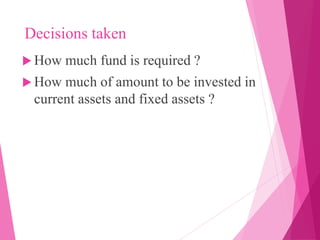
Decisions taken
 How much fund is required ?
 How much of amount to be invested in
current assets and fixed assets ?
FINANCE DECISIONS
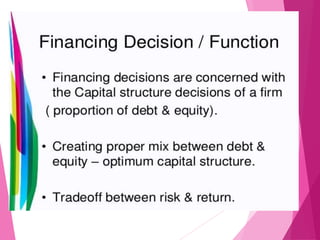
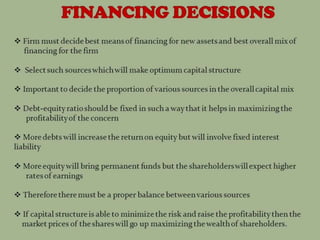
Financial decision is important to make wise decisions
about when, where and how should a business acquire
fund.
Because a firm tends to profit most when
the market estimation of an organization’s share
expands and this is not only a sign of development for
the firm but also it boosts investor’s wealth.
Consequently, this relates to the composition of
various securities in the capital structure of the
company.
Factors affecting Financing Decisions
 Cost: Financing decisions are all about allocation of funds and cost-cutting.
The cost of raising funds from various sources differ a lot. The most cost-
efficient source should be selected.
 Risk: The dangers of starting a venture with the funds from various sources
differ. Larger risk is linked with the funds which are borrowed, than the equity
funds. This risk assessment is one of the main aspects of financing decisions.
 Cash flow position: Cash flow is the regular day-to-day earnings of
the company. Good or bad cash flow position gives confidence or discourages
the investors to invest funds in the company.
 Control: In the situation where existing investors need to hold control of the
business then finance can be raised through borrowing money, however, when
they are prepared for diluting control of the business, equity can be utilized for
raising funds. How much control to give up is one of the main financing
decisions.
 Condition of the market: The condition of the market matter a lot for the
financing decisions. During boom period issue of equity is in majority but
during a depression, a firm will have to use debt. These decisions are an
important part of financing decisions.
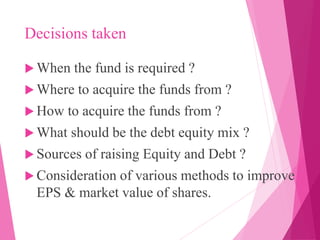
Decisions taken
 When the fund is required ?
 Where to acquire the funds from ?
 How to acquire the funds from ?
 What should be the debt equity mix ?
 Sources of raising Equity and Debt ?
 Consideration of various methods to improve
EPS & market value of shares.
INVESTMENT DECISIONS
 Investment decisions relate to the
investment in fixed assets and current assets.
 Investment in fixed asset is known as
Capital budgeting.
 Investment in current assets is known as
Asset Management Policy.
INVESTMENT DECISIONS
Investment decisions pertain to the allocation
of funds raised with a view to acquire assets.
Investment decisions should aim at
investment in assets, only when they are
expected to earn a return greater than a
minimum acceptable return, which is also
called hurdle rate.
A company’s assets and resources are rare and must
be put to their utmost utilization. A firm should pick
where to invest in order to gain the highest
conceivable returns. This decision relates to the
careful selection of assets in which funds will be
invested by the firms. The firm puts its funds in
procuring fixed assets and current assets. When
choice with respect to a fixed asset is taken it is
known as capital budgeting decision.
Factors affecting investment
decisions
 Cash flow of the project
 Cost of Capital
 Nature of business
 Business Cycle fluctuations
 Seasonal variations
 Credit Policy
 Market Competition.
Factors Affecting Investment Decision
 Cash flow of the venture: When an organization starts a venture it invests a
huge capital at the start. Even so, the organization expects at least some form
of income to meet everyday day-to-day expenses. Therefore, there must be
some regular cash flow within the venture to help it sustain.
 Profits: The basic criteria for starting any venture is to generate income but
moreover profits. The most critical criteria in choosing the venture are the
rate of return it will bring for the organization in the nature of profit for, e.g.,
if venture A is getting 10% return and venture В is getting 15% return then
one must prefer project B.
 Investment Criteria: Different Capital Budgeting procedures are accessible
to a business that can be utilized to assess different investment propositions.
Above all, these are based on calculations with regards to the amount of
investment, interest rates, cash flows and rate of returns associated with
propositions. These procedures are applied to the investment proposals to
choose the best proposal.
Decisions Taken
Availability of Funds
Proper selection of capital investment
proposal
Capital budgeting decisions
Working Capital decisions
Measurement of risk and uncertainty
proposals
Funds allocation and its retaining.
DIVIDEN DECISION
Dividends decisions relate to the distribution of
profits earned by the organization. The major
alternatives are whether to retain the earnings
profit or to distribute to the shareholders.
DIVIDEN DECISION
The term dividend refers to that part of profits
of a company which is distributed among its
shareholders for investment made by them in
the share capital of the company.
Factors Affecting Dividend Decisions
 Earnings: Returns to investors are paid out of the present and past income.
Consequently, earning is a noteworthy determinant of the dividend.
 Dependability in Earnings: An organization having higher and stable earnings
can announce higher dividend than an organization with lower income.
 Balancing Dividends: For the most part, organizations attempt to balance out
dividends per share. A consistent dividend is given every year. A change is
made, if the organization’s income potential has gone up and not only the
income of the present year.
 Development Opportunity: Organizations having great development openings
if they hold more cash out of their income to fund their required investment. The
dividend announced in growing organizations is smaller than that in the non-
development companies.
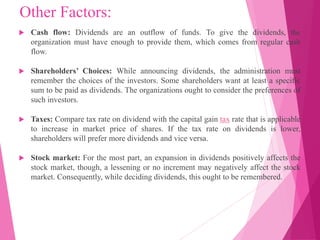
Other Factors:
 Cash flow: Dividends are an outflow of funds. To give the dividends, the
organization must have enough to provide them, which comes from regular cash
flow.
 Shareholders’ Choices: While announcing dividends, the administration must
remember the choices of the investors. Some shareholders want at least a specific
sum to be paid as dividends. The organizations ought to consider the preferences of
such investors.
 Taxes: Compare tax rate on dividend with the capital gain tax rate that is applicable
to increase in market price of shares. If the tax rate on dividends is lower,
shareholders will prefer more dividends and vice versa.
 Stock market: For the most part, an expansion in dividends positively affects the
stock market, though, a lessening or no increment may negatively affect the stock
market. Consequently, while deciding dividends, this ought to be remembered.
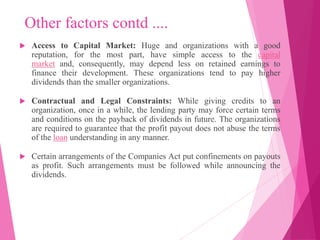
Other factors contd ....
 Access to Capital Market: Huge and organizations with a good
reputation, for the most part, have simple access to the capital
market and, consequently, may depend less on retained earnings to
finance their development. These organizations tend to pay higher
dividends than the smaller organizations.
 Contractual and Legal Constraints: While giving credits to an
organization, once in a while, the lending party may force certain terms
and conditions on the payback of dividends in future. The organizations
are required to guarantee that the profit payout does not abuse the terms
of the loan understanding in any manner.
 Certain arrangements of the Companies Act put confinements on payouts
as profit. Such arrangements must be followed while announcing the
dividends.
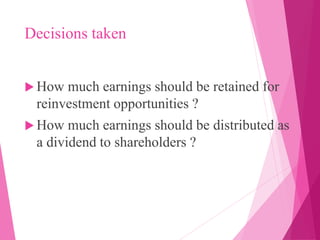
Decisions taken
 How much earnings should be retained for
reinvestment opportunities ?
 How much earnings should be distributed as
a dividend to shareholders ?
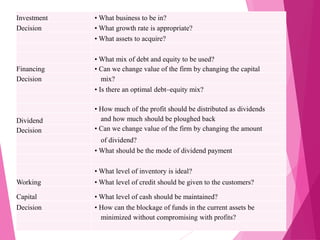
Investment • What business to be in?
Decision • What growth rate is appropriate?
• What assets to acquire?
• What mix of debt and equity to be used?
Financing • Can we change value of the firm by changing the capital
Decision mix?
• Is there an optimal debt–equity mix?
• How much of the profit should be distributed as dividends
Dividend and how much should be ploughed back
• Can we change value of the firm by changing the amountDecision
of dividend?
• What should be the mode of dividend payment
• What level of inventory is ideal?
Working • What level of credit should be given to the customers?
Capital • What level of cash should be maintained?
Decision • How can the blockage of funds in the current assets be
minimized without compromising with profits?
Thank You

Financial Management - Finance Decisions

  • 1.
    FINANCE DECISIONS By: Smt.UMA MINAJIGIREUR HEAD, DEPT. OF COMMERCE & Management Smt. V G Degree College for Women, Kalaburagi
  • 3.
    FOUR FINANCE DECISIONS FUNDS REQUIRED DECISION (Working Capital Decisions)  FINANCING DECISION (procurement of fund)  INVESTMENT DECISION (utilization of fund)  DIVIDEND DECISION (distribution of fund)
  • 4.
    FUNDS REQUIRED DECISION Funds requireddecision is also known as financial forecasting. Fund requirement decision is to estimate the different types of fund required for the business, i.e, short term and long term.
  • 6.
     A carefulestimation has to be made about the total funds required by the enterprise, taking into account both the fixed and working capital requirement.  Financial forecasting requires various statistical, mathematical and accounting techniques.
  • 7.
    Decisions taken  Howmuch fund is required ?  How much of amount to be invested in current assets and fixed assets ?
  • 8.
    FINANCE DECISIONS Financial decisionis important to make wise decisions about when, where and how should a business acquire fund. Because a firm tends to profit most when the market estimation of an organization’s share expands and this is not only a sign of development for the firm but also it boosts investor’s wealth. Consequently, this relates to the composition of various securities in the capital structure of the company.
  • 11.
    Factors affecting FinancingDecisions  Cost: Financing decisions are all about allocation of funds and cost-cutting. The cost of raising funds from various sources differ a lot. The most cost- efficient source should be selected.  Risk: The dangers of starting a venture with the funds from various sources differ. Larger risk is linked with the funds which are borrowed, than the equity funds. This risk assessment is one of the main aspects of financing decisions.  Cash flow position: Cash flow is the regular day-to-day earnings of the company. Good or bad cash flow position gives confidence or discourages the investors to invest funds in the company.  Control: In the situation where existing investors need to hold control of the business then finance can be raised through borrowing money, however, when they are prepared for diluting control of the business, equity can be utilized for raising funds. How much control to give up is one of the main financing decisions.  Condition of the market: The condition of the market matter a lot for the financing decisions. During boom period issue of equity is in majority but during a depression, a firm will have to use debt. These decisions are an important part of financing decisions.
  • 12.
    Decisions taken  Whenthe fund is required ?  Where to acquire the funds from ?  How to acquire the funds from ?  What should be the debt equity mix ?  Sources of raising Equity and Debt ?  Consideration of various methods to improve EPS & market value of shares.
  • 13.
    INVESTMENT DECISIONS  Investmentdecisions relate to the investment in fixed assets and current assets.  Investment in fixed asset is known as Capital budgeting.  Investment in current assets is known as Asset Management Policy.
  • 14.
    INVESTMENT DECISIONS Investment decisionspertain to the allocation of funds raised with a view to acquire assets. Investment decisions should aim at investment in assets, only when they are expected to earn a return greater than a minimum acceptable return, which is also called hurdle rate.
  • 15.
    A company’s assetsand resources are rare and must be put to their utmost utilization. A firm should pick where to invest in order to gain the highest conceivable returns. This decision relates to the careful selection of assets in which funds will be invested by the firms. The firm puts its funds in procuring fixed assets and current assets. When choice with respect to a fixed asset is taken it is known as capital budgeting decision.
  • 16.
    Factors affecting investment decisions Cash flow of the project  Cost of Capital  Nature of business  Business Cycle fluctuations  Seasonal variations  Credit Policy  Market Competition.
  • 17.
    Factors Affecting InvestmentDecision  Cash flow of the venture: When an organization starts a venture it invests a huge capital at the start. Even so, the organization expects at least some form of income to meet everyday day-to-day expenses. Therefore, there must be some regular cash flow within the venture to help it sustain.  Profits: The basic criteria for starting any venture is to generate income but moreover profits. The most critical criteria in choosing the venture are the rate of return it will bring for the organization in the nature of profit for, e.g., if venture A is getting 10% return and venture В is getting 15% return then one must prefer project B.  Investment Criteria: Different Capital Budgeting procedures are accessible to a business that can be utilized to assess different investment propositions. Above all, these are based on calculations with regards to the amount of investment, interest rates, cash flows and rate of returns associated with propositions. These procedures are applied to the investment proposals to choose the best proposal.
  • 18.
    Decisions Taken Availability ofFunds Proper selection of capital investment proposal Capital budgeting decisions Working Capital decisions Measurement of risk and uncertainty proposals Funds allocation and its retaining.
  • 19.
    DIVIDEN DECISION Dividends decisionsrelate to the distribution of profits earned by the organization. The major alternatives are whether to retain the earnings profit or to distribute to the shareholders.
  • 20.
    DIVIDEN DECISION The termdividend refers to that part of profits of a company which is distributed among its shareholders for investment made by them in the share capital of the company.
  • 21.
    Factors Affecting DividendDecisions  Earnings: Returns to investors are paid out of the present and past income. Consequently, earning is a noteworthy determinant of the dividend.  Dependability in Earnings: An organization having higher and stable earnings can announce higher dividend than an organization with lower income.  Balancing Dividends: For the most part, organizations attempt to balance out dividends per share. A consistent dividend is given every year. A change is made, if the organization’s income potential has gone up and not only the income of the present year.  Development Opportunity: Organizations having great development openings if they hold more cash out of their income to fund their required investment. The dividend announced in growing organizations is smaller than that in the non- development companies.
  • 22.
    Other Factors:  Cashflow: Dividends are an outflow of funds. To give the dividends, the organization must have enough to provide them, which comes from regular cash flow.  Shareholders’ Choices: While announcing dividends, the administration must remember the choices of the investors. Some shareholders want at least a specific sum to be paid as dividends. The organizations ought to consider the preferences of such investors.  Taxes: Compare tax rate on dividend with the capital gain tax rate that is applicable to increase in market price of shares. If the tax rate on dividends is lower, shareholders will prefer more dividends and vice versa.  Stock market: For the most part, an expansion in dividends positively affects the stock market, though, a lessening or no increment may negatively affect the stock market. Consequently, while deciding dividends, this ought to be remembered.
  • 23.
    Other factors contd....  Access to Capital Market: Huge and organizations with a good reputation, for the most part, have simple access to the capital market and, consequently, may depend less on retained earnings to finance their development. These organizations tend to pay higher dividends than the smaller organizations.  Contractual and Legal Constraints: While giving credits to an organization, once in a while, the lending party may force certain terms and conditions on the payback of dividends in future. The organizations are required to guarantee that the profit payout does not abuse the terms of the loan understanding in any manner.  Certain arrangements of the Companies Act put confinements on payouts as profit. Such arrangements must be followed while announcing the dividends.
  • 24.
    Decisions taken  Howmuch earnings should be retained for reinvestment opportunities ?  How much earnings should be distributed as a dividend to shareholders ?
  • 25.
    Investment • Whatbusiness to be in? Decision • What growth rate is appropriate? • What assets to acquire? • What mix of debt and equity to be used? Financing • Can we change value of the firm by changing the capital Decision mix? • Is there an optimal debt–equity mix? • How much of the profit should be distributed as dividends Dividend and how much should be ploughed back • Can we change value of the firm by changing the amountDecision of dividend? • What should be the mode of dividend payment • What level of inventory is ideal? Working • What level of credit should be given to the customers? Capital • What level of cash should be maintained? Decision • How can the blockage of funds in the current assets be minimized without compromising with profits?
  • 26.