Optimal Capital Structure of Project
1
Project Management
Submitted by:
Akshat Padliya
Chayan Maheshwari
Sanket Tripathi
Harsheeta Ved
Neha Jain
Anila Zaidi
Submitted to:
Dr. T.K. Mandal
SVSM, SVVV
Capital Structure
2
• Capital Structure means the arrangement of capital from different sources
so that the long term, funds needed for the business are raised.
• It refers to the proportions or combinations of equity share capital,
preference share capital, debentures, long term loans, retained earnings and
other long term sources of funds in total amount of capital which a firm
has to raise to run its business.
• According to John J. Hampton “Capital Structure is the combination of
debt and equity securities that comprise a firm’s financing for its assets”.
Optimal Capital Structure of Project
3
• An optimal capital structure is the objectively best mix of debt, preferred stock
and common stock that maximizes a company’s market while minimizing the
cost of capital.
• At this stage of capital structure, the market price per share is maximum and cost
of capital is minimum.
• According to E.F. Brigham “ The optimum capital structure strikes that balance
between risk and return which maximizes the price of the stock and
simultaneously minimizes the firm’s overall cost of capital.
Features of an Optimum Capital Structure
4
• Simplicity
• Profitability
• Solvency
• Flexibility
• Conservatism
• Control
• Optimal debt-equity mix
• Maximization of the value of firm
Theories of Capital Structure
5
• Net Income Approach
• Net Operating Income Approach
• Traditional Theory
• Modigliani Miller Theory
6
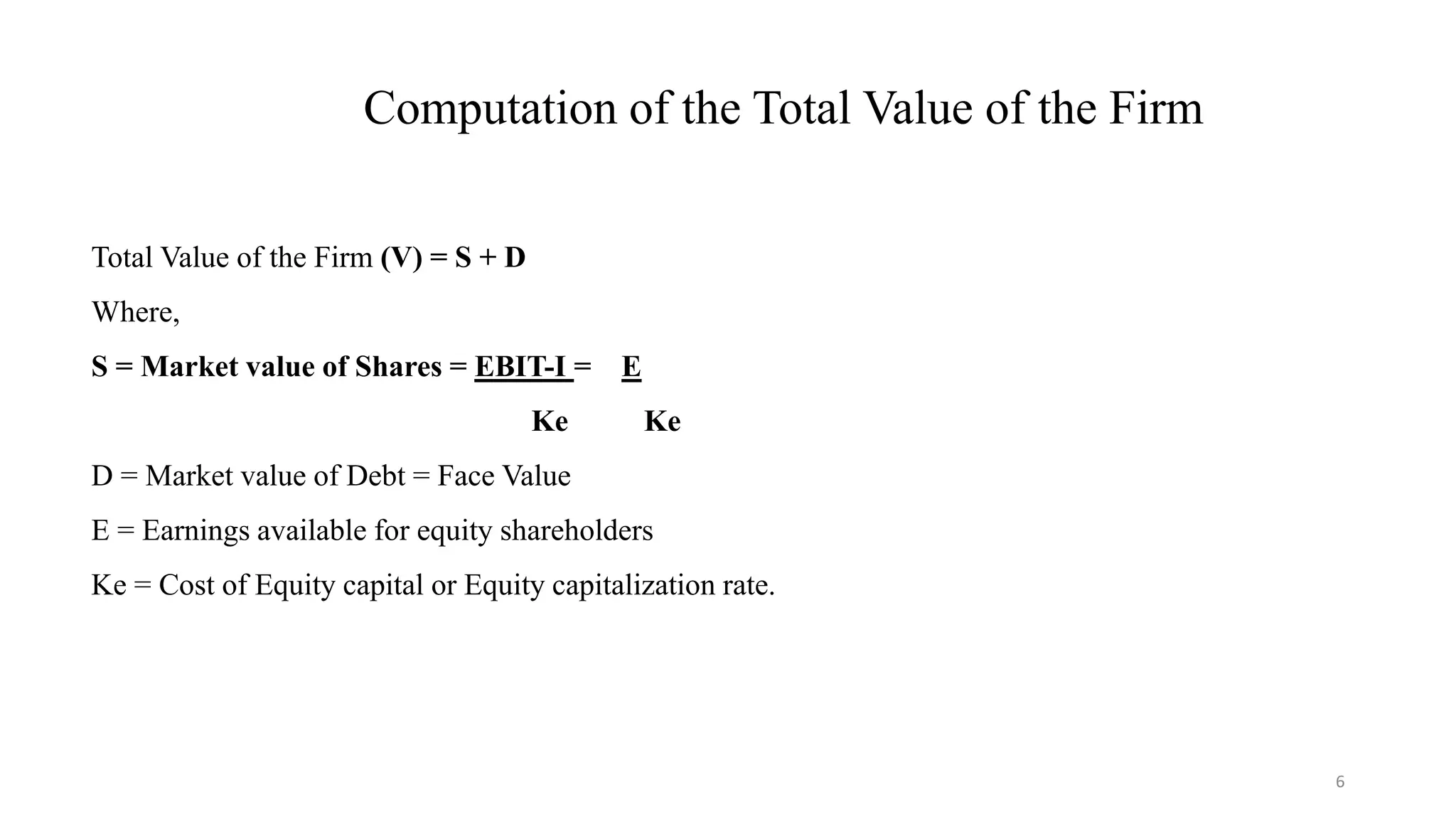
Computation of the Total Value of the Firm
Total Value of the Firm (V) = S + D
Where,
S = Market value of Shares = EBIT-I = E
Ke Ke
D = Market value of Debt = Face Value
E = Earnings available for equity shareholders
Ke = Cost of Equity capital or Equity capitalization rate.
7
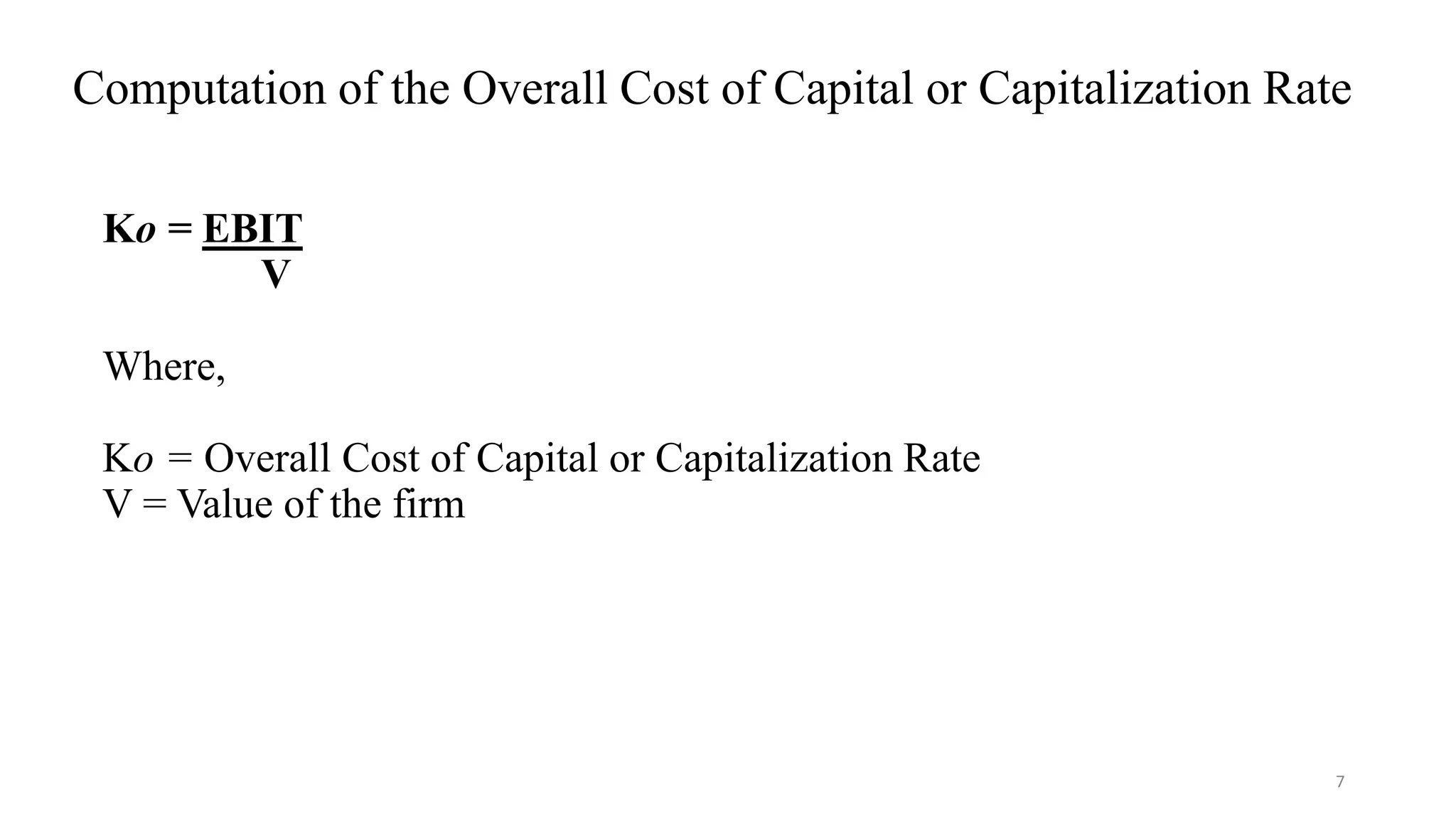
Computation of the Overall Cost of Capital or Capitalization Rate
Ko = EBIT
V
Where,
Ko = Overall Cost of Capital or Capitalization Rate
V = Value of the firm
Illustrations of Capital Structure
8
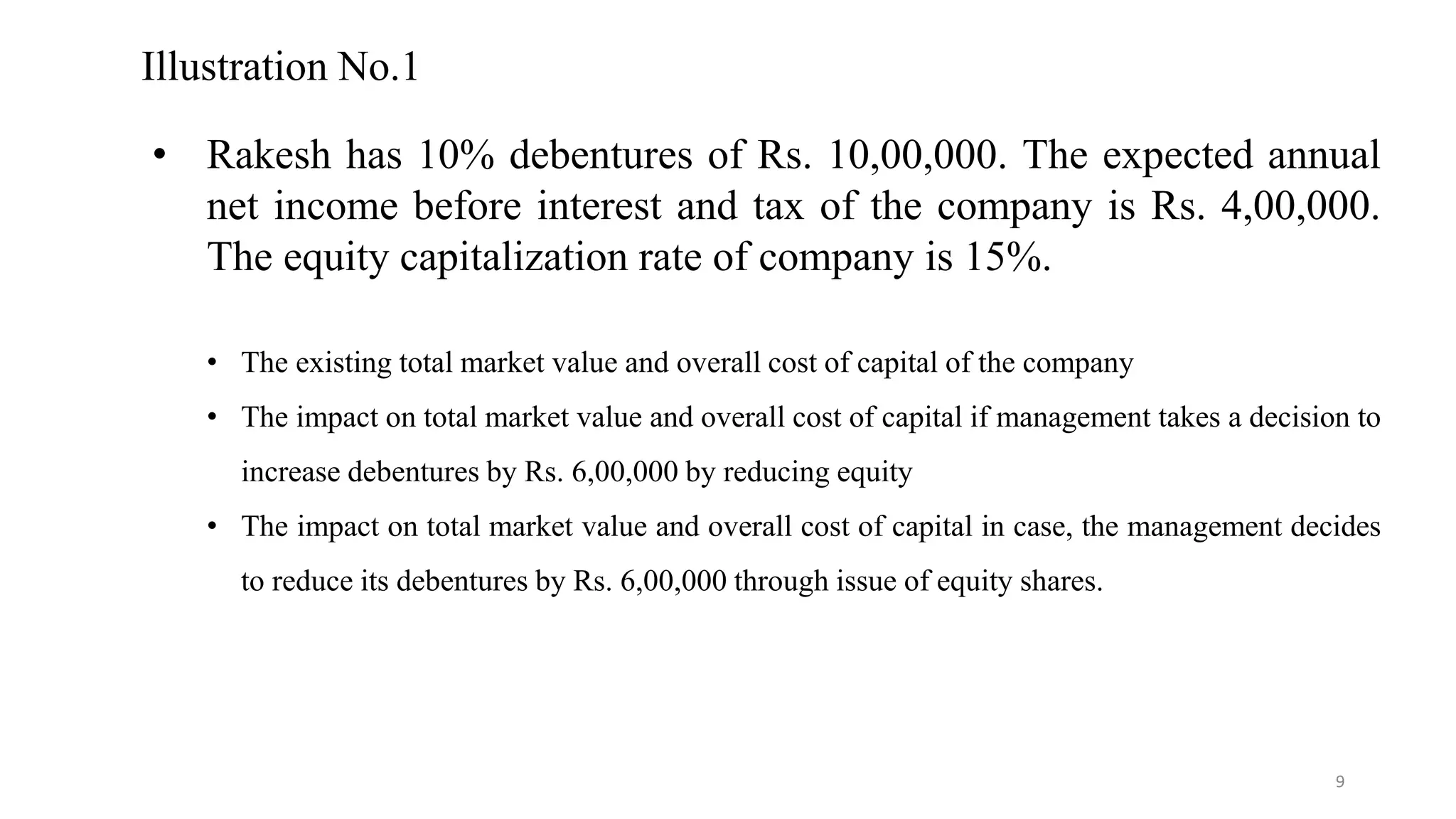
Illustration No.1
• Rakesh has 10% debentures of Rs. 10,00,000. The expected annual
net income before interest and tax of the company is Rs. 4,00,000.
The equity capitalization rate of company is 15%.
• The existing total market value and overall cost of capital of the company
• The impact on total market value and overall cost of capital if management takes a decision to
increase debentures by Rs. 6,00,000 by reducing equity
• The impact on total market value and overall cost of capital in case, the management decides
to reduce its debentures by Rs. 6,00,000 through issue of equity shares.
9
A) Calculation of Existing total market value of the company
(EBIT) 400000
Interest — 100000
Equity Earnings (E) 300000
Cost of Equity (Ke) 15%
Cost of Debt (Kd) 10%
Market Value of Equity(S)=E/Ke 20,00,000
Market Value of Debt(D)=I/Kd 10,00,000
Total Value of the Firm (V)=[S+D] 30,00,000
Overall cost of capital (K0)=EBIT *100
V
13.33%
10
B) Increase in Debentures in Total Capitalization
(EBIT) 400000
Interest — 160000
Equity Earnings (E) 240000
Cost of Equity (Ke) 15%
Cost of Debt (Kd) 10%
Market Value of Equity(S)=E/Ke 16,00,000
Market Value of Debt(D)=I/Kd 16,00,000
Total Value of the Firm (V)=[S+D] 32,00,000
Overall cost of capital (K0)=EBIT *100
V
12.50%
11
C) Decrease in Debentures in Total Capitalization
(EBIT) 400000
Interest — 40000
Equity Earnings (E) 360000
Cost of Equity (Ke) 15%
Cost of Debt (Kd) 10%
Market Value of Equity(S)=E/Ke 24,00,000
Market Value of Debt(D)=I/Kd 4,00,000
Total Value of the Firm (V)=[S+D] 28,00,000
Overall cost of capital (K0)=EBIT *100
V
14.29%
12
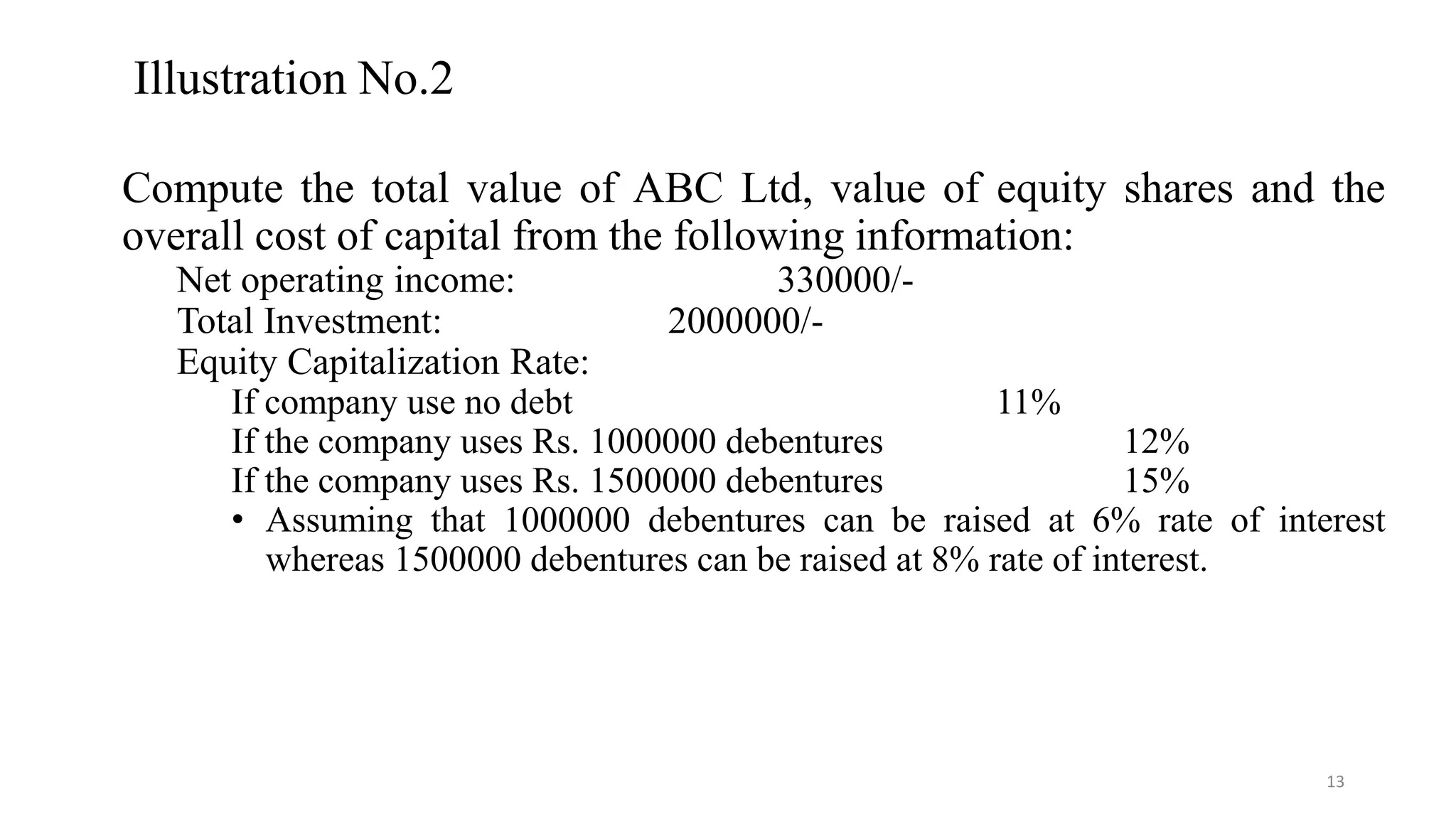
Illustration No.2
Compute the total value of ABC Ltd, value of equity shares and the
overall cost of capital from the following information:
Net operating income: 330000/-
Total Investment: 2000000/-
Equity Capitalization Rate:
If company use no debt 11%
If the company uses Rs. 1000000 debentures 12%
If the company uses Rs. 1500000 debentures 15%
• Assuming that 1000000 debentures can be raised at 6% rate of interest
whereas 1500000 debentures can be raised at 8% rate of interest.
13
No debt Rs. 10 lac
@6% debt
Rs. 15 lac @
8% debt
EBIT 330000 330000 330000
Less: Interest -- 60000 120000
EBT 330000 270000 210000
Ke 11% 12% 15%
Market Value of
Equity
3000000 2250000 1400000
Market Value of
Debt
-- 1000000 1500000
Total Market
value
3000000 3250000 2900000
Ko 11% 10.15% 11.38%
Solution:
14
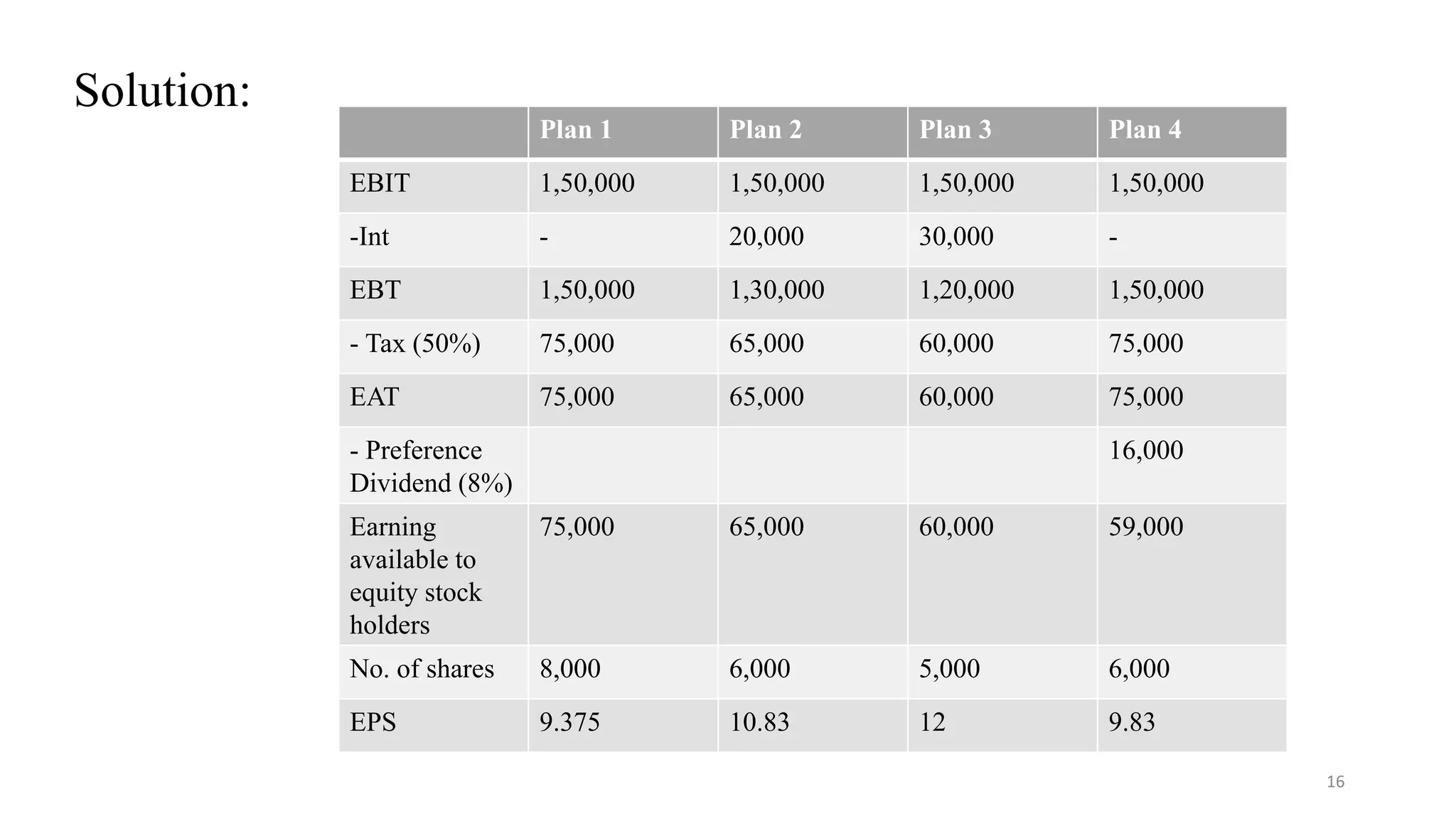
A ltd. Company has equity share capital of Rs.5,00,000 divided into shares of Rs.100
each. Net Income Before Interest and Tax is 1,50,000. Tax rate is 50%. It wishes to raise
further Rs.3,00,000 for expansion. The company plans the following financial schemes:
All common stock 100 each
Rs.1 lakh in common stock 100 each and Rs.2lakh in debt @10% p.a.
All debts at 10% p.a.
Rs.1 lakh in common stock 100 each and Rs.2lakh in preference capital 100 each
with the rate of dividend at 8%.
Calculate EPS.
Illustration No.3
15
Plan 1 Plan 2 Plan 3 Plan 4
EBIT 1,50,000 1,50,000 1,50,000 1,50,000
-Int - 20,000 30,000 -
EBT 1,50,000 1,30,000 1,20,000 1,50,000
- Tax (50%) 75,000 65,000 60,000 75,000
EAT 75,000 65,000 60,000 75,000
- Preference
Dividend (8%)
16,000
Earning
available to
equity stock
holders
75,000 65,000 60,000 59,000
No. of shares 8,000 6,000 5,000 6,000
EPS 9.375 10.83 12 9.83
Solution:
16
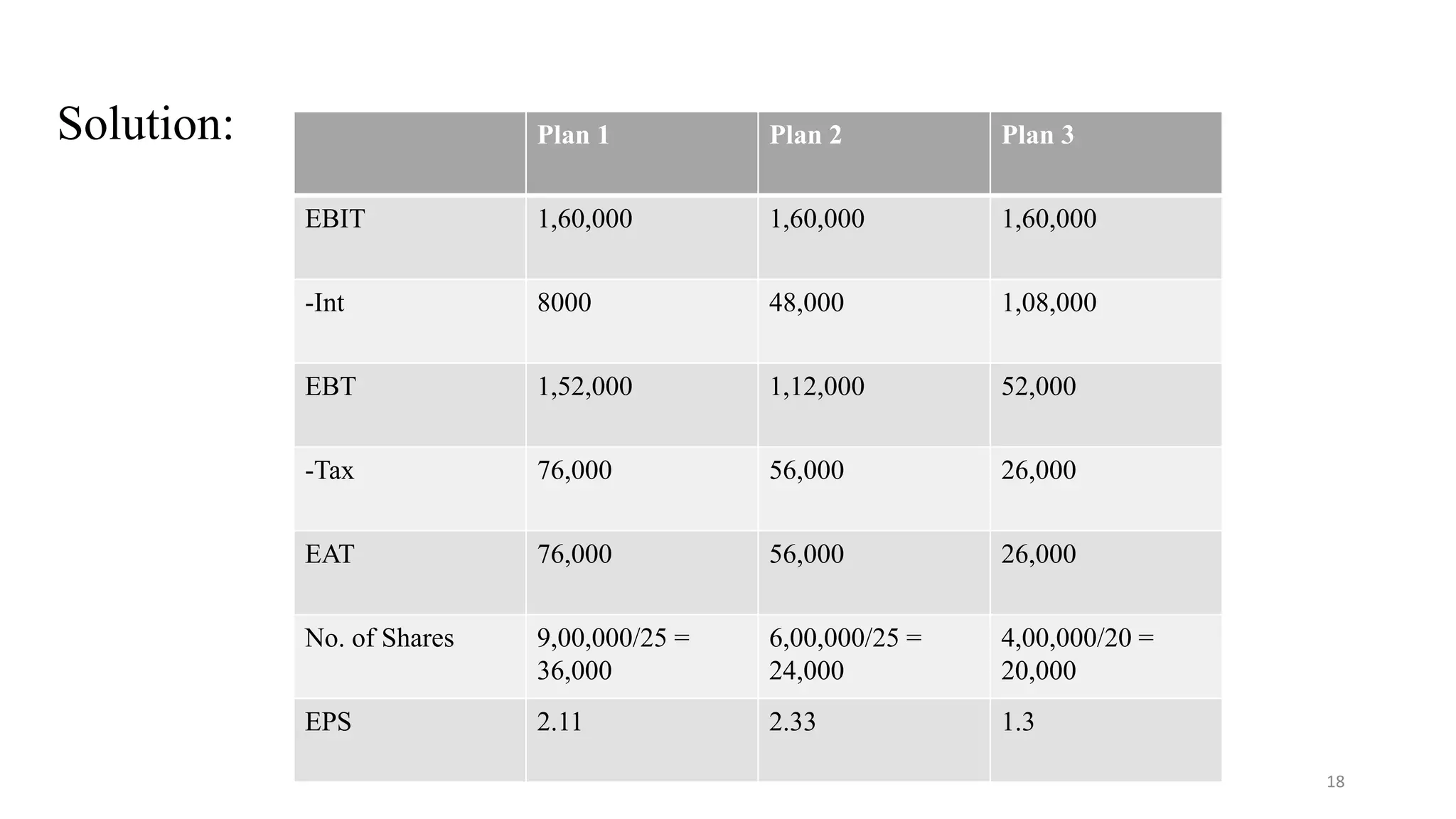
AB Ltd. Needs Rs. 10,00,000 for expansion. The expansion is expected to yield an annual EBIT of Rs.
1,60,000. it is considering a possibility of issuing equity shares and raising debt of Rs. 1,00,000 or Rs.
4,00,000 or Rs. 6,00,000. Current market price is 25 and it can drop to 20 if the funds are borrowed in
excess of Rs. 5,00,000. funds can be borrowed at the rates indicated below:
1. Up to 1,00,000 @ 8%
2. Over 1,00,000 up to rs. 5,00,000 at 12%
3. Over 5,00,000 @ 18%.
Assume tax rate to be 50% determine EPS
Illustration. 4
17
Plan 1 Plan 2 Plan 3
EBIT 1,60,000 1,60,000 1,60,000
-Int 8000 48,000 1,08,000
EBT 1,52,000 1,12,000 52,000
-Tax 76,000 56,000 26,000
EAT 76,000 56,000 26,000
No. of Shares 9,00,000/25 =
36,000
6,00,000/25 =
24,000
4,00,000/20 =
20,000
EPS 2.11 2.33 1.3
Solution:
18

optimal capital structure

  • 1.
    Optimal Capital Structureof Project 1 Project Management Submitted by: Akshat Padliya Chayan Maheshwari Sanket Tripathi Harsheeta Ved Neha Jain Anila Zaidi Submitted to: Dr. T.K. Mandal SVSM, SVVV
  • 2.
    Capital Structure 2 • CapitalStructure means the arrangement of capital from different sources so that the long term, funds needed for the business are raised. • It refers to the proportions or combinations of equity share capital, preference share capital, debentures, long term loans, retained earnings and other long term sources of funds in total amount of capital which a firm has to raise to run its business. • According to John J. Hampton “Capital Structure is the combination of debt and equity securities that comprise a firm’s financing for its assets”.
  • 3.
    Optimal Capital Structureof Project 3 • An optimal capital structure is the objectively best mix of debt, preferred stock and common stock that maximizes a company’s market while minimizing the cost of capital. • At this stage of capital structure, the market price per share is maximum and cost of capital is minimum. • According to E.F. Brigham “ The optimum capital structure strikes that balance between risk and return which maximizes the price of the stock and simultaneously minimizes the firm’s overall cost of capital.
  • 4.
    Features of anOptimum Capital Structure 4 • Simplicity • Profitability • Solvency • Flexibility • Conservatism • Control • Optimal debt-equity mix • Maximization of the value of firm
  • 5.
    Theories of CapitalStructure 5 • Net Income Approach • Net Operating Income Approach • Traditional Theory • Modigliani Miller Theory
  • 6.
    6 Computation of theTotal Value of the Firm Total Value of the Firm (V) = S + D Where, S = Market value of Shares = EBIT-I = E Ke Ke D = Market value of Debt = Face Value E = Earnings available for equity shareholders Ke = Cost of Equity capital or Equity capitalization rate.
  • 7.
    7 Computation of theOverall Cost of Capital or Capitalization Rate Ko = EBIT V Where, Ko = Overall Cost of Capital or Capitalization Rate V = Value of the firm
  • 8.
  • 9.
    Illustration No.1 • Rakeshhas 10% debentures of Rs. 10,00,000. The expected annual net income before interest and tax of the company is Rs. 4,00,000. The equity capitalization rate of company is 15%. • The existing total market value and overall cost of capital of the company • The impact on total market value and overall cost of capital if management takes a decision to increase debentures by Rs. 6,00,000 by reducing equity • The impact on total market value and overall cost of capital in case, the management decides to reduce its debentures by Rs. 6,00,000 through issue of equity shares. 9
  • 10.
    A) Calculation ofExisting total market value of the company (EBIT) 400000 Interest — 100000 Equity Earnings (E) 300000 Cost of Equity (Ke) 15% Cost of Debt (Kd) 10% Market Value of Equity(S)=E/Ke 20,00,000 Market Value of Debt(D)=I/Kd 10,00,000 Total Value of the Firm (V)=[S+D] 30,00,000 Overall cost of capital (K0)=EBIT *100 V 13.33% 10
  • 11.
    B) Increase inDebentures in Total Capitalization (EBIT) 400000 Interest — 160000 Equity Earnings (E) 240000 Cost of Equity (Ke) 15% Cost of Debt (Kd) 10% Market Value of Equity(S)=E/Ke 16,00,000 Market Value of Debt(D)=I/Kd 16,00,000 Total Value of the Firm (V)=[S+D] 32,00,000 Overall cost of capital (K0)=EBIT *100 V 12.50% 11
  • 12.
    C) Decrease inDebentures in Total Capitalization (EBIT) 400000 Interest — 40000 Equity Earnings (E) 360000 Cost of Equity (Ke) 15% Cost of Debt (Kd) 10% Market Value of Equity(S)=E/Ke 24,00,000 Market Value of Debt(D)=I/Kd 4,00,000 Total Value of the Firm (V)=[S+D] 28,00,000 Overall cost of capital (K0)=EBIT *100 V 14.29% 12
  • 13.
    Illustration No.2 Compute thetotal value of ABC Ltd, value of equity shares and the overall cost of capital from the following information: Net operating income: 330000/- Total Investment: 2000000/- Equity Capitalization Rate: If company use no debt 11% If the company uses Rs. 1000000 debentures 12% If the company uses Rs. 1500000 debentures 15% • Assuming that 1000000 debentures can be raised at 6% rate of interest whereas 1500000 debentures can be raised at 8% rate of interest. 13
  • 14.
    No debt Rs.10 lac @6% debt Rs. 15 lac @ 8% debt EBIT 330000 330000 330000 Less: Interest -- 60000 120000 EBT 330000 270000 210000 Ke 11% 12% 15% Market Value of Equity 3000000 2250000 1400000 Market Value of Debt -- 1000000 1500000 Total Market value 3000000 3250000 2900000 Ko 11% 10.15% 11.38% Solution: 14
  • 15.
    A ltd. Companyhas equity share capital of Rs.5,00,000 divided into shares of Rs.100 each. Net Income Before Interest and Tax is 1,50,000. Tax rate is 50%. It wishes to raise further Rs.3,00,000 for expansion. The company plans the following financial schemes: All common stock 100 each Rs.1 lakh in common stock 100 each and Rs.2lakh in debt @10% p.a. All debts at 10% p.a. Rs.1 lakh in common stock 100 each and Rs.2lakh in preference capital 100 each with the rate of dividend at 8%. Calculate EPS. Illustration No.3 15
  • 16.
    Plan 1 Plan2 Plan 3 Plan 4 EBIT 1,50,000 1,50,000 1,50,000 1,50,000 -Int - 20,000 30,000 - EBT 1,50,000 1,30,000 1,20,000 1,50,000 - Tax (50%) 75,000 65,000 60,000 75,000 EAT 75,000 65,000 60,000 75,000 - Preference Dividend (8%) 16,000 Earning available to equity stock holders 75,000 65,000 60,000 59,000 No. of shares 8,000 6,000 5,000 6,000 EPS 9.375 10.83 12 9.83 Solution: 16
  • 17.
    AB Ltd. NeedsRs. 10,00,000 for expansion. The expansion is expected to yield an annual EBIT of Rs. 1,60,000. it is considering a possibility of issuing equity shares and raising debt of Rs. 1,00,000 or Rs. 4,00,000 or Rs. 6,00,000. Current market price is 25 and it can drop to 20 if the funds are borrowed in excess of Rs. 5,00,000. funds can be borrowed at the rates indicated below: 1. Up to 1,00,000 @ 8% 2. Over 1,00,000 up to rs. 5,00,000 at 12% 3. Over 5,00,000 @ 18%. Assume tax rate to be 50% determine EPS Illustration. 4 17
  • 18.
    Plan 1 Plan2 Plan 3 EBIT 1,60,000 1,60,000 1,60,000 -Int 8000 48,000 1,08,000 EBT 1,52,000 1,12,000 52,000 -Tax 76,000 56,000 26,000 EAT 76,000 56,000 26,000 No. of Shares 9,00,000/25 = 36,000 6,00,000/25 = 24,000 4,00,000/20 = 20,000 EPS 2.11 2.33 1.3 Solution: 18