Presented by:
Manasa H J
1st M.Com
Capital rationing: Meaning, types
and problems of project selection
under capital rationing
Under the guidance of
Sundar B. N.
Asst. Prof. & Course Co-ordinator
GFGCW, PG Studies in Commerce
Holenarasipura
CONTENTS
CAPITAL RATIONING
• Introduction
• Meaning
• Types
• Selection of projects
• Conclusion
• Reference
Introduction
Capital rationing is defined as the process of placing a
limit on the extent of new projects or investments that a
company decides to undertake. This is made possible by
placing a much higher cost of capital for the
consideration of the investments or by placing a ceiling
on a particular proportion of a budget.
A company might intend to implement capital
rationing in scenarios where the past revenues generated
through investments were not up to the mark.
MEANING:-
Rationing is the process of allocating
scarce resources on the basis of priority based
on certain criterion.
It is a situation when the company cannot
undertake all investment projects with positive
NPV.
CONSIDER THE FOLLOWING SITUATION
 No problem if the company has sufficient funds
 Suppose, the firm has only Rs. 200 lakhs; the firm
cannot invest in or undertake all projects which have
positive NPV or IRR above the cost of capital
 In this case the firm has to reject project “B”-a
profitable investment project due to lack or
insufficiency of capital
 Further, cannot maximize the wealth
 Such a situation warrants capital rationing
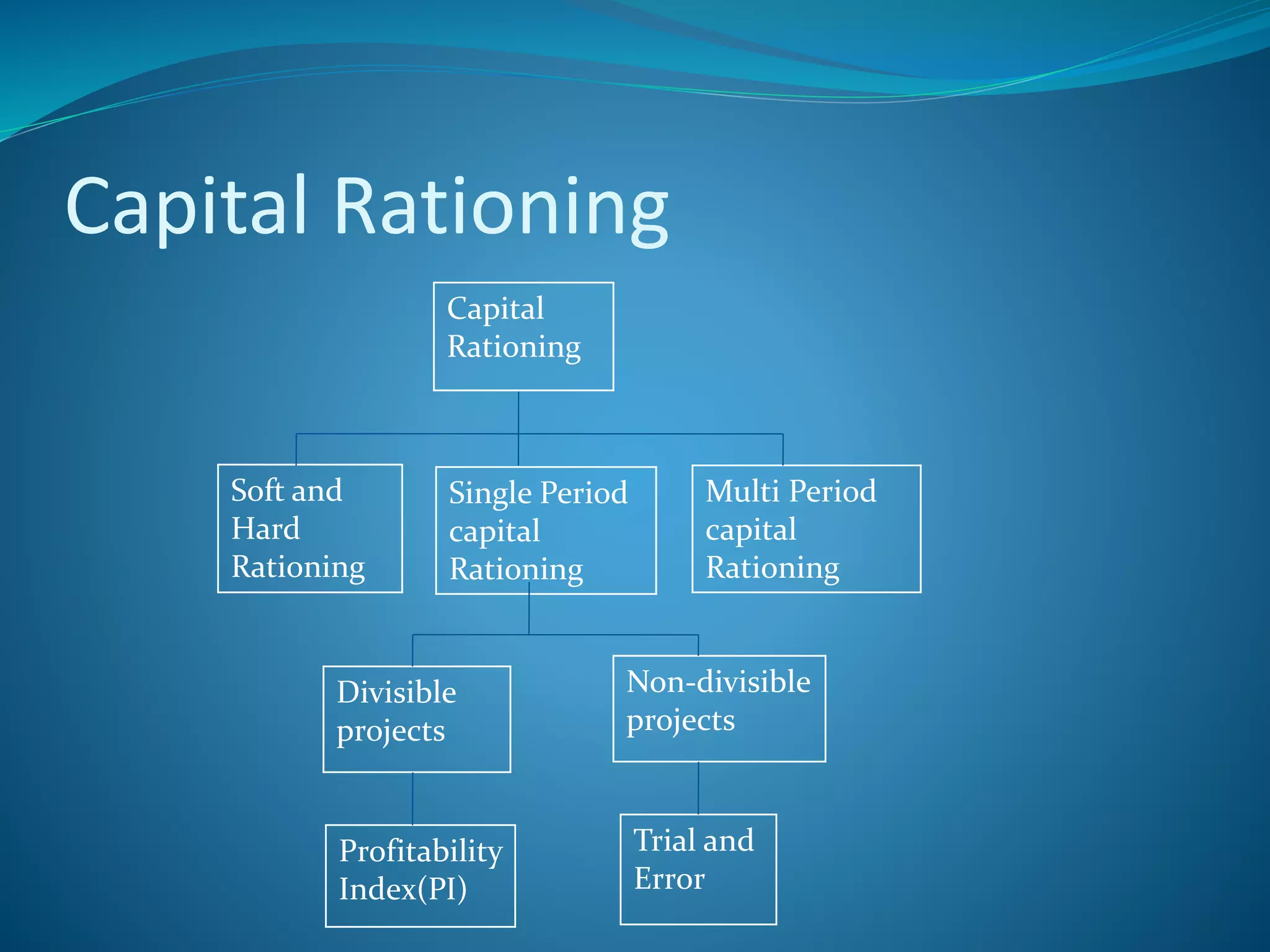
Capital Rationing
Capital
Rationing
Single Period
capital
Rationing
Soft and
Hard
Rationing
Multi Period
capital
Rationing
Divisible
projects
Non-divisible
projects
Profitability
Index(PI)
Trial and
Error
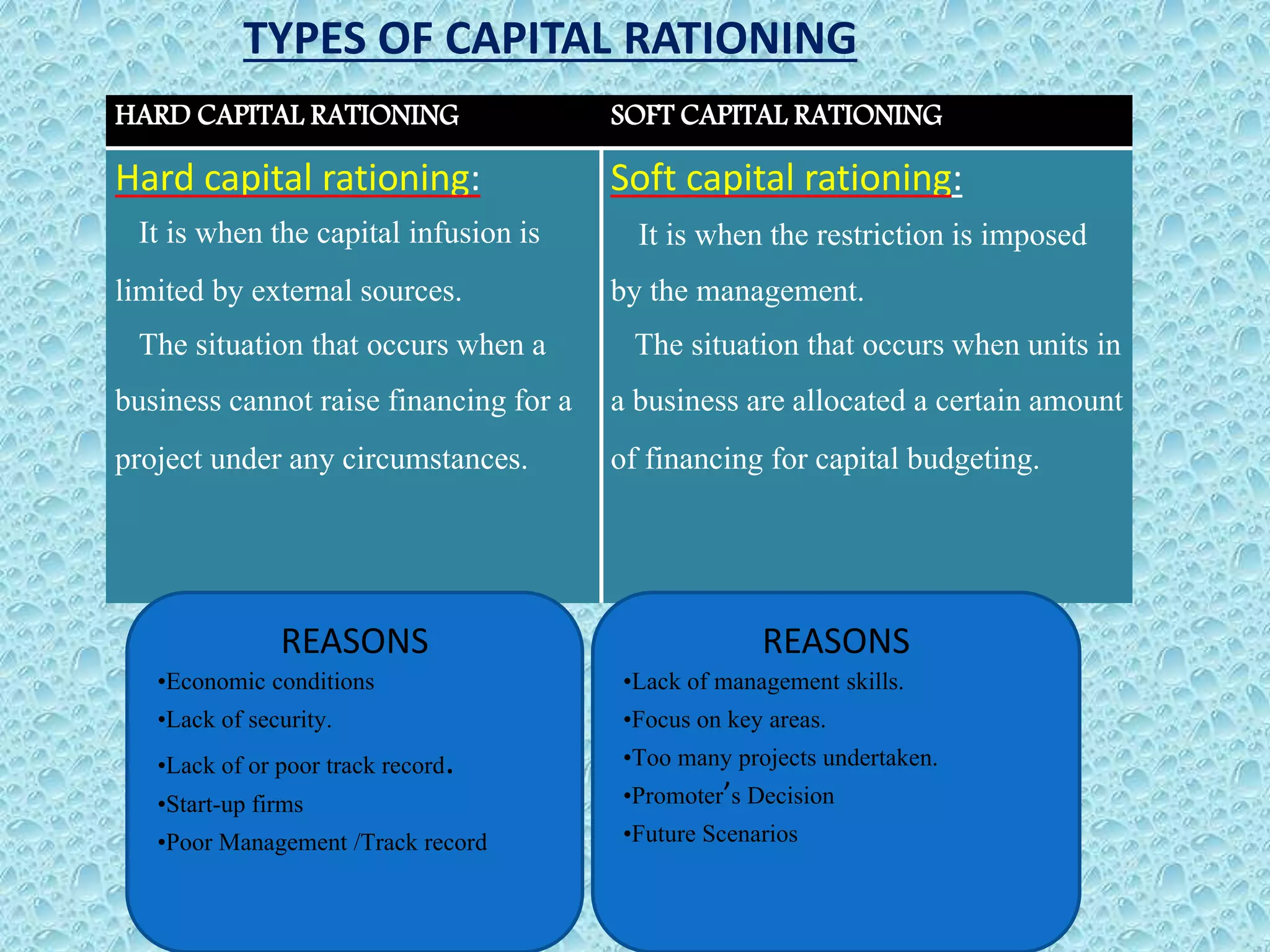
HARD CAPITAL RATIONING SOFT CAPITAL RATIONING
Hard capital rationing:
It is when the capital infusion is
limited by external sources.
The situation that occurs when a
business cannot raise financing for a
project under any circumstances.
Soft capital rationing:
It is when the restriction is imposed
by the management.
The situation that occurs when units in
a business are allocated a certain amount
of financing for capital budgeting.
REASONS
•Economic conditions
•Lack of security.
•Lack of or poor track record.
•Start-up firms
•Poor Management /Track record
REASONS
•Lack of management skills.
•Focus on key areas.
•Too many projects undertaken.
•Promoter’s Decision
•Future Scenarios
TYPES OF CAPITAL RATIONING
Single and Multi period capital
Rationing
 Capital rationing can apply to a single period, or to
multiple periods. Single-period capital rationing
occurs when there is a shortage of funds for one period
only.
 Multi-period capital rationing is where there will be a
shortage of funds in more than one period.
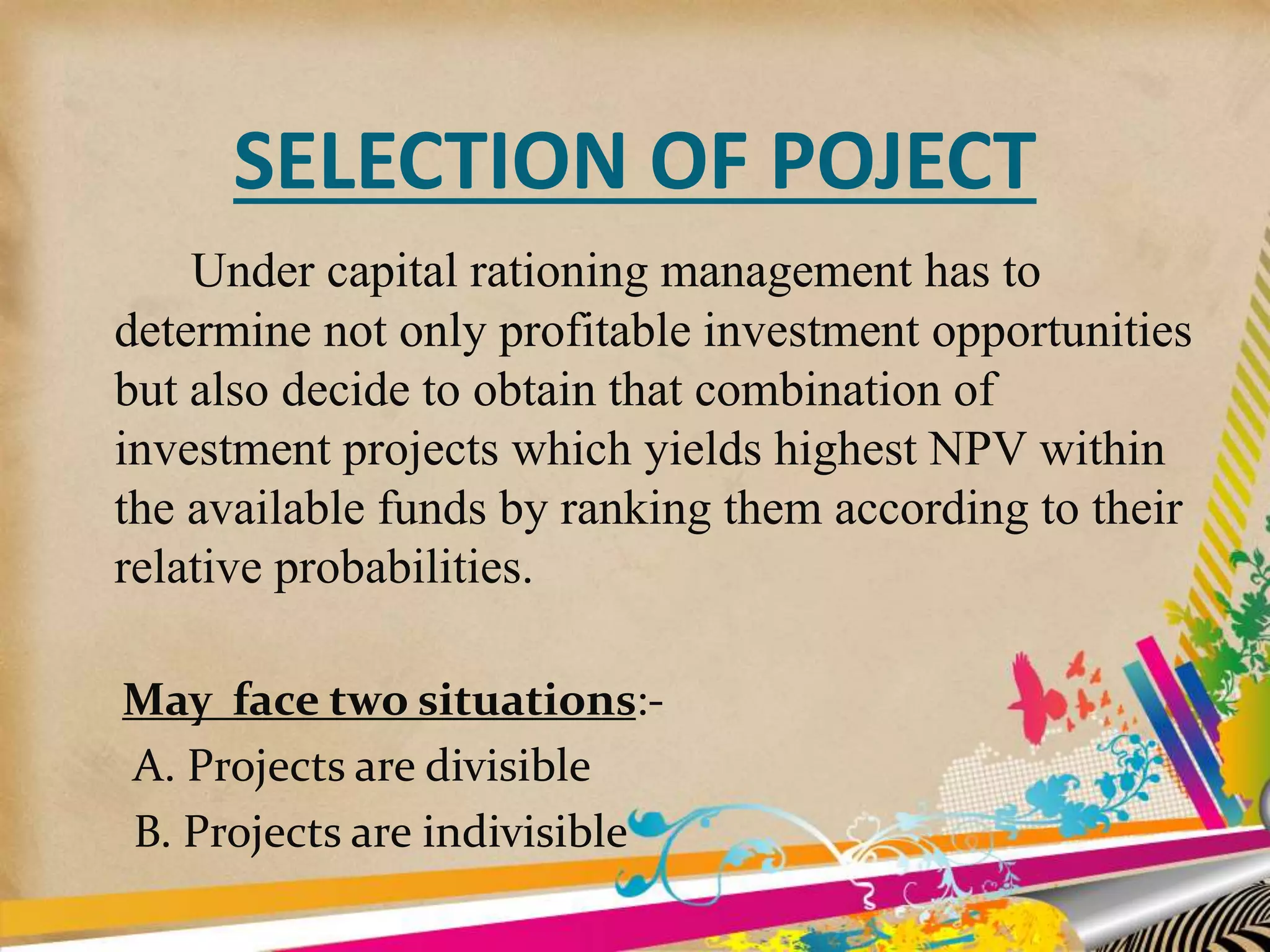
SELECTION OF POJECT
Under capital rationing management has to
determine not only profitable investment opportunities
but also decide to obtain that combination of
investment projects which yields highest NPV within
the available funds by ranking them according to their
relative probabilities.
May face two situations:-
A. Projects are divisible
B. Projects are indivisible
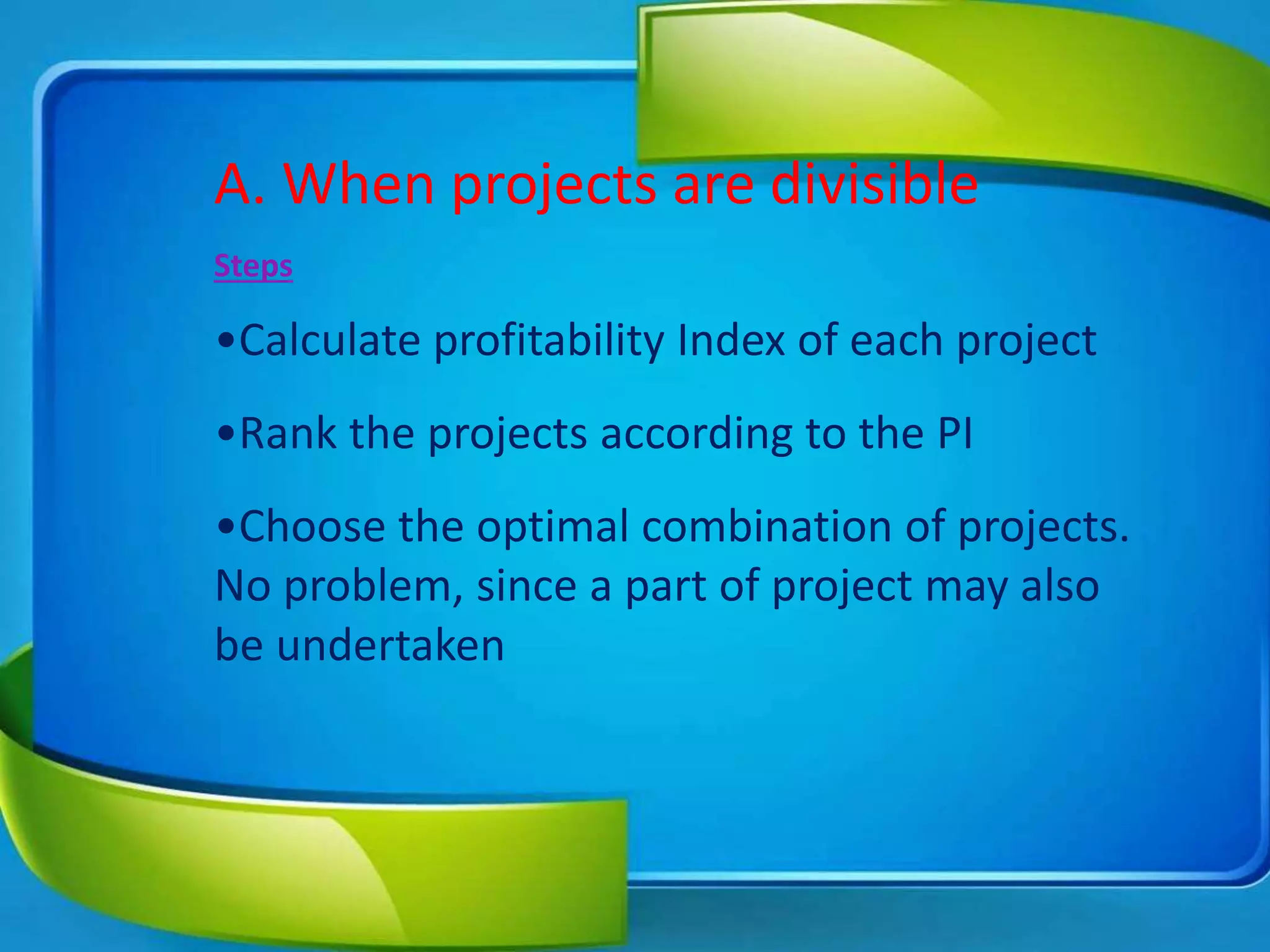
A. When projects are divisible
Steps
•Calculate profitability Index of each project
•Rank the projects according to the PI
•Choose the optimal combination of projects.
No problem, since a part of project may also
be undertaken
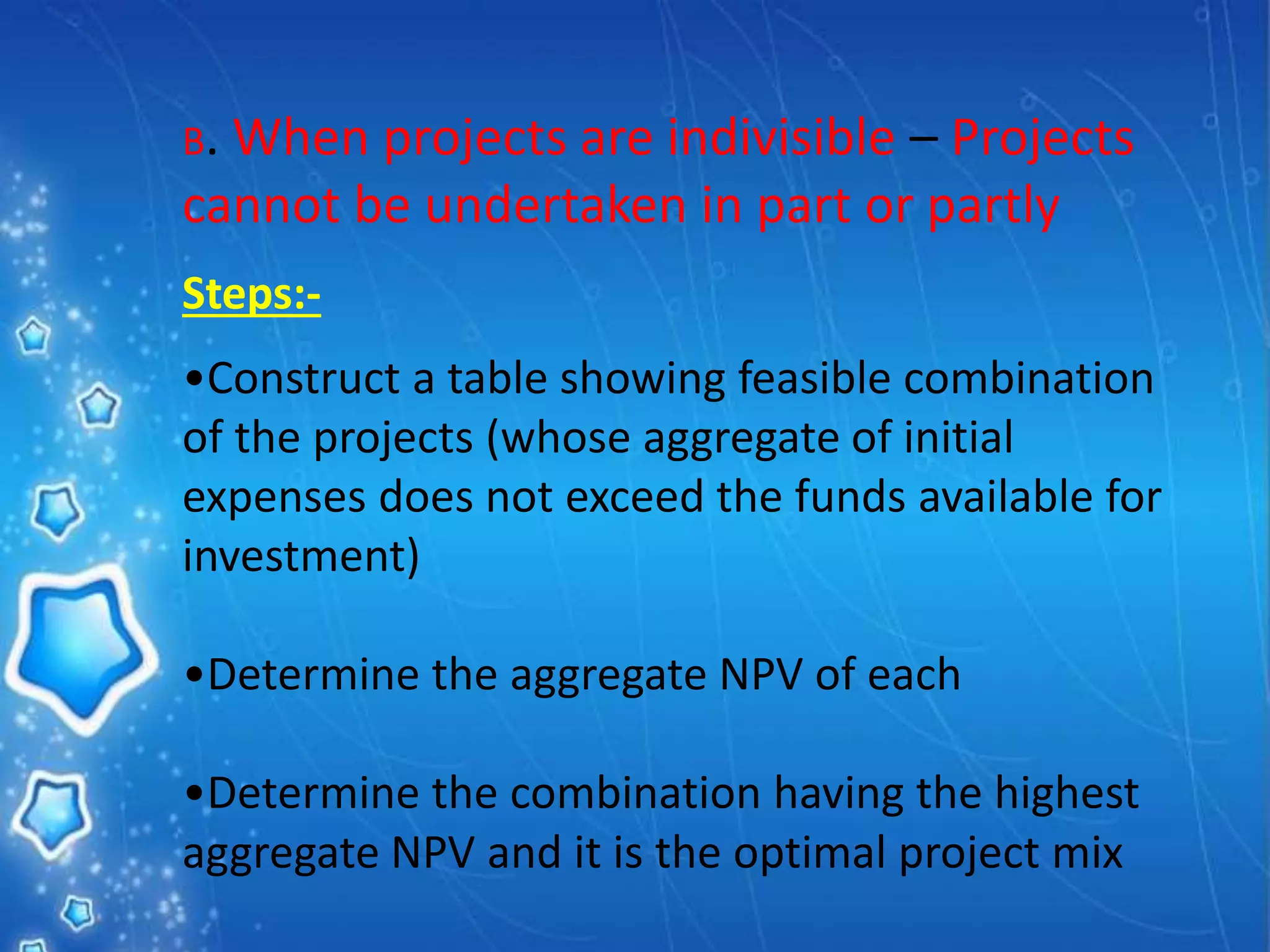
B. When projects are indivisible – Projects
cannot be undertaken in part or partly
Steps:-
•Construct a table showing feasible combination
of the projects (whose aggregate of initial
expenses does not exceed the funds available for
investment)
•Determine the aggregate NPV of each
•Determine the combination having the highest
aggregate NPV and it is the optimal project mix
Selecting the best
 It is not wrong to say that all the investment with
positive NPV should be accepted but at the same
time the ground reality prevails that the
availability of capital is limited. The calculation
and method prescribes arranging projects
descending(downward) order of their profitability
based on IRR, NPV and PI and selecting the
optimal combination.
REFERENCE
 Introduction to capital rationing (Retrieved from,
https://cleartax.in /g/terms/ )capital rationing
 Selection process and other details
(https://www.ypuarticlelibrary.com/) capital rationing
selection process
CONCLUSION
 From the above illustration, the decision regarding
choice of set of projects which best meets the corporate
financial objective in a capital rationing situation depends
upon the criterion situation depends upon the criterion
used for selection. In some cases NPV may result in the
best solution. In some others, IRR may give the best
combination of projects. While in still others, the set of
projects chosen by using PI as the criterion may help
maximize the net returns to the enterprise. Sometimes two
or even all three criterion may result in the same solution.

Capital rationing - Meaning, Types and Problems of Project Selection under capital rationing

  • 1.
    Presented by: Manasa HJ 1st M.Com Capital rationing: Meaning, types and problems of project selection under capital rationing Under the guidance of Sundar B. N. Asst. Prof. & Course Co-ordinator GFGCW, PG Studies in Commerce Holenarasipura
  • 2.
    CONTENTS CAPITAL RATIONING • Introduction •Meaning • Types • Selection of projects • Conclusion • Reference
  • 3.
    Introduction Capital rationing isdefined as the process of placing a limit on the extent of new projects or investments that a company decides to undertake. This is made possible by placing a much higher cost of capital for the consideration of the investments or by placing a ceiling on a particular proportion of a budget. A company might intend to implement capital rationing in scenarios where the past revenues generated through investments were not up to the mark.
  • 4.
    MEANING:- Rationing is theprocess of allocating scarce resources on the basis of priority based on certain criterion. It is a situation when the company cannot undertake all investment projects with positive NPV.
  • 5.
    CONSIDER THE FOLLOWINGSITUATION  No problem if the company has sufficient funds  Suppose, the firm has only Rs. 200 lakhs; the firm cannot invest in or undertake all projects which have positive NPV or IRR above the cost of capital  In this case the firm has to reject project “B”-a profitable investment project due to lack or insufficiency of capital  Further, cannot maximize the wealth  Such a situation warrants capital rationing
  • 6.
    Capital Rationing Capital Rationing Single Period capital Rationing Softand Hard Rationing Multi Period capital Rationing Divisible projects Non-divisible projects Profitability Index(PI) Trial and Error
  • 7.
    HARD CAPITAL RATIONINGSOFT CAPITAL RATIONING Hard capital rationing: It is when the capital infusion is limited by external sources. The situation that occurs when a business cannot raise financing for a project under any circumstances. Soft capital rationing: It is when the restriction is imposed by the management. The situation that occurs when units in a business are allocated a certain amount of financing for capital budgeting. REASONS •Economic conditions •Lack of security. •Lack of or poor track record. •Start-up firms •Poor Management /Track record REASONS •Lack of management skills. •Focus on key areas. •Too many projects undertaken. •Promoter’s Decision •Future Scenarios TYPES OF CAPITAL RATIONING
  • 8.
    Single and Multiperiod capital Rationing  Capital rationing can apply to a single period, or to multiple periods. Single-period capital rationing occurs when there is a shortage of funds for one period only.  Multi-period capital rationing is where there will be a shortage of funds in more than one period.
  • 9.
    SELECTION OF POJECT Undercapital rationing management has to determine not only profitable investment opportunities but also decide to obtain that combination of investment projects which yields highest NPV within the available funds by ranking them according to their relative probabilities. May face two situations:- A. Projects are divisible B. Projects are indivisible
  • 10.
    A. When projectsare divisible Steps •Calculate profitability Index of each project •Rank the projects according to the PI •Choose the optimal combination of projects. No problem, since a part of project may also be undertaken
  • 11.
    B. When projectsare indivisible – Projects cannot be undertaken in part or partly Steps:- •Construct a table showing feasible combination of the projects (whose aggregate of initial expenses does not exceed the funds available for investment) •Determine the aggregate NPV of each •Determine the combination having the highest aggregate NPV and it is the optimal project mix
  • 12.
    Selecting the best It is not wrong to say that all the investment with positive NPV should be accepted but at the same time the ground reality prevails that the availability of capital is limited. The calculation and method prescribes arranging projects descending(downward) order of their profitability based on IRR, NPV and PI and selecting the optimal combination.
  • 13.
    REFERENCE  Introduction tocapital rationing (Retrieved from, https://cleartax.in /g/terms/ )capital rationing  Selection process and other details (https://www.ypuarticlelibrary.com/) capital rationing selection process
  • 14.
    CONCLUSION  From theabove illustration, the decision regarding choice of set of projects which best meets the corporate financial objective in a capital rationing situation depends upon the criterion situation depends upon the criterion used for selection. In some cases NPV may result in the best solution. In some others, IRR may give the best combination of projects. While in still others, the set of projects chosen by using PI as the criterion may help maximize the net returns to the enterprise. Sometimes two or even all three criterion may result in the same solution.