Download to read offline
![Poonam Yadav Int. Journal of Engineering Research and Applications www.ijera.com
ISSN : 2248-9622, Vol. 5, Issue 7, ( Part - 1) July 2015, pp.12-17
www.ijera.com 12 | P a g e
Analysis and Comparison of CMOS Comparator At 90 NM
Technology
Poonam Yadav
M.Tech VLSI Design, Department of Electrical, Electronics & Communication Engg.
School of Engineering & Technology, ITM University, Gurgaon-122001 (Haryana) India
Abstract—
In this paper, A CMOS comparator with low power dissipation is presented. The preamplifier latch comparator
is compared with conventional double tail comparator. The comparators designed and simulated in 90nm
Cadence virtuoso environment technology. The particular preamplifier latch comparator will be mix of a good
amplifier and a latch comparator can easily effect higher velocity and also low electric power dissipation. The
proposed circuit topology improves kickback noise and reduces power dissipation compared with a conventional
double tail comparator.Analysis are testified and compared with conventional comparator and enhancements
are detected in this paper.
Index Terms-Pre amplifier latch comparator, Power dissipation, Kickback noise.
I. INTRODUCTION
Comparator can be widespread along the way
connected with transforming analog impulses to be
able to digital impulses. Inside A/D alteration process,
it is necessary to be able to 1st small sample the actual
insight. That tested indication can be than placed on
combining comparators to determine the digital
equivalent from the analog indication. [1].A
comparator is a circuit that compares two signal, one
input named as reference input with respect to the
other input, and produce a digital output either (+) or
(-) depending upon which input is greater[2].
Comparators have crucial influence on the overall
performance of high-speed analog-to-digital
converters [3]. Minimizing the power dissipation for
the digital circuits requires optimization at all level of
the design.
So, this optimization depends on circuit style,
topologies and in fact includes the technology which
is used to implement the digital circuits [4] .So a
topology for the comparator is developed and
compared with the existing model using the existing
model Cadence Environment (Virtuoso) at GPDK 90
nm technology for analyzing. Block representation of
the proposed design of the comparator is shown in
Fig. 1. This designed comparator consists of three
stages namely input stage, decision stage and output
stage. The input stage (The actual insight point (the
preamplifier stage) amplifies the particular insight
indication to enhance the particular comparator
sensitivity as well as segregate the particular insight in
the comparator coming from moving over noises
coming from optimistic responses point[5].
Choosing one signal may be the center from the
comparator used to figure out which in turn from the
input signs is larger. The last period may be the output
buffer amplifies the details from latch as well as
results an electronic signal. [6]
Figure1. Block diagram of preamplifier based
Comparator [17]
The preamplifier latch comparator [7], is usually
mix of the amplifier and also a latch comparator can
purchase excessive rate and minimal electrical power
dissipation.. Due to continue technology scaling,
reduce intrinsic gain with reducing the drain to source
resistance and increasing the static power dissipation
[8]. The proposed circuit topology improves
kickback noise and reduces power dissipation
compared with a conventional comparator.
II. POWER AND DELAY ANALYSIS
A. Power Dissipation :
Dynamic comparator electric power dissipation is
similar to of which connected with digital gates,
which may have an electric dissipation offered
somewhere around by means of.
p = f c (vdd) ²
RESEARCH ARTICLE OPEN ACCESS](https://image.slidesharecdn.com/c57011217-150803063319-lva1-app6892/85/Analysis-and-Comparison-of-CMOS-Comparator-At-90-NM-Technology-1-320.jpg)
![Poonam Yadav Int. Journal of Engineering Research and Applications www.ijera.com
ISSN : 2248-9622, Vol. 5, Issue 7, ( Part - 1) July 2015, pp.12-17
www.ijera.com 12 | P a g e
Analysis and Comparison of CMOS Comparator At 90 NM
Technology
Poonam Yadav
M.Tech VLSI Design, Department of Electrical, Electronics & Communication Engg.
School of Engineering & Technology, ITM University, Gurgaon-122001 (Haryana) India
Abstract—
In this paper, A CMOS comparator with low power dissipation is presented. The preamplifier latch comparator
is compared with conventional double tail comparator. The comparators designed and simulated in 90nm
Cadence virtuoso environment technology. The particular preamplifier latch comparator will be mix of a good
amplifier and a latch comparator can easily effect higher velocity and also low electric power dissipation. The
proposed circuit topology improves kickback noise and reduces power dissipation compared with a conventional
double tail comparator.Analysis are testified and compared with conventional comparator and enhancements
are detected in this paper.
Index Terms-Pre amplifier latch comparator, Power dissipation, Kickback noise.
I. INTRODUCTION
Comparator can be widespread along the way
connected with transforming analog impulses to be
able to digital impulses. Inside A/D alteration process,
it is necessary to be able to 1st small sample the actual
insight. That tested indication can be than placed on
combining comparators to determine the digital
equivalent from the analog indication. [1].A
comparator is a circuit that compares two signal, one
input named as reference input with respect to the
other input, and produce a digital output either (+) or
(-) depending upon which input is greater[2].
Comparators have crucial influence on the overall
performance of high-speed analog-to-digital
converters [3]. Minimizing the power dissipation for
the digital circuits requires optimization at all level of
the design.
So, this optimization depends on circuit style,
topologies and in fact includes the technology which
is used to implement the digital circuits [4] .So a
topology for the comparator is developed and
compared with the existing model using the existing
model Cadence Environment (Virtuoso) at GPDK 90
nm technology for analyzing. Block representation of
the proposed design of the comparator is shown in
Fig. 1. This designed comparator consists of three
stages namely input stage, decision stage and output
stage. The input stage (The actual insight point (the
preamplifier stage) amplifies the particular insight
indication to enhance the particular comparator
sensitivity as well as segregate the particular insight in
the comparator coming from moving over noises
coming from optimistic responses point[5].
Choosing one signal may be the center from the
comparator used to figure out which in turn from the
input signs is larger. The last period may be the output
buffer amplifies the details from latch as well as
results an electronic signal. [6]
Figure1. Block diagram of preamplifier based
Comparator [17]
The preamplifier latch comparator [7], is usually
mix of the amplifier and also a latch comparator can
purchase excessive rate and minimal electrical power
dissipation.. Due to continue technology scaling,
reduce intrinsic gain with reducing the drain to source
resistance and increasing the static power dissipation
[8]. The proposed circuit topology improves
kickback noise and reduces power dissipation
compared with a conventional comparator.
II. POWER AND DELAY ANALYSIS
A. Power Dissipation :
Dynamic comparator electric power dissipation is
similar to of which connected with digital gates,
which may have an electric dissipation offered
somewhere around by means of.
p = f c (vdd) ²
RESEARCH ARTICLE OPEN ACCESS](https://image.slidesharecdn.com/c57011217-150803063319-lva1-app6892/75/Analysis-and-Comparison-of-CMOS-Comparator-At-90-NM-Technology-1-2048.jpg)
![Poonam Yadav Int. Journal of Engineering Research and Applications www.ijera.com
ISSN : 2248-9622, Vol. 5, Issue 7, ( Part - 1) July 2015, pp.12-17
www.ijera.com 13 | P a g e
Where
f = output frequency [1]
c = output capacitance
Vdd = supply voltage
B. Propagation delay :
Propagation delay can be defined as at how much
speed the amplifier
responds with applied input. Simply speaking
propagation delay is the delay between output and
input.
Propagation time delay = (Rising Propagation Delay
time + Falling Propagation Delay Time) /2
[1]
III. CONVENTIONAL DOUBLE
TAIL COMPARATOR
A rail-to-rail comparator design consists of a
CMOS latch circuit and an S-R latch circuit. The
latch has been designed by transistors T1-T10 and S-
R latch by transistors T11-T18 The particular latch
level can be used to ascertain which usually with the
feedback indicators is bigger and amplifies the
variation.[18] SR latch which acts as a memory to
keep values for a clock period.
Figure 2: A high speed low power double tail latched
comparator [9]
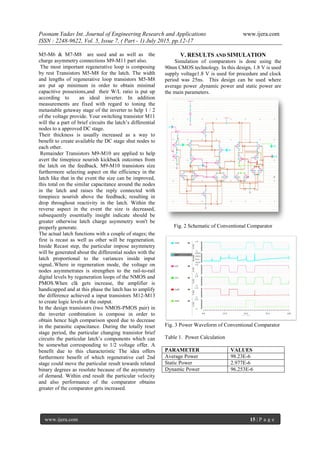
The conventional architecture of comparator shown
in Fig. 3 subsists of an S-R latch circuit and a CMOS
latch circuit .The CMOS latch circuit latch consists of
transistors T1-T10 and S-R latch is made up of
transistors T11-T18. Transistor T1 and T10 have been
employed as enlarged end of the latch circuit. The
latch stage plays the role of decide the larger input
signals larger and intensely magnify their difference
[11]. When the clock1 is small T1 and T10 gets ON
and when it is huge (reset mode) transistors T1 and
T10 gets OFF.
This method has least stacking help to perform at
small supply power as comparison [ 11,12].In this
DT comparator urn on and separate the inputs from
remaining of the circuit [13]. PMOS differential pair
(T1 and T3) creates current alteration for saturating
T6 or T9 for a lesser alteration between V in and V
ref .V ref effects the increment of voltage offset for
the S-R latch for properly working of comparator.
The transistors T6-T9 built the NMOS regeneration
circuit in which T6 and T7 are the switching NMOS
transistors touches the switching time [14,15].
Transistors T11-T18 built a SR latch play the part to
performances as a memory for retaining values for a
clock period.
IV. PROPOSED PREAMPLIFIER
LATCH COMPARATOR:
proposed This proposed preamplifier latch
comparator subsists involving about three stages: the
actual suggestions preamplifier stage, some sort of
latch stage, in addition to a good production load
stage (it is usually inherently some sort of self-biased
differential amplifier pursue by an inverter which
gives the digital output).The preamplifier stage is a
differential amplifier with active loads [16]. The
preamp stage role is amplification of the input signal
in order to get improvement in the particular
comparator tenderness by means of improving the
particular minimal input indication in which the
particular comparator could make a decision and
distinct the particular input from the comparator
coming from transferring sound (also named
kickback noise) from the constructive comments
point. [16]. It also can reduce input referred latch
offset.
The Ml as well as M2 sizes are usually fixed by
subtracting straight into thinking about the diff-amp
trans conductance along with the feedback
capacitance. Your trans conductance sets the actual
gain from the stage as well as how big Ml as well as
M2 ascertains the actual feedback capacitance from
the comparator [16]. Right here gary the gadget guy
m1 = gary the gadget guy m2. The optimistic
responses latch stage is employed to discover greater
feedback indicators and others as well as next to each
other incredibly amplifies their variation. [9].
It takes positive feedback from the cross gate
connection of M8 and M9. Consider i+ >> i- so that
M7 and M9 are ON and M8 and M10 are OFF. Here
also β 7 = β 10 =β a and β 8 = β 9 =β b for which
vo- is ~ 0V and v0+ is
(i)
When drain to source voltage value of M9 is reach
equal to the threshold voltage, if we increase i- is
and decrease i+ is V th of M8, switching occurs and.
At the point M8 takes current afar from M7 which in](https://image.slidesharecdn.com/c57011217-150803063319-lva1-app6892/85/Analysis-and-Comparison-of-CMOS-Comparator-At-90-NM-Technology-2-320.jpg)
![Poonam Yadav Int. Journal of Engineering Research and Applications www.ijera.com
ISSN : 2248-9622, Vol. 5, Issue 7, ( Part - 1) July 2015, pp.12-17
www.ijera.com 14 | P a g e
turn cause decrement in drain to source voltage of M7
and M9 gets turns off in result.
If we suppose that maximum value of v+ or v- is
equal to 2V th, then below these circumstances M8
and M9 will operate under cut-off under steady state
conditions [16]. Then voltage over M9 becomes V th
and M9 gets saturated and current of M9 is
This is the point at which switching occurs; i.e. M9
gets shuts off and in opposite M8 gets turns on. If β a
= β b,then switching occurs when the currents, i+
and i-, are equal. A identical study of increasing i+
and decreasing i- results in
The output buffer which is the final component of
the preamplifier latch comparator play the role of
changing this productivity of the latch stage in to a
total degree digital stage productivity (logic 0 as well
as reasoning 1).
This end result barrier must get a differential enter
signal and never to create slew-rate limitation.
This routine in the end result barrier is usually
inherently a new self-biased differential amplifier
pursued by a great inverter. The inverter is joined as a
isolate supplementary gain stage and remove any load
capacitance from differential amplifier [7].To
conclude, the actual preamplifier dependent
comparator tries higher velocity in addition to much
less counteract voltage although has enormous static
electrical power usage.
Fig.4.2 Schematic view of proposed comparator. [3]
The proposed preamplifier latch comparator subsists
of transistors M1,M2,M3,M4. The differential part
is made up of NMOS transistors M0 & M1, as well as
the load transistor subsists of transistors PMOS M4
and M3.
Your gain on this preamplifier very easily achieve a
suitable benefit using smaller the size of input
differential pair can be retained this type of smaller
benefit in order that the gain on this preamplifier very
easily scopes an adequate benefit
.In this comparator design the part of Latch is the
most susceptible. It this part subsists of two inverters
which are joined returning to rear collectively
compose a differential comparator and the two
differential nodes of the latch are joined by an NMOS
transistor .The latch part subsists of transistors from
M5 to M13 in which two cross coupled inverter pair](https://image.slidesharecdn.com/c57011217-150803063319-lva1-app6892/85/Analysis-and-Comparison-of-CMOS-Comparator-At-90-NM-Technology-3-320.jpg)
![Poonam Yadav Int. Journal of Engineering Research and Applications www.ijera.com
ISSN : 2248-9622, Vol. 5, Issue 7, ( Part - 1) July 2015, pp.12-17
www.ijera.com 16 | P a g e
Fig 3 Schematic of proposed comparator
Fig 4 Power waveform
Table 2. Power waveform
PARAMETER VALUES
Average Power 51.38E-6
Static Power 211.1E-6
Dynamic Power -159.72E-6
Table 3. Comparison of Power Calculation
PARAMETERS CONVENTIONAL
COMPARATOR
PROPOSED
COMPARATOR
AVERAGE
POWER
98.23E-6 51.38E-6
STATIC POWER 2.977E-6 211.1E-6
DYNAMIC POWER 96.253E-6 -159.72E-6
VI. CONCLUSION
In this work Thesis subsists of a CMOS
comparator analysis and comparison to find less
power dissipation and. Propose analysis is centered
on pre amplifier regeneration part and a latch part.
This comparator is designed for analog to digital
converters .Analysis achieved with 1.8 V input
supply. Paper attained low average power
consumption nearby 46.85E-6 compare to
conventional comparator.
REFERENCES
[1] B.Razavi,“Design of Analog CMOS Integrated
Circuits,”Tata McGraw-Hill, Delhi, 2002.
[2] Ramakant A. Gayakwad ―Op-Amps and
Linear Integrated circuits fourth edition
Pearson Education.
[3] Razavi and B. A. Wooley, “Design techniques
for high-resolution comparators,” IEEE J.
Solid-State Circuits, vol. 27, no. 6, pp. 1916-
1926, Dec. 1992.
[4] Geetanjali Sharma, Uma Nirmal, Yogesh
Misra, “ A low power8-bit magnitude
comparator with small transistor count hybrid
PTL/CMOS logic,” International Journal of
Computational Engineering & Management,
Vol 12, April2011.
[5] R. Wang, K. Li, J. Zhang and B. Nie, “A High
Speed High Resolution Latch Comparator For-
Pipeline ADC,” IEEE International Workshop
on Anti-counterfeiting, Security, Identification,
Xiamen, 16-18 April 2007, pp. 28-31.
[6] W. Rong, W. Xiaobo and Y. Xiaolang, “A
Dynamic CMOS Comparator with High
Precision and Resolution,” IEEE Proceedings
of 7th International Conference on Solid-State
and Integrated Circuits Technology, 18-21
October 2004, pp. 1567-1570.
[7] J. M. Kim, “A 6-Bit 1.3 GSample/s A/D
Converter in 0.35 μm CMOS,” Doctor Thesis,
University of Texas at Dallas, Dallas, 2005.
[8] B. Murmann et al., "Impact of scaling on
analog performance and associated modeling
needs," IEEE Trans. Electron Devices, vol. 53,
no. 9, pp. 2160-2167, Sep. 2006..
[9] Nikoozadeh and B. Murmann, “An Analysis of
Latch Comparator Offset Due to Load
Capacitor Mismatch,” IEEE Trans. Circuits
Syst. II: Exp. Briefs, vol. 53, no. 12, pp. 1398-
1402, Dec. 2006.
[10] Shubhara Yewale, Radheshyam Gamad”
Design of Low Power and High Speed CMOS
Comparator for A/D Converter
Application”Scientific Reasarch, Wireless
Engineering and Technology, 2012, 3, 90-95.
[11] Riyan Wang, Kaihang Li, Jianqin Zhang and
Bin Nie, “A High-Speed High-Resolution
Latch Comparator for Pipeline Analog-to-](https://image.slidesharecdn.com/c57011217-150803063319-lva1-app6892/85/Analysis-and-Comparison-of-CMOS-Comparator-At-90-NM-Technology-5-320.jpg)
![Poonam Yadav Int. Journal of Engineering Research and Applications www.ijera.com
ISSN : 2248-9622, Vol. 5, Issue 7, ( Part - 1) July 2015, pp.12-17
www.ijera.com 17 | P a g e
Digital Converters”, IEEE International
workshop, April 2007, pp 28 – 31.
[12] J.-T. Wu and B. A. Wooley, “A 100-MHZ
Pipelined CMOS Comparator”, IEEE Journal
Solid-State Circuits, Dec. 1988 Vol.23, No. 6,
pp 1379 – 1386.
[13] P.M. Figueiredo and J.C Vital, “Low kickback
noise techniques for CMOS latched
comparators”, International Symposium on
Circuits and Systems, May 2004, Vol.1 pp 537
– 540.
[14] H. P. Le, A. Zayegh and J. Singh, “
Performance Analysis of optimized CMOS
Comparator”, Electronics Letters, May 2003,
Vol. 39 pp 833 – 835.
[15] P. R. Gray, P. J. Hurst, S. H. Lewis and R. G.
Meyer, “Analysis and design of analog
integrated circuits”, John Wiley & Son Iuc,
USA, 2009, 5th editon.
[16] R. Jacob Baker, Harry W. Li, David E. Boyce,
“CMOS- Circuit Design, Layout, and
Simulation”, IEEE Press Series on
Microelectronic Systems, IEEE Press, Prentice
Hall of India Private Limited, Eastern
Economy Edition,2002.
[17] Rohit Mongre , R. C. Gurjar “Design of Low
Power & High Speed Comparator with 0.18µm
Technology for ADC Application” Rohit
Mongre Int. Journal of Engineering Research
and Applications ISSN : 2248-9622, Vol. 4,
Issue 8( Version 1), August 2014, pp. 146-153.
[18] Riyan Wang, Kaihang Li, Jianqin Zhang and
Bin Nie, “A High-Speed High-Resolution
Latch Comparator for Pipeline Analog-to-
Digital Converters”, IEEE International
workshop, April 2007, pp 28 – 31.](https://image.slidesharecdn.com/c57011217-150803063319-lva1-app6892/85/Analysis-and-Comparison-of-CMOS-Comparator-At-90-NM-Technology-6-320.jpg)

The document presents a CMOS comparator designed for low power dissipation using a preamplifier latch architecture. The proposed design is compared with a conventional double tail comparator, showing improvements in speed and reduced kickback noise. Simulations in a 90 nm technology environment demonstrate that the proposed comparator achieves significantly lower average power consumption compared to traditional designs.


![Lecture6[1]](https://cdn.slidesharecdn.com/ss_thumbnails/lecture61-170105102032-thumbnail.jpg?width=640&height=640&fit=bounds)


![Analysis and design_of_a_low-voltage_low-power[1]](https://cdn.slidesharecdn.com/ss_thumbnails/analysisanddesignofalow-voltagelow-power1-140802050345-phpapp02-thumbnail.jpg?width=640&height=640&fit=bounds)


