IEEE TRANSACTIONS ON VERY LARGE SCALE INTEGRATION (VLSI) SYSTEMS, VOL. 22, NO. 2, FEBRUARY 2014 343
Analysis and Design of a Low-Voltage Low-Power
Double-Tail Comparator
Samaneh Babayan-Mashhadi, Student Member, IEEE, and Reza Lotfi, Member, IEEE
Abstract—The need for ultra low-power, area efficient, and
high speed analog-to-digital converters is pushing toward the
use of dynamic regenerative comparators to maximize speed and
power efficiency. In this paper, an analysis on the delay of the
dynamic comparators will be presented and analytical expres-
sions are derived. From the analytical expressions, designers can
obtain an intuition about the main contributors to the comparator
delay and fully explore the tradeoffs in dynamic comparator
design. Based on the presented analysis, a new dynamic com-
parator is proposed, where the circuit of a conventional double-
tail comparator is modified for low-power and fast operation
even in small supply voltages. Without complicating the design
and by adding few transistors, the positive feedback during
the regeneration is strengthened, which results in remarkably
reduced delay time. Post-layout simulation results in a 0.18-µm
CMOS technology confirm the analysis results. It is shown that in
the proposed dynamic comparator both the power consumption
and delay time are significantly reduced. The maximum clock
frequency of the proposed comparator can be increased to 2.5
and 1.1 GHz at supply voltages of 1.2 and 0.6 V, while consuming
1.4 mW and 153 µW, respectively. The standard deviation of the
input-referred offset is 7.8 mV at 1.2 V supply.
Index Terms—Double-tail comparator, dynamic clocked
comparator, high-speed analog-to-digital converters (ADCs),
low-power analog design.
I. INTRODUCTION
COMPARATOR is one of the fundamental building blocks
in most analog-to-digital converters (ADCs). Many high-
speed ADCs, such as flash ADCs, require high-speed, low-
power comparators with small chip area. High-speed compara-
tors in ultra deep submicrometer (UDSM) CMOS technologies
suffer from low supply voltages especially when considering
the fact that threshold voltages of the devices have not
been scaled at the same pace as the supply voltages of the
modern CMOS processes [1]. Hence, designing high-speed
comparators is more challenging when the supply voltage is
smaller. In other words, in a given technology, to achieve
high speed, larger transistors are required to compensate the
reduction of supply voltage, which also means that more
die area and power is needed. Besides, low-voltage opera-
tion results in limited common-mode input range, which is
important in many high-speed ADC architectures, such as flash
Manuscript received September 4, 2012; revised December 7, 2012;
accepted January 15, 2013. Date of publication February 11, 2013; date of
current version January 17, 2014.
The authors are with the Electrical Engineering Group of Engineering
Department, Ferdowsi University of Mashhad, Mashhad 91775-111, Iran
(e-mail: babayan@ieee.org; rlotfi@ieee.org).
Color versions of one or more of the figures in this paper are available
online at http://ieeexplore.ieee.org.
Digital Object Identifier 10.1109/TVLSI.2013.2241799
ADCs. Many techniques, such as supply boosting methods [2],
[3], techniques employing body-driven transistors [4], [5],
current-mode design [6] and those using dual-oxide processes,
which can handle higher supply voltages have been developed
to meet the low-voltage design challenges. Boosting and
bootstrapping are two techniques based on augmenting the
supply, reference, or clock voltage to address input-range
and switching problems. These are effective techniques, but
they introduce reliability issues especially in UDSM CMOS
technologies. Body-driven technique adopted by Blalock [4],
removes the threshold voltage requirement such that body-
driven MOSFET operates as a depletion-type device. Based
on this approach, in [5], a 1-bit quantizer for sub-1V
modulators is proposed. Despite the advantages, the body-
driven transistor suffers from smaller transconductance (equal
to gmb of the transistor) compared to its gate-driven counter-
part while special fabrication process, such as deep n-well is
required to have both nMOS and pMOS transistors operate
in the body-driven configuration. Apart from technological
modifications, developing new circuit structures which avoid
stacking too many transistors between the supply rails is
preferable for low-voltage operation, especially if they do not
increase the circuit complexity. In [7]–[9], additional circuitry
is added to the conventional dynamic comparator to enhance
the comparator speed in low supply voltages. The proposed
comparator of [7] works down to a supply voltage of 0.5 V
with a maximum clock frequency of 600 MHz and consumes
18 μW. Despite the effectiveness of this approach, the effect
of component mismatch in the additional circuitry on the
performance of the comparator should be considered. The
structure of double-tail dynamic comparator first proposed
in [10] is based on designing a separate input and cross-
coupled stage. This separation enables fast operation over a
wide common-mode and supply voltage range [10].
In this paper, a comprehensive analysis about the delay of
dynamic comparators has been presented for various architec-
tures. Furthermore, based on the double-tail structure proposed
in [10], a new dynamic comparator is presented, which does
not require boosted voltage or stacking of too many transistors.
Merely by adding a few minimum-size transistors to the
conventional double-tail dynamic comparator, latch delay time
is profoundly reduced. This modification also results in con-
siderable power savings when compared to the conventional
dynamic comparator and double-tail comparator.
The rest of this paper is organized as follows. Section II
investigates the operation of the conventional clocked
regenerative comparators and the pros and cons of each
1063-8210 © 2013 IEEE. Personal use is permitted, but republication/redistribution requires IEEE permission.
See http://www.ieee.org/publications_standards/publications/rights/index.html for more information.
344 IEEE TRANSACTIONS ON VERY LARGE SCALE INTEGRATION (VLSI) SYSTEMS, VOL. 22, NO. 2, FEBRUARY 2014
Fig. 1. Schematic diagram of the conventional dynamic comparator.
structure is discussed. Delay analysis is also presented and
the analytical expressions for the delay of the comparators are
derived. The proposed comparator is presented in Section III.
Section IV discusses the design issues. Simulation results are
addressed in Section V, followed by conclusions in Section VI.
II. CLOCKED REGENERATIVE COMPARATORS
Clocked regenerative comparators have found wide appli-
cations in many high-speed ADCs since they can make
fast decisions due to the strong positive feedback in the
regenerative latch. Recently, many comprehensive analyses
have been presented, which investigate the performance of
these comparators from different aspects, such as noise [11],
offset [12], [13], and [14], random decision errors [15], and
kick-back noise [16]. In this section, a comprehensive delay
analysis is presented; the delay time of two common struc-
tures, i.e., conventional dynamic comparator and conventional
dynamic double-tail comparator are analyzed, based on which
the proposed comparator will be presented.
A. Conventional Dynamic Comparator
The schematic diagram of the conventional dynamic com-
parator widely used in A/D converters, with high input
impedance, rail-to-rail output swing, and no static power
consumption is shown in Fig. 1 [1], [17]. The operation of
the comparator is as follows. During the reset phase when
CLK = 0 and Mtail is off, reset transistors (M7–M8) pull
both output nodes Outn and Outp to VDD to define a start
condition and to have a valid logical level during reset. In the
comparison phase, when CLK = VDD, transistors M7 and M8
are off, and Mtail is on. Output voltages (Outp, Outn), which
had been pre-charged to VDD, start to discharge with different
discharging rates depending on the corresponding input volt-
age (INN/INP). Assuming the case where VINP > VINN, Outp
discharges faster than Outn, hence when Outp (discharged
by transistor M2 drain current), falls down to VDD–|Vthp|
before Outn (discharged by transistor M1 drain current), the
corresponding pMOS transistor (M5) will turn on initiating the
latch regeneration caused by back-to-back inverters (M3, M5
Fig. 2. Transient simulations of the conventional dynamic comparator for
input voltage difference of Vin = 5 mV, Vcm = 0.7 V, and VDD = 0.8 V.
and M4, M6). Thus, Outn pulls to VDD and Outp discharges
to ground. If VINP < VINN, the circuits works vice versa.
As shown in Fig. 2, the delay of this comparator is com-
prised of two time delays, t0 and tlatch. The delay t0 represents
the capacitive discharge of the load capacitance CL until
the first p-channel transistor (M5/M6) turns on. In case, the
voltage at node INP is bigger than INN (i.e., VINP > VINN),
the drain current of transistor M2 (I2) causes faster discharge
of Outp node compared to the Outn node, which is driven by
M1 with smaller current. Consequently, the discharge delay
(t0) is given by
t0 =
CL Vthp
I2
∼= 2
CL Vthp
Itail
. (1)
In (1), since I2 = Itail/2 + Iin = Itail/2 + gm1,2 Vin, for
small differential input ( Vin), I2 can be approximated to be
constant and equal to the half of the tail current.
The second term, tlatch, is the latching delay of two cross-
coupled inverters. It is assumed that a voltage swing of
Vout = VDD/2 has to be obtained from an initial output
voltage difference V0 at the falling output (e.g., Outp). Half
of the supply voltage is considered to be the threshold voltage
of the comparator following inverter or SR latch [17]. Hence,
the latch delay time is given by, [18]
tlatch =
CL
gm,eff
· ln
Vout
V0
=
CL
gm,eff
· ln
VDD/2
V0
(2)
where gm,eff is the effective transconductance of the back-to-
back inverters. In fact, this delay depends, in a logarithmic
manner, on the initial output voltage difference at the begin-
ning of the regeneration (i.e., at t = t0). Based on (1), V0
can be calculated from (3)
V0 = Voutp(t = t0) − Voutn(t = t0)
= Vthp −
I2t0
CL
= Vthp 1 −
I2
I1
. (3)
The current difference, Iin = |I1 − I2|, between the
branches is much smaller than I1 and I2. Thus, I1 can be
BABAYAN-MASHHADI AND LOTFI: ANALYSIS AND DESIGN OF A LOW-VOLTAGE LOW-POWER DOUBLE-TAIL COMPARATOR 345
approximated by Itail/2 and (3) can be rewritten as
V0 = Vthp
Iin
I1
≈ 2 Vthp
Iin
Itail
= 2 Vthp
β1,2Itail
Itail
Vin
= 2 Vthp
β1,2
Itail
Vin. (4)
In this equation, β1,2 is the input transistors’ current factor
and Itail is a function of input common-mode voltage (Vcm)
and VDD. Now, substituting V0 in latch delay expression and
considering t0, the expression for the delay of the conventional
dynamic comparator is obtained as
tdelay = t0+tlatch
= 2
CL Vthp
Itail
+
CL
gm,eff
· ln
VDD
4 Vthp Vin
Itail
β1,2
. (5)
Equation (5) explains the impact of various parameters. The
total delay is directly proportional to the comparator load
capacitance CL and inversely proportional to the input dif-
ference voltage ( Vin). Besides, the delay depends indirectly
to the input common-mode voltage (Vcm). By reducing Vcm,
the delay t0 of the first sensing phase increases because lower
Vcm causes smaller bias current (Itail). On the other hand, (4)
shows that a delayed discharge with smaller Itail results in
an increased initial voltage difference ( V0), reducing tlatch.
Simulation results show that the effect of reducing the Vcm on
increasing of t0 and reducing of tlatch will finally lead to an
increase in the total delay. In [17], it has been shown that an
input common-mode voltage of 70% of the supply voltage is
optimal regarding speed and yield.
In principle, this structure has the advantages of high input
impedance, rail-to-rail output swing, no static power consump-
tion, and good robustness against noise and mismatch [1]. Due
to the fact that parasitic capacitances of input transistors do
not directly affect the switching speed of the output nodes,
it is possible to design large input transistors to minimize the
offset. The disadvantage, on the other hand, is the fact that due
to several stacked transistors, a sufficiently high supply voltage
is needed for a proper delay time. The reason is that, at the
beginning of the decision, only transistors M3 and M4 of the
latch contribute to the positive feedback until the voltage level
of one output node has dropped below a level small enough to
turn on transistors M5 or M6 to start complete regeneration. At
a low supply voltage, this voltage drop only contributes a small
gate-source voltage for transistors M3 and M4, where the gate-
source voltage of M5 and M6 is also small; thus, the delay time
of the latch becomes large due to lower transconductances.
Another important drawback of this structure is that there is
only one current path, via tail transistor Mtail, which defines
the current for both the differential amplifier and the latch
(the cross-coupled inverters). While one would like a small
tail current to keep the differential pair in weak inversion and
obtain a long integration interval and a better Gm/I ratio, a
Fig. 3. Schematic diagram of the conventional double-tail dynamic com-
parator.
large tail current would be desirable to enable fast regeneration
in the latch [10]. Besides, as far as Mtail operates mostly in
triode region, the tail current depends on input common-mode
voltage, which is not favorable for regeneration.
B. Conventional Double-Tail Dynamic Comparator
A conventional double-tail comparator is shown in
Fig. 3 [10]. This topology has less stacking and therefore can
operate at lower supply voltages compared to the conventional
dynamic comparator. The double tail enables both a large
current in the latching stage and wider Mtail2, for fast latching
independent of the input common-mode voltage (Vcm), and
a small current in the input stage (small Mtail1), for low
offset [10].
The operation of this comparator is as follows (see Fig. 4).
During reset phase (CLK = 0, Mtail1, and Mtail2 are off),
transistors M3-M4 pre-charge fn and fp nodes to VDD, which
in turn causes transistors MR1 and MR2 to discharge the output
nodes to ground. During decision-making phase (CLK =
VDD, Mtail1 and Mtail2 turn on), M3-M4 turn off and volt-
ages at nodes fn and fp start to drop with the rate defined
by IMtail1/Cfn(p) and on top of this, an input-dependent
differential voltage Vfn(p) will build up. The intermediate
stage formed by MR1 and MR2 passes Vfn(p) to the cross-
coupled inverters and also provides a good shielding between
input and output, resulting in reduced value of kickback
noise [10].
Similar to the conventional dynamic comparator, the delay
of this comparator comprises two main parts, t0 and tlatch.
The delay t0 represents the capacitive charging of the load
capacitance CLout (at the latch stage output nodes, Outn and
Outp) until the first n-channel transistor (M9/M10) turns on,
after which the latch regeneration starts; thus t0 is obtained
346 IEEE TRANSACTIONS ON VERY LARGE SCALE INTEGRATION (VLSI) SYSTEMS, VOL. 22, NO. 2, FEBRUARY 2014
Fig. 4. Transient simulations of the conventional double-tail dynamic
comparator for input voltage difference of Vin = 5 mV, Vcm = 0.7 V,
and VDD = 0.8 V.
from
t0 =
VThnCLout
IB1
≈ 2
VThnCLout
Itail2
(6)
where IB1 is the drain current of the M9 (assuming VINP >
VINN, see Fig. 3) and is approximately equal to the half of the
tail current (Itail2).
After the first n-channel transistor of the latch turns on (for
instance, M9), the corresponding output (e.g., Outn) will be
discharged to the ground, leading front p-channel transistor
(e.g., M8) to turn on, charging another output (Outp) to the
supply voltage (VDD). The regeneration time (tlatch) is achieved
according to (2). For the initial output voltage difference at
time t0, V0 we have
V0 = Voutp(t = t0) − Voutn(t = t0) = VThn −
IB2t0
CLout
= VThn 1 −
IB2
IB1
(7)
where IB1 and IB2 are the currents of the latch left- and right-
side branches of the second stage, respectively.
Considering Ilatch = |IB1 − IB2| = gmR1,2 Vfn/fp, (7) can
be rewritten as
V0 = VThn
Ilatch
IB1
≈ 2VThn
Ilatch
Itail2
= 2VThn
gmR1,2
Itail2
Vfn/fp
(8)
where gmR1,2 is the transconductance of the intermediate
stage transistors (MR1 and MR2) and Vfn/fp is the voltage
difference at the first stage outputs (fn and fp) at time
t0. Thus, it can be concluded that two main parameters
which influence the initial output differential voltage ( V0)
and thereby the latch regeneration time are the transcon-
ductance of the intermediate stage transistors (gmR1,2) and
the voltage difference at the first stage outputs (fn and fp)
at time t0. In fact, intermediate stage transistors amplify
the voltage difference of Vfn/fp causing the latch to be
imbalanced.
The differential voltage at nodes fn/fp ( Vfn/fp) at time t0
can be achieved from
Vfn/fp = Vfn(t = t0) − Vfp(t = t0)
= t0 ·
IN1 − IN2
CL,fn(p)
= t0 ·
gm1,2 Vin
CL,fn(p)
. (9)
In this equation, IN1 and IN2 refer to the discharging
currents of input transistors (M1 and M2), which are dependent
on the input differential voltage (i.e., IN = gm1,2 Vin).
Substituting (9) in (8), V0 will be
V0 = 2VThn
gmR1,2
Itail2
Vfn/fp
=
2VThn
Itail2
2
·
CLout
CL,fn(p)
· gmR1,2gm1,2 Vin. (10)
This equation shows that V0 depends strongly on the
transconductance of input and intermediate stage transistors,
input voltage difference ( Vin), latch tail current, and the
capacitive ratio of CLout to CL,fn(p). Substituting V0 in latch
regeneration time (2), the total delay of this comparator is
achieved as follows:
tdelay = t0 + tlatch = 2
VThnCLout
Itail2
+
CLout
gm,eff
· ln
VDD/2
V0
= 2
VThnCLout
Itail2
+
CLout
gm,eff
· ln
VDD · I2
tail2 · CL,fn(p)
8V2
Thn · CLoutgmR1,2gm1,2 Vin
. (11)
From the equations derived for the delay of the double-tail
dynamic comparator, some important notes can be concluded.
1) The voltage difference at the first stage outputs ( Vfn/fp)
at time t0 has a profound effect on latch initial differen-
tial output voltage ( V0) and consequently on the latch
delay. Therefore, increasing it would profoundly reduce
the delay of the comparator.
2) In this comparator, both intermediate stage transistors
will be finally cut-off, (since fn and fp nodes both
discharge to the ground), hence they do not play any
role in improving the effective transconductance of the
latch. Besides, during reset phase, these nodes have to
be charged from ground to VDD, which means power
consumption. The following section describes how the
proposed comparator improves the performance of the
double-tail comparator from the above points of view.
III. PROPOSED DOUBLE-TAIL DYNAMIC COMPARATOR
Fig. 5 demonstrates the schematic diagram of the proposed
dynamic double-tail comparator. Due to the better performance
of double-tail architecture in low-voltage applications, the
proposed comparator is designed based on the double-tail
structure. The main idea of the proposed comparator is to
increase Vfn/fp in order to increase the latch regeneration
speed. For this purpose, two control transistors (Mc1 and
Mc2) have been added to the first stage in parallel to M3/M4
transistors but in a cross-coupled manner [see Fig. 5(a)].
BABAYAN-MASHHADI AND LOTFI: ANALYSIS AND DESIGN OF A LOW-VOLTAGE LOW-POWER DOUBLE-TAIL COMPARATOR 347
(b)(a)
Fig. 5. Schematic diagram of the proposed dynamic comparator. (a) Main idea. (b) Final structure.
A. Operation of the Proposed Comparator
The operation of the proposed comparator is as follows (see
Fig. 6). During reset phase (CLK = 0, Mtail1 and Mtail2 are off,
avoiding static power), M3 and M4 pulls both fn and fp nodes
to VDD, hence transistor Mc1 and Mc2 are cut off. Intermediate
stage transistors, MR1 and MR2, reset both latch outputs to
ground.
During decision-making phase (CLK = VDD, Mtail1, and
Mtail2 are on), transistors M3 and M4 turn off. Furthermore, at
the beginning of this phase, the control transistors are still off
(since fn and fp are about VDD). Thus, fn and fp start to drop
with different rates according to the input voltages. Suppose
VINP > VINN, thus fn drops faster than fp, (since M2 provides
more current than M1). As long as fn continues falling, the
corresponding pMOS control transistor (Mc1 in this case) starts
to turn on, pulling fp node back to the VDD; so another control
transistor (Mc2) remains off, allowing fn to be discharged
completely. In other words, unlike conventional double-tail
dynamic comparator, in which Vfn/fp is just a function of
input transistor transconductance and input voltage difference
(9), in the proposed structure as soon as the comparator detects
that for instance node fn discharges faster, a pMOS transistor
(Mc1) turns on, pulling the other node fp back to the VDD.
Therefore by the time passing, the difference between fn and
fp ( Vfn/fp) increases in an exponential manner, leading to
the reduction of latch regeneration time (this will be shown in
Section III-B). Despite the effectiveness of the proposed idea,
one of the points which should be considered is that in this
circuit, when one of the control transistors (e.g., Mc1) turns on,
a current from VDD is drawn to the ground via input and tail
transistor (e.g., Mc1, M1, and Mtail1), resulting in static power
consumption. To overcome this issue, two nMOS switches are
used below the input transistors [Msw1 and Msw2, as shown in
Fig. 5(b)].
At the beginning of the decision making phase, due to the
fact that both fn and fp nodes have been pre-charged to VDD
Fig. 6. Transient simulations of the proposed double-tail dynamic comparator
for input voltage difference of Vin = 5 mV, Vcm = 0.7 V, and VDD = 0.8 V.
(during the reset phase), both switches are closed and fn and
fp start to drop with different discharging rates. As soon as the
comparator detects that one of the fn/fp nodes is discharging
faster, control transistors will act in a way to increase their
voltage difference. Suppose that fp is pulling up to the VDD
and fn should be discharged completely, hence the switch in
the charging path of fp will be opened (in order to prevent any
current drawn from VDD) but the other switch connected to fn
will be closed to allow the complete discharge of fn node. In
other words, the operation of the control transistors with the
switches emulates the operation of the latch. This will be more
discussed in the following section.
B. Delay Analysis
In order to theoretically demonstrate how the delay is
reduced, delay equations are derived for this structure as
348 IEEE TRANSACTIONS ON VERY LARGE SCALE INTEGRATION (VLSI) SYSTEMS, VOL. 22, NO. 2, FEBRUARY 2014
previously done for the conventional dynamic comparator and
the conventional double-tail dynamic comparator. The analysis
is similar to the conventional double-tail dynamic comparator,
however; the proposed dynamic comparator enhances the
speed of the double-tail comparator by affecting two important
factors: first, it increases the initial output voltage difference
( V0) at the beginning of the regeneration (t = t0); and
second, it enhances the effective transconductace (gmeff) of
the latch. Each of these factors will be discussed in detail.
1) Effect of Enhancing V0: As discussed before, we define
t0, as a time after which latch regeneration starts. In other
words, t0 is considered to be the time it takes (while both latch
outputs are rising with different rates) until the first nMOS
transistor of the back-to-back inverters turns on, so that it will
pull down one of the outputs and regeneration will commence.
According to (2), the latch output voltage difference at time
t0, ( V0) has a considerable impact on the latch regeneration
time, such that bigger V0 results in less regeneration time.
Similar to the equation derived for the V0 of the double-tail
structure, in this comparator we have
V0 = VThn
Ilatch
IB1
≈ 2VThn
Ilatch
Itail2
= 2VThn
gmR1,2
Itail2
Vfn/fp. (12)
In order to find Vfn/fp at t = t0, we shall notice that the
combination of the control transistors (Mc1 and Mc2) with two
serial switches (Msw1, Msw2) emulates the operation of a back-
to-back inverter pair; thus using small-signal model presented
in [18], Vfn/fp is calculated by
Vfn/fp = Vfn(p)0 exp((Av − 1)t/τ). (13)
In this equation, τ
Av−1
∼=
CL,fn(p)
Gm,eff1
and Vfn(p)0 is the initial
fn/fp node difference voltage at the time when the correspond-
ing pMOS control transistor is started to be turned on. Hence,
it can be shown that Vfn(p)0 is obtained from
Vfn(p)0 = 2 VThp
gm1,2 Vin
Itail1
. (14)
Substituting (13) in (12), V0 will be
V0 = 2VThn
gmR1,2
Itail2
Vfn/fp
= 4VThn VThp
gmR1,2
Itail2
gm1,2 Vin
Itail1
exp
Gm,eff1 · t0
CL,fn(p)
.
(15)
Comparing (15) with (10), it is evident that V0 has been
increased remarkably (in an exponential manner) in compare
with the conventional dynamic comparator.
2) Effect of Enhancing Latch Effective Transconductance:
As mentioned before, in conventional double-tail comparator,
both fn and fp nodes will be finally discharged completely.
In our proposed comparator, however, the fact that one of the
first stage output nodes (fn/fp) will charge up back to the
VDD at the beginning of the decision making phase, will turn
on one of the intermediate stage transistors, thus the effective
transconductance of the latch is increased. In other words,
positive feedback is strengthened. Hence, tlatch will be
tlatch =
CLout
gm,eff + gmR1,2
· ln
Vout
V0
=
CLout
gm,eff + gmR1,2
· ln
VDD/2
V0
. (16)
Finally, by including both effects, the total delay of the
proposed comparator is achieved from
tdelay = t0 + tlatch
= 2
VThnCLout
Itail2
+
CLout
gm,eff + gmr1,2
· ln
VDD/2
V0
= 2
VThnCLout
Itail2
+
CLout
gm,eff + gmR1,2
× ln
⎛
⎝ VDD/2
4VThn VThp
gmR1,2
Itail2
gm1,2 Vin
Itail1
exp
Gm,eff1·t0
CL,fn(p)
⎞
⎠.
(17)
By comparing the expressions derived for the delay of the
three mentioned structures, it can be seen that the proposed
comparator takes advantage of an inner positive feedback
in double-tail operation, which strengthen the whole latch
regeneration. This speed improvement is even more obvious
in lower supply voltages. This is due to the fact that for larger
values of VTh/VDD, the transconductance of the transistors
decreases, thus the existence of an inner positive feedback
in the architecture of the first stage will lead to the improved
performance of the comparator. Simulation results confirm this
matter.
3) Reducing the Energy Per Comparison: It is not only the
delay parameter which is improved in the modified proposed
comparator, but the energy per conversion is reduced as well.
As discussed earlier, in conventional double-tail topology, both
fn and fp nodes discharge to the ground during the decision
making phase and each time during the reset phase they should
be pulled up back to the VDD. However, in our proposed
comparator, only one of the mentioned nodes (fn/fp) has to
be charged during the reset phase. This is due to the fact that
during the previous decision making phase, based on the status
of control transistors, one of the nodes had not been discharged
and thus less power is required. This can be seen when being
compared with conventional topologies [see Figs. 9(b) and
10(b)].
IV. DESIGN CONSIDERATIONS
In designing the proposed comparator, some design issues
must be considered. When determining the size of tail transis-
tors (Mtail1 and Mtail2), it is necessary to ensure that the time
it takes that one of the control transistors turns on must be
smaller than t0 (start of regeneration)
ton,Mc1(2) < t0 →
VThp · CL,fn(p)
In1,2
<
VThnCLout
IB1
→
VThp · CL,fn(p)
ITail1
2
<
VThn · CLout
ITail2
2
. (18)
BABAYAN-MASHHADI AND LOTFI: ANALYSIS AND DESIGN OF A LOW-VOLTAGE LOW-POWER DOUBLE-TAIL COMPARATOR 349
This condition can be easily achieved by properly designing
the first and second stage tail currents. Even if possible in the
fabrication technology, low-threshold pMOS devices can be
used as control transistors leading to faster turn on.
In designing the nMOS switches, located below the input
transistors, the drain-source voltage of these switches must
be considered since it might limit the voltage headroom,
restricting the advantage of being used in low-voltage applica-
tions. In order to diminish this effect, low-on-resistance nMOS
switches are required. In other words, large transistors must
be used. Since the parasitic capacitances of these switches do
not affect the parasitic capacitances of the fn/fp nodes (delay
bottlenecks), it is possible to optimally select the size of the
nMOS switch transistors in a way that both low-voltage and
low-power operations are maintained.
The effect of mismatch between controlling transistors on
the total input-referred offset of the comparator is another
important issue. When determining the size of controlling
transistors (MC1 − MC2), two important issues should be
considered. First, the effect of threshold voltage mismatch
and current factor mismatch of the controlling transistors
on the comparator input-referred offset voltage. Second, the
effect of transistor sizing on parasitic capacitances of the
fn/fp nodes, i.e., CL,fn(p), and consequently the delay of the
comparator. While larger transistors are required for better
matching; however, the increased parasitic capacitances are
delay bottlenecks. In order to study the effect of threshold
and current factor mismatch of control transistors on the
total input-referred offset voltage, a brief mismatch analysis
is presented here.
A. Mismatch Analysis
In principle, the effect of threshold voltage mismatch and
current factor mismatch of controlling transistors is almost
negligible in most cases except for the situation where input
differential voltage ( Vin) is very small where fn and fp have
approximately similar discharging rates. This is true because
by the time that the controlling transistor (Mc1 or MC2) turns
on, the differential input signal is already amplified to large
amplitude compared to the mismatches. In other words, offset
due to the controlling transistor mismatches is divided by the
gain from the input to the output. However, in case of small
Vin, when fn and fp follow each other tightly, the mismatch
of the controlling transistors might influence the result of the
comparison. Hence, the following brief analyzes the effect
of threshold and current factor mismatches of controlling
transistors on the total input-referred offset voltage.
1)Effect of Threshold Voltage Mismatch of MC1, MC2, i.e.,
VThC1,2:
The differential current due to the threshold voltage mis-
match can be obtained from
idiff = gmc1,2 VThc1,2 (19)
where gmc1,2 is the transconductance of the controlling tran-
sistors. So, the input-referred offset voltage due to the Mc1,2
threshold voltage mismatch is obtained as follows:
Veq,due VThc1,2 =
gmc1,2 VThc1,2
gm1,2
=
μpWC1,2VODC1,2
μnW1,2VOD1,2
VThc1,2 (20)
where VOD refers to the overdrive voltage of the transistors.
2)Effect of Current-Factor Mismatch MC1, MC2, i.e.,
βC1,2:
In order to calculate the input-referred offset due to the
current factor mismatch of MC1,2, βC1,2 is modeled as a
channel width mismatch W, i.e., β/β = W/W. The
differential current that W generates can be obtained as
expressed in (21).
idiff =
1
2
μpCox
W
L
(Vgsc1,2 − Vthc1,2)2
. (21)
Note that the controlling transistors are in saturation since
|VGDc1,2| = |Vfn − Vfp| < |Vthp|. So the input-referred offset
voltage due to the current factor mismatch is calculated from
Veq,due βC1,2
=
idiff
gm1,2
=
0.5μpWC1,2(Vgsc1,2 − Vthp)2
μnW1,2(Vgs1,2 − Vthn)
=
0.5μpWC1,2V 2
ODC1,2
μnW1,2(Vcm −RCLK KnC1,2V 2
ODC1,2
− Vthn)
(22)
where Vcm is the input common mode voltage and Rclk is the
equivalent on resistance of the tail transistor.
Assuming both mismatch factors, the total input-referred
offset due to the mismatch of the controlling transistors can
be found from
σtotal = σ2
VThC1,2
+ σ2
βC1,2
. (23)
From (20) and (22), it can be concluded that the ratio of
the controlling transistor sizes to the input transistor size, i.e.,
(WC1,2/W1,2), is effective in reducing the offset. Due to the
fact that the transconductance of the input transistors (gm1,2)
is important in amplifying the input differential voltage and
due to the dominant role of the size of these transistors on
total input-referred offset, usually large input transistors are
designed, which results in diminishing the effect of controlling
transistors mismatch.
B. Kickback Noise
Principally in latched comparators, the large voltage vari-
ations on the regeneration nodes are coupled, through the
parasitic capacitances of the transistors, to the input of the
comparator. Since the circuit preceding it does not have zero
output impedance, the input voltage is disturbed, which may
degrade the accuracy of the converter. This disturbance is
usually called “kickback noise.” In [16], it has been shown
that the fastest and most power efficient comparators gen-
erate more kickback noise. This is true about our proposed
dynamic comparator. Although it improves the double-tail
350 IEEE TRANSACTIONS ON VERY LARGE SCALE INTEGRATION (VLSI) SYSTEMS, VOL. 22, NO. 2, FEBRUARY 2014
Fig. 7. Peak input voltage error due to kickback noise.
Fig. 8. Layout schematic diagram of the proposed dynamic comparator.
topology in terms of operation speed and thus energy per
comparison, the kickback noise is increased in comparison to
conventional double-tail structure (Fig. 3). Fig. 7 presents the
peak disturbance as a function of differential input voltage of
the comparator in three studied architectures. While double-
tail structure takes advantage of input-output isolation and
thus the minimum kickback noise, the conventional dynamic
comparator and our proposed structure has nearly similar
kickback noise. However, in our proposed comparator since
control transistors are not supposed to be as strong as the latch
transistors in conventional dynamic comparator, it is possible
to determine the size of those transistors in a way that keeps
the advantages of the speed enhancement and power reduction,
while reducing kickback noise. Besides, for some applications
where kickback becomes important, it is possible to apply sim-
ple kickback reduction techniques, such as neutralization [16]
to remarkably reduce the kickback noise (See Fig. 7, proposed
dynamic comparator with neutralization).
V. SIMULATION RESULTS
In order to compare the proposed comparator with the
conventional and double-tail dynamic comparators, all cir-
cuits have been simulated in a 0.18-μm CMOS technology
with VDD = 1.2 V. The comparators were optimized and
the transistor dimensions were scaled to get an equal offset
standard variation of σOS = 8 mV at the input common-
mode voltage of V cm = 1.1 V (the same conditions that are
(b)
(a)
Fig. 9. (a) Post-layout simulated delay and (b) energy per conversion as a
function of supply voltage ( Vin = 50 mV, Vcm = VDD − 0.1).
(a)
(b)
Fig. 10. (a) Post-layout simulated delay and (b) energy per conversion as a
function of input common-mode voltage ( Vin = 50 mV, VDD = 1.2).
TABLE I
SUMMARY OF THE COMPARATOR PERFORMANCE
Item Value
Technology 180-nm CMOS
Supply voltage 1.2 V
Average power dissipation per conversion
@ freq. = 500 MHz
329 μW
Worst case delay (Vcm = 0.6 V,
Vin = 1 mV)
550 ps
Delay/log( Vin) 69 ps/dec
Offset standard deviation
(1-sigma) (σos)
7.8 mV
Energy efficiency 0.66 pJ
found in [10]). Fig. 8 shows the layout of the comparator.
Particular care was taken in the layout to avoid affecting delay
and power of the comparator. Fig. 9(a) and (b) demonstrates
BABAYAN-MASHHADI AND LOTFI: ANALYSIS AND DESIGN OF A LOW-VOLTAGE LOW-POWER DOUBLE-TAIL COMPARATOR 351
TABLE II
PERFORMANCE COMPARISON
Comparator structure Conventional Dynamic
Comparator
Double-tail Dynamic
Comparator
Proposed Dynamic Comparator
Technology CMOS 180 nm 180 nm 180 nm
Supply voltage (V) 0.8 V 0.8 V 0.8 V
Maximum sampling frequency 900 MHz 1.8 GHz 2.4 GHz
Delay/log( Vin) (ps/dec.) 940 358 294
Peak transient noise voltage
at regeneration time(nV)
215 n 221 n 219 n
Kickback noise voltage (at Vin = 10 mV) 51.3 mV 5.3 mV 43 mV With neutralization: 13 mV
Energy per conversion (J) 0.3 p 0.27 p 0.24 p Without Msw1 and Msw2: 0.265 p
Input-referred offset voltage (mV) 7.89 mV 7.91 mV 7.8 m
Estimated area 16 μ × 16 μ 28 μ × 12 μ 28 μ × 14 μ
the post-layout simulation results of the delay and the energy
per conversion of the mentioned dynamic comparators versus
supply voltage variation. As shown in Fig. 9(a), in comparison
with the other two structures, the delay of the proposed double-
tail dynamic comparator is significantly reduced in low-voltage
supplies. It is obvious that at high supply voltages, all struc-
tures have approximately similar performances, about 200 ps
clk-to-output delay (including clock buffer) with 0.65 pJ/bit-
conversion for 8-mV offset. However, by decreasing the supply
voltage, three structures start to behave differently. It is evident
that the double-tail topology can operate faster and can be used
in lower supply voltages, while consuming nearly the same
power as the conventional dynamic comparator. The case is
even much better for the proposed comparator when compared
to the conventional double-tail topology. For instance, the
proposed comparator can operate in 0.6 V supply at the
cost of 106 fJ/conversion with 840 ps delay versus 1.81 ns
for the conventional double-tail comparator and 3.5 ns for
the conventional topology. Our simulations show that if the
circuit is optimized for VDD = 0.6 V, the results would
be even better for the proposed circuit. Fig. 10 shows the
simulated performance as a function of input common-voltage
(Vcm). Generally in the double-tail topologies, the delay of
the comparator is less influenced by the variation of the input
common-mode voltage in comparison with the conventional
dynamic topology and thus has a wider common-mode range.
The power consumption is nearly equal.
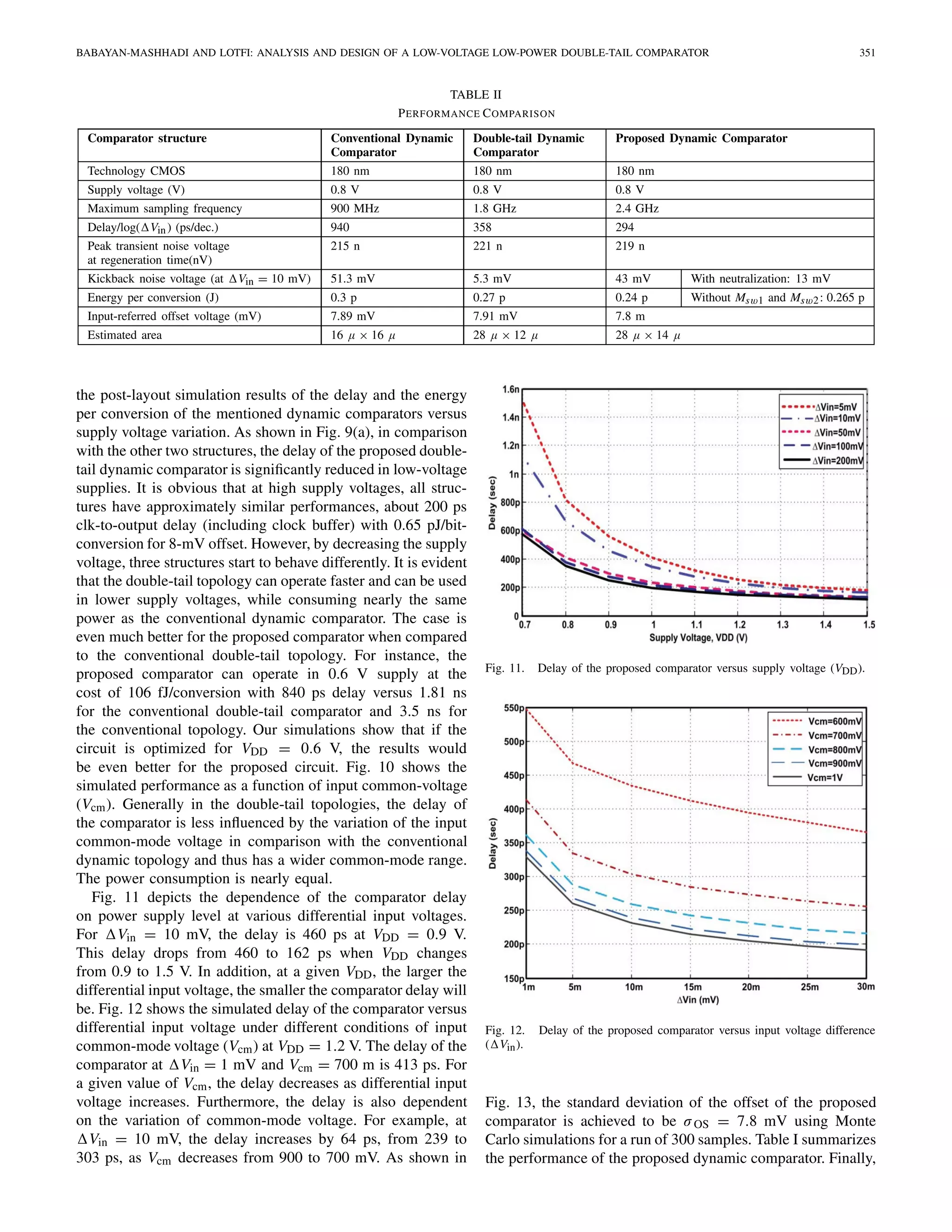
Fig. 11 depicts the dependence of the comparator delay
on power supply level at various differential input voltages.
For Vin = 10 mV, the delay is 460 ps at VDD = 0.9 V.
This delay drops from 460 to 162 ps when VDD changes
from 0.9 to 1.5 V. In addition, at a given VDD, the larger the
differential input voltage, the smaller the comparator delay will
be. Fig. 12 shows the simulated delay of the comparator versus
differential input voltage under different conditions of input
common-mode voltage (Vcm) at VDD = 1.2 V. The delay of the
comparator at Vin = 1 mV and Vcm = 700 m is 413 ps. For
a given value of Vcm, the delay decreases as differential input
voltage increases. Furthermore, the delay is also dependent
on the variation of common-mode voltage. For example, at
Vin = 10 mV, the delay increases by 64 ps, from 239 to
303 ps, as Vcm decreases from 900 to 700 mV. As shown in
Fig. 11. Delay of the proposed comparator versus supply voltage (VDD).
Fig. 12. Delay of the proposed comparator versus input voltage difference
( Vin).
Fig. 13, the standard deviation of the offset of the proposed
comparator is achieved to be σOS = 7.8 mV using Monte
Carlo simulations for a run of 300 samples. Table I summarizes
the performance of the proposed dynamic comparator. Finally,
352 IEEE TRANSACTIONS ON VERY LARGE SCALE INTEGRATION (VLSI) SYSTEMS, VOL. 22, NO. 2, FEBRUARY 2014
Fig. 13. Histogram diagram of Monte Carlo simulation of the offset in
proposed dynamic comparator.
Table II compares the performance of the proposed comparator
with the conventional dynamic and double-tail comparators.
In 0.18-μm CMOS, the proposed comparator provides the
maximum sampling of 2.4 GHz at 0.8-V supply voltage.
VI. CONCLUSION
In this paper, we presented a comprehensive delay analy-
sis for clocked dynamic comparators and expressions were
derived. Two common structures of conventional dynamic
comparator and conventional double-tail dynamic comparators
were analyzed. Also, based on theoretical analyses, a new
dynamic comparator with low-voltage low-power capability
was proposed in order to improve the performance of the
comparator. Post-layout simulation results in 0.18-μm CMOS
technology confirmed that the delay and energy per conversion
of the proposed comparator is reduced to a great extent in
comparison with the conventional dynamic comparator and
double-tail comparator.
REFERENCES
[1] B. Goll and H. Zimmermann, “A comparator with reduced delay time in
65-nm CMOS for supply voltages down to 0.65,” IEEE Trans. Circuits
Syst. II, Exp. Briefs, vol. 56, no. 11, pp. 810–814, Nov. 2009.
[2] S. U. Ay, “A sub-1 volt 10-bit supply boosted SAR ADC design in
standard CMOS,” Int. J. Analog Integr. Circuits Signal Process., vol. 66,
no. 2, pp. 213–221, Feb. 2011.
[3] A. Mesgarani, M. N. Alam, F. Z. Nelson, and S. U. Ay, “Supply
boosting technique for designing very low-voltage mixed-signal circuits
in standard CMOS,” in Proc. IEEE Int. Midwest Symp. Circuits Syst.
Dig. Tech. Papers, Aug. 2010, pp. 893–896.
[4] B. J. Blalock, “Body-driving as a Low-Voltage Analog Design Technique
for CMOS technology,” in Proc. IEEE Southwest Symp. Mixed-Signal
Design, Feb. 2000, pp. 113–118.
[5] M. Maymandi-Nejad and M. Sachdev, “1-bit quantiser with rail to rail
input range for sub-1V modulators,” IEEE Electron. Lett., vol. 39,
no. 12, pp. 894–895, Jan. 2003.
[6] Y. Okaniwa, H. Tamura, M. Kibune, D. Yamazaki, T.-S. Cheung,
J. Ogawa, N. Tzartzanis, W. W. Walker, and T. Kuroda, “A 40G-
b/s CMOS clocked comparator with bandwidth modulation technique,”
IEEE J. Solid-State Circuits, vol. 40, no. 8, pp. 1680–1687, Aug. 2005.
[7] B. Goll and H. Zimmermann, “A 0.12 μm CMOS comparator requiring
0.5V at 600MHz and 1.5V at 6 GHz,” in Proc. IEEE Int. Solid-State
Circuits Conf., Dig. Tech. Papers, Feb. 2007, pp. 316–317.
[8] B. Goll and H. Zimmermann, “A 65nm CMOS comparator with modified
latch to achieve 7GHz/1.3mW at 1.2V and 700MHz/47μW at 0.6V,” in
Proc. IEEE Int. Solid-State Circuits Conf. Dig. Tech. Papers, Feb. 2009,
pp. 328–329.
[9] B. Goll and H. Zimmermann, “Low-power 600MHz comparator for
0.5 V supply voltage in 0.12 μm CMOS,” IEEE Electron. Lett., vol. 43,
no. 7, pp. 388–390, Mar. 2007.
[10] D. Shinkel, E. Mensink, E. Klumperink, E. van Tuijl, and B. Nauta,
“A double-tail latch-type voltage sense amplifier with 18ps Setup+Hold
time,” in Proc. IEEE Int. Solid-State Circuits Conf., Dig. Tech. Papers,
Feb. 2007, pp. 314–315.
[11] P. Nuzzo, F. D. Bernardinis, P. Terreni, and G. Van der Plas, “Noise
analysis of regenerative comparators for reconfigurable ADC archi-
tectures,” IEEE Trans. Circuits Syst. I, Reg. Papers, vol. 55, no. 6,
pp. 1441–1454, Jul. 2008.
[12] A. Nikoozadeh and B. Murmann, “An analysis of latched comaprator
offset due to load capacitor mismatch,” IEEE Trans. Circuits Syst.
II, Exp. Briefs, vol. 53, no. 12, pp. 1398–1402, Dec. 2006.
[13] S. Babayan-Mashhadi and R. Lotfi, “An offset cancellation technique
for comparators using body-voltage trimming,” Int. J. Analog Integr.
Circuits Signal Process., vol. 73, no. 3, pp. 673–682, Dec. 2012.
[14] J. He, S. Zhan, D. Chen, and R. J. Geiger, “Analyses of static and
dynamic random offset voltages in dynamic comparators,” IEEE Trans.
Circuits Syst. I, Reg. Papers, vol. 56, no. 5, pp. 911–919, May 2009.
[15] J. Kim, B. S. Leibowits, J. Ren, and C. J. Madden, “Simulation and
analysis of random decision errors in clocked comparators,” IEEE Trans.
Circuits Syst. I, Reg. Papers, vol. 56, no. 8, pp. 1844–1857, Aug. 2009.
[16] P. M. Figueiredo and J. C. Vital, “Kickback noise reduction technique
for CMOS latched comapartors,” IEEE Trans. Circuits Syst. II, Exp.
Briefs, vol. 53, no. 7, pp. 541–545, Jul. 2006.
[17] B. Wicht, T. Nirschl, and D. Schmitt-Landsiedel, “Yield and speed
optimization of a latch-type voltage sense amplifier,” IEEE J. Solid-State
Circuits, vol. 39, no. 7, pp. 1148–1158, Jul. 2004.
[18] D. Johns and K. Martin, Analog Integrated Circuit Design, New York,
USA: Wiley, 1997.
Samaneh Babayan-Mashhadi was born in Mash-
had, Iran, in 1984. She received the B.S. and M.S.
degrees (Hons.) in electrical engineering from the
Ferdowsi University of Mashhad, Mashhad, Iran, in
2006 and 2008, respectively, where she is currently
pursuing the Ph.D. degree, from the Electrical Engi-
neering Department, with research on design of low-
power high-resolution, high-speed analog-to-digital
converters.
Her current research interests include low-power
low-voltage analog and mixed-signal integrated
circuits.
Reza Lotfi received the B.Sc. degree from Ferdowsi
University of Mashhad, Mashhad, Iran, the M.Sc.
degree from the Sharif University of Technology,
Tehran, Iran, and the Ph.D. degree from the Uni-
versity of Tehran, Tehran, in 1997, 1999, and 2004,
respectively, all in electrical engineering.
Since 2004, he has been with the Ferdowsi Univer-
sity of Mashhad, where he is currently an Associate
Professor. From 2008 to 2009, he was with the
Electronics Research Laboratory, Delft University
of Technology, Delft, the Netherlands, as a Post-
Doctoral Scientific Researcher involved in research on ultralow-power analog
and mixed-signal integrated circuits for biomedical applications. His current
research interests include low-voltage low-power analog integrated circuit
design for biomedical applications and high-speed data converters for telecom-
munication systems.
Dr. Lotfi has been an Associate Editor of the IEEE TRANSACTIONS ON
CIRCUITS AND SYSTEMS—PART I: REGULAR PAPERS since 2010.

Analysis and design_of_a_low-voltage_low-power[1]

  • 1.
    IEEE TRANSACTIONS ONVERY LARGE SCALE INTEGRATION (VLSI) SYSTEMS, VOL. 22, NO. 2, FEBRUARY 2014 343 Analysis and Design of a Low-Voltage Low-Power Double-Tail Comparator Samaneh Babayan-Mashhadi, Student Member, IEEE, and Reza Lotfi, Member, IEEE Abstract—The need for ultra low-power, area efficient, and high speed analog-to-digital converters is pushing toward the use of dynamic regenerative comparators to maximize speed and power efficiency. In this paper, an analysis on the delay of the dynamic comparators will be presented and analytical expres- sions are derived. From the analytical expressions, designers can obtain an intuition about the main contributors to the comparator delay and fully explore the tradeoffs in dynamic comparator design. Based on the presented analysis, a new dynamic com- parator is proposed, where the circuit of a conventional double- tail comparator is modified for low-power and fast operation even in small supply voltages. Without complicating the design and by adding few transistors, the positive feedback during the regeneration is strengthened, which results in remarkably reduced delay time. Post-layout simulation results in a 0.18-µm CMOS technology confirm the analysis results. It is shown that in the proposed dynamic comparator both the power consumption and delay time are significantly reduced. The maximum clock frequency of the proposed comparator can be increased to 2.5 and 1.1 GHz at supply voltages of 1.2 and 0.6 V, while consuming 1.4 mW and 153 µW, respectively. The standard deviation of the input-referred offset is 7.8 mV at 1.2 V supply. Index Terms—Double-tail comparator, dynamic clocked comparator, high-speed analog-to-digital converters (ADCs), low-power analog design. I. INTRODUCTION COMPARATOR is one of the fundamental building blocks in most analog-to-digital converters (ADCs). Many high- speed ADCs, such as flash ADCs, require high-speed, low- power comparators with small chip area. High-speed compara- tors in ultra deep submicrometer (UDSM) CMOS technologies suffer from low supply voltages especially when considering the fact that threshold voltages of the devices have not been scaled at the same pace as the supply voltages of the modern CMOS processes [1]. Hence, designing high-speed comparators is more challenging when the supply voltage is smaller. In other words, in a given technology, to achieve high speed, larger transistors are required to compensate the reduction of supply voltage, which also means that more die area and power is needed. Besides, low-voltage opera- tion results in limited common-mode input range, which is important in many high-speed ADC architectures, such as flash Manuscript received September 4, 2012; revised December 7, 2012; accepted January 15, 2013. Date of publication February 11, 2013; date of current version January 17, 2014. The authors are with the Electrical Engineering Group of Engineering Department, Ferdowsi University of Mashhad, Mashhad 91775-111, Iran (e-mail: babayan@ieee.org; rlotfi@ieee.org). Color versions of one or more of the figures in this paper are available online at http://ieeexplore.ieee.org. Digital Object Identifier 10.1109/TVLSI.2013.2241799 ADCs. Many techniques, such as supply boosting methods [2], [3], techniques employing body-driven transistors [4], [5], current-mode design [6] and those using dual-oxide processes, which can handle higher supply voltages have been developed to meet the low-voltage design challenges. Boosting and bootstrapping are two techniques based on augmenting the supply, reference, or clock voltage to address input-range and switching problems. These are effective techniques, but they introduce reliability issues especially in UDSM CMOS technologies. Body-driven technique adopted by Blalock [4], removes the threshold voltage requirement such that body- driven MOSFET operates as a depletion-type device. Based on this approach, in [5], a 1-bit quantizer for sub-1V modulators is proposed. Despite the advantages, the body- driven transistor suffers from smaller transconductance (equal to gmb of the transistor) compared to its gate-driven counter- part while special fabrication process, such as deep n-well is required to have both nMOS and pMOS transistors operate in the body-driven configuration. Apart from technological modifications, developing new circuit structures which avoid stacking too many transistors between the supply rails is preferable for low-voltage operation, especially if they do not increase the circuit complexity. In [7]–[9], additional circuitry is added to the conventional dynamic comparator to enhance the comparator speed in low supply voltages. The proposed comparator of [7] works down to a supply voltage of 0.5 V with a maximum clock frequency of 600 MHz and consumes 18 μW. Despite the effectiveness of this approach, the effect of component mismatch in the additional circuitry on the performance of the comparator should be considered. The structure of double-tail dynamic comparator first proposed in [10] is based on designing a separate input and cross- coupled stage. This separation enables fast operation over a wide common-mode and supply voltage range [10]. In this paper, a comprehensive analysis about the delay of dynamic comparators has been presented for various architec- tures. Furthermore, based on the double-tail structure proposed in [10], a new dynamic comparator is presented, which does not require boosted voltage or stacking of too many transistors. Merely by adding a few minimum-size transistors to the conventional double-tail dynamic comparator, latch delay time is profoundly reduced. This modification also results in con- siderable power savings when compared to the conventional dynamic comparator and double-tail comparator. The rest of this paper is organized as follows. Section II investigates the operation of the conventional clocked regenerative comparators and the pros and cons of each 1063-8210 © 2013 IEEE. Personal use is permitted, but republication/redistribution requires IEEE permission. See http://www.ieee.org/publications_standards/publications/rights/index.html for more information.
  • 2.
    344 IEEE TRANSACTIONSON VERY LARGE SCALE INTEGRATION (VLSI) SYSTEMS, VOL. 22, NO. 2, FEBRUARY 2014 Fig. 1. Schematic diagram of the conventional dynamic comparator. structure is discussed. Delay analysis is also presented and the analytical expressions for the delay of the comparators are derived. The proposed comparator is presented in Section III. Section IV discusses the design issues. Simulation results are addressed in Section V, followed by conclusions in Section VI. II. CLOCKED REGENERATIVE COMPARATORS Clocked regenerative comparators have found wide appli- cations in many high-speed ADCs since they can make fast decisions due to the strong positive feedback in the regenerative latch. Recently, many comprehensive analyses have been presented, which investigate the performance of these comparators from different aspects, such as noise [11], offset [12], [13], and [14], random decision errors [15], and kick-back noise [16]. In this section, a comprehensive delay analysis is presented; the delay time of two common struc- tures, i.e., conventional dynamic comparator and conventional dynamic double-tail comparator are analyzed, based on which the proposed comparator will be presented. A. Conventional Dynamic Comparator The schematic diagram of the conventional dynamic com- parator widely used in A/D converters, with high input impedance, rail-to-rail output swing, and no static power consumption is shown in Fig. 1 [1], [17]. The operation of the comparator is as follows. During the reset phase when CLK = 0 and Mtail is off, reset transistors (M7–M8) pull both output nodes Outn and Outp to VDD to define a start condition and to have a valid logical level during reset. In the comparison phase, when CLK = VDD, transistors M7 and M8 are off, and Mtail is on. Output voltages (Outp, Outn), which had been pre-charged to VDD, start to discharge with different discharging rates depending on the corresponding input volt- age (INN/INP). Assuming the case where VINP > VINN, Outp discharges faster than Outn, hence when Outp (discharged by transistor M2 drain current), falls down to VDD–|Vthp| before Outn (discharged by transistor M1 drain current), the corresponding pMOS transistor (M5) will turn on initiating the latch regeneration caused by back-to-back inverters (M3, M5 Fig. 2. Transient simulations of the conventional dynamic comparator for input voltage difference of Vin = 5 mV, Vcm = 0.7 V, and VDD = 0.8 V. and M4, M6). Thus, Outn pulls to VDD and Outp discharges to ground. If VINP < VINN, the circuits works vice versa. As shown in Fig. 2, the delay of this comparator is com- prised of two time delays, t0 and tlatch. The delay t0 represents the capacitive discharge of the load capacitance CL until the first p-channel transistor (M5/M6) turns on. In case, the voltage at node INP is bigger than INN (i.e., VINP > VINN), the drain current of transistor M2 (I2) causes faster discharge of Outp node compared to the Outn node, which is driven by M1 with smaller current. Consequently, the discharge delay (t0) is given by t0 = CL Vthp I2 ∼= 2 CL Vthp Itail . (1) In (1), since I2 = Itail/2 + Iin = Itail/2 + gm1,2 Vin, for small differential input ( Vin), I2 can be approximated to be constant and equal to the half of the tail current. The second term, tlatch, is the latching delay of two cross- coupled inverters. It is assumed that a voltage swing of Vout = VDD/2 has to be obtained from an initial output voltage difference V0 at the falling output (e.g., Outp). Half of the supply voltage is considered to be the threshold voltage of the comparator following inverter or SR latch [17]. Hence, the latch delay time is given by, [18] tlatch = CL gm,eff · ln Vout V0 = CL gm,eff · ln VDD/2 V0 (2) where gm,eff is the effective transconductance of the back-to- back inverters. In fact, this delay depends, in a logarithmic manner, on the initial output voltage difference at the begin- ning of the regeneration (i.e., at t = t0). Based on (1), V0 can be calculated from (3) V0 = Voutp(t = t0) − Voutn(t = t0) = Vthp − I2t0 CL = Vthp 1 − I2 I1 . (3) The current difference, Iin = |I1 − I2|, between the branches is much smaller than I1 and I2. Thus, I1 can be
  • 3.
    BABAYAN-MASHHADI AND LOTFI:ANALYSIS AND DESIGN OF A LOW-VOLTAGE LOW-POWER DOUBLE-TAIL COMPARATOR 345 approximated by Itail/2 and (3) can be rewritten as V0 = Vthp Iin I1 ≈ 2 Vthp Iin Itail = 2 Vthp β1,2Itail Itail Vin = 2 Vthp β1,2 Itail Vin. (4) In this equation, β1,2 is the input transistors’ current factor and Itail is a function of input common-mode voltage (Vcm) and VDD. Now, substituting V0 in latch delay expression and considering t0, the expression for the delay of the conventional dynamic comparator is obtained as tdelay = t0+tlatch = 2 CL Vthp Itail + CL gm,eff · ln VDD 4 Vthp Vin Itail β1,2 . (5) Equation (5) explains the impact of various parameters. The total delay is directly proportional to the comparator load capacitance CL and inversely proportional to the input dif- ference voltage ( Vin). Besides, the delay depends indirectly to the input common-mode voltage (Vcm). By reducing Vcm, the delay t0 of the first sensing phase increases because lower Vcm causes smaller bias current (Itail). On the other hand, (4) shows that a delayed discharge with smaller Itail results in an increased initial voltage difference ( V0), reducing tlatch. Simulation results show that the effect of reducing the Vcm on increasing of t0 and reducing of tlatch will finally lead to an increase in the total delay. In [17], it has been shown that an input common-mode voltage of 70% of the supply voltage is optimal regarding speed and yield. In principle, this structure has the advantages of high input impedance, rail-to-rail output swing, no static power consump- tion, and good robustness against noise and mismatch [1]. Due to the fact that parasitic capacitances of input transistors do not directly affect the switching speed of the output nodes, it is possible to design large input transistors to minimize the offset. The disadvantage, on the other hand, is the fact that due to several stacked transistors, a sufficiently high supply voltage is needed for a proper delay time. The reason is that, at the beginning of the decision, only transistors M3 and M4 of the latch contribute to the positive feedback until the voltage level of one output node has dropped below a level small enough to turn on transistors M5 or M6 to start complete regeneration. At a low supply voltage, this voltage drop only contributes a small gate-source voltage for transistors M3 and M4, where the gate- source voltage of M5 and M6 is also small; thus, the delay time of the latch becomes large due to lower transconductances. Another important drawback of this structure is that there is only one current path, via tail transistor Mtail, which defines the current for both the differential amplifier and the latch (the cross-coupled inverters). While one would like a small tail current to keep the differential pair in weak inversion and obtain a long integration interval and a better Gm/I ratio, a Fig. 3. Schematic diagram of the conventional double-tail dynamic com- parator. large tail current would be desirable to enable fast regeneration in the latch [10]. Besides, as far as Mtail operates mostly in triode region, the tail current depends on input common-mode voltage, which is not favorable for regeneration. B. Conventional Double-Tail Dynamic Comparator A conventional double-tail comparator is shown in Fig. 3 [10]. This topology has less stacking and therefore can operate at lower supply voltages compared to the conventional dynamic comparator. The double tail enables both a large current in the latching stage and wider Mtail2, for fast latching independent of the input common-mode voltage (Vcm), and a small current in the input stage (small Mtail1), for low offset [10]. The operation of this comparator is as follows (see Fig. 4). During reset phase (CLK = 0, Mtail1, and Mtail2 are off), transistors M3-M4 pre-charge fn and fp nodes to VDD, which in turn causes transistors MR1 and MR2 to discharge the output nodes to ground. During decision-making phase (CLK = VDD, Mtail1 and Mtail2 turn on), M3-M4 turn off and volt- ages at nodes fn and fp start to drop with the rate defined by IMtail1/Cfn(p) and on top of this, an input-dependent differential voltage Vfn(p) will build up. The intermediate stage formed by MR1 and MR2 passes Vfn(p) to the cross- coupled inverters and also provides a good shielding between input and output, resulting in reduced value of kickback noise [10]. Similar to the conventional dynamic comparator, the delay of this comparator comprises two main parts, t0 and tlatch. The delay t0 represents the capacitive charging of the load capacitance CLout (at the latch stage output nodes, Outn and Outp) until the first n-channel transistor (M9/M10) turns on, after which the latch regeneration starts; thus t0 is obtained
  • 4.
    346 IEEE TRANSACTIONSON VERY LARGE SCALE INTEGRATION (VLSI) SYSTEMS, VOL. 22, NO. 2, FEBRUARY 2014 Fig. 4. Transient simulations of the conventional double-tail dynamic comparator for input voltage difference of Vin = 5 mV, Vcm = 0.7 V, and VDD = 0.8 V. from t0 = VThnCLout IB1 ≈ 2 VThnCLout Itail2 (6) where IB1 is the drain current of the M9 (assuming VINP > VINN, see Fig. 3) and is approximately equal to the half of the tail current (Itail2). After the first n-channel transistor of the latch turns on (for instance, M9), the corresponding output (e.g., Outn) will be discharged to the ground, leading front p-channel transistor (e.g., M8) to turn on, charging another output (Outp) to the supply voltage (VDD). The regeneration time (tlatch) is achieved according to (2). For the initial output voltage difference at time t0, V0 we have V0 = Voutp(t = t0) − Voutn(t = t0) = VThn − IB2t0 CLout = VThn 1 − IB2 IB1 (7) where IB1 and IB2 are the currents of the latch left- and right- side branches of the second stage, respectively. Considering Ilatch = |IB1 − IB2| = gmR1,2 Vfn/fp, (7) can be rewritten as V0 = VThn Ilatch IB1 ≈ 2VThn Ilatch Itail2 = 2VThn gmR1,2 Itail2 Vfn/fp (8) where gmR1,2 is the transconductance of the intermediate stage transistors (MR1 and MR2) and Vfn/fp is the voltage difference at the first stage outputs (fn and fp) at time t0. Thus, it can be concluded that two main parameters which influence the initial output differential voltage ( V0) and thereby the latch regeneration time are the transcon- ductance of the intermediate stage transistors (gmR1,2) and the voltage difference at the first stage outputs (fn and fp) at time t0. In fact, intermediate stage transistors amplify the voltage difference of Vfn/fp causing the latch to be imbalanced. The differential voltage at nodes fn/fp ( Vfn/fp) at time t0 can be achieved from Vfn/fp = Vfn(t = t0) − Vfp(t = t0) = t0 · IN1 − IN2 CL,fn(p) = t0 · gm1,2 Vin CL,fn(p) . (9) In this equation, IN1 and IN2 refer to the discharging currents of input transistors (M1 and M2), which are dependent on the input differential voltage (i.e., IN = gm1,2 Vin). Substituting (9) in (8), V0 will be V0 = 2VThn gmR1,2 Itail2 Vfn/fp = 2VThn Itail2 2 · CLout CL,fn(p) · gmR1,2gm1,2 Vin. (10) This equation shows that V0 depends strongly on the transconductance of input and intermediate stage transistors, input voltage difference ( Vin), latch tail current, and the capacitive ratio of CLout to CL,fn(p). Substituting V0 in latch regeneration time (2), the total delay of this comparator is achieved as follows: tdelay = t0 + tlatch = 2 VThnCLout Itail2 + CLout gm,eff · ln VDD/2 V0 = 2 VThnCLout Itail2 + CLout gm,eff · ln VDD · I2 tail2 · CL,fn(p) 8V2 Thn · CLoutgmR1,2gm1,2 Vin . (11) From the equations derived for the delay of the double-tail dynamic comparator, some important notes can be concluded. 1) The voltage difference at the first stage outputs ( Vfn/fp) at time t0 has a profound effect on latch initial differen- tial output voltage ( V0) and consequently on the latch delay. Therefore, increasing it would profoundly reduce the delay of the comparator. 2) In this comparator, both intermediate stage transistors will be finally cut-off, (since fn and fp nodes both discharge to the ground), hence they do not play any role in improving the effective transconductance of the latch. Besides, during reset phase, these nodes have to be charged from ground to VDD, which means power consumption. The following section describes how the proposed comparator improves the performance of the double-tail comparator from the above points of view. III. PROPOSED DOUBLE-TAIL DYNAMIC COMPARATOR Fig. 5 demonstrates the schematic diagram of the proposed dynamic double-tail comparator. Due to the better performance of double-tail architecture in low-voltage applications, the proposed comparator is designed based on the double-tail structure. The main idea of the proposed comparator is to increase Vfn/fp in order to increase the latch regeneration speed. For this purpose, two control transistors (Mc1 and Mc2) have been added to the first stage in parallel to M3/M4 transistors but in a cross-coupled manner [see Fig. 5(a)].
  • 5.
    BABAYAN-MASHHADI AND LOTFI:ANALYSIS AND DESIGN OF A LOW-VOLTAGE LOW-POWER DOUBLE-TAIL COMPARATOR 347 (b)(a) Fig. 5. Schematic diagram of the proposed dynamic comparator. (a) Main idea. (b) Final structure. A. Operation of the Proposed Comparator The operation of the proposed comparator is as follows (see Fig. 6). During reset phase (CLK = 0, Mtail1 and Mtail2 are off, avoiding static power), M3 and M4 pulls both fn and fp nodes to VDD, hence transistor Mc1 and Mc2 are cut off. Intermediate stage transistors, MR1 and MR2, reset both latch outputs to ground. During decision-making phase (CLK = VDD, Mtail1, and Mtail2 are on), transistors M3 and M4 turn off. Furthermore, at the beginning of this phase, the control transistors are still off (since fn and fp are about VDD). Thus, fn and fp start to drop with different rates according to the input voltages. Suppose VINP > VINN, thus fn drops faster than fp, (since M2 provides more current than M1). As long as fn continues falling, the corresponding pMOS control transistor (Mc1 in this case) starts to turn on, pulling fp node back to the VDD; so another control transistor (Mc2) remains off, allowing fn to be discharged completely. In other words, unlike conventional double-tail dynamic comparator, in which Vfn/fp is just a function of input transistor transconductance and input voltage difference (9), in the proposed structure as soon as the comparator detects that for instance node fn discharges faster, a pMOS transistor (Mc1) turns on, pulling the other node fp back to the VDD. Therefore by the time passing, the difference between fn and fp ( Vfn/fp) increases in an exponential manner, leading to the reduction of latch regeneration time (this will be shown in Section III-B). Despite the effectiveness of the proposed idea, one of the points which should be considered is that in this circuit, when one of the control transistors (e.g., Mc1) turns on, a current from VDD is drawn to the ground via input and tail transistor (e.g., Mc1, M1, and Mtail1), resulting in static power consumption. To overcome this issue, two nMOS switches are used below the input transistors [Msw1 and Msw2, as shown in Fig. 5(b)]. At the beginning of the decision making phase, due to the fact that both fn and fp nodes have been pre-charged to VDD Fig. 6. Transient simulations of the proposed double-tail dynamic comparator for input voltage difference of Vin = 5 mV, Vcm = 0.7 V, and VDD = 0.8 V. (during the reset phase), both switches are closed and fn and fp start to drop with different discharging rates. As soon as the comparator detects that one of the fn/fp nodes is discharging faster, control transistors will act in a way to increase their voltage difference. Suppose that fp is pulling up to the VDD and fn should be discharged completely, hence the switch in the charging path of fp will be opened (in order to prevent any current drawn from VDD) but the other switch connected to fn will be closed to allow the complete discharge of fn node. In other words, the operation of the control transistors with the switches emulates the operation of the latch. This will be more discussed in the following section. B. Delay Analysis In order to theoretically demonstrate how the delay is reduced, delay equations are derived for this structure as
  • 6.
    348 IEEE TRANSACTIONSON VERY LARGE SCALE INTEGRATION (VLSI) SYSTEMS, VOL. 22, NO. 2, FEBRUARY 2014 previously done for the conventional dynamic comparator and the conventional double-tail dynamic comparator. The analysis is similar to the conventional double-tail dynamic comparator, however; the proposed dynamic comparator enhances the speed of the double-tail comparator by affecting two important factors: first, it increases the initial output voltage difference ( V0) at the beginning of the regeneration (t = t0); and second, it enhances the effective transconductace (gmeff) of the latch. Each of these factors will be discussed in detail. 1) Effect of Enhancing V0: As discussed before, we define t0, as a time after which latch regeneration starts. In other words, t0 is considered to be the time it takes (while both latch outputs are rising with different rates) until the first nMOS transistor of the back-to-back inverters turns on, so that it will pull down one of the outputs and regeneration will commence. According to (2), the latch output voltage difference at time t0, ( V0) has a considerable impact on the latch regeneration time, such that bigger V0 results in less regeneration time. Similar to the equation derived for the V0 of the double-tail structure, in this comparator we have V0 = VThn Ilatch IB1 ≈ 2VThn Ilatch Itail2 = 2VThn gmR1,2 Itail2 Vfn/fp. (12) In order to find Vfn/fp at t = t0, we shall notice that the combination of the control transistors (Mc1 and Mc2) with two serial switches (Msw1, Msw2) emulates the operation of a back- to-back inverter pair; thus using small-signal model presented in [18], Vfn/fp is calculated by Vfn/fp = Vfn(p)0 exp((Av − 1)t/τ). (13) In this equation, τ Av−1 ∼= CL,fn(p) Gm,eff1 and Vfn(p)0 is the initial fn/fp node difference voltage at the time when the correspond- ing pMOS control transistor is started to be turned on. Hence, it can be shown that Vfn(p)0 is obtained from Vfn(p)0 = 2 VThp gm1,2 Vin Itail1 . (14) Substituting (13) in (12), V0 will be V0 = 2VThn gmR1,2 Itail2 Vfn/fp = 4VThn VThp gmR1,2 Itail2 gm1,2 Vin Itail1 exp Gm,eff1 · t0 CL,fn(p) . (15) Comparing (15) with (10), it is evident that V0 has been increased remarkably (in an exponential manner) in compare with the conventional dynamic comparator. 2) Effect of Enhancing Latch Effective Transconductance: As mentioned before, in conventional double-tail comparator, both fn and fp nodes will be finally discharged completely. In our proposed comparator, however, the fact that one of the first stage output nodes (fn/fp) will charge up back to the VDD at the beginning of the decision making phase, will turn on one of the intermediate stage transistors, thus the effective transconductance of the latch is increased. In other words, positive feedback is strengthened. Hence, tlatch will be tlatch = CLout gm,eff + gmR1,2 · ln Vout V0 = CLout gm,eff + gmR1,2 · ln VDD/2 V0 . (16) Finally, by including both effects, the total delay of the proposed comparator is achieved from tdelay = t0 + tlatch = 2 VThnCLout Itail2 + CLout gm,eff + gmr1,2 · ln VDD/2 V0 = 2 VThnCLout Itail2 + CLout gm,eff + gmR1,2 × ln ⎛ ⎝ VDD/2 4VThn VThp gmR1,2 Itail2 gm1,2 Vin Itail1 exp Gm,eff1·t0 CL,fn(p) ⎞ ⎠. (17) By comparing the expressions derived for the delay of the three mentioned structures, it can be seen that the proposed comparator takes advantage of an inner positive feedback in double-tail operation, which strengthen the whole latch regeneration. This speed improvement is even more obvious in lower supply voltages. This is due to the fact that for larger values of VTh/VDD, the transconductance of the transistors decreases, thus the existence of an inner positive feedback in the architecture of the first stage will lead to the improved performance of the comparator. Simulation results confirm this matter. 3) Reducing the Energy Per Comparison: It is not only the delay parameter which is improved in the modified proposed comparator, but the energy per conversion is reduced as well. As discussed earlier, in conventional double-tail topology, both fn and fp nodes discharge to the ground during the decision making phase and each time during the reset phase they should be pulled up back to the VDD. However, in our proposed comparator, only one of the mentioned nodes (fn/fp) has to be charged during the reset phase. This is due to the fact that during the previous decision making phase, based on the status of control transistors, one of the nodes had not been discharged and thus less power is required. This can be seen when being compared with conventional topologies [see Figs. 9(b) and 10(b)]. IV. DESIGN CONSIDERATIONS In designing the proposed comparator, some design issues must be considered. When determining the size of tail transis- tors (Mtail1 and Mtail2), it is necessary to ensure that the time it takes that one of the control transistors turns on must be smaller than t0 (start of regeneration) ton,Mc1(2) < t0 → VThp · CL,fn(p) In1,2 < VThnCLout IB1 → VThp · CL,fn(p) ITail1 2 < VThn · CLout ITail2 2 . (18)
  • 7.
    BABAYAN-MASHHADI AND LOTFI:ANALYSIS AND DESIGN OF A LOW-VOLTAGE LOW-POWER DOUBLE-TAIL COMPARATOR 349 This condition can be easily achieved by properly designing the first and second stage tail currents. Even if possible in the fabrication technology, low-threshold pMOS devices can be used as control transistors leading to faster turn on. In designing the nMOS switches, located below the input transistors, the drain-source voltage of these switches must be considered since it might limit the voltage headroom, restricting the advantage of being used in low-voltage applica- tions. In order to diminish this effect, low-on-resistance nMOS switches are required. In other words, large transistors must be used. Since the parasitic capacitances of these switches do not affect the parasitic capacitances of the fn/fp nodes (delay bottlenecks), it is possible to optimally select the size of the nMOS switch transistors in a way that both low-voltage and low-power operations are maintained. The effect of mismatch between controlling transistors on the total input-referred offset of the comparator is another important issue. When determining the size of controlling transistors (MC1 − MC2), two important issues should be considered. First, the effect of threshold voltage mismatch and current factor mismatch of the controlling transistors on the comparator input-referred offset voltage. Second, the effect of transistor sizing on parasitic capacitances of the fn/fp nodes, i.e., CL,fn(p), and consequently the delay of the comparator. While larger transistors are required for better matching; however, the increased parasitic capacitances are delay bottlenecks. In order to study the effect of threshold and current factor mismatch of control transistors on the total input-referred offset voltage, a brief mismatch analysis is presented here. A. Mismatch Analysis In principle, the effect of threshold voltage mismatch and current factor mismatch of controlling transistors is almost negligible in most cases except for the situation where input differential voltage ( Vin) is very small where fn and fp have approximately similar discharging rates. This is true because by the time that the controlling transistor (Mc1 or MC2) turns on, the differential input signal is already amplified to large amplitude compared to the mismatches. In other words, offset due to the controlling transistor mismatches is divided by the gain from the input to the output. However, in case of small Vin, when fn and fp follow each other tightly, the mismatch of the controlling transistors might influence the result of the comparison. Hence, the following brief analyzes the effect of threshold and current factor mismatches of controlling transistors on the total input-referred offset voltage. 1)Effect of Threshold Voltage Mismatch of MC1, MC2, i.e., VThC1,2: The differential current due to the threshold voltage mis- match can be obtained from idiff = gmc1,2 VThc1,2 (19) where gmc1,2 is the transconductance of the controlling tran- sistors. So, the input-referred offset voltage due to the Mc1,2 threshold voltage mismatch is obtained as follows: Veq,due VThc1,2 = gmc1,2 VThc1,2 gm1,2 = μpWC1,2VODC1,2 μnW1,2VOD1,2 VThc1,2 (20) where VOD refers to the overdrive voltage of the transistors. 2)Effect of Current-Factor Mismatch MC1, MC2, i.e., βC1,2: In order to calculate the input-referred offset due to the current factor mismatch of MC1,2, βC1,2 is modeled as a channel width mismatch W, i.e., β/β = W/W. The differential current that W generates can be obtained as expressed in (21). idiff = 1 2 μpCox W L (Vgsc1,2 − Vthc1,2)2 . (21) Note that the controlling transistors are in saturation since |VGDc1,2| = |Vfn − Vfp| < |Vthp|. So the input-referred offset voltage due to the current factor mismatch is calculated from Veq,due βC1,2 = idiff gm1,2 = 0.5μpWC1,2(Vgsc1,2 − Vthp)2 μnW1,2(Vgs1,2 − Vthn) = 0.5μpWC1,2V 2 ODC1,2 μnW1,2(Vcm −RCLK KnC1,2V 2 ODC1,2 − Vthn) (22) where Vcm is the input common mode voltage and Rclk is the equivalent on resistance of the tail transistor. Assuming both mismatch factors, the total input-referred offset due to the mismatch of the controlling transistors can be found from σtotal = σ2 VThC1,2 + σ2 βC1,2 . (23) From (20) and (22), it can be concluded that the ratio of the controlling transistor sizes to the input transistor size, i.e., (WC1,2/W1,2), is effective in reducing the offset. Due to the fact that the transconductance of the input transistors (gm1,2) is important in amplifying the input differential voltage and due to the dominant role of the size of these transistors on total input-referred offset, usually large input transistors are designed, which results in diminishing the effect of controlling transistors mismatch. B. Kickback Noise Principally in latched comparators, the large voltage vari- ations on the regeneration nodes are coupled, through the parasitic capacitances of the transistors, to the input of the comparator. Since the circuit preceding it does not have zero output impedance, the input voltage is disturbed, which may degrade the accuracy of the converter. This disturbance is usually called “kickback noise.” In [16], it has been shown that the fastest and most power efficient comparators gen- erate more kickback noise. This is true about our proposed dynamic comparator. Although it improves the double-tail
  • 8.
    350 IEEE TRANSACTIONSON VERY LARGE SCALE INTEGRATION (VLSI) SYSTEMS, VOL. 22, NO. 2, FEBRUARY 2014 Fig. 7. Peak input voltage error due to kickback noise. Fig. 8. Layout schematic diagram of the proposed dynamic comparator. topology in terms of operation speed and thus energy per comparison, the kickback noise is increased in comparison to conventional double-tail structure (Fig. 3). Fig. 7 presents the peak disturbance as a function of differential input voltage of the comparator in three studied architectures. While double- tail structure takes advantage of input-output isolation and thus the minimum kickback noise, the conventional dynamic comparator and our proposed structure has nearly similar kickback noise. However, in our proposed comparator since control transistors are not supposed to be as strong as the latch transistors in conventional dynamic comparator, it is possible to determine the size of those transistors in a way that keeps the advantages of the speed enhancement and power reduction, while reducing kickback noise. Besides, for some applications where kickback becomes important, it is possible to apply sim- ple kickback reduction techniques, such as neutralization [16] to remarkably reduce the kickback noise (See Fig. 7, proposed dynamic comparator with neutralization). V. SIMULATION RESULTS In order to compare the proposed comparator with the conventional and double-tail dynamic comparators, all cir- cuits have been simulated in a 0.18-μm CMOS technology with VDD = 1.2 V. The comparators were optimized and the transistor dimensions were scaled to get an equal offset standard variation of σOS = 8 mV at the input common- mode voltage of V cm = 1.1 V (the same conditions that are (b) (a) Fig. 9. (a) Post-layout simulated delay and (b) energy per conversion as a function of supply voltage ( Vin = 50 mV, Vcm = VDD − 0.1). (a) (b) Fig. 10. (a) Post-layout simulated delay and (b) energy per conversion as a function of input common-mode voltage ( Vin = 50 mV, VDD = 1.2). TABLE I SUMMARY OF THE COMPARATOR PERFORMANCE Item Value Technology 180-nm CMOS Supply voltage 1.2 V Average power dissipation per conversion @ freq. = 500 MHz 329 μW Worst case delay (Vcm = 0.6 V, Vin = 1 mV) 550 ps Delay/log( Vin) 69 ps/dec Offset standard deviation (1-sigma) (σos) 7.8 mV Energy efficiency 0.66 pJ found in [10]). Fig. 8 shows the layout of the comparator. Particular care was taken in the layout to avoid affecting delay and power of the comparator. Fig. 9(a) and (b) demonstrates
  • 9.
    BABAYAN-MASHHADI AND LOTFI:ANALYSIS AND DESIGN OF A LOW-VOLTAGE LOW-POWER DOUBLE-TAIL COMPARATOR 351 TABLE II PERFORMANCE COMPARISON Comparator structure Conventional Dynamic Comparator Double-tail Dynamic Comparator Proposed Dynamic Comparator Technology CMOS 180 nm 180 nm 180 nm Supply voltage (V) 0.8 V 0.8 V 0.8 V Maximum sampling frequency 900 MHz 1.8 GHz 2.4 GHz Delay/log( Vin) (ps/dec.) 940 358 294 Peak transient noise voltage at regeneration time(nV) 215 n 221 n 219 n Kickback noise voltage (at Vin = 10 mV) 51.3 mV 5.3 mV 43 mV With neutralization: 13 mV Energy per conversion (J) 0.3 p 0.27 p 0.24 p Without Msw1 and Msw2: 0.265 p Input-referred offset voltage (mV) 7.89 mV 7.91 mV 7.8 m Estimated area 16 μ × 16 μ 28 μ × 12 μ 28 μ × 14 μ the post-layout simulation results of the delay and the energy per conversion of the mentioned dynamic comparators versus supply voltage variation. As shown in Fig. 9(a), in comparison with the other two structures, the delay of the proposed double- tail dynamic comparator is significantly reduced in low-voltage supplies. It is obvious that at high supply voltages, all struc- tures have approximately similar performances, about 200 ps clk-to-output delay (including clock buffer) with 0.65 pJ/bit- conversion for 8-mV offset. However, by decreasing the supply voltage, three structures start to behave differently. It is evident that the double-tail topology can operate faster and can be used in lower supply voltages, while consuming nearly the same power as the conventional dynamic comparator. The case is even much better for the proposed comparator when compared to the conventional double-tail topology. For instance, the proposed comparator can operate in 0.6 V supply at the cost of 106 fJ/conversion with 840 ps delay versus 1.81 ns for the conventional double-tail comparator and 3.5 ns for the conventional topology. Our simulations show that if the circuit is optimized for VDD = 0.6 V, the results would be even better for the proposed circuit. Fig. 10 shows the simulated performance as a function of input common-voltage (Vcm). Generally in the double-tail topologies, the delay of the comparator is less influenced by the variation of the input common-mode voltage in comparison with the conventional dynamic topology and thus has a wider common-mode range. The power consumption is nearly equal. Fig. 11 depicts the dependence of the comparator delay on power supply level at various differential input voltages. For Vin = 10 mV, the delay is 460 ps at VDD = 0.9 V. This delay drops from 460 to 162 ps when VDD changes from 0.9 to 1.5 V. In addition, at a given VDD, the larger the differential input voltage, the smaller the comparator delay will be. Fig. 12 shows the simulated delay of the comparator versus differential input voltage under different conditions of input common-mode voltage (Vcm) at VDD = 1.2 V. The delay of the comparator at Vin = 1 mV and Vcm = 700 m is 413 ps. For a given value of Vcm, the delay decreases as differential input voltage increases. Furthermore, the delay is also dependent on the variation of common-mode voltage. For example, at Vin = 10 mV, the delay increases by 64 ps, from 239 to 303 ps, as Vcm decreases from 900 to 700 mV. As shown in Fig. 11. Delay of the proposed comparator versus supply voltage (VDD). Fig. 12. Delay of the proposed comparator versus input voltage difference ( Vin). Fig. 13, the standard deviation of the offset of the proposed comparator is achieved to be σOS = 7.8 mV using Monte Carlo simulations for a run of 300 samples. Table I summarizes the performance of the proposed dynamic comparator. Finally,
  • 10.
    352 IEEE TRANSACTIONSON VERY LARGE SCALE INTEGRATION (VLSI) SYSTEMS, VOL. 22, NO. 2, FEBRUARY 2014 Fig. 13. Histogram diagram of Monte Carlo simulation of the offset in proposed dynamic comparator. Table II compares the performance of the proposed comparator with the conventional dynamic and double-tail comparators. In 0.18-μm CMOS, the proposed comparator provides the maximum sampling of 2.4 GHz at 0.8-V supply voltage. VI. CONCLUSION In this paper, we presented a comprehensive delay analy- sis for clocked dynamic comparators and expressions were derived. Two common structures of conventional dynamic comparator and conventional double-tail dynamic comparators were analyzed. Also, based on theoretical analyses, a new dynamic comparator with low-voltage low-power capability was proposed in order to improve the performance of the comparator. Post-layout simulation results in 0.18-μm CMOS technology confirmed that the delay and energy per conversion of the proposed comparator is reduced to a great extent in comparison with the conventional dynamic comparator and double-tail comparator. REFERENCES [1] B. Goll and H. Zimmermann, “A comparator with reduced delay time in 65-nm CMOS for supply voltages down to 0.65,” IEEE Trans. Circuits Syst. II, Exp. Briefs, vol. 56, no. 11, pp. 810–814, Nov. 2009. [2] S. U. Ay, “A sub-1 volt 10-bit supply boosted SAR ADC design in standard CMOS,” Int. J. Analog Integr. Circuits Signal Process., vol. 66, no. 2, pp. 213–221, Feb. 2011. [3] A. Mesgarani, M. N. Alam, F. Z. Nelson, and S. U. Ay, “Supply boosting technique for designing very low-voltage mixed-signal circuits in standard CMOS,” in Proc. IEEE Int. Midwest Symp. Circuits Syst. Dig. Tech. Papers, Aug. 2010, pp. 893–896. [4] B. J. Blalock, “Body-driving as a Low-Voltage Analog Design Technique for CMOS technology,” in Proc. IEEE Southwest Symp. Mixed-Signal Design, Feb. 2000, pp. 113–118. [5] M. Maymandi-Nejad and M. Sachdev, “1-bit quantiser with rail to rail input range for sub-1V modulators,” IEEE Electron. Lett., vol. 39, no. 12, pp. 894–895, Jan. 2003. [6] Y. Okaniwa, H. Tamura, M. Kibune, D. Yamazaki, T.-S. Cheung, J. Ogawa, N. Tzartzanis, W. W. Walker, and T. Kuroda, “A 40G- b/s CMOS clocked comparator with bandwidth modulation technique,” IEEE J. Solid-State Circuits, vol. 40, no. 8, pp. 1680–1687, Aug. 2005. [7] B. Goll and H. Zimmermann, “A 0.12 μm CMOS comparator requiring 0.5V at 600MHz and 1.5V at 6 GHz,” in Proc. IEEE Int. Solid-State Circuits Conf., Dig. Tech. Papers, Feb. 2007, pp. 316–317. [8] B. Goll and H. Zimmermann, “A 65nm CMOS comparator with modified latch to achieve 7GHz/1.3mW at 1.2V and 700MHz/47μW at 0.6V,” in Proc. IEEE Int. Solid-State Circuits Conf. Dig. Tech. Papers, Feb. 2009, pp. 328–329. [9] B. Goll and H. Zimmermann, “Low-power 600MHz comparator for 0.5 V supply voltage in 0.12 μm CMOS,” IEEE Electron. Lett., vol. 43, no. 7, pp. 388–390, Mar. 2007. [10] D. Shinkel, E. Mensink, E. Klumperink, E. van Tuijl, and B. Nauta, “A double-tail latch-type voltage sense amplifier with 18ps Setup+Hold time,” in Proc. IEEE Int. Solid-State Circuits Conf., Dig. Tech. Papers, Feb. 2007, pp. 314–315. [11] P. Nuzzo, F. D. Bernardinis, P. Terreni, and G. Van der Plas, “Noise analysis of regenerative comparators for reconfigurable ADC archi- tectures,” IEEE Trans. Circuits Syst. I, Reg. Papers, vol. 55, no. 6, pp. 1441–1454, Jul. 2008. [12] A. Nikoozadeh and B. Murmann, “An analysis of latched comaprator offset due to load capacitor mismatch,” IEEE Trans. Circuits Syst. II, Exp. Briefs, vol. 53, no. 12, pp. 1398–1402, Dec. 2006. [13] S. Babayan-Mashhadi and R. Lotfi, “An offset cancellation technique for comparators using body-voltage trimming,” Int. J. Analog Integr. Circuits Signal Process., vol. 73, no. 3, pp. 673–682, Dec. 2012. [14] J. He, S. Zhan, D. Chen, and R. J. Geiger, “Analyses of static and dynamic random offset voltages in dynamic comparators,” IEEE Trans. Circuits Syst. I, Reg. Papers, vol. 56, no. 5, pp. 911–919, May 2009. [15] J. Kim, B. S. Leibowits, J. Ren, and C. J. Madden, “Simulation and analysis of random decision errors in clocked comparators,” IEEE Trans. Circuits Syst. I, Reg. Papers, vol. 56, no. 8, pp. 1844–1857, Aug. 2009. [16] P. M. Figueiredo and J. C. Vital, “Kickback noise reduction technique for CMOS latched comapartors,” IEEE Trans. Circuits Syst. II, Exp. Briefs, vol. 53, no. 7, pp. 541–545, Jul. 2006. [17] B. Wicht, T. Nirschl, and D. Schmitt-Landsiedel, “Yield and speed optimization of a latch-type voltage sense amplifier,” IEEE J. Solid-State Circuits, vol. 39, no. 7, pp. 1148–1158, Jul. 2004. [18] D. Johns and K. Martin, Analog Integrated Circuit Design, New York, USA: Wiley, 1997. Samaneh Babayan-Mashhadi was born in Mash- had, Iran, in 1984. She received the B.S. and M.S. degrees (Hons.) in electrical engineering from the Ferdowsi University of Mashhad, Mashhad, Iran, in 2006 and 2008, respectively, where she is currently pursuing the Ph.D. degree, from the Electrical Engi- neering Department, with research on design of low- power high-resolution, high-speed analog-to-digital converters. Her current research interests include low-power low-voltage analog and mixed-signal integrated circuits. Reza Lotfi received the B.Sc. degree from Ferdowsi University of Mashhad, Mashhad, Iran, the M.Sc. degree from the Sharif University of Technology, Tehran, Iran, and the Ph.D. degree from the Uni- versity of Tehran, Tehran, in 1997, 1999, and 2004, respectively, all in electrical engineering. Since 2004, he has been with the Ferdowsi Univer- sity of Mashhad, where he is currently an Associate Professor. From 2008 to 2009, he was with the Electronics Research Laboratory, Delft University of Technology, Delft, the Netherlands, as a Post- Doctoral Scientific Researcher involved in research on ultralow-power analog and mixed-signal integrated circuits for biomedical applications. His current research interests include low-voltage low-power analog integrated circuit design for biomedical applications and high-speed data converters for telecom- munication systems. Dr. Lotfi has been an Associate Editor of the IEEE TRANSACTIONS ON CIRCUITS AND SYSTEMS—PART I: REGULAR PAPERS since 2010.