International Research Journal of Engineering and Technology (IRJET) e-ISSN: 2395-0056
Volume: 06 Issue: 09 | Sep 2019 www.irjet.net p-ISSN: 2395-0072
© 2019, IRJET | Impact Factor value: 7.34 | ISO 9001:2008 Certified Journal | Page 2016
A Novel High Speed Power Efficient Double Tail Comparator in 180nm
CMOS Technology
Thasni G1, Mrs. Lekshmi T.2, Mr. Ben P. Babu3
1PG Scholar, Dept. of ECE, Govt. Engineering College, Idukki
2Asst.Prof, Dept. of ECE, Govt. Engineering College, Idukki
3Asst.Prof, Dept. of ECE, Govt. Engineering College, Idukki, kerala, India.
--------------------------------------------------------------------------***-------------------------------------------------------------------------
Abstract - Comparator is one of the basic building blocks in
most analog to digital converters. Many high speed analog
to digital converters require high speed and low power
comparators. This paper presents the idea of a new double
tail comparator, which is more power efficient and high
speed in operation. A model for the comparator is developed
and its functionality is verified by showing a comparison of
result between the proposed model and the existing models.
Initially a study on the conventional comparator is
performed. It is followed by the simulation of the circuit.
Then the study and simulation of a single tail comparator is
performed. The estimation of power and delay is also
performed. Later the design and simulation of double tail
comparator is performed. The core objective of designing a
high speed and power efficient comparator is accomplished.
The platform used to develop and analyze the models is
cadence virtuoso tool.
Keywords: comparator, schematic, simulation, DRC,
LVS, layout.
1. INTRODUCTION
Comparator is one among the basic building blocks in
most analog to digital converters. Comparators compares
an analog signal with another analog signal and outputs a
binary signal based on the comparison. The comparator
can act as a decision-making circuit. The comparator is
widely used for converting analog signals to digital signals.
Comparators can be classified broadly into dynamic and
static comparators depending upon whether its operation
is controlled by clock signal. Static latched comparator
suffers from high power con-sumption and slow
regeneration process and thus is not suit-able for and low
power and high-speed applications. Dynamic comparators
were proposed to reduce power consumption and enhance
comparison speed. It finds application in high-speed ADCs.
Many high speed analog to digital converters require
high speed and low power comparators. CMOS evolution
has reached a point where power is the crucial factor. A
major issue is the decreasing supply voltage. The supply
voltage has dropped from 5 V in the early nineties down to
1.8 V. Today the drop in supply voltages is expected to
cause serious roadblocks for analog circuits, because the
signal headroom becomes too small to design circuits with
sufficient signal integrity at reasonable power
consumption levels. The analog transistor properties are
the same for identical bias conditions. But lower supply
voltages require biasing at lower operating voltages which
results in worse transistor properties, and hence yield
circuits with lower performance. The second issue that
occurs is the gate leakage. Gate leakage will increase
extremely when migrating to newer technologies. When
the gate oxide thickness is reduced to the equivalent of one
atomic layer, the gate current increases by approximately
one order of magnitude.
2. METHODOLOGY
This work aims at optimisation of power and delay for
the double tail comparator using the different power
reduction techniques. The delay and power of the
conventional topologies are estimated. Then the analysis
and comparison is performed for a better design. Since the
proposal aims at power and delay optimisation, a study on
existing power reduction techniques is required. The
design of a high speed power efficient double tail
comparator requires detailed analysis of power in the
existing topologies. The detailed analysis and comparison
of the different designs is to be performed.
2.1 SINGLE TAIL COMPARATOR
A single tail comparator is the conventional dynamic
comparator with a tail transistor at its bottom end. The tail
transistor present controls the circuit functioning. The
clock provided improves the functionality of the circuit as
it controls the transistors switching them ON and OFF. The
working of the comparator circuit can be explained in two
phases namely reset phase and evaluation phase. The
operation of the comparator is as follows.
During the reset phase when CLK=0 and Mtail is off,
reset transistors (M7,M8) pull both output nodes to VDD
to define a start condition and to have a valid logical level
during reset. During the comparison phase, when
CLK=VDD, transistors M7 and M8 are off, and Mtail is on.
Output voltage nodes, which had been pre-charged to VDD,
International Research Journal of Engineering and Technology (IRJET) e-ISSN: 2395-0056
Volume: 06 Issue: 09 | Sep 2019 www.irjet.net p-ISSN: 2395-0072
© 2019, IRJET | Impact Factor value: 7.34 | ISO 9001:2008 Certified Journal | Page 2017
start discharging with different rates depending on the
corresponding input voltage.
Assuming the case where IN1>IN2, Out1 discharges
faster than Out2, the corresponding pMOS transistor (M5)
will turn on initiating the latch regeneration caused by
back-to-back inverters (M3, M5 and M4, M6). Thus, Out2
pulls to VDD and Out1 discharges to ground. If IN1 <IN2,
the circuits works vice versa.
Fig. 1. Circuit diagram of a conventional Single tail
comparator
2.2 DOUBLE TAIL COMPARATOR
The architecture of a Double tail dynamic comparator
which is designed to operate at low voltages is shown in
the figure. It can be observed from figure that the
architecture contains separate input gain stage and output
latch stage. This comparator architecture does not require
too many transistors and are designed to operate at lower
supply voltages when compared to conventional
comparators.
The double tail architecture contains wider Mtail2 for
fast latching and low current in the input stage due to
small Mtail1. This small Mtail1 reduces offset and fast
latching is found to be independent of the input common-
mode voltage (Vcm). At the Reset phase, when CLK=0 both
the tail transistors Mtail1 and Mtail2 are in OFF state
,while M3 and M4 transistors makes the fn and fp nodes to
be charged to VDD denoting the start condition.
During the comparison phase, when CLK=VDD, the tail
transistors becomes ON, while the p-mos transistors M3
and M4 turns OFF. Meanwhile voltages at fn and fp nodes
start to discharge depending on the input voltages. The
two cases depending on the input voltages are: If
VINP>VINN, fn starts discharging at a rate faster than the
node fp, which results more current in M2 than in M1. If
VINN >VINP, fp starts discharging at a rate faster than the
node fn.
The differential voltage builds up, is passed through the
MR1 and MR2 transistors to the back to back cross coupled
inverters and protects the circuit from the adverse effects
of switching noise called kickback noise [3]. With less
stacking, this type of architecture is suited for low supply
voltages. But, during reset phase, fn and fp nodes have to
be charged from ground to VDD, which increases power
consumption.
Fig. 2. Circuit diagram of conventional double tail
comparator
2.3 DOUBLE TAIL COMPARATOR IN 16T
CONFIGURATION
The configuration is named so due to the use of a total of
16 transistors in the circuit. It includes seven pmos and
nine nmos transistors. The 16T configuration includes the
use of two control transistors, two intermediate
transistors and two nmos switches. The introduction of
these additional transistors leads to reduction in the value
of power and delay.
The control transistors in the double tail comparator
with control transistors architecture form a direct current
path from VDD to ground leads to static power
consumption. During the reset phase, both the outputs
which were precharged to VDD is grounded by the
intermediate transistors. Another change in the circuit is
the presence of two nmos switches. In order to minimize
static power, two NMOS switches [Msw1 and Msw2] are
added below the input transistors [IN1 and IN2].
At the beginning of the decision making process, both the
switches are closed, since F1 and F2 nodes are charged to
VDD.
While in evaluation phase nodes F1 and F2 start to reduce
with different discharging rates. Switch in the F2 charging
path is opened in this case, where F2 is pulling up to the
VDD, meanwhile F1 should be discharged completely. This
prevents current drawn from VDD to drop through the F2
International Research Journal of Engineering and Technology (IRJET) e-ISSN: 2395-0056
Volume: 06 Issue: 09 | Sep 2019 www.irjet.net p-ISSN: 2395-0072
© 2019, IRJET | Impact Factor value: 7.34 | ISO 9001:2008 Certified Journal | Page 2018
path. The other switch in the path of F1 node is closed and
allows F1 node to discharge.
3. SIMULATION RESULTS
The simulation results obtained using the cadence tool
are incorporated below. The modified circuit of a double
tail comparator is simulated. The transient response of the
schematic is derived and the estimation of power and
delay is performed. The performance is evaluated by
comparing the values obtained.
Fig. 3. Schematic diagram of comparator in 16t
configuration
Fig. 4. Transient response of double tail comparator in 16t
configuration
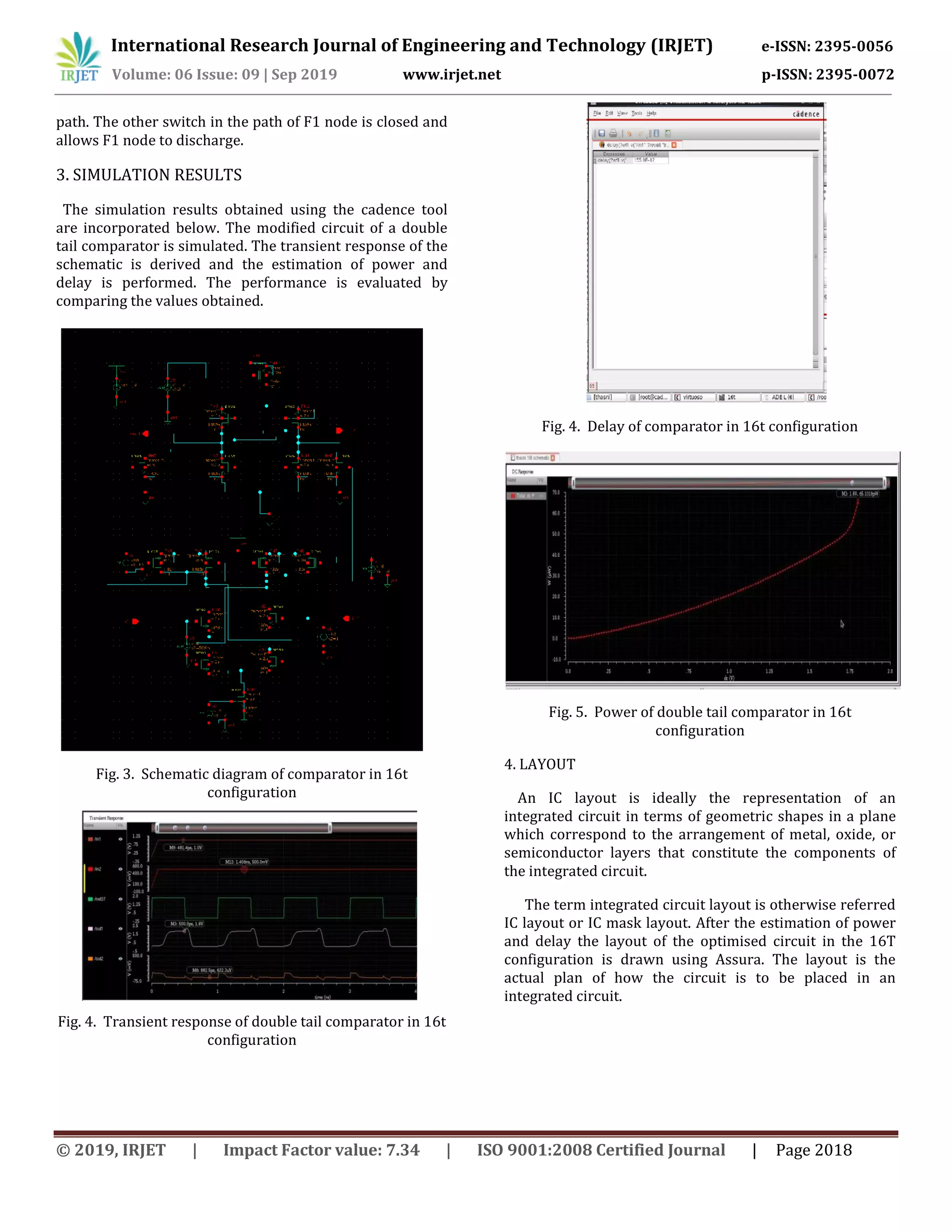
Fig. 4. Delay of comparator in 16t configuration
Fig. 5. Power of double tail comparator in 16t
configuration
4. LAYOUT
An IC layout is ideally the representation of an
integrated circuit in terms of geometric shapes in a plane
which correspond to the arrangement of metal, oxide, or
semiconductor layers that constitute the components of
the integrated circuit.
The term integrated circuit layout is otherwise referred
IC layout or IC mask layout. After the estimation of power
and delay the layout of the optimised circuit in the 16T
configuration is drawn using Assura. The layout is the
actual plan of how the circuit is to be placed in an
integrated circuit.
International Research Journal of Engineering and Technology (IRJET) e-ISSN: 2395-0056
Volume: 06 Issue: 09 | Sep 2019 www.irjet.net p-ISSN: 2395-0072
© 2019, IRJET | Impact Factor value: 7.34 | ISO 9001:2008 Certified Journal | Page 2019
Fig. 7. Layout of double tail comparator in 16t
configuration
5. PHYSICAL VERIFICATION
The process of Physical verification relies upon comparing
and crosschecking an integrated circuit layout (IC layout)
design via EDA software tools to ensure perfect electrical
and logical functionality and feasibility. The steps of
physical verification mainly consists of running a DRC and
LVS in ASSURA.
A. Running a DRC
DRC is a design rule check constraint which check the
physical checks of metal width, pitch and spacing
requirement of different layers with respect to different
manufacturing processes. Whenever we give physical
connection to components we have to consider the DRC
rules. Otherwise it will lead to failure of functionality of a
system.
The main objective of design rule checking is to achieve a
high overall yield and reliability for the design. If the
design rules are violated the design will not function
properly. To meet the goal of improving yields, DRC has
evolved from simple measurement and boolean checks to
more complex set of rules that modify existing features,
insert new features, and check the entire design for
process limitations such as layer density.
A completed layout consists not only of the geometric
representation of the design but also data that provides
support for the manufacturer of the design. While design
rule check do not validate that the design will operate
correctly, they are constructed to verify that the structure
meets the process constraints for the given design.
Fig. 8. Result of DRC run
B. Running LVS
Layout Versus Schematic is the class of electronic design
automation verification software that determines whether
a particular integrated circuit layout corresponds to the
original schematic or circuit diagram of the design. A
successful DRC ensures that the layout conforms to the
rules designed or required for faultless fabrication.
However, it does not guarantee if it really represents the
circuit you desire to fabricate. This is the case where an
LVS check is used.
6. CONCLUSION
This paper proposes a power efficient and high speed
double tail comparator in 180nm CMOS technology.
Different power minimisation techniques are applied for a
better design. The performance of different comparator
architectures have been analyzed in terms of power and
delay. . The comparator architectures are implemented
and performance parameters are analyzed. It is observed
that the performance of conventional comparator modified
using various techniques by adding extra transistors is
found to be better than the conventional structure. The
simulation results obtained for modified comparators
shows that the double tail comparator operate at low
supply voltages, consumes less power and delay and also
the power of the comparator architecture in 16T
configuration is found to be lesser than other architectures
International Research Journal of Engineering and Technology (IRJET) e-ISSN: 2395-0056
Volume: 06 Issue: 09 | Sep 2019 www.irjet.net p-ISSN: 2395-0072
© 2019, IRJET | Impact Factor value: 7.34 | ISO 9001:2008 Certified Journal | Page 2020
Fig. 9. Result of LVS run
Fig. 10. Tabulation of power and delay values obtained
by simulation
Fig. 11. Comparison of results obtained in simulation
ACKNOWLEDGMENT
This project work would not have been possible without
the sincere assistance of a number of eminent people. I
take this opportunity to acknowledge my heartfelt
gratitude to our respected principal Dr. Jalaja M.J for
providing all the necessary facilities in this institution to
complete my work. I express profound and sincere thanks
to Dr.Leena Mary, the project coordinator and Head of the
Department of Electronics and Communication
Engineering for the valuable supervision.
I am deeply indebted to my guide Mrs.Lekshmi T ,Assistant
Professor, Department of Electronics and Communication
Engg. and Mr.Ben P. Babu, Assistant Professor, Department
of Electronics and Communication Engg., for careful
attention and support to my work.I would like to express
my deepest appreciation to my advisor for helping me to
overcome several constraints. I extend my special thanks
to all my friends for their enthusiastic encouragement and
full support. More than anybody else, I am grateful to my
parents for their encouragement, support, and blessing.
REFERENCES
[1] K. Dinesh, P. Giribabu”Area Efficient Low Power Double
tail Comparator Using SwitchingTransistors, ” IJRAET,
Volume 4, Issue1, APR 2015.
[2] Sri Harsha Gubbala, Venkata Sai Rohit Bhagavatula”
Design of a Single Tail Comparatoron a 90nm Technology,”
International Journal of Engineering Research Technology
(IJERT), ISSN:22780181, IJERTV4IS100269 Vol. 4Issue10,
2015.
[3] Vaishnavi Jumade, Prof. Amol Boke”Designing Of
Double Tail Comparator For HighSpeed Application,”
International Research Journal of Engineering and
Technology (IRJET),e-ISSN: 2395 -0056 Volume: 03 Issue:
04 — Apr-2016.
[4] Rahul Jain, K. Dubey”Design of Low-Power High-Speed
Double-Tail Dynamic CMOSComparator using Novel Latch
Structure, ”IEEE International Conference on Electrical,
Computer and Electronics (UPCON)., IEEE 2017.
[5] Ghazal A. Fahmy”A 6.25ghz, 2.7microwatt, 0.5V,
Double-tail Comparator Using Charge-steering Approach,”
IEEE International Conference on Electrical, Computer and
Electronics (UPCON)., IEEE 2017
[6] Amol D. Shinde, Manish Sharma” Low Power, Area
Efficient Dynamic Comparator With Reduced Activity
Factor,” IEEE International Conference on Electrical,
Computer and Electronics (UPCON).,IEEE 2017.
International Research Journal of Engineering and Technology (IRJET) e-ISSN: 2395-0056
Volume: 06 Issue: 09 | Sep 2019 www.irjet.net p-ISSN: 2395-0072
© 2019, IRJET | Impact Factor value: 7.34 | ISO 9001:2008 Certified Journal | Page 2021
[7] Shruti Pancholi ,Dr. R.S.Meena” A New Design of a
CMOS Comparator using 45nmTechnology , ”IJISET ,
International Journal of Innovative Science, Engineering
Technology, Vol. 2 Issue 9, September 2015.,IJISET2015.
[8] Nidhi Tarun, Shruti Suman, P. K. Ghosh” Design of Low
Offset and High Speed CMOS Comparator for Analog to
Digital Converter,” IISET, Innovative Systems Design and
Engineering ISSN 2222-1727 (Paper) ISSN 2222-2871
(Online) Vol.5, No.4, 2014.
[9] Yusuke Okaniwa, Hirotaka Tamura,” A 40-Gb/s CMOS
Clocked Comparator With Bandwidth Modulation
Technique,” IEEE JOURNAL OF SOLID-STATE
CIRCUITS,VOL. 40,NO. 8, AUGUST 2005.
[10] Shweta Jadhav, Sujeet Mishra,”A Design of High Speed
and Low Power Clocked Com-parator,” International
Journal of Engineering Science and Computing, November
2016,Volume6 Issue No. 11,IJESC 2016.
[11] Bao-ni Han, Yin-tang Yang, Zhang-ming Zhu,”A Novel
1.25GSPS Ultra High-Speed Comparator in 180nm
CMOS,”International Institute of Microelectronics, Xidian
University, Xian 710071, China, 2016.

IRJET- A Novel High Speed Power Efficient Double Tail Comparator in 180nm CMOS Technology

  • 1.
    International Research Journalof Engineering and Technology (IRJET) e-ISSN: 2395-0056 Volume: 06 Issue: 09 | Sep 2019 www.irjet.net p-ISSN: 2395-0072 © 2019, IRJET | Impact Factor value: 7.34 | ISO 9001:2008 Certified Journal | Page 2016 A Novel High Speed Power Efficient Double Tail Comparator in 180nm CMOS Technology Thasni G1, Mrs. Lekshmi T.2, Mr. Ben P. Babu3 1PG Scholar, Dept. of ECE, Govt. Engineering College, Idukki 2Asst.Prof, Dept. of ECE, Govt. Engineering College, Idukki 3Asst.Prof, Dept. of ECE, Govt. Engineering College, Idukki, kerala, India. --------------------------------------------------------------------------***------------------------------------------------------------------------- Abstract - Comparator is one of the basic building blocks in most analog to digital converters. Many high speed analog to digital converters require high speed and low power comparators. This paper presents the idea of a new double tail comparator, which is more power efficient and high speed in operation. A model for the comparator is developed and its functionality is verified by showing a comparison of result between the proposed model and the existing models. Initially a study on the conventional comparator is performed. It is followed by the simulation of the circuit. Then the study and simulation of a single tail comparator is performed. The estimation of power and delay is also performed. Later the design and simulation of double tail comparator is performed. The core objective of designing a high speed and power efficient comparator is accomplished. The platform used to develop and analyze the models is cadence virtuoso tool. Keywords: comparator, schematic, simulation, DRC, LVS, layout. 1. INTRODUCTION Comparator is one among the basic building blocks in most analog to digital converters. Comparators compares an analog signal with another analog signal and outputs a binary signal based on the comparison. The comparator can act as a decision-making circuit. The comparator is widely used for converting analog signals to digital signals. Comparators can be classified broadly into dynamic and static comparators depending upon whether its operation is controlled by clock signal. Static latched comparator suffers from high power con-sumption and slow regeneration process and thus is not suit-able for and low power and high-speed applications. Dynamic comparators were proposed to reduce power consumption and enhance comparison speed. It finds application in high-speed ADCs. Many high speed analog to digital converters require high speed and low power comparators. CMOS evolution has reached a point where power is the crucial factor. A major issue is the decreasing supply voltage. The supply voltage has dropped from 5 V in the early nineties down to 1.8 V. Today the drop in supply voltages is expected to cause serious roadblocks for analog circuits, because the signal headroom becomes too small to design circuits with sufficient signal integrity at reasonable power consumption levels. The analog transistor properties are the same for identical bias conditions. But lower supply voltages require biasing at lower operating voltages which results in worse transistor properties, and hence yield circuits with lower performance. The second issue that occurs is the gate leakage. Gate leakage will increase extremely when migrating to newer technologies. When the gate oxide thickness is reduced to the equivalent of one atomic layer, the gate current increases by approximately one order of magnitude. 2. METHODOLOGY This work aims at optimisation of power and delay for the double tail comparator using the different power reduction techniques. The delay and power of the conventional topologies are estimated. Then the analysis and comparison is performed for a better design. Since the proposal aims at power and delay optimisation, a study on existing power reduction techniques is required. The design of a high speed power efficient double tail comparator requires detailed analysis of power in the existing topologies. The detailed analysis and comparison of the different designs is to be performed. 2.1 SINGLE TAIL COMPARATOR A single tail comparator is the conventional dynamic comparator with a tail transistor at its bottom end. The tail transistor present controls the circuit functioning. The clock provided improves the functionality of the circuit as it controls the transistors switching them ON and OFF. The working of the comparator circuit can be explained in two phases namely reset phase and evaluation phase. The operation of the comparator is as follows. During the reset phase when CLK=0 and Mtail is off, reset transistors (M7,M8) pull both output nodes to VDD to define a start condition and to have a valid logical level during reset. During the comparison phase, when CLK=VDD, transistors M7 and M8 are off, and Mtail is on. Output voltage nodes, which had been pre-charged to VDD,
  • 2.
    International Research Journalof Engineering and Technology (IRJET) e-ISSN: 2395-0056 Volume: 06 Issue: 09 | Sep 2019 www.irjet.net p-ISSN: 2395-0072 © 2019, IRJET | Impact Factor value: 7.34 | ISO 9001:2008 Certified Journal | Page 2017 start discharging with different rates depending on the corresponding input voltage. Assuming the case where IN1>IN2, Out1 discharges faster than Out2, the corresponding pMOS transistor (M5) will turn on initiating the latch regeneration caused by back-to-back inverters (M3, M5 and M4, M6). Thus, Out2 pulls to VDD and Out1 discharges to ground. If IN1 <IN2, the circuits works vice versa. Fig. 1. Circuit diagram of a conventional Single tail comparator 2.2 DOUBLE TAIL COMPARATOR The architecture of a Double tail dynamic comparator which is designed to operate at low voltages is shown in the figure. It can be observed from figure that the architecture contains separate input gain stage and output latch stage. This comparator architecture does not require too many transistors and are designed to operate at lower supply voltages when compared to conventional comparators. The double tail architecture contains wider Mtail2 for fast latching and low current in the input stage due to small Mtail1. This small Mtail1 reduces offset and fast latching is found to be independent of the input common- mode voltage (Vcm). At the Reset phase, when CLK=0 both the tail transistors Mtail1 and Mtail2 are in OFF state ,while M3 and M4 transistors makes the fn and fp nodes to be charged to VDD denoting the start condition. During the comparison phase, when CLK=VDD, the tail transistors becomes ON, while the p-mos transistors M3 and M4 turns OFF. Meanwhile voltages at fn and fp nodes start to discharge depending on the input voltages. The two cases depending on the input voltages are: If VINP>VINN, fn starts discharging at a rate faster than the node fp, which results more current in M2 than in M1. If VINN >VINP, fp starts discharging at a rate faster than the node fn. The differential voltage builds up, is passed through the MR1 and MR2 transistors to the back to back cross coupled inverters and protects the circuit from the adverse effects of switching noise called kickback noise [3]. With less stacking, this type of architecture is suited for low supply voltages. But, during reset phase, fn and fp nodes have to be charged from ground to VDD, which increases power consumption. Fig. 2. Circuit diagram of conventional double tail comparator 2.3 DOUBLE TAIL COMPARATOR IN 16T CONFIGURATION The configuration is named so due to the use of a total of 16 transistors in the circuit. It includes seven pmos and nine nmos transistors. The 16T configuration includes the use of two control transistors, two intermediate transistors and two nmos switches. The introduction of these additional transistors leads to reduction in the value of power and delay. The control transistors in the double tail comparator with control transistors architecture form a direct current path from VDD to ground leads to static power consumption. During the reset phase, both the outputs which were precharged to VDD is grounded by the intermediate transistors. Another change in the circuit is the presence of two nmos switches. In order to minimize static power, two NMOS switches [Msw1 and Msw2] are added below the input transistors [IN1 and IN2]. At the beginning of the decision making process, both the switches are closed, since F1 and F2 nodes are charged to VDD. While in evaluation phase nodes F1 and F2 start to reduce with different discharging rates. Switch in the F2 charging path is opened in this case, where F2 is pulling up to the VDD, meanwhile F1 should be discharged completely. This prevents current drawn from VDD to drop through the F2
  • 3.
    International Research Journalof Engineering and Technology (IRJET) e-ISSN: 2395-0056 Volume: 06 Issue: 09 | Sep 2019 www.irjet.net p-ISSN: 2395-0072 © 2019, IRJET | Impact Factor value: 7.34 | ISO 9001:2008 Certified Journal | Page 2018 path. The other switch in the path of F1 node is closed and allows F1 node to discharge. 3. SIMULATION RESULTS The simulation results obtained using the cadence tool are incorporated below. The modified circuit of a double tail comparator is simulated. The transient response of the schematic is derived and the estimation of power and delay is performed. The performance is evaluated by comparing the values obtained. Fig. 3. Schematic diagram of comparator in 16t configuration Fig. 4. Transient response of double tail comparator in 16t configuration Fig. 4. Delay of comparator in 16t configuration Fig. 5. Power of double tail comparator in 16t configuration 4. LAYOUT An IC layout is ideally the representation of an integrated circuit in terms of geometric shapes in a plane which correspond to the arrangement of metal, oxide, or semiconductor layers that constitute the components of the integrated circuit. The term integrated circuit layout is otherwise referred IC layout or IC mask layout. After the estimation of power and delay the layout of the optimised circuit in the 16T configuration is drawn using Assura. The layout is the actual plan of how the circuit is to be placed in an integrated circuit.
  • 4.
    International Research Journalof Engineering and Technology (IRJET) e-ISSN: 2395-0056 Volume: 06 Issue: 09 | Sep 2019 www.irjet.net p-ISSN: 2395-0072 © 2019, IRJET | Impact Factor value: 7.34 | ISO 9001:2008 Certified Journal | Page 2019 Fig. 7. Layout of double tail comparator in 16t configuration 5. PHYSICAL VERIFICATION The process of Physical verification relies upon comparing and crosschecking an integrated circuit layout (IC layout) design via EDA software tools to ensure perfect electrical and logical functionality and feasibility. The steps of physical verification mainly consists of running a DRC and LVS in ASSURA. A. Running a DRC DRC is a design rule check constraint which check the physical checks of metal width, pitch and spacing requirement of different layers with respect to different manufacturing processes. Whenever we give physical connection to components we have to consider the DRC rules. Otherwise it will lead to failure of functionality of a system. The main objective of design rule checking is to achieve a high overall yield and reliability for the design. If the design rules are violated the design will not function properly. To meet the goal of improving yields, DRC has evolved from simple measurement and boolean checks to more complex set of rules that modify existing features, insert new features, and check the entire design for process limitations such as layer density. A completed layout consists not only of the geometric representation of the design but also data that provides support for the manufacturer of the design. While design rule check do not validate that the design will operate correctly, they are constructed to verify that the structure meets the process constraints for the given design. Fig. 8. Result of DRC run B. Running LVS Layout Versus Schematic is the class of electronic design automation verification software that determines whether a particular integrated circuit layout corresponds to the original schematic or circuit diagram of the design. A successful DRC ensures that the layout conforms to the rules designed or required for faultless fabrication. However, it does not guarantee if it really represents the circuit you desire to fabricate. This is the case where an LVS check is used. 6. CONCLUSION This paper proposes a power efficient and high speed double tail comparator in 180nm CMOS technology. Different power minimisation techniques are applied for a better design. The performance of different comparator architectures have been analyzed in terms of power and delay. . The comparator architectures are implemented and performance parameters are analyzed. It is observed that the performance of conventional comparator modified using various techniques by adding extra transistors is found to be better than the conventional structure. The simulation results obtained for modified comparators shows that the double tail comparator operate at low supply voltages, consumes less power and delay and also the power of the comparator architecture in 16T configuration is found to be lesser than other architectures
  • 5.
    International Research Journalof Engineering and Technology (IRJET) e-ISSN: 2395-0056 Volume: 06 Issue: 09 | Sep 2019 www.irjet.net p-ISSN: 2395-0072 © 2019, IRJET | Impact Factor value: 7.34 | ISO 9001:2008 Certified Journal | Page 2020 Fig. 9. Result of LVS run Fig. 10. Tabulation of power and delay values obtained by simulation Fig. 11. Comparison of results obtained in simulation ACKNOWLEDGMENT This project work would not have been possible without the sincere assistance of a number of eminent people. I take this opportunity to acknowledge my heartfelt gratitude to our respected principal Dr. Jalaja M.J for providing all the necessary facilities in this institution to complete my work. I express profound and sincere thanks to Dr.Leena Mary, the project coordinator and Head of the Department of Electronics and Communication Engineering for the valuable supervision. I am deeply indebted to my guide Mrs.Lekshmi T ,Assistant Professor, Department of Electronics and Communication Engg. and Mr.Ben P. Babu, Assistant Professor, Department of Electronics and Communication Engg., for careful attention and support to my work.I would like to express my deepest appreciation to my advisor for helping me to overcome several constraints. I extend my special thanks to all my friends for their enthusiastic encouragement and full support. More than anybody else, I am grateful to my parents for their encouragement, support, and blessing. REFERENCES [1] K. Dinesh, P. Giribabu”Area Efficient Low Power Double tail Comparator Using SwitchingTransistors, ” IJRAET, Volume 4, Issue1, APR 2015. [2] Sri Harsha Gubbala, Venkata Sai Rohit Bhagavatula” Design of a Single Tail Comparatoron a 90nm Technology,” International Journal of Engineering Research Technology (IJERT), ISSN:22780181, IJERTV4IS100269 Vol. 4Issue10, 2015. [3] Vaishnavi Jumade, Prof. Amol Boke”Designing Of Double Tail Comparator For HighSpeed Application,” International Research Journal of Engineering and Technology (IRJET),e-ISSN: 2395 -0056 Volume: 03 Issue: 04 — Apr-2016. [4] Rahul Jain, K. Dubey”Design of Low-Power High-Speed Double-Tail Dynamic CMOSComparator using Novel Latch Structure, ”IEEE International Conference on Electrical, Computer and Electronics (UPCON)., IEEE 2017. [5] Ghazal A. Fahmy”A 6.25ghz, 2.7microwatt, 0.5V, Double-tail Comparator Using Charge-steering Approach,” IEEE International Conference on Electrical, Computer and Electronics (UPCON)., IEEE 2017 [6] Amol D. Shinde, Manish Sharma” Low Power, Area Efficient Dynamic Comparator With Reduced Activity Factor,” IEEE International Conference on Electrical, Computer and Electronics (UPCON).,IEEE 2017.
  • 6.
    International Research Journalof Engineering and Technology (IRJET) e-ISSN: 2395-0056 Volume: 06 Issue: 09 | Sep 2019 www.irjet.net p-ISSN: 2395-0072 © 2019, IRJET | Impact Factor value: 7.34 | ISO 9001:2008 Certified Journal | Page 2021 [7] Shruti Pancholi ,Dr. R.S.Meena” A New Design of a CMOS Comparator using 45nmTechnology , ”IJISET , International Journal of Innovative Science, Engineering Technology, Vol. 2 Issue 9, September 2015.,IJISET2015. [8] Nidhi Tarun, Shruti Suman, P. K. Ghosh” Design of Low Offset and High Speed CMOS Comparator for Analog to Digital Converter,” IISET, Innovative Systems Design and Engineering ISSN 2222-1727 (Paper) ISSN 2222-2871 (Online) Vol.5, No.4, 2014. [9] Yusuke Okaniwa, Hirotaka Tamura,” A 40-Gb/s CMOS Clocked Comparator With Bandwidth Modulation Technique,” IEEE JOURNAL OF SOLID-STATE CIRCUITS,VOL. 40,NO. 8, AUGUST 2005. [10] Shweta Jadhav, Sujeet Mishra,”A Design of High Speed and Low Power Clocked Com-parator,” International Journal of Engineering Science and Computing, November 2016,Volume6 Issue No. 11,IJESC 2016. [11] Bao-ni Han, Yin-tang Yang, Zhang-ming Zhu,”A Novel 1.25GSPS Ultra High-Speed Comparator in 180nm CMOS,”International Institute of Microelectronics, Xidian University, Xian 710071, China, 2016.