ANATOMY
&
PHYSIOLOGY
GIANT CLAM
&
FISH
INTRODUCTION:
• CLAM is an informal term refers to any molluscan within class Bivalvia
• 1st appeared in cambrian age rocks 510 million years ago.
• They presently live in both freshwater and marine habitats, and range
in adult size from nearly microscopic to the giant clam, which can
weigh 200kg (440 lb). Some have life cycles of only one year, while at
least one has been discovered that may be over 500 years old.
• All clams have two calcareous shells or valves joined near a hinge
structure with a flexible ligament, and all are filter feeders.
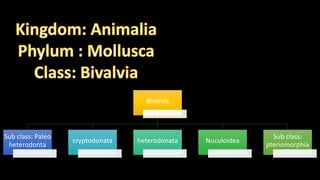
Bivalvia
Sub class: Paleo
heterodonta
cryptodonata heterodonata Nuculoidea
Sub class:
pteriomorphia
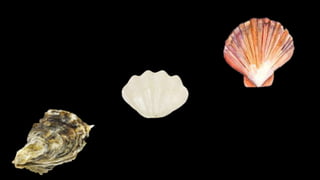
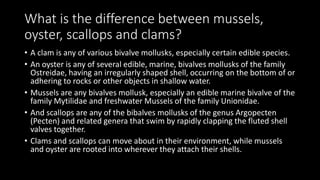
What is the difference between mussels,
oyster, scallops and clams?
• A clam is any of various bivalve mollusks, especially certain edible species.
• An oyster is any of several edible, marine, bivalves mollusks of the family
Ostreidae, having an irregularly shaped shell, occurring on the bottom of or
adhering to rocks or other objects in shallow water.
• Mussels are any bivalves mollusk, especially an edible marine bivalve of the
family Mytilidae and freshwater Mussels of the family Unionidae.
• And scallops are any of the bibalves mollusks of the genus Argopecten
(Pecten) and related genera that swim by rapidly clapping the fluted shell
valves together.
• Clams and scallops can move about in their environment, while mussels
and oyster are rooted into wherever they attach their shells.
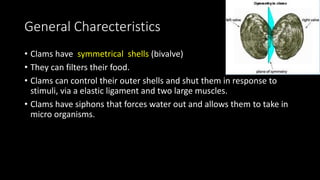
General Charecteristics
• Clams have symmetrical shells (bivalve)
• They can filters their food.
• Clams can control their outer shells and shut them in response to
stimuli, via a elastic ligament and two large muscles.
• Clams have siphons that forces water out and allows them to take in
micro organisms.

Distribution and habitat
• Marine clams are abundant in the low and mid intertidal zone in
temperate seas globally. Other species of marine mussel live in
tropical intertidal areas, but nit in the same huge numbers as in
temperate zones.
• Certain species of marine clams prefer salt marshes or quiet bays,
while others thrive in pounding surf, completely covering wave
washed rocks.
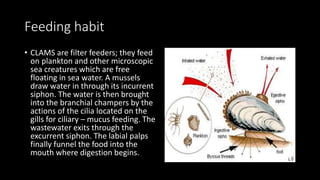
Feeding habit
• CLAMS are filter feeders; they feed
on plankton and other microscopic
sea creatures which are free
floating in sea water. A mussels
draw water in through its incurrent
siphon. The water is then brought
into the branchial champers by the
actions of the cilia located on the
gills for ciliary – mucus feeding. The
wastewater exits through the
excurrent siphon. The labial palps
finally funnel the food into the
mouth where digestion begins.
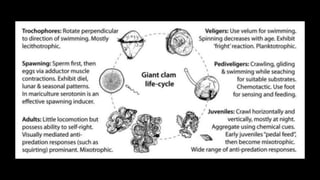
LIFE CYCLE
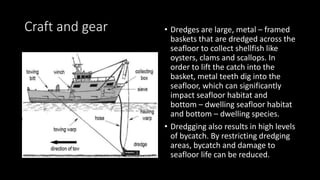
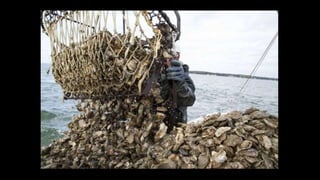
Craft and gear • Dredges are large, metal – framed
baskets that are dredged across the
seafloor to collect shellfish like
oysters, clams and scallops. In
order to lift the catch into the
basket, metal teeth dig into the
seafloor, which can significantly
impact seafloor habitat and
bottom – dwelling seafloor habitat
and bottom – dwelling species.
• Dredgging also results in high levels
of bycatch. By restricting dredging
areas, bycatch and damage to
seafloor life can be reduced.
Conclusion:
• There are over 150 edible species.
• There are over 15,000 species of clams.
• Small freshwater clams fertilize eggs in a pouch and bear their young
until its shells develops.
• The giant clam can weigh more than 400lb and live for over 150 years
• It takes 3 – 4 years for a clam to mature to market size.
• Some clams can produce pearls. One in 5,000 clams forms a pearl.
• A clam can live until about 35 years if not eaten.
Classification
•Kingdom- Animalia
•Phylum- Chordata
•Sub Phylum- Vertebrata
•Classes- Agnatha, Chondrichthyes,
Osteichthyes
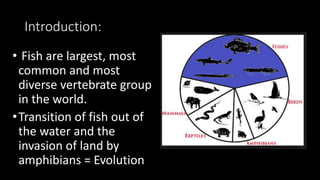
Introduction:
• Fish are largest, most
common and most
diverse vertebrate group
in the world.
•Transition of fish out of
the water and the
invasion of land by
amphibians = Evolution
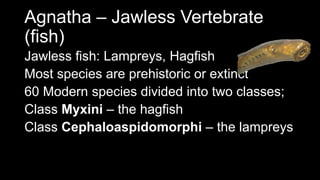
Agnatha – Jawless Vertebrate
(fish)
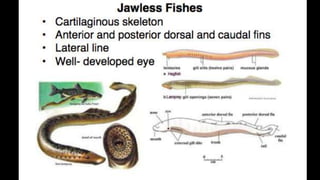
Jawless fish: Lampreys, Hagfish
Most species are prehistoric or extinct
60 Modern species divided into two classes;
Class Myxini – the hagfish
Class Cephaloaspidomorphi – the lampreys
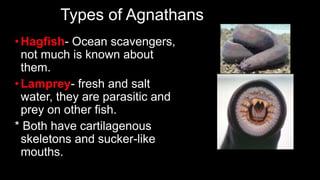
Types of Agnathans
•Hagfish- Ocean scavengers,
not much is known about
them.
•Lamprey- fresh and salt
water, they are parasitic and
prey on other fish.
* Both have cartilagenous
skeletons and sucker-like
mouths.
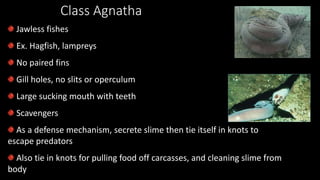
Class Agnatha
Jawless fishes
Ex. Hagfish, lampreys
No paired fins
Gill holes, no slits or operculum
Large sucking mouth with teeth
Scavengers
As a defense mechanism, secrete slime then tie itself in knots to
escape predators
Also tie in knots for pulling food off carcasses, and cleaning slime from
body
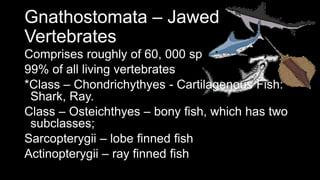
Gnathostomata – Jawed
Vertebrates
Comprises roughly of 60, 000 sp
99% of all living vertebrates
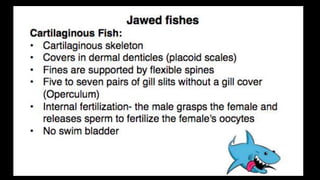
*Class – Chondrichythyes - Cartilagenous Fish:
Shark, Ray.
Class – Osteichthyes – bony fish, which has two
subclasses;
Sarcopterygii – lobe finned fish
Actinopterygii – ray finned fish
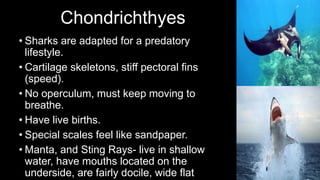
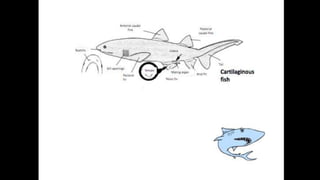
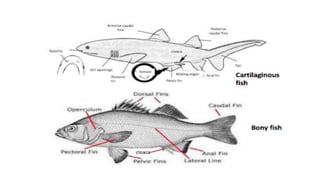
Chondrichthyes
• Sharks are adapted for a predatory
lifestyle.
• Cartilage skeletons, stiff pectoral fins
(speed).
• No operculum, must keep moving to
breathe.
• Have live births.
• Special scales feel like sandpaper.
• Manta, and Sting Rays- live in shallow
water, have mouths located on the
underside, are fairly docile, wide flat
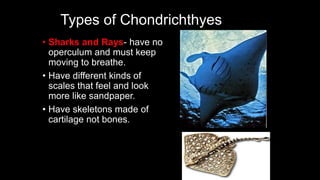
Types of Chondrichthyes
• Sharks and Rays- have no
operculum and must keep
moving to breathe.
• Have different kinds of
scales that feel and look
more like sandpaper.
• Have skeletons made of
cartilage not bones.
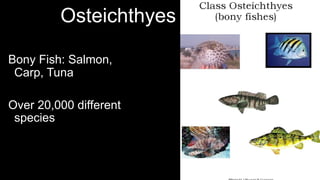
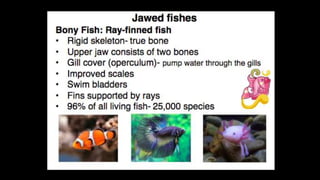
Osteichthyes
Bony Fish: Salmon,
Carp, Tuna
Over 20,000 different
species
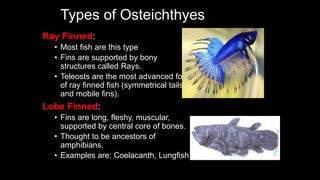
Types of Osteichthyes
Ray Finned:
• Most fish are this type
• Fins are supported by bony
structures called Rays.
• Teleosts are the most advanced form
of ray finned fish (symmetrical tails
and mobile fins).
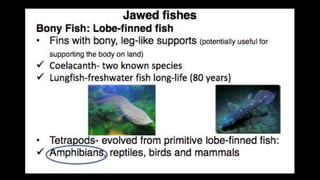
Lobe Finned:
• Fins are long, fleshy, muscular,
supported by central core of bones.
• Thought to be ancestors of
amphibians.
• Examples are: Coelacanth, Lungfish
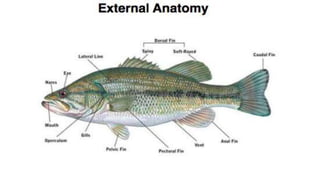
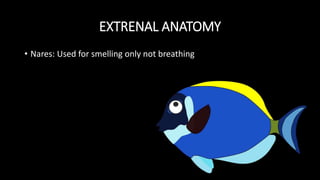
EXTRENAL ANATOMY
• Nares: Used for smelling only not breathing
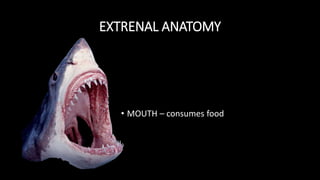
EXTRENAL ANATOMY
• MOUTH – consumes food
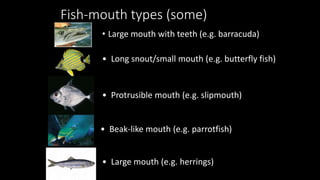
Fish-mouth types (some)
• Large mouth with teeth (e.g. barracuda)
• Long snout/small mouth (e.g. butterfly fish)
• Protrusible mouth (e.g. slipmouth)
• Large mouth (e.g. herrings)
• Beak-like mouth (e.g. parrotfish)
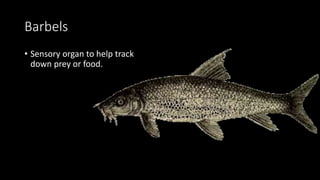
Barbels
• Sensory organ to help track
down prey or food.
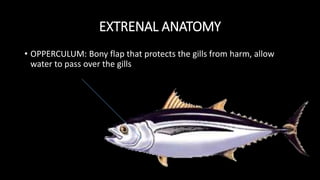
EXTRENAL ANATOMY
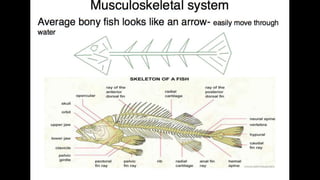
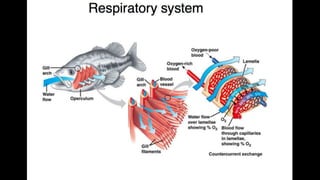
• OPPERCULUM: Bony flap that protects the gills from harm, allow
water to pass over the gills
FISH SENSES
• Eyesight:
• Two directions, one eye focusing on an object
• independent of the other (human’s eyes can only focus on one
object at a time)
• Hearing:
• No external ear openings, sound travels faster in water than in air.
Fish have internal ears with pairs of inner ear bones
• called otoliths. Which allows fish to sense sounds in the water.
• Otoliths can be used to determine fish age and the heal the Smell:
• Locate food and to aid in migrating
• Taste:
• Some fish have taste buds located on the outside of
the fish’s head and fins in small pores
• Lateral Line: Alongside a fish’s body from the
operculum to the tail,
• senses vibrations or movements in the water. Fish can
locate predators and find prey
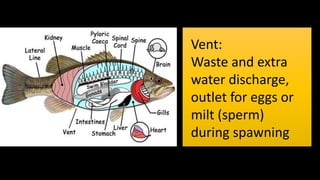
Vent:
Waste and extra
water discharge,
outlet for eggs or
milt (sperm)
during spawning
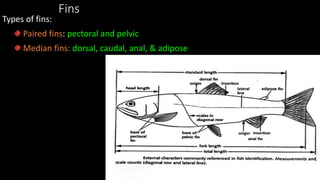
Fins
Types of fins:
Paired fins: pectoral and pelvic
Median fins: dorsal, caudal, anal, & adipose
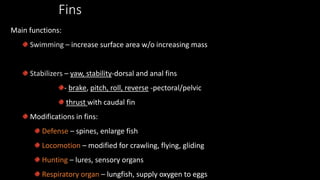
Fins
Main functions:
Swimming – increase surface area w/o increasing mass
Stabilizers – yaw, stability-dorsal and anal fins
- brake, pitch, roll, reverse -pectoral/pelvic
thrust with caudal fin
Modifications in fins:
Defense – spines, enlarge fish
Locomotion – modified for crawling, flying, gliding
Hunting – lures, sensory organs
Respiratory organ – lungfish, supply oxygen to eggs
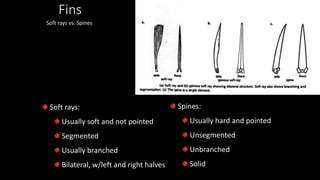
Fins
Soft rays vs. Spines
Soft rays:
Usually soft and not pointed
Segmented
Usually branched
Bilateral, w/left and right halves
Spines:
Usually hard and pointed
Unsegmented
Unbranched
Solid
EXTRENAL ANATOMY
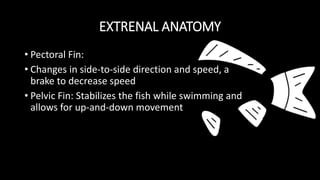
• Pectoral Fin:
• Changes in side-to-side direction and speed, a
brake to decrease speed
• Pelvic Fin: Stabilizes the fish while swimming and
allows for up-and-down movement
EXTRENAL ANATOMY
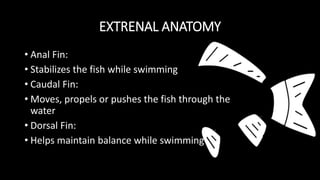
• Anal Fin:
• Stabilizes the fish while swimming
• Caudal Fin:
• Moves, propels or pushes the fish through the
water
• Dorsal Fin:
• Helps maintain balance while swimming
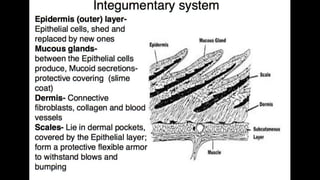
Fish Morphology
Skin
Color
Bioluminescence
Swimming Locomotion
Fins
Muscles
Skin
Organ of the body
Consists of connective tissue
Muscles pull against skin tissue & skeleton
Key component of the muscle-tendon-tail fin system
Layers
Epidermis
Typically 250 m thick  10-30 cell layers
Range 20 m – 3 mm
Dermis
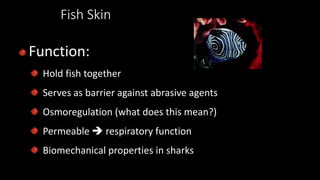
Fish Skin
Function:
Hold fish together
Serves as barrier against abrasive agents
Osmoregulation (what does this mean?)
Permeable  respiratory function
Biomechanical properties in sharks
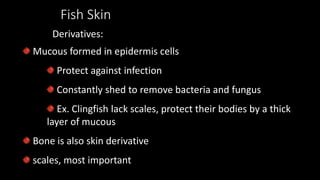
Fish Skin
Mucous formed in epidermis cells
Protect against infection
Constantly shed to remove bacteria and fungus
Ex. Clingfish lack scales, protect their bodies by a thick
layer of mucous
Bone is also skin derivative
scales, most important
Derivatives:
Fish ScalesFirst appear as dermal bone
Found in fossil of Cambrian period (570 mya)
Layered bone, solid armor-constrained movement
Evolved smaller and reduced into scales
5 types of scales (examples with images to follow)
Placoid
Cosmoid
Ganoid
Cycloid
Ctenoid
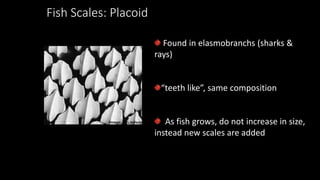
Fish Scales: Placoid
Found in elasmobranchs (sharks &
rays)
“teeth like”, same composition
As fish grows, do not increase in size,
instead new scales are added
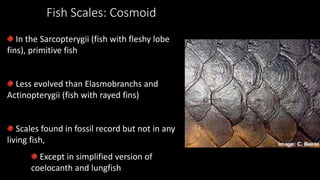
Fish Scales: Cosmoid
In the Sarcopterygii (fish with fleshy lobe
fins), primitive fish
Less evolved than Elasmobranchs and
Actinopterygii (fish with rayed fins)
Scales found in fossil record but not in any
living fish,
Except in simplified version of
coelocanth and lungfish
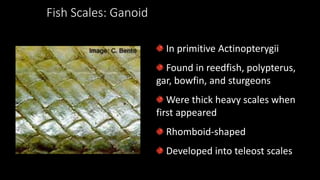
Fish Scales: Ganoid
In primitive Actinopterygii
Found in reedfish, polypterus,
gar, bowfin, and sturgeons
Were thick heavy scales when
first appeared
Rhomboid-shaped
Developed into teleost scales
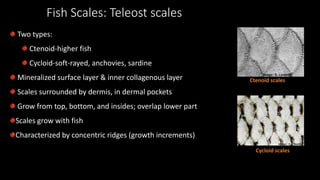
Fish Scales: Teleost scales
Ctenoid scales
Cycloid scales
Two types:
Ctenoid-higher fish
Cycloid-soft-rayed, anchovies, sardine
Mineralized surface layer & inner collagenous layer
Scales surrounded by dermis, in dermal pockets
Grow from top, bottom, and insides; overlap lower part
Scales grow with fish
Characterized by concentric ridges (growth increments)
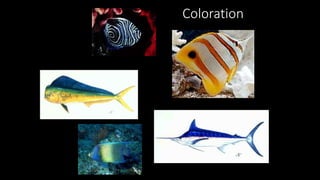
Coloration
Coloration
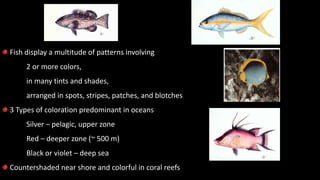
Fish display a multitude of patterns involving
2 or more colors,
in many tints and shades,
arranged in spots, stripes, patches, and blotches
3 Types of coloration predominant in oceans
Silver – pelagic, upper zone
Red – deeper zone (~ 500 m)
Black or violet – deep sea
Countershaded near shore and colorful in coral reefs
Coloration
Chromatophores
Colored cells from which light is reflected off
Located in the skin (dermis), eyes
Various colors/hues-combination of different chromatophores
Functional Roles of Colors in Fishes-examples of each to follow
Social Roles
Advertisement
Mimicry
Hiding
Protection from sun (especially larvae)
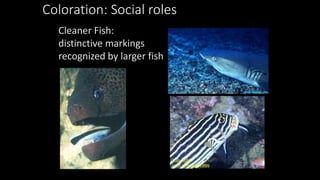
Coloration: Social roles
Cleaner Fish:
distinctive markings
recognized by larger fish
Coloration:
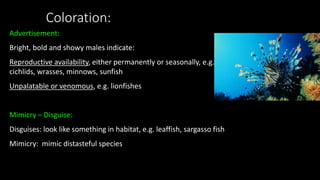
Advertisement:
Bright, bold and showy males indicate:
Reproductive availability, either permanently or seasonally, e.g.
cichlids, wrasses, minnows, sunfish
Unpalatable or venomous, e.g. lionfishes
Mimicry – Disguise:
Disguises: look like something in habitat, e.g. leaffish, sargasso fish
Mimicry: mimic distasteful species
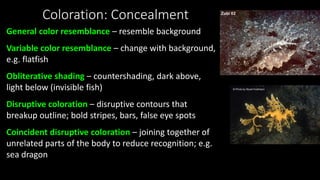
Coloration: Concealment
General color resemblance – resemble background
Variable color resemblance – change with background,
e.g. flatfish
Obliterative shading – countershading, dark above,
light below (invisible fish)
Disruptive coloration – disruptive contours that
breakup outline; bold stripes, bars, false eye spots
Coincident disruptive coloration – joining together of
unrelated parts of the body to reduce recognition; e.g.
sea dragon
Bioluminescence
Most luminous fish found 300-1000 m depths, few shallow
3 Types of light producing methods:
Self-luminous (on/off)
Symbiotic bacteria nurtured in special glands
Acquire from other bioluminescent organisms- diet contains light-emitting
compounds
Function:
Concealment by counter-illumination - ventral placement matches background from
above, against attack from below
Dorsal photophores safeguard against predators from above
Advertisement for courting, maintaining territory, to startle and confuse predators, and
feeding
LATERAL LINE -
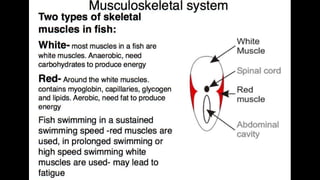
Fish Muscles
Muscles provide power for swimming
Myomers=bands of muscle, run along sides of body, attached to backbone
Constitute up to 80% of the fish itself
Much hardly used except during emergencies
Don’t have to contend with same effect of gravity
Fish muscle arrangement not suitable on land
Cow: 30% muscle/wt
Tuna: 60% muscle/wt
Contraction causes oscillation of body and tail
Body bends as one side contracts b/c of an incompressible
notochord or vertebral column
Caused by bands of muscle = myomeres
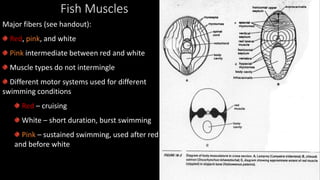
Fish Muscles
Major fibers (see handout):
Red, pink, and white
Pink intermediate between red and white
Muscle types do not intermingle
Different motor systems used for different
swimming conditions
Red – cruising
White – short duration, burst swimming
Pink – sustained swimming, used after red
and before white
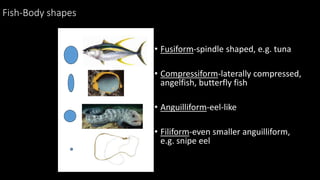
Fish-Body shapes
• Fusiform-spindle shaped, e.g. tuna
• Compressiform-laterally compressed,
angelfish, butterfly fish
• Anguilliform-eel-like
• Filiform-even smaller anguilliform,
e.g. snipe eel
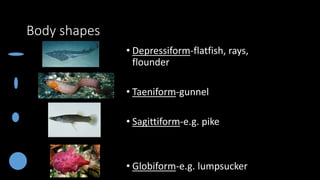
Body shapes
• Depressiform-flatfish, rays,
flounder
• Taeniform-gunnel
• Sagittiform-e.g. pike
• Globiform-e.g. lumpsucker
Fish Adaptations
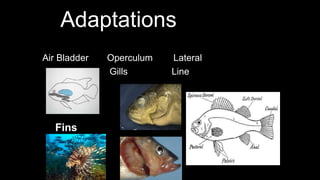
• Lateral Line System- used to detect vibrations, orient
the fish in water, it is a line of cells running down the side
of the fish.
• Operculum- gill cover, movement of operculum allows
more water to be drawn in.
• Swim Bladder- a gas filled sac that helps the fish
maintain buoyancy. Sharks don’t have a swim bladder!
• Fins- Dorsal, Caudal, Pectoral, Pelvic, Anal.
Adaptations
Air Bladder Operculum Lateral
Gills Line
Fins
Anatomy & Physiology - Giant Clam & fish

Anatomy & Physiology - Giant Clam & fish

  • 1.
  • 2.
    INTRODUCTION: • CLAM isan informal term refers to any molluscan within class Bivalvia • 1st appeared in cambrian age rocks 510 million years ago. • They presently live in both freshwater and marine habitats, and range in adult size from nearly microscopic to the giant clam, which can weigh 200kg (440 lb). Some have life cycles of only one year, while at least one has been discovered that may be over 500 years old. • All clams have two calcareous shells or valves joined near a hinge structure with a flexible ligament, and all are filter feeders.
  • 3.
    Bivalvia Sub class: Paleo heterodonta cryptodonataheterodonata Nuculoidea Sub class: pteriomorphia
  • 5.
    What is thedifference between mussels, oyster, scallops and clams? • A clam is any of various bivalve mollusks, especially certain edible species. • An oyster is any of several edible, marine, bivalves mollusks of the family Ostreidae, having an irregularly shaped shell, occurring on the bottom of or adhering to rocks or other objects in shallow water. • Mussels are any bivalves mollusk, especially an edible marine bivalve of the family Mytilidae and freshwater Mussels of the family Unionidae. • And scallops are any of the bibalves mollusks of the genus Argopecten (Pecten) and related genera that swim by rapidly clapping the fluted shell valves together. • Clams and scallops can move about in their environment, while mussels and oyster are rooted into wherever they attach their shells.
  • 6.
    General Charecteristics • Clamshave symmetrical shells (bivalve) • They can filters their food. • Clams can control their outer shells and shut them in response to stimuli, via a elastic ligament and two large muscles. • Clams have siphons that forces water out and allows them to take in micro organisms.
  • 8.
    Distribution and habitat •Marine clams are abundant in the low and mid intertidal zone in temperate seas globally. Other species of marine mussel live in tropical intertidal areas, but nit in the same huge numbers as in temperate zones. • Certain species of marine clams prefer salt marshes or quiet bays, while others thrive in pounding surf, completely covering wave washed rocks.
  • 9.
    Feeding habit • CLAMSare filter feeders; they feed on plankton and other microscopic sea creatures which are free floating in sea water. A mussels draw water in through its incurrent siphon. The water is then brought into the branchial champers by the actions of the cilia located on the gills for ciliary – mucus feeding. The wastewater exits through the excurrent siphon. The labial palps finally funnel the food into the mouth where digestion begins.
  • 10.
  • 13.
    Craft and gear• Dredges are large, metal – framed baskets that are dredged across the seafloor to collect shellfish like oysters, clams and scallops. In order to lift the catch into the basket, metal teeth dig into the seafloor, which can significantly impact seafloor habitat and bottom – dwelling seafloor habitat and bottom – dwelling species. • Dredgging also results in high levels of bycatch. By restricting dredging areas, bycatch and damage to seafloor life can be reduced.
  • 15.
    Conclusion: • There areover 150 edible species. • There are over 15,000 species of clams. • Small freshwater clams fertilize eggs in a pouch and bear their young until its shells develops. • The giant clam can weigh more than 400lb and live for over 150 years • It takes 3 – 4 years for a clam to mature to market size. • Some clams can produce pearls. One in 5,000 clams forms a pearl. • A clam can live until about 35 years if not eaten.
  • 17.
    Classification •Kingdom- Animalia •Phylum- Chordata •SubPhylum- Vertebrata •Classes- Agnatha, Chondrichthyes, Osteichthyes
  • 18.
    Introduction: • Fish arelargest, most common and most diverse vertebrate group in the world. •Transition of fish out of the water and the invasion of land by amphibians = Evolution
  • 19.
    Agnatha – JawlessVertebrate (fish) Jawless fish: Lampreys, Hagfish Most species are prehistoric or extinct 60 Modern species divided into two classes; Class Myxini – the hagfish Class Cephaloaspidomorphi – the lampreys
  • 20.
    Types of Agnathans •Hagfish-Ocean scavengers, not much is known about them. •Lamprey- fresh and salt water, they are parasitic and prey on other fish. * Both have cartilagenous skeletons and sucker-like mouths.
  • 21.
    Class Agnatha Jawless fishes Ex.Hagfish, lampreys No paired fins Gill holes, no slits or operculum Large sucking mouth with teeth Scavengers As a defense mechanism, secrete slime then tie itself in knots to escape predators Also tie in knots for pulling food off carcasses, and cleaning slime from body
  • 23.
    Gnathostomata – Jawed Vertebrates Comprisesroughly of 60, 000 sp 99% of all living vertebrates *Class – Chondrichythyes - Cartilagenous Fish: Shark, Ray. Class – Osteichthyes – bony fish, which has two subclasses; Sarcopterygii – lobe finned fish Actinopterygii – ray finned fish
  • 24.
    Chondrichthyes • Sharks areadapted for a predatory lifestyle. • Cartilage skeletons, stiff pectoral fins (speed). • No operculum, must keep moving to breathe. • Have live births. • Special scales feel like sandpaper. • Manta, and Sting Rays- live in shallow water, have mouths located on the underside, are fairly docile, wide flat
  • 25.
    Types of Chondrichthyes •Sharks and Rays- have no operculum and must keep moving to breathe. • Have different kinds of scales that feel and look more like sandpaper. • Have skeletons made of cartilage not bones.
  • 28.
    Osteichthyes Bony Fish: Salmon, Carp,Tuna Over 20,000 different species
  • 29.
    Types of Osteichthyes RayFinned: • Most fish are this type • Fins are supported by bony structures called Rays. • Teleosts are the most advanced form of ray finned fish (symmetrical tails and mobile fins). Lobe Finned: • Fins are long, fleshy, muscular, supported by central core of bones. • Thought to be ancestors of amphibians. • Examples are: Coelacanth, Lungfish
  • 34.
    EXTRENAL ANATOMY • Nares:Used for smelling only not breathing
  • 35.
    EXTRENAL ANATOMY • MOUTH– consumes food
  • 36.
    Fish-mouth types (some) •Large mouth with teeth (e.g. barracuda) • Long snout/small mouth (e.g. butterfly fish) • Protrusible mouth (e.g. slipmouth) • Large mouth (e.g. herrings) • Beak-like mouth (e.g. parrotfish)
  • 37.
    Barbels • Sensory organto help track down prey or food.
  • 38.
    EXTRENAL ANATOMY • OPPERCULUM:Bony flap that protects the gills from harm, allow water to pass over the gills
  • 39.
    FISH SENSES • Eyesight: •Two directions, one eye focusing on an object • independent of the other (human’s eyes can only focus on one object at a time) • Hearing: • No external ear openings, sound travels faster in water than in air. Fish have internal ears with pairs of inner ear bones • called otoliths. Which allows fish to sense sounds in the water. • Otoliths can be used to determine fish age and the heal the Smell: • Locate food and to aid in migrating
  • 40.
    • Taste: • Somefish have taste buds located on the outside of the fish’s head and fins in small pores • Lateral Line: Alongside a fish’s body from the operculum to the tail, • senses vibrations or movements in the water. Fish can locate predators and find prey
  • 41.
    Vent: Waste and extra waterdischarge, outlet for eggs or milt (sperm) during spawning
  • 42.
    Fins Types of fins: Pairedfins: pectoral and pelvic Median fins: dorsal, caudal, anal, & adipose
  • 43.
    Fins Main functions: Swimming –increase surface area w/o increasing mass Stabilizers – yaw, stability-dorsal and anal fins - brake, pitch, roll, reverse -pectoral/pelvic thrust with caudal fin Modifications in fins: Defense – spines, enlarge fish Locomotion – modified for crawling, flying, gliding Hunting – lures, sensory organs Respiratory organ – lungfish, supply oxygen to eggs
  • 44.
    Fins Soft rays vs.Spines Soft rays: Usually soft and not pointed Segmented Usually branched Bilateral, w/left and right halves Spines: Usually hard and pointed Unsegmented Unbranched Solid
  • 45.
    EXTRENAL ANATOMY • PectoralFin: • Changes in side-to-side direction and speed, a brake to decrease speed • Pelvic Fin: Stabilizes the fish while swimming and allows for up-and-down movement
  • 46.
    EXTRENAL ANATOMY • AnalFin: • Stabilizes the fish while swimming • Caudal Fin: • Moves, propels or pushes the fish through the water • Dorsal Fin: • Helps maintain balance while swimming
  • 47.
  • 48.
    Skin Organ of thebody Consists of connective tissue Muscles pull against skin tissue & skeleton Key component of the muscle-tendon-tail fin system Layers Epidermis Typically 250 m thick  10-30 cell layers Range 20 m – 3 mm Dermis
  • 49.
    Fish Skin Function: Hold fishtogether Serves as barrier against abrasive agents Osmoregulation (what does this mean?) Permeable  respiratory function Biomechanical properties in sharks
  • 50.
    Fish Skin Mucous formedin epidermis cells Protect against infection Constantly shed to remove bacteria and fungus Ex. Clingfish lack scales, protect their bodies by a thick layer of mucous Bone is also skin derivative scales, most important Derivatives:
  • 51.
    Fish ScalesFirst appearas dermal bone Found in fossil of Cambrian period (570 mya) Layered bone, solid armor-constrained movement Evolved smaller and reduced into scales 5 types of scales (examples with images to follow) Placoid Cosmoid Ganoid Cycloid Ctenoid
  • 52.
    Fish Scales: Placoid Foundin elasmobranchs (sharks & rays) “teeth like”, same composition As fish grows, do not increase in size, instead new scales are added
  • 53.
    Fish Scales: Cosmoid Inthe Sarcopterygii (fish with fleshy lobe fins), primitive fish Less evolved than Elasmobranchs and Actinopterygii (fish with rayed fins) Scales found in fossil record but not in any living fish, Except in simplified version of coelocanth and lungfish
  • 54.
    Fish Scales: Ganoid Inprimitive Actinopterygii Found in reedfish, polypterus, gar, bowfin, and sturgeons Were thick heavy scales when first appeared Rhomboid-shaped Developed into teleost scales
  • 55.
    Fish Scales: Teleostscales Ctenoid scales Cycloid scales Two types: Ctenoid-higher fish Cycloid-soft-rayed, anchovies, sardine Mineralized surface layer & inner collagenous layer Scales surrounded by dermis, in dermal pockets Grow from top, bottom, and insides; overlap lower part Scales grow with fish Characterized by concentric ridges (growth increments)
  • 56.
  • 57.
    Coloration Fish display amultitude of patterns involving 2 or more colors, in many tints and shades, arranged in spots, stripes, patches, and blotches 3 Types of coloration predominant in oceans Silver – pelagic, upper zone Red – deeper zone (~ 500 m) Black or violet – deep sea Countershaded near shore and colorful in coral reefs
  • 58.
    Coloration Chromatophores Colored cells fromwhich light is reflected off Located in the skin (dermis), eyes Various colors/hues-combination of different chromatophores Functional Roles of Colors in Fishes-examples of each to follow Social Roles Advertisement Mimicry Hiding Protection from sun (especially larvae)
  • 59.
    Coloration: Social roles CleanerFish: distinctive markings recognized by larger fish
  • 60.
    Coloration: Advertisement: Bright, bold andshowy males indicate: Reproductive availability, either permanently or seasonally, e.g. cichlids, wrasses, minnows, sunfish Unpalatable or venomous, e.g. lionfishes Mimicry – Disguise: Disguises: look like something in habitat, e.g. leaffish, sargasso fish Mimicry: mimic distasteful species
  • 61.
    Coloration: Concealment General colorresemblance – resemble background Variable color resemblance – change with background, e.g. flatfish Obliterative shading – countershading, dark above, light below (invisible fish) Disruptive coloration – disruptive contours that breakup outline; bold stripes, bars, false eye spots Coincident disruptive coloration – joining together of unrelated parts of the body to reduce recognition; e.g. sea dragon
  • 62.
    Bioluminescence Most luminous fishfound 300-1000 m depths, few shallow 3 Types of light producing methods: Self-luminous (on/off) Symbiotic bacteria nurtured in special glands Acquire from other bioluminescent organisms- diet contains light-emitting compounds Function: Concealment by counter-illumination - ventral placement matches background from above, against attack from below Dorsal photophores safeguard against predators from above Advertisement for courting, maintaining territory, to startle and confuse predators, and feeding
  • 63.
  • 64.
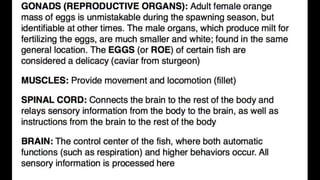
    Fish Muscles Muscles providepower for swimming Myomers=bands of muscle, run along sides of body, attached to backbone Constitute up to 80% of the fish itself Much hardly used except during emergencies Don’t have to contend with same effect of gravity Fish muscle arrangement not suitable on land Cow: 30% muscle/wt Tuna: 60% muscle/wt Contraction causes oscillation of body and tail Body bends as one side contracts b/c of an incompressible notochord or vertebral column Caused by bands of muscle = myomeres
  • 65.
    Fish Muscles Major fibers(see handout): Red, pink, and white Pink intermediate between red and white Muscle types do not intermingle Different motor systems used for different swimming conditions Red – cruising White – short duration, burst swimming Pink – sustained swimming, used after red and before white
  • 66.
    Fish-Body shapes • Fusiform-spindleshaped, e.g. tuna • Compressiform-laterally compressed, angelfish, butterfly fish • Anguilliform-eel-like • Filiform-even smaller anguilliform, e.g. snipe eel
  • 67.
    Body shapes • Depressiform-flatfish,rays, flounder • Taeniform-gunnel • Sagittiform-e.g. pike • Globiform-e.g. lumpsucker
  • 68.
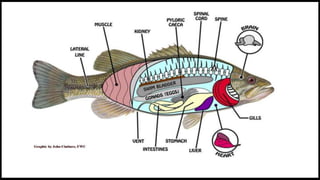
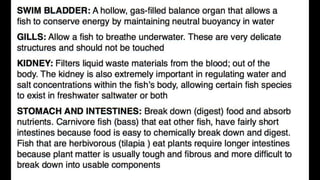
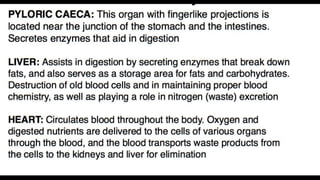
    Fish Adaptations • LateralLine System- used to detect vibrations, orient the fish in water, it is a line of cells running down the side of the fish. • Operculum- gill cover, movement of operculum allows more water to be drawn in. • Swim Bladder- a gas filled sac that helps the fish maintain buoyancy. Sharks don’t have a swim bladder! • Fins- Dorsal, Caudal, Pectoral, Pelvic, Anal.
  • 69.
    Adaptations Air Bladder OperculumLateral Gills Line Fins