INDIAN MAJOR CARPS
80% of freshwater farming constituted by carps and other cyprinids globally.
Indian major carps- CATLA, ROHU, MRIGAL- Indo Gangetic riverine systems of India
Common carp- Cyprinus carpio enjoys a world wide distribution
Silver barb- Puntius gonionotus main native carp species of Thailand.


REPRODUCTIVE BIOLOGY

Bisexual, sexes can be distinguished only during the breeding season

Males- Pectoral fin- has rough dorsal surface , longer than that in female
       Genital aperture not very prominent , milt oozes out
       Belly Not swollen

Females- Dorsal side of Pect. Fin smooth.
        Genital aperture reddish and swollen
        Belly is soft and bulging
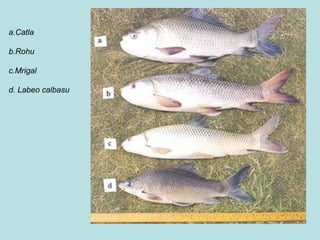
a.Catla

b.Rohu

c.Mrigal

d. Labeo calbasu
 All 3 major carps attain sexual maturity in the second year
 Males mature earlier than female
 Carps of 2+ years and up to 5 years are preferred for breeding.

 Spawning season
 Seasonal riverine spawners, spawning during the southwest monsoon.
 DONOT spawn in confined waters.

STRUCTURE OF EGG
 A FRESHLY LAID unfertilised egg consists of cyotplasm filled with yolk
 Nucleus is at the animal pole
 Oocyte is surrounded by a vitelline membrane ,which is enclosed in a
  chorion/shell .
 Narrow opening called the micropyle is present on this chorion.

 AFTER FERTILIZATION micropyle is closed.
 Eggs start absorbing water.
 Chorion changes into a tough structure through water hardening-
 Perivitelline space gets filled with water, and swelling of oocyte takes place
 Eggs attain more than 4 to 6 times their original size.
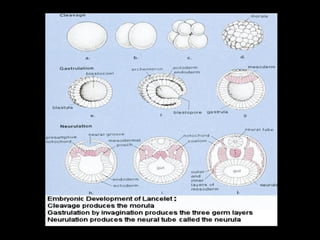
 Development of eggs start with meroblastic cleavage-
 Group of cells morula > blastula >GASTRULATION>embryo having3germlaye
– ecto, endo and mesoderm
After gastrulation body organs are formed.

Small embryo with bilaterally symmetrical body ,as the embryo grows
 the yolk sac gets reduced in size.

LARVAL DEVELOPMENT

 Thick inner layer of chorion is broken by hatching enzymes
  and the embryo by its feeble movements can break the weakened layer
  and hatch out.
The newly hatched larvae of carps – slender , transparent ,
  non pigmented body having head, trunk and tail.(3-5.3mm)

They lie at the bottom, occasionally coming up with irregular movements.
After 24 hrs- slight darting movements.

After 36 hrs- feeble horizontal movements.
After 48 hrs- shooting and darting movement .Devt of mouth, stomach,
    intestine & gills covered with operculum.

72 hrs- dorsal and ventral fin rudiments appear, yolk sac is fully absorbed
SEED COLLECTION FROM NATURAL SPAWNING GROUNDS
Major carps spawn during monsoon season- in inundated terrains
Adv-

1. Fresh floods kills the flora and fauna and the decaying matter
provides food for growth of micro org. and zoopl. –food for fry.

2. Area free from natural predators and predatory insects that feed on carp spawn.

3. Water rich in O2 favours rapid dev’t of eggs and larvae.


Disadv. of spawn collection from wild:-
1. Uncertainty in availability of seed.
2. Impossible to get a pure stock of seed
3. Process of procurement – labour intensive
4. Heavy mortality of seed collected
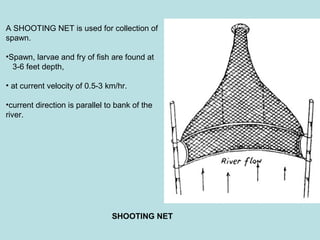
A SHOOTING NET is used for collection of
spawn.

•Spawn, larvae and fry of fish are found at
  3-6 feet depth,

• at current velocity of 0.5-3 km/hr.

•current direction is parallel to bank of the
river.


                                SHOOTING NET
BUNDH BREEDING

• First attempt to breed major carpslocated at thewater.of a catchment area.
                                     in confined
• Bundh – seasonal or perrenial pond              slope


•Breeding done during rainy season-the pond, which catchment is allowed guarded
  to flow through narrow canals into
                                     water from the
                                                    has an outlet valve also,
    by wire mesh. Conditions simulate a riverine condition and they breed.

•Wet bundhs- perrenial , largeWater rushes, from the in the slope of a catchment area
   With proper embankment.
                               water body situated
                                                      elevated catchment over an
  extensive shallow area, which stimulates the brood carp to spawn .
•No human interventions.


•Dry bundh- man made, well3designed. seasonal shallow ponds ,ranging from 0.5wateracr
                                                                              –4
•Bound by embankments on portion, malesfilled during monsoon. When sufficient is
  accumulated in the deeper
                            sides. Gets
                                         and females from the neighboring
    areas are introduced for acclimatization and spawning.

•Bundhs operational Summer.of West Bengal, Rajasthan, Maharashtra.
  Remains dry during
•                    in states
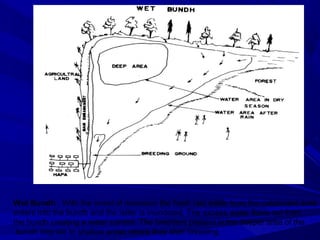
Wet Bundh : With the onset of monsoon the fresh rain water from the catchment area
enters into the bundh and the latter is inundated. The excess water flows out from
the bundh creating a water current. The breeders present in the deeper area of the
 bundh migrate to shallow areas where they start breeding.
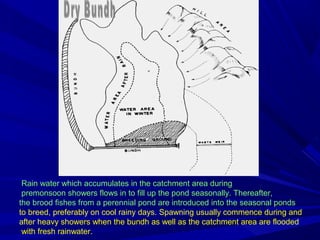
Rain water which accumulates in the catchment area during
 premonsoon showers flows in to fill up the pond seasonally. Thereafter,
the brood fishes from a perennial pond are introduced into the seasonal ponds
to breed, preferably on cool rainy days. Spawning usually commence during and
after heavy showers when the bundh as well as the catchment area are flooded
 with fresh rainwater.
INDUCED BREEDING OF CARPS

Technique responsible for augmenting the carp seed production in India.
More than 500 commercial hatcheries producing carp seed through this technique.
Both traditional HYPOPHYSATION AND GnRH based inducing techniques are used
HYPOPHYSATION-
Technique of induction of breeding by administration of PITUITARY EXTRACTS
        Different Steps in the technique
1. Collection of pituitary gland.
   Freshly killed or ice preserved mature fish.
   Either male / female

 2. Preservation
 a.Alcohol : Preserved in absolute alcohol in amber colored phial.
     Stored in refrigerator.

 b. Acetone: Pituitary is put in fresh acetone , kept in fridge for 36-48 hrs.
      Acetone is changed 2-3 times at 8-12 hrs.
      Glands are taken out, allowed to dry for 1 hr.
      Weighed. Stored in phials for 6-12 months.
3. Preparation of Pituitary Gland Extract
         Usually prepared just before injection.
         Weighed , homogenized in distilled water.
         Add distilled water @ 0.2 ml/kg of the breeder. Centrifuged.
         Supernatant( Carp Pituitary Extract ) is used for injection.

CPE can be preserved in glycerin for better shelf life, with ratio of 2:1 glycerin &water.
4. Administration of Hormones

Female is given 2 doses. First – initial dose / preparatory/priming dose
Second- after 5-6 hrs in IMC - final/ decisive/ resolving dose.
First dose advances the maturation of the oocytes, interval between the doses
 depends on the species and on temperature.
Males given one dose at the time of the second injection of the female.
Quantity of the dose depends on the maturity status of brood fish and
 quality of pituitary glands.

Injection done intramuscularly/ intraperitoneally- the latter is found more effective.
Dorsal part of caudal peduncle/ dorsal muscle above lateral line and below anterior
    Portion of dorsal fin- intramuscular
Intraperitoneal – inner side of base of pectoral fin

IMC    usually spawn 4-6 hrs after 2nd dose.
SPAWNING
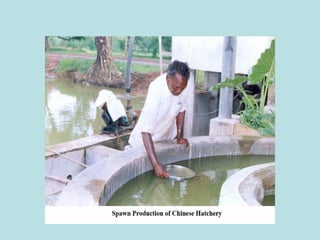
Carried out in 1. traditional Breeding Hapas
2. spawning pools of Chinese Circular Hatchery or
ecohatchery
One female with 2 males in breeding hapas
1:1 in ecohatchery

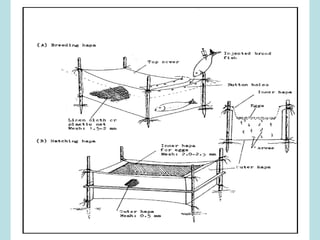
BREEDING HAPAS

Rectangular box shaped structure stitched out of fine meshed

   mosquito net cloth/nylon net cloth.size of hapa- 3.5 X1.5 X1m to
1.8 X0.9 X0.9m
Net tied with help of laces to 4 bamboo poles fixed in water
column
10-20 cm of upper surface of hapa is above water.
A flap at one end of the hapa is used for introduction of brood
pair & collection of eggs.
After hypophysation the pair is let into the hapa, fertilised eggs
are collected in the morning.
SPAWNING POOL OF CHINESE CIRCULAR HATCHERY

 Circular tank, 5-8 m dia depth of 1 to 1.5 m Tank made of bricks/ RCC or FRP.
 Bottom of the pool slopes towards the centre, into the outlet pipe which leads to the
  egg collection chamber / or directly into the incubation pool.

A circular flow of water is created inside the tank by arranging the
  inlet pipes at 60 degrees angle. Injected breeders are introduced into the
   tank in the evening hours
Over the spawning pool, water showers of 6 mm dia are fixed at 1 m on top of tanks.
Initial dose -2-3 mg/kg in female
After 5- 6 hrs males are given the dose at 4-6 mg/kg and females at 10-12 mg/kg.
Water current is created at speed of 2- 5 m/sec
Under the hormonal influence and the water current that simulates river flow ,
  spawning occurs.
Operational aspects of Spawning pool.
1. About 3.5 kg brood fish/m2 can be stocked in a spawning pool provided
    with good quality water with DO 5-6 ppm.
2. Water temp- 28-30 degree C.
3. Water depth 0.6-1m
4. Brood fish are kept under shower before and after hormone injection.
5. Water current is initiated one hour before the calculated spawning
   time.
6. Speed of water current – 3-5 m/sec.
7. Water flow stopped as soon as spawning is over.
8. Brood fish are transferred back to the pond
9. Spawning and hatching units are disinfected with 5 ppm KMNO4
   before and after each operation.
10.After 5-6 operations it is advisable to clean the tank with strong
    Formaldehyde solution.
INCUBATION OF FERTILISED EGGS

1. Hatching hapa
Two enclosures or hapas are used one inside the other (outer and inner
   hapa)
Hapas made of nylon net . Outer hapa mesh size- 0.5 mm and inner hapa 2-
   2.5mm.
Fixed in the pond using bamboo poles.

Eggs after prophylactic treatment are placed in inner hapa. After hatching
   the hatchlings move out of the inner hapa and are collected in the outer
   hapa.

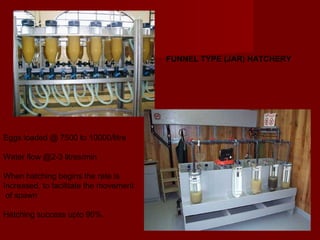
2. Funnel Type incubators
   Fiber glass funnel shaped vertical jars closed at the broad end with a
    rubber or plastic head and provided with an outlet.
 Eggs are incubated in the funnel after the water is let in through the inlet
    pipe.
The upward moving water causes the egg to move and roll in this process
    the eggs get sufficient oxygen and in turn the CO2 diffuses out.
Newly hatched eggs escape from the jar to be collected in a separate tub.
FUNNEL TYPE (JAR) HATCHERY


Eggs loaded @ 7500 to 10000/litre

Water flow @2-3 litres/min

When hatching begins the rate is
Increased, to facilitate the movement
 of spawn

Hatching success upto 90%.
3. INCUBATION POOL OF CHINESE CIRCULAR HATCHERY /ECOHATCHERY


Circular in shape having 2 chambers, outer and inner,.made of bricks/FRP
Outer chamber 3-6 m dia and inner 0.8- 1.5 m and depth of 1 to 1.5m
Circular wall separating the inner and outer chambers provided with windows with
fine meshed net , allows water flow but not eggs / spawn.
At centre of inner chamber is the outlet pipe , maintains the desired water depth in
  the chamber.
Inlet pipes duck mouth taps at the bottom of outer chamber , fitted at an angle of

    45 degrees so that water moves in a circle inside the chambers.
Eggs released into the outer chamber , drift in a circular motion.
Good water circulation is important for the hatching success –speed maintained at
 4- 5 m/sec – first 12 hrs
 1- 2 m/sec – in next 6 hrs
 3 - 4 m/sec- next 12 hrs.Hatchlings are allowed to remain there for 3 days until
the yolk sac is absorbed.
 Hatching time varies from 16-20 hrs depending upon the temperature.
Operational aspects of egg incubation unit of ecohatchery


1. Eggs must be received on a water cushion in the outer chamber, loaded @
   7-10 lakh eggs.

1. D. O should not be les than 4 ppm.

2. Direction of the duck mouth inlets and speed of the water are maintained
   in such a way that it keeps the developing eggs away from the screen
   and wall of incubation chamber.

4. Cleaning of the incubation pool should be done, incl. dead eggs and spawn
   Surface, Subsurface, Column and bottom cleaners are used.


                                                                               .

Carp breeding1

  • 2.
    INDIAN MAJOR CARPS 80%of freshwater farming constituted by carps and other cyprinids globally. Indian major carps- CATLA, ROHU, MRIGAL- Indo Gangetic riverine systems of India Common carp- Cyprinus carpio enjoys a world wide distribution Silver barb- Puntius gonionotus main native carp species of Thailand. REPRODUCTIVE BIOLOGY Bisexual, sexes can be distinguished only during the breeding season Males- Pectoral fin- has rough dorsal surface , longer than that in female  Genital aperture not very prominent , milt oozes out  Belly Not swollen Females- Dorsal side of Pect. Fin smooth.  Genital aperture reddish and swollen  Belly is soft and bulging
  • 3.
  • 4.
     All 3major carps attain sexual maturity in the second year  Males mature earlier than female  Carps of 2+ years and up to 5 years are preferred for breeding.  Spawning season  Seasonal riverine spawners, spawning during the southwest monsoon.  DONOT spawn in confined waters. STRUCTURE OF EGG  A FRESHLY LAID unfertilised egg consists of cyotplasm filled with yolk  Nucleus is at the animal pole  Oocyte is surrounded by a vitelline membrane ,which is enclosed in a chorion/shell .  Narrow opening called the micropyle is present on this chorion.  AFTER FERTILIZATION micropyle is closed.  Eggs start absorbing water.  Chorion changes into a tough structure through water hardening-  Perivitelline space gets filled with water, and swelling of oocyte takes place  Eggs attain more than 4 to 6 times their original size.  Development of eggs start with meroblastic cleavage-  Group of cells morula > blastula >GASTRULATION>embryo having3germlaye – ecto, endo and mesoderm
  • 6.
    After gastrulation bodyorgans are formed. Small embryo with bilaterally symmetrical body ,as the embryo grows the yolk sac gets reduced in size. LARVAL DEVELOPMENT  Thick inner layer of chorion is broken by hatching enzymes and the embryo by its feeble movements can break the weakened layer and hatch out. The newly hatched larvae of carps – slender , transparent , non pigmented body having head, trunk and tail.(3-5.3mm) They lie at the bottom, occasionally coming up with irregular movements. After 24 hrs- slight darting movements. After 36 hrs- feeble horizontal movements. After 48 hrs- shooting and darting movement .Devt of mouth, stomach, intestine & gills covered with operculum. 72 hrs- dorsal and ventral fin rudiments appear, yolk sac is fully absorbed
  • 7.
    SEED COLLECTION FROMNATURAL SPAWNING GROUNDS Major carps spawn during monsoon season- in inundated terrains Adv- 1. Fresh floods kills the flora and fauna and the decaying matter provides food for growth of micro org. and zoopl. –food for fry. 2. Area free from natural predators and predatory insects that feed on carp spawn. 3. Water rich in O2 favours rapid dev’t of eggs and larvae. Disadv. of spawn collection from wild:- 1. Uncertainty in availability of seed. 2. Impossible to get a pure stock of seed 3. Process of procurement – labour intensive 4. Heavy mortality of seed collected
  • 8.
    A SHOOTING NETis used for collection of spawn. •Spawn, larvae and fry of fish are found at 3-6 feet depth, • at current velocity of 0.5-3 km/hr. •current direction is parallel to bank of the river. SHOOTING NET
  • 9.
    BUNDH BREEDING • Firstattempt to breed major carpslocated at thewater.of a catchment area. in confined • Bundh – seasonal or perrenial pond slope •Breeding done during rainy season-the pond, which catchment is allowed guarded to flow through narrow canals into water from the has an outlet valve also, by wire mesh. Conditions simulate a riverine condition and they breed. •Wet bundhs- perrenial , largeWater rushes, from the in the slope of a catchment area With proper embankment. water body situated elevated catchment over an extensive shallow area, which stimulates the brood carp to spawn . •No human interventions. •Dry bundh- man made, well3designed. seasonal shallow ponds ,ranging from 0.5wateracr –4 •Bound by embankments on portion, malesfilled during monsoon. When sufficient is accumulated in the deeper sides. Gets and females from the neighboring areas are introduced for acclimatization and spawning. •Bundhs operational Summer.of West Bengal, Rajasthan, Maharashtra. Remains dry during • in states
  • 10.
    Wet Bundh :With the onset of monsoon the fresh rain water from the catchment area enters into the bundh and the latter is inundated. The excess water flows out from the bundh creating a water current. The breeders present in the deeper area of the bundh migrate to shallow areas where they start breeding.
  • 11.
    Rain water whichaccumulates in the catchment area during premonsoon showers flows in to fill up the pond seasonally. Thereafter, the brood fishes from a perennial pond are introduced into the seasonal ponds to breed, preferably on cool rainy days. Spawning usually commence during and after heavy showers when the bundh as well as the catchment area are flooded with fresh rainwater.
  • 12.
    INDUCED BREEDING OFCARPS Technique responsible for augmenting the carp seed production in India. More than 500 commercial hatcheries producing carp seed through this technique. Both traditional HYPOPHYSATION AND GnRH based inducing techniques are used HYPOPHYSATION- Technique of induction of breeding by administration of PITUITARY EXTRACTS Different Steps in the technique 1. Collection of pituitary gland. Freshly killed or ice preserved mature fish. Either male / female 2. Preservation a.Alcohol : Preserved in absolute alcohol in amber colored phial. Stored in refrigerator. b. Acetone: Pituitary is put in fresh acetone , kept in fridge for 36-48 hrs. Acetone is changed 2-3 times at 8-12 hrs. Glands are taken out, allowed to dry for 1 hr. Weighed. Stored in phials for 6-12 months.
  • 13.
    3. Preparation ofPituitary Gland Extract Usually prepared just before injection. Weighed , homogenized in distilled water. Add distilled water @ 0.2 ml/kg of the breeder. Centrifuged. Supernatant( Carp Pituitary Extract ) is used for injection. CPE can be preserved in glycerin for better shelf life, with ratio of 2:1 glycerin &water. 4. Administration of Hormones Female is given 2 doses. First – initial dose / preparatory/priming dose Second- after 5-6 hrs in IMC - final/ decisive/ resolving dose. First dose advances the maturation of the oocytes, interval between the doses depends on the species and on temperature. Males given one dose at the time of the second injection of the female. Quantity of the dose depends on the maturity status of brood fish and quality of pituitary glands. Injection done intramuscularly/ intraperitoneally- the latter is found more effective. Dorsal part of caudal peduncle/ dorsal muscle above lateral line and below anterior Portion of dorsal fin- intramuscular
  • 14.
    Intraperitoneal – innerside of base of pectoral fin IMC usually spawn 4-6 hrs after 2nd dose.
  • 15.
    SPAWNING Carried out in1. traditional Breeding Hapas 2. spawning pools of Chinese Circular Hatchery or ecohatchery One female with 2 males in breeding hapas 1:1 in ecohatchery BREEDING HAPAS Rectangular box shaped structure stitched out of fine meshed mosquito net cloth/nylon net cloth.size of hapa- 3.5 X1.5 X1m to 1.8 X0.9 X0.9m Net tied with help of laces to 4 bamboo poles fixed in water column 10-20 cm of upper surface of hapa is above water. A flap at one end of the hapa is used for introduction of brood pair & collection of eggs. After hypophysation the pair is let into the hapa, fertilised eggs are collected in the morning.
  • 17.
    SPAWNING POOL OFCHINESE CIRCULAR HATCHERY  Circular tank, 5-8 m dia depth of 1 to 1.5 m Tank made of bricks/ RCC or FRP.  Bottom of the pool slopes towards the centre, into the outlet pipe which leads to the egg collection chamber / or directly into the incubation pool. A circular flow of water is created inside the tank by arranging the inlet pipes at 60 degrees angle. Injected breeders are introduced into the tank in the evening hours Over the spawning pool, water showers of 6 mm dia are fixed at 1 m on top of tanks. Initial dose -2-3 mg/kg in female After 5- 6 hrs males are given the dose at 4-6 mg/kg and females at 10-12 mg/kg. Water current is created at speed of 2- 5 m/sec Under the hormonal influence and the water current that simulates river flow , spawning occurs.
  • 19.
    Operational aspects ofSpawning pool. 1. About 3.5 kg brood fish/m2 can be stocked in a spawning pool provided with good quality water with DO 5-6 ppm. 2. Water temp- 28-30 degree C. 3. Water depth 0.6-1m 4. Brood fish are kept under shower before and after hormone injection. 5. Water current is initiated one hour before the calculated spawning time. 6. Speed of water current – 3-5 m/sec. 7. Water flow stopped as soon as spawning is over. 8. Brood fish are transferred back to the pond 9. Spawning and hatching units are disinfected with 5 ppm KMNO4 before and after each operation. 10.After 5-6 operations it is advisable to clean the tank with strong Formaldehyde solution.
  • 20.
    INCUBATION OF FERTILISEDEGGS 1. Hatching hapa Two enclosures or hapas are used one inside the other (outer and inner hapa) Hapas made of nylon net . Outer hapa mesh size- 0.5 mm and inner hapa 2- 2.5mm. Fixed in the pond using bamboo poles. Eggs after prophylactic treatment are placed in inner hapa. After hatching the hatchlings move out of the inner hapa and are collected in the outer hapa. 2. Funnel Type incubators Fiber glass funnel shaped vertical jars closed at the broad end with a rubber or plastic head and provided with an outlet. Eggs are incubated in the funnel after the water is let in through the inlet pipe. The upward moving water causes the egg to move and roll in this process the eggs get sufficient oxygen and in turn the CO2 diffuses out. Newly hatched eggs escape from the jar to be collected in a separate tub.
  • 21.
    FUNNEL TYPE (JAR)HATCHERY Eggs loaded @ 7500 to 10000/litre Water flow @2-3 litres/min When hatching begins the rate is Increased, to facilitate the movement of spawn Hatching success upto 90%.
  • 22.
    3. INCUBATION POOLOF CHINESE CIRCULAR HATCHERY /ECOHATCHERY Circular in shape having 2 chambers, outer and inner,.made of bricks/FRP Outer chamber 3-6 m dia and inner 0.8- 1.5 m and depth of 1 to 1.5m Circular wall separating the inner and outer chambers provided with windows with fine meshed net , allows water flow but not eggs / spawn. At centre of inner chamber is the outlet pipe , maintains the desired water depth in the chamber. Inlet pipes duck mouth taps at the bottom of outer chamber , fitted at an angle of 45 degrees so that water moves in a circle inside the chambers. Eggs released into the outer chamber , drift in a circular motion. Good water circulation is important for the hatching success –speed maintained at  4- 5 m/sec – first 12 hrs  1- 2 m/sec – in next 6 hrs  3 - 4 m/sec- next 12 hrs.Hatchlings are allowed to remain there for 3 days until the yolk sac is absorbed.  Hatching time varies from 16-20 hrs depending upon the temperature.
  • 23.
    Operational aspects ofegg incubation unit of ecohatchery 1. Eggs must be received on a water cushion in the outer chamber, loaded @ 7-10 lakh eggs. 1. D. O should not be les than 4 ppm. 2. Direction of the duck mouth inlets and speed of the water are maintained in such a way that it keeps the developing eggs away from the screen and wall of incubation chamber. 4. Cleaning of the incubation pool should be done, incl. dead eggs and spawn Surface, Subsurface, Column and bottom cleaners are used. .