HISTORY
 Ordovarian Period (425-500 million
years ago)
 OSTRACODERMS
○ Slow, bottom-dwelling animals
○ Covered with thick bony plates and scales
○ Had very poorly developed fins and didn’t
have jaws
○ Believed to be the first animal with backbone
 Extinct about 250 million years ago
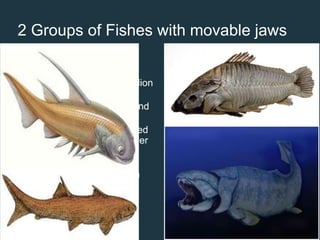
2 Groups of Fishes with movable jaws
PLACODERMS ACANTHODIANS
 Appeared about 395 million
years ago
 Had thick, bony plates and
paired fins
 Their upper jaw was fused
to the skull while the lower
jaw was hinged and
movable
 Extinct about 345 million
years ago
 Class Chondrichthyes
evolved
 Appeared about 410
million years ago
 Distinguished by the
bony spines projecting in
front their fins and by
minute diamond-shaped
scales
 Class Osteichthyes
evolved
GENERAL CHARACTERICTICS
 Fish are cold-blooded vertebrates that
breathe with gills and move with the aid of
fins.
 They have the most numerous vertebrates
with more than 30, 000 species.
 All fish must maintain proper levels of salt
and water in their bodies through osmosis.
 Freshwater fishes: Body salts are higher in
concentration than surrounding water
 Saltwater fishes: Surrounding water has higher
concentration than their bodies
 Most fish are able to react to changes in
water pressure, temperature, currents and
sounds.
 Fish have taste buds in their mouth, on their
lips and on their body and fins. Some are on
their barbels (whisker-like projections
around their mouth)
 Has highly developed sense of smell
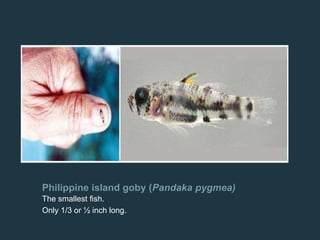
Philippine island goby (Pandaka pygmea)
The smallest fish.
Only 1/3 or ½ inch long.
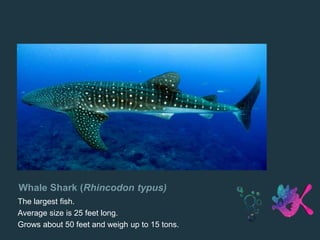
Whale Shark (Rhincodon typus)
The largest fish.
Average size is 25 feet long.
Grows about 50 feet and weigh up to 15 tons.
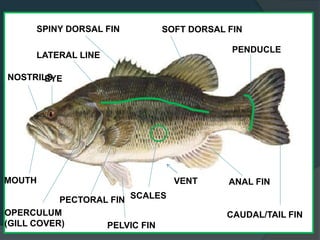
EXTERNAL ANATOMY
EYE
MOUTH
OPERCULUM
(GILL COVER)
PECTORAL FIN
ANAL FIN
PELVIC FIN
LATERAL LINE
SOFT DORSAL FIN
CAUDAL/TAIL FIN
SPINY DORSAL FIN
SCALES
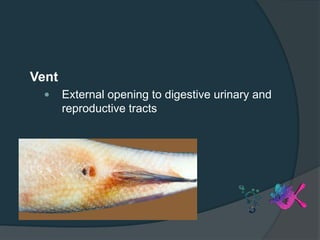
VENT
NOSTRILS
PENDUCLE
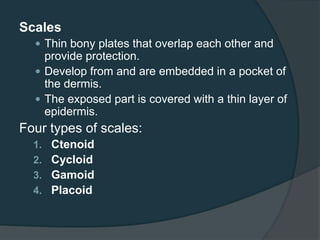
Scales
 Thin bony plates that overlap each other and
provide protection.
 Develop from and are embedded in a pocket of
the dermis.
 The exposed part is covered with a thin layer of
epidermis.
Four types of scales:
1. Ctenoid
2. Cycloid
3. Gamoid
4. Placoid
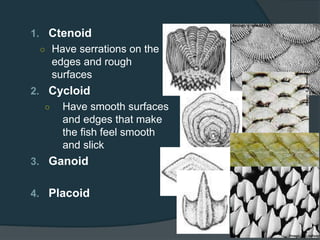
1. Ctenoid
○ Have serrations on the
edges and rough
surfaces
2. Cycloid
○ Have smooth surfaces
and edges that make
the fish feel smooth
and slick
3. Ganoid
4. Placoid
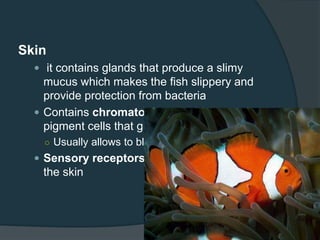
Skin
 it contains glands that produce a slimy
mucus which makes the fish slippery and
provide protection from bacteria
 Contains chromatophores which are
pigment cells that give the fish its colors.
○ Usually allows to blend with its surroundings
 Sensory receptors are also contained in
the skin
Anal fin
 Single
 Found on the underside near the tail
 Acts as rudder or keel to help steer the fish during
faster motion
 In some species, this has adapted to become a
sex organ
Fins
 Movable structures that aid the fish in
swimming and maintaining its balance.
 Most have rayed fins.
 These fins consist of a web of skin
supported by a bone or cartilage rods called
rays
○ May have sharp, spiny or soft rays
 Very flexible
 Pectoral fin
 generally in symmetrical pairs
 Found on the side just behind the head
 Used to stabilize, rotate and stop the fish during
slower motion
Caudal fin
 Single; also called tail fin
 Together with the caudal penducle, they
generate the forward thrust in most fish. These
are the main release point for that forward thrust.
Pelvic fin
 also called ventral fins
 Generally in symmetrical pairs
 Found below and just behind the pectoral fins
 Used in similar fashion to the pectoral fins
Dorsal fin
 Found along their back
 Soft dorsal fin
○ Used to stabilize the fish and keep them upright
○ Has similar purpose to the anal fin.
 Spinous dorsal fin
○ Also used to stabilize and keep them upright
○ Spiny and sharp
○ In some species, it contains venom for protection
from predators.
○ Display of an erect dorsal fin shows readiness to
mate and is in prime condition therefore a good
mate
Eyes
 Has spherical lens that focuses by moving
within the eyeball, not by changing the
curvature of the lens
 They don’t have eyelids, kept moist by the
water
 Size usually depends on the amount of
light reaching the eye
○ Fish living shallow and brightly lit waters
have small eyes
○ Those that live in dimly lit water have big
eyes
Lateral line
 Series of fluid-filled ducts/sacs with hair-like
sensory apparatus that are open to the
water through a series of pores located just
under the scales.
 Neuromasts – Row of sensors that allow
the fish to detect movement (vibration)
around them in order to capture prey, elude
predators and navigate efficiently
Mouth
 Have taste buds
 Feeding/food is based on its shape
○ Top dwellers – upturned
○ Middle dwellers – small mouths and are
straight forward, neither upward nor
downward
○ Bottom-dwellers – downward turned or
underslung
Nostrils
 Used to detect odors in water and can be
quite sensitive
Operculum (Gill cover)
 Flexible bony plate
 Protects the sensitive gills
Vent
 External opening to digestive urinary and
reproductive tracts
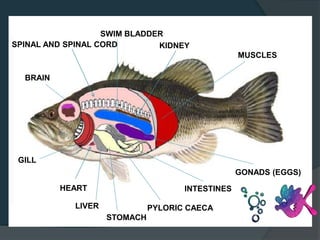
INTERNAL ANATOMY
BRAIN
GILL
HEART
LIVER
STOMACH
INTESTINES
PYLORIC CAECA
GONADS (EGGS)
MUSCLES
KIDNEY
SWIM BLADDER
SPINAL AND SPINAL CORD
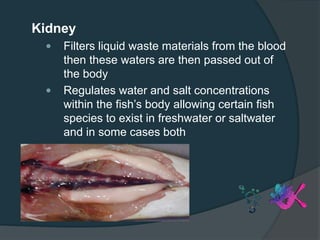
Kidney
 Filters liquid waste materials from the blood
then these waters are then passed out of
the body
 Regulates water and salt concentrations
within the fish’s body allowing certain fish
species to exist in freshwater or saltwater
and in some cases both
Liver
 Assists in digestion by secreting enzymes
that break down fats
 Serve as storage area for fats and
carbohydrates
 Destroys old blood cells
 Maintains proper blood chemistry
 Plays a role in nitrogen (waste) excretion
Muscle
 Provides movement and locomotion
 Part usually eaten and composes the fillet
or fish
Spinal Cord
 Connects the brain to the rest of the body
 Relays sensory information from the rest of
the body to the brain and vice versa
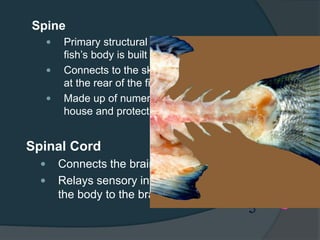
Spine
 Primary structural framework upon which the
fish’s body is built
 Connects to the skull at the front and to the tail
at the rear of the fish.
 Made up of numerous vertebrae (hollow which
house and protect the delicate spinal cord)
Stomach and Intestines
 Break down (digest) food and absorb
nutrients
 Piscivorous fish (eat other fish) have
fairly short intestine because such food is
easy to chemically break down and digest
 Herbivorous fish (eat plants) require
longer intestines because plant matter is
usually tough and fibrous and more difficult
to break down into usable components
Swim Bladder
 located in the abdominal cavity
 Filled with gases produced by blood which
enables the fish to maintain a particular depth.
 A few bony fishes are able to breathe
atmospheric air because their swim bladder is
supplied with blood vessels thus allows it to
function like a lung
 A few fish species have a part of their intestines
that are modified to allow oxygen intake.
○ They rise to the surface and gulp air into their
mouths
○ The air is swallowed into the digestive system,
then taken to the blood.
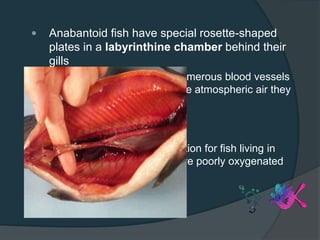
 Anabantoid fish have special rosette-shaped
plates in a labyrinthine chamber behind their
gills
○ These are supplied with numerous blood vessels
that absorb oxygen from the atmospheric air they
inhale through their mouth
>>These are important adaptation for fish living in
swamps or other waters that are poorly oxygenated
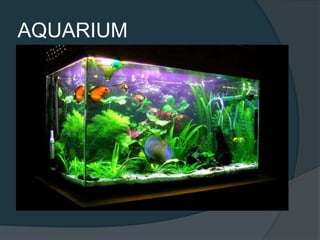
AQUARIUM
 The term combines the Latin root aqua,
meaning water, with the suffix -arium,
meaning "a place for relating to“
TYPES OF AQUARIUM
 Community Aquarium
 Freshwater and Saltwater Aquarium
 Mix of fish and plants originating from different
geographical areas with emphasis placed on color and
hardiness
 Can be successful if it follows the basic rules for
compatibility of its inhabitants with respect to
temperature, water chemistry, aquarium size and
character
 Planted aquariums
 Features emphasis on plants and limited fish populations
 Typical fish species are tetras or rasboras and some
angelfish
 Lighting and attention to appropriate filtration media are
important details
FILTER
FILTER SYSTEMS
FILTER MEDIA
HEATER
AIR PUMP
THERMOMETER
LIGHTING
AQUARIUM DECORATIONS
TEST KITS
FILTER
 Remove solid waste and uneaten food
materials from the water
 For water purity and quality
 Takes out visible particles, breaks down
toxic substances, and removes harmful
chemicals in aquariums
Filter Media
 Is the content of a filter system which is
in contact with the water flow and is the
substance that actually performs the
mechanical, biological and chemical
filtering.
MECHANICAL FILTRATION
 Removal of particulate waste from the
water
 Mechanical filter media, which is very
fine, will trap greater quantities of debris
and plug more rapidly
Regularly remove accumulated debris.
This will help support superior oxygen
levels, stable water conditions and reduce
nitrate accumulations.
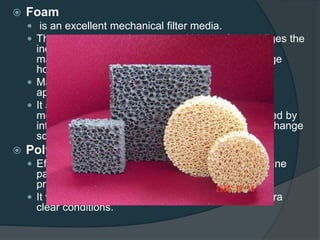
 Foam
 is an excellent mechanical filter media.
 The porous channel structure within the foam obliges the
incoming water to deviate from a straight path,
maximizing contact time and giving the foam a huge
holding capacity for debris.
 Maximum mechanical effect is achieved after
approximately 10 to 14 days.
 It also supports essential bacteria and can be a
mechanical and biological filter media, as evidenced by
internal filter systems, as long as a regular water change
schedule is respected.
 Polywool
 Effective mechanical filter media that will remove fine
particles and prevent other filter media from being
prematurely clogged.
 It will contribute to polishing aquarium water for ultra
clear conditions.
CHEMICAL FILTRATION
 Active control and change of specific water
characteristics.
 Filter media and various products exist that
clarify water, eliminate odor, remove chlorine,
eliminate medications after disease treatments,
neutralize heavy metal ions and effect changes
in hardness and pH levels.
 Specific chemical filter media should be used to
optimize water conditions for various groups of
fish and plants. This will ensure that fish and
plants will look their best and stay healthy.
 Accomplished with the use of activated
charcoal (soaks up dissolved minerals
and chemicals)
 Activated charcoal can be placed in box
filters or return water can flow through
the charcoal.
Charcoal must be replaced periodically as
it reaches the point where it can no longer
absorb dissolved materials.
 Carbon
 highly adsorptive and is capable of removing odors and liquid
wastes such as urine, dyes and many other impurities from
aquarium water.
 Provides the correct pore size and selection of optimal raw
ingredients to provide long lasting aquarium filtration. This is very
important as there are carbons that are manufactured using raw
materials which are designed for filtering air, not water, and are
sold for aquarium use.
 Opti–Carb
 An advanced chemical filter media that combines a high quality
carbon with both a synthetic Organic Adsorption and Ion
Exchange Resin.
 This potent combination of ingredients will ensure that aquarium
water is effectively free of dissolved protein matter, toxic heavy
metals, dissolved gasses that cause odor and discoloration for a
crystal clear aquarium.
 Both fresh and saltwater aquariums will benefit from improved
water quality. Fresh and saltwater fish will thrive in ultra pure water
while plants and corals will benefit from improved light availability
due to ultra clear water conditions.
 Phosphate Remover
 Phosphate is major nutrient and is undesirable within
freshwater aquariums that do not contain plants and in
marine aquariums in general. It’s presence is linked to
undesirable aquarium conditions and can result in an
unsightly appearance.
 Pre-Filter
 consists of inert, solid rings that are ideal for medium to
coarse filtration. These durable rings also serve as a
surface for beneficial bacteria, contributing to biological
filtration.
 Ammonia Remover
 natural mineral, which safely and effectively scavenges
ammonium from aquarium water.
 Particularly useful when chloramine is present in tap
water, and in instances where ammonia can occur,
such as new aquariums, fish loss, overfeeding, after
disease treatment, and overpopulated installations.
 Zeo-Carb
 Combines Ultra Grade Carbon and Ammonia Remover to
protect the aquarium from build-ups of ammonia and liquefied
waste, dyes and medication.
 It effectively controls and removes ammonia while trapping
organic compounds. In addition, it also supports biological
filtration.
 Nitrate Remover
 Effectively bind large quantities of Nitrate and highly toxic
Nitrite.
 As ammonia and nitrite are continuously converted by
nitrifying bacteria, there is an accumulation of nitrate. The
greater the concentration of fish and other life within the
aquarium the faster Nitrate will accumulate. This is a direct
reflection of poor water quality as well as being a major factor
in unsightly aquarium conditions. Regular use of this product is
highly recommended for well stocked freshwater aquariums,
especially those that do not contain live plants.
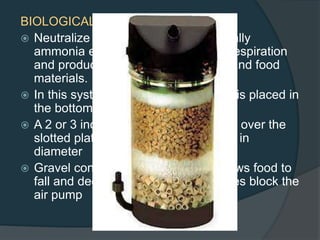
BIOLOGICAL FILTRATION
 Neutralize toxic substances, essentially
ammonia excreted from fish during respiration
and produced from decaying waste and food
materials.
 In this system, a slotted plastic plate is placed in
the bottom of the aquarium.
 A 2 or 3 inch layer of gravel is placed over the
slotted plate; should be 0.125 inches in
diameter
 Gravel containing large particles allows food to
fall and decay while too small particles block the
air pump
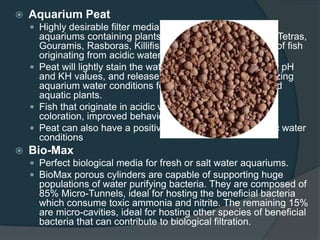
 Aquarium Peat
 Highly desirable filter media which is very beneficial for
aquariums containing plants, South American Cichlids, Tetras,
Gouramis, Rasboras, Killifish, and many other species of fish
originating from acidic waters.
 Peat will lightly stain the water a natural tan color, lower pH
and KH values, and release natural substances, optimizing
aquarium water conditions for many fresh water fish and
aquatic plants.
 Fish that originate in acidic water will exhibit optimum
coloration, improved behavior and reproduction.
 Peat can also have a positive effect in supporting acidic water
conditions
 Bio-Max
 Perfect biological media for fresh or salt water aquariums.
 BioMax porous cylinders are capable of supporting huge
populations of water purifying bacteria. They are composed of
85% Micro-Tunnels, ideal for hosting the beneficial bacteria
which consume toxic ammonia and nitrite. The remaining 15%
are micro-cavities, ideal for hosting other species of beneficial
bacteria that can contribute to biological filtration.
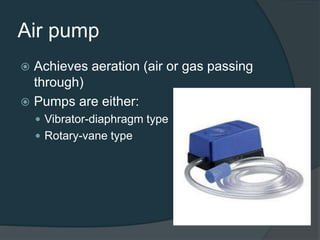
Air pump
 Achieves aeration (air or gas passing
through)
 Pumps are either:
 Vibrator-diaphragm type
 Rotary-vane type
Waste and ammonia
 Fish excrete waste and an unestablished (or
uncycled) aquarium is not capable of processing
these waste materials efficiently, so this creates toxic
conditions for the fish. The result is fish loss. Your
aquarium water must be free of toxic compounds in
order for fish to survive and thrive.
 Ammonia, perhaps the most notorious toxin, is
introduced into your aquarium through fish waste,
respiration, and other biological processes. It is
extremely toxic and fish will show signs of stress,
such as erratic swimming behavior, when ammonia is
present. High levels of ammonia attack the gills first,
causing fish to gasp at the surface. Continued
exposure affects their fins and skin, and eventually
their entire system is under attack.
 Factors contributing to the increase of
ammonia and nitrites:
 Increase in waste material and uneaten food on
the bottom of the aquarium
 Dirty filters
 Failure to change water at regular intervals
( ¼ to 1/5 of the water should be changed every 3
to 4 weeks)
 Overfeeding
 Overpopulation of fish
 In an established aquarium, ammonia is
promptly converted into less toxic substances
by beneficial bacteria through a natural
process called the nitrogen cycle.
 New aquariums do not have established
colonies of beneficial bacteria to adequately
process these toxins.
Cycling
 The process of establishing and maturing
biological filtration.
 The nitrogen cycling process that all new
aquarium setups go through when they first start
is what leads to the birth of the aquarium's
biological filtration. From start to finish, this cycle
usually takes around 30 to 45 days to complete.
 Importance:
 In order to establish efficient biological filtration
capable of breaking down these toxic compounds.
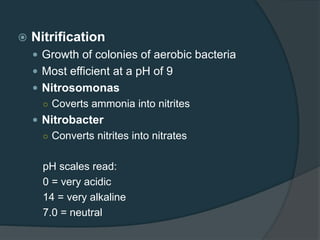
 Nitrification
 Growth of colonies of aerobic bacteria
 Most efficient at a pH of 9
 Nitrosomonas
○ Coverts ammonia into nitrites
 Nitrobacter
○ Converts nitrites into nitrates
pH scales read:
0 = very acidic
14 = very alkaline
7.0 = neutral
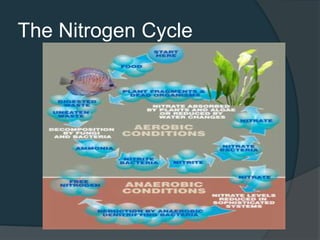
The Nitrogen Cycle
Importance
 The nitrogen cycle of an aquarium is a
natural chain of events resulting in the
colonization of various types of nitrifying
bacteria, each with their own job to do.
Without a strong, healthy biological filter,
an aquarium will never be able to
support a healthy population of fish and
invertebrates.
 What does toxic ammonia convert into
during the nitrogen cycle?
 First, oxygen-loving bacteria, called
Nitrosomonas, feed on ammonia and through
biological processes they excrete nitrite, a less
toxic but still dangerous chemical.
 Another oxygen-utilizing bacteria, called
Nitrobacter, feeds on the nitrite, converting it
into relatively harmless nitrate. Nitrate can be
used by plants in the aquarium, or can be
removed with water changes.
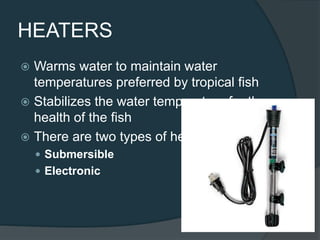
HEATERS
 Warms water to maintain water
temperatures preferred by tropical fish
 Stabilizes the water temperature for the
health of the fish
 There are two types of heaters:
 Submersible
 Electronic
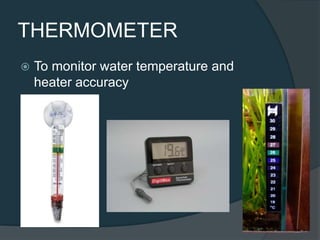
THERMOMETER
 To monitor water temperature and
heater accuracy
LIGHTING
 Brings out extraordinary colors in the
aquarium and facilitates the growth of
live plants
 For viewing aquarium inhabitants or for
healthy live plants
TYPES OF LIGHTING
 Fluorescent
 Incandescent
 LED
Factors that influence the type
and quantity of light required:
 Size of aquarium
 Fish species and other aquatic
inhabitants
 Plant life
 Aesthetics
Lighting tips:
 Most plants require approximately 12 hours per
day of light from a fluorescent fixture.
 Sudden changes in light may stress fish. When
turning canopy lights on or off, it is beneficial to
have room lights on for at least 30 minutes.
 Fish fed during the day should be allowed 30
minutes of light before and after feeding.
 Use timers when possible. Plants and fish will
respond better to consistent lighting periods.
 Plants and fish will adapt to gradual light
changes. When changing bulbs in a multiple
bulb installation, change 1 to 2 weeks apart.
 A remote ballast should be mounted in an area
where there is adequate ventilation to efficiently
dissipate heat. This is especially important in
ballast types that generate more heat.
 Electrical wiring leading to the ballast should
always incorporate a drip loop.
 Consider a GFI (Ground Fault Interrupter) power
bar as an inexpensive insurance to avoid
unpleasant circumstances surrounding any
potential electrical mishaps.
 Do not leave lights on 24 hours a day. As in
nature, fish and plants require dark periods as
well.
 To make it attractive
 Also provide shelter and hiding places
for inhabitants
 Plants can be added for attractiveness
and to provide a means of using carbon
dioxide while releasing oxygen
AQUARIUM DECOR
AQUARIUM DECOR
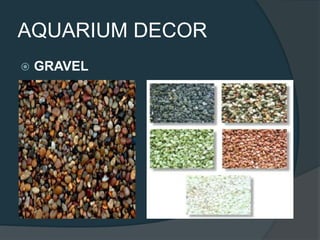
 GRAVEL
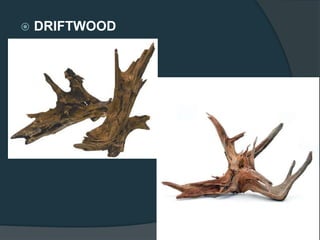
 DRIFTWOOD
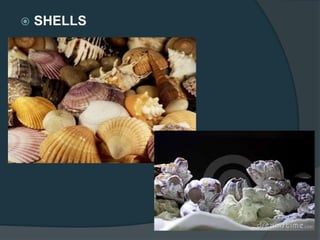
 SHELLS
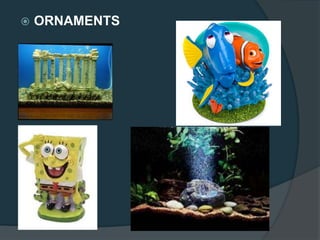
 ORNAMENTS
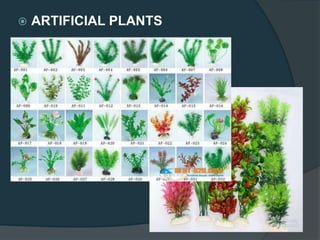
 ARTIFICIAL PLANTS
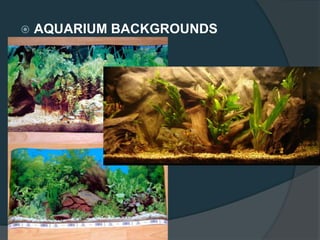
 AQUARIUM BACKGROUNDS
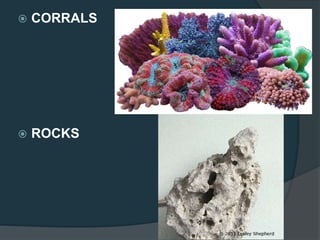
 CORRALS
 ROCKS
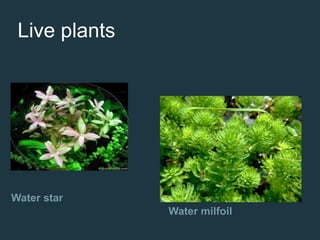
Water star
Water milfoil
Live plants
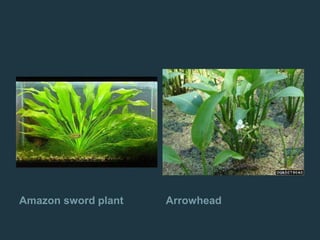
Amazon sword plant Arrowhead
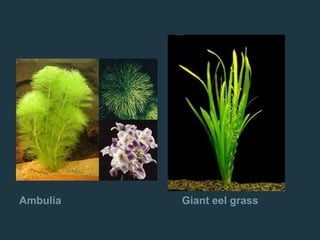
Ambulia Giant eel grass
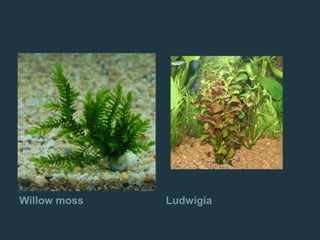
Willow moss Ludwigia
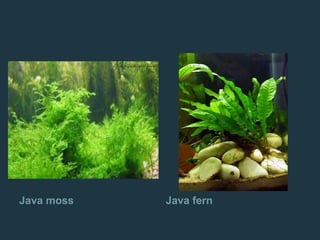
Java moss Java fern
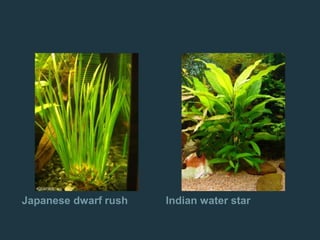
Japanese dwarf rush Indian water star
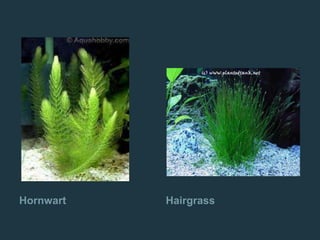
Hornwart Hairgrass
 TEST KITS
Success Begins with
Research
1. What aquarium inhabitants are appealing to you
and what others can be housed with them?
2. What size and shape of aquarium is
recommended for them?
3. What types of filtration, lighting, decorative
structure, and accessory equipment are needed
in order for the aquarium inhabitants to thrive?
4. What feeding and maintenance is required to
keep them healthy?
5. Most importantly, are you willing to invest the
time and money necessary for ongoing
maintenance?
Rules of the thumb
 Generally, the larger the aquarium the better, unless it will be too
heavy for the flooring to hold it. A tank that is filled with gravel and
water will weigh at least 10 lbs. per gallon. That adds up quickly, if
you consider that a seemingly small 20-gallon tank will weigh 200
pounds . . . and that does not account for the stand, lighting, or
filtration!
 It is imperative to choose a sturdy stand to hold the tank. If you
choose to setup your tank in an environment frequented by small
children, choose a stand that cannot be climbed on or pulled over.
 Choose a filter appropriate to the type of inhabitants you are keeping
and water capacity of the tank. Buy the best filter that you can
afford. At minimum, a filter should provide mechanical and biological
filtration.
 Next, you'll need a heater and a good thermometer. Make sure the
heater is at least 3-5 watts per gallon. For example, a 50-gallon tank
would require a 150-250 watt heater.
 You will need to choose an aquarium cover or hood. If the
inhabitants require special lighting, you'll want to purchase a
fixture that can accommodate it.
 A water conditioner will be needed to remove chlorine and heavy
metals if they are present in your water supply.
 Don't forget a net!
 Now, you're ready to decorate. It's essential to choose
decorations that provide fish with structure and hiding places to
relieve stress. Plants and decorations can also be used to
conceal filter parts. Gravel in the bottom of the tank holds plants
and decorations while hiding wastes. If you will be using an
under gravel filter, the gravel should be about 2 inches thick.
Dark colors will make the fish color appear more vibrant.
 A gravel cleaner and algae cleaner will be needed within 30 days
so you can begin regular maintenance.
 Before you place the items in the tank, rinse them off and rinse
gravel thoroughly until water drained off is clear.
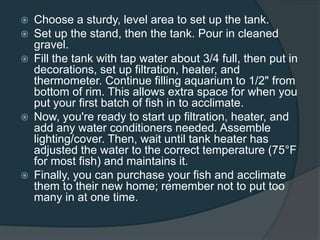
 Choose a sturdy, level area to set up the tank.
 Set up the stand, then the tank. Pour in cleaned
gravel.
 Fill the tank with tap water about 3/4 full, then put in
decorations, set up filtration, heater, and
thermometer. Continue filling aquarium to 1/2" from
bottom of rim. This allows extra space for when you
put your first batch of fish in to acclimate.
 Now, you're ready to start up filtration, heater, and
add any water conditioners needed. Assemble
lighting/cover. Then, wait until tank heater has
adjusted the water to the correct temperature (75°F
for most fish) and maintains it.
 Finally, you can purchase your fish and acclimate
them to their new home; remember not to put too
many in at one time.
10 BASIC TIPS FOR A
SUCCESSFUL AQUARIUM
1. AVOID OVERCOMPENSATING
Instead: Assess the situation and determine a prudent course of action. Many situations
benefit from patience rather than misguided action.
2. AVOID ADDING TOO MANY FISH TOO SOON
Instead: Allow two to three weeks between each introduction of new fish. Also, use a
biological additive with every addition. Adding too many fish too quickly taxes the biological
filter. The subsequent spike in ammonia level can often result in fish loss.
3. AVOID SKIPPING QUARANTINE
Instead: Always house new fish in a separate quarantine aquarium for a minimum of 2
weeks for observation and treatment of potential illness.
4. AVOID NEGLECTING WATER TESTS
Instead: Test aquarium water regularly to make sure water parameters are within acceptable
levels. Many common aquarium pollutants are invisible. Regular water testing is the only
accurate way to detect toxins such as ammonia or nitrite.
5. AVOID OVER-CLEANING
Instead: Stagger water changes and perform partial gravel cleaning to preserve vital
beneficial bacteria. Aggressive cleaning can upset established biological filtration by
removing beneficial bacteria. An imbalance may result where ammonia levels exceed the
processing capacity of the diminished bacterial population.
6. AVOID UNDER-CLEANING
Instead: Perform routine partial water changes and follow the manufacturer's
recommended schedule for replacing filter media. Lax maintenance habits have a
cumulative negative effect on overall water quality. Not only do pollutants accumulate
to unhealthy levels, it becomes more difficult to bring aquarium conditions within
acceptable parameters.
7. AVOID SKIPPING RESEARCH
Instead: Research care requirements of the species you are interested in first. Resist
impulse purchases. Make sure you are able to properly provide for the species and
that your aquarium is capable of supporting the new addition. Also, confirm
compatibility of existing aquarium inhabitants.
8. AVOID "GENERIC" EQUIPMENT SELECTION
Instead: Purchase equipment that satisfies the specific needs of YOUR aquarium
inhabitants. Each aquarium setup is unique, so research and customize filtration,
lighting, water movement, and aeration requirements.
9. AVOID IMPROPER NUTRITION
Instead: Offer a wide variety of foods, including flake foods, freeze-dried foods, and
frozen foods. Avoid over-feeding by following the manufacturer's feeding instructions.
Adjust feeding amount so fish are able to finish the dispensed portion within a couple
minutes.
10. AVOID IMPROPER USE OF BOTTLE REMEDIES
Instead: Always read and follow the manufacturer's label completely before
dispensing any medications, water conditioners, or algaecides. More does not always
mean better results.
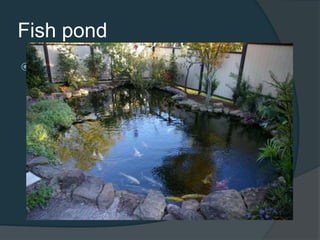
Fish pond
 a controlled pond, artificial lake,
or reservoir that is stocked with fish and
is used in aquaculture for fish farming,
or is used for recreational fishing or for
ornamental purposes.
STEP-BY STEP
1. MAKING CONTOURS
2. THE DIGGING
3. THE LINER
• 1st layer – polyester
• 2nd layer – rubber
4. INSTALLING EQUIPMENT
 Filter system
5. ADDING STRUCTURE
THINGS TO CONSIDER:
1. LOCATION
 A place with a good mixture of sun and shade.
 Build on a natural hill so we could put a waterfall
using a terrain.
2. STYLE/SIZE
 Depth
 Levels
 Most comfortable way of enjoying and feeding the
fish
3. MAINTENANCE COMMITMENT
4. SELECTING FISH
5. PLANT
6. WATERFALL
Water hardness
 Hardness – caused by a dissolved
magnesium and calcium salts
 can be diluted by removing some of the hard
water and adding soft water
 2 types:
 Temporary
○ can be removed by boiling the water
 Permanent
○ Removed by chemical means or distillation
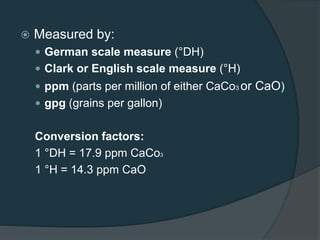
 Measured by:
 German scale measure (°DH)
 Clark or English scale measure (°H)
 ppm (parts per million of either CaCo3 or CaO)
 gpg (grains per gallon)
Conversion factors:
1 °DH = 17.9 ppm CaCo3
1 °H = 14.3 ppm CaO
Selecting Healthy Fish
 Clear Eyes (not cloudy).
 Erect, undamaged fins.
 Scales should be intact, parallel with body (not sticking outwards)
and no red blotches.
 No holes, ulcerations, or lumps.
 Species with translucent bodies, no inner appearing whitish areas.
 Active, lively, normal swimming patterns (some species are naturally
shy and reclusive).
 No white spots (salt grain size) or white cottony growths on the fins
or body.
 Respiration rate should be regular and steady (in unstressed
circumstances).
 Gills should be red inside, not faded or discolored, and not distended
or puffy.
 Actively feeding.
 Avoid selecting fish from a system that contains any sick specimens.
ACCLIMATION OF NEW
FISH
 Close the aquarium lights during the acclimation
period. Float the bag in the aquarium for
approximately 20 minutes to equalize water
temperatures.
 Open the bag and gently pour in some aquarium
water (approximately 1/3 the bag volume), wait 10
minutes. Repeat this water introduction twice more at
the same interval.
 Carefully net the fish out of the bag and place them
in the aquarium. Dispose of the water in the bag, DO
NOT release this water into the aquarium.
 If the newly introduced specimens are the only ones
in the aquarium, wait 24 hours before initial feeding.
To determine the number of fish
can be put in a tank
 One should multiply the length by the width to
determine the square inches of surface area
 Rule of thumb:
 Tropical Freshwater aquarium – no more than 1
inch of fish for every 10 square inches of surface
area
 Cold Freshwater aquarium – 1 inch of fish for every
30 square inches of surface area
 Marine aquarium – 1 inch of fish for every 48
square inches
SUBORDER CHARACOIDEI
FAMILY CHARACIDAE
FAMILY GASTEROPELECIDAE
FAMILY ANOSTOMIDAE
FAMILY HEMIODONTIDAE
SUBORDER CYPRINOIDEI
FAMILY CYPRINIDAE
FAMILY GYRINOCHEILDAE
FAMILY COBITIDAE
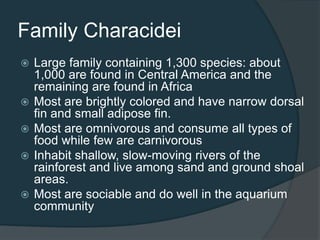
Family Characidei
 Large family containing 1,300 species: about
1,000 are found in Central America and the
remaining are found in Africa
 Most are brightly colored and have narrow dorsal
fin and small adipose fin.
 Most are omnivorous and consume all types of
food while few are carnivorous
 Inhabit shallow, slow-moving rivers of the
rainforest and live among sand and ground shoal
areas.
 Most are sociable and do well in the aquarium
community
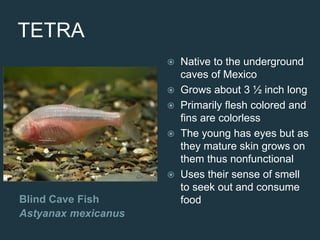
TETRA
Blind Cave Fish
Astyanax mexicanus
 Native to the underground
caves of Mexico
 Grows about 3 ½ inch long
 Primarily flesh colored and
fins are colorless
 The young has eyes but as
they mature skin grows on
them thus nonfunctional
 Uses their sense of smell
to seek out and consume
food
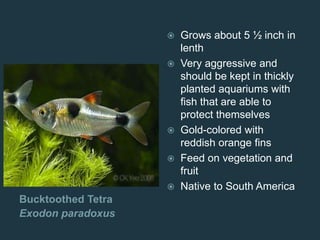
Bucktoothed Tetra
Exodon paradoxus
 Grows about 5 ½ inch in
lenth
 Very aggressive and
should be kept in thickly
planted aquariums with
fish that are able to
protect themselves
 Gold-colored with
reddish orange fins
 Feed on vegetation and
fruit
 Native to South America
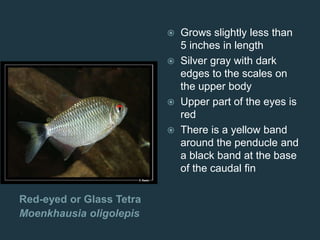
Red-eyed or Glass Tetra
Moenkhausia oligolepis
 Grows slightly less than
5 inches in length
 Silver gray with dark
edges to the scales on
the upper body
 Upper part of the eyes is
red
 There is a yellow band
around the penducle and
a black band at the base
of the caudal fin
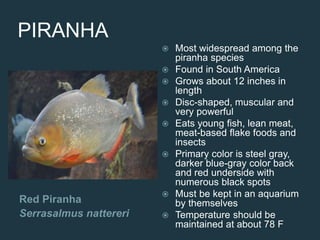
PIRANHA
Red Piranha
Serrasalmus nattereri
 Most widespread among the
piranha species
 Found in South America
 Grows about 12 inches in
length
 Disc-shaped, muscular and
very powerful
 Eats young fish, lean meat,
meat-based flake foods and
insects
 Primary color is steel gray,
darker blue-gray color back
and red underside with
numerous black spots
 Must be kept in an aquarium
by themselves
 Temperature should be
maintained at about 78 F