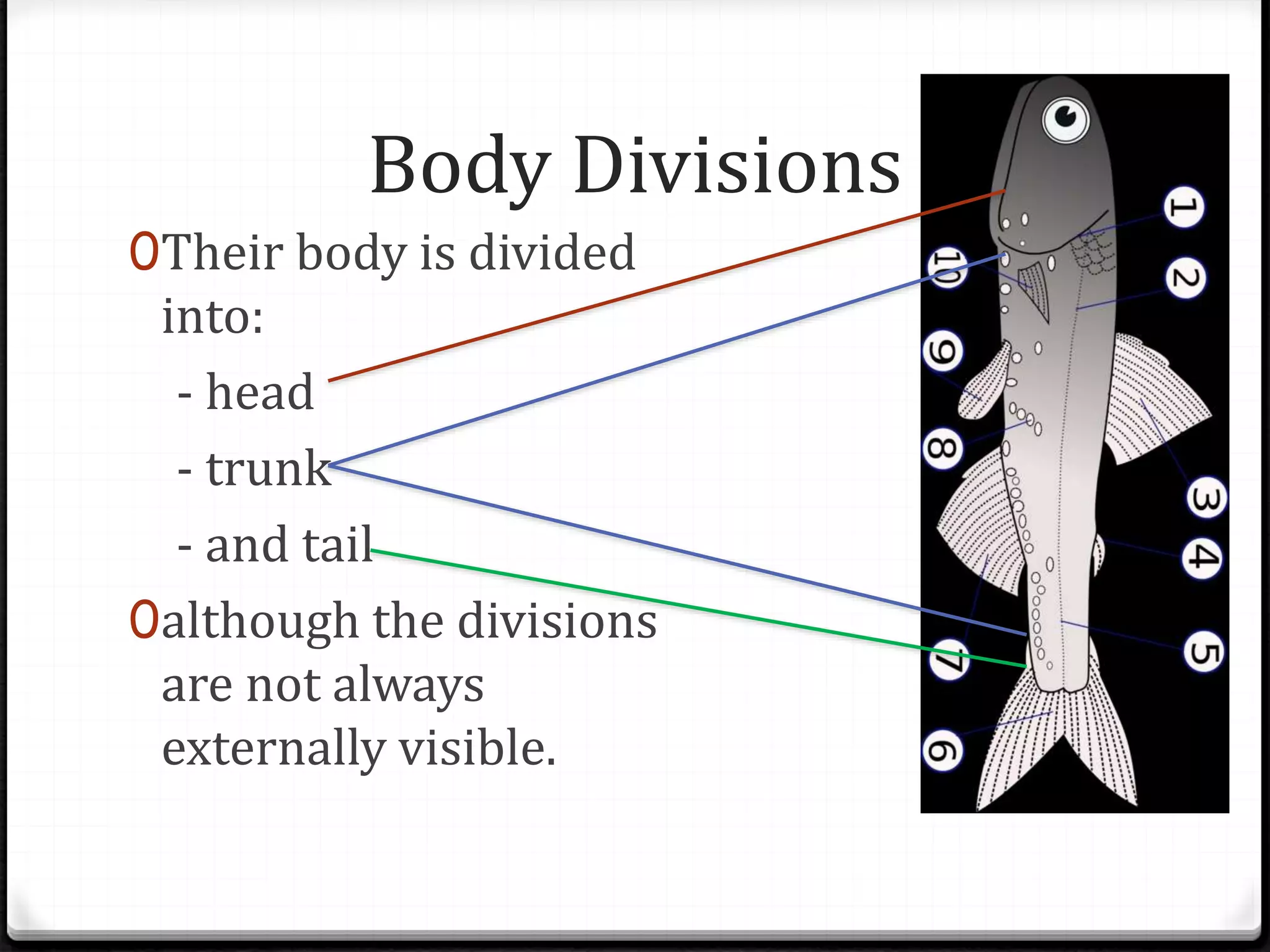
Body Divisions
0Their body is divided
into:
- head
- trunk
- and tail
0although the divisions
are not always
externally visible.
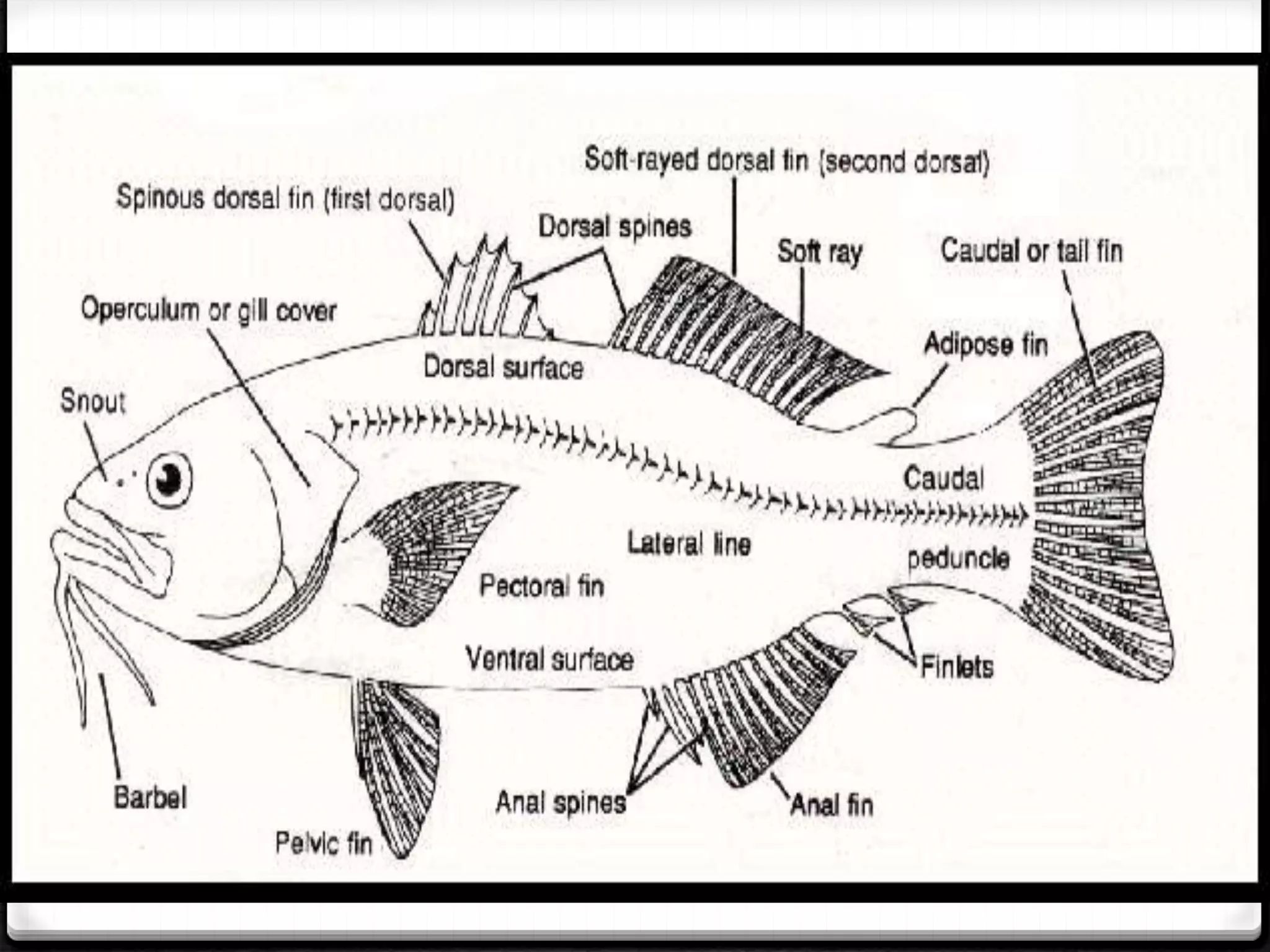
The caudal peduncle
0 is the narrow part of the fish's body to which the
caudal or tail fin is attached. The hypural joint is the
joint between the caudal fin and the last of the
vertebrae. The hypural is often fan-shaped.
Fishes were described and
classified by
1. Body parts
2. Mouth location and size
3. Tail shape
4. Color
5. Some special adaptations
Body shape
0A good indicator of how a fish moves and
where it lives.
1. flat or depressiform
They normally live on the bottom of the sea floor
flap their fins up and down to swim through the
water in the same way a bird flaps its wings.
ex. Skates and flounder
Oban Skates
Stingray
Body shape
2. Long and Skinny or Filiform
 slither through the water like a snake
 examples - like an eel
Snake eel
American eel
Body Shape
3. oval or fusiform
section like a salmon or bass are fast swimmers
usually live in open water
Largemouth Bass
Body Shape
Compressiform
shape like that of angelfish looks thin when viewed
from the front.
This body shape is well designed for making quick
turns and quick bursts of speed over short distances.
Compressiform fish commonly live
where there are many places to
take refuge such as ponds, lakes,
or coral reefs, or
They school together in shallow
open waters.
Blue Gill
Black Crappie
Body Shape
6. Sagittiform
These body shapes are good for rover predators,
which depend on an ability to strike quickly--often
from a hiding place.
"Arrow-like." Other fish with this body type include
pikes, gars, topminnows, killifish, needlefish, and
barracuda.
Spotted gar
Northern Walleye
7. Taeniform
"Ribbon-like." Example shown is a gunnel.
This shape is good for hiding in cracks and
crevices, but fishes like this do not move very
fast.
8. Globiform
"Globe-like." Shown is a smooth lumpsucker.
This, too, would be an unusual shape in a
freshwater environment, although pupfish
come close.
9. Anguilliform
"Eel-like." Many eels, of course have this
shape. Shown is a brook lamprey. This shape
allows a fish to enter and hide in very narrow
openings, and also helps the fish resist the
force of current.
Another way to classify body types is
by their function. In this system:
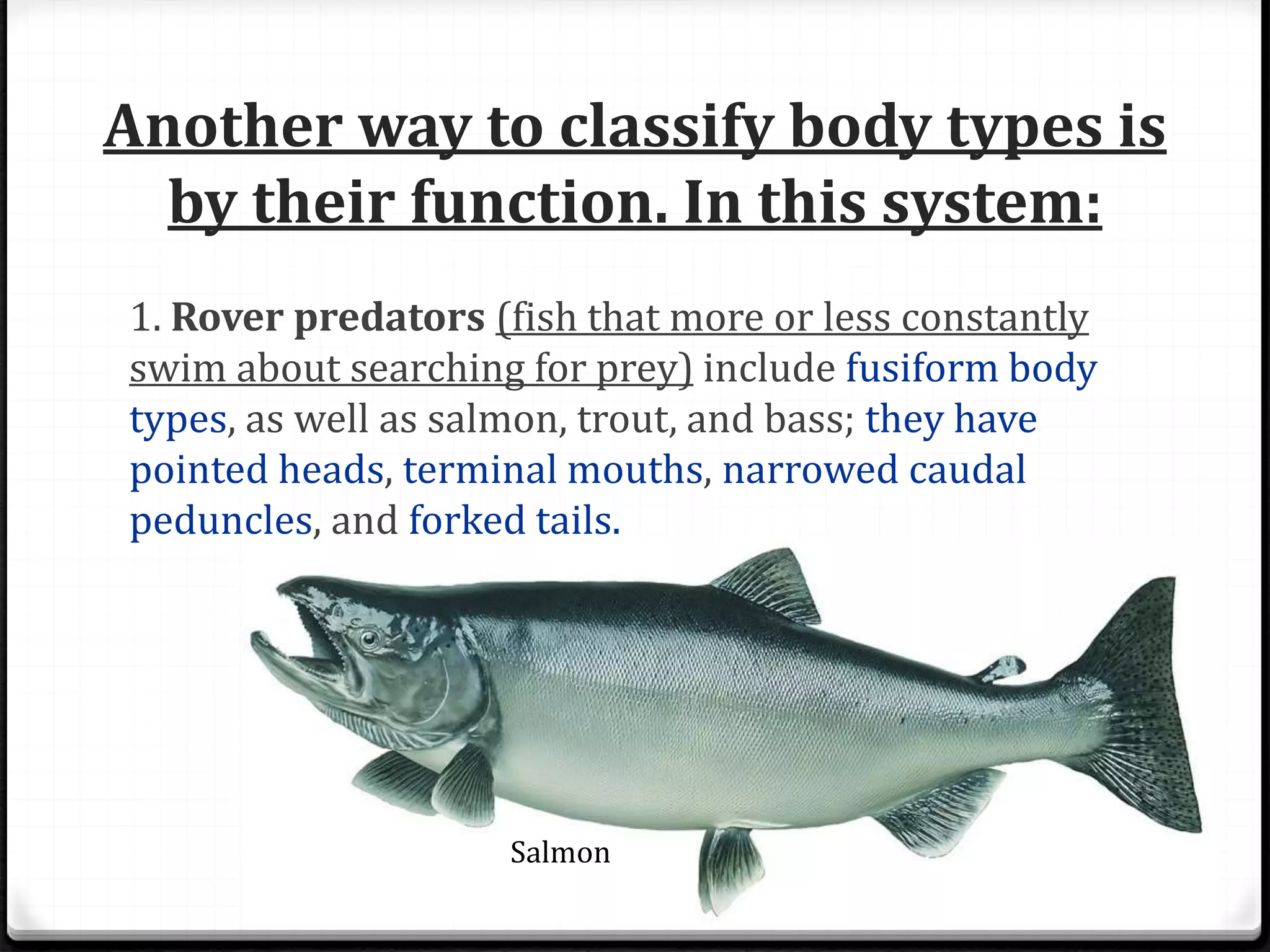
1. Rover predators (fish that more or less constantly
swim about searching for prey) include fusiform body
types, as well as salmon, trout, and bass; they have
pointed heads, terminal mouths, narrowed caudal
peduncles, and forked tails.
Salmon
2. Lie-in-wait predators (predators that catch their
prey by ambush) include sagittiform body types; they
have dorsal and anal fins placed well back on the body, a
streamlined form, flattened heads, and large, well-
toothed mouths.
3. Surface-oriented fishes are often small, with
mouths that are directed upwards toward the surface of
the water. These fishes often swim just below the
surface, and eat food that is floating on the surface or
flying above it. Topminnows, killifish, freshwater
hatchetfish, halfbeaks, and flying fish are examples of
surface-oriented fishes.
https://www.youtube.com/watch?v=4T1SQtavaUM
4. Deep-bodied fish include all the compressiform
types, and are found widely in places where the ability
to make tight, close turns is of value, such as rock reefs,
coral reefs, thickly vegetated areas, and schools.
5. Eel-like fish include taeniform, anguilliform, and
filiform shapes all in one category.
6. Bottom fish is a very broad category that includes
bottom rovers like catfishes, suckers, and sturgeons,
bottom clingers like sculpins, bottom hiders like
darters and blennies, and depressiform body types,
like flatfish.
Morphology: Fin type
Pectoral fins:
Pectoral fins may be horizontal and down low, like in a
salmon, trout, shark, or sturgeon, and used mainly for
gliding.
These are often are used for swimming, holding
position, and changing directions quickly.
Pelvic fin location:
Pelvic fins are usual abdominal, meaning that they are
attached midway down the belly.
When the pelvic fins are below the pectoral fins, such
as can be seen in the diagram of the non-existent fish
above, they are termed thoracic.
When a thoracic pelvic fin is attached under the gills,
it may also be called jugular, and if under the chin or
eye, mental.
Caudal fin shape:
A. The homocercal (homo-SUR-kul) tail is a modern
development. It is symmetrical.
It includes truncate, square, slightly forked, and deeply
forked types. It is by far the most common caudal fin
shape, shared by most fishes.
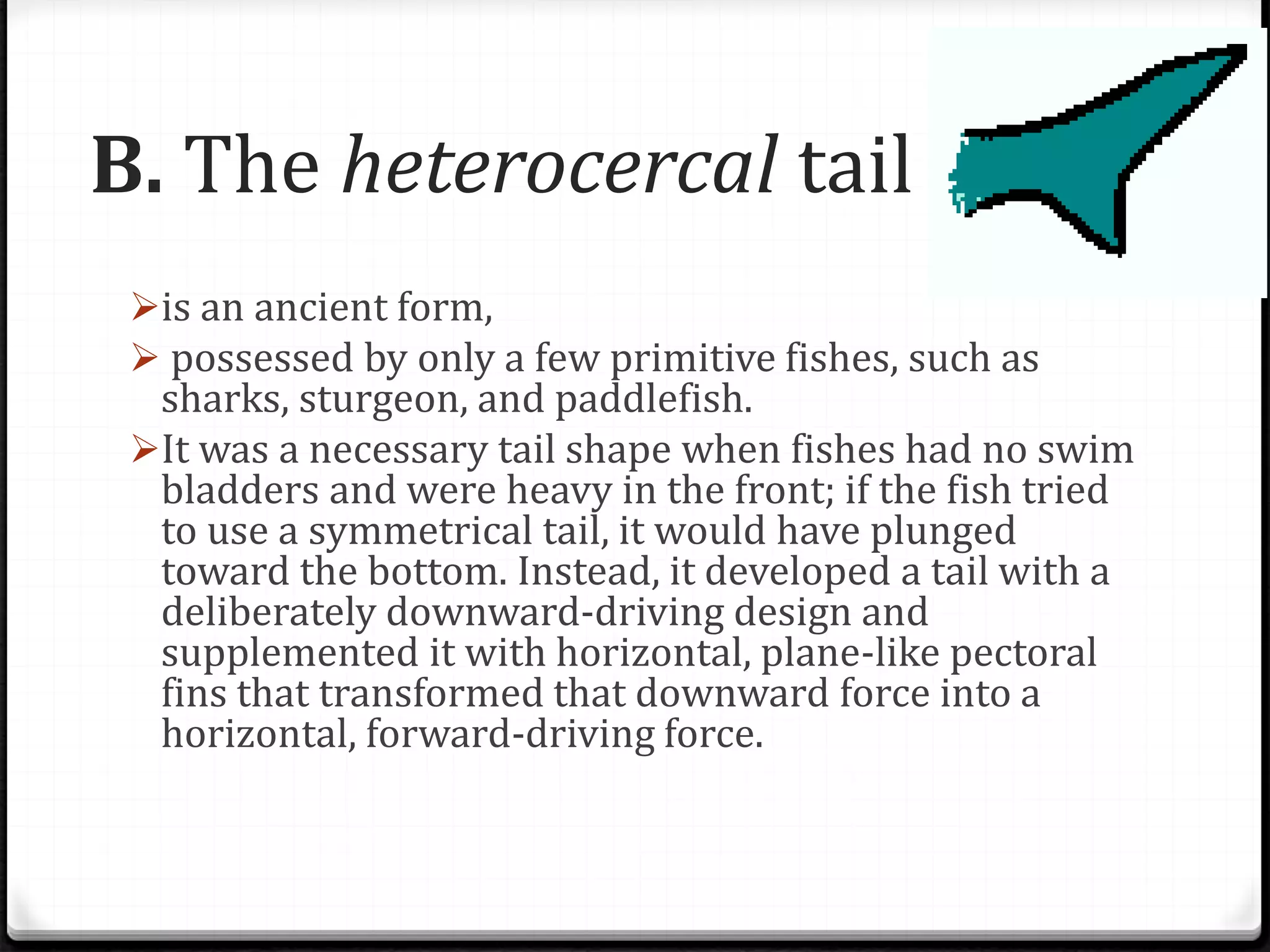
B. The heterocercal tail
is an ancient form,
 possessed by only a few primitive fishes, such as
sharks, sturgeon, and paddlefish.
It was a necessary tail shape when fishes had no swim
bladders and were heavy in the front; if the fish tried
to use a symmetrical tail, it would have plunged
toward the bottom. Instead, it developed a tail with a
deliberately downward-driving design and
supplemented it with horizontal, plane-like pectoral
fins that transformed that downward force into a
horizontal, forward-driving force.
C. This tail has a non-differentiated caudal
fin. This may be found on eels of all sorts,
as well as lampreys.
Fish Tail indicates how the fish moves and lives as well.
Types of fish tails:
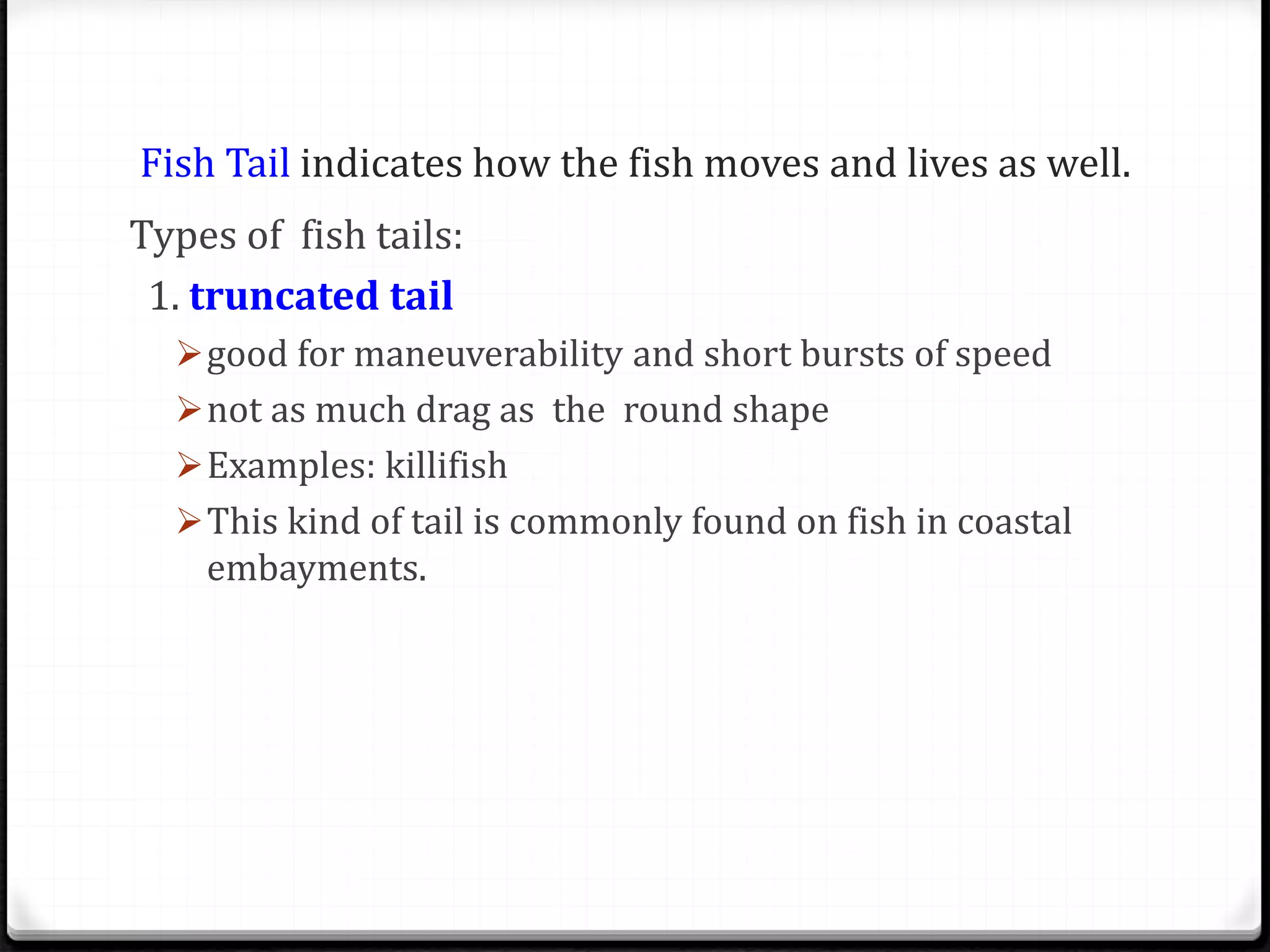
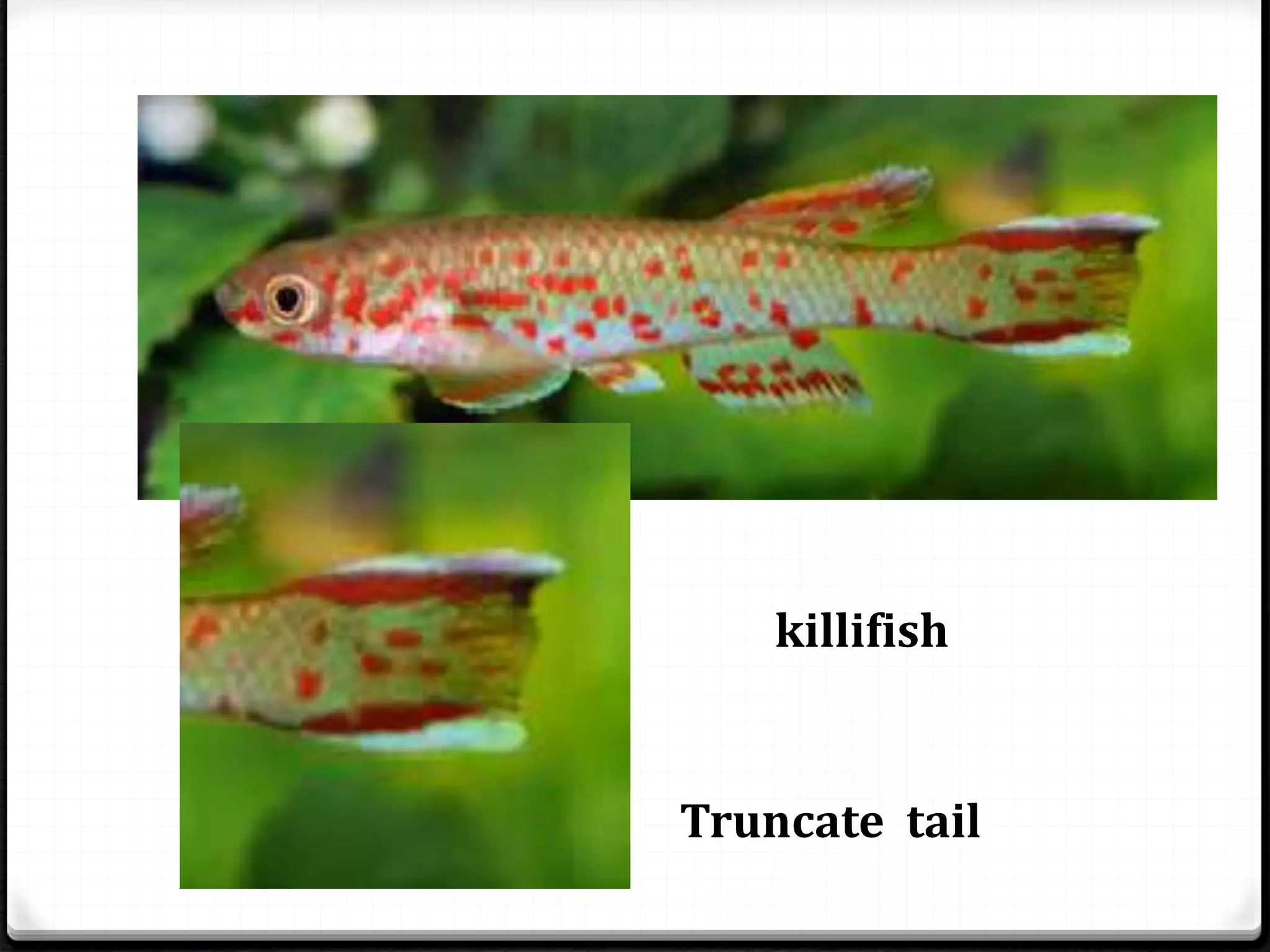
1. truncated tail
good for maneuverability and short bursts of speed
not as much drag as the round shape
Examples: killifish
This kind of tail is commonly found on fish in coastal
embayments.
killifish
Truncate tail
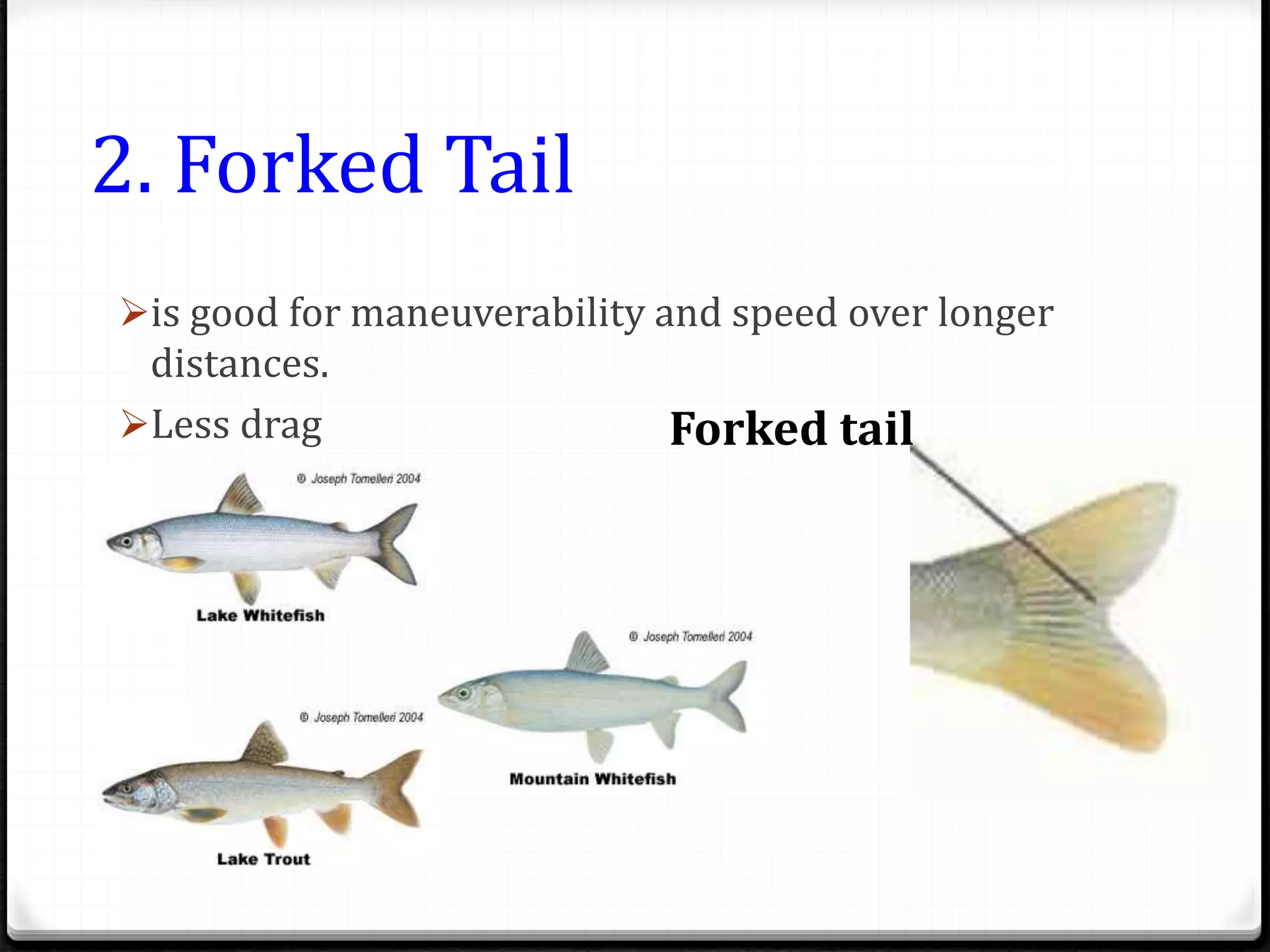
2. Forked Tail
is good for maneuverability and speed over longer
distances.
Less drag Forked tail
3. Round Tail
Large amounts of surface area
for effective maneuvering and
acceleration
but creates drag causing the
fish to tire easily
Round tail
Clown fish
4. Emarginate
Effective acceleration and maneuvering
not as much drag as the round and truncate
tail
5. Lunate or crescent
shaped tails like those found on a swordfish
not good for maneuvering
allow for great speed over long distances
usually found on fish that live in the open ocean.
Swordfish (Xiphias gladius)
Black Marlin (Makaira indica)
Morphology: Scale type
Scales have evolved over time and are of major
importance in classifying fishes. Most scales are
deeply buried in the fish's epidermis, or outer skin
layer, with only part of them showing. Below the
pictures of scales are examples of how the scales
would look on the fish's body.
Ganoid
"primitive" kind of scale
reminder of the time
when fishes used armor
plating to protect
themselves
Ganoid scales are hard
and smooth, and may take
the form of only a few
scales
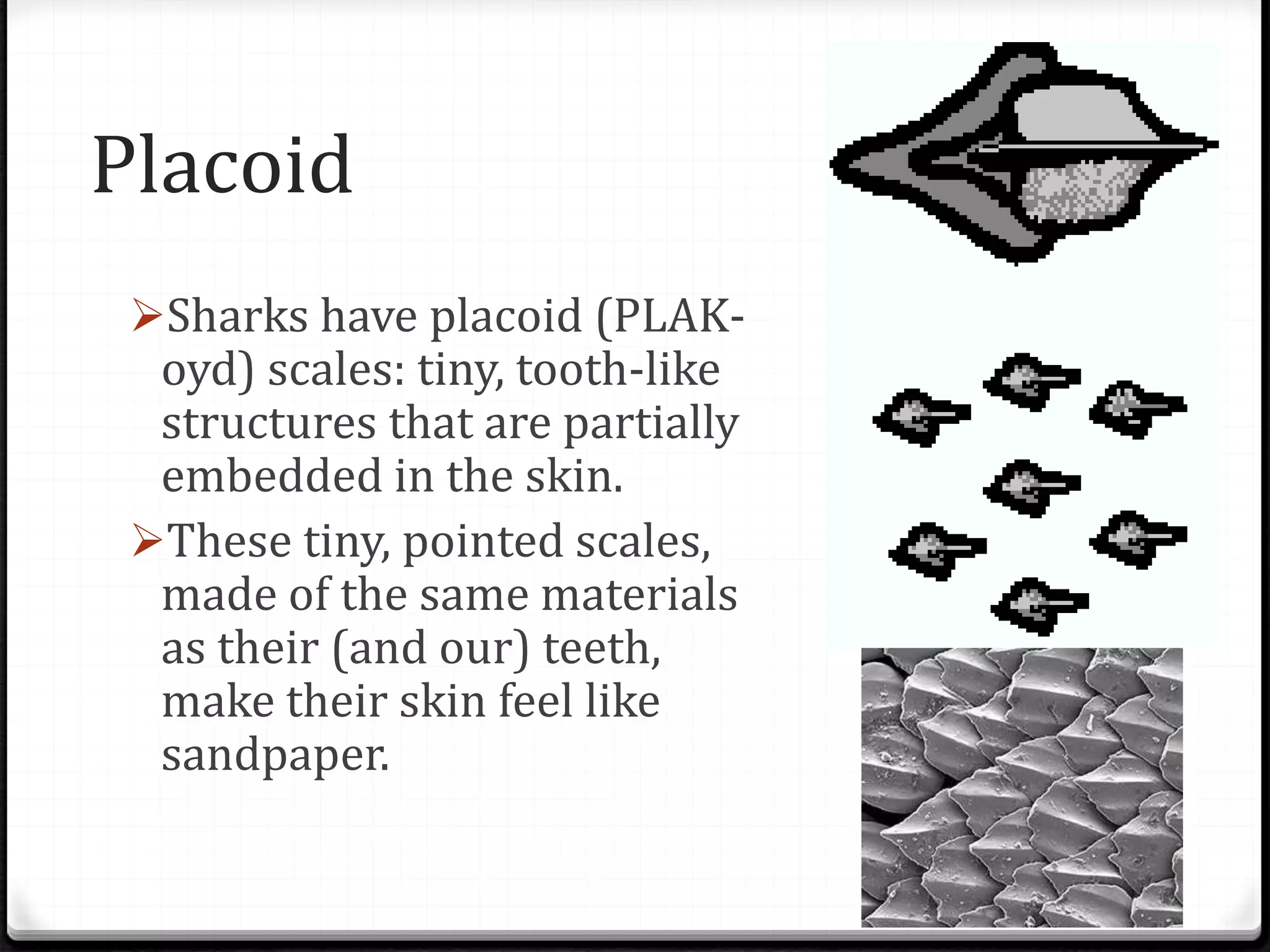
Placoid
Sharks have placoid (PLAK-
oyd) scales: tiny, tooth-like
structures that are partially
embedded in the skin.
These tiny, pointed scales,
made of the same materials
as their (and our) teeth,
make their skin feel like
sandpaper.
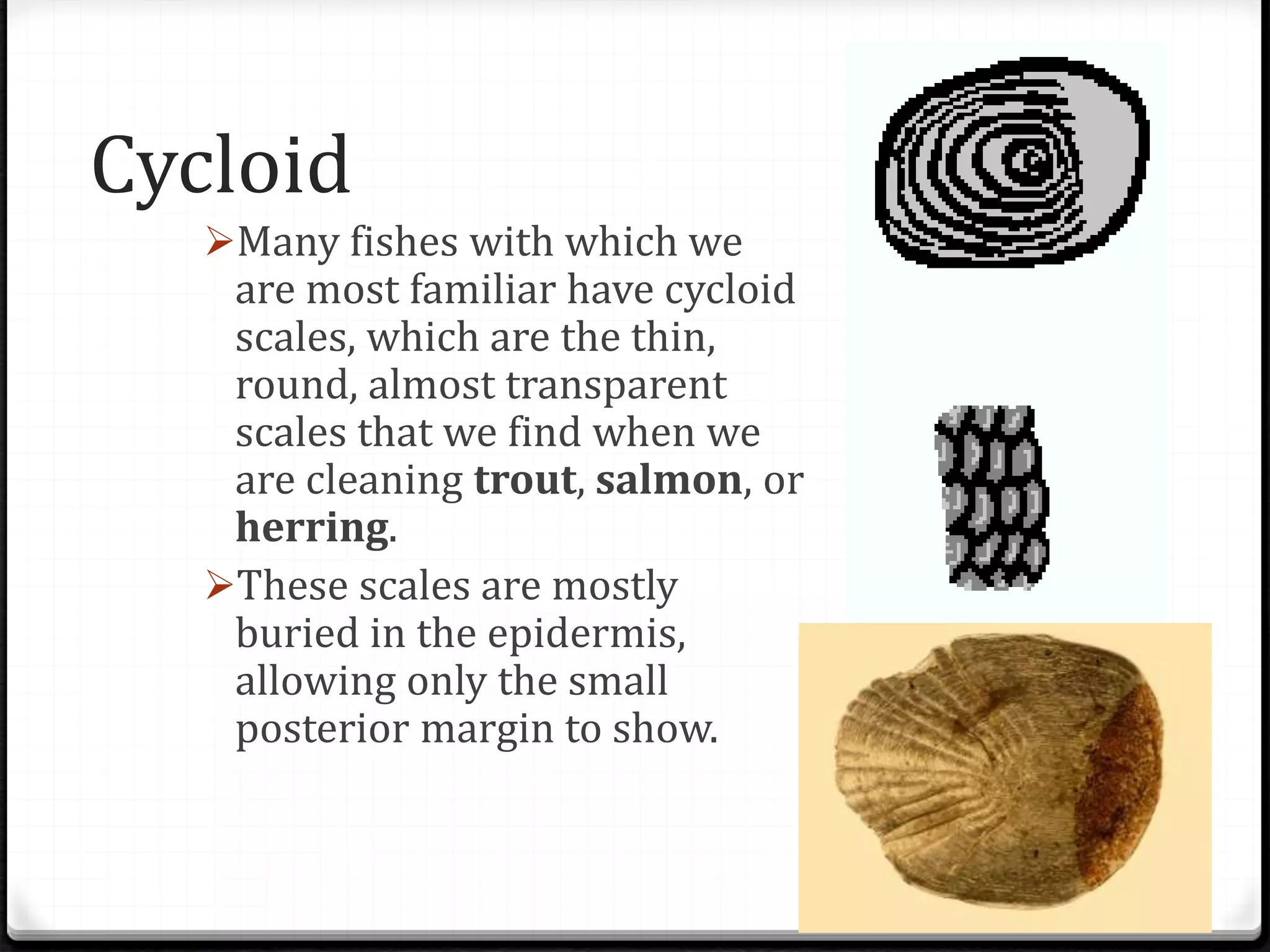
Cycloid
Many fishes with which we
are most familiar have cycloid
scales, which are the thin,
round, almost transparent
scales that we find when we
are cleaning trout, salmon, or
herring.
These scales are mostly
buried in the epidermis,
allowing only the small
posterior margin to show.
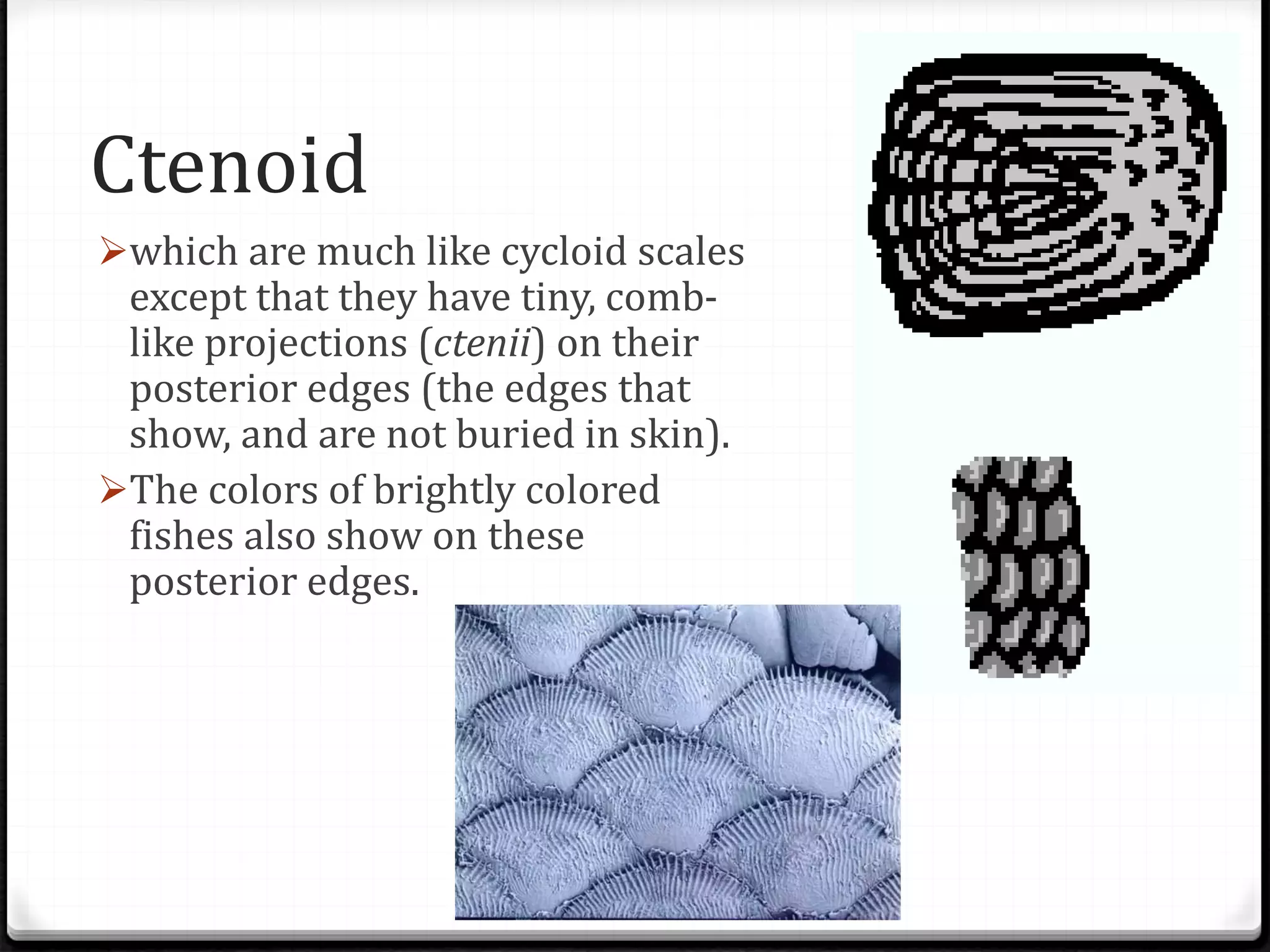
Ctenoid
which are much like cycloid scales
except that they have tiny, comb-
like projections (ctenii) on their
posterior edges (the edges that
show, and are not buried in skin).
The colors of brightly colored
fishes also show on these
posterior edges.
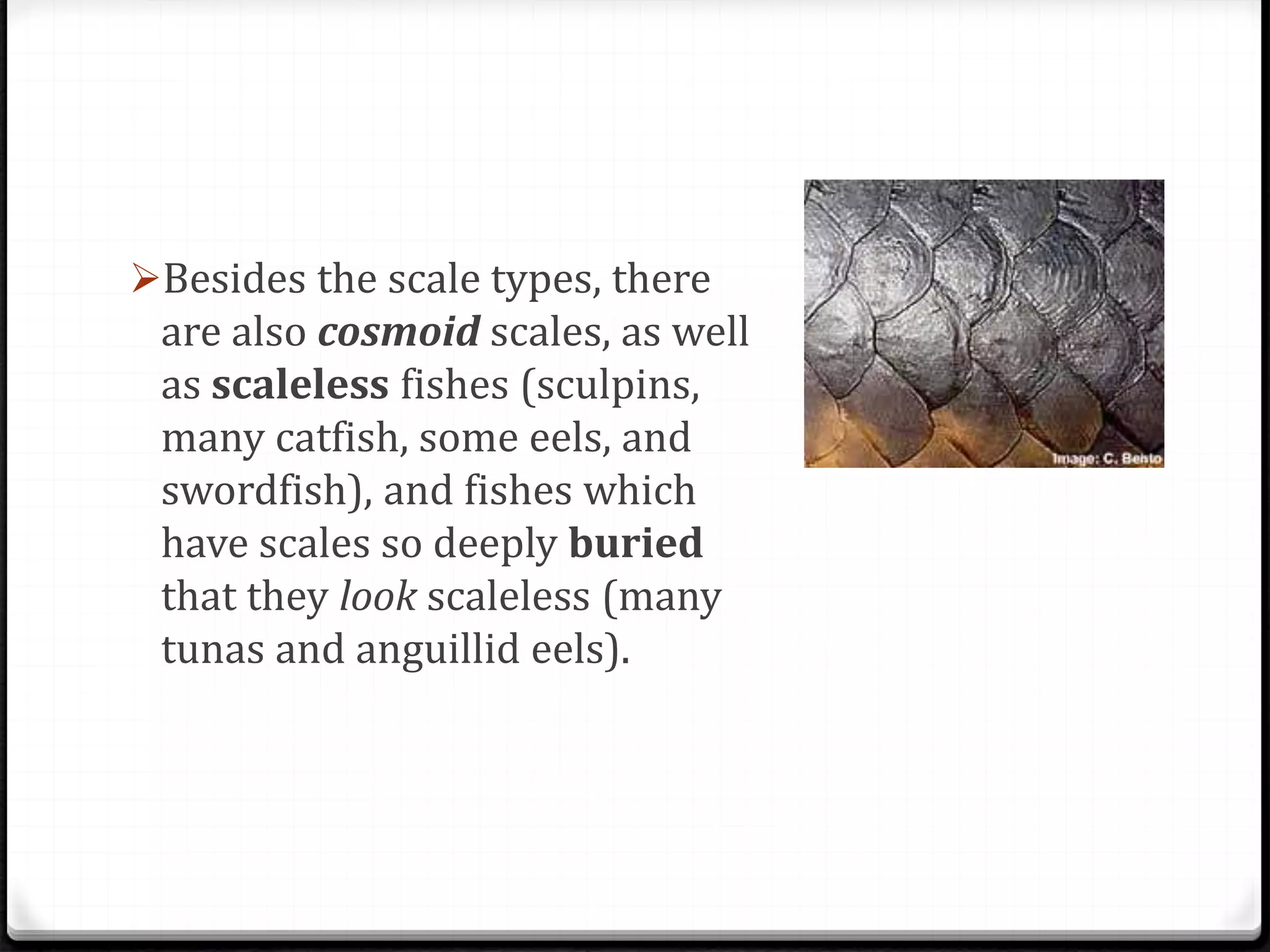
Besides the scale types, there
are also cosmoid scales, as well
as scaleless fishes (sculpins,
many catfish, some eels, and
swordfish), and fishes which
have scales so deeply buried
that they look scaleless (many
tunas and anguillid eels).
Morphology: Mouth Shape
1. Upward orientation
• used to capture prey on the water surface
2. large mouth
• swallowing/tearing large prey
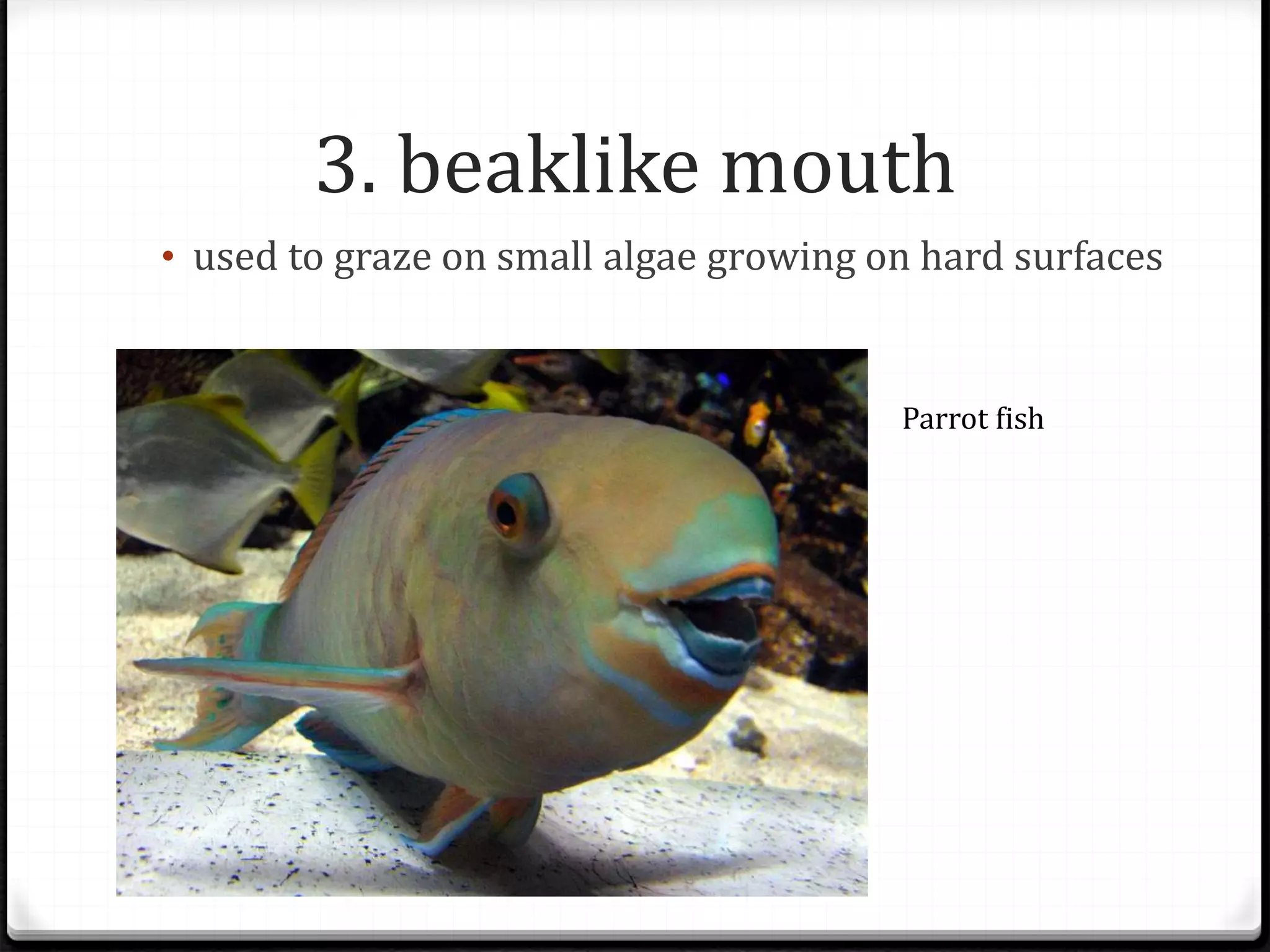
3. beaklike mouth
• used to graze on small algae growing on hard surfaces
Parrot fish
4. Downward
• orientated mouth-useful to suck food up from
bottom
Janitor fish
5. long, skinny bill
• tweezer like
• poking into crevices
Defense Strategies
1. Cryptic Coloration - form of camouflage, colored to
match background/surroundings
2. Countershading-dorsally darkened and ventrally
whitened, dark helps fish to blend in with the dark
bottom when viewed from above whereas the white
belly helps them to blend with the sky or clearer
waters above when viewed from below
3. Disruptive Coloration -another form of
camouflage, colors and patterns (i.e.. presence of
color stripes or bars) that break up the outline of a
fish making it harder to see
Basslet
firefish
4. Eye Spot (false eye)-black spot located near base of
the tail used to confuse predators
Four Eye Butterfly Fish.
5. Thickened Scales -protective covering making
their hard carpace relatively immune to predation
6. Spines-for defense and protection from predators,
may be venomous
Porcupine fish
7. Schooling-fish swimming
in schools may have a
greater chance to survive
than if by themselves
because an individual fish
in a school may be harder
to pick out by a predator
Reproductive types
o Asexual reproduction (parthenogenesis)
o Sexual Reproduction
Parthenogenesis
o There are two known species that undergo
parthenogenesis as their chosen form of reproduction.
o The Amazon Molly Poecilia formosa of Mexico and Texas
o Texas Silverside Menidia clarkhubbsi
Sexual Reproduction
o The standard form of reproduction is through the
union of male and female gametes
o Sexual maturity is reached at different ages for
different species. Factors that influence sexual
maturity include age, gender and size.
o Many bony fishes become sexually mature between
one and five years. Sturgeon take up to 15 years to
mature.
o In general, species of a small maximum size begin
reproducing at a younger age than those that have a
large maximum size.
Diversity in Gender
o The vast majority of fish are “dioecious” meaning that
there are male and female genders in separate bodies
o ‘Hermaphrodism’, is the alternative to dioecism
o Species can be either hermaphroditic simultaneously or
sequentially
o If simultaneous then they are both genders at the same
time
o If sequentially then the species changes genders due to
environmental cues
o Species that are born male are called protandrous
o Species that are born female are called Protogynous
Modes of Sexual
Reproduction
o There are three primary ways that fish reproduce
o Ovopartity – lay undeveloped eggs, external fertilization
(90% of bony fish), internal fertilization (some sharks
and rays)
o Ovovivparity – internal development – without direct
maternal nourishment – advanced at birth (most sharks
& rays) – Larval birth (some scorpeaniforme – rockfish)
o Viviparity – Internal development – direct nourishment
from mother – fully advanced at birth (some sharks, surf
perches)
Sexual Dimorphism
o In most species of fish the females are larger than the
males, this sexual dimorphism is not normally more
than a difference of about 10-15% by length.
o There are a family of fish however, that the male is
significantly smaller and lives as a parasite on the
female getting all of his nutrients from her.
Young Protection
o There are many different forms that fish use to protect
the young/eggs
o Mouth brooding, one adult collects the eggs in their
mouth after fertilization and keeps them safe until they
hatch (cichlids)
o External brooding pouch, or with the eggs stuck to the
males body (seahorses)
o Gill brooding, eggs are kept in the gill cavity of the adult

Fish Morphology.pptx

  • 3.
    Body Divisions 0Their bodyis divided into: - head - trunk - and tail 0although the divisions are not always externally visible.
  • 4.
    The caudal peduncle 0is the narrow part of the fish's body to which the caudal or tail fin is attached. The hypural joint is the joint between the caudal fin and the last of the vertebrae. The hypural is often fan-shaped.
  • 8.
    Fishes were describedand classified by 1. Body parts 2. Mouth location and size 3. Tail shape 4. Color 5. Some special adaptations
  • 9.
    Body shape 0A goodindicator of how a fish moves and where it lives. 1. flat or depressiform They normally live on the bottom of the sea floor flap their fins up and down to swim through the water in the same way a bird flaps its wings. ex. Skates and flounder
  • 10.
  • 11.
    Body shape 2. Longand Skinny or Filiform  slither through the water like a snake  examples - like an eel Snake eel American eel
  • 12.
    Body Shape 3. ovalor fusiform section like a salmon or bass are fast swimmers usually live in open water Largemouth Bass
  • 13.
    Body Shape Compressiform shape likethat of angelfish looks thin when viewed from the front. This body shape is well designed for making quick turns and quick bursts of speed over short distances. Compressiform fish commonly live where there are many places to take refuge such as ponds, lakes, or coral reefs, or They school together in shallow open waters. Blue Gill Black Crappie
  • 14.
    Body Shape 6. Sagittiform Thesebody shapes are good for rover predators, which depend on an ability to strike quickly--often from a hiding place. "Arrow-like." Other fish with this body type include pikes, gars, topminnows, killifish, needlefish, and barracuda.
  • 15.
  • 16.
    7. Taeniform "Ribbon-like." Exampleshown is a gunnel. This shape is good for hiding in cracks and crevices, but fishes like this do not move very fast.
  • 17.
    8. Globiform "Globe-like." Shownis a smooth lumpsucker. This, too, would be an unusual shape in a freshwater environment, although pupfish come close.
  • 18.
    9. Anguilliform "Eel-like." Manyeels, of course have this shape. Shown is a brook lamprey. This shape allows a fish to enter and hide in very narrow openings, and also helps the fish resist the force of current.
  • 20.
    Another way toclassify body types is by their function. In this system: 1. Rover predators (fish that more or less constantly swim about searching for prey) include fusiform body types, as well as salmon, trout, and bass; they have pointed heads, terminal mouths, narrowed caudal peduncles, and forked tails. Salmon
  • 21.
    2. Lie-in-wait predators(predators that catch their prey by ambush) include sagittiform body types; they have dorsal and anal fins placed well back on the body, a streamlined form, flattened heads, and large, well- toothed mouths.
  • 22.
    3. Surface-oriented fishesare often small, with mouths that are directed upwards toward the surface of the water. These fishes often swim just below the surface, and eat food that is floating on the surface or flying above it. Topminnows, killifish, freshwater hatchetfish, halfbeaks, and flying fish are examples of surface-oriented fishes. https://www.youtube.com/watch?v=4T1SQtavaUM
  • 23.
    4. Deep-bodied fishinclude all the compressiform types, and are found widely in places where the ability to make tight, close turns is of value, such as rock reefs, coral reefs, thickly vegetated areas, and schools.
  • 24.
    5. Eel-like fishinclude taeniform, anguilliform, and filiform shapes all in one category. 6. Bottom fish is a very broad category that includes bottom rovers like catfishes, suckers, and sturgeons, bottom clingers like sculpins, bottom hiders like darters and blennies, and depressiform body types, like flatfish.
  • 25.
  • 26.
    Pectoral fins: Pectoral finsmay be horizontal and down low, like in a salmon, trout, shark, or sturgeon, and used mainly for gliding. These are often are used for swimming, holding position, and changing directions quickly.
  • 27.
    Pelvic fin location: Pelvicfins are usual abdominal, meaning that they are attached midway down the belly. When the pelvic fins are below the pectoral fins, such as can be seen in the diagram of the non-existent fish above, they are termed thoracic. When a thoracic pelvic fin is attached under the gills, it may also be called jugular, and if under the chin or eye, mental.
  • 28.
    Caudal fin shape: A.The homocercal (homo-SUR-kul) tail is a modern development. It is symmetrical. It includes truncate, square, slightly forked, and deeply forked types. It is by far the most common caudal fin shape, shared by most fishes.
  • 29.
    B. The heterocercaltail is an ancient form,  possessed by only a few primitive fishes, such as sharks, sturgeon, and paddlefish. It was a necessary tail shape when fishes had no swim bladders and were heavy in the front; if the fish tried to use a symmetrical tail, it would have plunged toward the bottom. Instead, it developed a tail with a deliberately downward-driving design and supplemented it with horizontal, plane-like pectoral fins that transformed that downward force into a horizontal, forward-driving force.
  • 30.
    C. This tailhas a non-differentiated caudal fin. This may be found on eels of all sorts, as well as lampreys.
  • 31.
    Fish Tail indicateshow the fish moves and lives as well. Types of fish tails: 1. truncated tail good for maneuverability and short bursts of speed not as much drag as the round shape Examples: killifish This kind of tail is commonly found on fish in coastal embayments.
  • 32.
  • 33.
    2. Forked Tail isgood for maneuverability and speed over longer distances. Less drag Forked tail
  • 34.
    3. Round Tail Largeamounts of surface area for effective maneuvering and acceleration but creates drag causing the fish to tire easily Round tail Clown fish
  • 35.
    4. Emarginate Effective accelerationand maneuvering not as much drag as the round and truncate tail
  • 36.
    5. Lunate orcrescent shaped tails like those found on a swordfish not good for maneuvering allow for great speed over long distances usually found on fish that live in the open ocean.
  • 37.
    Swordfish (Xiphias gladius) BlackMarlin (Makaira indica)
  • 39.
    Morphology: Scale type Scaleshave evolved over time and are of major importance in classifying fishes. Most scales are deeply buried in the fish's epidermis, or outer skin layer, with only part of them showing. Below the pictures of scales are examples of how the scales would look on the fish's body.
  • 40.
    Ganoid "primitive" kind ofscale reminder of the time when fishes used armor plating to protect themselves Ganoid scales are hard and smooth, and may take the form of only a few scales
  • 41.
    Placoid Sharks have placoid(PLAK- oyd) scales: tiny, tooth-like structures that are partially embedded in the skin. These tiny, pointed scales, made of the same materials as their (and our) teeth, make their skin feel like sandpaper.
  • 42.
    Cycloid Many fishes withwhich we are most familiar have cycloid scales, which are the thin, round, almost transparent scales that we find when we are cleaning trout, salmon, or herring. These scales are mostly buried in the epidermis, allowing only the small posterior margin to show.
  • 43.
    Ctenoid which are muchlike cycloid scales except that they have tiny, comb- like projections (ctenii) on their posterior edges (the edges that show, and are not buried in skin). The colors of brightly colored fishes also show on these posterior edges.
  • 44.
    Besides the scaletypes, there are also cosmoid scales, as well as scaleless fishes (sculpins, many catfish, some eels, and swordfish), and fishes which have scales so deeply buried that they look scaleless (many tunas and anguillid eels).
  • 45.
    Morphology: Mouth Shape 1.Upward orientation • used to capture prey on the water surface
  • 46.
    2. large mouth •swallowing/tearing large prey
  • 47.
    3. beaklike mouth •used to graze on small algae growing on hard surfaces Parrot fish
  • 48.
    4. Downward • orientatedmouth-useful to suck food up from bottom Janitor fish
  • 49.
    5. long, skinnybill • tweezer like • poking into crevices
  • 50.
    Defense Strategies 1. CrypticColoration - form of camouflage, colored to match background/surroundings
  • 51.
    2. Countershading-dorsally darkenedand ventrally whitened, dark helps fish to blend in with the dark bottom when viewed from above whereas the white belly helps them to blend with the sky or clearer waters above when viewed from below
  • 52.
    3. Disruptive Coloration-another form of camouflage, colors and patterns (i.e.. presence of color stripes or bars) that break up the outline of a fish making it harder to see Basslet firefish
  • 53.
    4. Eye Spot(false eye)-black spot located near base of the tail used to confuse predators Four Eye Butterfly Fish.
  • 54.
    5. Thickened Scales-protective covering making their hard carpace relatively immune to predation
  • 55.
    6. Spines-for defenseand protection from predators, may be venomous Porcupine fish
  • 56.
    7. Schooling-fish swimming inschools may have a greater chance to survive than if by themselves because an individual fish in a school may be harder to pick out by a predator
  • 57.
    Reproductive types o Asexualreproduction (parthenogenesis) o Sexual Reproduction
  • 58.
    Parthenogenesis o There aretwo known species that undergo parthenogenesis as their chosen form of reproduction. o The Amazon Molly Poecilia formosa of Mexico and Texas o Texas Silverside Menidia clarkhubbsi
  • 59.
    Sexual Reproduction o Thestandard form of reproduction is through the union of male and female gametes o Sexual maturity is reached at different ages for different species. Factors that influence sexual maturity include age, gender and size. o Many bony fishes become sexually mature between one and five years. Sturgeon take up to 15 years to mature. o In general, species of a small maximum size begin reproducing at a younger age than those that have a large maximum size.
  • 60.
    Diversity in Gender oThe vast majority of fish are “dioecious” meaning that there are male and female genders in separate bodies o ‘Hermaphrodism’, is the alternative to dioecism o Species can be either hermaphroditic simultaneously or sequentially o If simultaneous then they are both genders at the same time o If sequentially then the species changes genders due to environmental cues o Species that are born male are called protandrous o Species that are born female are called Protogynous
  • 61.
    Modes of Sexual Reproduction oThere are three primary ways that fish reproduce o Ovopartity – lay undeveloped eggs, external fertilization (90% of bony fish), internal fertilization (some sharks and rays) o Ovovivparity – internal development – without direct maternal nourishment – advanced at birth (most sharks & rays) – Larval birth (some scorpeaniforme – rockfish) o Viviparity – Internal development – direct nourishment from mother – fully advanced at birth (some sharks, surf perches)
  • 62.
    Sexual Dimorphism o Inmost species of fish the females are larger than the males, this sexual dimorphism is not normally more than a difference of about 10-15% by length. o There are a family of fish however, that the male is significantly smaller and lives as a parasite on the female getting all of his nutrients from her.
  • 63.
    Young Protection o Thereare many different forms that fish use to protect the young/eggs o Mouth brooding, one adult collects the eggs in their mouth after fertilization and keeps them safe until they hatch (cichlids) o External brooding pouch, or with the eggs stuck to the males body (seahorses) o Gill brooding, eggs are kept in the gill cavity of the adult