4. Diversity of Fishes Kingdom  - Animalia Phylum  - Chordata 3 Classes: Agnatha, Chondrichthyes, Osteichthyes
Vertebrates: Ex: fish, amphibians, reptiles, birds, & mammals  Have a  notochord  (slim, flexible rod) present in early stages - may be replaced by backbone in adults  Have a  spinal cord  Respire through  pharyngeal or gill pouches  during early development  Have  post-anal tail  in early stages  Endoskeleton  made of bone &/or cartilage  Anterior head with well developed brain & sensory organs  (Cephalization)   Closed  circulatory system
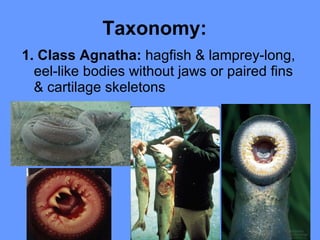
Taxonomy:   1. Class Agnatha:  hagfish & lamprey-long, eel-like bodies without jaws or paired fins & cartilage skeletons
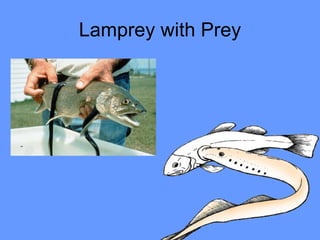
Agnatha (Jawless Fish):   Hagfish& lampreys Circular mouths that can’t close Sharp teeth & strong, raspy tongue-tears hole in prey & sucks out blood & body fluids Eel-shaped body  Skeleton made of cartilage  No paired fins  Gills – no operculum Hagfish: burrow in mud; scavenge on dead & dying fish; have tentacles around their mouth  Lampreys: usually parasitic; great sense of smell to find prey; covered with a poisonous slime
Lamprey with Prey
2. Class Chondrichthyes  include sharks, rays, & skates also with  cartilage skeletons , paired fins, & jaws
Characteristics of  the more advanced fishes:     Streamlined body & muscular tail   for swimming (know the differences between tail shapes!) Most - paired fins for maneuvering  Body covered with protective scales & mucus layer to reduce friction when swimming  Respire through gills  Most - lateral line system-sensory structures running down each side of the organism to detect changes in water temperature, pressure, current, etc.
Most w/ well-developed sense of sight & smell Most can detect electrical currents  Ectotherms (body temperature close to outside temp.) Two chambered heart (1 atrium/1ventrical)
Class Chondrichthyes Includes sharks, rays, & skates  Endoskeleton of cartilage  Hinged jaws & paired fins  Placoid scales & tooth-like dermal spines on scales Most Marine  Most Carnivorous
Sharks vs. Rays Sharks are torpedo shaped=“fusiform” Rays & skates have broad, flat bodies with wing-like fins and a tail
Shark Characteristics: Large, oily liver helps w/ buoyancy Have countershading: protective coloration (darker top & lighter bottom) Ventral mouth with 6-20 rows of sharp, replaceable teeth  Short, straight intestine with spiral valve to slow food movement  5-7 pairs of gills for gas exchange  Kidneys remove wastes & maintain water balance  Electroreceptors on head help find prey & navigate  Lateral line Separate sexes - external fertilization
Ray & Skate Characteristics: Usually harmless to humans  Broad, wing-like pectoral fins used to glide through water  Flattened bodies with ventral mouth  Both eyes on top of head  Have countershading Feed on fish & invertebrates  Stingray with poison spine by tip of tail Electric ray gives off strong, electric shock  Manta ray is largest
Traits of Bony Fish  (Class Osteichthyes)   Skeleton made of bone  Hinged jaws  Paired fins  Gills for gas exchange  Lateral line  Body covered with scales & mucus coating  Includes lobe-finned, ray-finned, and lung fish
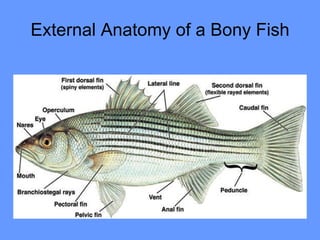
Ray-finned Fish: Fan-like fins supported by rays  Includes salmon, perch, catfish, tuna, etc.  Have movable fins  Dorsal fin (s) located on top-keep fish upright & used for defense  Caudal fin (tail) moves side to side to help steer  Pectoral fins (paired) on each side behind the operculum  Pelvic fins (paired) on ventral surface near the head  Anal fin (single) behind anus
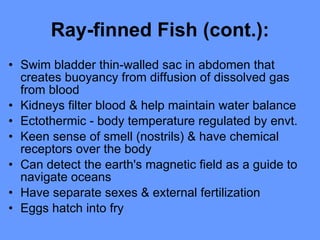
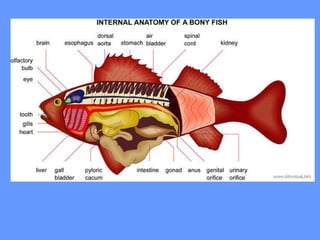
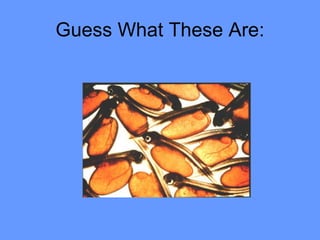
Ray-finned Fish (cont.): Swim bladder thin-walled sac in abdomen that creates buoyancy from diffusion of dissolved gas from blood  Kidneys filter blood & help maintain water balance  Ectothermic - body temperature regulated by envt. Keen sense of smell (nostrils) & have chemical receptors over the body  Can detect the earth's magnetic field as a guide to navigate oceans  Have separate sexes & external fertilization  Eggs hatch into fry
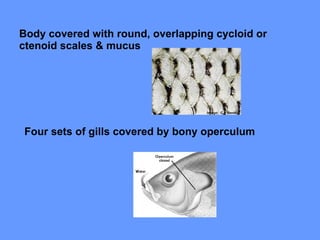
Body covered with round, overlapping cycloid or ctenoid scales & mucus Four sets of gills covered by bony operculum
External Anatomy of a Bony Fish
 
Guess What These Are:
Sites for Help on Vertebrates & Fish in Particular http://www.infovisual.info/02/033_en.html http://kentsimmons.uwinnipeg.ca/16cm05/1116/chordate.htm   http://www.fishbase.org/home.htm