
BIOLOGICAL
OXIDATION
What is Cellular Respiration?What is Cellular Respiration?
The process by which chemical energy
in organic molecules is released by
oxidation
if it requires oxygen:
aerobic respiration
if it requires no oxygen:
anaerobic respiration
The process of CellularThe process of Cellular
Respiration is:Respiration is:
An Oxidation-Reduction Process
or REDOX Reaction
Gain of hydrogen atoms
Loss of hydrogen atoms
Glucose
Energy
Oxidation of GLUCOSEOxidation of GLUCOSE
Reduction O2
to H2
OReduction O2
to H2
O
Oxidation & ReductionOxidation & Reduction
Oxidation is losing electrons
Reduction is gaining electrons
Glucose gives off energy as it is oxidised
Gain of hydrogen atoms
Loss of hydrogen atoms
Glucose
Energy
BREATHING / VENTILATION
CELLULAR
RESPIRATION
Muscle cells carrying out
CO2
Bloodstream
Sugar + O2 → ATP + CO2 + H2O
O2
In Cellular RespirationIn Cellular Respiration
organic molecules are broken
down, bond by bond by a
series of enzyme-controlled
reactions
Bond
Bond energy,
kJ/mol
C–C 347
C=C 615
C≡C 812
C–O 360
C=O 728
C–H 414
H–H 436
H–O 464
O=O 498
Glucose Molecule
(carbohydrate)
C
C
C
C
C
CH
H
H
H
H
OH
OH
OH
OH
HO H
H O
C6H12O6
Substance:
Formula:
Energy: 17 kJ g-1
Amino AcidSubstance:
Energy: 17 kJ g-1
C
C
C
C
C
C
H
C
H
C
H
H
H
H
H
H
H
H
H
H
H
H
H
H
C
C
C
C
C
C
H
C
H
C
H
H
H
H
H
H
H
H
H
H
H
H
H
H
C
C
C
C
C
C
H
C
H
C
H
H
H
H
H
H
H
H
H
H
H
H
H
H
C CC O OO
O OO
C C
C
H
H
H
H
H
TriglycerideTriglyceride
Substance:
Energy:
37 kJ g-1
In Cellular Respiration:In Cellular Respiration:
 each reaction releases aeach reaction releases a smallsmall
amount of & is transferredamount of & is transferred
to :to :
- ATP- ATP
- lost aslost as heatheat
Energy released
from glucose
(as heat and light)
Burning glucose
in an experiment
100% About
40%
“Burning” glucose
in cellular respiration
Burning gasoline
in an auto engine
Gasoline energy
converted to
movement
25%
Energy released
from glucose
banked in ATP
How efficient is cell respiration?How efficient is cell respiration?
ATP:ATP: AAdenosinedenosine ttriripphosphatehosphate
The energy released during respiration is
not used directly by cells
Instead it is used to make a molecule
called ATP which stores the energy until
it is needed
Chemical Structure of ATPChemical Structure of ATP
3 Phosphates3 Phosphates
Ribose SugarRibose Sugar
Adenine BaseAdenine Base
musclemuscle
contractioncontraction
Some uses of ATPSome uses of ATP
germinationgermination
cell divisioncell division
chemical changeschemical changes
in cellsin cells
RespirationRespiration
suppliessupplies
the energy forthe energy for
Universal Energy CarrierUniversal Energy Carrier
Why ATP is called theWhy ATP is called the universaluniversal
energy carrierenergy carrier??
Found inFound in ALLALL organisms.organisms.
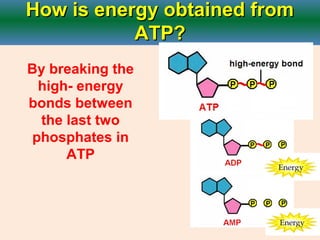
How is energy obtained fromHow is energy obtained from
ATP?ATP?
By breaking the
high- energy
bonds between
the last two
phosphates in
ATP
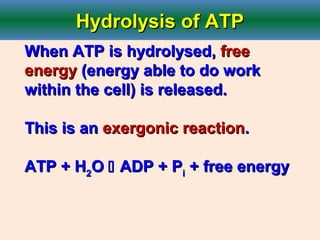
Hydrolysis of ATPHydrolysis of ATP
When ATP is hydrolysed,When ATP is hydrolysed, freefree
energyenergy (energy able to do work(energy able to do work
within the cell) is released.within the cell) is released.
This is anThis is an exergonic reactionexergonic reaction..
ATP + HATP + H22OO  ADP + PADP + Pii + free energy+ free energy
Hydrolysis needs an enzymeHydrolysis needs an enzyme
An EnzymeAn Enzyme
Respiration is exergonicRespiration is exergonic
Complete combustion of glucose is
highly exergonic
ATP is constantly being used and
remade
PHOSPHORYLATIONPHOSPHORYLATION
PhosphorylationPhosphorylation
As a result of respiration, energy isAs a result of respiration, energy is
released from the chemical bonds andreleased from the chemical bonds and
used for “phosphorylation” of ADP.used for “phosphorylation” of ADP.
PhosphorylationPhosphorylation is the process ofis the process of
adding a phosphate group to aadding a phosphate group to a
molecule…. By adding a phosphate ADPmolecule…. By adding a phosphate ADP
it becomes ATP.it becomes ATP.
PhosphorylationPhosphorylation
ADP may be rephosphorylated toADP may be rephosphorylated to
ATP inATP in THREETHREE ways:ways:
1.1.respiratory activityrespiratory activity
2.2.by another ‘high-energy’by another ‘high-energy’
compound, such ascompound, such as creatinecreatine
phosphatephosphate present in muscle cellspresent in muscle cells
3.3.photophosphorylationphotophosphorylation byby
chlorophyll-containing cells of greenchlorophyll-containing cells of green
plantsplants
1. Respiratory Activity = ATP1. Respiratory Activity = ATP
Burning or metabolism of glucose:Burning or metabolism of glucose:
Glucose metabolism pathway trapsGlucose metabolism pathway traps
the free energy in ATP:the free energy in ATP:
ATPenergyfreePADP i →++
energyfreeOHCOOOHC ++→+ 2226126 666
2. ATP from Creatine Phosphate2. ATP from Creatine Phosphate
• This system is extremely efficientThis system is extremely efficient
• It does not need oxygenIt does not need oxygen
• It leaves no waste productsIt leaves no waste products
WE ARE ONLY ABLE TO USE THIS FOR ABOUT 10-15WE ARE ONLY ABLE TO USE THIS FOR ABOUT 10-15
SECONDS BEFORE THIS SYSTEM RUNS OUT.SECONDS BEFORE THIS SYSTEM RUNS OUT.
HOWEVERHOWEVER
Creatine phosphateCreatine phosphate
is inside musclesis inside muscles
• RESPIRATORY SUBSTRATE
Fuels for Cellular RespirationFuels for Cellular Respiration
FuelsFuels: molecules whose stored energy: molecules whose stored energy
can be released for use.can be released for use.
The most common fuel in organismsThe most common fuel in organisms
isis glucoseglucose..
Other molecules are first convertedOther molecules are first converted
into glucose or other intermediateinto glucose or other intermediate
compounds.compounds.
Fuels are used in sequenceFuels are used in sequence
Glucose is stored here
as glycogen and is used
when the body is
working harder.
1. CARBOHYDRATES1. CARBOHYDRATES
2. FATS2. FATS
3. PROTEINS3. PROTEINS
Here some of the
glucose is stored as
glycogen and used to
maintain blood sugar
levels.
Liver
Muscle
Used when the
carbohydrates are
exhausted. Are
first converted to
glycerol and fatty
acids
Used when
carbohydrates
and fats have
been used up as
during prolonged
starvation
KEY REACTIONSKEY REACTIONS
Key ReactionsKey Reactions
Oxidation Decarboxylation
1. Adding oxygen
2. Removal of hydrogen
(dehydrogenation)
3. Removal of electrons
Removal of
carbon from a
compound to
make carbon
dioxide
What Carries the Electrons?What Carries the Electrons?
 NADNAD++
andand FADFAD++
are electron carriersare electron carriers
in redox reactionsin redox reactions
 twotwo forms:forms:
NADNAD++
/ FAD/ FAD++
(oxidised)(oxidised)
NADH + HNADH + H++
/ FADH/ FADH22 (reduced)(reduced)
What Carries the Electrons?What Carries the Electrons?
Gain or loss of electrons is often in the form of hydrogen.
The hydrogen is then passed to NAD+
or FAD+
Remember: glucose is oxidised as it loses hydrogen.
NADNAD++
(Nicotinamide Adenine
Dinucleotide:
 is derived from vitamin B
complex
acts as a coenzyme to
dehydrogenases by acting
as a hydrogen acceptor
++
+→+ HNADHHNAD 2
 needed in small amounts
in redox reactions
BindsBinds
looselyloosely
to theto the
enzymeenzyme
NADNAD++
acts as the energy carrieracts as the energy carrier
 NAD+
is reduced to NADH when it picks
up two electrons and one hydrogen ion
NADNAD++
accepts hydrogenaccepts hydrogen
NOTE:books use:
NADH;
NADH2;
reduced NAD
NADH+H+
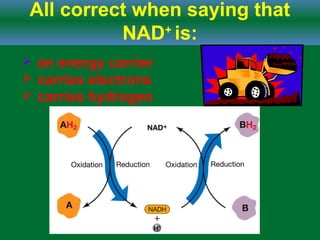
All correct when saying that
NAD+
is:
 an energy carrier
 carries electrons
 carries hydrogen
FADFAD++
((FFlavinlavin AAdeninedenine DDinucleotide)inucleotide)
 derived from the vitamin riboflavin (B2)
FADFAD++
:: a prosthetic group of
succinate dehydrogenase
BindsBinds
ttighighttly toly to
thethe
enzymeenzyme
FADFAD++
is reduced to FADHis reduced to FADH22
Importance of FADHImportance of FADH22 & NADH& NADH22
Reducing power in NADHReducing power in NADH22 and FADHand FADH22 isis
used to form ATP by oxidativeused to form ATP by oxidative
phosphorylationphosphorylation
AN OVERVIEW OFAN OVERVIEW OF
CELL RESPIRATIONCELL RESPIRATION
General OutlineGeneral Outline
Glucose
CYTOSOL
Pyruvate
No O2 present
Fermentation
O2 present
Cellular respiration
Ethanol
or
lactate
Acetyl CoA
MITOCHONDRION
Citric
acid
cycle
If O2 is present, four pathways
operate:
1. Glycolysis
2. Transition reaction / Link reaction
3. Citric acid cycle / Krebs Cycle /
Tricarboxylic Acid Cycle (TCA)
4. Oxidative phosphorylation (uses
Electron transport chain /
Respiratory chain)
Location of the 4 phasesLocation of the 4 phases
Indicate where glycolysis, link reaction,Indicate where glycolysis, link reaction,
krebs cycle and the electron transport chainkrebs cycle and the electron transport chain
are located in this photo.are located in this photo.
Glycolysis
(anywhere in
cytoplasm)
Link reaction &
krebs cycle
(anywhere in matrix)
ETC
(anywhere on inner
membrane)
Glycolysis is Common for:Glycolysis is Common for:
Pyruvic AcidPyruvic AcidOxygen
Aerobic
No Oxygen
Anaerobic
Transition Reaction
Krebs Cycle
Electron Transport Chain
Fermentation
GlucoseGlucose
Glycolysis
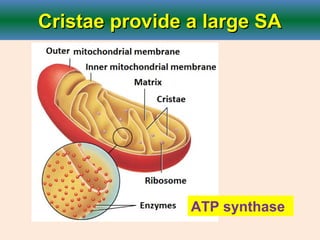
Mitochondrion StructureMitochondrion Structure
Smooth outer
membrane
Folded inner membrane
Fold called
crista
Space inside cristae
called the matrix
Cristae provide a large SACristae provide a large SA
ATP synthase
The four phases of completeThe four phases of complete
glucose breakdownglucose breakdown
CITRIC ACID CYCLE /CITRIC ACID CYCLE /
KREBS CYCLE /KREBS CYCLE /
TRICARBOXYLIC ACIDTRICARBOXYLIC ACID
CYCLE (TCA)CYCLE (TCA)
Krebs Cycle:Krebs Cycle: Discovered by Sir Hans
Krebs in 1937
 cyclical metabolic pathway located in
the matrix of the mitochondria
Acetyl Co-AAcetyl Co-A joins a C4 molecule
oxaloacetate and C6 citrate results
Oxaloacetate
Citrate
Acetyl Co-A will
be oxidised to:
CoA
2 CO2
molecules
Coenzyme A:
 is removed in
the first reaction
can be reused
CoA
Citric Acid Cycle Uses Acetyl Co-ACitric Acid Cycle Uses Acetyl Co-A
to generate:
 2 ATP
 6 NADH
 2 FADH2
 4 CO2
Oxaloacetate
Citrate
starting
from
C6H12O6
starting
from
C6H12O6
11
11
33
22
ONE acetyl-CoA PRODUCES
1 ATP per acetyl CoA
(substrate-level
phosphorylation)
1 ATP per acetyl CoA
(substrate-level
phosphorylation)
SummarySummary
As a result of one turn of the Krebs cycle the
cell makes:
1 FADH2
3 NADH
1 ATP
However, each glucose produces two pyruvic
acid molecules…. So the total outcome is:
2 FADH2
6 NADH
2 ATP
ELECTRON TRANSPORTELECTRON TRANSPORT
SYSTEM /SYSTEM /
ELECTRON TRANSPORTELECTRON TRANSPORT
CHAIN (ETC)CHAIN (ETC)
ETC is located in/on the cristaeETC is located in/on the cristae
What will happen to the electrons taken up
by NAD and FAD?
Electrons are carried along the ETC.
Why is this
important?
For ATP
production.
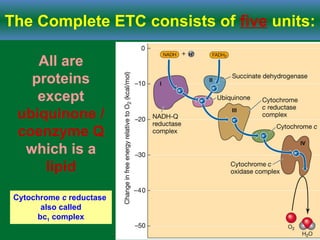
The Complete ETC consists of five units:
All are
proteins
except
ubiquinone /
coenzyme Q
which is a
lipid
Cytochrome c reductase
also called
bc1 complex
4 protein complexes: I, II, III, IV
I - NADH-Q reductase
Q -Ubiquinone
Cc- Cytochrome c reductase
IV - Cytochrome c oxidase
MOBILE
ATP Synthesis by Oxidative PhosphorylationATP Synthesis by Oxidative Phosphorylation
Fig. 11 ATP formation by
chemiosmosis.
What will happen to the
electrons taken up by NAD and
FAD?
Electrons are carried along the
ETC.
Why is this important?
For ATP production.
ETC is linked to ATP productionETC is linked to ATP production
ETC
ETC
Oxygen receives
energy-spent electrons
at the end of the ETC
Energy is lost on moving downEnergy is lost on moving down
the ETCthe ETC
What is the use of the energy lost byWhat is the use of the energy lost by
electrons in the ETC?electrons in the ETC?
To pump HTo pump H++
from matrixfrom matrix
into intermembrane spaceinto intermembrane space
Why is it important to pump out HWhy is it important to pump out H++
??
To establish a
proton gradient
across the inner
membrane,
necessary for ATP
synthase to
generate ATP.
ATP SynthaseATP Synthase
Most protons move back to the matrix
through ATP synthase
ATP synthase is a membrane-bound
enzyme that uses the energy of the
proton gradient to synthesise ATP from
ADP + Pi
ATP SynthaseATP Synthase
 3 to 4 protons moving through ATP
synthase is enough to convert a
molecule of ADP and Pi into a molecule
of ATP
One ATP synthase
complex can generate
>100 molecules of
ATP each second
ATP SynthaseATP Synthase
In order to provide
energy to sustain our
lives, every day, each
one us produces a
quantity of ATP by
this mechanism that
is approximately
equal to our body
weights.
Representation of the ETCRepresentation of the ETC
 Electrons removed from NADH2 and FADH2 enter the
electron transport system
 First two carriers transport hydrogen, but the rest
(cytochromes) carry electrons
 A pair of electrons is carried by cytochromes
 Oxygen accepts electrons from NADH2 & NADH2
 Oxidising agent is molecular oxygen (O2)
ETCETC
A series of protein carriers (some are
cytochromes), pass electrons from one to the other
Inner
mitochondrial
membrane
Intermembrane
space
Mitochondrial
matrix
Electron
flow
ATP
SYNTHASE
Cytochromes are proteinsCytochromes are proteins
having an iron-containing group which carries
electrons
The Various CytochromesThe Various Cytochromes
Electrons pass
along:
-cytochrome b
-cytochrome c1
-cytochrome c
-cytochrome a + a3
Redox reactions
Respiration can be inhibitedRespiration can be inhibited
Cytochrome a3
:
-also called cytochrome
oxidase
- contains copper (Cu)
-passes electrons to oxygen
to form water
-this last stage can be inhibited by cyanide
or carbon monoxide
Cyanide poisoning in fish.
Cyanide is a:
non-competitive inhibitor of
cytochrome oxidase
CO is a:
competitive inhibitor of
cytochrome oxidase
Electron transport is coupled toElectron transport is coupled to
ATP formationATP formation
CYANIDE & CO stop respiration by
inhibiting flow of electrons along ETC
Suggest an explanation for the following
observation:
Cyanide is a quick-acting poison;
Cyanide is an inhibitor of the respiratory
chain thus NAD and FAD cannot be
regenerated. It blocks ATP formation.
Chemiosmosis cannot occur as
electrons no longer flow down the
electron transport chain.
Why does the electron transportWhy does the electron transport
chain have so many steps?chain have so many steps?
Too much free energy would be
released all at once—it could not be
harvested by the cell.
In a series of reactions, each releases
a small amount of energy that can be
captured by an endergonic reaction.
Summary
ETC occurs in steps to harvest ATPETC occurs in steps to harvest ATP
H2 + 1
/2 O2 2 H 1
/2 O2
(from food via NADH)
2 H+
+ 2 e–
2 H+
2 e–
H2O
1
/2 O2
Controlled
release of
energy for
synthesis of
ATP
ATP
ATP
ATP
Electrontransportchain
Freeenergy,G
(b) Cellular respiration(a) Uncontrolled reaction
Freeenergy,G
H2O
Explosive
release of
heat and light
energy
+
1 NADH2 Yields 3 ATP
 accepts electrons from NADH2
 is the oxidising agent
O2 :
1 FADH1 FADH22
yields 2 ATPyields 2 ATP
Cells are able to make ATP via:Cells are able to make ATP via:
substrate-level phosphorylation
– transferring a phosphate
directly to ADP from another
molecule
oxidative phosphorylation
– use of ATP synthase and
energy derived from a
proton (H+
) gradient to make
ATP
11
22
Oxidative Phosphorylation:Oxidative Phosphorylation:
ATP is synthesised as electron
carriers are reoxidised in the
presence of O2.
Two stages:
Electron transport chain
Chemiosmosis
ATP Synthesis by Oxidative PhosphorylationATP Synthesis by Oxidative Phosphorylation
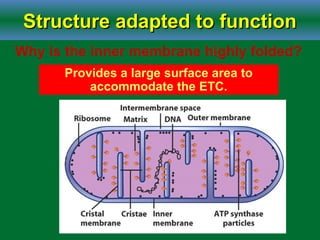
Structure adapted to functionStructure adapted to function
Why is the inner membrane highly folded?
Provides a large surface area to
accommodate the ETC.
The ChemiosmoTiCThe ChemiosmoTiC
TheoryTheory
The Chemiosmotic TheoryThe Chemiosmotic Theory
Peter Mitchell (1961)
proposed the Chemiosmotic
Theory: the ETC energy is
used to move H+
(protons)
across the cristae
membrane, and
 that ATP is generated as the
H+
diffuse back into the matrix
through [proton motive force]
Once ATP is
formed, it
moves out of
the matrix to
be of use
inside the
cell.
FeelingFeeling
frustrated?frustrated?
That’sThat’s
normal!!normal!!

Biological oxidation

  • 2.
  • 3.
    What is CellularRespiration?What is Cellular Respiration? The process by which chemical energy in organic molecules is released by oxidation if it requires oxygen: aerobic respiration if it requires no oxygen: anaerobic respiration
  • 4.
    The process ofCellularThe process of Cellular Respiration is:Respiration is: An Oxidation-Reduction Process or REDOX Reaction Gain of hydrogen atoms Loss of hydrogen atoms Glucose Energy Oxidation of GLUCOSEOxidation of GLUCOSE Reduction O2 to H2 OReduction O2 to H2 O
  • 5.
    Oxidation & ReductionOxidation& Reduction Oxidation is losing electrons Reduction is gaining electrons Glucose gives off energy as it is oxidised Gain of hydrogen atoms Loss of hydrogen atoms Glucose Energy
  • 6.
    BREATHING / VENTILATION CELLULAR RESPIRATION Musclecells carrying out CO2 Bloodstream Sugar + O2 → ATP + CO2 + H2O O2
  • 7.
    In Cellular RespirationInCellular Respiration organic molecules are broken down, bond by bond by a series of enzyme-controlled reactions
  • 9.
    Bond Bond energy, kJ/mol C–C 347 C=C615 C≡C 812 C–O 360 C=O 728 C–H 414 H–H 436 H–O 464 O=O 498
  • 10.
    Glucose Molecule (carbohydrate) C C C C C CH H H H H OH OH OH OH HO H HO C6H12O6 Substance: Formula: Energy: 17 kJ g-1
  • 11.
  • 12.
  • 13.
    In Cellular Respiration:InCellular Respiration:  each reaction releases aeach reaction releases a smallsmall amount of & is transferredamount of & is transferred to :to : - ATP- ATP - lost aslost as heatheat
  • 14.
    Energy released from glucose (asheat and light) Burning glucose in an experiment 100% About 40% “Burning” glucose in cellular respiration Burning gasoline in an auto engine Gasoline energy converted to movement 25% Energy released from glucose banked in ATP How efficient is cell respiration?How efficient is cell respiration?
  • 15.
    ATP:ATP: AAdenosinedenosine ttriripphosphatehosphate Theenergy released during respiration is not used directly by cells Instead it is used to make a molecule called ATP which stores the energy until it is needed
  • 16.
    Chemical Structure ofATPChemical Structure of ATP 3 Phosphates3 Phosphates Ribose SugarRibose Sugar Adenine BaseAdenine Base
  • 17.
    musclemuscle contractioncontraction Some uses ofATPSome uses of ATP germinationgermination cell divisioncell division chemical changeschemical changes in cellsin cells RespirationRespiration suppliessupplies the energy forthe energy for
  • 18.
    Universal Energy CarrierUniversalEnergy Carrier Why ATP is called theWhy ATP is called the universaluniversal energy carrierenergy carrier?? Found inFound in ALLALL organisms.organisms.
  • 19.
    How is energyobtained fromHow is energy obtained from ATP?ATP? By breaking the high- energy bonds between the last two phosphates in ATP
  • 20.
    Hydrolysis of ATPHydrolysisof ATP When ATP is hydrolysed,When ATP is hydrolysed, freefree energyenergy (energy able to do work(energy able to do work within the cell) is released.within the cell) is released. This is anThis is an exergonic reactionexergonic reaction.. ATP + HATP + H22OO  ADP + PADP + Pii + free energy+ free energy
  • 21.
    Hydrolysis needs anenzymeHydrolysis needs an enzyme An EnzymeAn Enzyme
  • 22.
    Respiration is exergonicRespirationis exergonic Complete combustion of glucose is highly exergonic ATP is constantly being used and remade
  • 23.
  • 24.
    PhosphorylationPhosphorylation As a resultof respiration, energy isAs a result of respiration, energy is released from the chemical bonds andreleased from the chemical bonds and used for “phosphorylation” of ADP.used for “phosphorylation” of ADP. PhosphorylationPhosphorylation is the process ofis the process of adding a phosphate group to aadding a phosphate group to a molecule…. By adding a phosphate ADPmolecule…. By adding a phosphate ADP it becomes ATP.it becomes ATP.
  • 25.
    PhosphorylationPhosphorylation ADP may berephosphorylated toADP may be rephosphorylated to ATP inATP in THREETHREE ways:ways: 1.1.respiratory activityrespiratory activity 2.2.by another ‘high-energy’by another ‘high-energy’ compound, such ascompound, such as creatinecreatine phosphatephosphate present in muscle cellspresent in muscle cells 3.3.photophosphorylationphotophosphorylation byby chlorophyll-containing cells of greenchlorophyll-containing cells of green plantsplants
  • 26.
    1. Respiratory Activity= ATP1. Respiratory Activity = ATP Burning or metabolism of glucose:Burning or metabolism of glucose: Glucose metabolism pathway trapsGlucose metabolism pathway traps the free energy in ATP:the free energy in ATP: ATPenergyfreePADP i →++ energyfreeOHCOOOHC ++→+ 2226126 666
  • 27.
    2. ATP fromCreatine Phosphate2. ATP from Creatine Phosphate • This system is extremely efficientThis system is extremely efficient • It does not need oxygenIt does not need oxygen • It leaves no waste productsIt leaves no waste products WE ARE ONLY ABLE TO USE THIS FOR ABOUT 10-15WE ARE ONLY ABLE TO USE THIS FOR ABOUT 10-15 SECONDS BEFORE THIS SYSTEM RUNS OUT.SECONDS BEFORE THIS SYSTEM RUNS OUT. HOWEVERHOWEVER Creatine phosphateCreatine phosphate is inside musclesis inside muscles
  • 28.
  • 29.
    Fuels for CellularRespirationFuels for Cellular Respiration FuelsFuels: molecules whose stored energy: molecules whose stored energy can be released for use.can be released for use. The most common fuel in organismsThe most common fuel in organisms isis glucoseglucose.. Other molecules are first convertedOther molecules are first converted into glucose or other intermediateinto glucose or other intermediate compounds.compounds.
  • 30.
    Fuels are usedin sequenceFuels are used in sequence Glucose is stored here as glycogen and is used when the body is working harder. 1. CARBOHYDRATES1. CARBOHYDRATES 2. FATS2. FATS 3. PROTEINS3. PROTEINS Here some of the glucose is stored as glycogen and used to maintain blood sugar levels. Liver Muscle Used when the carbohydrates are exhausted. Are first converted to glycerol and fatty acids Used when carbohydrates and fats have been used up as during prolonged starvation
  • 31.
  • 32.
    Key ReactionsKey Reactions OxidationDecarboxylation 1. Adding oxygen 2. Removal of hydrogen (dehydrogenation) 3. Removal of electrons Removal of carbon from a compound to make carbon dioxide
  • 33.
    What Carries theElectrons?What Carries the Electrons?  NADNAD++ andand FADFAD++ are electron carriersare electron carriers in redox reactionsin redox reactions  twotwo forms:forms: NADNAD++ / FAD/ FAD++ (oxidised)(oxidised) NADH + HNADH + H++ / FADH/ FADH22 (reduced)(reduced)
  • 34.
    What Carries theElectrons?What Carries the Electrons? Gain or loss of electrons is often in the form of hydrogen. The hydrogen is then passed to NAD+ or FAD+ Remember: glucose is oxidised as it loses hydrogen.
  • 35.
    NADNAD++ (Nicotinamide Adenine Dinucleotide:  isderived from vitamin B complex acts as a coenzyme to dehydrogenases by acting as a hydrogen acceptor ++ +→+ HNADHHNAD 2  needed in small amounts in redox reactions BindsBinds looselyloosely to theto the enzymeenzyme
  • 36.
    NADNAD++ acts as theenergy carrieracts as the energy carrier  NAD+ is reduced to NADH when it picks up two electrons and one hydrogen ion
  • 37.
    NADNAD++ accepts hydrogenaccepts hydrogen NOTE:booksuse: NADH; NADH2; reduced NAD NADH+H+
  • 38.
    All correct whensaying that NAD+ is:  an energy carrier  carries electrons  carries hydrogen
  • 39.
  • 40.
    FADFAD++ :: a prostheticgroup of succinate dehydrogenase BindsBinds ttighighttly toly to thethe enzymeenzyme
  • 41.
    FADFAD++ is reduced toFADHis reduced to FADH22
  • 42.
    Importance of FADHImportanceof FADH22 & NADH& NADH22 Reducing power in NADHReducing power in NADH22 and FADHand FADH22 isis used to form ATP by oxidativeused to form ATP by oxidative phosphorylationphosphorylation
  • 43.
    AN OVERVIEW OFANOVERVIEW OF CELL RESPIRATIONCELL RESPIRATION
  • 44.
    General OutlineGeneral Outline Glucose CYTOSOL Pyruvate NoO2 present Fermentation O2 present Cellular respiration Ethanol or lactate Acetyl CoA MITOCHONDRION Citric acid cycle
  • 45.
    If O2 ispresent, four pathways operate: 1. Glycolysis 2. Transition reaction / Link reaction 3. Citric acid cycle / Krebs Cycle / Tricarboxylic Acid Cycle (TCA) 4. Oxidative phosphorylation (uses Electron transport chain / Respiratory chain)
  • 46.
    Location of the4 phasesLocation of the 4 phases
  • 47.
    Indicate where glycolysis,link reaction,Indicate where glycolysis, link reaction, krebs cycle and the electron transport chainkrebs cycle and the electron transport chain are located in this photo.are located in this photo. Glycolysis (anywhere in cytoplasm) Link reaction & krebs cycle (anywhere in matrix) ETC (anywhere on inner membrane)
  • 48.
    Glycolysis is Commonfor:Glycolysis is Common for: Pyruvic AcidPyruvic AcidOxygen Aerobic No Oxygen Anaerobic Transition Reaction Krebs Cycle Electron Transport Chain Fermentation GlucoseGlucose Glycolysis
  • 49.
    Mitochondrion StructureMitochondrion Structure Smoothouter membrane Folded inner membrane Fold called crista Space inside cristae called the matrix
  • 50.
    Cristae provide alarge SACristae provide a large SA ATP synthase
  • 51.
    The four phasesof completeThe four phases of complete glucose breakdownglucose breakdown
  • 52.
    CITRIC ACID CYCLE/CITRIC ACID CYCLE / KREBS CYCLE /KREBS CYCLE / TRICARBOXYLIC ACIDTRICARBOXYLIC ACID CYCLE (TCA)CYCLE (TCA)
  • 53.
    Krebs Cycle:Krebs Cycle:Discovered by Sir Hans Krebs in 1937  cyclical metabolic pathway located in the matrix of the mitochondria
  • 54.
    Acetyl Co-AAcetyl Co-Ajoins a C4 molecule oxaloacetate and C6 citrate results Oxaloacetate Citrate Acetyl Co-A will be oxidised to: CoA 2 CO2 molecules Coenzyme A:  is removed in the first reaction can be reused CoA
  • 55.
    Citric Acid CycleUses Acetyl Co-ACitric Acid Cycle Uses Acetyl Co-A to generate:  2 ATP  6 NADH  2 FADH2  4 CO2 Oxaloacetate Citrate starting from C6H12O6 starting from C6H12O6
  • 56.
    11 11 33 22 ONE acetyl-CoA PRODUCES 1ATP per acetyl CoA (substrate-level phosphorylation) 1 ATP per acetyl CoA (substrate-level phosphorylation)
  • 57.
    SummarySummary As a resultof one turn of the Krebs cycle the cell makes: 1 FADH2 3 NADH 1 ATP However, each glucose produces two pyruvic acid molecules…. So the total outcome is: 2 FADH2 6 NADH 2 ATP
  • 58.
    ELECTRON TRANSPORTELECTRON TRANSPORT SYSTEM/SYSTEM / ELECTRON TRANSPORTELECTRON TRANSPORT CHAIN (ETC)CHAIN (ETC)
  • 59.
    ETC is locatedin/on the cristaeETC is located in/on the cristae
  • 60.
    What will happento the electrons taken up by NAD and FAD? Electrons are carried along the ETC. Why is this important? For ATP production.
  • 61.
    The Complete ETCconsists of five units: All are proteins except ubiquinone / coenzyme Q which is a lipid Cytochrome c reductase also called bc1 complex
  • 62.
    4 protein complexes:I, II, III, IV I - NADH-Q reductase Q -Ubiquinone Cc- Cytochrome c reductase IV - Cytochrome c oxidase MOBILE
  • 63.
    ATP Synthesis byOxidative PhosphorylationATP Synthesis by Oxidative Phosphorylation
  • 64.
    Fig. 11 ATPformation by chemiosmosis. What will happen to the electrons taken up by NAD and FAD? Electrons are carried along the ETC. Why is this important? For ATP production.
  • 65.
    ETC is linkedto ATP productionETC is linked to ATP production ETC ETC Oxygen receives energy-spent electrons at the end of the ETC
  • 66.
    Energy is loston moving downEnergy is lost on moving down the ETCthe ETC
  • 67.
    What is theuse of the energy lost byWhat is the use of the energy lost by electrons in the ETC?electrons in the ETC? To pump HTo pump H++ from matrixfrom matrix into intermembrane spaceinto intermembrane space
  • 68.
    Why is itimportant to pump out HWhy is it important to pump out H++ ?? To establish a proton gradient across the inner membrane, necessary for ATP synthase to generate ATP.
  • 69.
    ATP SynthaseATP Synthase Mostprotons move back to the matrix through ATP synthase ATP synthase is a membrane-bound enzyme that uses the energy of the proton gradient to synthesise ATP from ADP + Pi
  • 70.
    ATP SynthaseATP Synthase 3 to 4 protons moving through ATP synthase is enough to convert a molecule of ADP and Pi into a molecule of ATP One ATP synthase complex can generate >100 molecules of ATP each second
  • 71.
    ATP SynthaseATP Synthase Inorder to provide energy to sustain our lives, every day, each one us produces a quantity of ATP by this mechanism that is approximately equal to our body weights.
  • 72.
    Representation of theETCRepresentation of the ETC  Electrons removed from NADH2 and FADH2 enter the electron transport system  First two carriers transport hydrogen, but the rest (cytochromes) carry electrons  A pair of electrons is carried by cytochromes  Oxygen accepts electrons from NADH2 & NADH2  Oxidising agent is molecular oxygen (O2)
  • 73.
    ETCETC A series ofprotein carriers (some are cytochromes), pass electrons from one to the other Inner mitochondrial membrane Intermembrane space Mitochondrial matrix Electron flow ATP SYNTHASE
  • 74.
    Cytochromes are proteinsCytochromesare proteins having an iron-containing group which carries electrons
  • 75.
    The Various CytochromesTheVarious Cytochromes Electrons pass along: -cytochrome b -cytochrome c1 -cytochrome c -cytochrome a + a3
  • 76.
  • 77.
    Respiration can beinhibitedRespiration can be inhibited Cytochrome a3 : -also called cytochrome oxidase - contains copper (Cu) -passes electrons to oxygen to form water -this last stage can be inhibited by cyanide or carbon monoxide
  • 78.
  • 79.
    Cyanide is a: non-competitiveinhibitor of cytochrome oxidase CO is a: competitive inhibitor of cytochrome oxidase
  • 80.
    Electron transport iscoupled toElectron transport is coupled to ATP formationATP formation CYANIDE & CO stop respiration by inhibiting flow of electrons along ETC
  • 81.
    Suggest an explanationfor the following observation: Cyanide is a quick-acting poison; Cyanide is an inhibitor of the respiratory chain thus NAD and FAD cannot be regenerated. It blocks ATP formation. Chemiosmosis cannot occur as electrons no longer flow down the electron transport chain.
  • 83.
    Why does theelectron transportWhy does the electron transport chain have so many steps?chain have so many steps? Too much free energy would be released all at once—it could not be harvested by the cell. In a series of reactions, each releases a small amount of energy that can be captured by an endergonic reaction.
  • 84.
  • 85.
    ETC occurs insteps to harvest ATPETC occurs in steps to harvest ATP H2 + 1 /2 O2 2 H 1 /2 O2 (from food via NADH) 2 H+ + 2 e– 2 H+ 2 e– H2O 1 /2 O2 Controlled release of energy for synthesis of ATP ATP ATP ATP Electrontransportchain Freeenergy,G (b) Cellular respiration(a) Uncontrolled reaction Freeenergy,G H2O Explosive release of heat and light energy +
  • 86.
    1 NADH2 Yields3 ATP  accepts electrons from NADH2  is the oxidising agent O2 :
  • 87.
    1 FADH1 FADH22 yields2 ATPyields 2 ATP
  • 88.
    Cells are ableto make ATP via:Cells are able to make ATP via: substrate-level phosphorylation – transferring a phosphate directly to ADP from another molecule oxidative phosphorylation – use of ATP synthase and energy derived from a proton (H+ ) gradient to make ATP 11 22
  • 89.
    Oxidative Phosphorylation:Oxidative Phosphorylation: ATPis synthesised as electron carriers are reoxidised in the presence of O2. Two stages: Electron transport chain Chemiosmosis
  • 90.
    ATP Synthesis byOxidative PhosphorylationATP Synthesis by Oxidative Phosphorylation
  • 91.
    Structure adapted tofunctionStructure adapted to function Why is the inner membrane highly folded? Provides a large surface area to accommodate the ETC.
  • 92.
  • 93.
    The Chemiosmotic TheoryTheChemiosmotic Theory Peter Mitchell (1961) proposed the Chemiosmotic Theory: the ETC energy is used to move H+ (protons) across the cristae membrane, and  that ATP is generated as the H+ diffuse back into the matrix through [proton motive force]
  • 94.
    Once ATP is formed,it moves out of the matrix to be of use inside the cell.
  • 95.