MEGHA T P
MSc FOOD AND NUTRITION
NUTRITIONAL BIOCHEMISTRY
INTRODUCTION
 Proteins are the most abundant organic compounds and
constitute major part of the body dry weight(10-12kg in
adults).
 Proteins are nitrogen containing macromolecules consisting
of L-αamino acids as the repeating units.
 Of the 20 amino acids found in the proteins, half can be
synthesized by the body(non-essential) while the rest have to
be provided in the diet(non-essential).
 The proteins on degradation(proteolysis) release individual
amino acids.
 Protein metabolism is more appropriately learnt as
metabolism of Amino acid.
AMINO ACID POOL
 The amount of free amino acids distributed throught
the body is called Amino acid pool.
 An adult has about 100g of free amino acids, which
represent the amino acid pool of the body.
 The concentration of intracellular amino acid is always
higher than extracellular amino acid.
 Amino acid pool of the body is maintained by the
sources that contribute(input) and the metabolic
pathways that utilize(output) the amino acids.
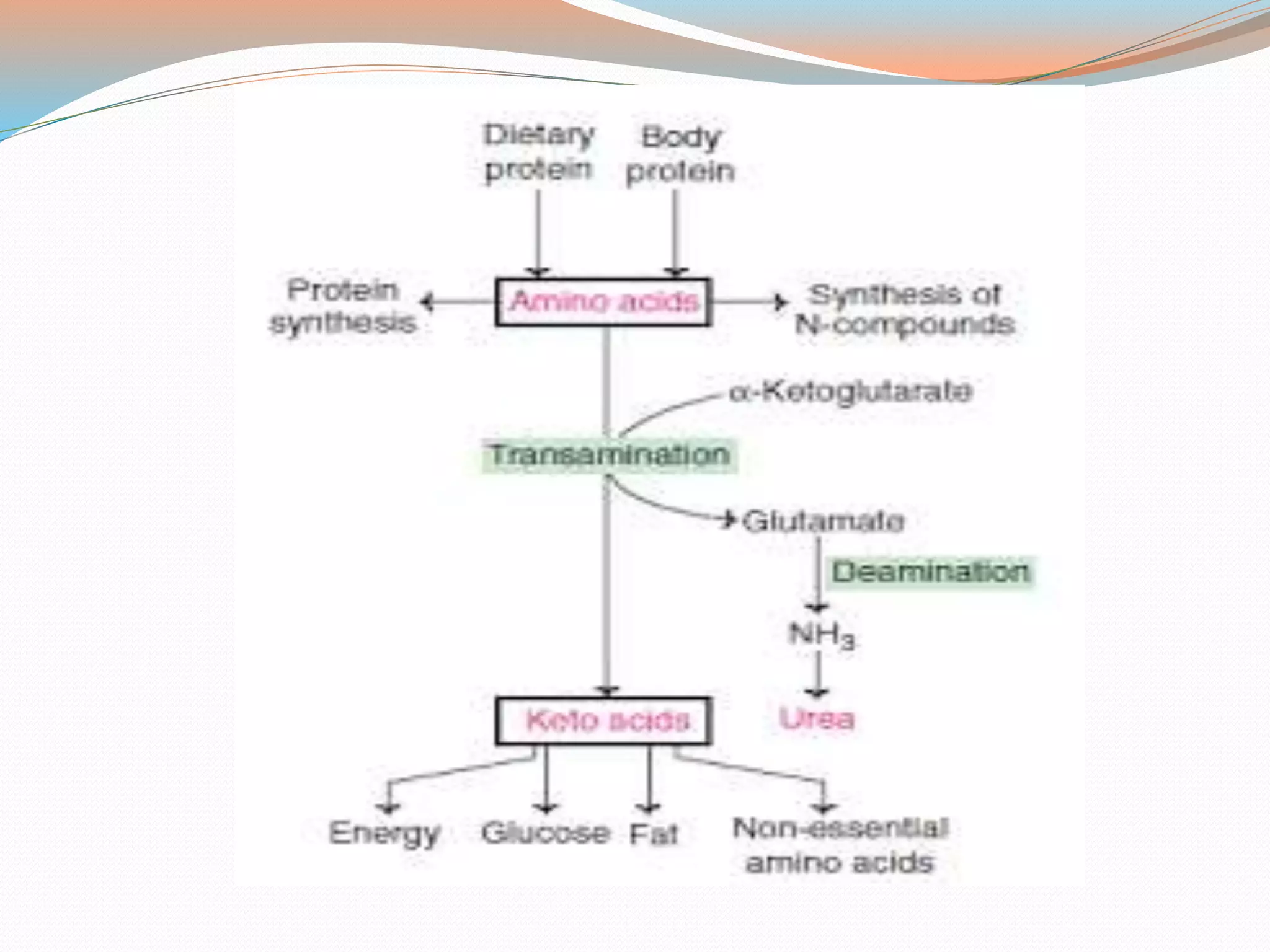
METABOLISM OF AMINO ACID
 The amino acids undergo certain common reactions like
transamination followed by deamination for the liberation
of ammonia.
 The amino group of amino acids utilized for the formation
of urea, which is the end product of protein metabolism.
TRANSAMINATION
 Transfer of amino(-NH2) group from an amino acid to keto
acid is known as transamination.
 This process involves interconversion of a pair of amino acids
and a pair of keto acids, catalysed by a group of enzymes
called transaminases(recently aminotransferases).
 All transaminases require pyridoxal phosphate(PLP), a
coenzyme derived from vitamin B6.
 Transamination is reversible.
 Transamination is important for the redistribution of amino
groups and production of non-essential amino acids, as per the
requirements of the cells.
 Transamination diverts excess amino acids towards energy
generation.
MECHANISM OF TRANSAMINATION
.
 Occurs in 2 stages
1. Transfer of amino group to the coenzyme pyridoxal
phosphate to form pyridoxamine phosphate.
2. Amino group of pyridoxamine phosphate is then
transferred to a keto acid to produce new amino acid and
the enzyme with PLP generated
Involvement of pyridoxal phosphate in transfer of amino group
DEAMINATION
 The removal of amino group from the amino acids as NH3.
 Deamination results in the liberation of ammonia for urea
synthesis.
 Deamination may be either oxidative or non-oxidative.
Oxidative deamination Non oxidative deamination
A form of deamination, which generates α-
keto acids and other oxidised products from
amine-containing compounds.
A form of deamination, which liberate ammonia
without undergoing oxidation.
Only occurs in the liver and kidney. Occurs in other type of organisms
Enzyme: Glutamate dehydrogenase (GDH). Main form of enzymes: Amino acid dehydratases
Primary type of amino acid: Glutamic acid
Hydroxy amino acids including serine,
homoserine, and threonine.
Coenzymes are responsible for the oxidation
reaction.
Non oxidising agents
UREA CYCLE
 Urea is the end product of protein metabolism.
 The nitrogen in amino acid, converted to ammonia, is toxic
to the body. It is converted to urea and detoxified.
 Urea is synthesized in liver and transported to kidney for
excretion.
 Urea cycle is the first metabolic cycle that was elucidated by
Hans krebs and Kurt henseleit (1932), hence it is known as
Krebs-Henseleit cycle.
 Urea has 2 amino (-NH2) groups, one derived from NH3
and the other from aspartate.
 Carbon atom is supplied by CO2.
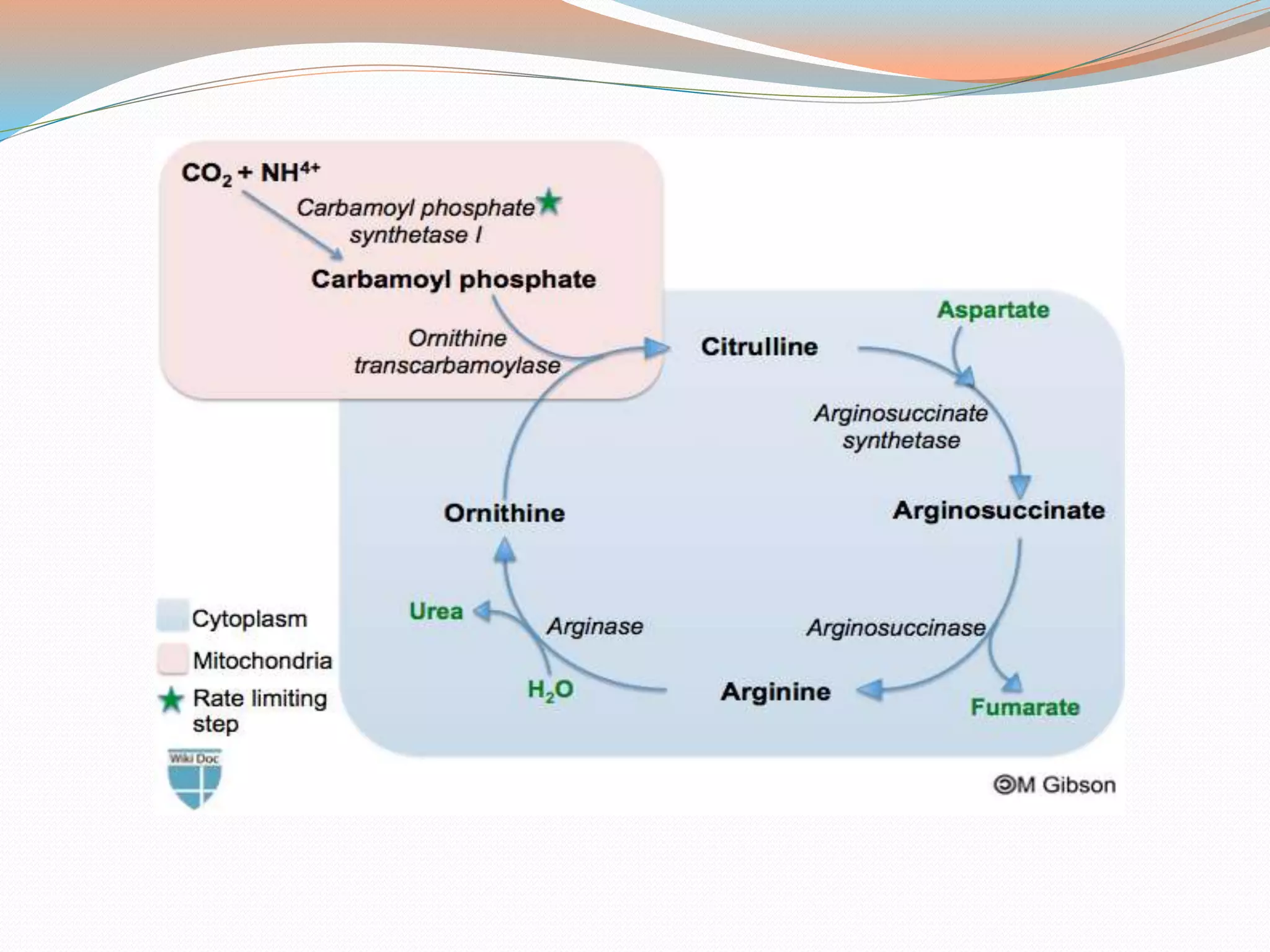
 Urea synthesis is a 5 step cyclic process, with 5 distinct enzymes.
 First 2 enzymes are present in mitochondria and others are
located in cytosol.
STEPS OF UREA CYCLE
1. SYNTHESIS OF CARBAMOYL PHOSPHATE
 Carbomoyl phosphate synthase1(CPS1) of mitochondria
catalyses the condensation of NH4
+ ions with CO2 to form
carbamoyl phosphate.
 This step consumes 2ATP and is irreversible.
 CPS1 requires N-acetyl glutamate for its activity.
2. FORMATION OF CITRULLINE
 Citrulline is synthesized from carbamoyl phosphate and
ornithine by Ornithine transcarbamoylase.
 Ornithine is generated and used in urea cycle.
 Ornithine and citrulline are basic amino acids. They never
found in protein structure due to lack of codons.
 Citrulline produced in this reaction is transported to cytosol
by transporter system.
3. SYNTHESIS OF ARGINOSUCCINATE
 Arginosuccinate synthase condenses citrulline with aspartate
to produce arginosuccinate.
 This step requires ATP which is cleaved to AMP and
Pyrophosphate(PPI).
 Later it’s immediately broken down into inorganic
phosphate(Pi).
4.CLEAVAGE OF ARGINOSUCCINATE
 Arginosuccinase cleaves arginosuccinate to give arginine and
fumarate.
 Arginine is the immediate precursor of urea.
5.FORMATION OF UREA
 Arginine is the fifth and final enzyme that cleaves arginine to
yield urea and ornithine.
 Ornithine so generated enters mitochondria for its use in
the urea cycle.
OVERALL REACTIONS AND ENERGETICS.
 Urea cycle is irreversible and cunsumes 4 ATP
 2 ATPs utilised for synthesis of carbamoyl phosphate.
 1 ATP converted to AMP & PPI to produce arginosuccinate
which equal to 2ATP.
NH4+ CO2+Aspartate+3ATP urea+fumarate+2ATP+2Pi+AMP+Ppi
DISPOSAL OF UREA
 Urea produced in the liver freely diffuses and is
transported in blood to kidneys and excreted.
 Small amount of urea enters the intestine where it is
broken down to CO2 and NH3 by bacterial enzyme urease.
 The ammonia is either lost in the faeces or absorbed into the
blood.
AMINO ACID METABOLISM.pptx

AMINO ACID METABOLISM.pptx

  • 1.
    MEGHA T P MScFOOD AND NUTRITION NUTRITIONAL BIOCHEMISTRY
  • 2.
    INTRODUCTION  Proteins arethe most abundant organic compounds and constitute major part of the body dry weight(10-12kg in adults).  Proteins are nitrogen containing macromolecules consisting of L-αamino acids as the repeating units.  Of the 20 amino acids found in the proteins, half can be synthesized by the body(non-essential) while the rest have to be provided in the diet(non-essential).  The proteins on degradation(proteolysis) release individual amino acids.  Protein metabolism is more appropriately learnt as metabolism of Amino acid.
  • 3.
    AMINO ACID POOL The amount of free amino acids distributed throught the body is called Amino acid pool.  An adult has about 100g of free amino acids, which represent the amino acid pool of the body.  The concentration of intracellular amino acid is always higher than extracellular amino acid.  Amino acid pool of the body is maintained by the sources that contribute(input) and the metabolic pathways that utilize(output) the amino acids.
  • 5.
    METABOLISM OF AMINOACID  The amino acids undergo certain common reactions like transamination followed by deamination for the liberation of ammonia.  The amino group of amino acids utilized for the formation of urea, which is the end product of protein metabolism.
  • 7.
    TRANSAMINATION  Transfer ofamino(-NH2) group from an amino acid to keto acid is known as transamination.  This process involves interconversion of a pair of amino acids and a pair of keto acids, catalysed by a group of enzymes called transaminases(recently aminotransferases).  All transaminases require pyridoxal phosphate(PLP), a coenzyme derived from vitamin B6.  Transamination is reversible.  Transamination is important for the redistribution of amino groups and production of non-essential amino acids, as per the requirements of the cells.  Transamination diverts excess amino acids towards energy generation.
  • 9.
    MECHANISM OF TRANSAMINATION . Occurs in 2 stages 1. Transfer of amino group to the coenzyme pyridoxal phosphate to form pyridoxamine phosphate. 2. Amino group of pyridoxamine phosphate is then transferred to a keto acid to produce new amino acid and the enzyme with PLP generated
  • 10.
    Involvement of pyridoxalphosphate in transfer of amino group
  • 11.
    DEAMINATION  The removalof amino group from the amino acids as NH3.  Deamination results in the liberation of ammonia for urea synthesis.  Deamination may be either oxidative or non-oxidative.
  • 12.
    Oxidative deamination Nonoxidative deamination A form of deamination, which generates α- keto acids and other oxidised products from amine-containing compounds. A form of deamination, which liberate ammonia without undergoing oxidation. Only occurs in the liver and kidney. Occurs in other type of organisms Enzyme: Glutamate dehydrogenase (GDH). Main form of enzymes: Amino acid dehydratases Primary type of amino acid: Glutamic acid Hydroxy amino acids including serine, homoserine, and threonine. Coenzymes are responsible for the oxidation reaction. Non oxidising agents
  • 13.
    UREA CYCLE  Ureais the end product of protein metabolism.  The nitrogen in amino acid, converted to ammonia, is toxic to the body. It is converted to urea and detoxified.  Urea is synthesized in liver and transported to kidney for excretion.  Urea cycle is the first metabolic cycle that was elucidated by Hans krebs and Kurt henseleit (1932), hence it is known as Krebs-Henseleit cycle.  Urea has 2 amino (-NH2) groups, one derived from NH3 and the other from aspartate.  Carbon atom is supplied by CO2.
  • 14.
     Urea synthesisis a 5 step cyclic process, with 5 distinct enzymes.  First 2 enzymes are present in mitochondria and others are located in cytosol. STEPS OF UREA CYCLE 1. SYNTHESIS OF CARBAMOYL PHOSPHATE  Carbomoyl phosphate synthase1(CPS1) of mitochondria catalyses the condensation of NH4 + ions with CO2 to form carbamoyl phosphate.  This step consumes 2ATP and is irreversible.  CPS1 requires N-acetyl glutamate for its activity.
  • 15.
    2. FORMATION OFCITRULLINE  Citrulline is synthesized from carbamoyl phosphate and ornithine by Ornithine transcarbamoylase.  Ornithine is generated and used in urea cycle.  Ornithine and citrulline are basic amino acids. They never found in protein structure due to lack of codons.  Citrulline produced in this reaction is transported to cytosol by transporter system. 3. SYNTHESIS OF ARGINOSUCCINATE  Arginosuccinate synthase condenses citrulline with aspartate to produce arginosuccinate.  This step requires ATP which is cleaved to AMP and Pyrophosphate(PPI).
  • 16.
     Later it’simmediately broken down into inorganic phosphate(Pi). 4.CLEAVAGE OF ARGINOSUCCINATE  Arginosuccinase cleaves arginosuccinate to give arginine and fumarate.  Arginine is the immediate precursor of urea. 5.FORMATION OF UREA  Arginine is the fifth and final enzyme that cleaves arginine to yield urea and ornithine.  Ornithine so generated enters mitochondria for its use in the urea cycle.
  • 18.
    OVERALL REACTIONS ANDENERGETICS.  Urea cycle is irreversible and cunsumes 4 ATP  2 ATPs utilised for synthesis of carbamoyl phosphate.  1 ATP converted to AMP & PPI to produce arginosuccinate which equal to 2ATP. NH4+ CO2+Aspartate+3ATP urea+fumarate+2ATP+2Pi+AMP+Ppi DISPOSAL OF UREA  Urea produced in the liver freely diffuses and is transported in blood to kidneys and excreted.  Small amount of urea enters the intestine where it is broken down to CO2 and NH3 by bacterial enzyme urease.
  • 19.
     The ammoniais either lost in the faeces or absorbed into the blood.