GLYCINE AMINO ACID
Dr. Mohammed Ellulu
What is the Glycine?
2


       Glycine is the smallest amino acids.
       Chemical formula is (NH2CH2COOH).
       Chemical structure:


       Colourless, sweet-tasting crystalline, hydrophilic or
        hydrophobic; due to its side chain is only one
        hydrogen atom.
Biosynthesis
3


       Glycine is non-essential A.A.
       Biosynthesized in the body from the A.A. Serine,
        which is in turn derived from 3-phosphoglycerate.
       The enzyme Serine hydroxymethyltransferase
        catalyses this transformation via the cofactor
        pyridoxal phosphate:
       Serine + tetrahydrofolate → Glycine + N5,N10-
        Methylene tetrahydrofolate + H2O
Biosynthesis in liver
4


       Catalyzed by glycine synthase (glycine cleavage
        enzyme), to get a reversible conversion.
       CO2 + NH4+ + N5,N10-Methylene tetrahydrofolate +
        NADH + H+→ Glycine + tetrahydrofolate + NAD+
       Most proteins incorporate only small quantities of
        glycine.
       A notable exception is collagen, which contains
        about 35% glycine.
Absorption of Amino Acids
5


     Conceptually identical to monosaccharides.
     Luminal plasma membrane bears sodium-
      dependent amino acid transporters.
     Depends on the electrochemical gradient of
      sodium across the epithelium.
     Absorption of di/tripeptides in small intestinal
      epithelial cell by cotransport with H+ ions.
Metabolism and
    degradation


6
Physiological actions of Glycine
7


       Create muscle tissue.
       Maintaining healthy central nervous and digestive
        systems.
       Provide protection via antioxidants from some types of
        cancer.
       Almost 1/3 of collagen, which keeps the skin and
        connective tissue firm and flexible.
       Glucogenic: supply body with glucose needed for
        energy.
       Help reduce the symptoms of prostatic hyperplasia in
        men.
8   Studies about Glycine
Amino acid promotes sleep (Ajinomoto,2004)
9


       A study of the brains of rats revealed that glycine
        accumulates in the pineal gland, a part of the brain
        associated with the rhythms of waking and sleeping.
       3g of glycine has tested on a group of men with
        sleep problems. Taking the supplement within an
        hour before going to bed.
       The researchers said the subjects showed brainwave
        patterns associated with non-REM sleep sooner and
        slept longer than those who did not take the amino
        acid.
Cancer Addicted to Glycine (Jain et al, 2012)
10


        According to study, the amino acid glycine fuels
         fast-growing cancer cells.
        Glycine is consumed by cancer cells but is released
         by normal cells.
        Food diaries from 60 human cancer cell lines show
         that they all consume large amounts of the amino
         acid glycine when growing fast.
        The team used liquid chromatography coupled with
         mass spectrometry.
Collagen for Osteoarthritis (world congress, 2003)
11

       Joint diseases account for the majority of all chronic conditions in
        people aged 65 and older and osteoarthritis represents the single
        most prevalent age-related disease.
      Dr Hans-Konrad Selbmann, from the German University in
        Tuebingen, highlighted a study within 1991:
      Adam et al compared four treatments to reduce the patients' levels
        of pain:
     1- collagen hydrolysate.
     2- gelatine.
     3- gelatine-glycine-calcium-fluid combination.
     4- albumin proteins.
      The study found that all three of the gelatine treatments were
        effective and significantly superior to the protein supplementation.
women's health (AHPA, 2005)
12


        New information on botanicals from American
         Herbal Products Association such as”
        red clover (Trifolium pratense) used for menopause,
        Chaste tree (Vitex agnus-castus) used to ease PMS,
        and soy (Glycine max), which is considered by some
         as an alternative to hormone replacement therapy.
Anti-carcinogenic factors
13


        Vitiva CEO, a special neutraceutical company in
         Slovenia, studied the rosemary-derived anti-
         oxidants, and yeast powder for the reduction of
         acrylamide in fried foods.
        Acrylamide is a carcinogen discovered by Swedish
         scientists in 2002.
        Yeast contains almost: L-cysteine, glycine and L-
         lysine.
References
14

        Ajinomoto Company (2004). Japanese amino acids supplier
         Ajinomoto is considering commercializing food supplements
         containing glycine, based on studies showing the amino acid could
         help people sleep better. William Reed Business Media SAS.
         NutraIngredients publications.
        Jain M, et al (2012). Metabolite profiling identifies a key role for
         glycine in rapid cancer cell proliferation. Science 336:1040-1044.
        The 8th world congress of the Osteoarthritis Research Society
         International took place in Berlin from 12-15 October 2003.
        American Herbal Products Association (2005). The first International
         Symposium on the Role of Botanicals in Women's Health. The
         symposium will take place on 16 & 17 February at Rutgers
         University in New Brunswick, New Jersey.
SERINE AMINO ACID
What is Serine?
16


        Chemical formula HO2CCH(NH2)CH2OH.
        Chemical structure:


        One of the proteinogenic amino acids.
        By hydroxyl group, serine is classified as a polar
         amino acid.
Biosynthesis
17


        The biosynthesis of serine starts with the oxidation
         of 3-phosphoglycerate to 3-phosphohydroxy-
         pyruvate and NADH.
        Reductive amination of this ketone followed by
         hydrolysis gives serine.
        Serine hydroxymethyltransferase catalyzes
         conversions of L-serine to glycine and 5,6,7,8-
         tetrahydrofolate to 5,10-methylenetetrahydrofolate
Biosynthesis
18
Serine deficiency
19


        Serine deficiency is a rare, inherited, metabolic
         disorder that interferes with normal growth and
         development, particularly in the central nervous
         system.
        Unlike similar neurodevelopmental disorders, serine
         deficiency can be treated.
        Children with serine deficiency are born with an
         abnormally small head (called microcephaly).
Biological functions
20


     Metabolic
      participates in the biosynthesis of purines and

       pyrimidines.
      precursor to several amino acids including glycine
       and cysteine.
      precursor to numerous metabolites, including folate,

       which is the principal donor of one-carbon
       fragments in biosynthesis.
Biological functions
21


     Structural role
        catalytic function of many enzymes.
        occur in the active sites of chymotrypsin, trypsin.
        nerve gases and insecticides shown to act by
         combining with a residue of serine in the active site
         of acetylcholine esterase.
        Serine proteases are a common type of protease.
Biological functions
22


     Signalling
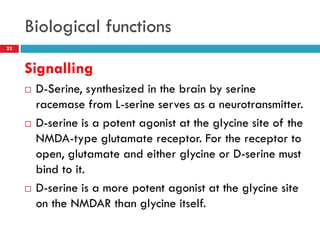
        D-Serine, synthesized in the brain by serine
         racemase from L-serine serves as a neurotransmitter.
        D-serine is a potent agonist at the glycine site of the
         NMDA-type glutamate receptor. For the receptor to
         open, glutamate and either glycine or D-serine must
         bind to it.
        D-serine is a more potent agonist at the glycine site
         on the NMDAR than glycine itself.
Biological functions
23


     Gustatory sensation
      Pure D-Serine is an off-white crystalline powder

       with dirty aroma.
      L-Serine is sweet with sour tastes at high
       concentration.
      D-Serine is sweet with an additional minor sour

       taste at medium and high concentrations.
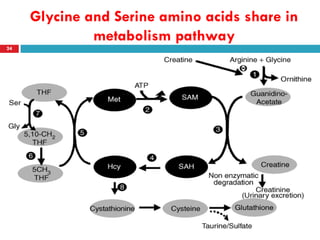
Glycine and Serine amino acids share in
              metabolism pathway
24
25   Studies about Serine
Cheese protect against IBD (Sprong et al, 2009)
26


        The study, published in the Journal of Dairy Science,
         suggests that dietary cheese whey protein could
         reduce symptoms and markers of inflammatory
         bowel disease (IBD), after it was found to reduce
         gene expression of inflammation markers and
         diminish the clinical symptoms of IBD such as
         diarrhea and fecal blood loss in an animal model.
        The study recommended that whey protein rich in:
         threonine, serine ,cysteine.
Soy and Casein decrease muscle
27
     protein breakdown (Luiking et al, 2010)
        The study involved 22 healthy 22 year olds
         randomly assigned to receive moderate-nitrogen
         and carbohydrate casein and soy meals.
        Researchers from the University of Arkansas for
         Medical Sciences, Maastricht University….US.
        The synthesis of muscle protein between the groups,
         did not suggest differences in changes in soy and
         casein, as they were rich in glutamate, glutamine,
         serine, histidine, isoleucine and branched chain
         amino acids.
Energy abounds in soft drinks market
28


        Energy drinks in the UK the Jordan Grand Prix
         brand has jumped on the bandwagon with the
         creation of the EJ-10 Liquid Performance Drink,
         named after Jordan Grand Prix's founder Eddie
         Jordan and the 10 active ingredients in the drink.
        Jordan EJ-10 is a hypotonic drink targeting drivers.
        It contains phosphatidyl serine, maltodextrins and
         isolated proteins, but no caffeine or taurine.

              Mintel's Global New Products Database: www.gnpd.com
Chemi Nutraceuticals
29


        Chemi Nutraceuticals is the new US branch of
         parent company C hemi, a privately held
         pharmaceutical and nutraceutical company based in
         Milan, Italy.
        Chemi, with cGMP certified manufacturing facilities
         in Italy and Brazil, is best known in the US nutritional
         arena for its introduction of phosphatidyl serine
         (PS), the popular dietary supplement used to
         enhance learning, memory, and concentration.
References
30

        Sprong RC , Schonewille AJ and van der Meer R (2009). Cheese whey protein may
         help to reduce genetic markers and symptoms associated with inflammatory bowel
         disease, according to a new study in rats. Journal of Dairy Science. 93: 1364–
         1371.
        Luiking YC, Engelen MPKJ, Soeters PB, Boirie Y and Deutz NEP (2010). Protein from
         soy or casein both benefit the synthesis of muscle protein at the same rate. Clinical
         Nutrition. doi: 10.1016.

Glycine and Serine Amino acid

  • 1.
    GLYCINE AMINO ACID Dr.Mohammed Ellulu
  • 2.
    What is theGlycine? 2  Glycine is the smallest amino acids.  Chemical formula is (NH2CH2COOH).  Chemical structure:  Colourless, sweet-tasting crystalline, hydrophilic or hydrophobic; due to its side chain is only one hydrogen atom.
  • 3.
    Biosynthesis 3  Glycine is non-essential A.A.  Biosynthesized in the body from the A.A. Serine, which is in turn derived from 3-phosphoglycerate.  The enzyme Serine hydroxymethyltransferase catalyses this transformation via the cofactor pyridoxal phosphate:  Serine + tetrahydrofolate → Glycine + N5,N10- Methylene tetrahydrofolate + H2O
  • 4.
    Biosynthesis in liver 4  Catalyzed by glycine synthase (glycine cleavage enzyme), to get a reversible conversion.  CO2 + NH4+ + N5,N10-Methylene tetrahydrofolate + NADH + H+→ Glycine + tetrahydrofolate + NAD+  Most proteins incorporate only small quantities of glycine.  A notable exception is collagen, which contains about 35% glycine.
  • 5.
    Absorption of AminoAcids 5  Conceptually identical to monosaccharides.  Luminal plasma membrane bears sodium- dependent amino acid transporters.  Depends on the electrochemical gradient of sodium across the epithelium.  Absorption of di/tripeptides in small intestinal epithelial cell by cotransport with H+ ions.
  • 6.
    Metabolism and degradation 6
  • 7.
    Physiological actions ofGlycine 7  Create muscle tissue.  Maintaining healthy central nervous and digestive systems.  Provide protection via antioxidants from some types of cancer.  Almost 1/3 of collagen, which keeps the skin and connective tissue firm and flexible.  Glucogenic: supply body with glucose needed for energy.  Help reduce the symptoms of prostatic hyperplasia in men.
  • 8.
    8 Studies about Glycine
  • 9.
    Amino acid promotessleep (Ajinomoto,2004) 9  A study of the brains of rats revealed that glycine accumulates in the pineal gland, a part of the brain associated with the rhythms of waking and sleeping.  3g of glycine has tested on a group of men with sleep problems. Taking the supplement within an hour before going to bed.  The researchers said the subjects showed brainwave patterns associated with non-REM sleep sooner and slept longer than those who did not take the amino acid.
  • 10.
    Cancer Addicted toGlycine (Jain et al, 2012) 10  According to study, the amino acid glycine fuels fast-growing cancer cells.  Glycine is consumed by cancer cells but is released by normal cells.  Food diaries from 60 human cancer cell lines show that they all consume large amounts of the amino acid glycine when growing fast.  The team used liquid chromatography coupled with mass spectrometry.
  • 11.
    Collagen for Osteoarthritis(world congress, 2003) 11  Joint diseases account for the majority of all chronic conditions in people aged 65 and older and osteoarthritis represents the single most prevalent age-related disease.  Dr Hans-Konrad Selbmann, from the German University in Tuebingen, highlighted a study within 1991:  Adam et al compared four treatments to reduce the patients' levels of pain: 1- collagen hydrolysate. 2- gelatine. 3- gelatine-glycine-calcium-fluid combination. 4- albumin proteins.  The study found that all three of the gelatine treatments were effective and significantly superior to the protein supplementation.
  • 12.
    women's health (AHPA,2005) 12  New information on botanicals from American Herbal Products Association such as”  red clover (Trifolium pratense) used for menopause,  Chaste tree (Vitex agnus-castus) used to ease PMS,  and soy (Glycine max), which is considered by some as an alternative to hormone replacement therapy.
  • 13.
    Anti-carcinogenic factors 13  Vitiva CEO, a special neutraceutical company in Slovenia, studied the rosemary-derived anti- oxidants, and yeast powder for the reduction of acrylamide in fried foods.  Acrylamide is a carcinogen discovered by Swedish scientists in 2002.  Yeast contains almost: L-cysteine, glycine and L- lysine.
  • 14.
    References 14  Ajinomoto Company (2004). Japanese amino acids supplier Ajinomoto is considering commercializing food supplements containing glycine, based on studies showing the amino acid could help people sleep better. William Reed Business Media SAS. NutraIngredients publications.  Jain M, et al (2012). Metabolite profiling identifies a key role for glycine in rapid cancer cell proliferation. Science 336:1040-1044.  The 8th world congress of the Osteoarthritis Research Society International took place in Berlin from 12-15 October 2003.  American Herbal Products Association (2005). The first International Symposium on the Role of Botanicals in Women's Health. The symposium will take place on 16 & 17 February at Rutgers University in New Brunswick, New Jersey.
  • 15.
  • 16.
    What is Serine? 16  Chemical formula HO2CCH(NH2)CH2OH.  Chemical structure:  One of the proteinogenic amino acids.  By hydroxyl group, serine is classified as a polar amino acid.
  • 17.
    Biosynthesis 17  The biosynthesis of serine starts with the oxidation of 3-phosphoglycerate to 3-phosphohydroxy- pyruvate and NADH.  Reductive amination of this ketone followed by hydrolysis gives serine.  Serine hydroxymethyltransferase catalyzes conversions of L-serine to glycine and 5,6,7,8- tetrahydrofolate to 5,10-methylenetetrahydrofolate
  • 18.
  • 19.
    Serine deficiency 19  Serine deficiency is a rare, inherited, metabolic disorder that interferes with normal growth and development, particularly in the central nervous system.  Unlike similar neurodevelopmental disorders, serine deficiency can be treated.  Children with serine deficiency are born with an abnormally small head (called microcephaly).
  • 20.
    Biological functions 20 Metabolic  participates in the biosynthesis of purines and pyrimidines.  precursor to several amino acids including glycine and cysteine.  precursor to numerous metabolites, including folate, which is the principal donor of one-carbon fragments in biosynthesis.
  • 21.
    Biological functions 21 Structural role  catalytic function of many enzymes.  occur in the active sites of chymotrypsin, trypsin.  nerve gases and insecticides shown to act by combining with a residue of serine in the active site of acetylcholine esterase.  Serine proteases are a common type of protease.
  • 22.
    Biological functions 22 Signalling  D-Serine, synthesized in the brain by serine racemase from L-serine serves as a neurotransmitter.  D-serine is a potent agonist at the glycine site of the NMDA-type glutamate receptor. For the receptor to open, glutamate and either glycine or D-serine must bind to it.  D-serine is a more potent agonist at the glycine site on the NMDAR than glycine itself.
  • 23.
    Biological functions 23 Gustatory sensation  Pure D-Serine is an off-white crystalline powder with dirty aroma.  L-Serine is sweet with sour tastes at high concentration.  D-Serine is sweet with an additional minor sour taste at medium and high concentrations.
  • 24.
    Glycine and Serineamino acids share in metabolism pathway 24
  • 25.
    25 Studies about Serine
  • 26.
    Cheese protect againstIBD (Sprong et al, 2009) 26  The study, published in the Journal of Dairy Science, suggests that dietary cheese whey protein could reduce symptoms and markers of inflammatory bowel disease (IBD), after it was found to reduce gene expression of inflammation markers and diminish the clinical symptoms of IBD such as diarrhea and fecal blood loss in an animal model.  The study recommended that whey protein rich in: threonine, serine ,cysteine.
  • 27.
    Soy and Caseindecrease muscle 27 protein breakdown (Luiking et al, 2010)  The study involved 22 healthy 22 year olds randomly assigned to receive moderate-nitrogen and carbohydrate casein and soy meals.  Researchers from the University of Arkansas for Medical Sciences, Maastricht University….US.  The synthesis of muscle protein between the groups, did not suggest differences in changes in soy and casein, as they were rich in glutamate, glutamine, serine, histidine, isoleucine and branched chain amino acids.
  • 28.
    Energy abounds insoft drinks market 28  Energy drinks in the UK the Jordan Grand Prix brand has jumped on the bandwagon with the creation of the EJ-10 Liquid Performance Drink, named after Jordan Grand Prix's founder Eddie Jordan and the 10 active ingredients in the drink.  Jordan EJ-10 is a hypotonic drink targeting drivers.  It contains phosphatidyl serine, maltodextrins and isolated proteins, but no caffeine or taurine. Mintel's Global New Products Database: www.gnpd.com
  • 29.
    Chemi Nutraceuticals 29  Chemi Nutraceuticals is the new US branch of parent company C hemi, a privately held pharmaceutical and nutraceutical company based in Milan, Italy.  Chemi, with cGMP certified manufacturing facilities in Italy and Brazil, is best known in the US nutritional arena for its introduction of phosphatidyl serine (PS), the popular dietary supplement used to enhance learning, memory, and concentration.
  • 30.
    References 30  Sprong RC , Schonewille AJ and van der Meer R (2009). Cheese whey protein may help to reduce genetic markers and symptoms associated with inflammatory bowel disease, according to a new study in rats. Journal of Dairy Science. 93: 1364– 1371.  Luiking YC, Engelen MPKJ, Soeters PB, Boirie Y and Deutz NEP (2010). Protein from soy or casein both benefit the synthesis of muscle protein at the same rate. Clinical Nutrition. doi: 10.1016.