Cellular Respiration
Honors Biology
Honors Biology
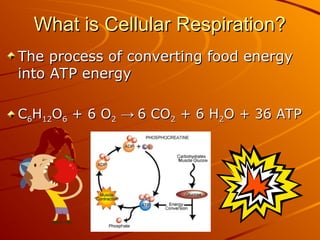
What is Cellular Respiration?
The process of converting food energy
into ATP energy
into ATP energy
C
C6
6H
H12
12O
O6
6 + 6 O
+ 6 O2
2 →
→ 6 CO
6 CO2
2 + 6 H
+ 6 H2
2O + 36 ATP
O + 36 ATP
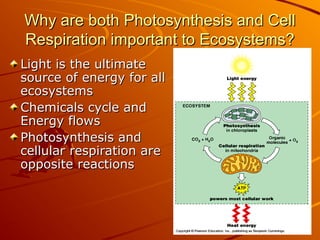
Why are both Photosynthesis and Cell
Respiration important to Ecosystems?
Light is the ultimate
source of energy for all
ecosystems
ecosystems
Chemicals cycle and
Chemicals cycle and
Energy flows
Energy flows
Photosynthesis and
Photosynthesis and
cellular respiration are
opposite reactions
opposite reactions
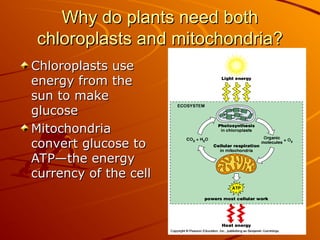
Why do plants need both
chloroplasts and mitochondria?
Chloroplasts use
Chloroplasts use
energy from the
energy from the
sun to make
sun to make
glucose
glucose
Mitochondria
Mitochondria
convert glucose to
convert glucose to
ATP—the energy
ATP—the energy
currency of the cell
What is ATP?
What is ATP?
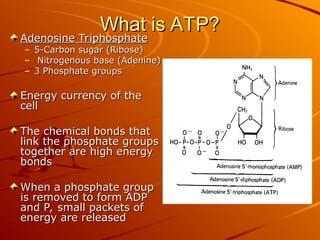
Adenosine Triphosphate
– 5-Carbon sugar (Ribose)
5-Carbon sugar (Ribose)
– Nitrogenous base (Adenine)
Nitrogenous base (Adenine)
– 3 Phosphate groups
3 Phosphate groups
Energy currency of the
cell
cell
The chemical bonds that
link the phosphate groups
together are high energy
bonds
bonds
When a phosphate group
is removed to form ADP
and P, small packets of
energy are released
energy are released
How is ATP used?
How is ATP used?
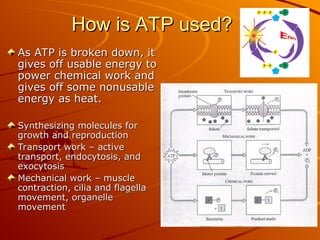
As ATP is broken down, it
gives off usable energy to
power chemical work and
gives off some nonusable
energy as heat.
energy as heat.
Synthesizing molecules for
growth and reproduction
Transport work – active
transport, endocytosis, and
exocytosis
exocytosis
Mechanical work – muscle
contraction, cilia and flagella
movement, organelle
movement, organelle
movement
movement
Why use ATP energy and not
energy from glucose?
Breaking down glucose yields too much energy
for cellular reactions and most of the energy
would be wasted as heat.
1 Glucose = 686 kcal
1 ATP = 7.3 kcal
1 ATP = 7.3 kcal
1 Glucose
1 Glucose →
→ 36 ATP
36 ATP
How efficient are cells at converting glucose into
ATP?
ATP?
– 38% of the energy from glucose yields ATP,
38% of the energy from glucose yields ATP,
therefore 62% wasted as heat.
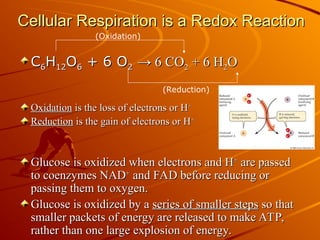
Cellular Respiration is a Redox Reaction
C
C6
6H
H12
12O
O6
6 + 6 O
+ 6 O2
2 → 6 CO
→ 6 CO2
2 + 6 H
+ 6 H2
2O
O
Oxidation
Oxidation is the loss of electrons or H
is the loss of electrons or H+
+
Reduction
Reduction is the gain of electrons or H
is the gain of electrons or H+
+
Glucose is oxidized when electrons and H
Glucose is oxidized when electrons and H+
+
are passed
are passed
to coenzymes NAD
to coenzymes NAD+
+
and FAD before reducing or
passing them to oxygen.
Glucose is oxidized by a
Glucose is oxidized by a series of smaller steps
series of smaller steps so that
so that
smaller packets of energy are released to make ATP,
rather than one large explosion of energy.
(Oxidation)
(Reduction)
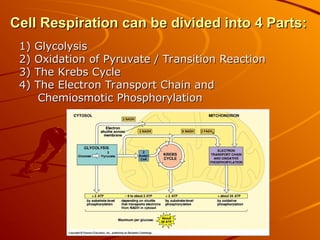
Cell Respiration can be divided into 4 Parts:
1) Glycolysis
1) Glycolysis
2) Oxidation of Pyruvate / Transition Reaction
3) The Krebs Cycle
3) The Krebs Cycle
4) The Electron Transport Chain and
Chemiosmotic Phosphorylation
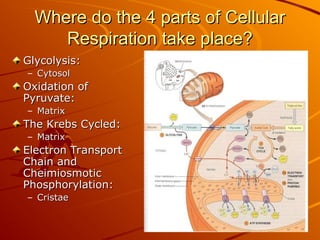
Where do the 4 parts of Cellular
Respiration take place?
Glycolysis:
Glycolysis:
– Cytosol
Cytosol
Oxidation of
Oxidation of
Pyruvate:
Pyruvate:
– Matrix
Matrix
The Krebs Cycled:
The Krebs Cycled:
– Matrix
Matrix
Electron Transport
Electron Transport
Chain and
Chain and
Cheimiosmotic
Cheimiosmotic
Phosphorylation:
Phosphorylation:
– Cristae
Cristae
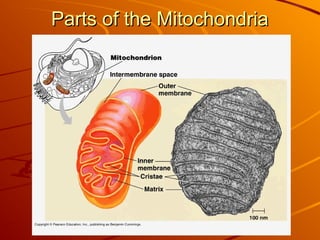
Parts of the Mitochondria
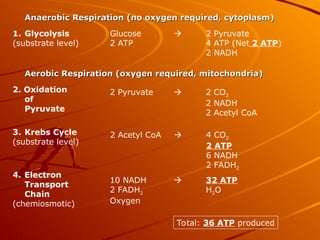
Anaerobic Respiration (no oxygen required, cytoplasm)
1. Glycolysis
(substrate level)
Glucose  2 Pyruvate
2 ATP 4 ATP (Net 2 ATP)
2 NADH
Aerobic Respiration (oxygen required, mitochondria)
2. Oxidation
of
Pyruvate
2 Pyruvate  2 CO2
2 NADH
2 Acetyl CoA
3. Krebs Cycle
(substrate level)
2 Acetyl CoA  4 CO2
2 ATP
6 NADH
2 FADH2
4. Electron
Transport
Chain
(chemiosmotic)
10 NADH  32 ATP
2 FADH2 H2O
Oxygen
Total: 36 ATP produced
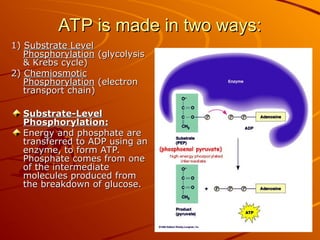
ATP is made in two ways:
1)
1) Substrate Level
Substrate Level
Phosphorylation
Phosphorylation (glycolysis
(glycolysis
& Krebs cycle)
& Krebs cycle)
2)
2) Chemiosmotic
Chemiosmotic
Phosphorylation
Phosphorylation (electron
(electron
transport chain)
transport chain)
Substrate-Level
Substrate-Level
Phosphorylation:
Phosphorylation:
Energy and phosphate are
transferred to ADP using an
enzyme, to form ATP.
Phosphate comes from one
of the intermediate
of the intermediate
molecules produced from
the breakdown of glucose.
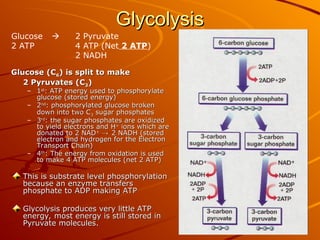
Glycolysis
Glycolysis
Glucose (C
Glucose (C6
6) is split to make
) is split to make
2 Pyruvates (C
2 Pyruvates (C3
3)
)
– 1
1st
st
: ATP energy used to phosphorylate
glucose (stored energy)
– 2
2nd
nd
: phosphorylated glucose broken
down into two C
down into two C3
3 sugar phosphates
sugar phosphates
– 3
3rd
rd
: the sugar phosphates are oxidized
to yield electrons and H
to yield electrons and H+
+
ions which are
ions which are
donated to 2 NAD
donated to 2 NAD+
+
→
→ 2 NADH (stored
2 NADH (stored
electron and hydrogen for the Electron
Transport Chain)
Transport Chain)
– 4
4th
th
: The energy from oxidation is used
to make 4 ATP molecules (net 2 ATP)
This is substrate level phosphorylation
because an enzyme transfers
phosphate to ADP making ATP
Glycolysis produces very little ATP
energy, most energy is still stored in
Pyruvate molecules.
Pyruvate molecules.
Glucose  2 Pyruvate
2 ATP 4 ATP (Net 2 ATP)
2 NADH
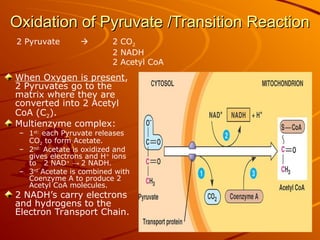
Oxidation of Pyruvate /Transition Reaction
When Oxygen is present,
2 Pyruvates go to the
matrix where they are
converted into 2 Acetyl
CoA (C2).
Multienzyme complex:
– 1st:
each Pyruvate releases
CO2 to form Acetate.
– 2nd:
Acetate is oxidized and
gives electrons and H+
ions
to 2 NAD+
→ 2 NADH.
– 3rd
Acetate is combined with
Coenzyme A to produce 2
Acetyl CoA molecules.
2 NADH’s carry electrons
and hydrogens to the
Electron Transport Chain.
2 Pyruvate  2 CO2
2 NADH
2 Acetyl CoA
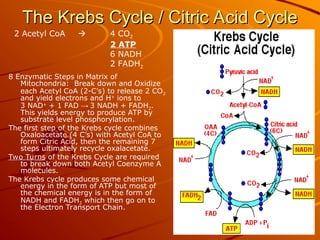
The Krebs Cycle / Citric Acid Cycle
8 Enzymatic Steps in Matrix of
Mitochondria: Break down and Oxidize
each Acetyl CoA (2-C’s) to release 2 CO2
and yield electrons and H+
ions to
3 NAD+
+ 1 FAD → 3 NADH + FADH2.
This yields energy to produce ATP by
substrate level phosphorylation.
The first step of the Krebs cycle combines
Oxaloacetate (4 C’s) with Acetyl CoA to
form Citric Acid, then the remaining 7
steps ultimately recycle oxalacetate.
Two Turns of the Krebs Cycle are required
to break down both Acetyl Coenzyme A
molecules.
The Krebs cycle produces some chemical
energy in the form of ATP but most of
the chemical energy is in the form of
NADH and FADH2 which then go on to
the Electron Transport Chain.
2 Acetyl CoA  4 CO2
2 ATP
6 NADH
2 FADH2
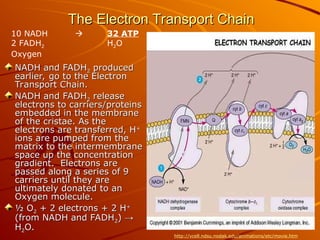
The Electron Transport Chain
NADH and FADH
NADH and FADH2
2 produced
produced
earlier, go to the Electron
Transport Chain.
Transport Chain.
NADH and FADH
NADH and FADH2
2 release
release
electrons to carriers/proteins
embedded in the membrane
of the cristae. As the
electrons are transferred, H
electrons are transferred, H+
+
ions are pumped from the
matrix to the intermembrane
space up the concentration
gradient. Electrons are
passed along a series of 9
carriers until they are
ultimately donated to an
Oxygen molecule.
Oxygen molecule.
½ O
½ O2
2 + 2 electrons + 2 H
+ 2 electrons + 2 H+
+
(from NADH and FADH
(from NADH and FADH2
2)
) →
→
H
H2
2O.
O.
10 NADH  32 ATP
2 FADH2 H2O
Oxygen
http://vcell.ndsu.nodak.edu/animations/etc/movie.htm
Chemiosmotic Phosphorylation
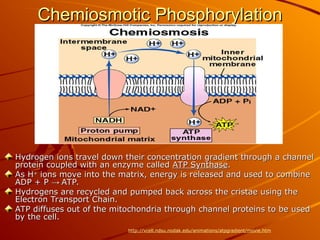
Hydrogen ions travel down their concentration gradient through a channel
protein coupled with an enzyme called
protein coupled with an enzyme called ATP Synthase
ATP Synthase.
.
As H
As H+
+
ions move into the matrix, energy is released and used to combine
ADP + P
ADP + P →
→ ATP.
ATP.
Hydrogens are recycled and pumped back across the cristae using the
Electron Transport Chain.
ATP diffuses out of the mitochondria through channel proteins to be used
by the cell.
by the cell.
http://vcell.ndsu.nodak.edu/animations/atpgradient/movie.htm
ATP Synthase
ATP Synthase
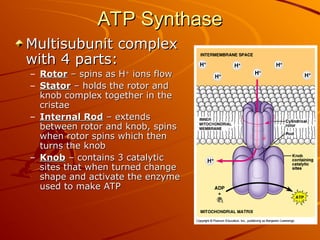
Multisubunit complex
with 4 parts:
with 4 parts:
– Rotor
Rotor – spins as H
– spins as H+
+
ions flow
ions flow
– Stator
Stator – holds the rotor and
– holds the rotor and
knob complex together in the
cristae
cristae
– Internal Rod
Internal Rod – extends
– extends
between rotor and knob, spins
when rotor spins which then
turns the knob
turns the knob
– Knob
Knob – contains 3 catalytic
– contains 3 catalytic
sites that when turned change
shape and activate the enzyme
used to make ATP
used to make ATP
Review ATP Production:
1) Glycolysis
1) Glycolysis →
→ 2 ATP
2 ATP
2) Oxidation of Pyruvate
2) Oxidation of Pyruvate →
→ No ATP
No ATP
3) The Krebs Cycle
3) The Krebs Cycle →
→ 2 ATP
2 ATP
4) The Electron Transport Chain and
Chemiosmotic Phosphorylation:
– Each NADH produces 2-3 ATP so 10
Each NADH produces 2-3 ATP so 10
NADH
NADH →
→ 28 ATP
28 ATP
– Each FADH
Each FADH2
2 produces 2 ATP so 2
produces 2 ATP so 2
FADH
FADH2
2 →
→ 4 ATP
4 ATP
Total = 36 ATP
Total = 36 ATP
1 Glucose = 686 kcal
1 ATP = 7.3 kcal
1 ATP = 7.3 kcal
1 Glucose
1 Glucose →
→ 36 ATP
36 ATP
How efficient are cells at converting
glucose into ATP?
glucose into ATP?
– 38% of the energy from glucose
38% of the energy from glucose
yields ATP, therefore 62% wasted as
heat (used to maintain body
temperature or is dissipated)
– Ex. Most efficient Cars: only 25% of
Ex. Most efficient Cars: only 25% of
the energy from gasoline is used to
move the car, 75% heat.
All Types of Molecules can be used
to form ATP by Cell Respiration:
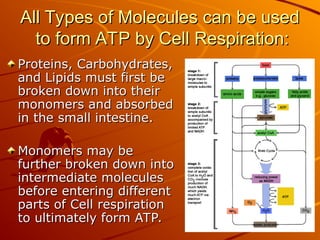
Proteins, Carbohydrates,
and Lipids must first be
broken down into their
monomers and absorbed
in the small intestine.
Monomers may be
Monomers may be
further broken down into
intermediate molecules
before entering different
parts of Cell respiration
to ultimately form ATP.
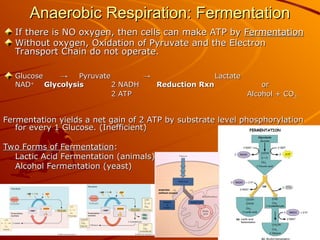
Anaerobic Respiration: Fermentation
If there is NO oxygen, then cells can make ATP by
If there is NO oxygen, then cells can make ATP by Fermentation
Fermentation
Without oxygen, Oxidation of Pyruvate and the Electron
Transport Chain do not operate.
Glucose
Glucose →
→ Pyruvate
Pyruvate →
→ Lactate
Lactate
NAD
NAD+
+
Glycolysis
Glycolysis 2 NADH
2 NADH Reduction Rxn
Reduction Rxn or
or
2 ATP
2 ATP Alcohol + CO
Alcohol + CO2
2
Fermentation yields a net gain of 2 ATP by substrate level phosphorylation
for every 1 Glucose. (Inefficient)
Two Forms of Fermentation
Two Forms of Fermentation:
:
Lactic Acid Fermentation (animals)
Alcohol Fermentation (yeast)

cellular_respiration_2 Biology grade 9.ppt

  • 1.
  • 2.
    What is CellularRespiration? What is Cellular Respiration? The process of converting food energy The process of converting food energy into ATP energy into ATP energy C C6 6H H12 12O O6 6 + 6 O + 6 O2 2 → → 6 CO 6 CO2 2 + 6 H + 6 H2 2O + 36 ATP O + 36 ATP
  • 3.
    Why are bothPhotosynthesis and Cell Why are both Photosynthesis and Cell Respiration important to Ecosystems? Respiration important to Ecosystems? Light is the ultimate Light is the ultimate source of energy for all source of energy for all ecosystems ecosystems Chemicals cycle and Chemicals cycle and Energy flows Energy flows Photosynthesis and Photosynthesis and cellular respiration are cellular respiration are opposite reactions opposite reactions
  • 4.
    Why do plantsneed both Why do plants need both chloroplasts and mitochondria? chloroplasts and mitochondria? Chloroplasts use Chloroplasts use energy from the energy from the sun to make sun to make glucose glucose Mitochondria Mitochondria convert glucose to convert glucose to ATP—the energy ATP—the energy currency of the cell currency of the cell
  • 5.
    What is ATP? Whatis ATP? Adenosine Triphosphate Adenosine Triphosphate – 5-Carbon sugar (Ribose) 5-Carbon sugar (Ribose) – Nitrogenous base (Adenine) Nitrogenous base (Adenine) – 3 Phosphate groups 3 Phosphate groups Energy currency of the Energy currency of the cell cell The chemical bonds that The chemical bonds that link the phosphate groups link the phosphate groups together are high energy together are high energy bonds bonds When a phosphate group When a phosphate group is removed to form ADP is removed to form ADP and P, small packets of and P, small packets of energy are released energy are released
  • 6.
    How is ATPused? How is ATP used? As ATP is broken down, it As ATP is broken down, it gives off usable energy to gives off usable energy to power chemical work and power chemical work and gives off some nonusable gives off some nonusable energy as heat. energy as heat. Synthesizing molecules for Synthesizing molecules for growth and reproduction growth and reproduction Transport work – active Transport work – active transport, endocytosis, and transport, endocytosis, and exocytosis exocytosis Mechanical work – muscle Mechanical work – muscle contraction, cilia and flagella contraction, cilia and flagella movement, organelle movement, organelle movement movement
  • 7.
    Why use ATPenergy and not Why use ATP energy and not energy from glucose? energy from glucose? Breaking down glucose yields too much energy Breaking down glucose yields too much energy for cellular reactions and most of the energy for cellular reactions and most of the energy would be wasted as heat. would be wasted as heat. 1 Glucose = 686 kcal 1 Glucose = 686 kcal 1 ATP = 7.3 kcal 1 ATP = 7.3 kcal 1 Glucose 1 Glucose → → 36 ATP 36 ATP How efficient are cells at converting glucose into How efficient are cells at converting glucose into ATP? ATP? – 38% of the energy from glucose yields ATP, 38% of the energy from glucose yields ATP, therefore 62% wasted as heat. therefore 62% wasted as heat.
  • 8.
    Cellular Respiration isa Redox Reaction Cellular Respiration is a Redox Reaction C C6 6H H12 12O O6 6 + 6 O + 6 O2 2 → 6 CO → 6 CO2 2 + 6 H + 6 H2 2O O Oxidation Oxidation is the loss of electrons or H is the loss of electrons or H+ + Reduction Reduction is the gain of electrons or H is the gain of electrons or H+ + Glucose is oxidized when electrons and H Glucose is oxidized when electrons and H+ + are passed are passed to coenzymes NAD to coenzymes NAD+ + and FAD before reducing or and FAD before reducing or passing them to oxygen. passing them to oxygen. Glucose is oxidized by a Glucose is oxidized by a series of smaller steps series of smaller steps so that so that smaller packets of energy are released to make ATP, smaller packets of energy are released to make ATP, rather than one large explosion of energy. rather than one large explosion of energy. (Oxidation) (Reduction)
  • 9.
    Cell Respiration canbe divided into 4 Parts: Cell Respiration can be divided into 4 Parts: 1) Glycolysis 1) Glycolysis 2) Oxidation of Pyruvate / Transition Reaction 2) Oxidation of Pyruvate / Transition Reaction 3) The Krebs Cycle 3) The Krebs Cycle 4) The Electron Transport Chain and 4) The Electron Transport Chain and Chemiosmotic Phosphorylation Chemiosmotic Phosphorylation
  • 10.
    Where do the4 parts of Cellular Where do the 4 parts of Cellular Respiration take place? Respiration take place? Glycolysis: Glycolysis: – Cytosol Cytosol Oxidation of Oxidation of Pyruvate: Pyruvate: – Matrix Matrix The Krebs Cycled: The Krebs Cycled: – Matrix Matrix Electron Transport Electron Transport Chain and Chain and Cheimiosmotic Cheimiosmotic Phosphorylation: Phosphorylation: – Cristae Cristae
  • 11.
    Parts of theMitochondria Parts of the Mitochondria
  • 12.
    Anaerobic Respiration (nooxygen required, cytoplasm) Anaerobic Respiration (no oxygen required, cytoplasm) 1. Glycolysis (substrate level) Glucose  2 Pyruvate 2 ATP 4 ATP (Net 2 ATP) 2 NADH Aerobic Respiration (oxygen required, mitochondria) Aerobic Respiration (oxygen required, mitochondria) 2. Oxidation of Pyruvate 2 Pyruvate  2 CO2 2 NADH 2 Acetyl CoA 3. Krebs Cycle (substrate level) 2 Acetyl CoA  4 CO2 2 ATP 6 NADH 2 FADH2 4. Electron Transport Chain (chemiosmotic) 10 NADH  32 ATP 2 FADH2 H2O Oxygen Total: 36 ATP produced
  • 13.
    ATP is madein two ways: ATP is made in two ways: 1) 1) Substrate Level Substrate Level Phosphorylation Phosphorylation (glycolysis (glycolysis & Krebs cycle) & Krebs cycle) 2) 2) Chemiosmotic Chemiosmotic Phosphorylation Phosphorylation (electron (electron transport chain) transport chain) Substrate-Level Substrate-Level Phosphorylation: Phosphorylation: Energy and phosphate are Energy and phosphate are transferred to ADP using an transferred to ADP using an enzyme, to form ATP. enzyme, to form ATP. Phosphate comes from one Phosphate comes from one of the intermediate of the intermediate molecules produced from molecules produced from the breakdown of glucose. the breakdown of glucose.
  • 14.
    Glycolysis Glycolysis Glucose (C Glucose (C6 6)is split to make ) is split to make 2 Pyruvates (C 2 Pyruvates (C3 3) ) – 1 1st st : ATP energy used to phosphorylate : ATP energy used to phosphorylate glucose (stored energy) glucose (stored energy) – 2 2nd nd : phosphorylated glucose broken : phosphorylated glucose broken down into two C down into two C3 3 sugar phosphates sugar phosphates – 3 3rd rd : the sugar phosphates are oxidized : the sugar phosphates are oxidized to yield electrons and H to yield electrons and H+ + ions which are ions which are donated to 2 NAD donated to 2 NAD+ + → → 2 NADH (stored 2 NADH (stored electron and hydrogen for the Electron electron and hydrogen for the Electron Transport Chain) Transport Chain) – 4 4th th : The energy from oxidation is used : The energy from oxidation is used to make 4 ATP molecules (net 2 ATP) to make 4 ATP molecules (net 2 ATP) This is substrate level phosphorylation This is substrate level phosphorylation because an enzyme transfers because an enzyme transfers phosphate to ADP making ATP phosphate to ADP making ATP Glycolysis produces very little ATP Glycolysis produces very little ATP energy, most energy is still stored in energy, most energy is still stored in Pyruvate molecules. Pyruvate molecules. Glucose  2 Pyruvate 2 ATP 4 ATP (Net 2 ATP) 2 NADH
  • 15.
    Oxidation of Pyruvate/Transition Reaction Oxidation of Pyruvate /Transition Reaction When Oxygen is present, 2 Pyruvates go to the matrix where they are converted into 2 Acetyl CoA (C2). Multienzyme complex: – 1st: each Pyruvate releases CO2 to form Acetate. – 2nd: Acetate is oxidized and gives electrons and H+ ions to 2 NAD+ → 2 NADH. – 3rd Acetate is combined with Coenzyme A to produce 2 Acetyl CoA molecules. 2 NADH’s carry electrons and hydrogens to the Electron Transport Chain. 2 Pyruvate  2 CO2 2 NADH 2 Acetyl CoA
  • 16.
    The Krebs Cycle/ Citric Acid Cycle The Krebs Cycle / Citric Acid Cycle 8 Enzymatic Steps in Matrix of Mitochondria: Break down and Oxidize each Acetyl CoA (2-C’s) to release 2 CO2 and yield electrons and H+ ions to 3 NAD+ + 1 FAD → 3 NADH + FADH2. This yields energy to produce ATP by substrate level phosphorylation. The first step of the Krebs cycle combines Oxaloacetate (4 C’s) with Acetyl CoA to form Citric Acid, then the remaining 7 steps ultimately recycle oxalacetate. Two Turns of the Krebs Cycle are required to break down both Acetyl Coenzyme A molecules. The Krebs cycle produces some chemical energy in the form of ATP but most of the chemical energy is in the form of NADH and FADH2 which then go on to the Electron Transport Chain. 2 Acetyl CoA  4 CO2 2 ATP 6 NADH 2 FADH2
  • 17.
    The Electron TransportChain The Electron Transport Chain NADH and FADH NADH and FADH2 2 produced produced earlier, go to the Electron earlier, go to the Electron Transport Chain. Transport Chain. NADH and FADH NADH and FADH2 2 release release electrons to carriers/proteins electrons to carriers/proteins embedded in the membrane embedded in the membrane of the cristae. As the of the cristae. As the electrons are transferred, H electrons are transferred, H+ + ions are pumped from the ions are pumped from the matrix to the intermembrane matrix to the intermembrane space up the concentration space up the concentration gradient. Electrons are gradient. Electrons are passed along a series of 9 passed along a series of 9 carriers until they are carriers until they are ultimately donated to an ultimately donated to an Oxygen molecule. Oxygen molecule. ½ O ½ O2 2 + 2 electrons + 2 H + 2 electrons + 2 H+ + (from NADH and FADH (from NADH and FADH2 2) ) → → H H2 2O. O. 10 NADH  32 ATP 2 FADH2 H2O Oxygen http://vcell.ndsu.nodak.edu/animations/etc/movie.htm
  • 18.
    Chemiosmotic Phosphorylation Chemiosmotic Phosphorylation Hydrogenions travel down their concentration gradient through a channel Hydrogen ions travel down their concentration gradient through a channel protein coupled with an enzyme called protein coupled with an enzyme called ATP Synthase ATP Synthase. . As H As H+ + ions move into the matrix, energy is released and used to combine ions move into the matrix, energy is released and used to combine ADP + P ADP + P → → ATP. ATP. Hydrogens are recycled and pumped back across the cristae using the Hydrogens are recycled and pumped back across the cristae using the Electron Transport Chain. Electron Transport Chain. ATP diffuses out of the mitochondria through channel proteins to be used ATP diffuses out of the mitochondria through channel proteins to be used by the cell. by the cell. http://vcell.ndsu.nodak.edu/animations/atpgradient/movie.htm
  • 19.
    ATP Synthase ATP Synthase Multisubunitcomplex Multisubunit complex with 4 parts: with 4 parts: – Rotor Rotor – spins as H – spins as H+ + ions flow ions flow – Stator Stator – holds the rotor and – holds the rotor and knob complex together in the knob complex together in the cristae cristae – Internal Rod Internal Rod – extends – extends between rotor and knob, spins between rotor and knob, spins when rotor spins which then when rotor spins which then turns the knob turns the knob – Knob Knob – contains 3 catalytic – contains 3 catalytic sites that when turned change sites that when turned change shape and activate the enzyme shape and activate the enzyme used to make ATP used to make ATP
  • 20.
    Review ATP Production: ReviewATP Production: 1) Glycolysis 1) Glycolysis → → 2 ATP 2 ATP 2) Oxidation of Pyruvate 2) Oxidation of Pyruvate → → No ATP No ATP 3) The Krebs Cycle 3) The Krebs Cycle → → 2 ATP 2 ATP 4) The Electron Transport Chain and 4) The Electron Transport Chain and Chemiosmotic Phosphorylation: Chemiosmotic Phosphorylation: – Each NADH produces 2-3 ATP so 10 Each NADH produces 2-3 ATP so 10 NADH NADH → → 28 ATP 28 ATP – Each FADH Each FADH2 2 produces 2 ATP so 2 produces 2 ATP so 2 FADH FADH2 2 → → 4 ATP 4 ATP Total = 36 ATP Total = 36 ATP 1 Glucose = 686 kcal 1 Glucose = 686 kcal 1 ATP = 7.3 kcal 1 ATP = 7.3 kcal 1 Glucose 1 Glucose → → 36 ATP 36 ATP How efficient are cells at converting How efficient are cells at converting glucose into ATP? glucose into ATP? – 38% of the energy from glucose 38% of the energy from glucose yields ATP, therefore 62% wasted as yields ATP, therefore 62% wasted as heat (used to maintain body heat (used to maintain body temperature or is dissipated) temperature or is dissipated) – Ex. Most efficient Cars: only 25% of Ex. Most efficient Cars: only 25% of the energy from gasoline is used to the energy from gasoline is used to move the car, 75% heat. move the car, 75% heat.
  • 21.
    All Types ofMolecules can be used All Types of Molecules can be used to form ATP by Cell Respiration: to form ATP by Cell Respiration: Proteins, Carbohydrates, Proteins, Carbohydrates, and Lipids must first be and Lipids must first be broken down into their broken down into their monomers and absorbed monomers and absorbed in the small intestine. in the small intestine. Monomers may be Monomers may be further broken down into further broken down into intermediate molecules intermediate molecules before entering different before entering different parts of Cell respiration parts of Cell respiration to ultimately form ATP. to ultimately form ATP.
  • 22.
    Anaerobic Respiration: Fermentation AnaerobicRespiration: Fermentation If there is NO oxygen, then cells can make ATP by If there is NO oxygen, then cells can make ATP by Fermentation Fermentation Without oxygen, Oxidation of Pyruvate and the Electron Without oxygen, Oxidation of Pyruvate and the Electron Transport Chain do not operate. Transport Chain do not operate. Glucose Glucose → → Pyruvate Pyruvate → → Lactate Lactate NAD NAD+ + Glycolysis Glycolysis 2 NADH 2 NADH Reduction Rxn Reduction Rxn or or 2 ATP 2 ATP Alcohol + CO Alcohol + CO2 2 Fermentation yields a net gain of 2 ATP by substrate level phosphorylation Fermentation yields a net gain of 2 ATP by substrate level phosphorylation for every 1 Glucose. (Inefficient) for every 1 Glucose. (Inefficient) Two Forms of Fermentation Two Forms of Fermentation: : Lactic Acid Fermentation (animals) Lactic Acid Fermentation (animals) Alcohol Fermentation (yeast) Alcohol Fermentation (yeast)