1
Vijayaraj Nagarajan PhD
Computational Biologist, BCBB/OCICB/NIAID/NIH
Biological Networks :
building, visualization and analysis
OFFICE OF CYBER INFRASTRUCTURE AND COMPUTATIONAL BIOLOGY
NATIONAL INSTITUTE OF ALLERGY AND INFECTIOUS DISEASES
Outline	
  
•  Introduc)on	
  to	
  Biological	
  Networks	
  
•  Basic	
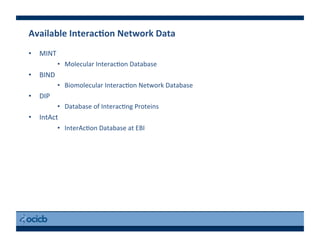
  components	
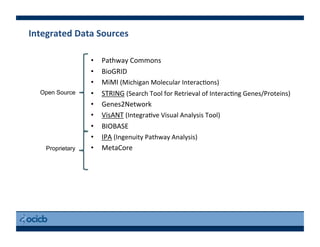
  of	
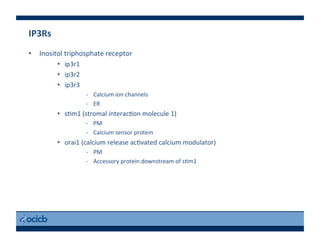
  a	
  network	
  
•  Types	
  of	
  biological	
  networks	
  
•  Predic)ng/Building	
  Biological	
  Networks	
  
•  Methods	
  
-­‐  Logic	
  and	
  concept	
  
•  Available	
  Interac)on	
  data	
  
•  Integrated	
  protein-­‐protein	
  interac)on	
  databases	
  
•  Searching	
  for	
  interac)on	
  data	
  
•  Network	
  Visualiza)on	
  and	
  Analysis	
  tools	
  
•  Popular	
  visualiza)on	
  tools	
  
•  Network	
  analysis	
  
•  Demonstra)on	
  
•  Building,	
  visualiza)on	
  and	
  analysis	
  of	
  the	
  biological	
  networks	
  (Cytoscape)	
  
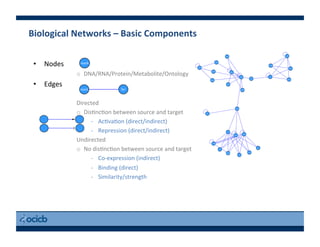
•  Nodes	
  
o  DNA/RNA/Protein/Metabolite/Ontology	
  
•  Edges	
  
Directed	
  
o  Dis)nc)on	
  between	
  source	
  and	
  target	
  
-­‐  Ac)va)on	
  (direct/indirect)	
  
-­‐  Repression	
  (direct/indirect)	
  
Undirected	
  
o  No	
  dis)nc)on	
  between	
  source	
  and	
  target	
  
-­‐  Co-­‐expression	
  (indirect)	
  
-­‐  Binding	
  (direct)	
  
-­‐  Similarity/strength	
  
Biological	
  Networks	
  –	
  Basic	
  Components	
  
Biological	
  Networks	
  -­‐	
  Basic	
  Features	
  
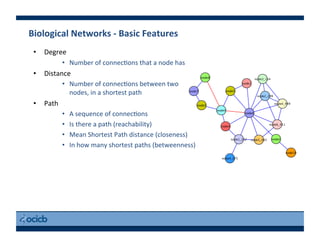
•  Degree	
  
•  Number	
  of	
  connec)ons	
  that	
  a	
  node	
  has	
  
•  Distance	
  
•  Number	
  of	
  connec)ons	
  between	
  two	
  
nodes,	
  in	
  a	
  shortest	
  path	
  
•  Path	
  
•  A	
  sequence	
  of	
  connec)ons	
  
•  Is	
  there	
  a	
  path	
  (reachability)	
  
•  Mean	
  Shortest	
  Path	
  distance	
  (closeness)	
  
•  In	
  how	
  many	
  shortest	
  paths	
  (betweenness)	
  
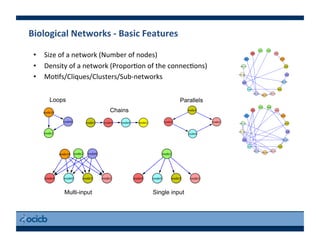
•  Size	
  of	
  a	
  network	
  (Number	
  of	
  nodes)	
  
•  Density	
  of	
  a	
  network	
  (Propor)on	
  of	
  the	
  connec)ons)	
  
•  Mo)fs/Cliques/Clusters/Sub-­‐networks	
  
Loops
Chains
Parallels
Multi-input Single input
Biological	
  Networks	
  -­‐	
  Basic	
  Features	
  
Types	
  of	
  Biological	
  Networks	
  
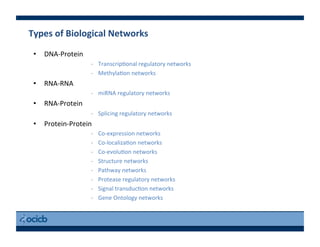
•  DNA-­‐Protein	
  
-­‐  Transcrip)onal	
  regulatory	
  networks	
  
-­‐  Methyla)on	
  networks	
  
•  RNA-­‐RNA	
  
-­‐  miRNA	
  regulatory	
  networks	
  
•  RNA-­‐Protein	
  
-­‐  Splicing	
  regulatory	
  networks	
  
•  Protein-­‐Protein	
  
-­‐  Co-­‐expression	
  networks	
  
-­‐  Co-­‐localiza)on	
  networks	
  
-­‐  Co-­‐evolu)on	
  networks	
  
-­‐  Structure	
  networks	
  
-­‐  Pathway	
  networks	
  
-­‐  Protease	
  regulatory	
  networks	
  
-­‐  Signal	
  transduc)on	
  networks	
  
-­‐  Gene	
  Ontology	
  networks	
  
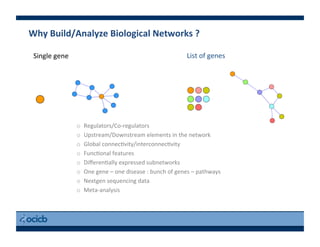
Single	
  gene 	


o  Regulators/Co-­‐regulators	
  
o  Upstream/Downstream	
  elements	
  in	
  the	
  network	
  
o  Global	
  connec)vity/interconnec)vity	
  
o  Func)onal	
  features	
  
o  Differen)ally	
  expressed	
  subnetworks	
  
o  One	
  gene	
  –	
  one	
  disease	
  :	
  bunch	
  of	
  genes	
  –	
  pathways	
  
o  Nextgen	
  sequencing	
  data	
  
o  Meta-­‐analysis	
  
List	
  of	
  genes	
  
Why	
  Build/Analyze	
  Biological	
  Networks	
  ?	
  
Outline	
  
•  Introduc)on	
  to	
  Biological	
  Networks	
  
•  Basic	
  components	
  of	
  a	
  network	
  
•  Types	
  of	
  biological	
  networks	
  
•  Predic)ng/Building	
  Biological	
  Networks	
  
•  Methods	
  
-­‐  Logic	
  and	
  concept	
  
•  Available	
  Interac)on	
  data	
  
•  Integrated	
  protein-­‐protein	
  interac)on	
  databases	
  
•  Searching	
  for	
  interac)on	
  data	
  
•  Network	
  Visualiza)on	
  and	
  Analysis	
  tools	
  
•  Popular	
  visualiza)on	
  tools	
  
•  Network	
  analysis	
  
•  Demonstra)on	
  
•  Building,	
  visualiza)on	
  and	
  analysis	
  of	
  the	
  biological	
  networks	
  (Cytoscape)	
  
How	
  to	
  Build	
  Biological	
  Networks	
  ?	
  	
  
•  Search/Retrieve	
  from	
  knowledge	
  bases	
  
•  Predict	
  from	
  genome	
  sequences	
  
•  Predict	
  from	
   omics 	
  data	
  
•  Predict	
  from	
  literature	
  
•  Integrate	
  and	
  analyze	
  
•  Meta-­‐networks	
  from	
  genome	
  scale	
  data	
  analysis	
  
Protein Engineering, Vol. 14, No. 9, 609-614, September 2001
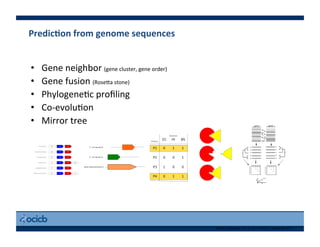
PredicEon	
  from	
  genome	
  sequences	
  
•  Gene	
  neighbor	
  (gene	
  cluster,	
  gene	
  order)	
  
•  Gene	
  fusion	
  (RoseVa	
  stone)	
  
•  Phylogene)c	
  profiling	
  
•  Co-­‐evolu)on	
  
•  Mirror	
  tree	
  
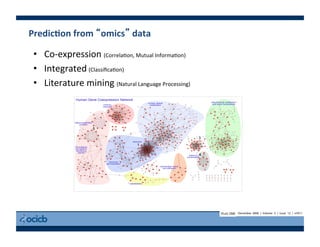
PredicEon	
  from	
   omics 	
  data	
  
•  Co-­‐expression	
  (Correla)on,	
  Mutual	
  Informa)on)	
  
•  Integrated	
  (Classifica)on)	
  
•  Literature	
  mining	
  (Natural	
  Language	
  Processing)	
  
Outline	
  
•  Introduc)on	
  to	
  Biological	
  Networks	
  
•  Basic	
  components	
  of	
  a	
  network	
  
•  Types	
  of	
  Biological	
  networks	
  
•  Predic)ng/Building	
  Biological	
  Networks	
  
•  Methods	
  
-­‐  Logic	
  and	
  concept	
  
•  Available	
  network	
  data	
  
•  Integrated	
  interac)on	
  databases	
  
•  Searching	
  for	
  interac)on	
  data	
  
•  Network	
  Visualiza)on	
  and	
  Analysis	
  tools	
  
•  Popular	
  visualiza)on	
  tools	
  
•  Network	
  analysis	
  
•  Demonstra)on	
  
•  Building,	
  visualiza)on	
  and	
  analysis	
  of	
  the	
  predicted	
  network	
  (Cytoscape)	
  
Available	
  InteracEon	
  Network	
  Data	
  
•  MINT	
  
•  Molecular	
  Interac)on	
  Database	
  
•  BIND	
  
•  Biomolecular	
  Interac)on	
  Network	
  Database	
  
•  DIP	
  
•  Database	
  of	
  Interac)ng	
  Proteins	
  
•  IntAct	
  
•  InterAc)on	
  Database	
  at	
  EBI	
  
Integrated	
  Data	
  Sources	
  
•  Pathway	
  Commons	
  
•  BioGRID	
  
•  MiMI	
  (Michigan	
  Molecular	
  Interac)ons)	
  
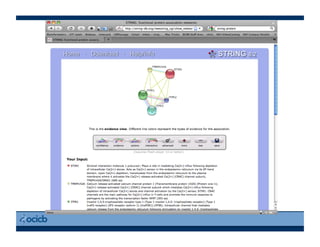
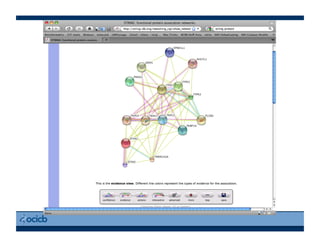
•  STRING	
  (Search	
  Tool	
  for	
  Retrieval	
  of	
  Interac)ng	
  Genes/Proteins)	
  
•  Genes2Network	
  
•  VisANT	
  (Integra)ve	
  Visual	
  Analysis	
  Tool)	
  	
  
•  BIOBASE	
  
•  IPA	
  (Ingenuity	
  Pathway	
  Analysis)	
  
•  MetaCore	
  
Open Source
Proprietary
IP3Rs	
  
•  Inositol	
  triphosphate	
  receptor	
  
•  ip3r1	
  
•  ip3r2	
  
•  ip3r3	
  
-­‐  Calcium	
  ion	
  channels	
  
-­‐  ER	
  
•  s)m1	
  (stromal	
  interac)on	
  molecule	
  1)	
  
-­‐  PM	
  
-­‐  Calcium	
  sensor	
  protein	
  
•  orai1	
  (calcium	
  release	
  ac)vated	
  calcium	
  modulator)	
  
-­‐  PM	
  
-­‐  Accessory	
  protein	
  downstream	
  of	
  s)m1	
  
Searching	
  for	
  InteracEon	
  Data	
  
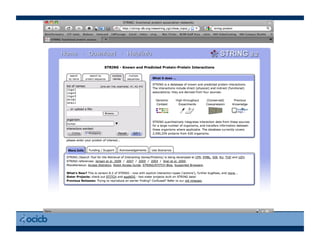
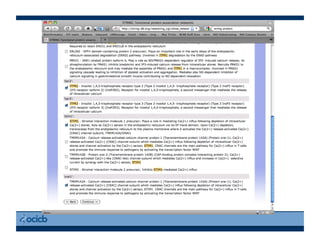
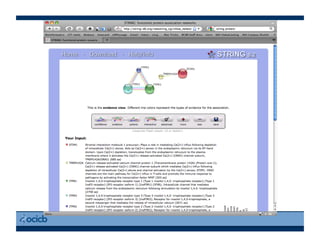
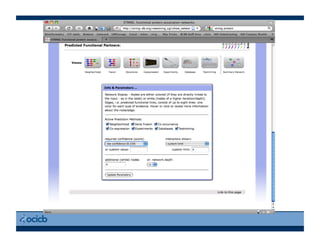
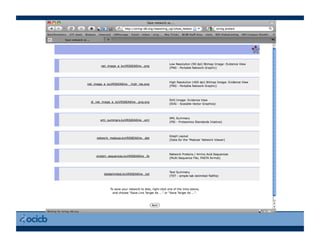
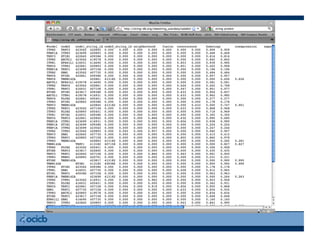
STRING	
  
IPA	
  
IPA	
  
Outline	
  
•  Introduc)on	
  to	
  Biological	
  Networks	
  
•  Basic	
  components	
  of	
  a	
  network	
  
•  Types	
  of	
  Biological	
  networks	
  
•  Predic)ng/Building	
  Biological	
  Networks	
  
•  Methods	
  
-­‐  Logic	
  and	
  concept	
  
•  Available	
  network	
  data	
  
•  Integrated	
  interac)on	
  databases	
  
•  Searching	
  for	
  interac)on	
  data	
  
•  Network	
  Visualiza)on	
  and	
  Analysis	
  tools	
  
•  Popular	
  visualiza)on	
  tools	
  
•  Network	
  analysis	
  
•  Demonstra)on	
  
•  Building,	
  visualiza)on	
  and	
  analysis	
  of	
  the	
  predicted	
  network	
  (Cytoscape)	
  
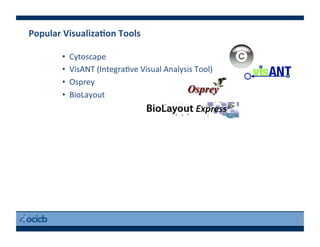
•  Cytoscape	
  
•  VisANT	
  (Integra)ve	
  Visual	
  Analysis	
  Tool)	
  
•  Osprey	
  
•  BioLayout	
  
Popular	
  VisualizaEon	
  Tools	
  
Analysis	
  Tools	
  
•  Phunkee	
  (Pairing	
  subgraphs	
  Using	
  Network	
  Environment	
  Equivalence	
  –	
  finds	
  similar	
  
subnets)	
  
•  mfinder	
  (mo)f	
  detec)on)	
  
•  MAVisto	
  (Mo)f	
  Analysis	
  and	
  Visualiza)on	
  tool	
  –	
  explora)on	
  of	
  mo)fs)	
  
•  GraphMatch	
  (Search	
  for	
  similar	
  sub-­‐nets)	
  
•  NeAT	
  (Network	
  Analysis	
  Tools	
  –	
  mo)f	
  finding,	
  node	
  sta)s)cs)	
  
•  Cfinder	
  (Finds	
  clusters	
  –	
  dense	
  group	
  of	
  nodes)	
  
•  NetworkBLAST	
  (Compares	
  mul)ple	
  networks	
  to	
  infer	
  complexes	
  &	
  paths)	
  
Outline	
  
•  Introduc)on	
  to	
  Biological	
  Networks	
  
•  Basic	
  components	
  of	
  a	
  network	
  
•  Types	
  of	
  Biological	
  networks	
  
•  Predic)ng/Building	
  Biological	
  Networks	
  
•  Methods	
  
-­‐  Logic	
  and	
  concept	
  
•  Available	
  network	
  data	
  
•  Integrated	
  interac)on	
  databases	
  
•  Searching	
  for	
  interac)on	
  data	
  
•  Network	
  Visualiza)on	
  and	
  Analysis	
  tools	
  
•  Popular	
  visualiza)on	
  tools	
  
•  Network	
  analysis	
  
•  Demonstra)on	
  
•  Building,	
  visualiza)on	
  and	
  analysis	
  of	
  the	
  predicted	
  network	
  (Cytoscape)	
  
PPI	
  PredicEon	
  Using	
  Microarray	
  Data	
  
•  Co-­‐expression	
  concept	
  
•  Correla)on	
  Coefficient	
  
-­‐  SIMoNE	
  (Sta)s)cal	
  Inference	
  for	
  Modular	
  Networks)	
  -­‐	
  R	
  
•  Mutual	
  Informa)on	
  
-­‐  Reference	
  Networks	
  
-­‐  ARACNE	
  (Algorithm	
  for	
  Reconstruc)on	
  of	
  Accurate	
  Cellular	
  Networks)	
  –	
  R,	
  
geWorkbench	
  
-­‐  CLR	
  (Context	
  Likelihood	
  of	
  Relatedness)	
  –	
  R	
  
-­‐  MRNET	
  (Maximum	
  Relevance/Minimum	
  Redundancy)	
  –	
  R	
  
-­‐  MONET	
  (Modularized	
  NETwork	
  Learning)	
  -­‐	
  Cytoscape	
  
•  Bayesian	
  Network	
  
PPI	
  PredicEon	
  Using	
  Microarray	
  Data	
  
•  Melanoma	
  metastasis	
  
•  83	
  samples	
  
•  Affymetrix	
  
•  GEO	
  
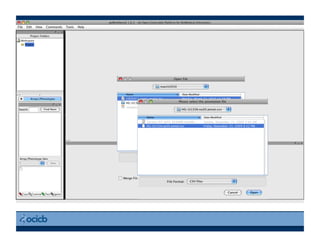
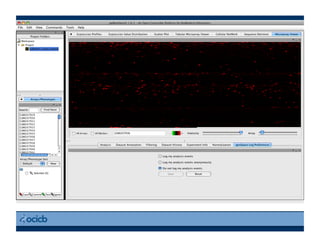
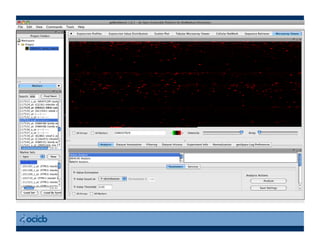
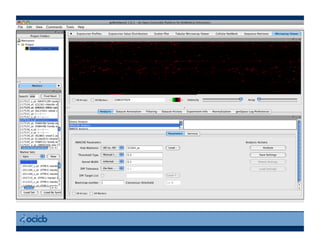
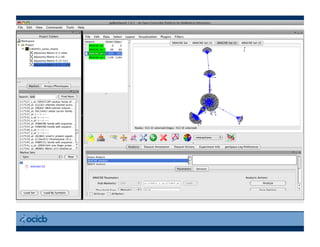
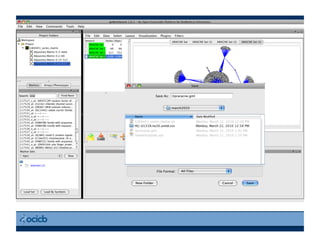
•  ARACNE	
  
•  geWorkbench	
  
•  IP3R1,	
  IP3R2,	
  IP3R3,	
  STIM1,	
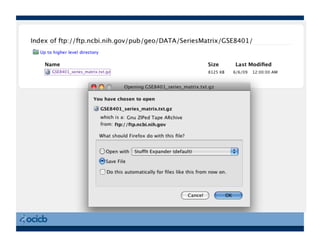
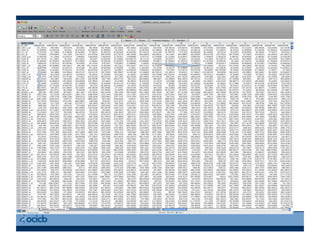
  ORAI1	
  
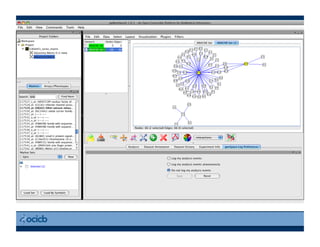
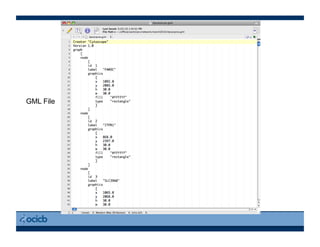
GML File
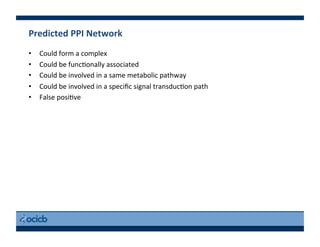
Predicted	
  PPI	
  Network	
  
•  Could	
  form	
  a	
  complex	
  
•  Could	
  be	
  func)onally	
  associated	
  
•  Could	
  be	
  involved	
  in	
  a	
  same	
  metabolic	
  pathway	
  
•  Could	
  be	
  involved	
  in	
  a	
  specific	
  signal	
  transduc)on	
  path	
  
•  False	
  posi)ve	
  
VisualizaEon	
  and	
  Analysis	
  Using	
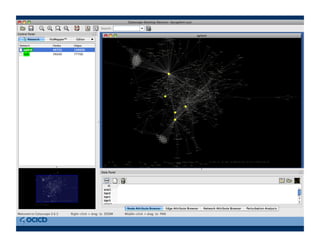
  Cytoscape	
  
•  Cytoscape	
  
•  Opensource	
  
•  Works	
  in	
  Windows,	
  Linux,	
  Mac	
  
•  One	
  of	
  the	
  first	
  developed	
  tools	
  
•  Great	
  number	
  of	
  PLUGINS	
  
•  Excellent	
  help	
  from	
  community	
  
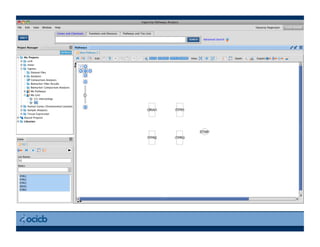
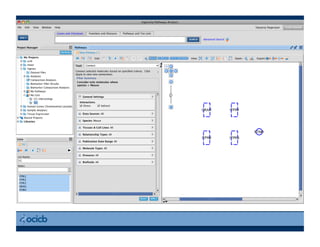
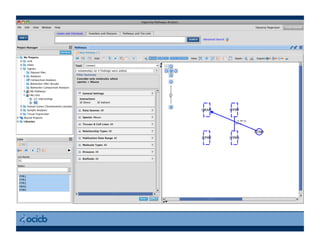
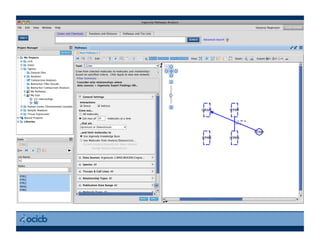
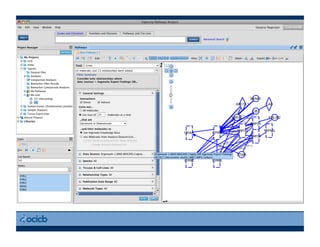
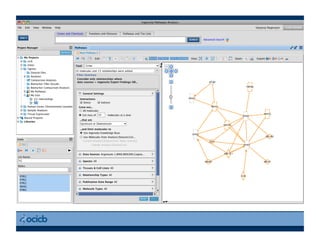
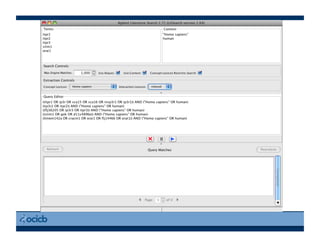
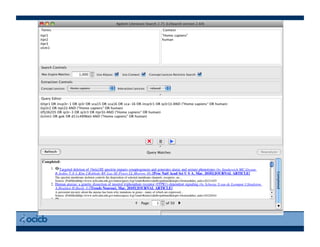
Literature	
  Based	
  PPI	
  PredicEon	
  	
  
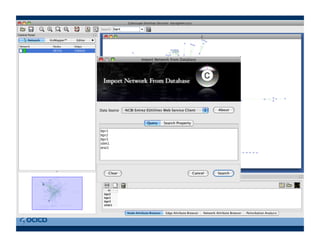
Using	
  Cytoscape	
  
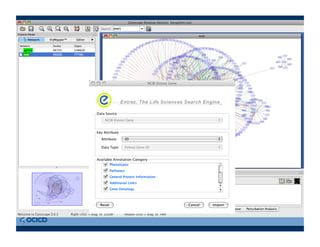
Retrieving	
  PPI	
  Using	
  Cytoscape	
  
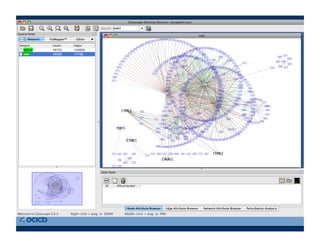
Data	
  VisualizaEon,	
  IntegraEon,	
  Analysis	
  
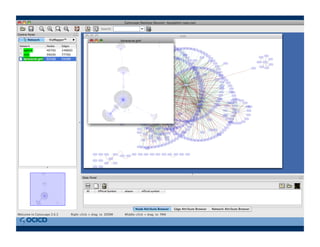
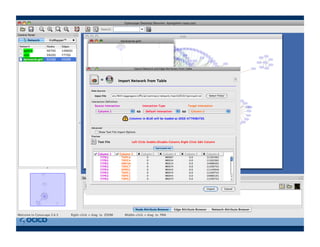
•  Import	
  ARACNE	
  predicted	
  network	
  
•  Import	
  VisANT	
  retrieved	
  network	
  
•  Merge	
  all	
  networks	
  
•  Mo)f	
  finding	
  
70
71
ScienceApps@niaid.nih.gov
nagarajanv@mail.nih.gov
Thank	
  You	
  

Biological networks

  • 1.
    1 Vijayaraj Nagarajan PhD ComputationalBiologist, BCBB/OCICB/NIAID/NIH Biological Networks : building, visualization and analysis OFFICE OF CYBER INFRASTRUCTURE AND COMPUTATIONAL BIOLOGY NATIONAL INSTITUTE OF ALLERGY AND INFECTIOUS DISEASES
  • 2.
    Outline   •  Introduc)on  to  Biological  Networks   •  Basic  components  of  a  network   •  Types  of  biological  networks   •  Predic)ng/Building  Biological  Networks   •  Methods   -­‐  Logic  and  concept   •  Available  Interac)on  data   •  Integrated  protein-­‐protein  interac)on  databases   •  Searching  for  interac)on  data   •  Network  Visualiza)on  and  Analysis  tools   •  Popular  visualiza)on  tools   •  Network  analysis   •  Demonstra)on   •  Building,  visualiza)on  and  analysis  of  the  biological  networks  (Cytoscape)  
  • 3.
    •  Nodes   o DNA/RNA/Protein/Metabolite/Ontology   •  Edges   Directed   o  Dis)nc)on  between  source  and  target   -­‐  Ac)va)on  (direct/indirect)   -­‐  Repression  (direct/indirect)   Undirected   o  No  dis)nc)on  between  source  and  target   -­‐  Co-­‐expression  (indirect)   -­‐  Binding  (direct)   -­‐  Similarity/strength   Biological  Networks  –  Basic  Components  
  • 4.
    Biological  Networks  -­‐  Basic  Features   •  Degree   •  Number  of  connec)ons  that  a  node  has   •  Distance   •  Number  of  connec)ons  between  two   nodes,  in  a  shortest  path   •  Path   •  A  sequence  of  connec)ons   •  Is  there  a  path  (reachability)   •  Mean  Shortest  Path  distance  (closeness)   •  In  how  many  shortest  paths  (betweenness)  
  • 5.
    •  Size  of  a  network  (Number  of  nodes)   •  Density  of  a  network  (Propor)on  of  the  connec)ons)   •  Mo)fs/Cliques/Clusters/Sub-­‐networks   Loops Chains Parallels Multi-input Single input Biological  Networks  -­‐  Basic  Features  
  • 6.
    Types  of  Biological  Networks   •  DNA-­‐Protein   -­‐  Transcrip)onal  regulatory  networks   -­‐  Methyla)on  networks   •  RNA-­‐RNA   -­‐  miRNA  regulatory  networks   •  RNA-­‐Protein   -­‐  Splicing  regulatory  networks   •  Protein-­‐Protein   -­‐  Co-­‐expression  networks   -­‐  Co-­‐localiza)on  networks   -­‐  Co-­‐evolu)on  networks   -­‐  Structure  networks   -­‐  Pathway  networks   -­‐  Protease  regulatory  networks   -­‐  Signal  transduc)on  networks   -­‐  Gene  Ontology  networks  
  • 7.
    Single  gene         o  Regulators/Co-­‐regulators   o  Upstream/Downstream  elements  in  the  network   o  Global  connec)vity/interconnec)vity   o  Func)onal  features   o  Differen)ally  expressed  subnetworks   o  One  gene  –  one  disease  :  bunch  of  genes  –  pathways   o  Nextgen  sequencing  data   o  Meta-­‐analysis   List  of  genes   Why  Build/Analyze  Biological  Networks  ?  
  • 8.
    Outline   •  Introduc)on  to  Biological  Networks   •  Basic  components  of  a  network   •  Types  of  biological  networks   •  Predic)ng/Building  Biological  Networks   •  Methods   -­‐  Logic  and  concept   •  Available  Interac)on  data   •  Integrated  protein-­‐protein  interac)on  databases   •  Searching  for  interac)on  data   •  Network  Visualiza)on  and  Analysis  tools   •  Popular  visualiza)on  tools   •  Network  analysis   •  Demonstra)on   •  Building,  visualiza)on  and  analysis  of  the  biological  networks  (Cytoscape)  
  • 9.
    How  to  Build  Biological  Networks  ?     •  Search/Retrieve  from  knowledge  bases   •  Predict  from  genome  sequences   •  Predict  from   omics  data   •  Predict  from  literature   •  Integrate  and  analyze   •  Meta-­‐networks  from  genome  scale  data  analysis  
  • 10.
    Protein Engineering, Vol.14, No. 9, 609-614, September 2001 PredicEon  from  genome  sequences   •  Gene  neighbor  (gene  cluster,  gene  order)   •  Gene  fusion  (RoseVa  stone)   •  Phylogene)c  profiling   •  Co-­‐evolu)on   •  Mirror  tree  
  • 11.
    PredicEon  from  omics  data   •  Co-­‐expression  (Correla)on,  Mutual  Informa)on)   •  Integrated  (Classifica)on)   •  Literature  mining  (Natural  Language  Processing)  
  • 12.
    Outline   •  Introduc)on  to  Biological  Networks   •  Basic  components  of  a  network   •  Types  of  Biological  networks   •  Predic)ng/Building  Biological  Networks   •  Methods   -­‐  Logic  and  concept   •  Available  network  data   •  Integrated  interac)on  databases   •  Searching  for  interac)on  data   •  Network  Visualiza)on  and  Analysis  tools   •  Popular  visualiza)on  tools   •  Network  analysis   •  Demonstra)on   •  Building,  visualiza)on  and  analysis  of  the  predicted  network  (Cytoscape)  
  • 13.
    Available  InteracEon  Network  Data   •  MINT   •  Molecular  Interac)on  Database   •  BIND   •  Biomolecular  Interac)on  Network  Database   •  DIP   •  Database  of  Interac)ng  Proteins   •  IntAct   •  InterAc)on  Database  at  EBI  
  • 14.
    Integrated  Data  Sources   •  Pathway  Commons   •  BioGRID   •  MiMI  (Michigan  Molecular  Interac)ons)   •  STRING  (Search  Tool  for  Retrieval  of  Interac)ng  Genes/Proteins)   •  Genes2Network   •  VisANT  (Integra)ve  Visual  Analysis  Tool)     •  BIOBASE   •  IPA  (Ingenuity  Pathway  Analysis)   •  MetaCore   Open Source Proprietary
  • 15.
    IP3Rs   •  Inositol  triphosphate  receptor   •  ip3r1   •  ip3r2   •  ip3r3   -­‐  Calcium  ion  channels   -­‐  ER   •  s)m1  (stromal  interac)on  molecule  1)   -­‐  PM   -­‐  Calcium  sensor  protein   •  orai1  (calcium  release  ac)vated  calcium  modulator)   -­‐  PM   -­‐  Accessory  protein  downstream  of  s)m1  
  • 16.
    Searching  for  InteracEon  Data   STRING   IPA  
  • 25.
  • 32.
    Outline   •  Introduc)on  to  Biological  Networks   •  Basic  components  of  a  network   •  Types  of  Biological  networks   •  Predic)ng/Building  Biological  Networks   •  Methods   -­‐  Logic  and  concept   •  Available  network  data   •  Integrated  interac)on  databases   •  Searching  for  interac)on  data   •  Network  Visualiza)on  and  Analysis  tools   •  Popular  visualiza)on  tools   •  Network  analysis   •  Demonstra)on   •  Building,  visualiza)on  and  analysis  of  the  predicted  network  (Cytoscape)  
  • 33.
    •  Cytoscape   • VisANT  (Integra)ve  Visual  Analysis  Tool)   •  Osprey   •  BioLayout   Popular  VisualizaEon  Tools  
  • 34.
    Analysis  Tools   • Phunkee  (Pairing  subgraphs  Using  Network  Environment  Equivalence  –  finds  similar   subnets)   •  mfinder  (mo)f  detec)on)   •  MAVisto  (Mo)f  Analysis  and  Visualiza)on  tool  –  explora)on  of  mo)fs)   •  GraphMatch  (Search  for  similar  sub-­‐nets)   •  NeAT  (Network  Analysis  Tools  –  mo)f  finding,  node  sta)s)cs)   •  Cfinder  (Finds  clusters  –  dense  group  of  nodes)   •  NetworkBLAST  (Compares  mul)ple  networks  to  infer  complexes  &  paths)  
  • 35.
    Outline   •  Introduc)on  to  Biological  Networks   •  Basic  components  of  a  network   •  Types  of  Biological  networks   •  Predic)ng/Building  Biological  Networks   •  Methods   -­‐  Logic  and  concept   •  Available  network  data   •  Integrated  interac)on  databases   •  Searching  for  interac)on  data   •  Network  Visualiza)on  and  Analysis  tools   •  Popular  visualiza)on  tools   •  Network  analysis   •  Demonstra)on   •  Building,  visualiza)on  and  analysis  of  the  predicted  network  (Cytoscape)  
  • 36.
    PPI  PredicEon  Using  Microarray  Data   •  Co-­‐expression  concept   •  Correla)on  Coefficient   -­‐  SIMoNE  (Sta)s)cal  Inference  for  Modular  Networks)  -­‐  R   •  Mutual  Informa)on   -­‐  Reference  Networks   -­‐  ARACNE  (Algorithm  for  Reconstruc)on  of  Accurate  Cellular  Networks)  –  R,   geWorkbench   -­‐  CLR  (Context  Likelihood  of  Relatedness)  –  R   -­‐  MRNET  (Maximum  Relevance/Minimum  Redundancy)  –  R   -­‐  MONET  (Modularized  NETwork  Learning)  -­‐  Cytoscape   •  Bayesian  Network  
  • 37.
    PPI  PredicEon  Using  Microarray  Data   •  Melanoma  metastasis   •  83  samples   •  Affymetrix   •  GEO   •  ARACNE   •  geWorkbench   •  IP3R1,  IP3R2,  IP3R3,  STIM1,  ORAI1  
  • 49.
  • 50.
    Predicted  PPI  Network   •  Could  form  a  complex   •  Could  be  func)onally  associated   •  Could  be  involved  in  a  same  metabolic  pathway   •  Could  be  involved  in  a  specific  signal  transduc)on  path   •  False  posi)ve  
  • 51.
    VisualizaEon  and  Analysis  Using  Cytoscape   •  Cytoscape   •  Opensource   •  Works  in  Windows,  Linux,  Mac   •  One  of  the  first  developed  tools   •  Great  number  of  PLUGINS   •  Excellent  help  from  community  
  • 52.
    Literature  Based  PPI  PredicEon     Using  Cytoscape  
  • 56.
  • 60.
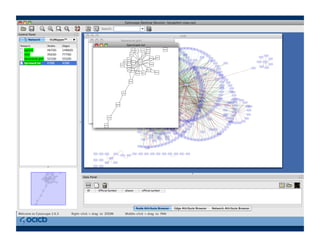
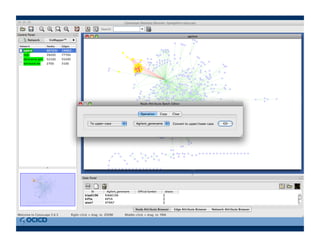
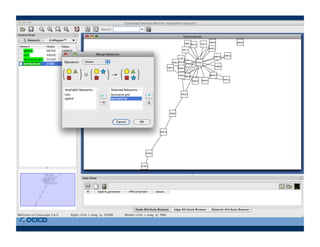
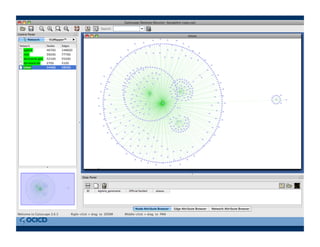
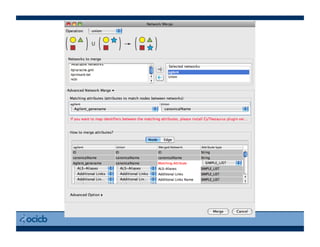
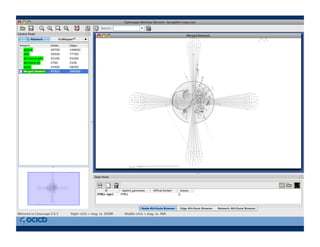
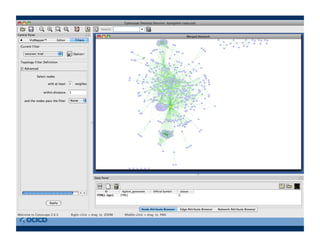
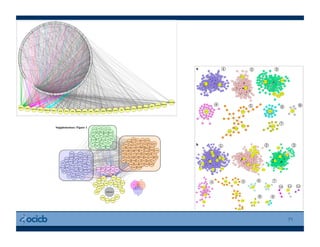
    Data  VisualizaEon,  IntegraEon,  Analysis   •  Import  ARACNE  predicted  network   •  Import  VisANT  retrieved  network   •  Merge  all  networks   •  Mo)f  finding  
  • 70.
  • 71.
  • 72.