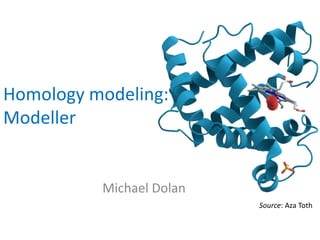
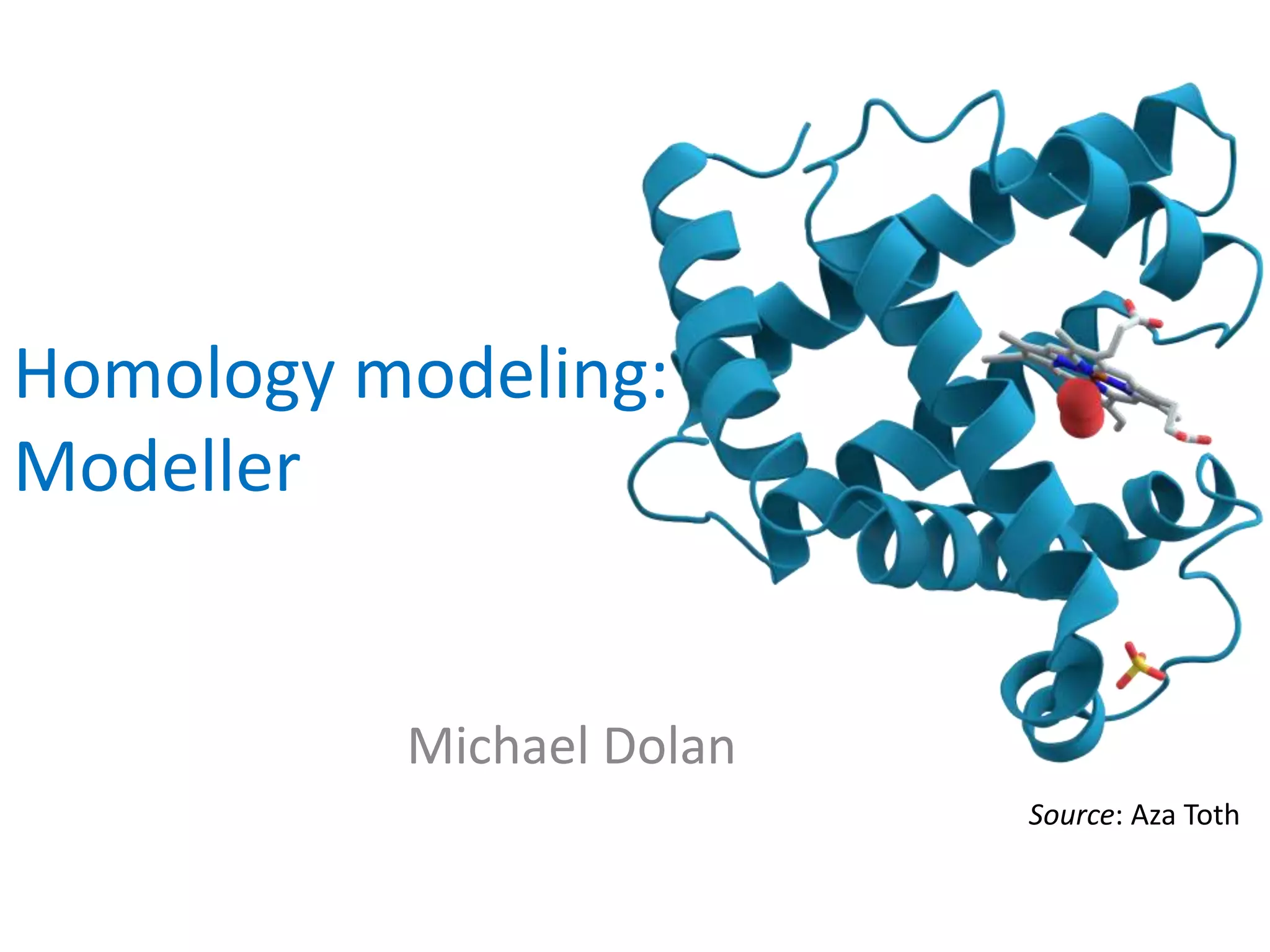
Homology modeling:
Modeller
Michael Dolan
Source: Aza Toth
What is “molecular modeling?”
• a technique for deriving, representing and manipulating the
structures and reactions of molecules, and those properties
that are dependent on these three dimensional structures
• Drug design
• Protein homology (or comparative) modeling
• Nucleic acid 2º or 3º structure
• Protein folding/threading
• Molecular dynamics
• Measurements
protein-centric
Experimental protein structure
prediction methods
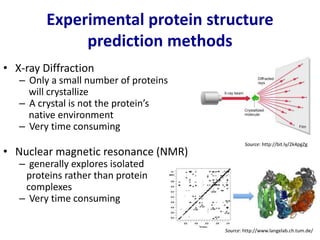
• X-ray Diffraction
– Only a small number of proteins
will crystallize
– A crystal is not the protein’s
native environment
– Very time consuming
• Nuclear magnetic resonance (NMR)
– generally explores isolated
proteins rather than protein
complexes
– Very time consuming
Source: http://bit.ly/2k4pgZg
Source: http://www.langelab.ch.tum.de/
Why the need for
computational protein
structure prediction?
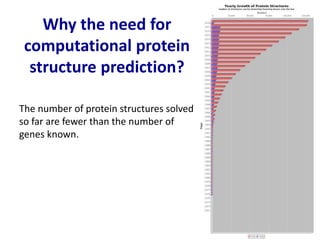
The number of protein structures solved
so far are fewer than the number of
genes known.
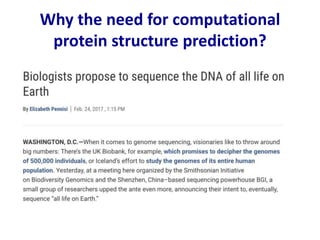
Why the need for computational
protein structure prediction?
Why the need for computational
protein structure prediction?
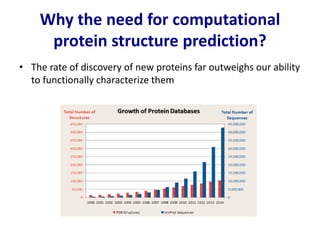
• The rate of discovery of new proteins far outweighs our ability
to functionally characterize them
Why the need for computational
protein structure prediction?
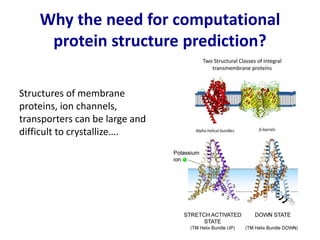
Structures of membrane
proteins, ion channels,
transporters can be large and
difficult to crystallize….
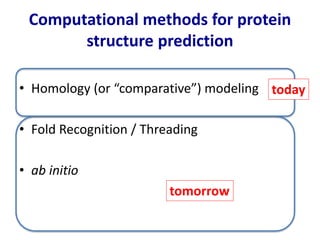
Computational methods for protein
structure prediction
• Homology (or “comparative”) modeling
• Fold Recognition / Threading
• ab initio
today
tomorrow
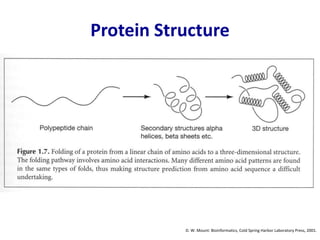
Protein Structure
D. W. Mount: Bioinformatics, Cold Spring Harbor Laboratory Press, 2001.
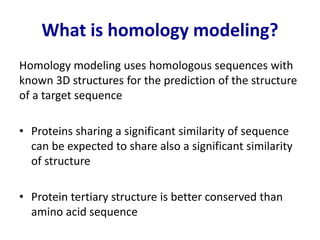
What is homology modeling?
Homology modeling uses homologous sequences with
known 3D structures for the prediction of the structure
of a target sequence
• Proteins sharing a significant similarity of sequence
can be expected to share also a significant similarity
of structure
• Protein tertiary structure is better conserved than
amino acid sequence
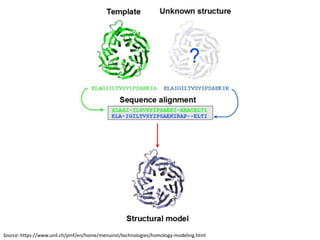
Source: https://www.unil.ch/pmf/en/home/menuinst/technologies/homology-modeling.html
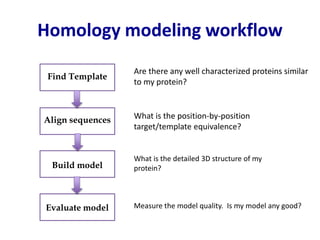
Homology modeling workflow
Find Template
Align sequences
Build model
Evaluate model
Are there any well characterized proteins similar
to my protein?
What is the position-by-position
target/template equivalence?
What is the detailed 3D structure of my
protein?
Measure the model quality. Is my model any good?
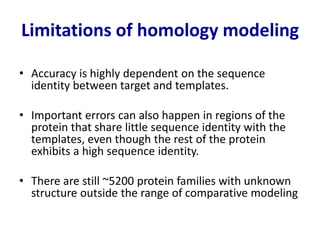
Limitations of homology modeling
• Accuracy is highly dependent on the sequence
identity between target and templates.
• Important errors can also happen in regions of the
protein that share little sequence identity with the
templates, even though the rest of the protein
exhibits a high sequence identity.
• There are still ~5200 protein families with unknown
structure outside the range of comparative modeling
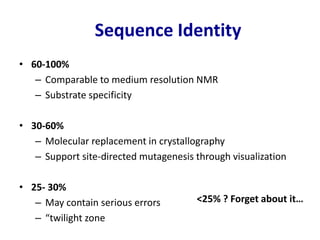
Sequence Identity
• 60-100%
– Comparable to medium resolution NMR
– Substrate specificity
• 30-60%
– Molecular replacement in crystallography
– Support site-directed mutagenesis through visualization
• 25- 30%
– May contain serious errors
– “twilight zone
<25% ? Forget about it…
I-TASSER
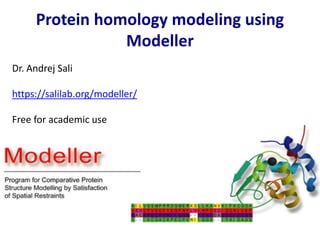
Protein homology modeling using
Modeller
Dr. Andrej Sali
https://salilab.org/modeller/
Free for academic use
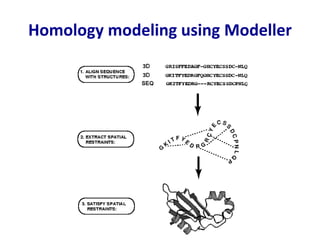
Homology modeling using Modeller
• Input:
– Alignment between target & template
– Known protein structure of the template
• Output:
– Model for the target
Homology modeling using Modeller
Hands-on Activity: Homology modeling
using Modeller
• Tutorial files: https://shorturl.at/moCS0
• Modeling of Lottia pelta malate
dehydrogenase Modeller using Chimera web
service
• Modeling of S. aureus tyrosine phosphatase
with Modeller using standalone program

Homology modeling: Modeller

  • 1.
  • 2.
    What is “molecularmodeling?” • a technique for deriving, representing and manipulating the structures and reactions of molecules, and those properties that are dependent on these three dimensional structures • Drug design • Protein homology (or comparative) modeling • Nucleic acid 2º or 3º structure • Protein folding/threading • Molecular dynamics • Measurements protein-centric
  • 3.
    Experimental protein structure predictionmethods • X-ray Diffraction – Only a small number of proteins will crystallize – A crystal is not the protein’s native environment – Very time consuming • Nuclear magnetic resonance (NMR) – generally explores isolated proteins rather than protein complexes – Very time consuming Source: http://bit.ly/2k4pgZg Source: http://www.langelab.ch.tum.de/
  • 4.
    Why the needfor computational protein structure prediction? The number of protein structures solved so far are fewer than the number of genes known.
  • 5.
    Why the needfor computational protein structure prediction?
  • 6.
    Why the needfor computational protein structure prediction? • The rate of discovery of new proteins far outweighs our ability to functionally characterize them
  • 7.
    Why the needfor computational protein structure prediction? Structures of membrane proteins, ion channels, transporters can be large and difficult to crystallize….
  • 8.
    Computational methods forprotein structure prediction • Homology (or “comparative”) modeling • Fold Recognition / Threading • ab initio today tomorrow
  • 9.
    Protein Structure D. W.Mount: Bioinformatics, Cold Spring Harbor Laboratory Press, 2001.
  • 10.
    What is homologymodeling? Homology modeling uses homologous sequences with known 3D structures for the prediction of the structure of a target sequence • Proteins sharing a significant similarity of sequence can be expected to share also a significant similarity of structure • Protein tertiary structure is better conserved than amino acid sequence
  • 11.
  • 12.
    Homology modeling workflow FindTemplate Align sequences Build model Evaluate model Are there any well characterized proteins similar to my protein? What is the position-by-position target/template equivalence? What is the detailed 3D structure of my protein? Measure the model quality. Is my model any good?
  • 13.
    Limitations of homologymodeling • Accuracy is highly dependent on the sequence identity between target and templates. • Important errors can also happen in regions of the protein that share little sequence identity with the templates, even though the rest of the protein exhibits a high sequence identity. • There are still ~5200 protein families with unknown structure outside the range of comparative modeling
  • 14.
    Sequence Identity • 60-100% –Comparable to medium resolution NMR – Substrate specificity • 30-60% – Molecular replacement in crystallography – Support site-directed mutagenesis through visualization • 25- 30% – May contain serious errors – “twilight zone <25% ? Forget about it…
  • 15.
  • 16.
    Protein homology modelingusing Modeller Dr. Andrej Sali https://salilab.org/modeller/ Free for academic use
  • 17.
    Homology modeling usingModeller • Input: – Alignment between target & template – Known protein structure of the template • Output: – Model for the target
  • 18.
  • 19.
    Hands-on Activity: Homologymodeling using Modeller • Tutorial files: https://shorturl.at/moCS0 • Modeling of Lottia pelta malate dehydrogenase Modeller using Chimera web service • Modeling of S. aureus tyrosine phosphatase with Modeller using standalone program