1) Systems Biology
2) Pathway and Network
Assignment Presentation By -
Pinakkumar Patel
04-AGRPH-02657-2022
Content
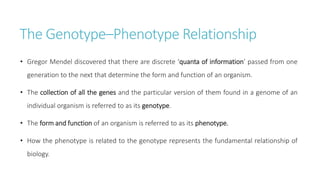
1. The Genotype–Phenotype Relationship
2. Historical background in the development of systems biology
3. What Is System biology?
4. Biological Networks
5. Benefits of Studying Pathway and Network Analysis
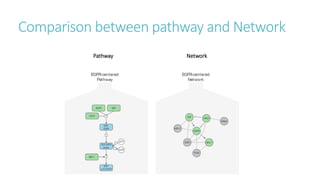
6. Comparison between pathway and Network
7. Types of Network and Pathway Analysis
8. Network visualization
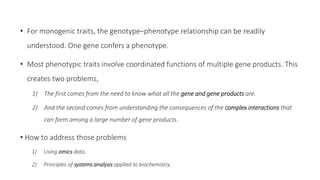
The Genotype–Phenotype Relationship
• Gregor Mendel discovered that there are discrete ‘quanta of information’ passed from one
generation to the next that determine the form and function of an organism.
• The collection of all the genes and the particular version of them found in a genome of an
individual organism is referred to as its genotype.
• The form and function of an organism is referred to as its phenotype.
• How the phenotype is related to the genotype represents the fundamental relationship of
biology.
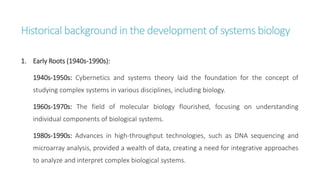
• For monogenic traits, the genotype–phenotype relationship can be readily
understood. One gene confers a phenotype.
• Most phenotypic traits involve coordinated functions of multiple gene products. This
creates two problems,
1) The first comes from the need to know what all the gene and gene products are.
2) And the second comes from understanding the consequences of the complex interactions that
can form among a large number of gene products.
• How to address those problems
1) Using omics data.
2) Principles of systems analysis applied to biochemistry.
Historical background in the development of systems biology
1. Early Roots (1940s-1990s):
1940s-1950s: Cybernetics and systems theory laid the foundation for the concept of
studying complex systems in various disciplines, including biology.
1960s-1970s: The field of molecular biology flourished, focusing on understanding
individual components of biological systems.
1980s-1990s: Advances in high-throughput technologies, such as DNA sequencing and
microarray analysis, provided a wealth of data, creating a need for integrative approaches
to analyze and interpret complex biological systems.
2. Rise of Systems Biology (1990s-2000s):
1992: Hiroaki Kitano proposed the concept of "Systems Biology" to study biological
systems as an integrated whole, combining experimental and computational
approaches.
Late 1990s: The field began to take shape with the development of mathematical
models, computational algorithms, and experimental techniques to study complex
biological networks.
2000: The Institute for Systems Biology (ISB) was founded by Leroy Hood,
pioneering the application of systems biology approaches to human health and
disease.
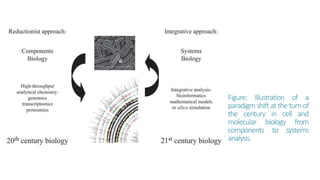
Figure: Illustration of a
paradigm shift at the turn of
the century in cell and
molecular biology from
components to systems
analysis.
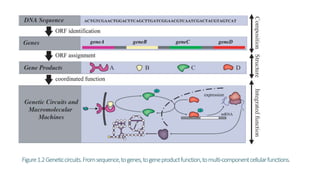
Figure1.2Geneticcircuits.Fromsequence,togenes,togeneproductfunction,tomulti-componentcellularfunctions.
What Is System biology?
• Systems biology is an interdisciplinary field of science that aims to
understand biological systems as complex networks of interacting
components. It combines experimental and computational approaches to
analyze and model biological processes at multiple scales, from molecular
and cellular levels to organismal and ecological levels.
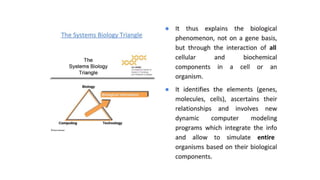
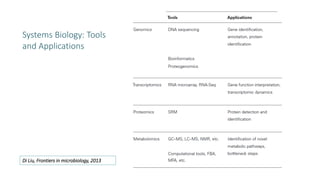
Systems Biology: Tools
and Applications
Di Liu, Frontiers in microbiology, 2013
Principle Steps
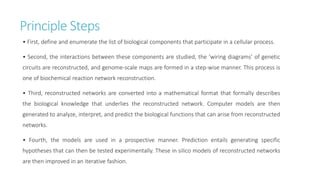
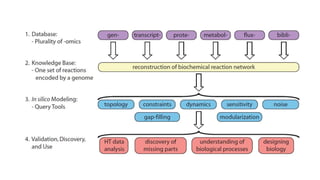
• First, define and enumerate the list of biological components that participate in a cellular process.
• Second, the interactions between these components are studied, the ‘wiring diagrams’ of genetic
circuits are reconstructed, and genome-scale maps are formed in a step-wise manner. This process is
one of biochemical reaction network reconstruction.
• Third, reconstructed networks are converted into a mathematical format that formally describes
the biological knowledge that underlies the reconstructed network. Computer models are then
generated to analyze, interpret, and predict the biological functions that can arise from reconstructed
networks.
• Fourth, the models are used in a prospective manner. Prediction entails generating specific
hypotheses that can then be tested experimentally. These in silico models of reconstructed networks
are then improved in an iterative fashion.
Biological Networks
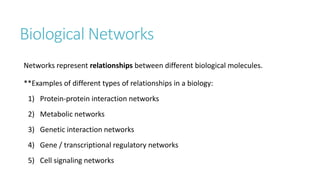
Networks represent relationships between different biological molecules.
**Examples of different types of relationships in a biology:
1) Protein-protein interaction networks
2) Metabolic networks
3) Genetic interaction networks
4) Gene / transcriptional regulatory networks
5) Cell signaling networks
Benefits of Studying Pathway and
Network Analysis
1- Improve the statistical power.
2- Results concepts are easier to interpret.
3- Potential causal mechanisms can be identified.
4- More reproducible.
5- Facilitate the integration of multiple data types.
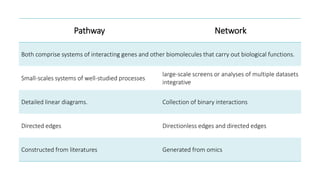
Comparison between pathway and Network
Pathway Network
Pathway Network
Both comprise systems of interacting genes and other biomolecules that carry out biological functions.
Small-scales systems of well-studied processes
large-scale screens or analyses of multiple datasets
integrative
Detailed linear diagrams. Collection of binary interactions
Directed edges Directionless edges and directed edges
Constructed from literatures Generated from omics
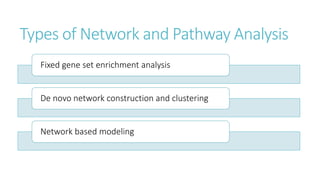
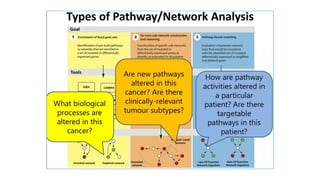
Types of Network and Pathway Analysis
Fixed gene set enrichment analysis
De novo network construction and clustering
Network based modeling
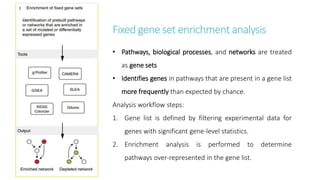
Fixed gene set enrichment analysis
• Pathways, biological processes, and networks are treated
as gene sets
• Identifies genes in pathways that are present in a gene list
more frequently than expected by chance.
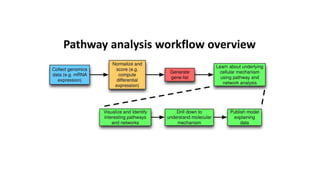
Analysis workflow steps:
1. Gene list is defined by filtering experimental data for
genes with significant gene-level statistics.
2. Enrichment analysis is performed to determine
pathways over-represented in the gene list.
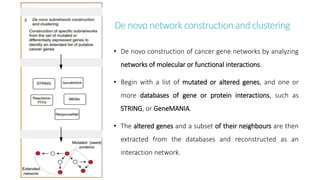
De novo networkconstructionandclustering
• De novo construction of cancer gene networks by analyzing
networks of molecular or functional interactions.
• Begin with a list of mutated or altered genes, and one or
more databases of gene or protein interactions, such as
STRING, or GeneMANIA.
• The altered genes and a subset of their neighbours are then
extracted from the databases and reconstructed as an
interaction network.
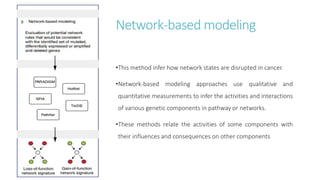
Network-based modeling
•This method infer how network states are disrupted in cancer.
•Network-based modeling approaches use qualitative and
quantitative measurements to infer the activities and interactions
of various genetic components in pathway or networks.
•These methods relate the activities of some components with
their influences and consequences on other components
Network visualization
Nodes in a network:
• Gene
• Protein
• Micro RNA
• Microorganism
• Disease
Edges in a network (interaction):
• Physical protein interaction
• Genetic interaction
• Signaling interaction
• Metabolic interaction
• DNA binding
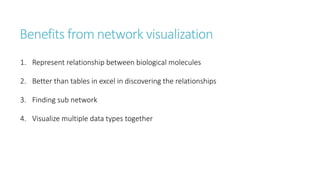
Benefits from network visualization
1. Represent relationship between biological molecules
2. Better than tables in excel in discovering the relationships
3. Finding sub network
4. Visualize multiple data types together
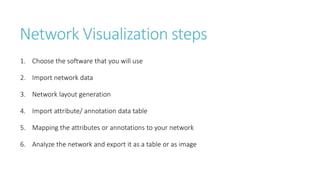
Network Visualization steps
1. Choose the software that you will use
2. Import network data
3. Network layout generation
4. Import attribute/ annotation data table
5. Mapping the attributes or annotations to your network
6. Analyze the network and export it as a table or as image
Software to create and analyze network
Import the network data
Data can be loaded from different sources in different formats depends on your
biological question :
1) Public databases ( String, Wikipathways,…etc)
2) Local or remote file
3) Software apps like (Biopax, KEGG,…etc) in Cytoscape.
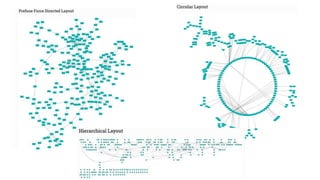
Network Layout Generation
• Layouts determine the location of nods and sometimes the path of edges
• Use the layout to convey the relationships between the nodes
Types of layouts:
• Simple (Grid, Partition)
• Hierarchical : layout data as a tree or hierarchy
• Circular (radial ) : arrange nodes around a circle , use the node attributes to
govern position
• Force directed
Thank You

System Biology and Pathway Network.pptx

  • 1.
    1) Systems Biology 2)Pathway and Network Assignment Presentation By - Pinakkumar Patel 04-AGRPH-02657-2022
  • 2.
    Content 1. The Genotype–PhenotypeRelationship 2. Historical background in the development of systems biology 3. What Is System biology? 4. Biological Networks 5. Benefits of Studying Pathway and Network Analysis 6. Comparison between pathway and Network 7. Types of Network and Pathway Analysis 8. Network visualization
  • 3.
    The Genotype–Phenotype Relationship •Gregor Mendel discovered that there are discrete ‘quanta of information’ passed from one generation to the next that determine the form and function of an organism. • The collection of all the genes and the particular version of them found in a genome of an individual organism is referred to as its genotype. • The form and function of an organism is referred to as its phenotype. • How the phenotype is related to the genotype represents the fundamental relationship of biology.
  • 4.
    • For monogenictraits, the genotype–phenotype relationship can be readily understood. One gene confers a phenotype. • Most phenotypic traits involve coordinated functions of multiple gene products. This creates two problems, 1) The first comes from the need to know what all the gene and gene products are. 2) And the second comes from understanding the consequences of the complex interactions that can form among a large number of gene products. • How to address those problems 1) Using omics data. 2) Principles of systems analysis applied to biochemistry.
  • 5.
    Historical background inthe development of systems biology 1. Early Roots (1940s-1990s): 1940s-1950s: Cybernetics and systems theory laid the foundation for the concept of studying complex systems in various disciplines, including biology. 1960s-1970s: The field of molecular biology flourished, focusing on understanding individual components of biological systems. 1980s-1990s: Advances in high-throughput technologies, such as DNA sequencing and microarray analysis, provided a wealth of data, creating a need for integrative approaches to analyze and interpret complex biological systems.
  • 6.
    2. Rise ofSystems Biology (1990s-2000s): 1992: Hiroaki Kitano proposed the concept of "Systems Biology" to study biological systems as an integrated whole, combining experimental and computational approaches. Late 1990s: The field began to take shape with the development of mathematical models, computational algorithms, and experimental techniques to study complex biological networks. 2000: The Institute for Systems Biology (ISB) was founded by Leroy Hood, pioneering the application of systems biology approaches to human health and disease.
  • 7.
    Figure: Illustration ofa paradigm shift at the turn of the century in cell and molecular biology from components to systems analysis.
  • 8.
  • 9.
    What Is Systembiology? • Systems biology is an interdisciplinary field of science that aims to understand biological systems as complex networks of interacting components. It combines experimental and computational approaches to analyze and model biological processes at multiple scales, from molecular and cellular levels to organismal and ecological levels.
  • 11.
    Systems Biology: Tools andApplications Di Liu, Frontiers in microbiology, 2013
  • 12.
    Principle Steps • First,define and enumerate the list of biological components that participate in a cellular process. • Second, the interactions between these components are studied, the ‘wiring diagrams’ of genetic circuits are reconstructed, and genome-scale maps are formed in a step-wise manner. This process is one of biochemical reaction network reconstruction. • Third, reconstructed networks are converted into a mathematical format that formally describes the biological knowledge that underlies the reconstructed network. Computer models are then generated to analyze, interpret, and predict the biological functions that can arise from reconstructed networks. • Fourth, the models are used in a prospective manner. Prediction entails generating specific hypotheses that can then be tested experimentally. These in silico models of reconstructed networks are then improved in an iterative fashion.
  • 14.
    Biological Networks Networks representrelationships between different biological molecules. **Examples of different types of relationships in a biology: 1) Protein-protein interaction networks 2) Metabolic networks 3) Genetic interaction networks 4) Gene / transcriptional regulatory networks 5) Cell signaling networks
  • 15.
    Benefits of StudyingPathway and Network Analysis 1- Improve the statistical power. 2- Results concepts are easier to interpret. 3- Potential causal mechanisms can be identified. 4- More reproducible. 5- Facilitate the integration of multiple data types.
  • 16.
    Comparison between pathwayand Network Pathway Network
  • 17.
    Pathway Network Both comprisesystems of interacting genes and other biomolecules that carry out biological functions. Small-scales systems of well-studied processes large-scale screens or analyses of multiple datasets integrative Detailed linear diagrams. Collection of binary interactions Directed edges Directionless edges and directed edges Constructed from literatures Generated from omics
  • 18.
    Types of Networkand Pathway Analysis Fixed gene set enrichment analysis De novo network construction and clustering Network based modeling
  • 19.
    Fixed gene setenrichment analysis • Pathways, biological processes, and networks are treated as gene sets • Identifies genes in pathways that are present in a gene list more frequently than expected by chance. Analysis workflow steps: 1. Gene list is defined by filtering experimental data for genes with significant gene-level statistics. 2. Enrichment analysis is performed to determine pathways over-represented in the gene list.
  • 20.
    De novo networkconstructionandclustering •De novo construction of cancer gene networks by analyzing networks of molecular or functional interactions. • Begin with a list of mutated or altered genes, and one or more databases of gene or protein interactions, such as STRING, or GeneMANIA. • The altered genes and a subset of their neighbours are then extracted from the databases and reconstructed as an interaction network.
  • 21.
    Network-based modeling •This methodinfer how network states are disrupted in cancer. •Network-based modeling approaches use qualitative and quantitative measurements to infer the activities and interactions of various genetic components in pathway or networks. •These methods relate the activities of some components with their influences and consequences on other components
  • 24.
    Network visualization Nodes ina network: • Gene • Protein • Micro RNA • Microorganism • Disease Edges in a network (interaction): • Physical protein interaction • Genetic interaction • Signaling interaction • Metabolic interaction • DNA binding
  • 25.
    Benefits from networkvisualization 1. Represent relationship between biological molecules 2. Better than tables in excel in discovering the relationships 3. Finding sub network 4. Visualize multiple data types together
  • 26.
    Network Visualization steps 1.Choose the software that you will use 2. Import network data 3. Network layout generation 4. Import attribute/ annotation data table 5. Mapping the attributes or annotations to your network 6. Analyze the network and export it as a table or as image
  • 27.
    Software to createand analyze network
  • 28.
    Import the networkdata Data can be loaded from different sources in different formats depends on your biological question : 1) Public databases ( String, Wikipathways,…etc) 2) Local or remote file 3) Software apps like (Biopax, KEGG,…etc) in Cytoscape.
  • 29.
    Network Layout Generation •Layouts determine the location of nods and sometimes the path of edges • Use the layout to convey the relationships between the nodes Types of layouts: • Simple (Grid, Partition) • Hierarchical : layout data as a tree or hierarchy • Circular (radial ) : arrange nodes around a circle , use the node attributes to govern position • Force directed
  • 31.