SYSTEMBIOLOGY AND ITS TOOLS
BY
GAURAVDIWAKAR
44820
Systems Biology Definition:
• A field that seeks to the study of relationships and
interactions between various parts of a biological
system (metabolic pathways, organelles, cells and
organisms) and to integrate this information to
understand how biological systems function.
• Systems biology is a relatively new biological study
field that focuses on the systematic study of complex
interactions in biological systems.
What is a biological network?
• Researchers are learning that biological
pathways are far more complicated than once
thought. Most pathways do not start at point A
and end at point B. In fact, many pathways
have no real boundaries, and they often work
together to accomplish tasks. When multiple
biological pathways interact with each other, it
is called a biological network.
Biology Networks
A network is a set of nodes and a set of directed or undirected
edgesbetween the nodes.
Transcriptional Regulatory Network:
• Gene are the nodes and edges are directed
Signal transduction network:
• Proteins are nodes and edges are directed
Metabolite network:
• Metabolite are nodes and edges are directed
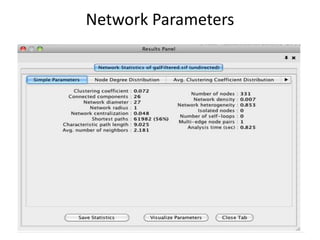
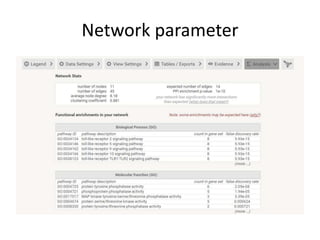
Parameter of Biological network
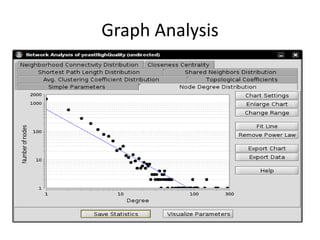
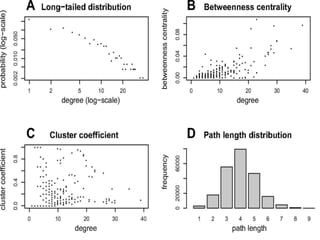
• Degree: the degree of a node in a network is
the number of connections it has to other
nodes
• Diameter: largest distance between any two
nodes in the network
• Average path length: Average distance
between any two nodesin the network
• Betweenness centrality: It is an indicator of a
node's centrality in a network. It is equal to
the number of shortest paths from all vertices
to all others that pass through that node.
• Clustering coefficient: A measure of the
degree to node which tend to cluster together
Database resources for System Biology
• Microarray gene expression database
• ArrayExpress (http://www.ebi.ac.uk/microarray-as/ae/)
• GEO (http://www.ncbi.nlm.nih.gov/geo/)
• CIBEX ( http://cibex.nig.ac.jp/index.jsp)
• Protein-protein interaction database
• BINDplus (Biomolecular Object Network Database)
http://www.thomsonreuters.com/products_services/scientific/BINDp
lus
• DIP(The Database of Interacting Proteins) http://dip.doe-
mbi.ucla.edu/dip/Main.cgi
• MINT(The Molecular INTeraction database)
http://mint.bio.uniroma2.it/mint/Welcome.do
• STRING(Search Tool for the Retrieval of Interacting
Genes/Proteins)
http://string.embl.de/
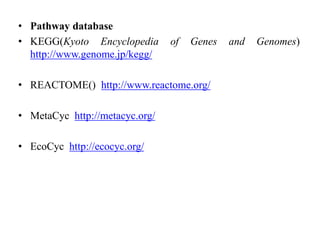
• Pathway database
• KEGG(Kyoto Encyclopedia of Genes and Genomes)
http://www.genome.jp/kegg/
• REACTOME() http://www.reactome.org/
• MetaCyc http://metacyc.org/
• EcoCyc http://ecocyc.org/
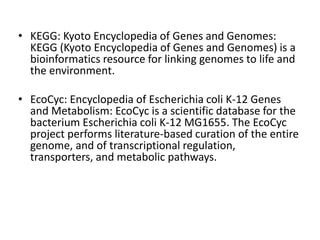
• KEGG: Kyoto Encyclopedia of Genes and Genomes:
KEGG (Kyoto Encyclopedia of Genes and Genomes) is a
bioinformatics resource for linking genomes to life and
the environment.
• EcoCyc: Encyclopedia of Escherichia coli K-12 Genes
and Metabolism: EcoCyc is a scientific database for the
bacterium Escherichia coli K-12 MG1655. The EcoCyc
project performs literature-based curation of the entire
genome, and of transcriptional regulation,
transporters, and metabolic pathways.
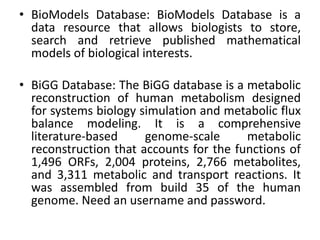
• BioModels Database: BioModels Database is a
data resource that allows biologists to store,
search and retrieve published mathematical
models of biological interests.
• BiGG Database: The BiGG database is a metabolic
reconstruction of human metabolism designed
for systems biology simulation and metabolic flux
balance modeling. It is a comprehensive
literature-based genome-scale metabolic
reconstruction that accounts for the functions of
1,496 ORFs, 2,004 proteins, 2,766 metabolites,
and 3,311 metabolic and transport reactions. It
was assembled from build 35 of the human
genome. Need an username and password.
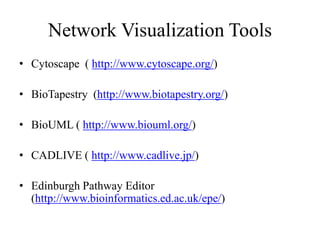
Network Visualization Tools
• Cytoscape ( http://www.cytoscape.org/)
• BioTapestry (http://www.biotapestry.org/)
• BioUML ( http://www.biouml.org/)
• CADLIVE ( http://www.cadlive.jp/)
• Edinburgh Pathway Editor
(http://www.bioinformatics.ed.ac.uk/epe/)
Modeling &Simulation tools
• CellDesigner http://www.celldesigner.org/
• Jarnac/JDesigner http://sbw.kgi.edu/
• COPASI http://www.copasi.org/
• E-Cell http://www.e-cell.org/
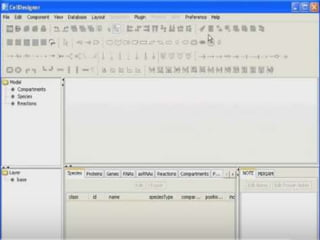
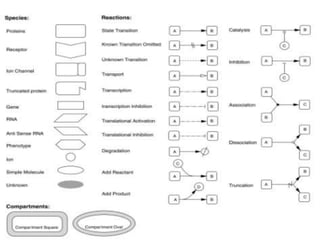
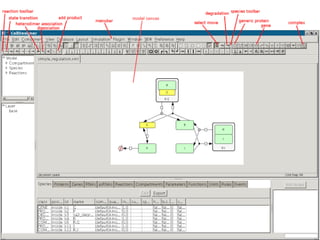
Cell Desginer
• CellDesigner is a structured diagram editor for
drawing gene-regulatory and biochemical
networks. Networks are drawn based on the
process diagram, with graphical notation
system proposed by Kitano, and are stored
using the Systems Biology Markup Language
(SBML).
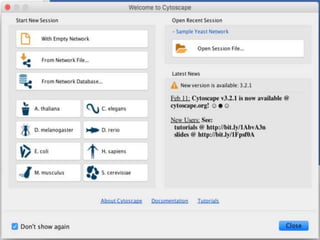
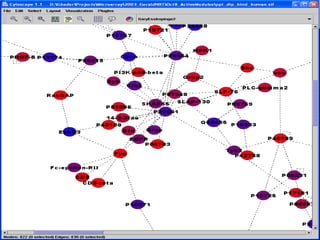
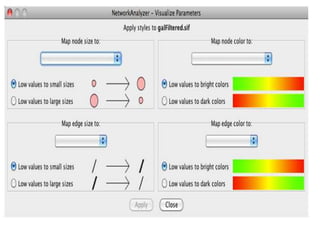
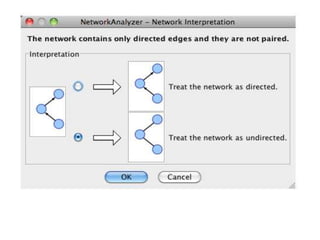
Cytoscape
• Cytoscape is an open source bioinformatics
software platform for visualizing molecular
interaction networks and integrating these
interactions with gene expression profiles and
other state data.
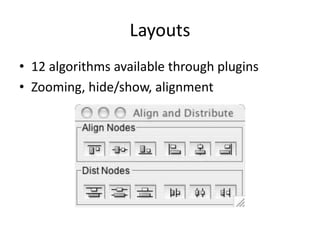
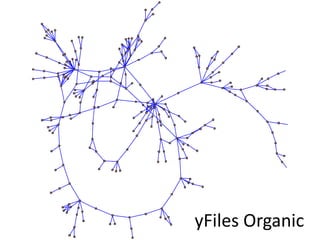
Layouts
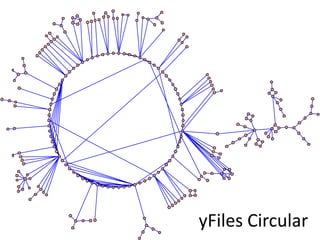
• 12 algorithms available through plugins
• Zooming, hide/show, alignment
yFiles Organic
yFiles Circular
Network Parameters
Graph Analysis
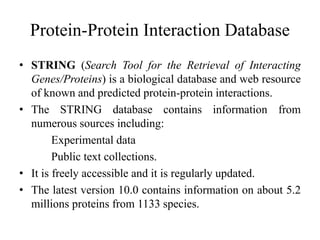
Protein-Protein Interaction Database
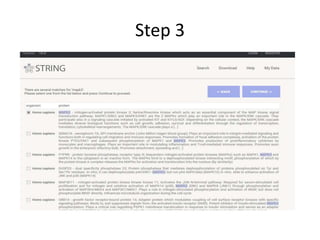
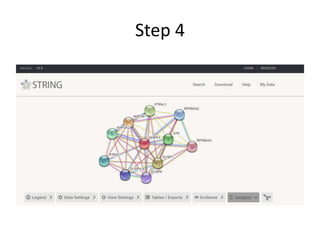
• STRING (Search Tool for the Retrieval of Interacting
Genes/Proteins) is a biological database and web resource
of known and predicted protein-protein interactions.
• The STRING database contains information from
numerous sources including:
Experimental data
Public text collections.
• It is freely accessible and it is regularly updated.
• The latest version 10.0 contains information on about 5.2
millions proteins from 1133 species.
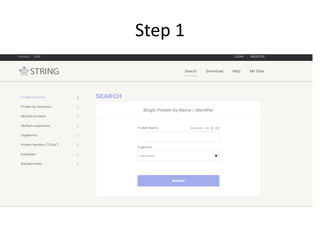
Step 1
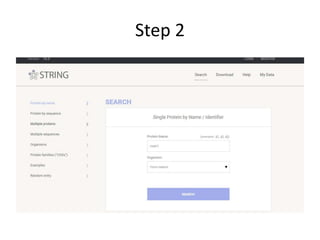
Step 2
Step 3
Step 4
Network parameter
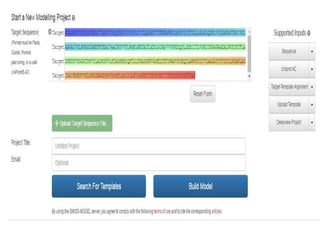
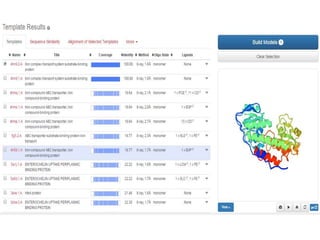
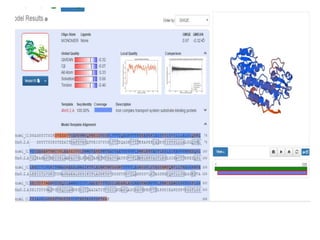
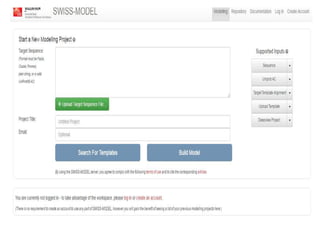
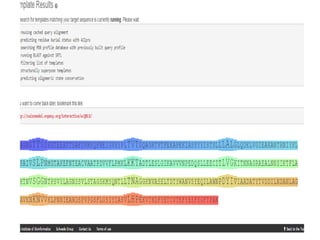
SWISS MODEL
• SWISS-MODEL is a fully automated protein
structure homology-modelling server,
accessible via the ExPASy web server, or from
the program DeepView (Swiss Pdb-Viewer).
The purpose of this server is to make Protein
Modelling accessible to all biochemists and
molecular biologists worldwide.
• https://swissmodel.expasy.org
APPLICATION OF SYSTEM BIOLOGY
• System biology in Crop improvement
• System biology in drug discovery
• Network biology
• Topological analysis of Biological network
THANK YOU

System biology and its tools

  • 1.
    SYSTEMBIOLOGY AND ITSTOOLS BY GAURAVDIWAKAR 44820
  • 2.
    Systems Biology Definition: •A field that seeks to the study of relationships and interactions between various parts of a biological system (metabolic pathways, organelles, cells and organisms) and to integrate this information to understand how biological systems function. • Systems biology is a relatively new biological study field that focuses on the systematic study of complex interactions in biological systems.
  • 3.
    What is abiological network? • Researchers are learning that biological pathways are far more complicated than once thought. Most pathways do not start at point A and end at point B. In fact, many pathways have no real boundaries, and they often work together to accomplish tasks. When multiple biological pathways interact with each other, it is called a biological network.
  • 4.
    Biology Networks A networkis a set of nodes and a set of directed or undirected edgesbetween the nodes. Transcriptional Regulatory Network: • Gene are the nodes and edges are directed Signal transduction network: • Proteins are nodes and edges are directed Metabolite network: • Metabolite are nodes and edges are directed
  • 5.
    Parameter of Biologicalnetwork • Degree: the degree of a node in a network is the number of connections it has to other nodes • Diameter: largest distance between any two nodes in the network • Average path length: Average distance between any two nodesin the network
  • 6.
    • Betweenness centrality:It is an indicator of a node's centrality in a network. It is equal to the number of shortest paths from all vertices to all others that pass through that node. • Clustering coefficient: A measure of the degree to node which tend to cluster together
  • 7.
    Database resources forSystem Biology • Microarray gene expression database • ArrayExpress (http://www.ebi.ac.uk/microarray-as/ae/) • GEO (http://www.ncbi.nlm.nih.gov/geo/) • CIBEX ( http://cibex.nig.ac.jp/index.jsp)
  • 8.
    • Protein-protein interactiondatabase • BINDplus (Biomolecular Object Network Database) http://www.thomsonreuters.com/products_services/scientific/BINDp lus • DIP(The Database of Interacting Proteins) http://dip.doe- mbi.ucla.edu/dip/Main.cgi • MINT(The Molecular INTeraction database) http://mint.bio.uniroma2.it/mint/Welcome.do • STRING(Search Tool for the Retrieval of Interacting Genes/Proteins) http://string.embl.de/
  • 9.
    • Pathway database •KEGG(Kyoto Encyclopedia of Genes and Genomes) http://www.genome.jp/kegg/ • REACTOME() http://www.reactome.org/ • MetaCyc http://metacyc.org/ • EcoCyc http://ecocyc.org/
  • 10.
    • KEGG: KyotoEncyclopedia of Genes and Genomes: KEGG (Kyoto Encyclopedia of Genes and Genomes) is a bioinformatics resource for linking genomes to life and the environment. • EcoCyc: Encyclopedia of Escherichia coli K-12 Genes and Metabolism: EcoCyc is a scientific database for the bacterium Escherichia coli K-12 MG1655. The EcoCyc project performs literature-based curation of the entire genome, and of transcriptional regulation, transporters, and metabolic pathways.
  • 11.
    • BioModels Database:BioModels Database is a data resource that allows biologists to store, search and retrieve published mathematical models of biological interests. • BiGG Database: The BiGG database is a metabolic reconstruction of human metabolism designed for systems biology simulation and metabolic flux balance modeling. It is a comprehensive literature-based genome-scale metabolic reconstruction that accounts for the functions of 1,496 ORFs, 2,004 proteins, 2,766 metabolites, and 3,311 metabolic and transport reactions. It was assembled from build 35 of the human genome. Need an username and password.
  • 12.
    Network Visualization Tools •Cytoscape ( http://www.cytoscape.org/) • BioTapestry (http://www.biotapestry.org/) • BioUML ( http://www.biouml.org/) • CADLIVE ( http://www.cadlive.jp/) • Edinburgh Pathway Editor (http://www.bioinformatics.ed.ac.uk/epe/)
  • 13.
    Modeling &Simulation tools •CellDesigner http://www.celldesigner.org/ • Jarnac/JDesigner http://sbw.kgi.edu/ • COPASI http://www.copasi.org/ • E-Cell http://www.e-cell.org/
  • 14.
    Cell Desginer • CellDesigneris a structured diagram editor for drawing gene-regulatory and biochemical networks. Networks are drawn based on the process diagram, with graphical notation system proposed by Kitano, and are stored using the Systems Biology Markup Language (SBML).
  • 19.
    Cytoscape • Cytoscape isan open source bioinformatics software platform for visualizing molecular interaction networks and integrating these interactions with gene expression profiles and other state data.
  • 23.
    Layouts • 12 algorithmsavailable through plugins • Zooming, hide/show, alignment
  • 24.
  • 25.
  • 27.
  • 28.
  • 30.
    Protein-Protein Interaction Database •STRING (Search Tool for the Retrieval of Interacting Genes/Proteins) is a biological database and web resource of known and predicted protein-protein interactions. • The STRING database contains information from numerous sources including: Experimental data Public text collections. • It is freely accessible and it is regularly updated. • The latest version 10.0 contains information on about 5.2 millions proteins from 1133 species.
  • 31.
  • 32.
  • 33.
  • 34.
  • 35.
  • 36.
    SWISS MODEL • SWISS-MODELis a fully automated protein structure homology-modelling server, accessible via the ExPASy web server, or from the program DeepView (Swiss Pdb-Viewer). The purpose of this server is to make Protein Modelling accessible to all biochemists and molecular biologists worldwide. • https://swissmodel.expasy.org
  • 42.
    APPLICATION OF SYSTEMBIOLOGY • System biology in Crop improvement • System biology in drug discovery • Network biology • Topological analysis of Biological network
  • 43.