
3/29/2010
1
CurveCurve‐‐Fitting with Fitting with GraphPadGraphPad PrismPrism
Presented by: Jeff Skinner, M.S.
Biostatistics Specialist
Bioinformatics and Computational Biosciences Branch
National Institute of Allergy and Infectious Diseases 
Office of Cyber Infrastructure and Computational Biology
GraphPad PRISM® at NIAID
• Free site license download• Free site license download
• Free training, consultation and 
support from BSIP ***
• Statistical results and help p
menus designed specifically for 
biological researchers 
• Intuitive curve‐fitting
*** Please contact:
ScienceApps@niaid.nih.gov
3/29/2010
2
NIAID Site License
http://graphpad.com/paasl/index.cfm?sitecode=NIHNIAID
http://bioinformatics.niaid.nih.gov/
Nonlinear Regression
• Statistical technique commonly used for  log dose s response
q y
curve‐fitting by biologists at NIAID
– Dose‐response studies
– Protein binding experiments
• Nonlinear regression is rarely studied in 
statistics coursework
Sometimes mentioned briefl in a regression
log-dose vs response
-10 -8 -6 -4 -2
-100
0
100
200
300
400
500
No inhibitor
Inhibitor
log[Dose]
Response
dose vs. response
– Sometimes mentioned briefly in a regression 
or linear models course
• Nonlinear regression is sometimes 
omitted from statistical software or 
poorly executed in software packages
0.0000 0.0001 0.0002 0.0003 0.0004
0
100
200
300
400
500
No inhibitor
Inhibitor
Dose
Response
3/29/2010
3
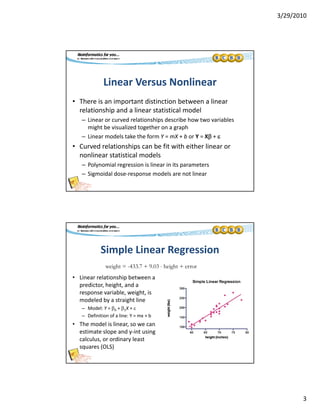
Linear Versus Nonlinear
• There is an important distinction between a linear 
relationship and a linear statistical model
– Linear or curved relationships describe how two variables 
might be visualized together on a graph
– Linear models take the form Y = mX + b or Y = X + 
C d l ti hi b fit ith ith li• Curved relationships can be fit with either linear or 
nonlinear statistical models
– Polynomial regression is linear in its parameters
– Sigmoidal dose‐response models are not linear
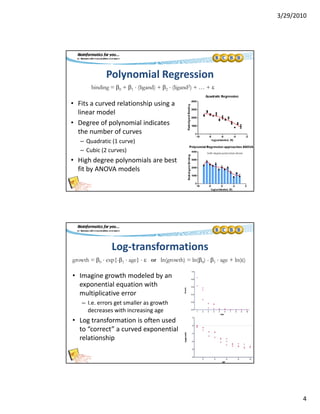
Simple Linear Regression
weight = -433.7 + 9.03  height + error
• Linear relationship between a 
predictor, height, and a 
response variable, weight, is 
modeled by a straight line
– Model: Y = 0 + 1X + 
– Definition of a line: Y = mx + b
g g
Definition of a line: Y = mx + b
• The model is linear, so we can 
estimate slope and y‐int using 
calculus, or ordinary least 
squares (OLS)
3/29/2010
4
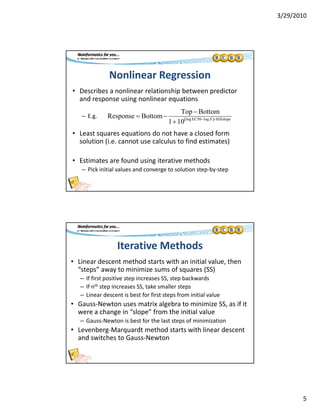
Polynomial Regression
binding = 0 + 1  (ligand) + 2  (ligand2) + … + 
• Fits a curved relationship using a 
linear model
• Degree of polynomial indicates 
the number of curves
– Quadratic (1 curve)
– Cubic (2 curves)
• High degree polynomials are best 
fit by ANOVA models
Log‐transformations
growth = 0  exp{-1  age}   or ln(growth) = ln(0) - 1  age + ln()
• Imagine growth modeled by an 
exponential equation with 
multiplicative error
– I.e. errors get smaller as growth 
decreases with increasing age
• Log transformation is often used 
to “correct” a curved exponential 
relationship
3/29/2010
5
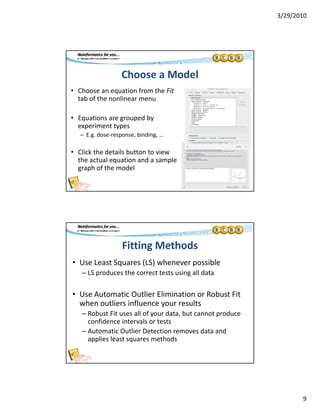
Nonlinear Regression
• Describes a nonlinear relationship between predictor 
d i li tiand response using nonlinear equations
– E.g. 
• Least squares equations do not have a closed form 
solution (i.e. cannot use calculus to find estimates)
Response  Bottom
Top  Bottom
110 log EC50logX Hillslope
( )
• Estimates are found using iterative methods
– Pick initial values and converge to solution step‐by‐step
Iterative Methods
• Linear descent method starts with an initial value, then 
“steps” away to minimize sums of squares (SS)steps  away to minimize sums of squares (SS)
– If first positive step increases SS, step backwards
– If nth step increases SS, take smaller steps
– Linear descent is best for first steps from initial value
• Gauss‐Newton uses matrix algebra to minimize SS, as if it 
were a change in “slope” from the initial value
– Gauss‐Newton is best for the last steps of minimization
• Levenberg‐Marquardt method starts with linear descent 
and switches to Gauss‐Newton
3/29/2010
6
Iterative Methods (continued)
• Strength of the iterative methods
– Can be used to fit any model
• Weaknesses of the iterative method
– Computationally slower than calculus method
– May find the local min, instead of global min
– May get “stuck” if model choice is poor 
Local vs. Global Minima
L l
msofSquares
Global
Minimum
Local
Minimum
Finding a local
minimum implies
you have not
found the best
possible fit
Hillslope
Sum
possible fit
3/29/2010
7
Dose‐Response Models
• Most commonly used model 
among NIAID researchers
log-dose vs response
500
• Up to five parameters
– TOP and BOTTOM
– Log(EC50)
– Hillslope (default = 1)
– Symmetry (default = 1)
-10 -8 -6 -4 -2
-100
0
100
200
300
400
500
No inhibitor
Inhibitor
log[Agonist], M
• Concepts presented for dose‐
response models will apply to all 
other nonlinear models Response  Bottom
Top  Bottom
110 logEC50logX Hillslope
Getting Started in PRISM
• Open a XY data table and 
enter data
• Transform and normalize 
data if necessary
• Open the nonlinear fit 
menu in PRISM
3/29/2010
8
Why Use log(X) For Sigmoid Dose Response?
• Raw X values produce a
dose vs. response
500
Raw X values produce a 
hyperbolic curve
– Large errors at the ascent
– Small errors at the plateau
• Log(X) values produce a  log dose vs response
0.0000 0.0001 0.0002 0.0003 0.0004
0
100
200
300
400
No inhibitor
Inhibitor
Dose
Response
sigmoid “esse” curve
– Moderate errors throughout
– Best estimates of EC50
log-dose vs response
-10 -8 -6 -4 -2
-100
0
100
200
300
400
500
No inhibitor
Inhibitor
log[Dose]
Response
Importance of Log Transform
3/29/2010
9
Choose a Model
• Choose an equation from the Fit
tab of the nonlinear mentab of the nonlinear menu
• Equations are grouped by 
experiment types
– E.g. dose‐response, binding, …
• Click the details button to view 
the actual equation and a sample 
graph of the model
Fitting Methods
• Use Least Squares (LS) whenever possible
– LS produces the correct tests using all data
• Use Automatic Outlier Elimination or Robust Fit 
when outliers influence your results
– Robust Fit uses all of your data, but cannot produce y , p
confidence intervals or tests
– Automatic Outlier Detection removes data and 
applies least squares methods
3/29/2010
10
Compare Groups or Models?
• Compare the fit of two different equations on 
the same data set(s)
– Compare dose‐response models with and without a 
variable slope parameter
– Compare different sets of constraints, etc.
• Compare best fit parameters between two or• Compare best fit parameters between two or 
more groups in your experiment
– E.g. Compare EC50 between 2 or more groups
F‐test or AIC?
• Use extra sums of squares F‐test whenever the 
i dtwo equations are nested:
– Dose‐response vs Dose‐Response (variable slope) is 
nested, because one equation is a simplification of 
the other equation
– Dose‐response versus binding equations is not 
nested because the equations are unrelatednested, because the equations are unrelated
– Comparing 2 or more groups is always nested
• Use AIC if you are unsure about nesting
3/29/2010
11
Statistical Output
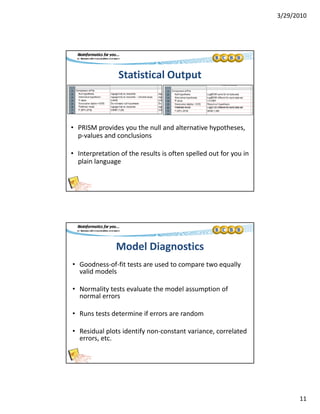
• PRISM provides you the null and alternative hypotheses, 
p‐values and conclusions
• Interpretation of the results is often spelled out for you in 
plain language
Model Diagnostics
• Goodness‐of‐fit tests are used to compare two equally 
lid d lvalid models
• Normality tests evaluate the model assumption of 
normal errors
• Runs tests determine if errors are random
• Residual plots identify non‐constant variance, correlated 
errors, etc.
3/29/2010
12
Goodness of Fit Tests
• Coefficient of determination (R2) is the percent of 
variation explained by the model
– Remember R2 is only meaningful if the model 
assumptions have been met
– Typically used to compare valid models
• Sums of squares (SS) and standard deviation of 
the residuals (sy.x) are more descriptive
– Bigger SS implies model is more informative
– Smaller sy.x implies model has smaller errors
Normality Tests
• D’Agostino‐Pearson Omnibus test
Tests the magnitude of skewness and kurtosis statistics to– Tests the magnitude of skewness and kurtosis statistics to 
determine if errors are normal
• Shapiro‐Wilk test
– Uses ranks to compare errors to normal distribution
• Kolmogorov‐Smirnov test     (historical use only)
– Tests the magnitude of the largest difference between two 
empirical cdf plots
3/29/2010
13
Runs Tests and Replicates Tests 
• Does the curve systematically 
diff f b d i t ?differ from observed points?
• Use replicates test for replicated 
curve‐fit data
– Compare error between points and 
curve to error among reps
• Use runs test for non‐replicated p
curve‐fit data
– Tests the largest “run” of points 
above or below the curve
Notice the largest run
of 3 points above the
curve suggests model
is incorrect
Residual Plots
• Residuals are the errors 
between points and curvebetween points and curve
• Want to find independent and 
identically distributed random 
normal errors
• Look for non‐random trends 
and non‐constant variance
3/29/2010
14
Improving Model Fit
• Change the initial values to aid convergence
• Limit the range of X or Y to eliminate outliers 
• Add constraints to force the model to meet certain 
criteria that improve model fit
– E.g. Bottom = 0%, Top = 100%, …
• Use a weighting scheme to combat non‐constant 
variance or emphasize parts of the curve
Initial Values and Range
• Change the initial values of the parameters, if the 
model does not converge
– Try the “Don’t Fit Curve” option on the diagnostics tab to find 
better initial values
• Select the range of X values used curve‐fit to eliminate 
outliers or invalid data pointsoutliers or invalid data points
• Select the range of the fitted curve to complete the 
graphs and figures, if necessary
3/29/2010
15
Model Constraints
• Add hard or soft constraints 
to a model parameter
– Bottom = 0
– Top ≤ 100 %
• Improve model fit if doses 
are poorly chosen, etc.
– Not enough low doses
– Doses too low for saturation
Weights
• Use 1 / SD2 weights for non‐constant variance
– Requires many replicates per X
• Use other weight schemes to apply unequal weights to 
one part of the curve
– Use 1 / Y2 for larger errors at the highest responses
– Use 1 / X to emphasize values on the left of the graph
3/29/2010
16
Summary
• Remember these same basic techniques can q
be applied to any nonlinear regression
• Contact ScienceApps@niaid.nih.gov for 
additional help if needed
• Additional PRISM training is available
– Statistical Applications in Prism – April 8th, 1‐3 pm

GraphPad Prism: Curve fitting