Bias Variance Trade-off in Machine Learning
Subject: Machine Learning
Dr. Varun Kumar
Subject: Machine Learning Dr. Varun Kumar Machine Learning 1 / 13
Outlines
1 Introduction to Under Fitting and Over Fitting
2 Introduction to Bias and Variance
3 Mathematical Intuition
4 Bias Variance Trade-off relation
5 References
Subject: Machine Learning Dr. Varun Kumar Machine Learning 2 / 13
Introduction to under fitting and over fitting and best fit
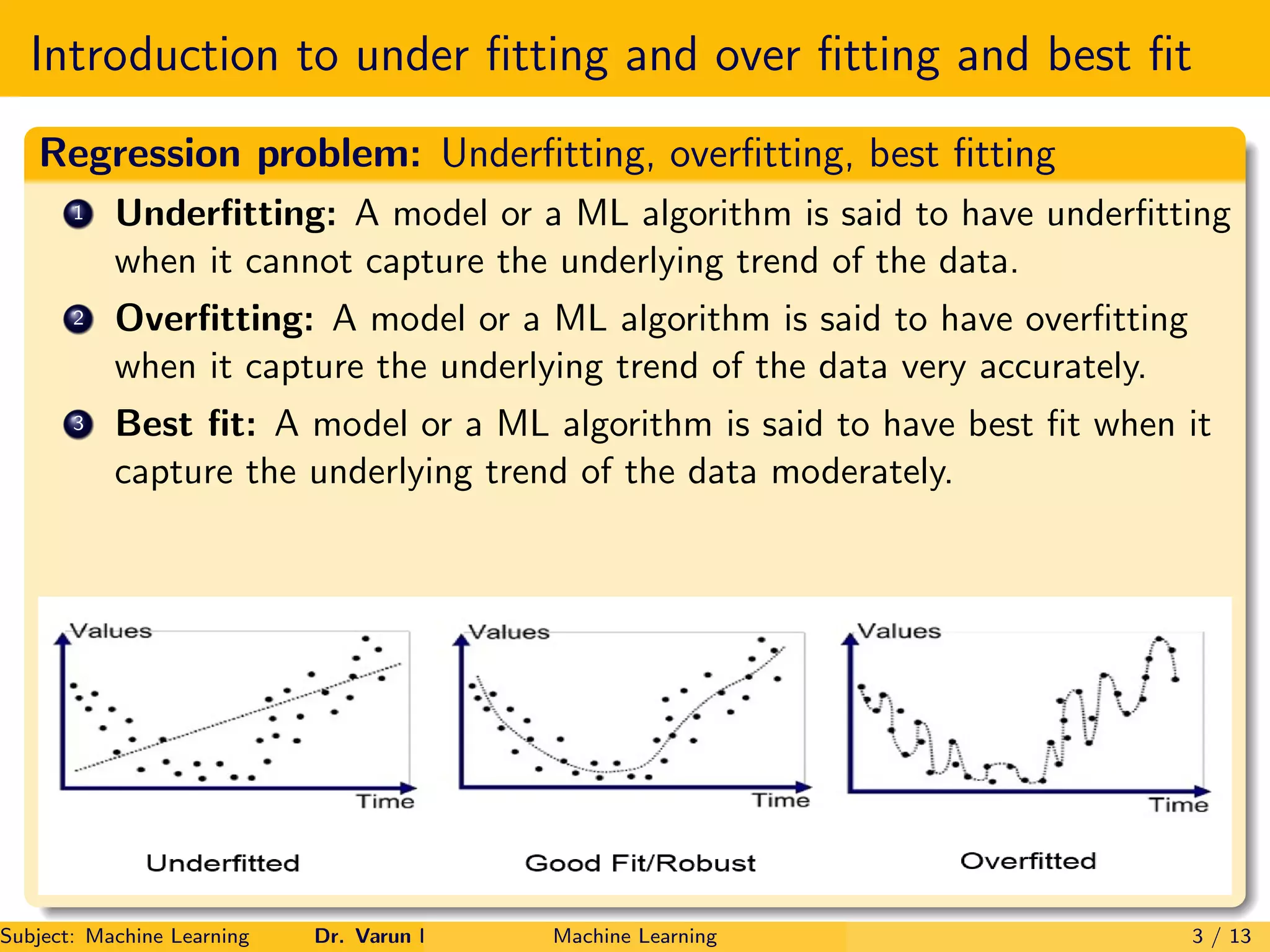
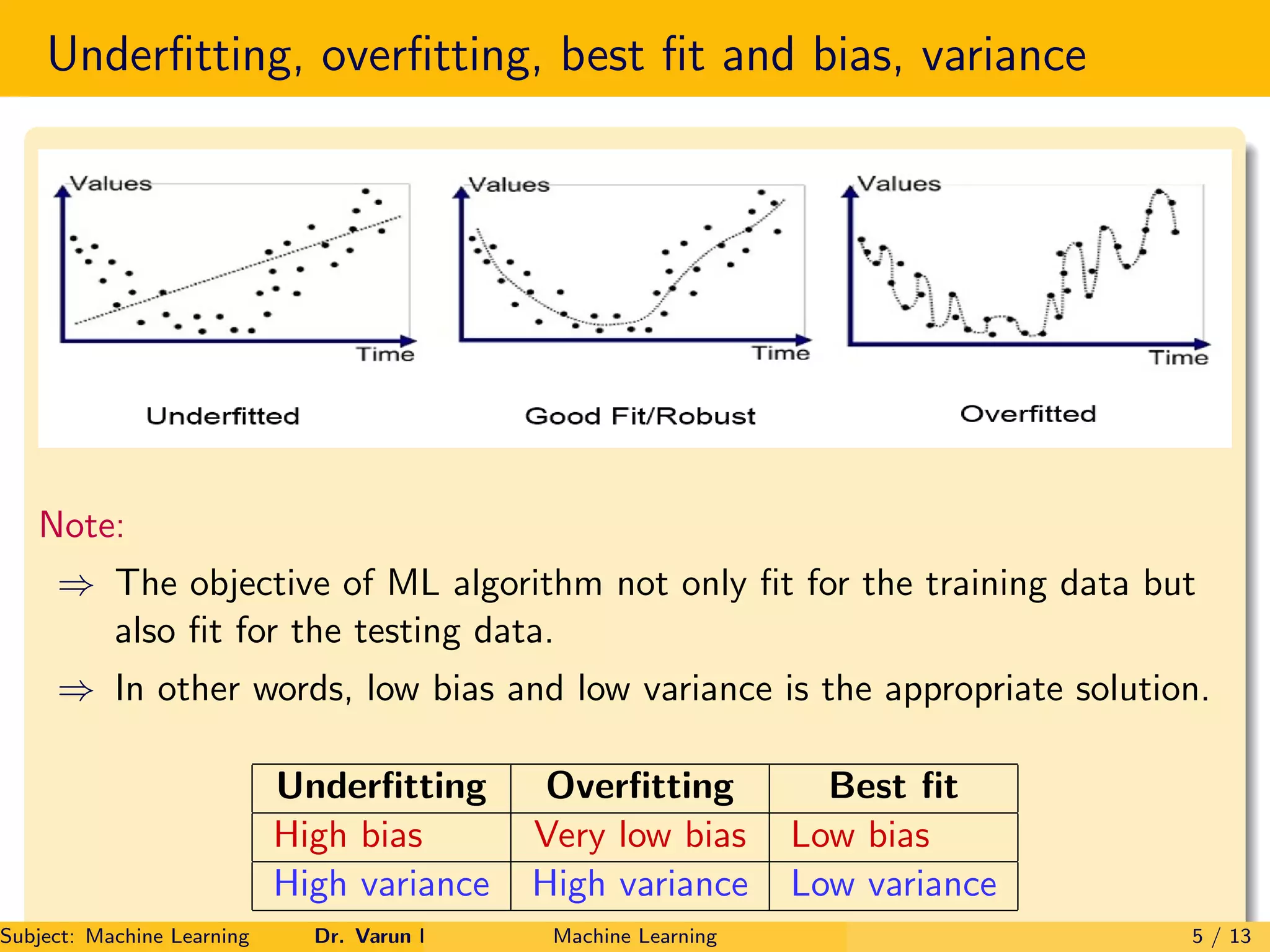
Regression problem: Underfitting, overfitting, best fitting
1 Underfitting: A model or a ML algorithm is said to have underfitting
when it cannot capture the underlying trend of the data.
2 Overfitting: A model or a ML algorithm is said to have overfitting
when it capture the underlying trend of the data very accurately.
3 Best fit: A model or a ML algorithm is said to have best fit when it
capture the underlying trend of the data moderately.
Subject: Machine Learning Dr. Varun Kumar Machine Learning 3 / 13
Bias and variance
1 Bias: It shows the degree of randomness of the training data.
(a) Based on the training data a suitable model may be created for the
regression or classification problem.
(b) Regression: Linear, logistic, polynomial
(c) Classification: Decision tree, random forest, naive baye’s, KNN, SVM
2 Variance: It shows the degree of randomness of the testing data.
(i) Testing data validates the accuracy of a model, that has been made
with the help of training data set.
(ii) Testing data is nothing but the unlabeled or unknown data.
Subject: Machine Learning Dr. Varun Kumar Machine Learning 4 / 13
Underfitting, overfitting, best fit and bias, variance
Note:
⇒ The objective of ML algorithm not only fit for the training data but
also fit for the testing data.
⇒ In other words, low bias and low variance is the appropriate solution.
Underfitting Overfitting Best fit
High bias Very low bias Low bias
High variance High variance Low variance
Subject: Machine Learning Dr. Varun Kumar Machine Learning 5 / 13
Underfitting, overfitting, and best fit in classification problem
A classifier (Decision tree, random forest, naive baye’s, KNN, SVM) works
on two types of data
Training data
Testing data
Example:
Classifier comes under the category of underfitting, overfitting, and best fit
based on its training and testing accuracy.
Underfitting Overfitting Best fit
Train error=25% Train error=1% Train error=8%
Test error= 27% Test error= 23% Test error=9%
Subject: Machine Learning Dr. Varun Kumar Machine Learning 6 / 13
Mathematical intuition
bias ˆ
f (x)

= E[ˆ
f (x)] − f (x) (1)
variance ˆ
f (x)

= E
h
ˆ
f (x) − E[ˆ
f (x)]
2
i
(2)
⇒ ˆ
f (x) → output observed through the training model
⇒ For linear model ˆ
f (x) = w1x + w0
⇒ For complex model ˆ
f (x) =
Pp
i=1 wi xi + w0
⇒ We don’t have idea regarding the true f (x).
⇒ Simple model: Low bias  high variance
⇒ Complex model: High bias  low variance
E[(y − ˆ
f (x))2
] = bias2
+ Variance + σ2
(Irreducible error) (3)
Subject: Machine Learning Dr. Varun Kumar Machine Learning 7 / 13
Continued–
⇒ Let there be n + m sample data in a given data set in which n and m
samples are taken for the training and testing (validation) purpose then
trainerr =
1
n
n
X
i=1
(yi − ˆ
f (xi ))2
testerr =
1
m
n+m
X
i=n+1
(yi − ˆ
f (xi ))2
⇒ If model complexity is increased the training model becomes too optimistic
gives a wrong picture of how close ˆ
f to f .
⇒ Let D = {xi , yi }n+m
1 is a given data set, where
yi = f (xi ) + i
⇒  ∼ N(0, σ2
)
Subject: Machine Learning Dr. Varun Kumar Machine Learning 8 / 13
Continued–
⇒ We use ˆ
f to approximate f , where training set T ⊂ D such that
yi = ˆ
f (xi )
⇒ We are interested to know
E
h
ˆ
f (xi ) − f (xi )
2
i
⇒ We cannot estimate the above expression directly, because we don’t know
f (xi )
E

(ŷi − yi )2

= E

(ˆ
f (xi ) − f (xi ) − i )2

⇐ yi = f (xi ) + i
= E

(ˆ
f (xi ) − f (xi ))2
− 2i (ˆ
f (xi ) − f (xi )) + 2
i

= E

(ˆ
f (xi ) − f (xi ))2

− 2E

i (ˆ
f (xi ) − f (xi ))

+ E

2
i

E

(ˆ
f (xi ) − f (xi ))2

= E

(ŷi − yi )2

+ 2E

i (ˆ
f (xi ) − f (xi ))

− E

2
i

(4)
Subject: Machine Learning Dr. Varun Kumar Machine Learning 9 / 13
Continued–
⇒ Empirical estimate: Let Z = {zi }n
i=1
E(Z) =
1
n
n
X
i=1
zi
⇒ We can empirically evaluate R.H.S using training or test observation
Case 1: Using test observation:
E

(ˆ
f (xi ) − f (xi ))2

| {z }
True error
= E

(ŷi − yi )2

+ 2E

i (ˆ
f (xi ) − f (xi ))

− E

2
i

=
1
m
n+m
X
i=n+1
(ŷi − yi )2
| {z }
Empirical error
−
1
m
n+m
X
i=n+1
(i )2
| {z }
Small constant
+ 2E
h
i (ˆ
f (xi ) − f (xi ))
i
| {z }
Covariance
∵ Cov(X, Y ) = E
h
(X − µx )(Y − µy )
i
let i = X and Y = (ˆ
f (xi ) − f (xi ))
Subject: Machine Learning Dr. Varun Kumar Machine Learning 10 / 13
Continued–
⇒ E
h
(X − µx )(Y − µy )
i
= E
h
X(Y − µy )
i
= E

XY

− µy E

X

= E[XY ]
⇒ None of the test data participated for estimating the ˆ
f (xi ).
⇒ ˆ
f (xi ) is estimated only using the training data.
⇒ ∴ i ⊥ (ˆ
f (xi ) − f (xi ))
∴ E[XY ] = E[X]E[Y ] = 0
⇒ True error=Empirical error+Small constant ← Test data
Case 2: For training observation:
E[XY ] 6= 0
Using Stein’s Lemma
1
n
n
X
i=1
i (ˆ
f (xi ) − f (xi )) =
σ2
n
n
X
i=1
∂ ˆ
f (xi )
∂yi
Subject: Machine Learning Dr. Varun Kumar Machine Learning 11 / 13
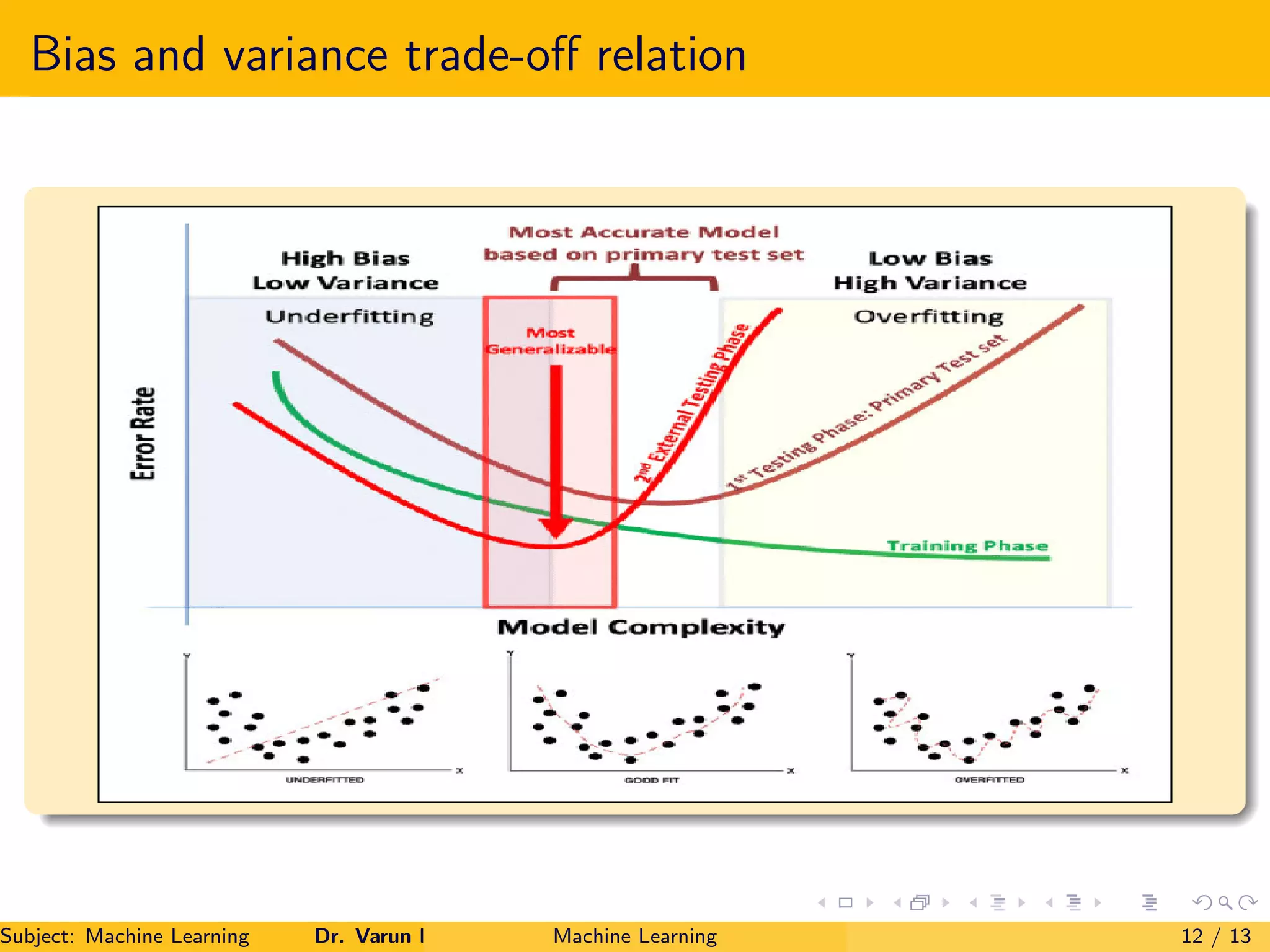
Bias and variance trade-off relation
Subject: Machine Learning Dr. Varun Kumar Machine Learning 12 / 13
References
E. Alpaydin, Introduction to machine learning. MIT press, 2020.
J. Grus, Data science from scratch: first principles with python. O’Reilly Media,
2019.
T. M. Mitchell, The discipline of machine learning. Carnegie Mellon University,
School of Computer Science, Machine Learning , 2006, vol. 9.
Subject: Machine Learning Dr. Varun Kumar Machine Learning 13 / 13

Bias and variance trade off

  • 1.
    Bias Variance Trade-offin Machine Learning Subject: Machine Learning Dr. Varun Kumar Subject: Machine Learning Dr. Varun Kumar Machine Learning 1 / 13
  • 2.
    Outlines 1 Introduction toUnder Fitting and Over Fitting 2 Introduction to Bias and Variance 3 Mathematical Intuition 4 Bias Variance Trade-off relation 5 References Subject: Machine Learning Dr. Varun Kumar Machine Learning 2 / 13
  • 3.
    Introduction to underfitting and over fitting and best fit Regression problem: Underfitting, overfitting, best fitting 1 Underfitting: A model or a ML algorithm is said to have underfitting when it cannot capture the underlying trend of the data. 2 Overfitting: A model or a ML algorithm is said to have overfitting when it capture the underlying trend of the data very accurately. 3 Best fit: A model or a ML algorithm is said to have best fit when it capture the underlying trend of the data moderately. Subject: Machine Learning Dr. Varun Kumar Machine Learning 3 / 13
  • 4.
    Bias and variance 1Bias: It shows the degree of randomness of the training data. (a) Based on the training data a suitable model may be created for the regression or classification problem. (b) Regression: Linear, logistic, polynomial (c) Classification: Decision tree, random forest, naive baye’s, KNN, SVM 2 Variance: It shows the degree of randomness of the testing data. (i) Testing data validates the accuracy of a model, that has been made with the help of training data set. (ii) Testing data is nothing but the unlabeled or unknown data. Subject: Machine Learning Dr. Varun Kumar Machine Learning 4 / 13
  • 5.
    Underfitting, overfitting, bestfit and bias, variance Note: ⇒ The objective of ML algorithm not only fit for the training data but also fit for the testing data. ⇒ In other words, low bias and low variance is the appropriate solution. Underfitting Overfitting Best fit High bias Very low bias Low bias High variance High variance Low variance Subject: Machine Learning Dr. Varun Kumar Machine Learning 5 / 13
  • 6.
    Underfitting, overfitting, andbest fit in classification problem A classifier (Decision tree, random forest, naive baye’s, KNN, SVM) works on two types of data Training data Testing data Example: Classifier comes under the category of underfitting, overfitting, and best fit based on its training and testing accuracy. Underfitting Overfitting Best fit Train error=25% Train error=1% Train error=8% Test error= 27% Test error= 23% Test error=9% Subject: Machine Learning Dr. Varun Kumar Machine Learning 6 / 13
  • 7.
    Mathematical intuition bias ˆ f(x) = E[ˆ f (x)] − f (x) (1) variance ˆ f (x) = E h ˆ f (x) − E[ˆ f (x)] 2 i (2) ⇒ ˆ f (x) → output observed through the training model ⇒ For linear model ˆ f (x) = w1x + w0 ⇒ For complex model ˆ f (x) = Pp i=1 wi xi + w0 ⇒ We don’t have idea regarding the true f (x). ⇒ Simple model: Low bias high variance ⇒ Complex model: High bias low variance E[(y − ˆ f (x))2 ] = bias2 + Variance + σ2 (Irreducible error) (3) Subject: Machine Learning Dr. Varun Kumar Machine Learning 7 / 13
  • 8.
    Continued– ⇒ Let therebe n + m sample data in a given data set in which n and m samples are taken for the training and testing (validation) purpose then trainerr = 1 n n X i=1 (yi − ˆ f (xi ))2 testerr = 1 m n+m X i=n+1 (yi − ˆ f (xi ))2 ⇒ If model complexity is increased the training model becomes too optimistic gives a wrong picture of how close ˆ f to f . ⇒ Let D = {xi , yi }n+m 1 is a given data set, where yi = f (xi ) + i ⇒ ∼ N(0, σ2 ) Subject: Machine Learning Dr. Varun Kumar Machine Learning 8 / 13
  • 9.
    Continued– ⇒ We useˆ f to approximate f , where training set T ⊂ D such that yi = ˆ f (xi ) ⇒ We are interested to know E h ˆ f (xi ) − f (xi ) 2 i ⇒ We cannot estimate the above expression directly, because we don’t know f (xi ) E (ŷi − yi )2 = E (ˆ f (xi ) − f (xi ) − i )2 ⇐ yi = f (xi ) + i = E (ˆ f (xi ) − f (xi ))2 − 2i (ˆ f (xi ) − f (xi )) + 2 i = E (ˆ f (xi ) − f (xi ))2 − 2E i (ˆ f (xi ) − f (xi )) + E 2 i E (ˆ f (xi ) − f (xi ))2 = E (ŷi − yi )2 + 2E i (ˆ f (xi ) − f (xi )) − E 2 i (4) Subject: Machine Learning Dr. Varun Kumar Machine Learning 9 / 13
  • 10.
    Continued– ⇒ Empirical estimate:Let Z = {zi }n i=1 E(Z) = 1 n n X i=1 zi ⇒ We can empirically evaluate R.H.S using training or test observation Case 1: Using test observation: E (ˆ f (xi ) − f (xi ))2 | {z } True error = E (ŷi − yi )2 + 2E i (ˆ f (xi ) − f (xi )) − E 2 i = 1 m n+m X i=n+1 (ŷi − yi )2 | {z } Empirical error − 1 m n+m X i=n+1 (i )2 | {z } Small constant + 2E h i (ˆ f (xi ) − f (xi )) i | {z } Covariance ∵ Cov(X, Y ) = E h (X − µx )(Y − µy ) i let i = X and Y = (ˆ f (xi ) − f (xi )) Subject: Machine Learning Dr. Varun Kumar Machine Learning 10 / 13
  • 11.
    Continued– ⇒ E h (X −µx )(Y − µy ) i = E h X(Y − µy ) i = E XY − µy E X = E[XY ] ⇒ None of the test data participated for estimating the ˆ f (xi ). ⇒ ˆ f (xi ) is estimated only using the training data. ⇒ ∴ i ⊥ (ˆ f (xi ) − f (xi )) ∴ E[XY ] = E[X]E[Y ] = 0 ⇒ True error=Empirical error+Small constant ← Test data Case 2: For training observation: E[XY ] 6= 0 Using Stein’s Lemma 1 n n X i=1 i (ˆ f (xi ) − f (xi )) = σ2 n n X i=1 ∂ ˆ f (xi ) ∂yi Subject: Machine Learning Dr. Varun Kumar Machine Learning 11 / 13
  • 12.
    Bias and variancetrade-off relation Subject: Machine Learning Dr. Varun Kumar Machine Learning 12 / 13
  • 13.
    References E. Alpaydin, Introductionto machine learning. MIT press, 2020. J. Grus, Data science from scratch: first principles with python. O’Reilly Media, 2019. T. M. Mitchell, The discipline of machine learning. Carnegie Mellon University, School of Computer Science, Machine Learning , 2006, vol. 9. Subject: Machine Learning Dr. Varun Kumar Machine Learning 13 / 13