Decision Trees &
Ensemble Models
Lecture 2
Agenda
• Class review
• The Bias-Variance Trade-off
• Generalizations of the Bias-Variance Trade-off
• The ExtraTrees Algorithm
• Interface in sklearn
• Conclusions
Class Review
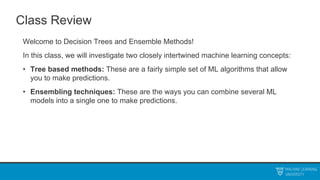
Welcome to Decision Trees and Ensemble Methods!
In this class, we will investigate two closely intertwined machine learning concepts:
• Tree based methods: These are a fairly simple set of ML algorithms that allow
you to make predictions.
• Ensembling techniques: These are the ways you can combine several ML
models into a single one to make predictions.
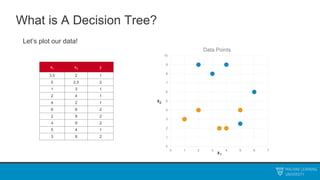
What is A Decision Tree?
Let’s plot our data!
x1 x2 y
3.5 2 1
5 2.5 2
1 3 1
2 4 1
4 2 1
6 6 2
2 9 2
4 9 2
5 4 1
3 8 2
0
1
2
3
4
5
6
7
8
9
10
0 1 2 3 4 5 6 7
Data Points
x1
x2
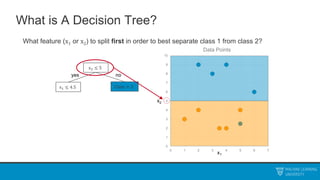
What is A Decision Tree?
x2 ≤ 5
Class = 2
x1 ≤ 4.5
yes no
What feature (x1 or x2) to split first in order to best separate class 1 from class 2?
0
1
2
3
4
5
6
7
8
9
10
0 1 2 3 4 5 6 7
Data Points
x1
x2
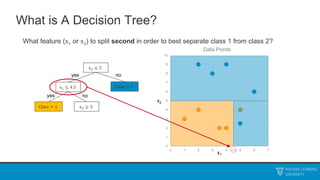
What is A Decision Tree?
x2 ≤ 5
Class = 2
x1 ≤ 4.5
Class = 1 x2 ≥ 3
yes no
yes no
What feature (x1 or x2) to split second in order to best separate class 1 from class 2?
0
1
2
3
4
5
6
7
8
9
10
0 1 2 3 4 5 6 7
Data Points
4.5
x1
x2
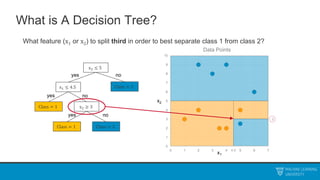
What is A Decision Tree?
x2 ≤ 5
Class = 2
x1 ≤ 4.5
Class = 1 x2 ≥ 3
Class = 1 Class = 2
yes no
yes no
yes no
What feature (x1 or x2) to split third in order to best separate class 1 from class 2?
0
1
2
3
4
5
6
7
8
9
10
0 1 2 3 4 5 6 7
Data Points
4.5
3
x1
x2
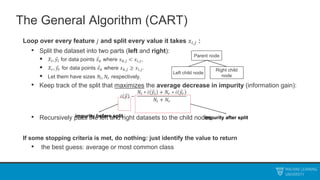
The General Algorithm (CART)
Loop over every feature 𝑗 and split every value it takes 𝑥𝑖,𝑗 :
• Split the dataset into two parts (left and right):
 𝑋𝑙, 𝑦𝑙 for data points 𝑥𝑘 where 𝑥𝑘,𝑗 < 𝑥𝑖,𝑗,
 𝑋𝑟, 𝑦𝑟 for data points 𝑥𝑘 where 𝑥𝑘,𝑗 ≥ 𝑥𝑖,𝑗.
 Let them have sizes 𝑁𝑙, 𝑁𝑟 respectively.
• Keep track of the split that maximizes the average decrease in impurity (information gain):
𝑖 𝑦 −
𝑁𝑙 ∗ 𝑖 𝑦𝑙 + 𝑁𝑟 ∗ 𝑖 𝑦𝑟
𝑁𝑙 + 𝑁𝑟
• Recursively pass the left and right datasets to the child nodes.
If some stopping criteria is met, do nothing: just identify the value to return
• the best guess: average or most common class
impurity before split impurity after split
Parent node
Left child node
Right child
node
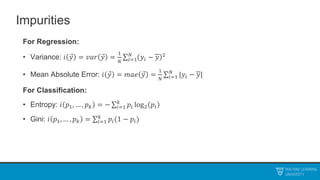
Impurities
For Regression:
• Variance: 𝑖 𝑦 = 𝑣𝑎𝑟 𝑦 =
1
𝑁 𝑖=1
𝑁
𝑦𝑖 − 𝑦 2
• Mean Absolute Error: 𝑖 𝑦 = 𝑚𝑎𝑒 𝑦 =
1
𝑁 𝑖=1
𝑁
|𝑦𝑖 − 𝑦|
For Classification:
• Entropy: 𝑖 𝑝1, … , 𝑝𝑘 = − 𝑖=1
𝑘
𝑝𝑖 log2 𝑝𝑖
• Gini: 𝑖 𝑝1, … , 𝑝𝑘 = 𝑖=1
𝑘
𝑝𝑖(1 − 𝑝𝑖)
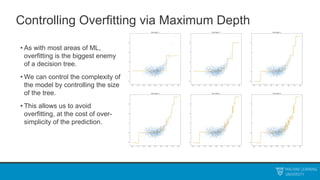
Controlling Overfitting via Maximum Depth
• As with most areas of ML,
overfitting is the biggest enemy
of a decision tree.
• We can control the complexity of
the model by controlling the size
of the tree.
• This allows us to avoid
overfitting, at the cost of over-
simplicity of the prediction.
Further Controlling Overfitting
• This is a very simple technique, but it clearly induces an extremely biased
model (the fact they are ”step-functions” ensures it always makes
systematic errors).
• To see how to best counteract this, we need to dive further into the nature
of overfitting, and really drill down into the Bias-Variance Trade-off.
Agenda
• Class review
• The Bias-Variance Trade-off
• Generalizations of the Bias-Variance Trade-off
• The ExtraTrees Algorithm
• Interface in sklearn
• Conclusions
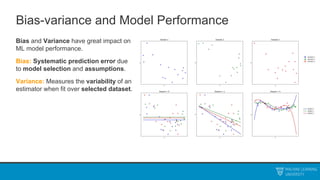
Bias-variance and Model Performance
Bias and Variance have great impact on
ML model performance.
Bias: Systematic prediction error due
to model selection and assumptions.
Variance: Measures the variability of an
estimator when fit over selected dataset.
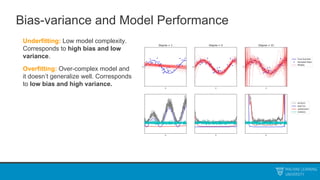
Bias-variance and Model Performance
Underfitting: Low model complexity.
Corresponds to high bias and low
variance.
Overfitting: Over-complex model and
it doesn’t generalize well. Corresponds
to low bias and high variance.
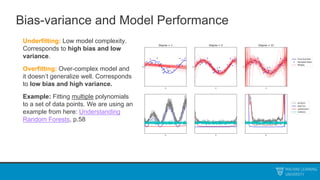
Bias-variance and Model Performance
Underfitting: Low model complexity.
Corresponds to high bias and low
variance.
Overfitting: Over-complex model and
it doesn’t generalize well. Corresponds
to low bias and high variance.
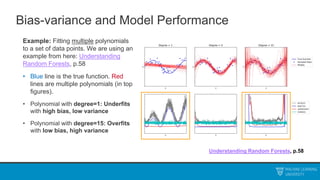
Example: Fitting multiple polynomials
to a set of data points. We are using an
example from here: Understanding
Random Forests, p.58
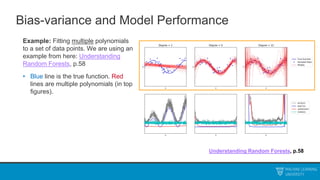
Bias-variance and Model Performance
Example: Fitting multiple polynomials
to a set of data points. We are using an
example from here: Understanding
Random Forests, p.58
• Blue line is the true function. Red
lines are multiple polynomials (in top
figures).
Understanding Random Forests, p.58
Bias-variance and Model Performance
Example: Fitting multiple polynomials
to a set of data points. We are using an
example from here: Understanding
Random Forests, p.58
• Blue line is the true function. Red
lines are multiple polynomials (in top
figures).
• Polynomial with degree=1: Underfits
with high bias, low variance
• Polynomial with degree=15: Overfits
with low bias, high variance
Understanding Random Forests, p.58
The Bias-Variance Decomposition
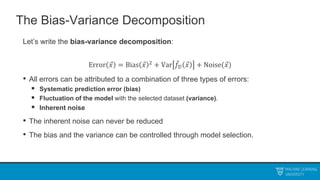
Let’s write the bias-variance decomposition:
Error 𝑥 = Bias 𝑥 2
+ Var 𝑓𝒟 𝑥 + Noise(𝑥)
• All errors can be attributed to a combination of three types of errors:
 Systematic prediction error (bias)
 Fluctuation of the model with the selected dataset (variance).
 Inherent noise
• The inherent noise can never be reduced
• The bias and the variance can be controlled through model selection.
The Bias-Variance Decomposition
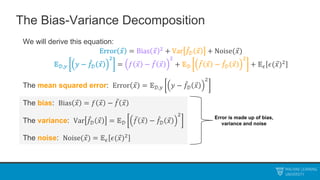
We will derive this equation:
Error 𝑥 = Bias 𝑥 2 + Var 𝑓𝒟 𝑥 + Noise(𝑥)
𝔼𝒟,𝑦 𝑦 − 𝑓𝒟 𝑥
2
= 𝑓 𝑥 − 𝑓 𝑥
2
+ 𝔼𝒟 𝑓 𝑥 − 𝑓𝒟 𝑥
2
+ 𝔼𝜖 𝜖(𝑥)2
The mean squared error: Error 𝑥 = 𝔼𝒟,𝑦 𝑦 − 𝑓𝒟 𝑥
2
The bias: Bias 𝑥 = 𝑓 𝑥 − 𝑓 𝑥
The variance: Var 𝑓𝒟 𝑥 = 𝔼𝒟 𝑓 𝑥 − 𝑓𝒟 𝑥
2
The noise: Noise(𝑥) = 𝔼𝜖 𝜖(𝑥)2
Error is made up of bias,
variance and noise
The Setup I
• Suppose I have a regression problem where I take in vectors 𝑥𝑖 and try to make
predictions of a single value 𝑦𝑖. Suppose for the moment that we know the
absolute true answer up to an independent random noise:
𝑦 = 𝑓 𝑥 + 𝜖(𝑥)
• The noise should be independent from any randomness inherent in 𝑥, and should
have mean zero, so that 𝑓 is the best possible guess.
• The function 𝑓 is deterministic. You can think of it as averaging the answer over
the true distribution in the world for that input:
𝑓 𝑥 = 𝔼[𝑦|𝑥]
The Setup II
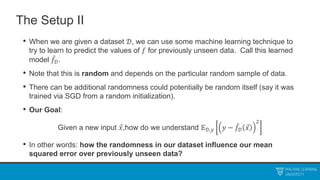
• When we are given a dataset 𝒟, we can use some machine learning technique to
try to learn to predict the values of 𝑓 for previously unseen data. Call this learned
model 𝑓𝒟.
• Note that this is random and depends on the particular random sample of data.
• There can be additional randomness could potentially be random itself (say it was
trained via SGD from a random initialization).
• Our Goal:
Given a new input 𝑥,how do we understand 𝔼𝒟,𝑦 𝑦 − 𝑓𝒟 𝑥
2
• In other words: how the randomness in our dataset influence our mean
squared error over previously unseen data?
Deriving the Relationship I
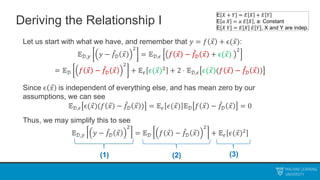
Let us start with what we have, and remember that 𝑦 = 𝑓 𝑥 + ϵ(𝑥):
𝔼𝒟,𝑦 𝑦 − 𝑓𝒟 𝑥
2
= 𝔼𝒟,𝜖 𝑓 𝑥 − 𝑓𝒟 𝑥 + ϵ(𝑥)
2
= 𝔼𝒟 𝑓 𝑥 − 𝑓𝒟 𝑥
2
+ 𝔼𝜖 𝜖(𝑥)2
+ 2 ⋅ 𝔼𝒟,𝜖 𝜖(𝑥)(𝑓 𝑥 − 𝑓𝒟 𝑥 )
Since ϵ 𝑥 is independent of everything else, and has mean zero by our
assumptions, we can see
𝔼𝒟,𝜖 ϵ(𝑥)(𝑓 𝑥 − 𝑓𝒟 𝑥 ) = 𝔼𝜖 𝜖(𝑥) 𝔼𝒟 𝑓 𝑥 − 𝑓𝒟 𝑥 = 0
Thus, we may simplify this to see
𝔼𝒟,𝑦 𝑦 − 𝑓𝒟 𝑥
2
= 𝔼𝒟 𝑓 𝑥 − 𝑓𝒟 𝑥
2
+ 𝔼𝜖 𝜖(𝑥)2
(1) (2) (3)
E 𝑋 + 𝑌 = 𝐸 𝑋 + 𝐸 𝑌
E 𝑎 𝑋 = 𝑎 𝐸 𝑋 , a: Constant
E 𝑋 𝑌 = 𝐸 𝑋 𝐸 𝑌 , X and Y are indep.
Deriving the Relationship II
Now, let 𝑓(𝑥) = 𝔼𝒟[𝑓𝒟 𝑥 ] denote the average prediction of the ML model over every
training set. We may write:
𝔼𝒟 𝑓 𝑥 − 𝑓𝒟 𝑥
2
= 𝔼𝒟 𝑓 𝑥 − 𝑓 𝑥 + 𝑓 𝑥 − 𝑓𝒟 𝑥
2
= 𝔼𝒟 𝑓 𝑥 − 𝑓 𝑥
2
+ 𝔼𝒟 𝑓 𝑥 − 𝑓𝒟 𝑥
2
+2 ⋅ 𝔼𝑦,𝒟 𝑓 𝑥 − 𝑓 𝑥 𝑓 𝑥 − 𝑓𝒟 𝑥
Thus the last term is zero.
Also note 𝑓 𝑥 − 𝑓 𝑥 is not random, so the expectation does nothing on the left.
Doesn’t depend on
the dataset
Mean zero when
averaged over 𝒟
(2)
E 𝑋 + 𝑌 = 𝐸 𝑋 + 𝐸 𝑌
E 𝑎 𝑋 = 𝑎 𝐸 𝑋 , a: Constant
E 𝑋 𝑌 = 𝐸 𝑋 𝐸 𝑌 , X and Y are indep.
Deriving the Relationship II
Now, let 𝑓(𝑥) = 𝔼𝒟[𝑓𝒟 𝑥 ] denote the average prediction of the ML model over every
training set. We may write:
𝔼𝒟 𝑓 𝑥 − 𝑓𝒟 𝑥
2
= 𝔼𝒟 𝑓 𝑥 − 𝑓 𝑥 + 𝑓 𝑥 − 𝑓𝒟 𝑥
2
= 𝔼𝒟 𝑓 𝑥 − 𝑓 𝑥
2
+ 𝔼𝒟 𝑓 𝑥 − 𝑓𝒟 𝑥
2
+2 ⋅ 𝔼𝑦,𝒟 𝑓 𝑥 − 𝑓 𝑥 𝑓 𝑥 − 𝑓𝒟 𝑥
Thus the last term is zero.
Also note 𝑓 𝑥 − 𝑓 𝑥 is not random, so the expectation does nothing on the left.
Doesn’t depend on
the dataset
Mean zero when
averaged over 𝒟
(2)
E 𝑋 + 𝑌 = 𝐸 𝑋 + 𝐸 𝑌
E 𝑎 𝑋 = 𝑎 𝐸 𝑋 , a: Constant
E 𝑋 𝑌 = 𝐸 𝑋 𝐸 𝑌 , X and Y are indep.
2 ⋅ (𝑓 𝑥 − 𝑓 𝑥 ) ⋅ 𝔼𝒟 𝑓 𝑥 − 𝑓𝒟 𝑥
Deriving the Relationship II
Now, let 𝑓(𝑥) = 𝔼𝒟[𝑓𝒟 𝑥 ] denote the average prediction of the ML model over every
training set. We may write:
𝔼𝒟 𝑓 𝑥 − 𝑓𝒟 𝑥
2
= 𝔼𝒟 𝑓 𝑥 − 𝑓 𝑥 + 𝑓 𝑥 − 𝑓𝒟 𝑥
2
= 𝔼𝒟 𝑓 𝑥 − 𝑓 𝑥
2
+ 𝔼𝒟 𝑓 𝑥 − 𝑓𝒟 𝑥
2
+2 ⋅ 𝔼𝑦,𝒟 𝑓 𝑥 − 𝑓 𝑥 𝑓 𝑥 − 𝑓𝒟 𝑥
Thus the last term is zero.
Also note 𝑓 𝑥 − 𝑓 𝑥 is not random, so the expectation does nothing on the left.
Doesn’t depend on
the dataset
Mean zero when
averaged over 𝒟
(2)
E 𝑋 + 𝑌 = 𝐸 𝑋 + 𝐸 𝑌
E 𝑎 𝑋 = 𝑎 𝐸 𝑋 , a: Constant
E 𝑋 𝑌 = 𝐸 𝑋 𝐸 𝑌 , X and Y are indep.
2 ⋅ (𝑓 𝑥 − 𝑓 𝑥 ) ⋅ 𝔼𝒟 𝑓 𝑥 − 𝑓𝒟 𝑥
2 ⋅ (𝑓 𝑥 − 𝑓 𝑥 ) ⋅ (𝔼𝒟 𝑓 𝑥 − 𝔼𝒟 𝑓𝒟 𝑥 )
Deriving the Relationship II
Now, let 𝑓(𝑥) = 𝔼𝒟[𝑓𝒟 𝑥 ] denote the average prediction of the ML model over every
training set. We may write:
𝔼𝒟 𝑓 𝑥 − 𝑓𝒟 𝑥
2
= 𝔼𝒟 𝑓 𝑥 − 𝑓 𝑥 + 𝑓 𝑥 − 𝑓𝒟 𝑥
2
= 𝔼𝒟 𝑓 𝑥 − 𝑓 𝑥
2
+ 𝔼𝒟 𝑓 𝑥 − 𝑓𝒟 𝑥
2
+2 ⋅ 𝔼𝑦,𝒟 𝑓 𝑥 − 𝑓 𝑥 𝑓 𝑥 − 𝑓𝒟 𝑥
Thus the last term is zero.
Also note 𝑓 𝑥 − 𝑓 𝑥 is not random, so the expectation does nothing on the left.
Doesn’t depend on
the dataset
Mean zero when
averaged over 𝒟
(2)
E 𝑋 + 𝑌 = 𝐸 𝑋 + 𝐸 𝑌
E 𝑎 𝑋 = 𝑎 𝐸 𝑋 , a: Constant
E 𝑋 𝑌 = 𝐸 𝑋 𝐸 𝑌 , X and Y are indep.
2 ⋅ (𝑓 𝑥 − 𝑓 𝑥 ) ⋅ 𝔼𝒟 𝑓 𝑥 − 𝑓𝒟 𝑥
2 ⋅ (𝑓 𝑥 − 𝑓 𝑥 ) ⋅ (𝑓 𝑥 − 𝑓 𝑥 )
2 ⋅ (𝑓 𝑥 − 𝑓 𝑥 ) ⋅ (𝔼𝒟 𝑓 𝑥 − 𝔼𝒟 𝑓𝒟 𝑥 )
𝟎
Deriving the Relationship III
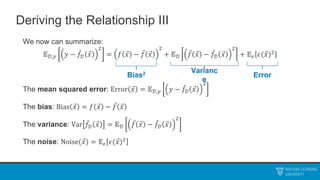
We now can summarize:
𝔼𝒟,𝑦 𝑦 − 𝑓𝒟 𝑥
2
= 𝑓 𝑥 − 𝑓 𝑥
2
+ 𝔼𝒟 𝑓 𝑥 − 𝑓𝒟 𝑥
2
+ 𝔼𝜖 𝜖(𝑥)2
The mean squared error: Error 𝑥 = 𝔼𝒟,𝑦 𝑦 − 𝑓𝒟 𝑥
2
The bias: Bias 𝑥 = 𝑓 𝑥 − 𝑓 𝑥
The variance: Var 𝑓𝒟 𝑥 = 𝔼𝒟 𝑓 𝑥 − 𝑓𝒟 𝑥
2
The noise: Noise(𝑥) = 𝔼𝜖 𝜖(𝑥)2
Error
Bias2 Varianc
e
Agenda
• Class review
• The Bias-Variance Trade-off
• Generalizations of the Bias-Variance Trade-off
• The ExtraTrees Algorithm
• Interface in sklearn
• Conclusions
What about classification?
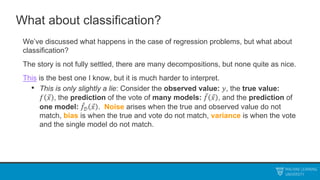
We’ve discussed what happens in the case of regression problems, but what about
classification?
The story is not fully settled, there are many decompositions, but none quite as nice.
This is the best one I know, but it is much harder to interpret.
• This is only slightly a lie: Consider the observed value: 𝑦, the true value:
𝑓 𝑥 , the prediction of the vote of many models: 𝑓 𝑥 , and the prediction of
one model: 𝑓𝒟 𝑥 . Noise arises when the true and observed value do not
match, bias is when the true and vote do not match, variance is when the vote
and the single model do not match.
Randomized Algorithms
This generalization will be key to the entire rest of our class.
• Suppose that 𝑓𝒟 does not depend only on the data, but some additional
independent randomness that we add in ourselves, call it ℛ.
• If you follow through additional work, you can further decompose:
Var 𝑓𝒟 𝑥 = 𝔼𝒟 Varℛ 𝑓𝒟,ℛ 𝑥 |𝒟 + Var𝒟 𝔼ℛ 𝑓𝒟,ℛ 𝑥 |𝒟
• The first term is the average variance due to the added randomness, and the
second term is the variance in the average prediction due to the dataset.
𝑉𝑎𝑟 𝑌 = 𝐸[𝑉𝑎𝑟 𝑌 𝑋 ] + 𝑉𝑎𝑟(𝐸[𝑌|𝑋])
Why is this so fundamental?
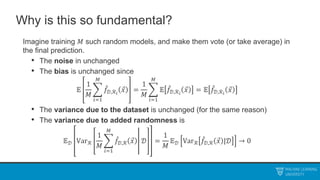
Imagine training 𝑀 such random models, and make them vote (or take average) in
the final prediction.
• The noise in unchanged
• The bias is unchanged since
𝔼
1
𝑀
𝑖=1
𝑀
𝑓𝒟,ℛ𝑖
𝑥 =
1
𝑀
𝑖=1
𝑀
𝔼 𝑓𝒟,ℛ𝑖
𝑥 = 𝔼 𝑓𝒟,ℛ𝑖
𝑥
• The variance due to the dataset is unchanged (for the same reason)
• The variance due to added randomness is
𝔼𝒟 Varℛ
1
𝑀
𝑖=1
𝑀
𝑓𝒟,ℛ 𝑥 𝒟 =
1
𝑀
𝔼𝒟 Varℛ 𝑓𝒟,ℛ 𝑥 |𝒟 → 0
Key Idea
If we can transform some of the variance due to the dataset into variance due to
added randomness without making the bias much worse, we can make a model
with overall lower error by having them vote (Ensembling)!
Agenda
• Class review
• The Bias-Variance Trade-off
• Generalizations of the Bias-Variance Trade-off
• The ExtraTrees Algorithm
• Interface in sklearn
• Conclusions
Motivating The ExtraTrees Algorithm
• Decision trees Decision trees generally low bias models
• Why? Just keep cutting you space until you have (for example) 𝑁 many
points in each leaf. As you add more data, both the location of the splits and
the error of the average will be decreased leading to zero bias in the limit.
• When it comes to variance, we’ve already seen one way we can counteract it,
which is by controlling the complexity of the tree directly, but even then there is
overfitting due to the optimization of the cut points.
Motivating the ExtraTrees Algorithm
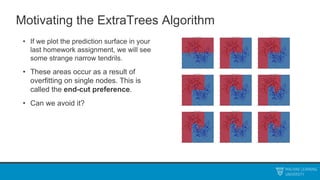
• If we plot the prediction surface in your
last homework assignment, we will see
some strange narrow tendrils.
• These areas occur as a result of
overfitting on single nodes. This is
called the end-cut preference.
• Can we avoid it?
ExtraTrees Algorithm
Since it can overfit directly during the optimization of a single node, what if we restrict the
degree to which it can look at a single node?
• Rather than try all splits on all variables, let us add a new parameter 𝐾 which is the
number of splits to try (Original paper here).
• Each of those splits is done on a randomly chosen feature, with a randomly chosen cut-
point.
• For an ordinal variable pick uniformly in the range min 𝑥⋅,𝑖 , max 𝑥⋅,𝑖
• For a nominal variable pick one of the categories at random
• Only optimize over the 𝐾 random splits
• In sklearn they make another common choice, which is they try a single split for every
feature, and pick amongst those.
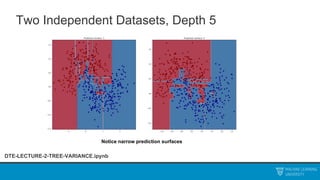
Two Independent Datasets, Depth 5
Notice narrow prediction surfaces
DTE-LECTURE-2-TREE-VARIANCE.ipynb
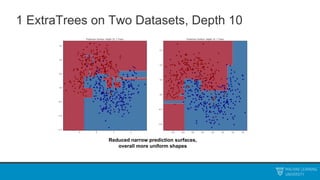
1 ExtraTrees on Two Datasets, Depth 10
Reduced narrow prediction surfaces,
overall more uniform shapes
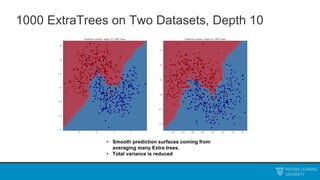
1000 ExtraTrees on Two Datasets, Depth 10
• Smooth prediction surfaces coming from
averaging many Extra trees.
• Total variance is reduced
A few Observations
• We have improved the computational complexity somewhat (although not as much
as you’d like) of our algorithm since fewer splits need to be considered.
• When going from standard decision tree to a single ExtraTree:
• There is an increase in bias for a fixed depth (Indeed, the models produced by a depth 10
ExtraTree were still simpler than the depth 5 standard decision tree)
• Total variance of the tree didn’t really get better either! We shouldn’t expect it to, since we
are in fact adding in more randomness.
• The problem with the end-cut preference is a bit improved.
• Multiple ExtraTrees: Averaging many trees lead to a vastly improved prediction
surface!
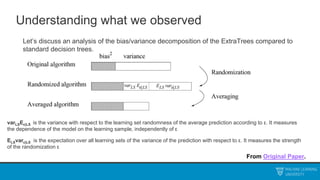
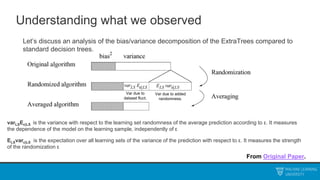
Understanding what we observed
Let’s discuss an analysis of the bias/variance decomposition of the ExtraTrees compared to
standard decision trees.
From Original Paper.
varLSEε|LS is the variance with respect to the learning set randomness of the average prediction according to ε. It measures
the dependence of the model on the learning sample, independently of ε
ELSvarε|LS is the expectation over all learning sets of the variance of the prediction with respect to ε. It measures the strength
of the randomization ε
Understanding what we observed
Let’s discuss an analysis of the bias/variance decomposition of the ExtraTrees compared to
standard decision trees.
From Original Paper.
varLSEε|LS is the variance with respect to the learning set randomness of the average prediction according to ε. It measures
the dependence of the model on the learning sample, independently of ε
ELSvarε|LS is the expectation over all learning sets of the variance of the prediction with respect to ε. It measures the strength
of the randomization ε
Var due to
dataset fluct.
Var due to added
randomness.
Understanding what we observed
• This can indeed be seen to be the case in practice (and you’ll do so on the
homework)
• If you deal with synthetic data (which is practically infinite, notice that you can
actually estimate all these components of bias and variance directly!
Agenda
• Class review
• The Bias-Variance Trade-off
• Generalizations of the Bias-Variance Trade-off
• The ExtraTrees Algorithm
• Interface in sklearn
• Conclusions
Sklearn ExtraTrees
• The interface in sklearn for ExtraTrees matches with everything else you’ve seen before
ExtraTreesClassifier(n_estimators=10, criterion=‘gini’, max_depth=N
one, random_state=None)
• I’ve suppressed most of the options, but I wanted to point out a few:
• n_estimators controls the number of random trees you learn
• All of the standard options like the splitting criterion and the max_depth are still
included.
• Now you can specify a random_state for repeatability of the learned model.
• Note: there is no control on the number of random choices, they do one per feature.
Agenda
• Class review
• The Bias-Variance Trade-off
• Generalizations of the Bias-Variance Trade-off
• The ExtraTrees Algorithm
• Interface in sklearn
• Conclusions
Conclusions
• Today we have seen how to further control overfitting by explicitly adding
randomness into our model, and then training many models to average out the
new randomness.
• This is a bit counterintuitive! However, it makes sense once you think, the new
randomness forces it to not memorize the data as effectively.
• This can be even taken to the extreme to produce totally random trees, ones
where you get one random split and that’s it!
• A careful examination of the bias-variance trade-off reveals that this is indeed a
reasonable thing to do.
Next Time
• This is one way to introduce randomness so we may ensemble the models, but it
isn’t the only way!
• Next time, we’ll learn about bagging, a general purpose ensembling method that
lets us inject randomness into any ML technique, and then average it out at the
end.
Final Project – Predict Pet Adoption Time
You will working with pet adoption data
from Austin Animal Center.
We joined two datasets that cover intake
and outcome of animals. Intake data is
available from here and outcome is from
here.
We want you to predict whether a pet is
adopted within the 30 days stay time in
the animal center.
We give you a starter notebook: DTE-
FINAL-PROJECT.ipynb
Dataset schema:
Pet ID - Unique ID of pet
Outcome Type - State of pet at the time of recording the outcome
Sex upon Outcome - Sex of pet at outcome
Name - Name of pet
Found Location - Found location of pet before entered the center
Intake Type - Circumstances bringing the pet to the center
Intake Condition - Health condition of pet when entered the center
Pet Type - Type of pet
Sex upon Intake - Sex of pet when entered the center
Breed - Breed of pet
Color - Color of pet
Age upon Intake Days - Age of pet when entered the center (days)
Time at Center - Time at center (0 = less than 30 days; 1 = more
than 30 days). This is the value to predict.
Libraries-tools and licenses
• Numpy: BSD
• Pandas: BSD
• Sagemaker: Apache license 2.0
• Seaborn: BSD
• Sklearn: BSD
• Matplotlib: BSD
• CatBoost: Apache license 2.0
• LightGBM: MIT
• XGBoost: Apache license 2.0
• MXNet: Apache license 2.0

MLU_DTE_Lecture_2.pptx

  • 2.
    Decision Trees & EnsembleModels Lecture 2
  • 3.
    Agenda • Class review •The Bias-Variance Trade-off • Generalizations of the Bias-Variance Trade-off • The ExtraTrees Algorithm • Interface in sklearn • Conclusions
  • 4.
    Class Review Welcome toDecision Trees and Ensemble Methods! In this class, we will investigate two closely intertwined machine learning concepts: • Tree based methods: These are a fairly simple set of ML algorithms that allow you to make predictions. • Ensembling techniques: These are the ways you can combine several ML models into a single one to make predictions.
  • 5.
    What is ADecision Tree? Let’s plot our data! x1 x2 y 3.5 2 1 5 2.5 2 1 3 1 2 4 1 4 2 1 6 6 2 2 9 2 4 9 2 5 4 1 3 8 2 0 1 2 3 4 5 6 7 8 9 10 0 1 2 3 4 5 6 7 Data Points x1 x2
  • 6.
    What is ADecision Tree? x2 ≤ 5 Class = 2 x1 ≤ 4.5 yes no What feature (x1 or x2) to split first in order to best separate class 1 from class 2? 0 1 2 3 4 5 6 7 8 9 10 0 1 2 3 4 5 6 7 Data Points x1 x2
  • 7.
    What is ADecision Tree? x2 ≤ 5 Class = 2 x1 ≤ 4.5 Class = 1 x2 ≥ 3 yes no yes no What feature (x1 or x2) to split second in order to best separate class 1 from class 2? 0 1 2 3 4 5 6 7 8 9 10 0 1 2 3 4 5 6 7 Data Points 4.5 x1 x2
  • 8.
    What is ADecision Tree? x2 ≤ 5 Class = 2 x1 ≤ 4.5 Class = 1 x2 ≥ 3 Class = 1 Class = 2 yes no yes no yes no What feature (x1 or x2) to split third in order to best separate class 1 from class 2? 0 1 2 3 4 5 6 7 8 9 10 0 1 2 3 4 5 6 7 Data Points 4.5 3 x1 x2
  • 9.
    The General Algorithm(CART) Loop over every feature 𝑗 and split every value it takes 𝑥𝑖,𝑗 : • Split the dataset into two parts (left and right):  𝑋𝑙, 𝑦𝑙 for data points 𝑥𝑘 where 𝑥𝑘,𝑗 < 𝑥𝑖,𝑗,  𝑋𝑟, 𝑦𝑟 for data points 𝑥𝑘 where 𝑥𝑘,𝑗 ≥ 𝑥𝑖,𝑗.  Let them have sizes 𝑁𝑙, 𝑁𝑟 respectively. • Keep track of the split that maximizes the average decrease in impurity (information gain): 𝑖 𝑦 − 𝑁𝑙 ∗ 𝑖 𝑦𝑙 + 𝑁𝑟 ∗ 𝑖 𝑦𝑟 𝑁𝑙 + 𝑁𝑟 • Recursively pass the left and right datasets to the child nodes. If some stopping criteria is met, do nothing: just identify the value to return • the best guess: average or most common class impurity before split impurity after split Parent node Left child node Right child node
  • 10.
    Impurities For Regression: • Variance:𝑖 𝑦 = 𝑣𝑎𝑟 𝑦 = 1 𝑁 𝑖=1 𝑁 𝑦𝑖 − 𝑦 2 • Mean Absolute Error: 𝑖 𝑦 = 𝑚𝑎𝑒 𝑦 = 1 𝑁 𝑖=1 𝑁 |𝑦𝑖 − 𝑦| For Classification: • Entropy: 𝑖 𝑝1, … , 𝑝𝑘 = − 𝑖=1 𝑘 𝑝𝑖 log2 𝑝𝑖 • Gini: 𝑖 𝑝1, … , 𝑝𝑘 = 𝑖=1 𝑘 𝑝𝑖(1 − 𝑝𝑖)
  • 11.
    Controlling Overfitting viaMaximum Depth • As with most areas of ML, overfitting is the biggest enemy of a decision tree. • We can control the complexity of the model by controlling the size of the tree. • This allows us to avoid overfitting, at the cost of over- simplicity of the prediction.
  • 12.
    Further Controlling Overfitting •This is a very simple technique, but it clearly induces an extremely biased model (the fact they are ”step-functions” ensures it always makes systematic errors). • To see how to best counteract this, we need to dive further into the nature of overfitting, and really drill down into the Bias-Variance Trade-off.
  • 13.
    Agenda • Class review •The Bias-Variance Trade-off • Generalizations of the Bias-Variance Trade-off • The ExtraTrees Algorithm • Interface in sklearn • Conclusions
  • 14.
    Bias-variance and ModelPerformance Bias and Variance have great impact on ML model performance. Bias: Systematic prediction error due to model selection and assumptions. Variance: Measures the variability of an estimator when fit over selected dataset.
  • 15.
    Bias-variance and ModelPerformance Underfitting: Low model complexity. Corresponds to high bias and low variance. Overfitting: Over-complex model and it doesn’t generalize well. Corresponds to low bias and high variance.
  • 16.
    Bias-variance and ModelPerformance Underfitting: Low model complexity. Corresponds to high bias and low variance. Overfitting: Over-complex model and it doesn’t generalize well. Corresponds to low bias and high variance. Example: Fitting multiple polynomials to a set of data points. We are using an example from here: Understanding Random Forests, p.58
  • 17.
    Bias-variance and ModelPerformance Example: Fitting multiple polynomials to a set of data points. We are using an example from here: Understanding Random Forests, p.58 • Blue line is the true function. Red lines are multiple polynomials (in top figures). Understanding Random Forests, p.58
  • 18.
    Bias-variance and ModelPerformance Example: Fitting multiple polynomials to a set of data points. We are using an example from here: Understanding Random Forests, p.58 • Blue line is the true function. Red lines are multiple polynomials (in top figures). • Polynomial with degree=1: Underfits with high bias, low variance • Polynomial with degree=15: Overfits with low bias, high variance Understanding Random Forests, p.58
  • 19.
    The Bias-Variance Decomposition Let’swrite the bias-variance decomposition: Error 𝑥 = Bias 𝑥 2 + Var 𝑓𝒟 𝑥 + Noise(𝑥) • All errors can be attributed to a combination of three types of errors:  Systematic prediction error (bias)  Fluctuation of the model with the selected dataset (variance).  Inherent noise • The inherent noise can never be reduced • The bias and the variance can be controlled through model selection.
  • 20.
    The Bias-Variance Decomposition Wewill derive this equation: Error 𝑥 = Bias 𝑥 2 + Var 𝑓𝒟 𝑥 + Noise(𝑥) 𝔼𝒟,𝑦 𝑦 − 𝑓𝒟 𝑥 2 = 𝑓 𝑥 − 𝑓 𝑥 2 + 𝔼𝒟 𝑓 𝑥 − 𝑓𝒟 𝑥 2 + 𝔼𝜖 𝜖(𝑥)2 The mean squared error: Error 𝑥 = 𝔼𝒟,𝑦 𝑦 − 𝑓𝒟 𝑥 2 The bias: Bias 𝑥 = 𝑓 𝑥 − 𝑓 𝑥 The variance: Var 𝑓𝒟 𝑥 = 𝔼𝒟 𝑓 𝑥 − 𝑓𝒟 𝑥 2 The noise: Noise(𝑥) = 𝔼𝜖 𝜖(𝑥)2 Error is made up of bias, variance and noise
  • 21.
    The Setup I •Suppose I have a regression problem where I take in vectors 𝑥𝑖 and try to make predictions of a single value 𝑦𝑖. Suppose for the moment that we know the absolute true answer up to an independent random noise: 𝑦 = 𝑓 𝑥 + 𝜖(𝑥) • The noise should be independent from any randomness inherent in 𝑥, and should have mean zero, so that 𝑓 is the best possible guess. • The function 𝑓 is deterministic. You can think of it as averaging the answer over the true distribution in the world for that input: 𝑓 𝑥 = 𝔼[𝑦|𝑥]
  • 22.
    The Setup II •When we are given a dataset 𝒟, we can use some machine learning technique to try to learn to predict the values of 𝑓 for previously unseen data. Call this learned model 𝑓𝒟. • Note that this is random and depends on the particular random sample of data. • There can be additional randomness could potentially be random itself (say it was trained via SGD from a random initialization). • Our Goal: Given a new input 𝑥,how do we understand 𝔼𝒟,𝑦 𝑦 − 𝑓𝒟 𝑥 2 • In other words: how the randomness in our dataset influence our mean squared error over previously unseen data?
  • 23.
    Deriving the RelationshipI Let us start with what we have, and remember that 𝑦 = 𝑓 𝑥 + ϵ(𝑥): 𝔼𝒟,𝑦 𝑦 − 𝑓𝒟 𝑥 2 = 𝔼𝒟,𝜖 𝑓 𝑥 − 𝑓𝒟 𝑥 + ϵ(𝑥) 2 = 𝔼𝒟 𝑓 𝑥 − 𝑓𝒟 𝑥 2 + 𝔼𝜖 𝜖(𝑥)2 + 2 ⋅ 𝔼𝒟,𝜖 𝜖(𝑥)(𝑓 𝑥 − 𝑓𝒟 𝑥 ) Since ϵ 𝑥 is independent of everything else, and has mean zero by our assumptions, we can see 𝔼𝒟,𝜖 ϵ(𝑥)(𝑓 𝑥 − 𝑓𝒟 𝑥 ) = 𝔼𝜖 𝜖(𝑥) 𝔼𝒟 𝑓 𝑥 − 𝑓𝒟 𝑥 = 0 Thus, we may simplify this to see 𝔼𝒟,𝑦 𝑦 − 𝑓𝒟 𝑥 2 = 𝔼𝒟 𝑓 𝑥 − 𝑓𝒟 𝑥 2 + 𝔼𝜖 𝜖(𝑥)2 (1) (2) (3) E 𝑋 + 𝑌 = 𝐸 𝑋 + 𝐸 𝑌 E 𝑎 𝑋 = 𝑎 𝐸 𝑋 , a: Constant E 𝑋 𝑌 = 𝐸 𝑋 𝐸 𝑌 , X and Y are indep.
  • 24.
    Deriving the RelationshipII Now, let 𝑓(𝑥) = 𝔼𝒟[𝑓𝒟 𝑥 ] denote the average prediction of the ML model over every training set. We may write: 𝔼𝒟 𝑓 𝑥 − 𝑓𝒟 𝑥 2 = 𝔼𝒟 𝑓 𝑥 − 𝑓 𝑥 + 𝑓 𝑥 − 𝑓𝒟 𝑥 2 = 𝔼𝒟 𝑓 𝑥 − 𝑓 𝑥 2 + 𝔼𝒟 𝑓 𝑥 − 𝑓𝒟 𝑥 2 +2 ⋅ 𝔼𝑦,𝒟 𝑓 𝑥 − 𝑓 𝑥 𝑓 𝑥 − 𝑓𝒟 𝑥 Thus the last term is zero. Also note 𝑓 𝑥 − 𝑓 𝑥 is not random, so the expectation does nothing on the left. Doesn’t depend on the dataset Mean zero when averaged over 𝒟 (2) E 𝑋 + 𝑌 = 𝐸 𝑋 + 𝐸 𝑌 E 𝑎 𝑋 = 𝑎 𝐸 𝑋 , a: Constant E 𝑋 𝑌 = 𝐸 𝑋 𝐸 𝑌 , X and Y are indep.
  • 25.
    Deriving the RelationshipII Now, let 𝑓(𝑥) = 𝔼𝒟[𝑓𝒟 𝑥 ] denote the average prediction of the ML model over every training set. We may write: 𝔼𝒟 𝑓 𝑥 − 𝑓𝒟 𝑥 2 = 𝔼𝒟 𝑓 𝑥 − 𝑓 𝑥 + 𝑓 𝑥 − 𝑓𝒟 𝑥 2 = 𝔼𝒟 𝑓 𝑥 − 𝑓 𝑥 2 + 𝔼𝒟 𝑓 𝑥 − 𝑓𝒟 𝑥 2 +2 ⋅ 𝔼𝑦,𝒟 𝑓 𝑥 − 𝑓 𝑥 𝑓 𝑥 − 𝑓𝒟 𝑥 Thus the last term is zero. Also note 𝑓 𝑥 − 𝑓 𝑥 is not random, so the expectation does nothing on the left. Doesn’t depend on the dataset Mean zero when averaged over 𝒟 (2) E 𝑋 + 𝑌 = 𝐸 𝑋 + 𝐸 𝑌 E 𝑎 𝑋 = 𝑎 𝐸 𝑋 , a: Constant E 𝑋 𝑌 = 𝐸 𝑋 𝐸 𝑌 , X and Y are indep. 2 ⋅ (𝑓 𝑥 − 𝑓 𝑥 ) ⋅ 𝔼𝒟 𝑓 𝑥 − 𝑓𝒟 𝑥
  • 26.
    Deriving the RelationshipII Now, let 𝑓(𝑥) = 𝔼𝒟[𝑓𝒟 𝑥 ] denote the average prediction of the ML model over every training set. We may write: 𝔼𝒟 𝑓 𝑥 − 𝑓𝒟 𝑥 2 = 𝔼𝒟 𝑓 𝑥 − 𝑓 𝑥 + 𝑓 𝑥 − 𝑓𝒟 𝑥 2 = 𝔼𝒟 𝑓 𝑥 − 𝑓 𝑥 2 + 𝔼𝒟 𝑓 𝑥 − 𝑓𝒟 𝑥 2 +2 ⋅ 𝔼𝑦,𝒟 𝑓 𝑥 − 𝑓 𝑥 𝑓 𝑥 − 𝑓𝒟 𝑥 Thus the last term is zero. Also note 𝑓 𝑥 − 𝑓 𝑥 is not random, so the expectation does nothing on the left. Doesn’t depend on the dataset Mean zero when averaged over 𝒟 (2) E 𝑋 + 𝑌 = 𝐸 𝑋 + 𝐸 𝑌 E 𝑎 𝑋 = 𝑎 𝐸 𝑋 , a: Constant E 𝑋 𝑌 = 𝐸 𝑋 𝐸 𝑌 , X and Y are indep. 2 ⋅ (𝑓 𝑥 − 𝑓 𝑥 ) ⋅ 𝔼𝒟 𝑓 𝑥 − 𝑓𝒟 𝑥 2 ⋅ (𝑓 𝑥 − 𝑓 𝑥 ) ⋅ (𝔼𝒟 𝑓 𝑥 − 𝔼𝒟 𝑓𝒟 𝑥 )
  • 27.
    Deriving the RelationshipII Now, let 𝑓(𝑥) = 𝔼𝒟[𝑓𝒟 𝑥 ] denote the average prediction of the ML model over every training set. We may write: 𝔼𝒟 𝑓 𝑥 − 𝑓𝒟 𝑥 2 = 𝔼𝒟 𝑓 𝑥 − 𝑓 𝑥 + 𝑓 𝑥 − 𝑓𝒟 𝑥 2 = 𝔼𝒟 𝑓 𝑥 − 𝑓 𝑥 2 + 𝔼𝒟 𝑓 𝑥 − 𝑓𝒟 𝑥 2 +2 ⋅ 𝔼𝑦,𝒟 𝑓 𝑥 − 𝑓 𝑥 𝑓 𝑥 − 𝑓𝒟 𝑥 Thus the last term is zero. Also note 𝑓 𝑥 − 𝑓 𝑥 is not random, so the expectation does nothing on the left. Doesn’t depend on the dataset Mean zero when averaged over 𝒟 (2) E 𝑋 + 𝑌 = 𝐸 𝑋 + 𝐸 𝑌 E 𝑎 𝑋 = 𝑎 𝐸 𝑋 , a: Constant E 𝑋 𝑌 = 𝐸 𝑋 𝐸 𝑌 , X and Y are indep. 2 ⋅ (𝑓 𝑥 − 𝑓 𝑥 ) ⋅ 𝔼𝒟 𝑓 𝑥 − 𝑓𝒟 𝑥 2 ⋅ (𝑓 𝑥 − 𝑓 𝑥 ) ⋅ (𝑓 𝑥 − 𝑓 𝑥 ) 2 ⋅ (𝑓 𝑥 − 𝑓 𝑥 ) ⋅ (𝔼𝒟 𝑓 𝑥 − 𝔼𝒟 𝑓𝒟 𝑥 ) 𝟎
  • 28.
    Deriving the RelationshipIII We now can summarize: 𝔼𝒟,𝑦 𝑦 − 𝑓𝒟 𝑥 2 = 𝑓 𝑥 − 𝑓 𝑥 2 + 𝔼𝒟 𝑓 𝑥 − 𝑓𝒟 𝑥 2 + 𝔼𝜖 𝜖(𝑥)2 The mean squared error: Error 𝑥 = 𝔼𝒟,𝑦 𝑦 − 𝑓𝒟 𝑥 2 The bias: Bias 𝑥 = 𝑓 𝑥 − 𝑓 𝑥 The variance: Var 𝑓𝒟 𝑥 = 𝔼𝒟 𝑓 𝑥 − 𝑓𝒟 𝑥 2 The noise: Noise(𝑥) = 𝔼𝜖 𝜖(𝑥)2 Error Bias2 Varianc e
  • 29.
    Agenda • Class review •The Bias-Variance Trade-off • Generalizations of the Bias-Variance Trade-off • The ExtraTrees Algorithm • Interface in sklearn • Conclusions
  • 30.
    What about classification? We’vediscussed what happens in the case of regression problems, but what about classification? The story is not fully settled, there are many decompositions, but none quite as nice. This is the best one I know, but it is much harder to interpret. • This is only slightly a lie: Consider the observed value: 𝑦, the true value: 𝑓 𝑥 , the prediction of the vote of many models: 𝑓 𝑥 , and the prediction of one model: 𝑓𝒟 𝑥 . Noise arises when the true and observed value do not match, bias is when the true and vote do not match, variance is when the vote and the single model do not match.
  • 31.
    Randomized Algorithms This generalizationwill be key to the entire rest of our class. • Suppose that 𝑓𝒟 does not depend only on the data, but some additional independent randomness that we add in ourselves, call it ℛ. • If you follow through additional work, you can further decompose: Var 𝑓𝒟 𝑥 = 𝔼𝒟 Varℛ 𝑓𝒟,ℛ 𝑥 |𝒟 + Var𝒟 𝔼ℛ 𝑓𝒟,ℛ 𝑥 |𝒟 • The first term is the average variance due to the added randomness, and the second term is the variance in the average prediction due to the dataset. 𝑉𝑎𝑟 𝑌 = 𝐸[𝑉𝑎𝑟 𝑌 𝑋 ] + 𝑉𝑎𝑟(𝐸[𝑌|𝑋])
  • 32.
    Why is thisso fundamental? Imagine training 𝑀 such random models, and make them vote (or take average) in the final prediction. • The noise in unchanged • The bias is unchanged since 𝔼 1 𝑀 𝑖=1 𝑀 𝑓𝒟,ℛ𝑖 𝑥 = 1 𝑀 𝑖=1 𝑀 𝔼 𝑓𝒟,ℛ𝑖 𝑥 = 𝔼 𝑓𝒟,ℛ𝑖 𝑥 • The variance due to the dataset is unchanged (for the same reason) • The variance due to added randomness is 𝔼𝒟 Varℛ 1 𝑀 𝑖=1 𝑀 𝑓𝒟,ℛ 𝑥 𝒟 = 1 𝑀 𝔼𝒟 Varℛ 𝑓𝒟,ℛ 𝑥 |𝒟 → 0
  • 33.
    Key Idea If wecan transform some of the variance due to the dataset into variance due to added randomness without making the bias much worse, we can make a model with overall lower error by having them vote (Ensembling)!
  • 34.
    Agenda • Class review •The Bias-Variance Trade-off • Generalizations of the Bias-Variance Trade-off • The ExtraTrees Algorithm • Interface in sklearn • Conclusions
  • 35.
    Motivating The ExtraTreesAlgorithm • Decision trees Decision trees generally low bias models • Why? Just keep cutting you space until you have (for example) 𝑁 many points in each leaf. As you add more data, both the location of the splits and the error of the average will be decreased leading to zero bias in the limit. • When it comes to variance, we’ve already seen one way we can counteract it, which is by controlling the complexity of the tree directly, but even then there is overfitting due to the optimization of the cut points.
  • 36.
    Motivating the ExtraTreesAlgorithm • If we plot the prediction surface in your last homework assignment, we will see some strange narrow tendrils. • These areas occur as a result of overfitting on single nodes. This is called the end-cut preference. • Can we avoid it?
  • 37.
    ExtraTrees Algorithm Since itcan overfit directly during the optimization of a single node, what if we restrict the degree to which it can look at a single node? • Rather than try all splits on all variables, let us add a new parameter 𝐾 which is the number of splits to try (Original paper here). • Each of those splits is done on a randomly chosen feature, with a randomly chosen cut- point. • For an ordinal variable pick uniformly in the range min 𝑥⋅,𝑖 , max 𝑥⋅,𝑖 • For a nominal variable pick one of the categories at random • Only optimize over the 𝐾 random splits • In sklearn they make another common choice, which is they try a single split for every feature, and pick amongst those.
  • 38.
    Two Independent Datasets,Depth 5 Notice narrow prediction surfaces DTE-LECTURE-2-TREE-VARIANCE.ipynb
  • 39.
    1 ExtraTrees onTwo Datasets, Depth 10 Reduced narrow prediction surfaces, overall more uniform shapes
  • 40.
    1000 ExtraTrees onTwo Datasets, Depth 10 • Smooth prediction surfaces coming from averaging many Extra trees. • Total variance is reduced
  • 41.
    A few Observations •We have improved the computational complexity somewhat (although not as much as you’d like) of our algorithm since fewer splits need to be considered. • When going from standard decision tree to a single ExtraTree: • There is an increase in bias for a fixed depth (Indeed, the models produced by a depth 10 ExtraTree were still simpler than the depth 5 standard decision tree) • Total variance of the tree didn’t really get better either! We shouldn’t expect it to, since we are in fact adding in more randomness. • The problem with the end-cut preference is a bit improved. • Multiple ExtraTrees: Averaging many trees lead to a vastly improved prediction surface!
  • 42.
    Understanding what weobserved Let’s discuss an analysis of the bias/variance decomposition of the ExtraTrees compared to standard decision trees. From Original Paper. varLSEε|LS is the variance with respect to the learning set randomness of the average prediction according to ε. It measures the dependence of the model on the learning sample, independently of ε ELSvarε|LS is the expectation over all learning sets of the variance of the prediction with respect to ε. It measures the strength of the randomization ε
  • 43.
    Understanding what weobserved Let’s discuss an analysis of the bias/variance decomposition of the ExtraTrees compared to standard decision trees. From Original Paper. varLSEε|LS is the variance with respect to the learning set randomness of the average prediction according to ε. It measures the dependence of the model on the learning sample, independently of ε ELSvarε|LS is the expectation over all learning sets of the variance of the prediction with respect to ε. It measures the strength of the randomization ε Var due to dataset fluct. Var due to added randomness.
  • 44.
    Understanding what weobserved • This can indeed be seen to be the case in practice (and you’ll do so on the homework) • If you deal with synthetic data (which is practically infinite, notice that you can actually estimate all these components of bias and variance directly!
  • 45.
    Agenda • Class review •The Bias-Variance Trade-off • Generalizations of the Bias-Variance Trade-off • The ExtraTrees Algorithm • Interface in sklearn • Conclusions
  • 46.
    Sklearn ExtraTrees • Theinterface in sklearn for ExtraTrees matches with everything else you’ve seen before ExtraTreesClassifier(n_estimators=10, criterion=‘gini’, max_depth=N one, random_state=None) • I’ve suppressed most of the options, but I wanted to point out a few: • n_estimators controls the number of random trees you learn • All of the standard options like the splitting criterion and the max_depth are still included. • Now you can specify a random_state for repeatability of the learned model. • Note: there is no control on the number of random choices, they do one per feature.
  • 47.
    Agenda • Class review •The Bias-Variance Trade-off • Generalizations of the Bias-Variance Trade-off • The ExtraTrees Algorithm • Interface in sklearn • Conclusions
  • 48.
    Conclusions • Today wehave seen how to further control overfitting by explicitly adding randomness into our model, and then training many models to average out the new randomness. • This is a bit counterintuitive! However, it makes sense once you think, the new randomness forces it to not memorize the data as effectively. • This can be even taken to the extreme to produce totally random trees, ones where you get one random split and that’s it! • A careful examination of the bias-variance trade-off reveals that this is indeed a reasonable thing to do.
  • 49.
    Next Time • Thisis one way to introduce randomness so we may ensemble the models, but it isn’t the only way! • Next time, we’ll learn about bagging, a general purpose ensembling method that lets us inject randomness into any ML technique, and then average it out at the end.
  • 50.
    Final Project –Predict Pet Adoption Time You will working with pet adoption data from Austin Animal Center. We joined two datasets that cover intake and outcome of animals. Intake data is available from here and outcome is from here. We want you to predict whether a pet is adopted within the 30 days stay time in the animal center. We give you a starter notebook: DTE- FINAL-PROJECT.ipynb Dataset schema: Pet ID - Unique ID of pet Outcome Type - State of pet at the time of recording the outcome Sex upon Outcome - Sex of pet at outcome Name - Name of pet Found Location - Found location of pet before entered the center Intake Type - Circumstances bringing the pet to the center Intake Condition - Health condition of pet when entered the center Pet Type - Type of pet Sex upon Intake - Sex of pet when entered the center Breed - Breed of pet Color - Color of pet Age upon Intake Days - Age of pet when entered the center (days) Time at Center - Time at center (0 = less than 30 days; 1 = more than 30 days). This is the value to predict.
  • 51.
    Libraries-tools and licenses •Numpy: BSD • Pandas: BSD • Sagemaker: Apache license 2.0 • Seaborn: BSD • Sklearn: BSD • Matplotlib: BSD • CatBoost: Apache license 2.0 • LightGBM: MIT • XGBoost: Apache license 2.0 • MXNet: Apache license 2.0