E-democracy
Dr. Varun Kumar
Dr. Varun Kumar (IIIT Surat) Lecture-30 1 / 8
Outlines
1 Introduction
2 Key features of e-democracy
Expansion of conventional democratic system
Improving democracy
Disruption of e-democracy and Digital inclusion
3 Issues with e-democracy
Dr. Varun Kumar (IIIT Surat) Lecture-30 2 / 8
Introduction
Key point
⇒ E-democracy = Electronic + Democracy.
⇒ It is also called as digital democracy or Internet democracy.
⇒ It is the use of information and communication technology (ICT) in
political and governance processes.
⇒ The term is proposed by digital activist Steven Clift.
⇒ ICT include civic technology and government technology.
⇒ All adult citizens are presumed to be eligible to participate equally in
the proposal, development and creation of laws.
⇒ E-democracy encompasses social, economic and cultural conditions
that enable the free and equal practice of political self-determination.
Dr. Varun Kumar (IIIT Surat) Lecture-30 3 / 8
Key features of E-democracy
Expanding democracy
⇒ The Internet encourage thinking capability by a democratic medium.
⇒ Electronic voting should be done with a proper purpose and with
achieving a common constitutional goal.
⇒ Example: Expanding democracy → e-voting (by EVM) Vs traditional
ballots.
Social design in the early days of internet:
⇒ Strong support for free speech (norms of a democracy).
⇒ Sharing culture
Unmediated mass communication on the internet
Newsgroups
Chat rooms etc
Finally, because the Internet is a massive digital network with open
standards, universal and inexpensive access to a wide variety of
communication media and models could actually be attained.
Dr. Varun Kumar (IIIT Surat) Lecture-30 4 / 8
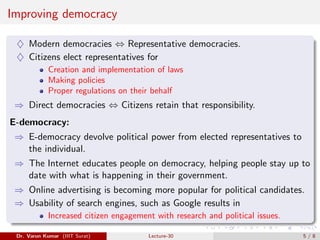
Improving democracy
♦ Modern democracies ⇔ Representative democracies.
♦ Citizens elect representatives for
Creation and implementation of laws
Making policies
Proper regulations on their behalf
⇒ Direct democracies ⇔ Citizens retain that responsibility.
E-democracy:
⇒ E-democracy devolve political power from elected representatives to
the individual.
⇒ The Internet educates people on democracy, helping people stay up to
date with what is happening in their government.
⇒ Online advertising is becoming more popular for political candidates.
⇒ Usability of search engines, such as Google results in
Increased citizen engagement with research and political issues.
Dr. Varun Kumar (IIIT Surat) Lecture-30 5 / 8
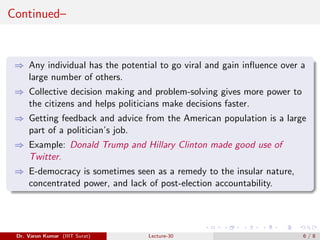
Continued–
⇒ Any individual has the potential to go viral and gain influence over a
large number of others.
⇒ Collective decision making and problem-solving gives more power to
the citizens and helps politicians make decisions faster.
⇒ Getting feedback and advice from the American population is a large
part of a politician’s job.
⇒ Example: Donald Trump and Hillary Clinton made good use of
Twitter.
⇒ E-democracy is sometimes seen as a remedy to the insular nature,
concentrated power, and lack of post-election accountability.
Dr. Varun Kumar (IIIT Surat) Lecture-30 6 / 8
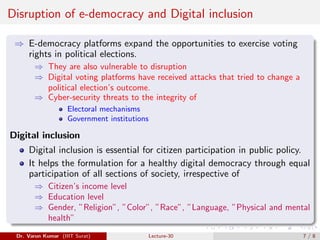
Disruption of e-democracy and Digital inclusion
⇒ E-democracy platforms expand the opportunities to exercise voting
rights in political elections.
⇒ They are also vulnerable to disruption
⇒ Digital voting platforms have received attacks that tried to change a
political election’s outcome.
⇒ Cyber-security threats to the integrity of
Electoral mechanisms
Government institutions
Digital inclusion
Digital inclusion is essential for citizen participation in public policy.
It helps the formulation for a healthy digital democracy through equal
participation of all sections of society, irrespective of
⇒ Citizen’s income level
⇒ Education level
⇒ Gender, ”Religion”, ”Color”, ”Race”, ”Language, ”Physical and mental
health”
Dr. Varun Kumar (IIIT Surat) Lecture-30 7 / 8
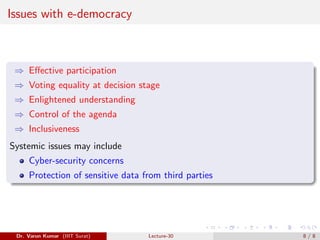
Issues with e-democracy
⇒ Effective participation
⇒ Voting equality at decision stage
⇒ Enlightened understanding
⇒ Control of the agenda
⇒ Inclusiveness
Systemic issues may include
Cyber-security concerns
Protection of sensitive data from third parties
Dr. Varun Kumar (IIIT Surat) Lecture-30 8 / 8

E-democracy or Digital Democracy

  • 1.
    E-democracy Dr. Varun Kumar Dr.Varun Kumar (IIIT Surat) Lecture-30 1 / 8
  • 2.
    Outlines 1 Introduction 2 Keyfeatures of e-democracy Expansion of conventional democratic system Improving democracy Disruption of e-democracy and Digital inclusion 3 Issues with e-democracy Dr. Varun Kumar (IIIT Surat) Lecture-30 2 / 8
  • 3.
    Introduction Key point ⇒ E-democracy= Electronic + Democracy. ⇒ It is also called as digital democracy or Internet democracy. ⇒ It is the use of information and communication technology (ICT) in political and governance processes. ⇒ The term is proposed by digital activist Steven Clift. ⇒ ICT include civic technology and government technology. ⇒ All adult citizens are presumed to be eligible to participate equally in the proposal, development and creation of laws. ⇒ E-democracy encompasses social, economic and cultural conditions that enable the free and equal practice of political self-determination. Dr. Varun Kumar (IIIT Surat) Lecture-30 3 / 8
  • 4.
    Key features ofE-democracy Expanding democracy ⇒ The Internet encourage thinking capability by a democratic medium. ⇒ Electronic voting should be done with a proper purpose and with achieving a common constitutional goal. ⇒ Example: Expanding democracy → e-voting (by EVM) Vs traditional ballots. Social design in the early days of internet: ⇒ Strong support for free speech (norms of a democracy). ⇒ Sharing culture Unmediated mass communication on the internet Newsgroups Chat rooms etc Finally, because the Internet is a massive digital network with open standards, universal and inexpensive access to a wide variety of communication media and models could actually be attained. Dr. Varun Kumar (IIIT Surat) Lecture-30 4 / 8
  • 5.
    Improving democracy ♦ Moderndemocracies ⇔ Representative democracies. ♦ Citizens elect representatives for Creation and implementation of laws Making policies Proper regulations on their behalf ⇒ Direct democracies ⇔ Citizens retain that responsibility. E-democracy: ⇒ E-democracy devolve political power from elected representatives to the individual. ⇒ The Internet educates people on democracy, helping people stay up to date with what is happening in their government. ⇒ Online advertising is becoming more popular for political candidates. ⇒ Usability of search engines, such as Google results in Increased citizen engagement with research and political issues. Dr. Varun Kumar (IIIT Surat) Lecture-30 5 / 8
  • 6.
    Continued– ⇒ Any individualhas the potential to go viral and gain influence over a large number of others. ⇒ Collective decision making and problem-solving gives more power to the citizens and helps politicians make decisions faster. ⇒ Getting feedback and advice from the American population is a large part of a politician’s job. ⇒ Example: Donald Trump and Hillary Clinton made good use of Twitter. ⇒ E-democracy is sometimes seen as a remedy to the insular nature, concentrated power, and lack of post-election accountability. Dr. Varun Kumar (IIIT Surat) Lecture-30 6 / 8
  • 7.
    Disruption of e-democracyand Digital inclusion ⇒ E-democracy platforms expand the opportunities to exercise voting rights in political elections. ⇒ They are also vulnerable to disruption ⇒ Digital voting platforms have received attacks that tried to change a political election’s outcome. ⇒ Cyber-security threats to the integrity of Electoral mechanisms Government institutions Digital inclusion Digital inclusion is essential for citizen participation in public policy. It helps the formulation for a healthy digital democracy through equal participation of all sections of society, irrespective of ⇒ Citizen’s income level ⇒ Education level ⇒ Gender, ”Religion”, ”Color”, ”Race”, ”Language, ”Physical and mental health” Dr. Varun Kumar (IIIT Surat) Lecture-30 7 / 8
  • 8.
    Issues with e-democracy ⇒Effective participation ⇒ Voting equality at decision stage ⇒ Enlightened understanding ⇒ Control of the agenda ⇒ Inclusiveness Systemic issues may include Cyber-security concerns Protection of sensitive data from third parties Dr. Varun Kumar (IIIT Surat) Lecture-30 8 / 8