© Eric Xing @ CMU, 2006-2010 1
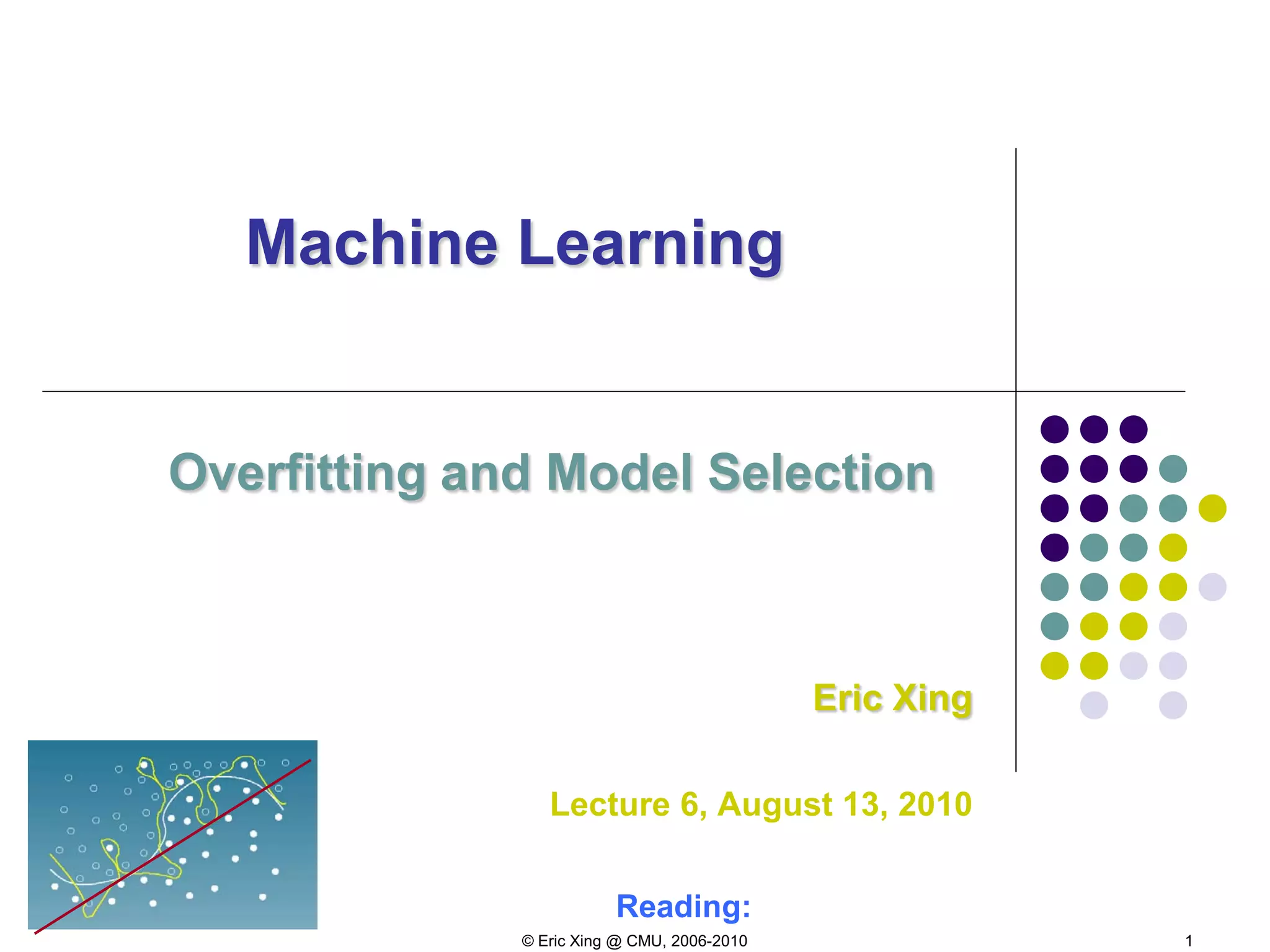
Machine Learning
Overfitting and Model Selection
Eric Xing
Lecture 6, August 13, 2010
Reading:
© Eric Xing @ CMU, 2006-2010 2
Outline
 Overfitting
 kNN
 Regression
 Bias-variance decomposition
 Generalization Theory and Structural Risk Minimization
 The battle against overfitting:
each learning algorithm has some "free knobs" that one can "tune" (i.e.,
heck) to make the algorithm generalizes better to test data.
But is there a more principled way?
 Cross validation
 Regularization
 Feature selection
 Model selection --- Occam's razor
 Model averaging
© Eric Xing @ CMU, 2006-2010 3
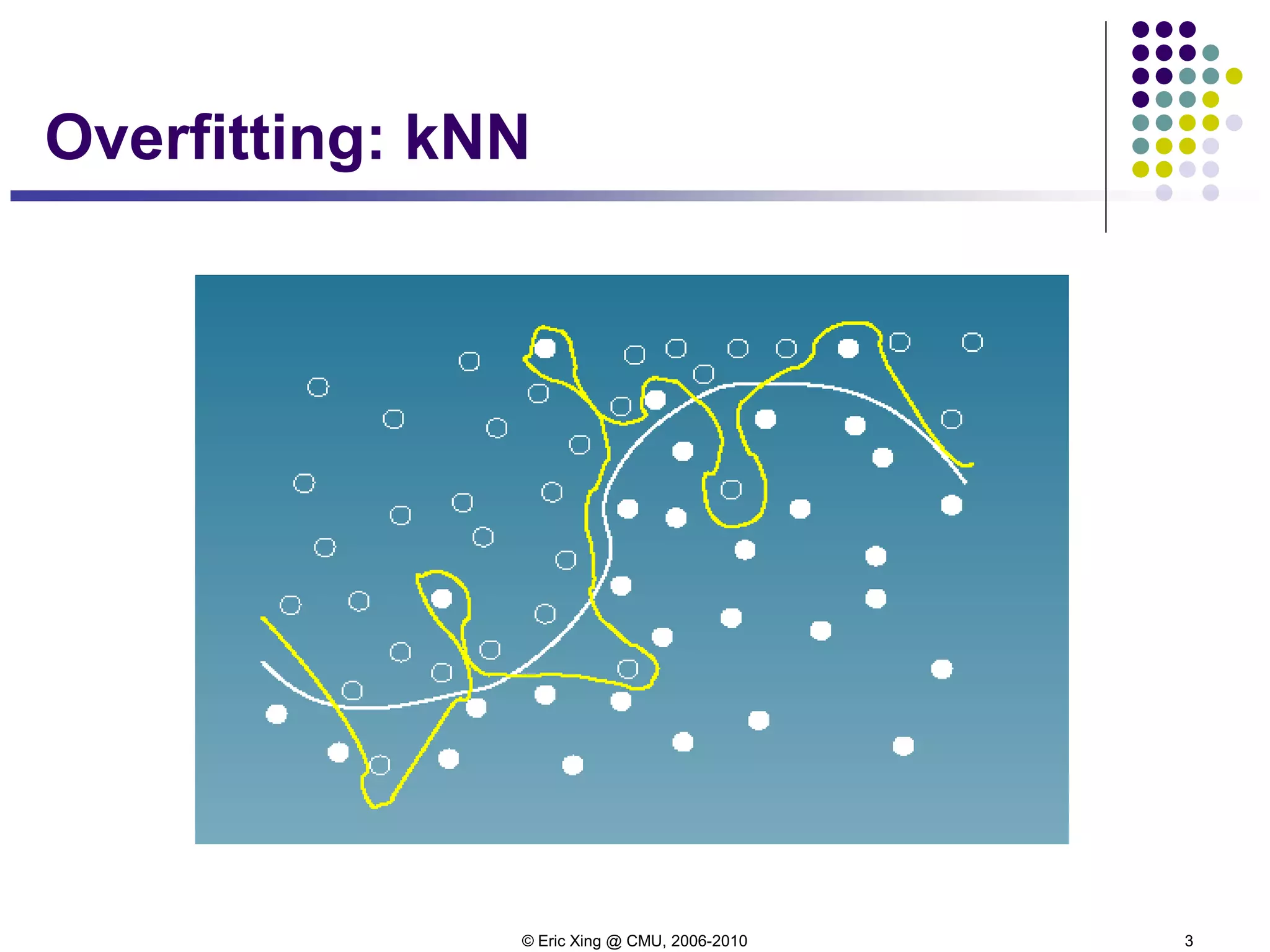
Overfitting: kNN
© Eric Xing @ CMU, 2006-2010 4
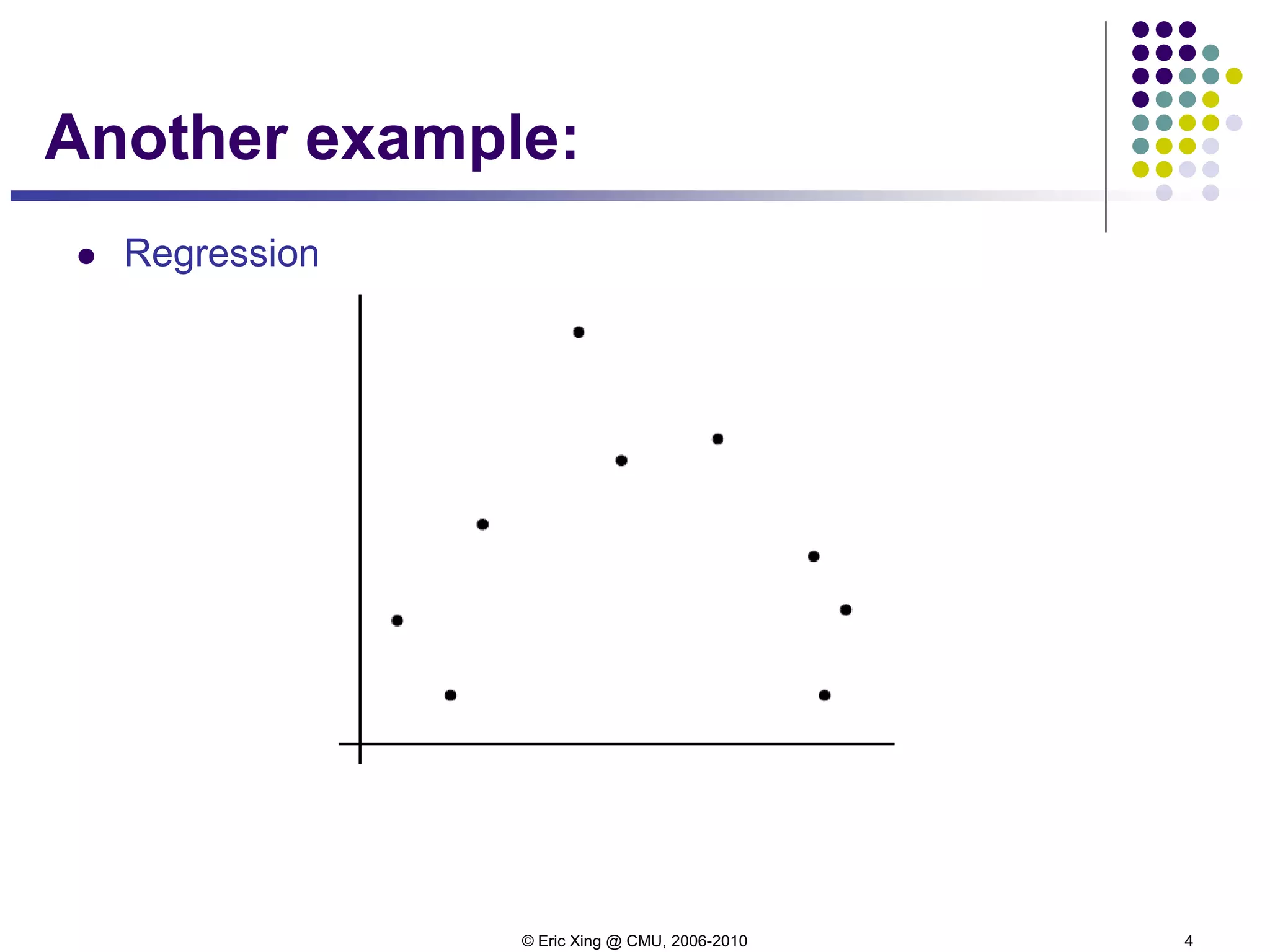
Another example:
 Regression
© Eric Xing @ CMU, 2006-2010 5
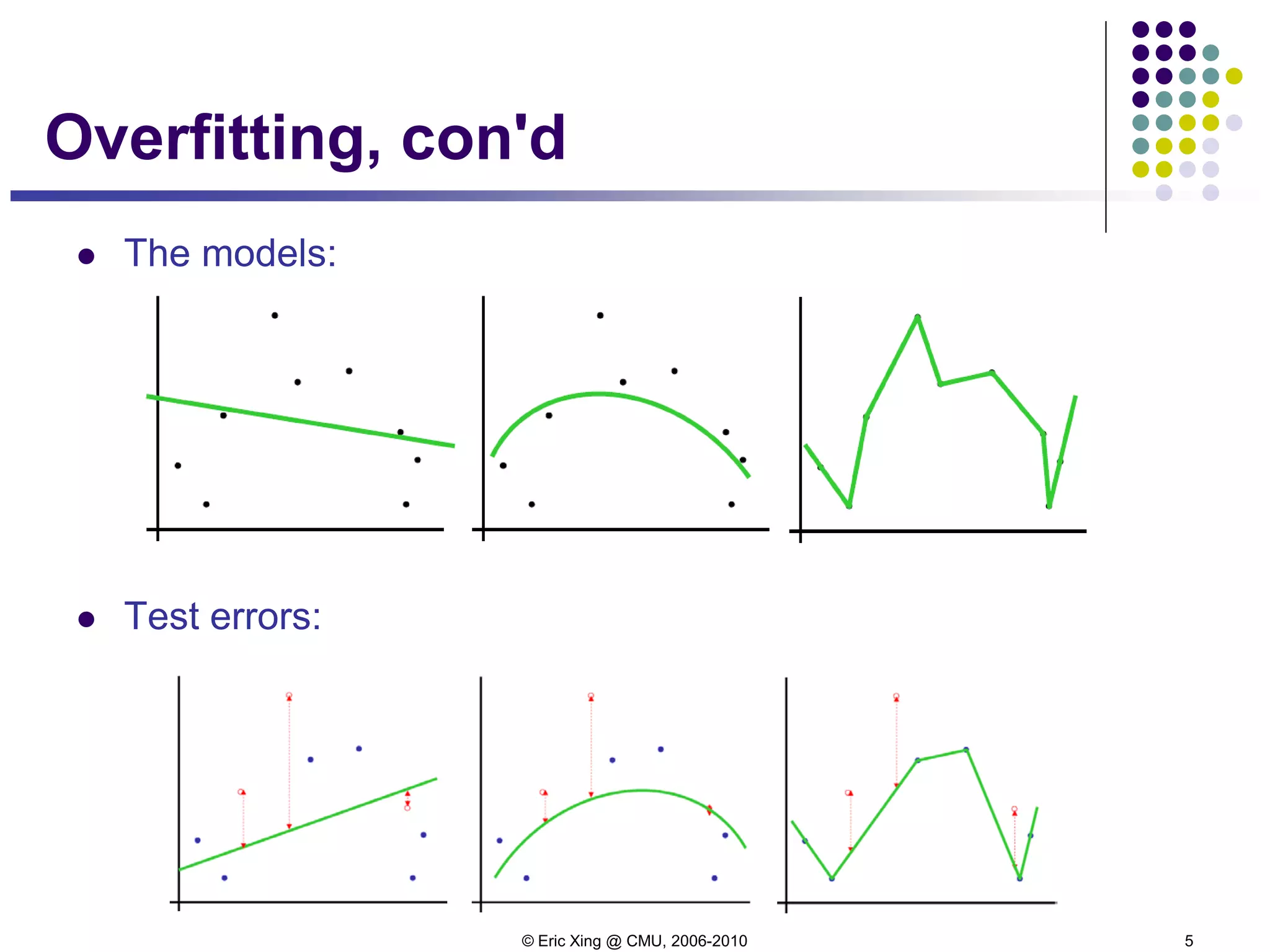
Overfitting, con'd
 The models:
 Test errors:
© Eric Xing @ CMU, 2006-2010 6
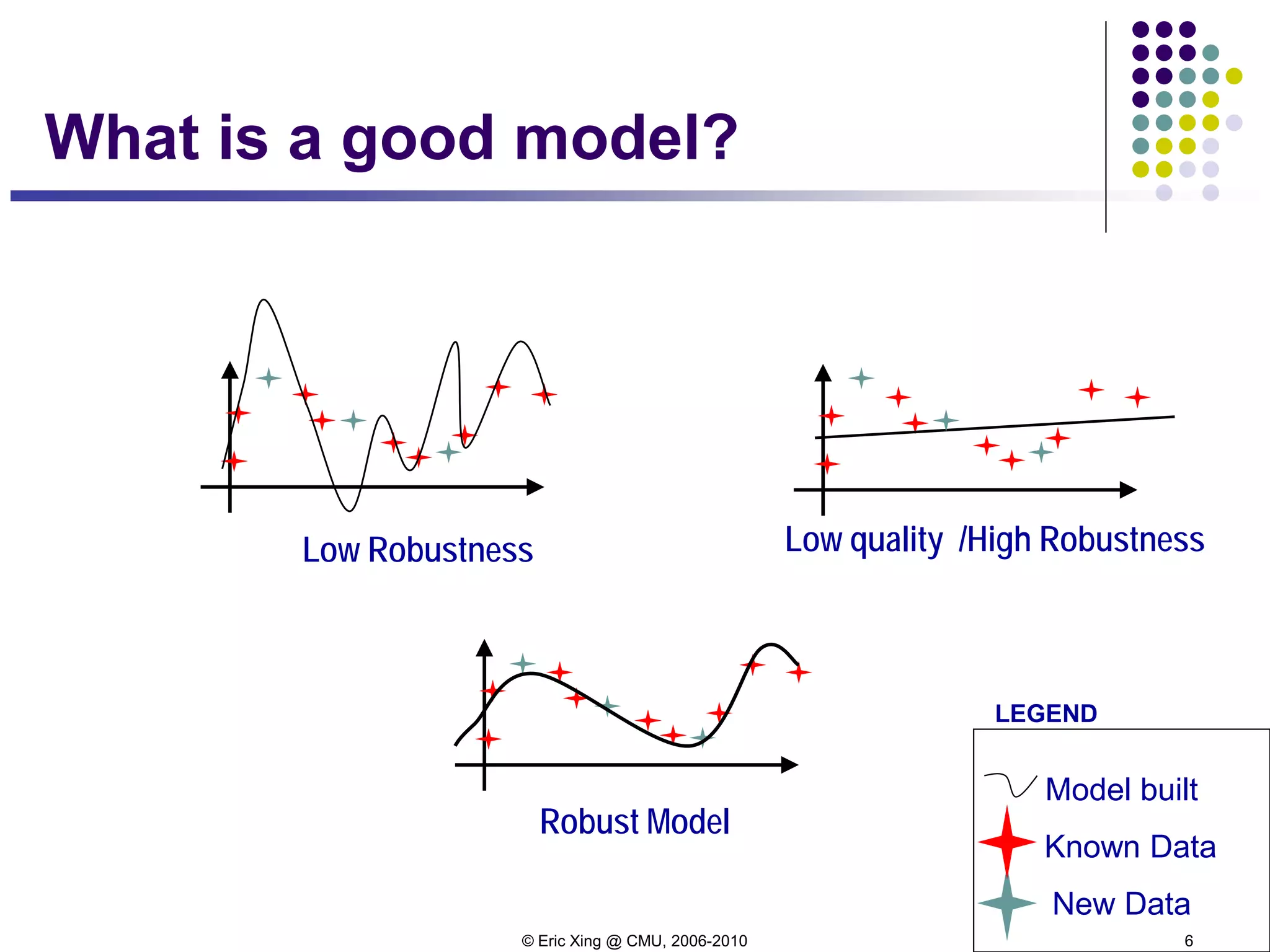
What is a good model?
Low Robustness
Robust Model
Low quality /High Robustness
Model built
Known Data
New Data
LEGEND
© Eric Xing @ CMU, 2006-2010 7
Bias-variance decomposition
 Now let's look more closely into two sources of errors in an
functional approximator:
 Let h(x) = E[t|x] be the optimal predictor, and y(x) our actual
predictor:
 expected loss = (bias)2 + variance + noise
( )[ ] [ ]( ) [ ]( )[ ]222
);();()();()();( DxyEDxyExhDxyExhDxyE DDDD −+−=−
© Eric Xing @ CMU, 2006-2010 8
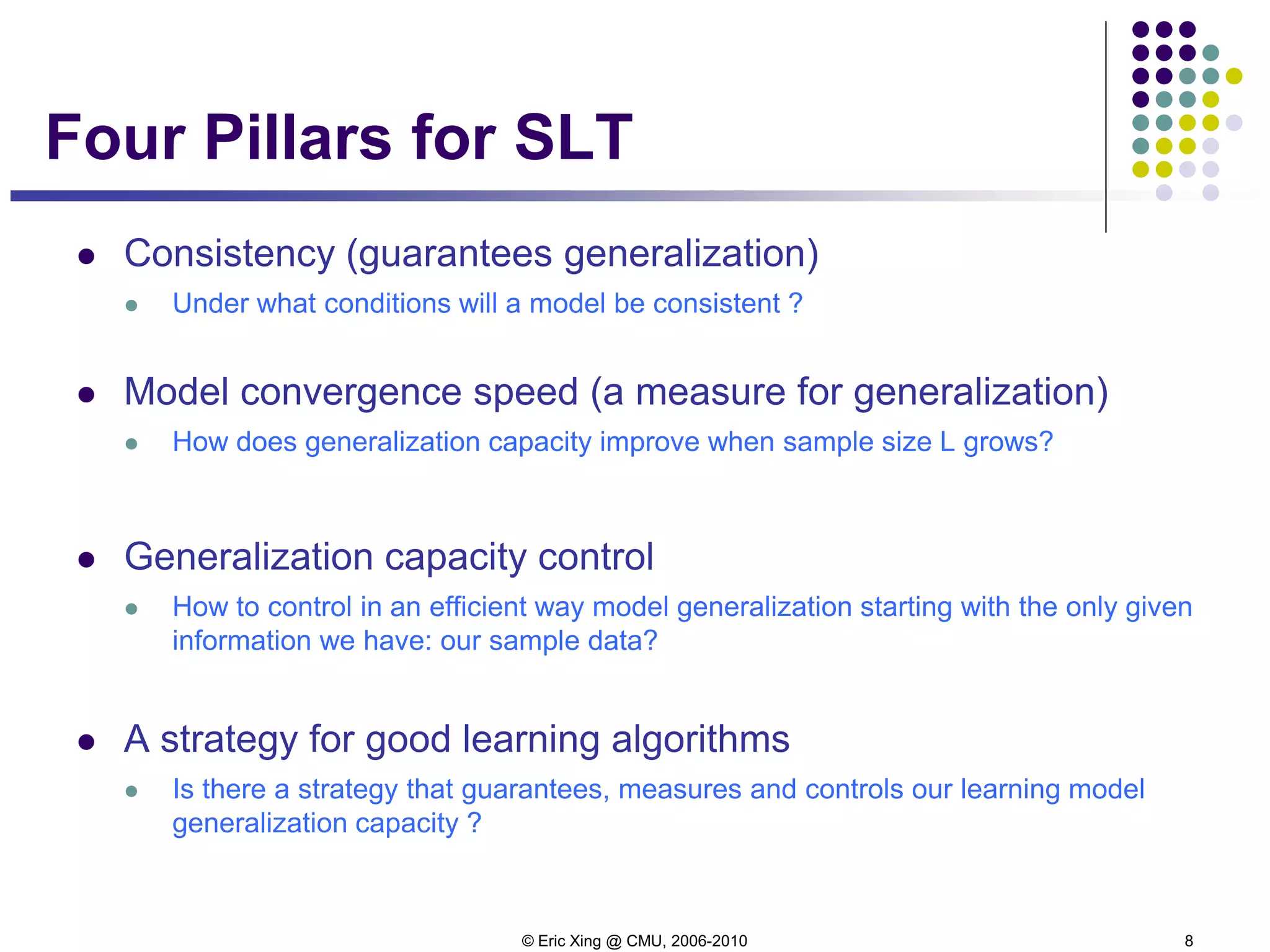
Four Pillars for SLT
 Consistency (guarantees generalization)
 Under what conditions will a model be consistent ?
 Model convergence speed (a measure for generalization)
 How does generalization capacity improve when sample size L grows?
 Generalization capacity control
 How to control in an efficient way model generalization starting with the only given
information we have: our sample data?
 A strategy for good learning algorithms
 Is there a strategy that guarantees, measures and controls our learning model
generalization capacity ?
© Eric Xing @ CMU, 2006-2010 10
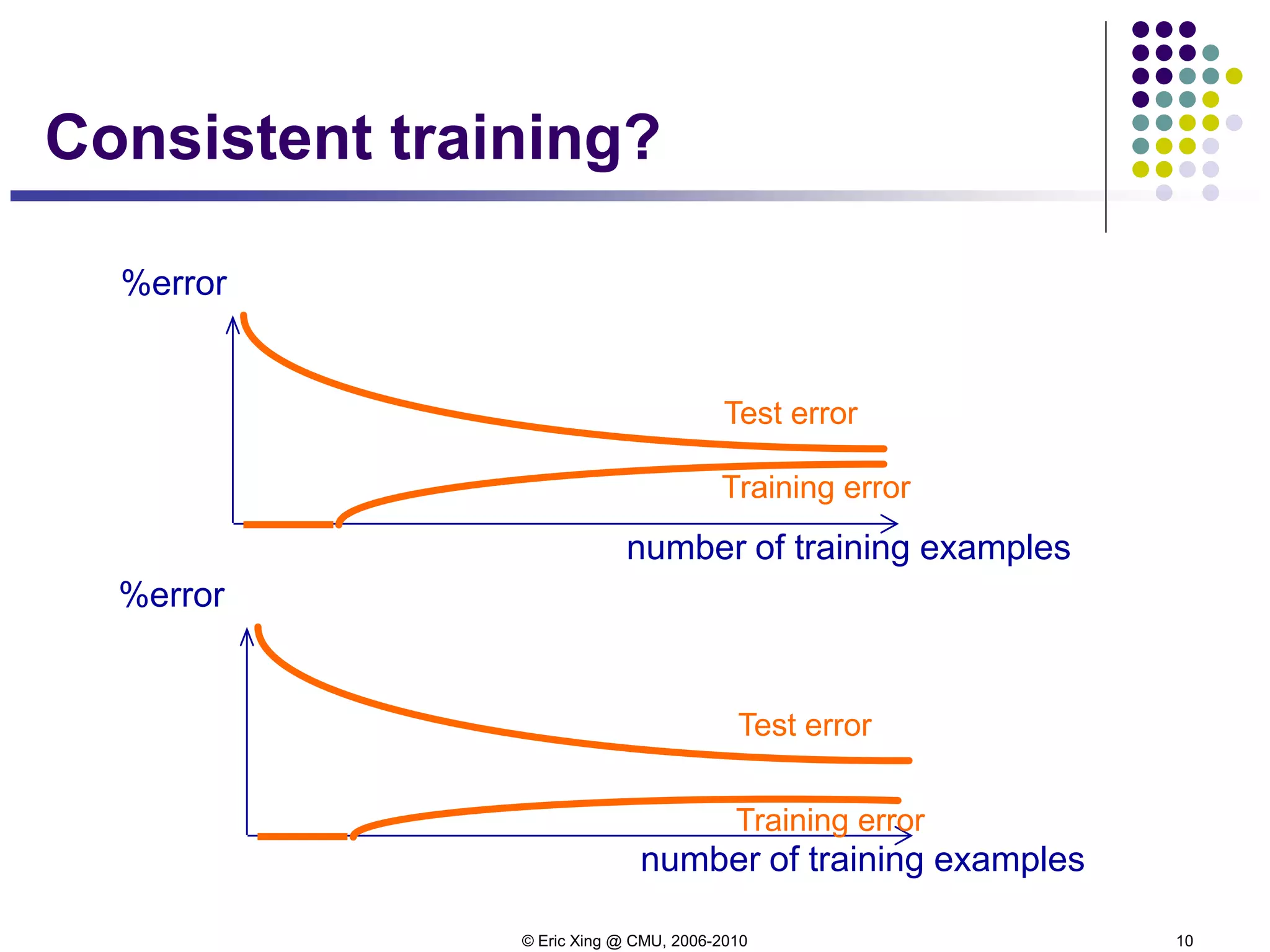
%error
number of training examples
Test error
Training error
%error
number of training examples
Test error
Training error
Consistent training?
© Eric Xing @ CMU, 2006-2010 11
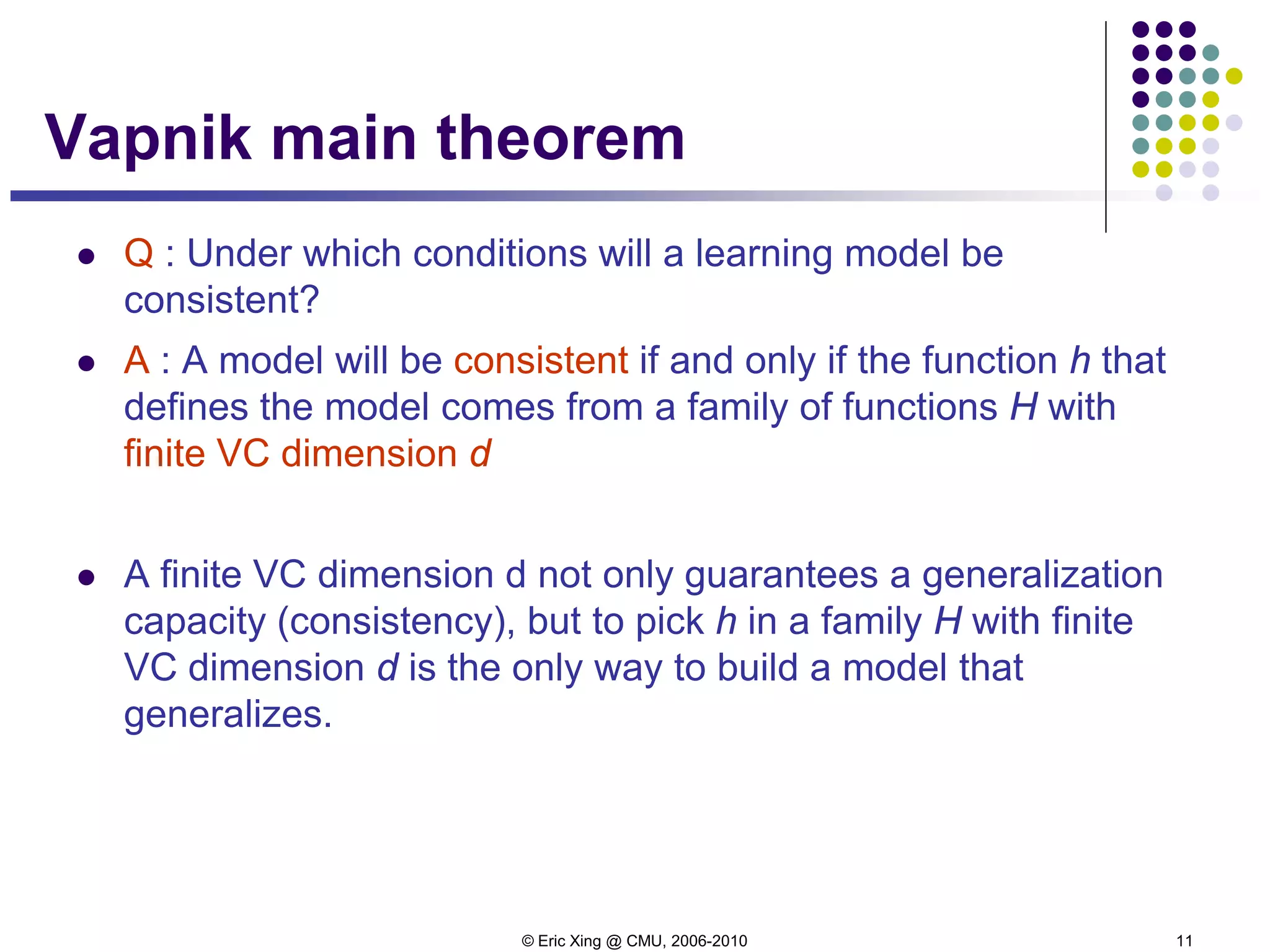
 Q : Under which conditions will a learning model be
consistent?
 A : A model will be consistent if and only if the function h that
defines the model comes from a family of functions H with
finite VC dimension d
 A finite VC dimension d not only guarantees a generalization
capacity (consistency), but to pick h in a family H with finite
VC dimension d is the only way to build a model that
generalizes.
Vapnik main theorem
© Eric Xing @ CMU, 2006-2010 12
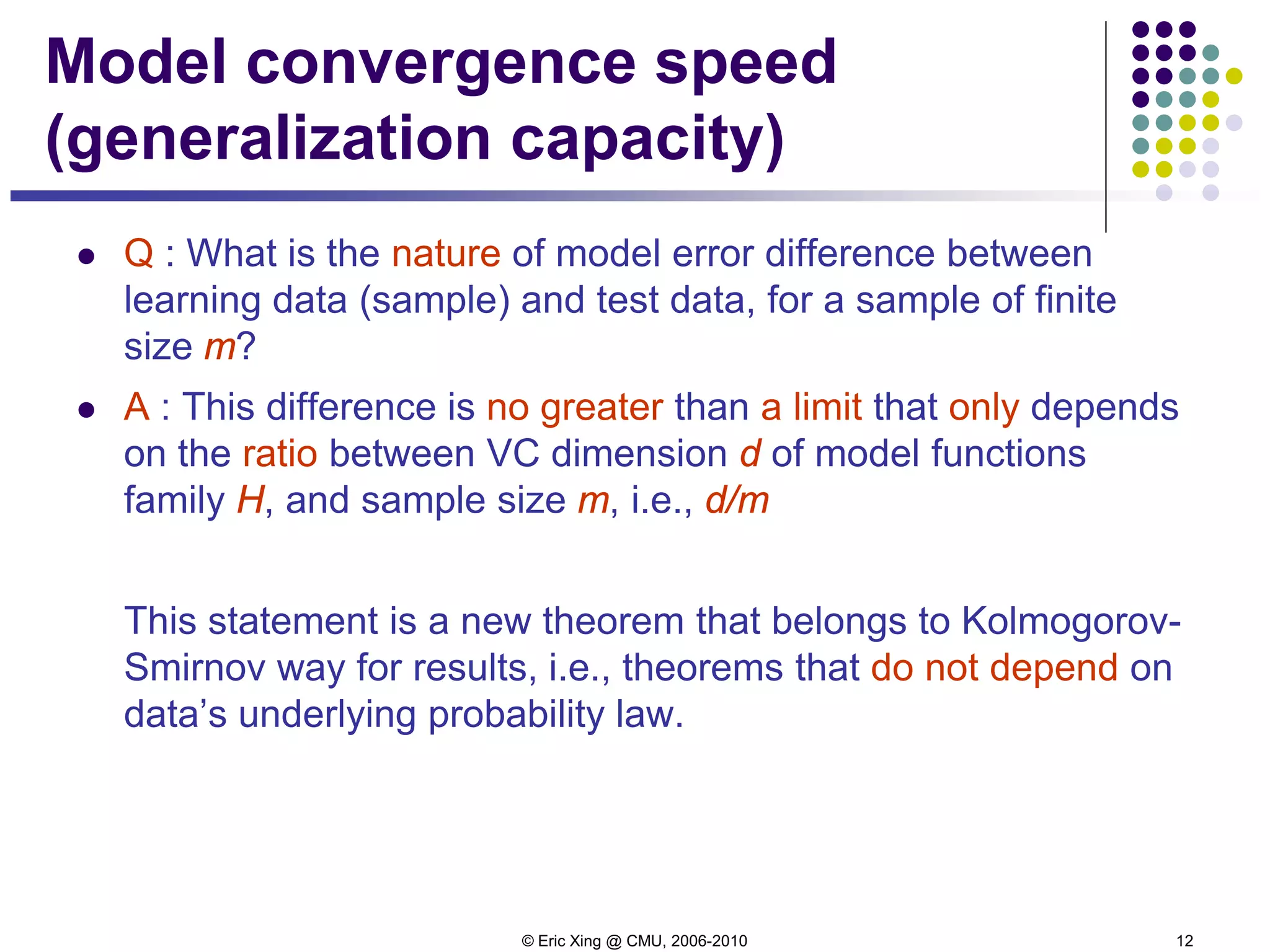
Model convergence speed
(generalization capacity)
 Q : What is the nature of model error difference between
learning data (sample) and test data, for a sample of finite
size m?
 A : This difference is no greater than a limit that only depends
on the ratio between VC dimension d of model functions
family H, and sample size m, i.e., d/m
This statement is a new theorem that belongs to Kolmogorov-
Smirnov way for results, i.e., theorems that do not depend on
data’s underlying probability law.
© Eric Xing @ CMU, 2006-2010 13
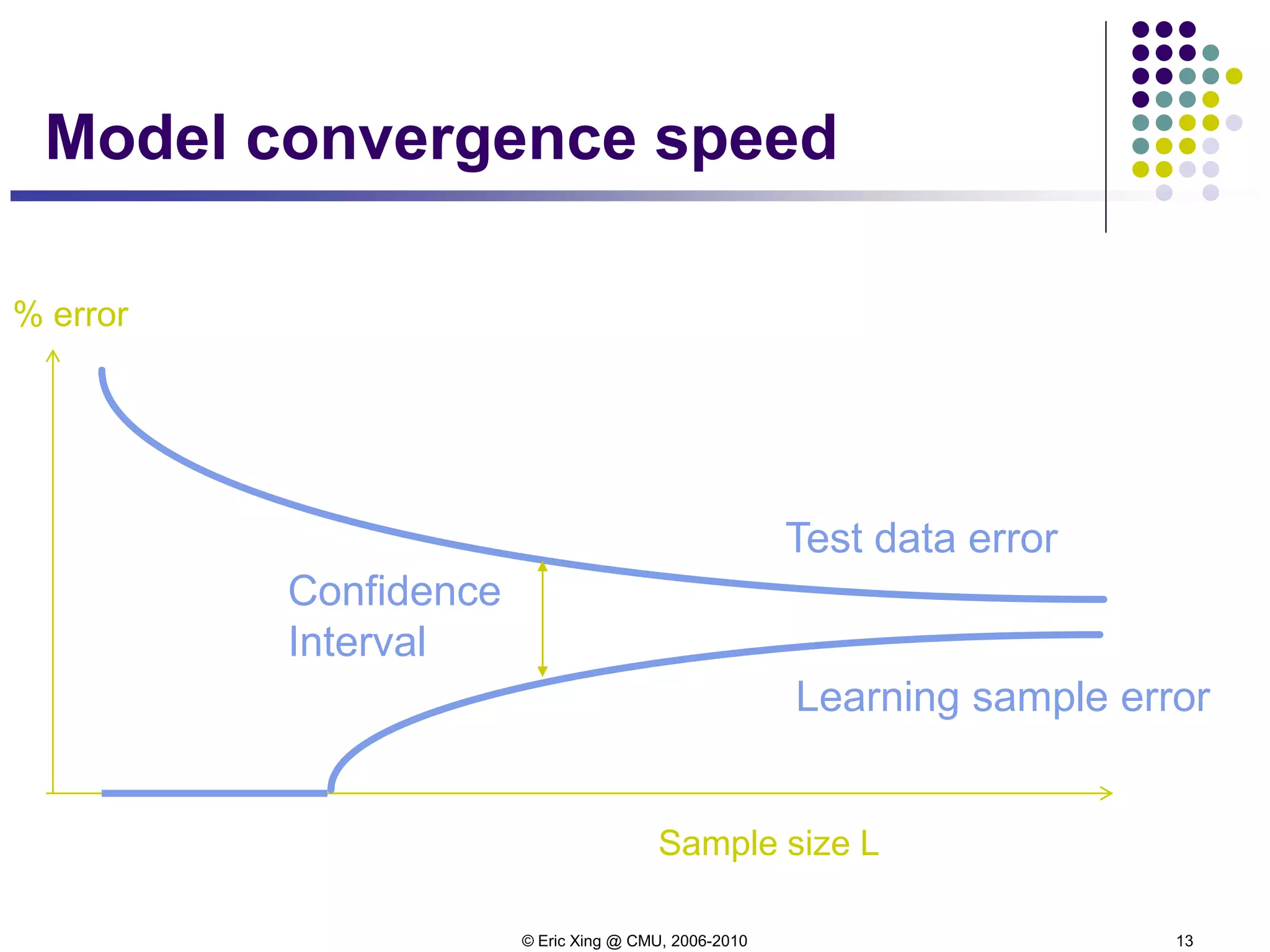
Sample size L
Confidence
Interval
Test data error
Learning sample error
% error
Model convergence speed
© Eric Xing @ CMU, 2006-2010 14
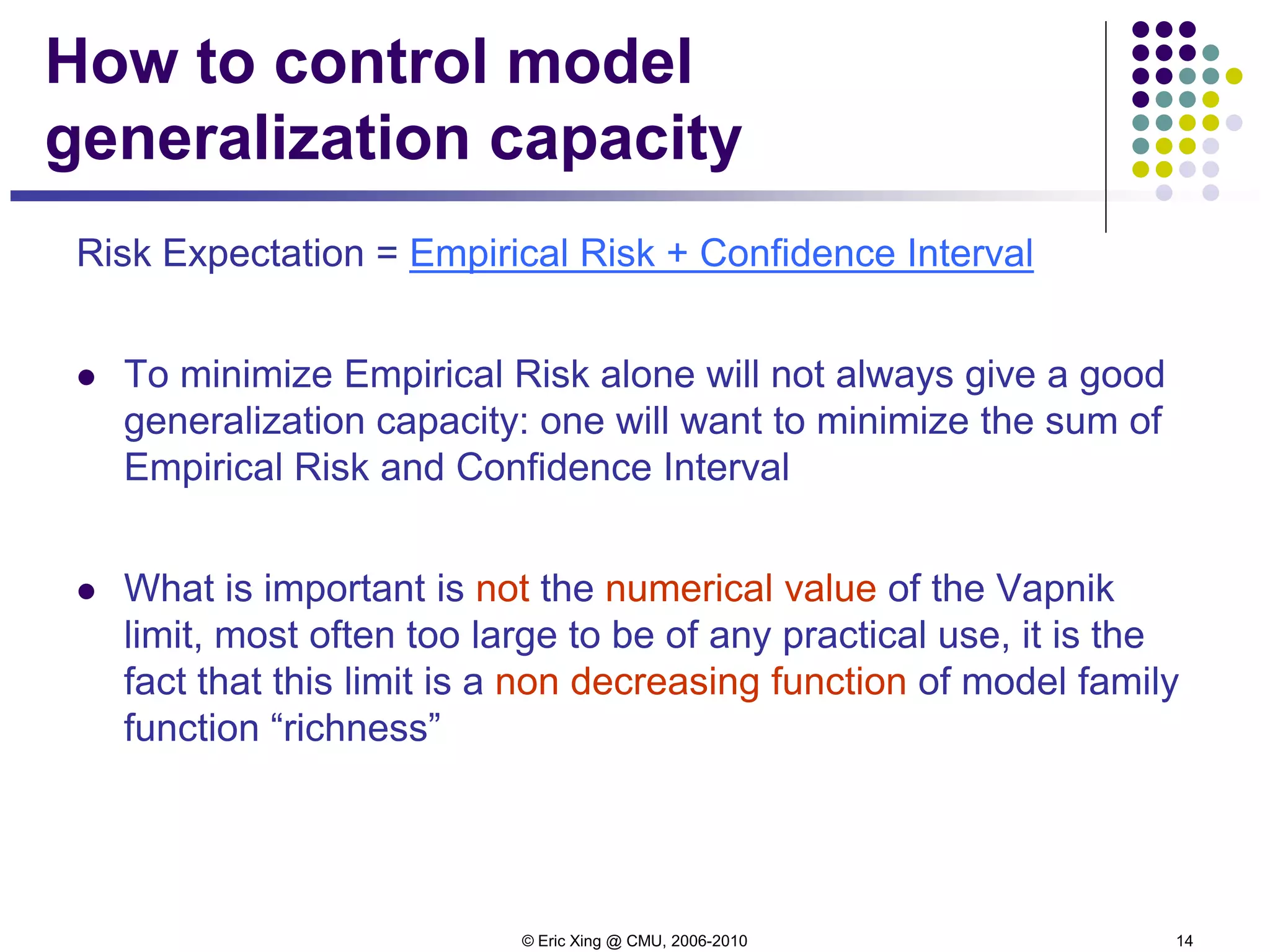
How to control model
generalization capacity
Risk Expectation = Empirical Risk + Confidence Interval
 To minimize Empirical Risk alone will not always give a good
generalization capacity: one will want to minimize the sum of
Empirical Risk and Confidence Interval
 What is important is not the numerical value of the Vapnik
limit, most often too large to be of any practical use, it is the
fact that this limit is a non decreasing function of model family
function “richness”
© Eric Xing @ CMU, 2006-2010 15
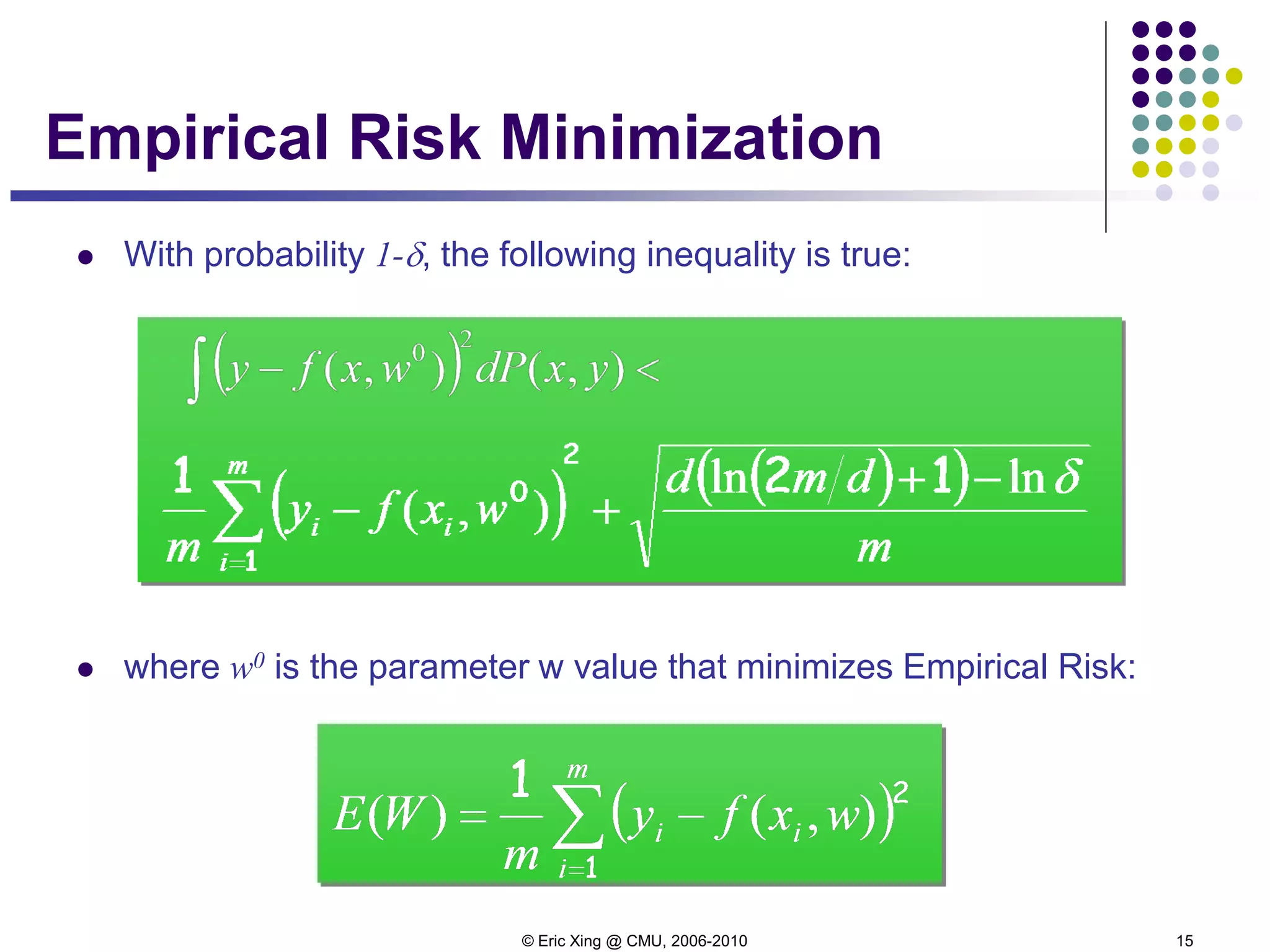
 With probability 1-δ, the following inequality is true:
 where w0 is the parameter w value that minimizes Empirical Risk:
Empirical Risk Minimization
© Eric Xing @ CMU, 2006-2010 16
Structural Risk Minimization
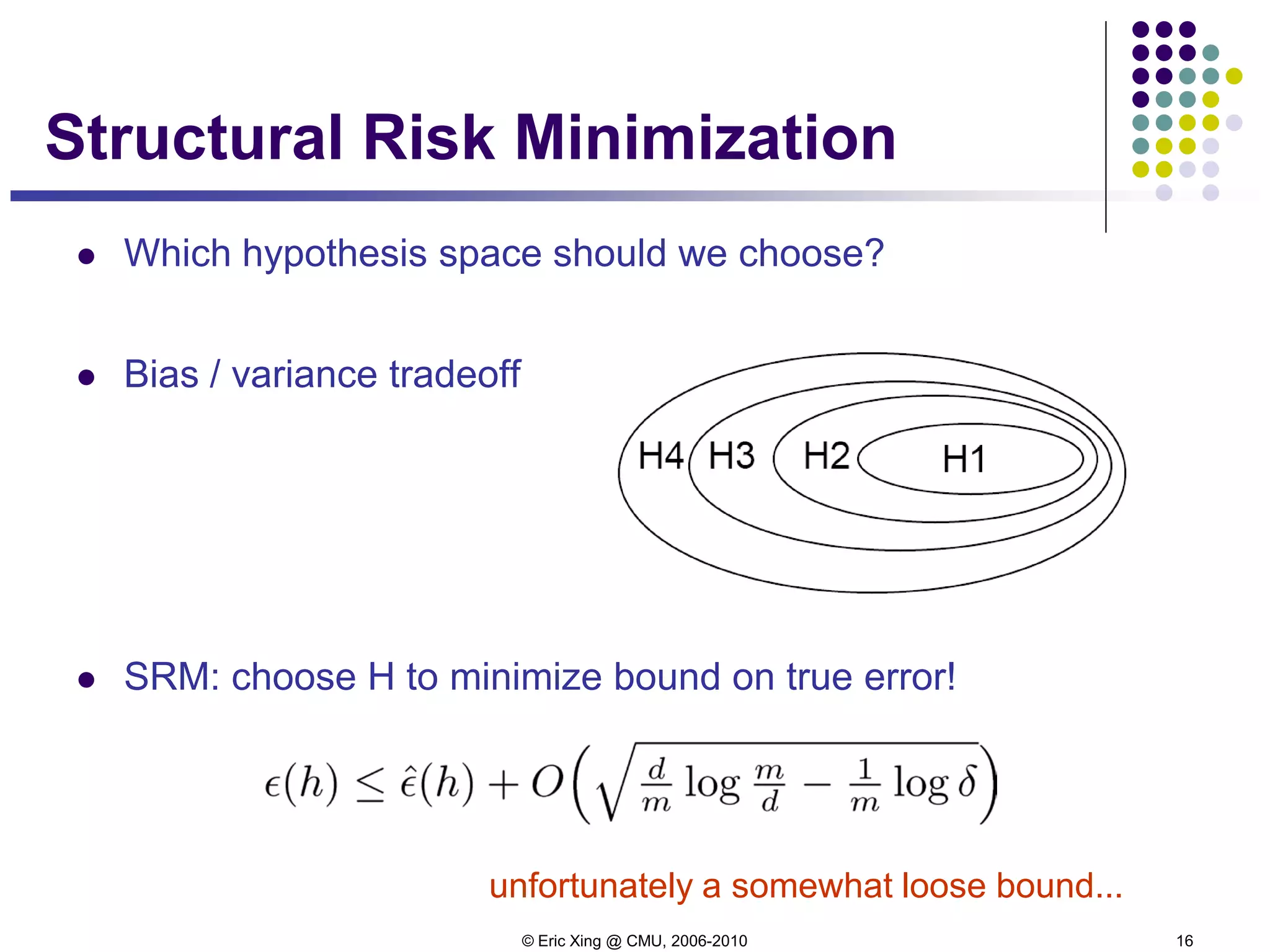
 Which hypothesis space should we choose?
 Bias / variance tradeoff
 SRM: choose H to minimize bound on true error!
unfortunately a somewhat loose bound...
© Eric Xing @ CMU, 2006-2010 17
SRM strategy (1)
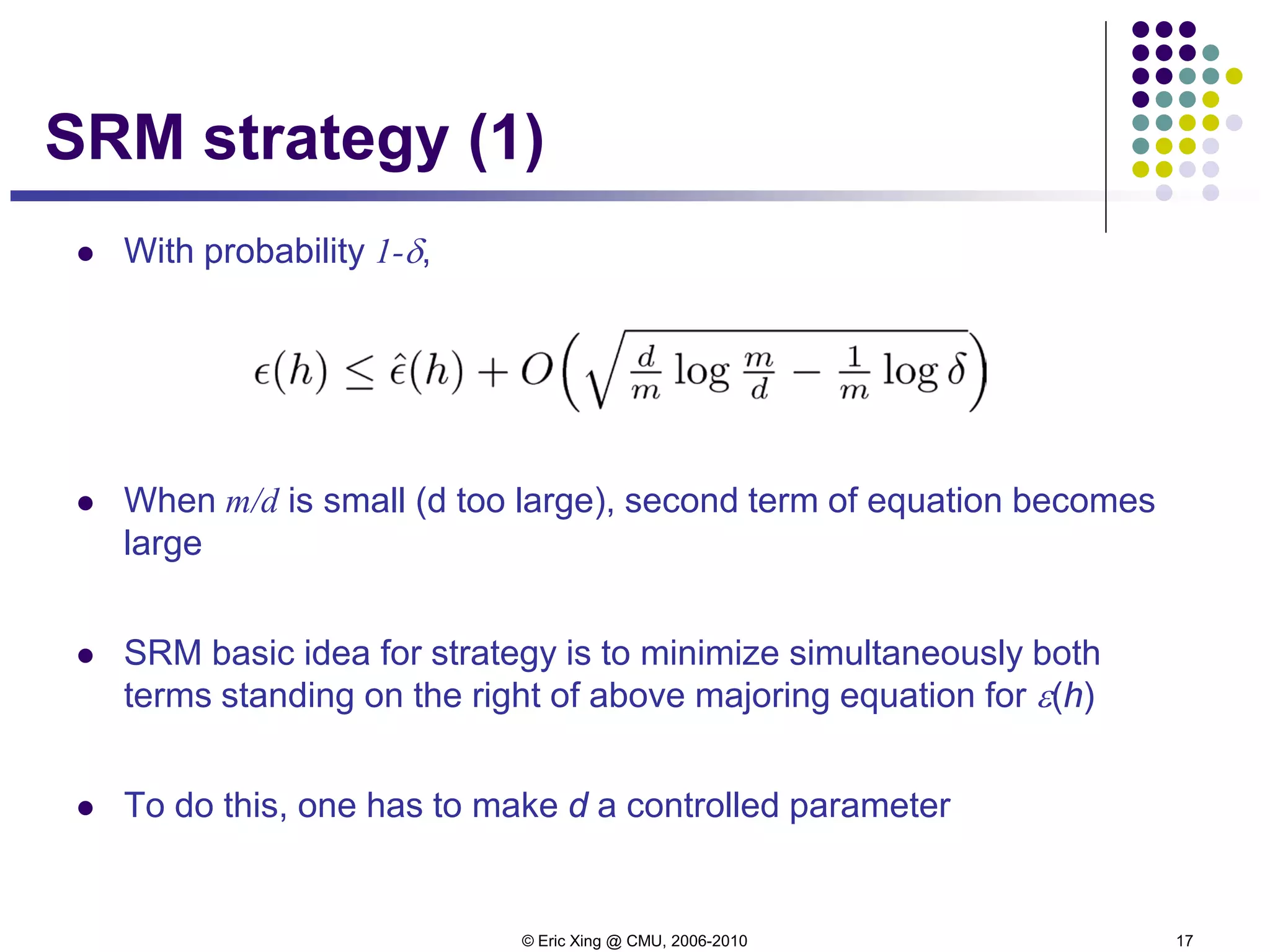
 With probability 1-δ,
 When m/d is small (d too large), second term of equation becomes
large
 SRM basic idea for strategy is to minimize simultaneously both
terms standing on the right of above majoring equation for ε(h)
 To do this, one has to make d a controlled parameter
© Eric Xing @ CMU, 2006-2010 18
SRM strategy (2)
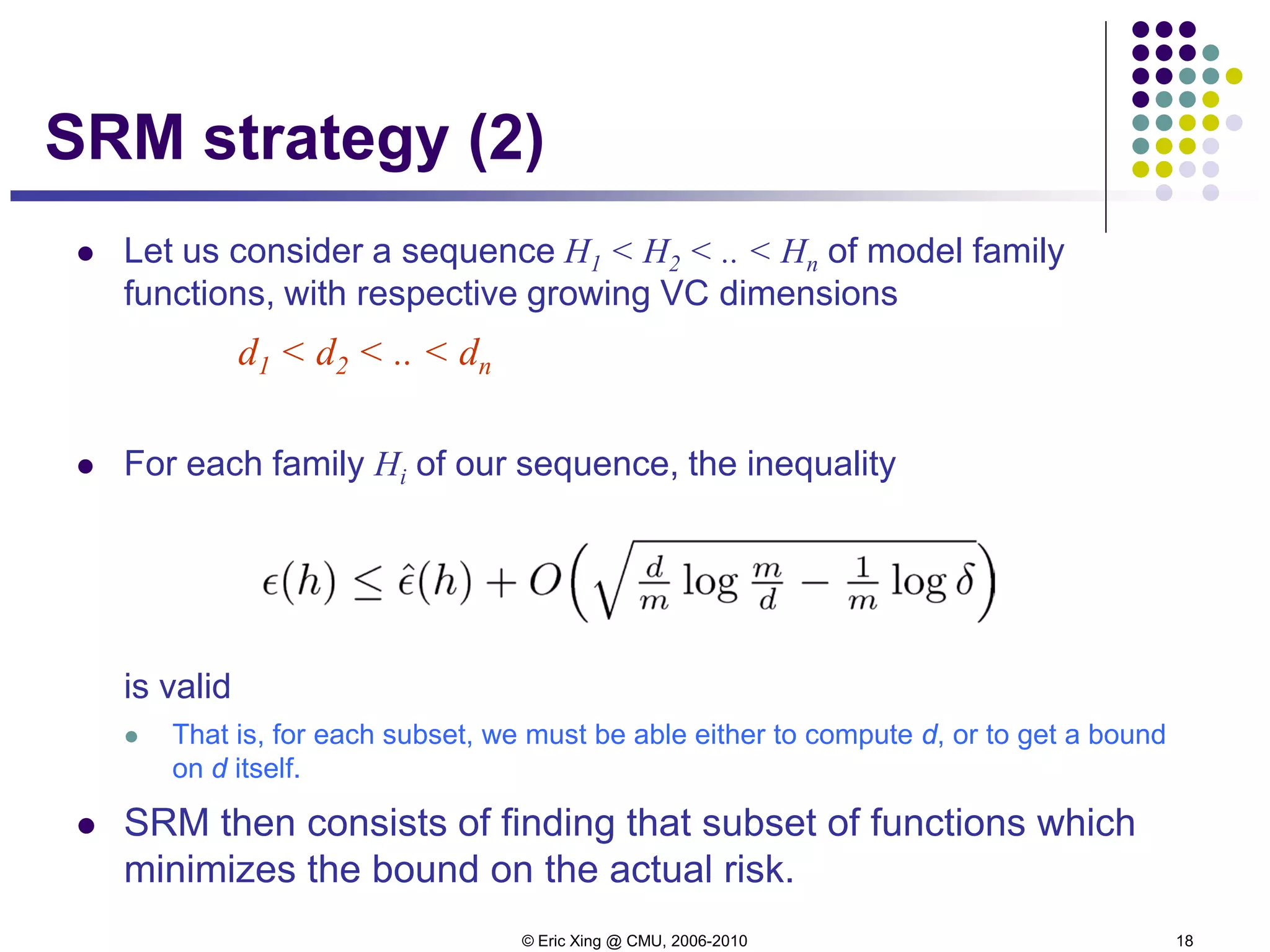
 Let us consider a sequence H1 < H2 < .. < Hn of model family
functions, with respective growing VC dimensions
d1 < d2 < .. < dn
 For each family Hi of our sequence, the inequality
is valid
 That is, for each subset, we must be able either to compute d, or to get a bound
on d itself.
 SRM then consists of finding that subset of functions which
minimizes the bound on the actual risk.
© Eric Xing @ CMU, 2006-2010 19
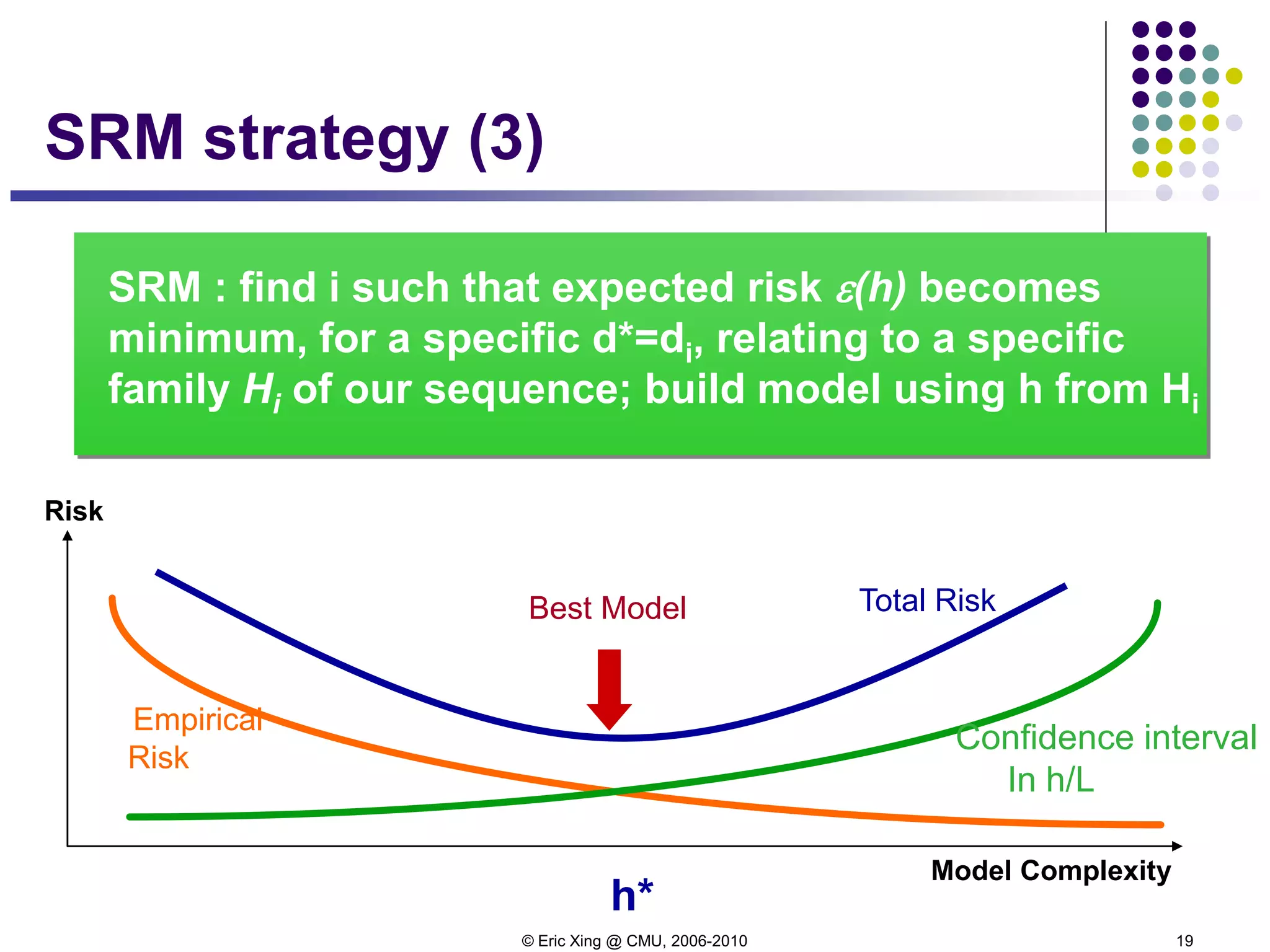
SRM : find i such that expected risk ε(h) becomes
minimum, for a specific d*=di, relating to a specific
family Hi of our sequence; build model using h from Hi
Empirical
Risk
Risk
Model Complexity
Total Risk
Confidence interval
In h/L
Best Model
h*
SRM strategy (3)
© Eric Xing @ CMU, 2006-2010 20
Putting SRM into action:
linear models case (1)
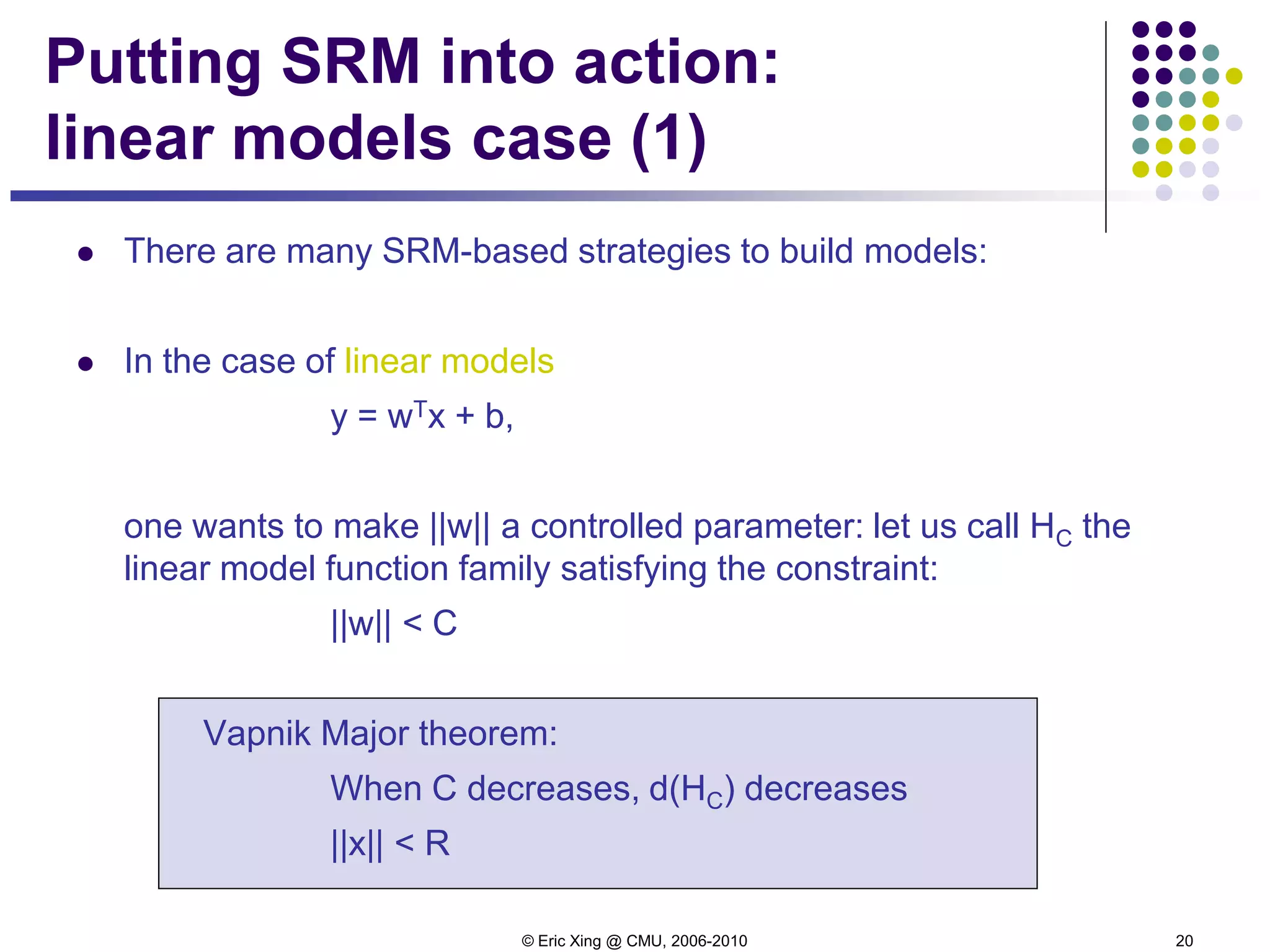
 There are many SRM-based strategies to build models:
 In the case of linear models
y = wTx + b,
one wants to make ||w|| a controlled parameter: let us call HC the
linear model function family satisfying the constraint:
||w|| < C
Vapnik Major theorem:
When C decreases, d(HC) decreases
||x|| < R
© Eric Xing @ CMU, 2006-2010 21
Putting SRM into action:
linear models case (2)
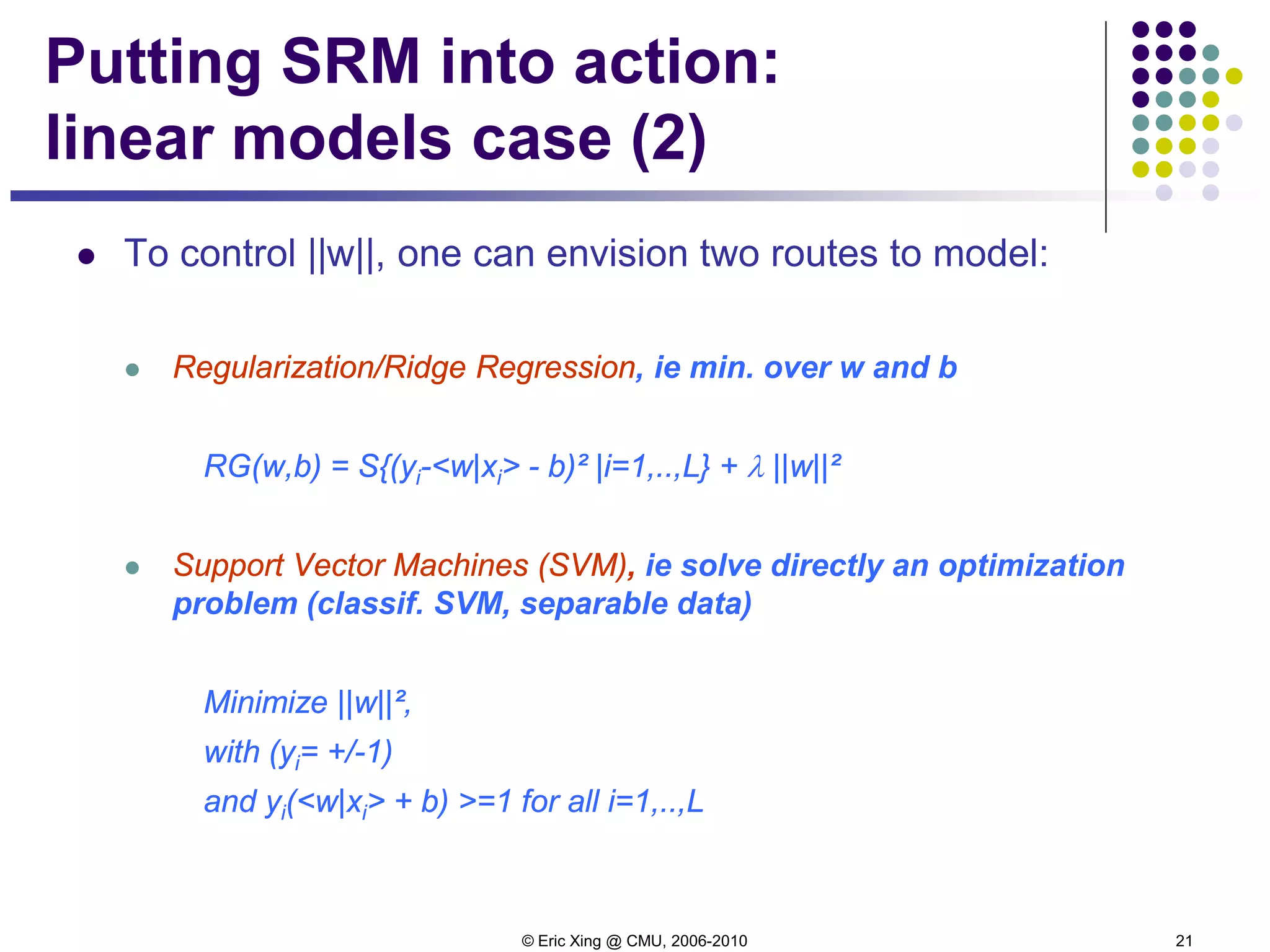
 To control ||w||, one can envision two routes to model:
 Regularization/Ridge Regression, ie min. over w and b
RG(w,b) = S{(yi-<w|xi> - b)² |i=1,..,L} + λ ||w||²
 Support Vector Machines (SVM), ie solve directly an optimization
problem (classif. SVM, separable data)
Minimize ||w||²,
with (yi= +/-1)
and yi(<w|xi> + b) >=1 for all i=1,..,L
© Eric Xing @ CMU, 2006-2010 22
Regularized Regression
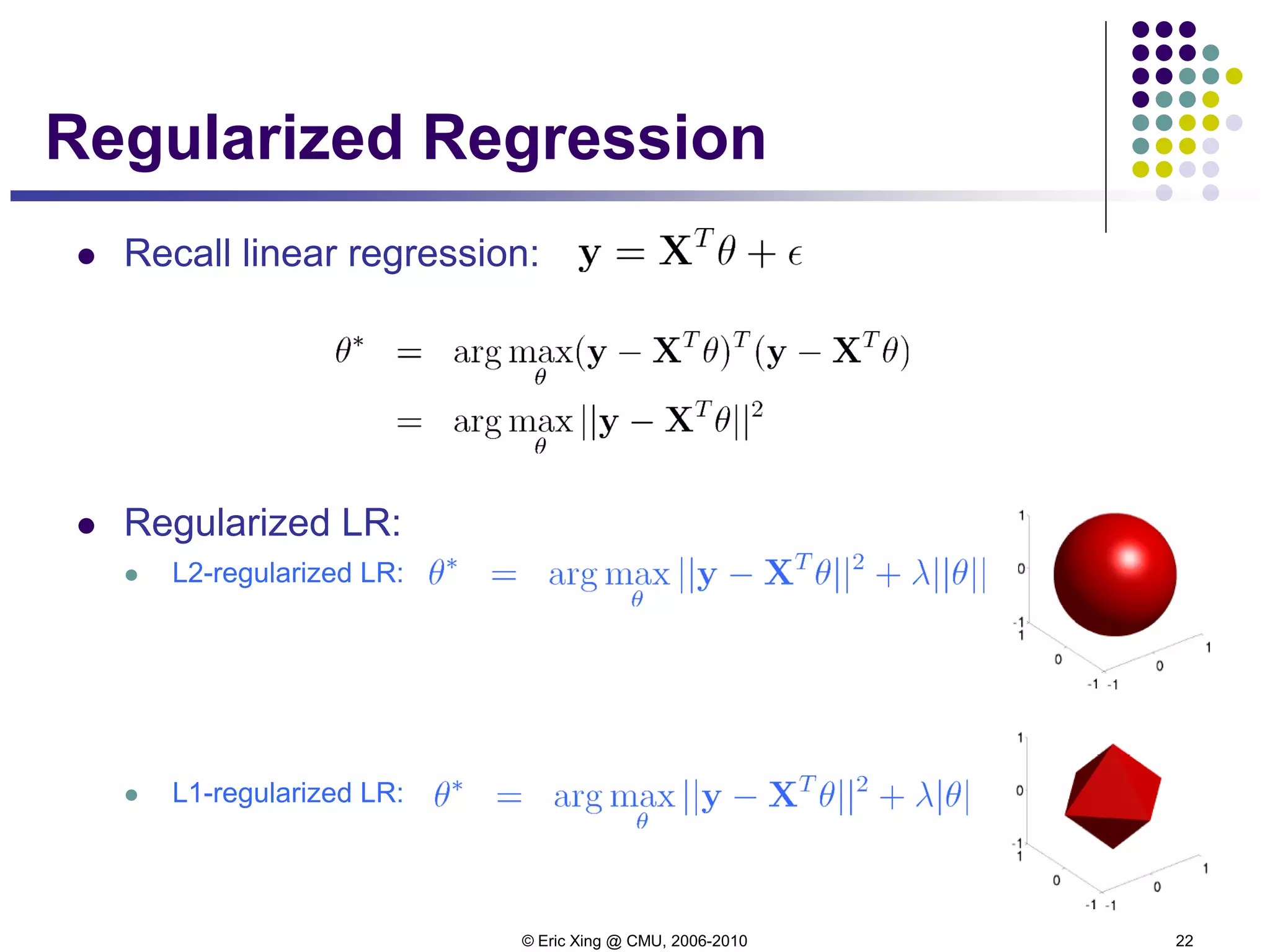
 Recall linear regression:
 Regularized LR:
 L2-regularized LR:
 L1-regularized LR:
© Eric Xing @ CMU, 2006-2010 23
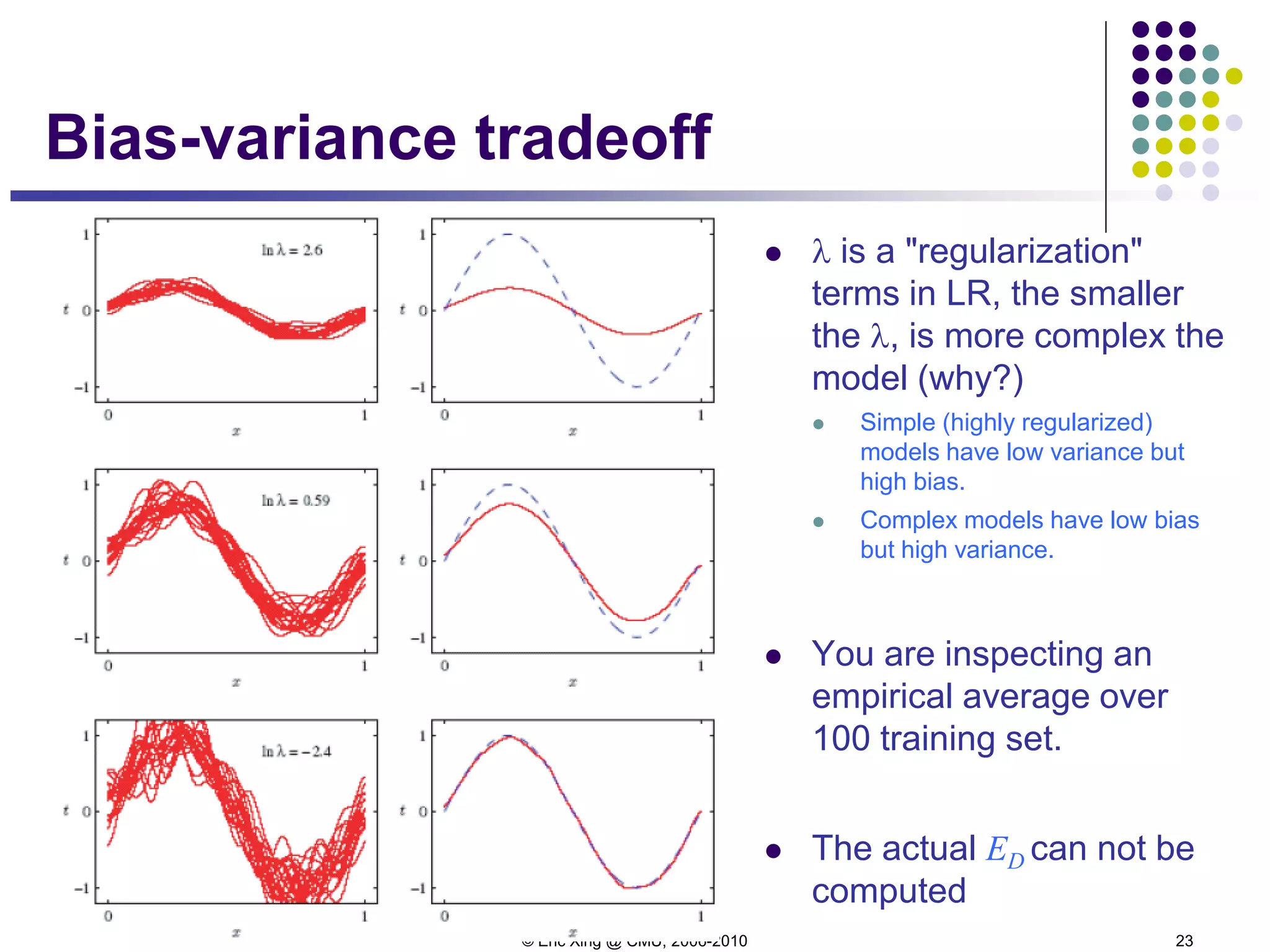
Bias-variance tradeoff
 λ is a "regularization"
terms in LR, the smaller
the λ, is more complex the
model (why?)
 Simple (highly regularized)
models have low variance but
high bias.
 Complex models have low bias
but high variance.
 You are inspecting an
empirical average over
100 training set.
 The actual ED can not be
computed
© Eric Xing @ CMU, 2006-2010 24
Bias2+variance vs regularizer
 Bias2+variance predicts (shape of) test error quite well.
 However, bias and variance cannot be computed since it
relies on knowing the true distribution of x and t (and hence
h(x) = E[t|x]).
© Eric Xing @ CMU, 2006-2010 25
The battle against overfitting
© Eric Xing @ CMU, 2006-2010 26
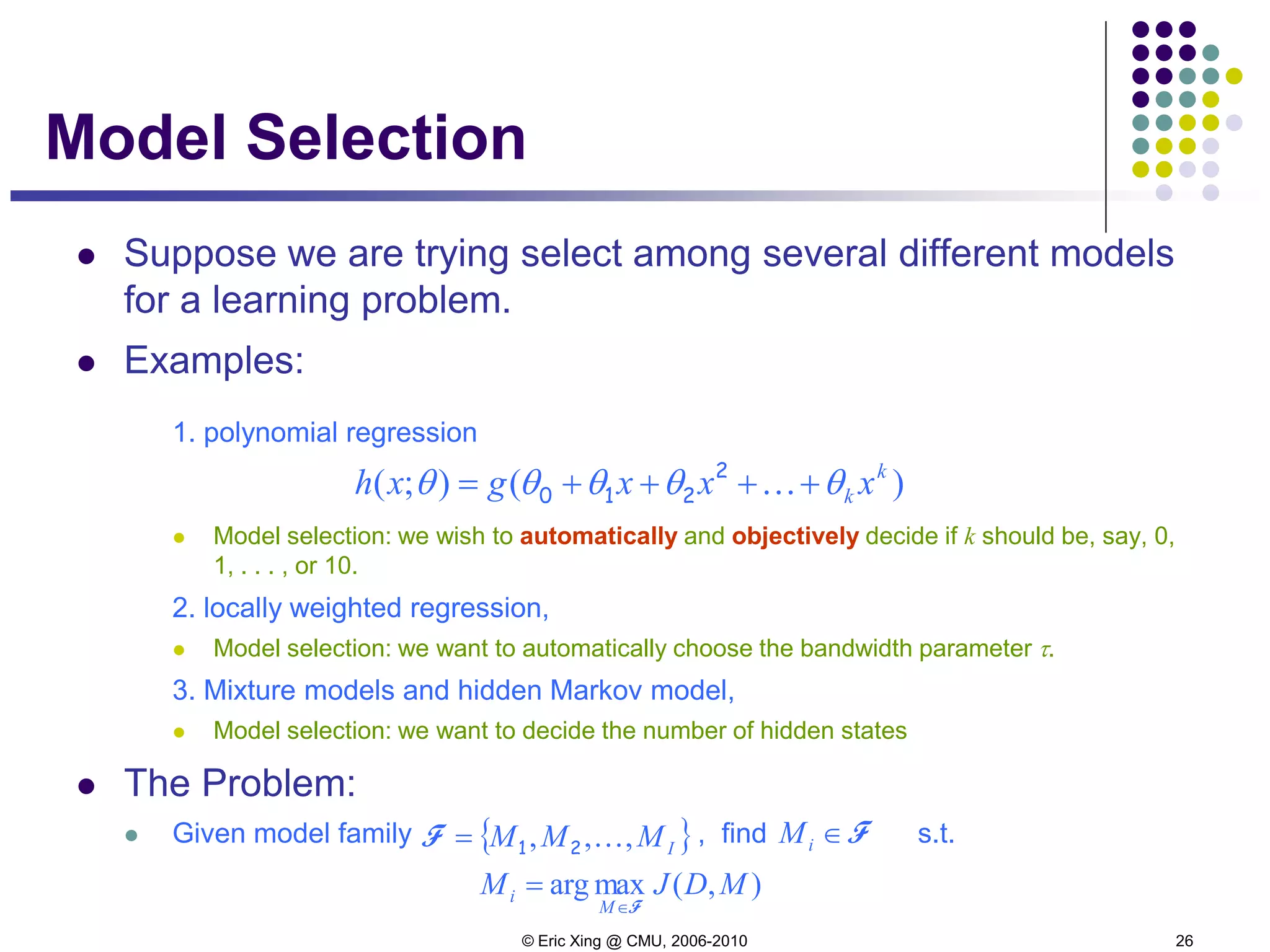
Model Selection
 Suppose we are trying select among several different models
for a learning problem.
 Examples:
1. polynomial regression
 Model selection: we wish to automatically and objectively decide if k should be, say, 0,
1, . . . , or 10.
2. locally weighted regression,
 Model selection: we want to automatically choose the bandwidth parameter τ.
3. Mixture models and hidden Markov model,
 Model selection: we want to decide the number of hidden states
 The Problem:
 Given model family , find s.t.
)();( k
k xxxgxh θθθθθ ++++= 2
210
{ }IMMM ,,, 21=F F∈iM
),(maxarg MDJM
M
i
F∈
=
© Eric Xing @ CMU, 2006-2010 27
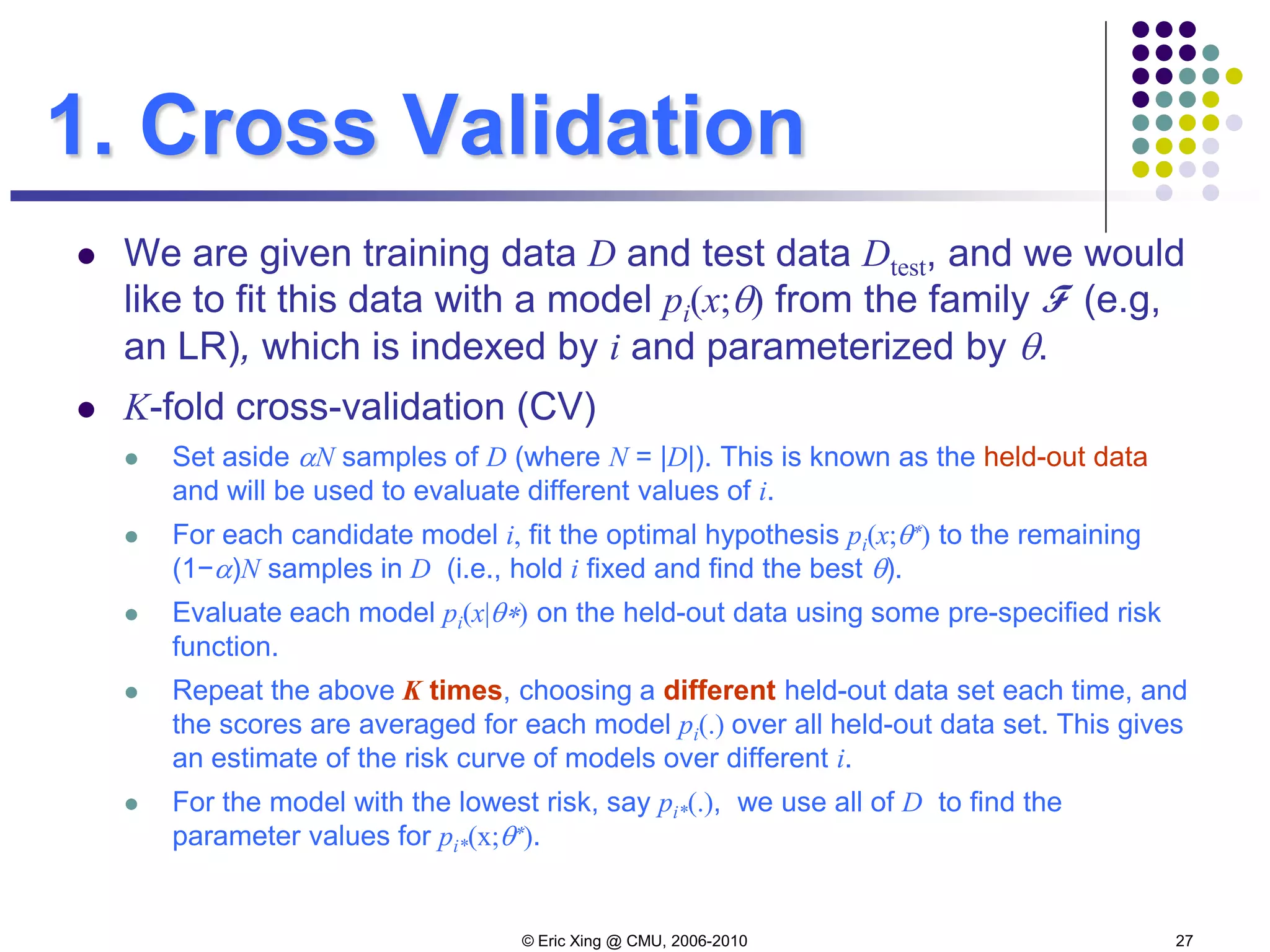
1. Cross Validation
 We are given training data D and test data Dtest, and we would
like to fit this data with a model pi(x;θ) from the family F (e.g,
an LR), which is indexed by i and parameterized by θ.
 K-fold cross-validation (CV)
 Set aside αN samples of D (where N = |D|). This is known as the held-out data
and will be used to evaluate different values of i.
 For each candidate model i, fit the optimal hypothesis pi(x;θ∗) to the remaining
(1−α)N samples in D (i.e., hold i fixed and find the best θ).
 Evaluate each model pi(x|θ∗) on the held-out data using some pre-specified risk
function.
 Repeat the above K times, choosing a different held-out data set each time, and
the scores are averaged for each model pi(.) over all held-out data set. This gives
an estimate of the risk curve of models over different i.
 For the model with the lowest risk, say pi*(.), we use all of D to find the
parameter values for pi*(x;θ∗).
© Eric Xing @ CMU, 2006-2010 28
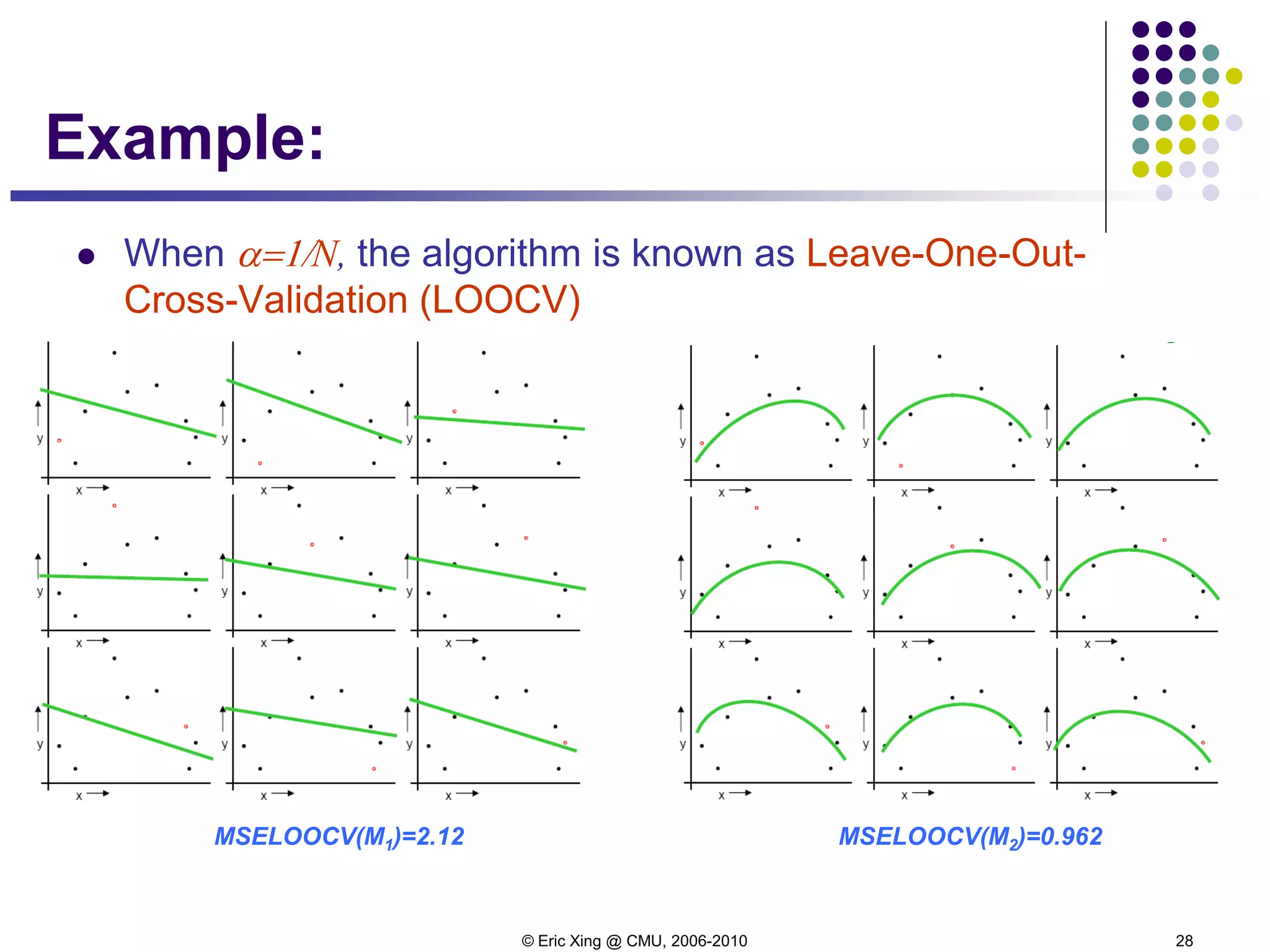
Example:
 When α=1/N, the algorithm is known as Leave-One-Out-
Cross-Validation (LOOCV)
MSELOOCV(M2)=0.962MSELOOCV(M1)=2.12
© Eric Xing @ CMU, 2006-2010 29
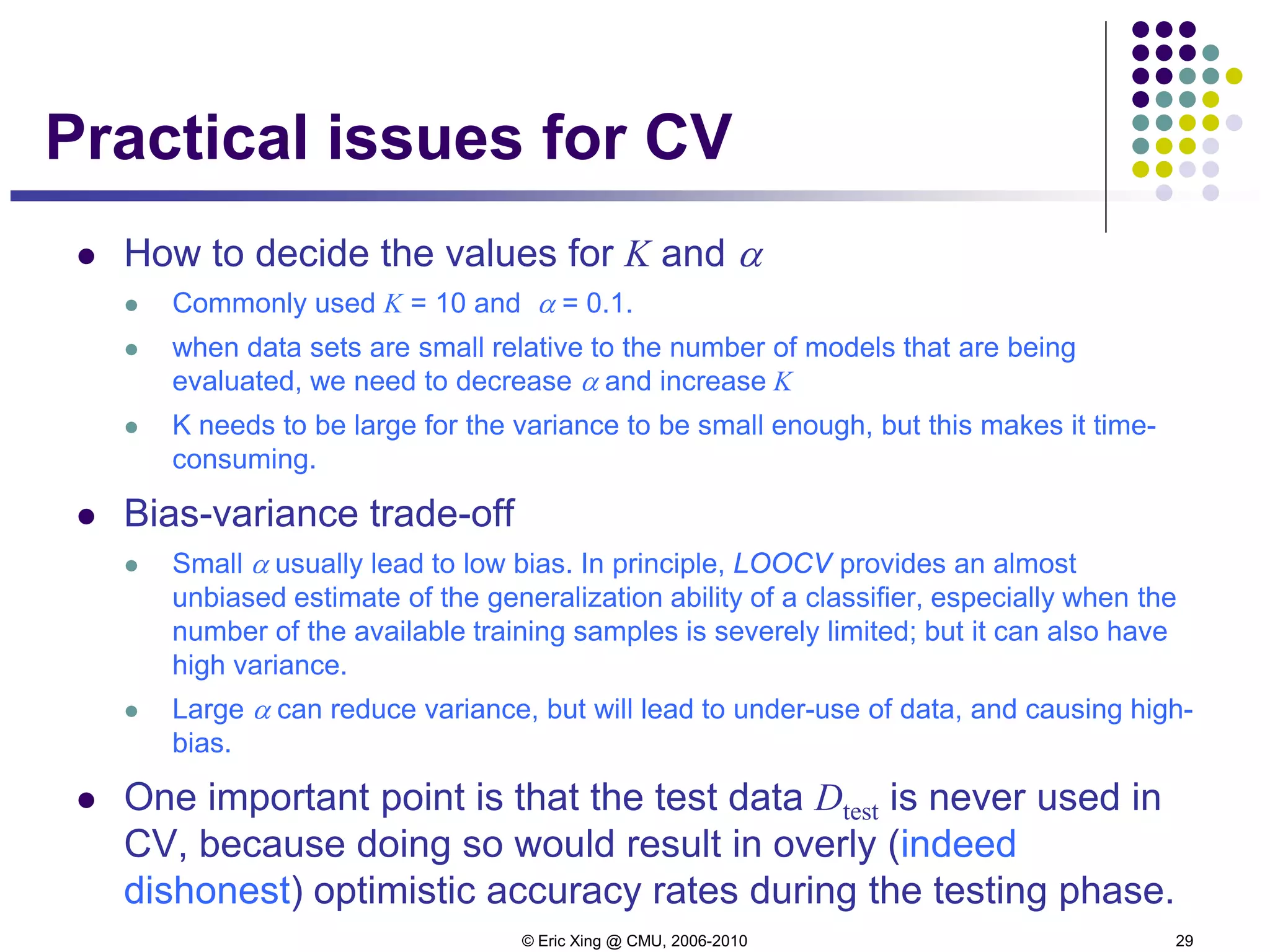
Practical issues for CV
 How to decide the values for K and α
 Commonly used K = 10 and α = 0.1.
 when data sets are small relative to the number of models that are being
evaluated, we need to decrease α and increase K
 K needs to be large for the variance to be small enough, but this makes it time-
consuming.
 Bias-variance trade-off
 Small α usually lead to low bias. In principle, LOOCV provides an almost
unbiased estimate of the generalization ability of a classifier, especially when the
number of the available training samples is severely limited; but it can also have
high variance.
 Large α can reduce variance, but will lead to under-use of data, and causing high-
bias.
 One important point is that the test data Dtest is never used in
CV, because doing so would result in overly (indeed
dishonest) optimistic accuracy rates during the testing phase.
© Eric Xing @ CMU, 2006-2010 30
2. Regularization
 Maximum-likelihood estimates are not always the best (James
and Stein showed a counter example in the early 60's)
 Alternative: we "regularize" the likelihood objective (also
known as penalized likelihood, shrinkage, smoothing, etc.), by
adding to it a penalty term:
where λ>0 and ||θ|| might be the L1 or L2 norm.
 The choice of norm has an effect
 using the L2 norm pulls directly towards the origin,
 while using the L1 norm pulls towards the coordinate axes, i.e it tries to set some
of the coordinates to 0.
 This second approach can be useful in a feature-selection setting.
[ ]θλθθ
θ
+= );(maxargˆ
shrinkage Dl
© Eric Xing @ CMU, 2006-2010 31
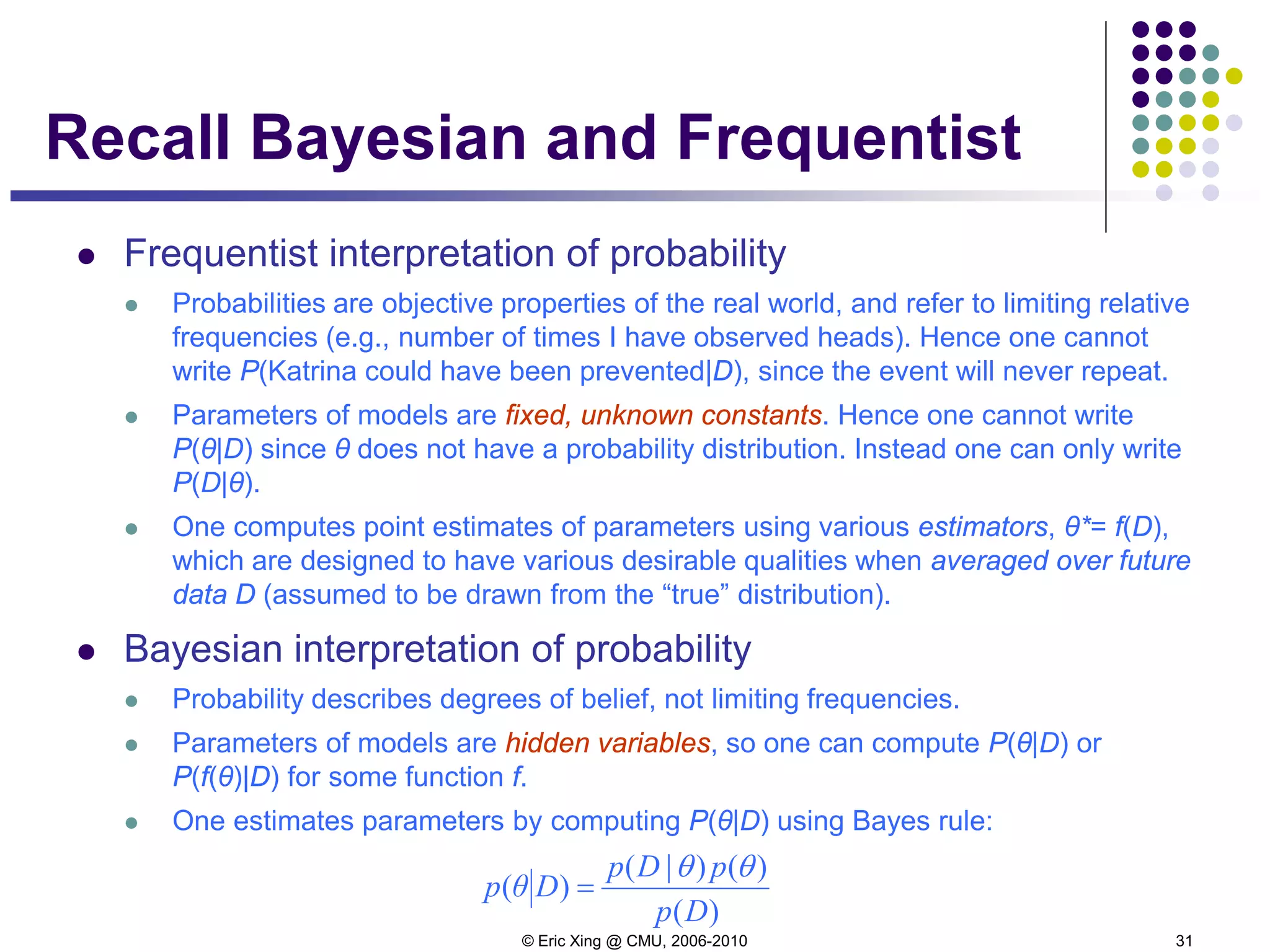
Recall Bayesian and Frequentist
 Frequentist interpretation of probability
 Probabilities are objective properties of the real world, and refer to limiting relative
frequencies (e.g., number of times I have observed heads). Hence one cannot
write P(Katrina could have been prevented|D), since the event will never repeat.
 Parameters of models are fixed, unknown constants. Hence one cannot write
P(θ|D) since θ does not have a probability distribution. Instead one can only write
P(D|θ).
 One computes point estimates of parameters using various estimators, θ*= f(D),
which are designed to have various desirable qualities when averaged over future
data D (assumed to be drawn from the “true” distribution).
 Bayesian interpretation of probability
 Probability describes degrees of belief, not limiting frequencies.
 Parameters of models are hidden variables, so one can compute P(θ|D) or
P(f(θ)|D) for some function f.
 One estimates parameters by computing P(θ|D) using Bayes rule:
)(
)()|(
)(
Dp
pDp
Dθp
θθ
=
© Eric Xing @ CMU, 2006-2010 32
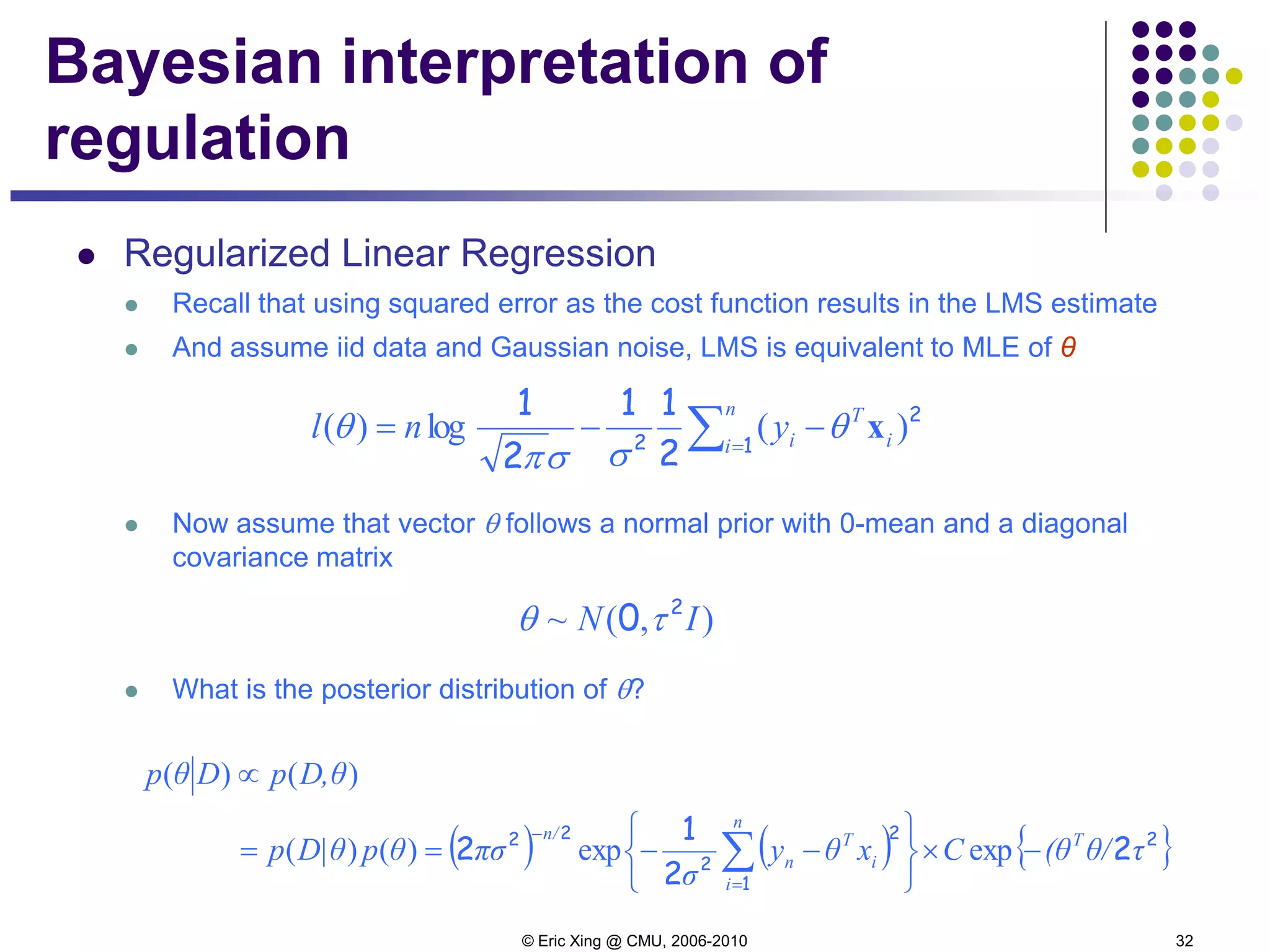
Bayesian interpretation of
regulation
 Regularized Linear Regression
 Recall that using squared error as the cost function results in the LMS estimate
 And assume iid data and Gaussian noise, LMS is equivalent to MLE of θ
 Now assume that vector θ follows a normal prior with 0-mean and a diagonal
covariance matrix
 What is the posterior distribution of θ?
∑=
−−=
n
i i
T
iynl 1
2
2
2
11
2
1
)(log)( xθ
σσπ
θ
),(~ IN 2
0 τθ
( ) ( ) { }2
1
2
2
22
2
2
1
2 τθ/(θCxθy
σ
πσθpD|θp
D,θpDθp
T
n
i
i
T
n
n/
−×






−−==
∝
∑=
−
expexp)()(
)()(
© Eric Xing @ CMU, 2006-2010 33
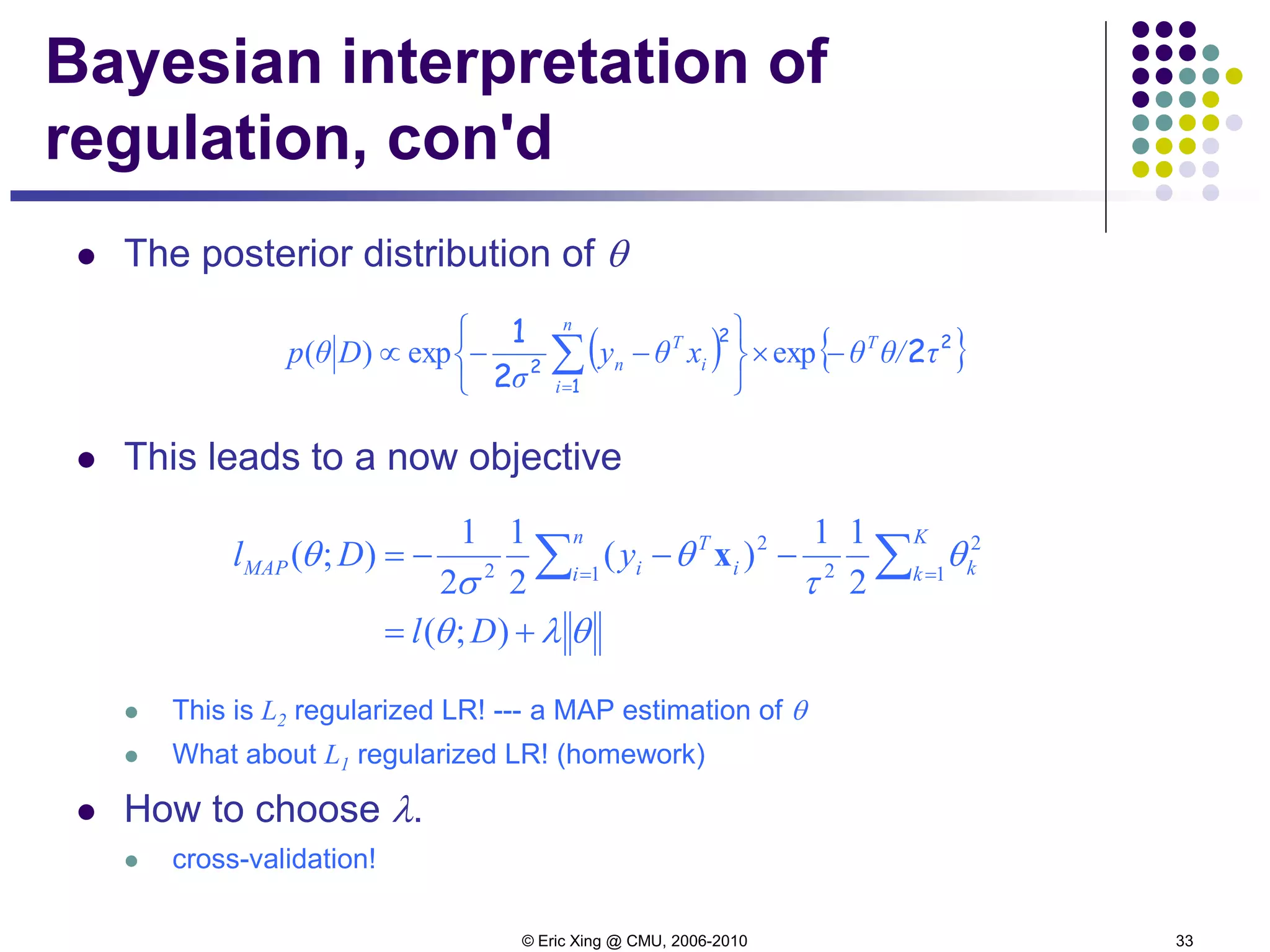
Bayesian interpretation of
regulation, con'd
 The posterior distribution of θ
 This leads to a now objective
 This is L2 regularized LR! --- a MAP estimation of θ
 What about L1 regularized LR! (homework)
 How to choose λ.
 cross-validation!
θλθ
θ
τ
θ
σ
θ
+=
−−−= ∑∑ ==
);(
2
11
)(
2
1
2
1
);( 1
2
21
2
2
Dl
yDl
K
k k
n
i i
T
iMAP x
( ) { }2
1
2
2
2
2
1
τθ/θxθy
σ
Dθp T
n
i
i
T
n −×






−−∝ ∑=
expexp)(
© Eric Xing @ CMU, 2006-2010 34
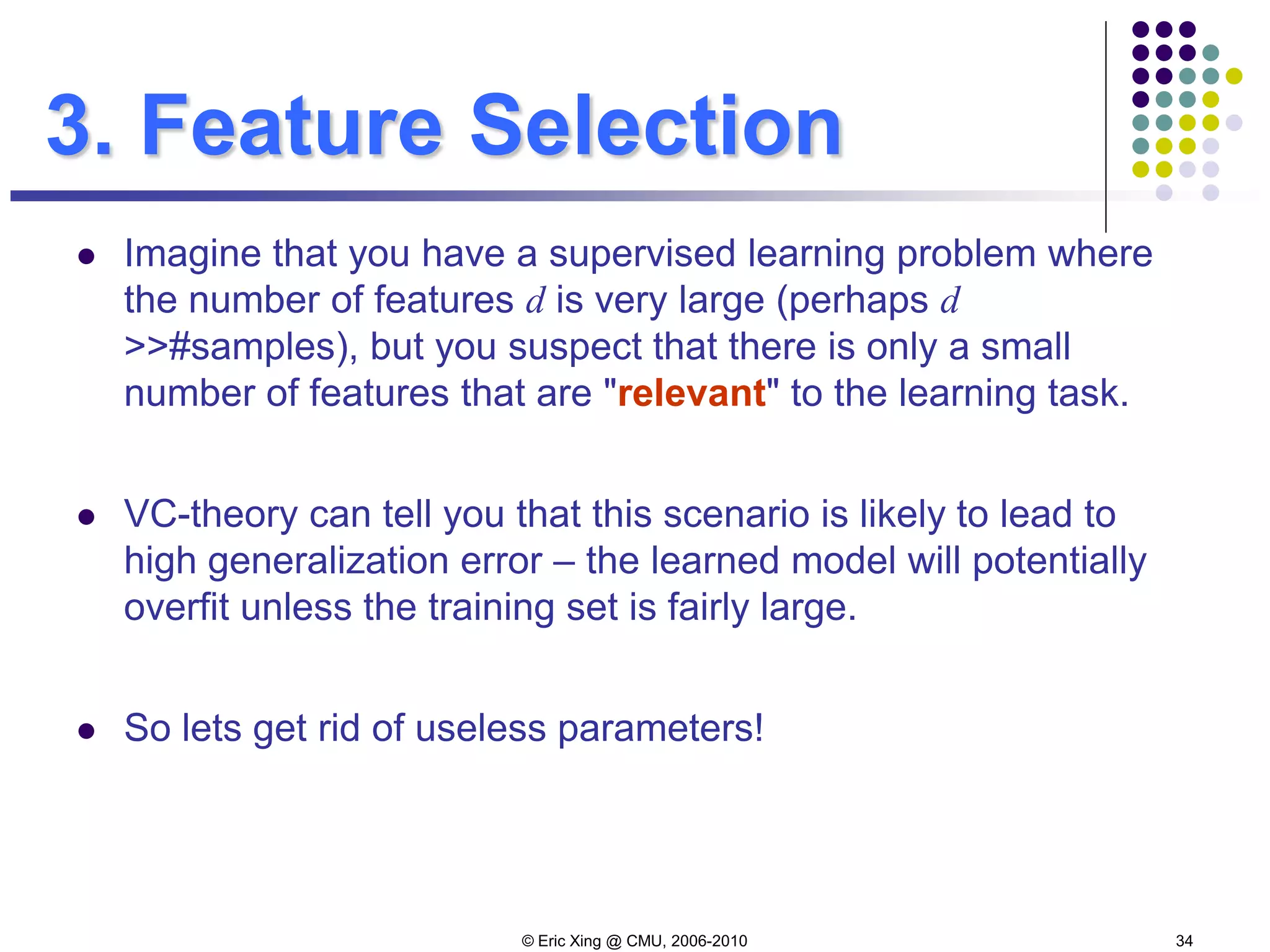
3. Feature Selection
 Imagine that you have a supervised learning problem where
the number of features d is very large (perhaps d
>>#samples), but you suspect that there is only a small
number of features that are "relevant" to the learning task.
 VC-theory can tell you that this scenario is likely to lead to
high generalization error – the learned model will potentially
overfit unless the training set is fairly large.
 So lets get rid of useless parameters!
© Eric Xing @ CMU, 2006-2010 35
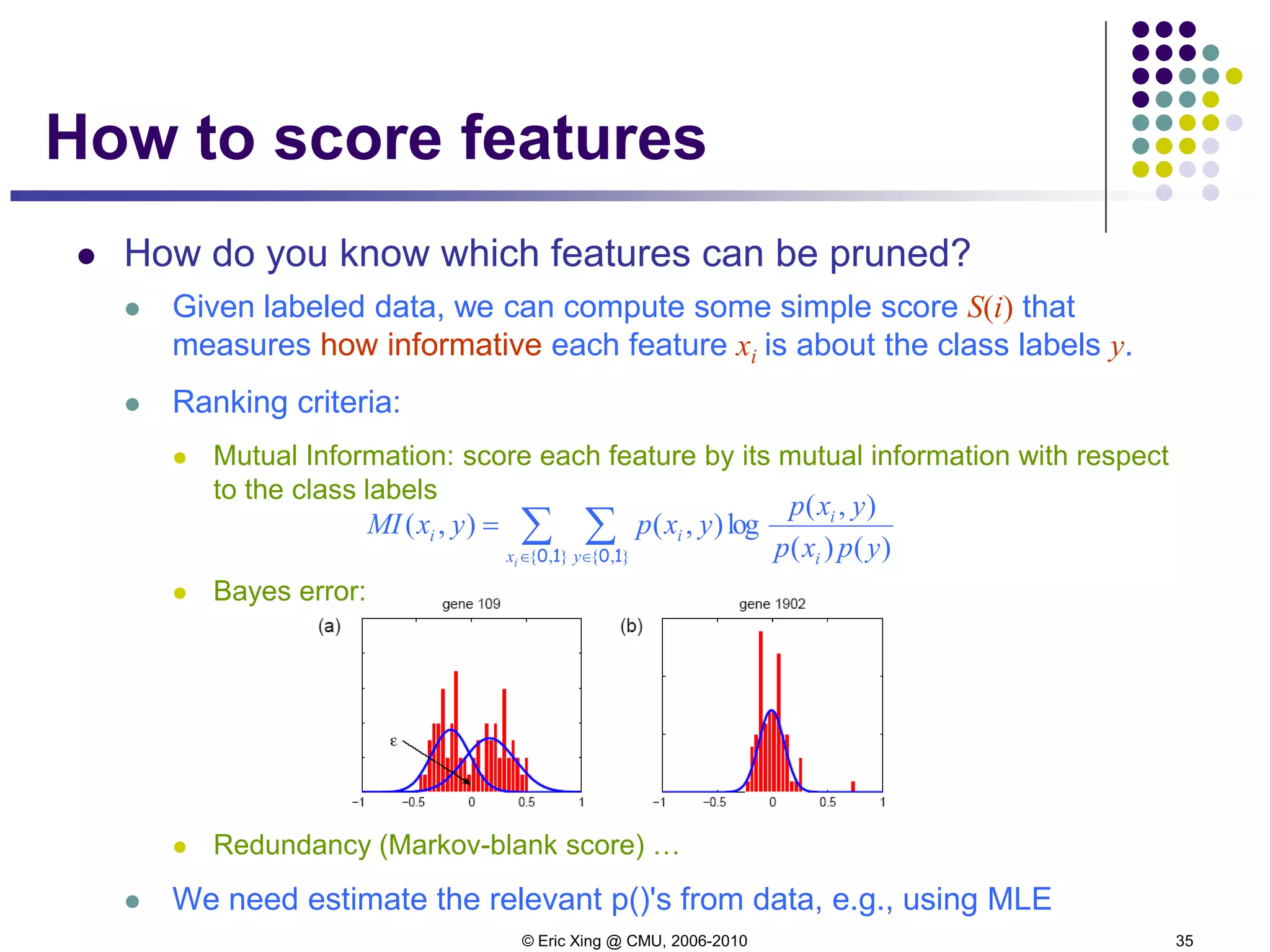
How to score features
 How do you know which features can be pruned?
 Given labeled data, we can compute some simple score S(i) that
measures how informative each feature xi is about the class labels y.
 Ranking criteria:
 Mutual Information: score each feature by its mutual information with respect
to the class labels
 Bayes error:
 Redundancy (Markov-blank score) …
 We need estimate the relevant p()'s from data, e.g., using MLE
∑ ∑∈ ∈
=
},{ },{ )()(
),(
log),(),(
10 10ix y i
i
ii
ypxp
yxp
yxpyxMI
© Eric Xing @ CMU, 2006-2010 36
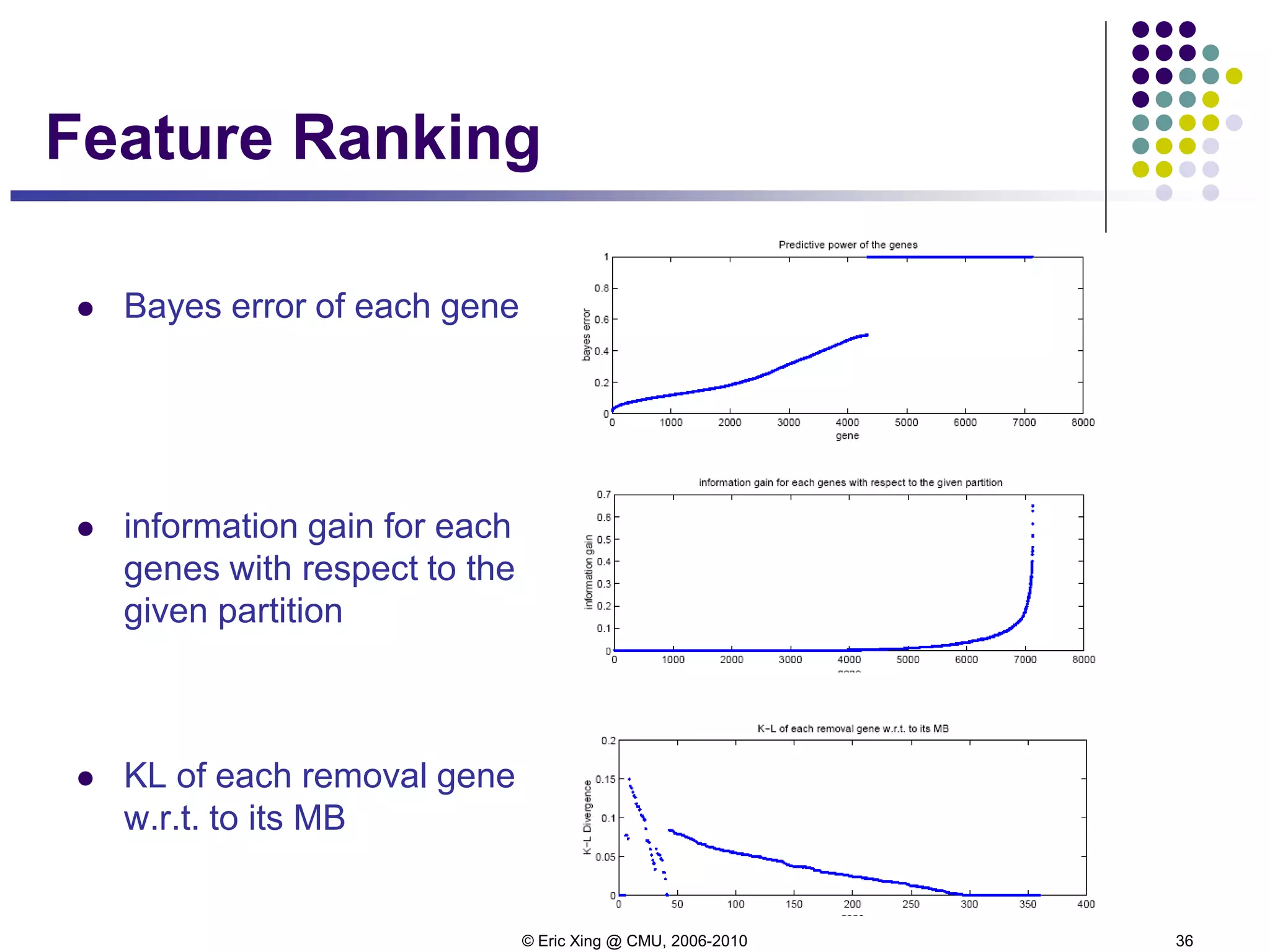
Feature Ranking
 Bayes error of each gene
 information gain for each
genes with respect to the
given partition
 KL of each removal gene
w.r.t. to its MB
© Eric Xing @ CMU, 2006-2010 37
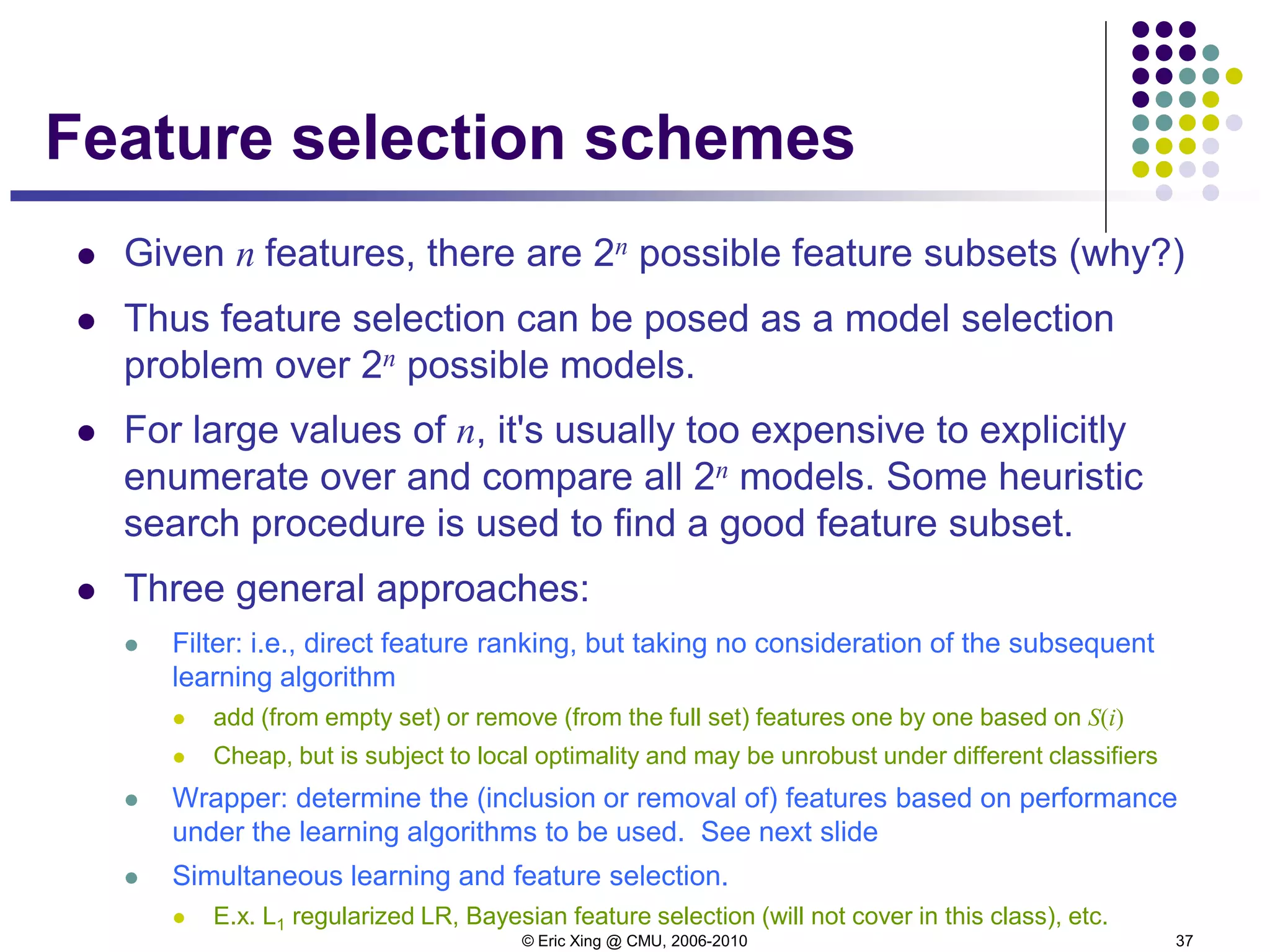
Feature selection schemes
 Given n features, there are 2n possible feature subsets (why?)
 Thus feature selection can be posed as a model selection
problem over 2n possible models.
 For large values of n, it's usually too expensive to explicitly
enumerate over and compare all 2n models. Some heuristic
search procedure is used to find a good feature subset.
 Three general approaches:
 Filter: i.e., direct feature ranking, but taking no consideration of the subsequent
learning algorithm
 add (from empty set) or remove (from the full set) features one by one based on S(i)
 Cheap, but is subject to local optimality and may be unrobust under different classifiers
 Wrapper: determine the (inclusion or removal of) features based on performance
under the learning algorithms to be used. See next slide
 Simultaneous learning and feature selection.
 E.x. L1 regularized LR, Bayesian feature selection (will not cover in this class), etc.
© Eric Xing @ CMU, 2006-2010 38
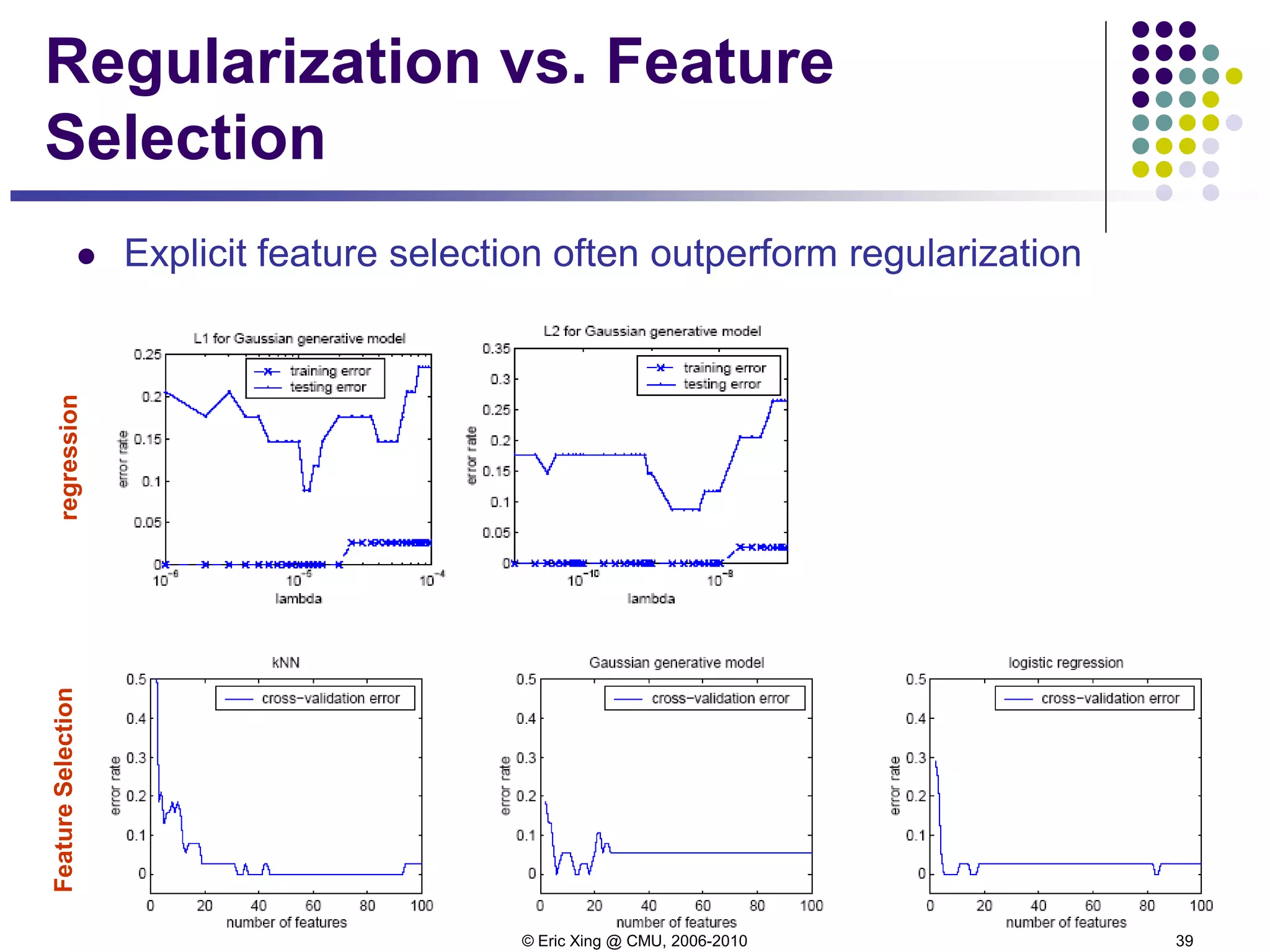
Case study [Xing et al, 2001]
 The case:
 7130 genes from a microarray dataset
 72 samples
 47 type I Leukemias (called ALL)
and 25 type II Leukemias (called AML)
 Three classifier:
 kNN
 Gaussian classifier
 Logistic regression
© Eric Xing @ CMU, 2006-2010 39
Regularization vs. Feature
Selection
 Explicit feature selection often outperform regularization
regressionFeatureSelection
© Eric Xing @ CMU, 2006-2010 40
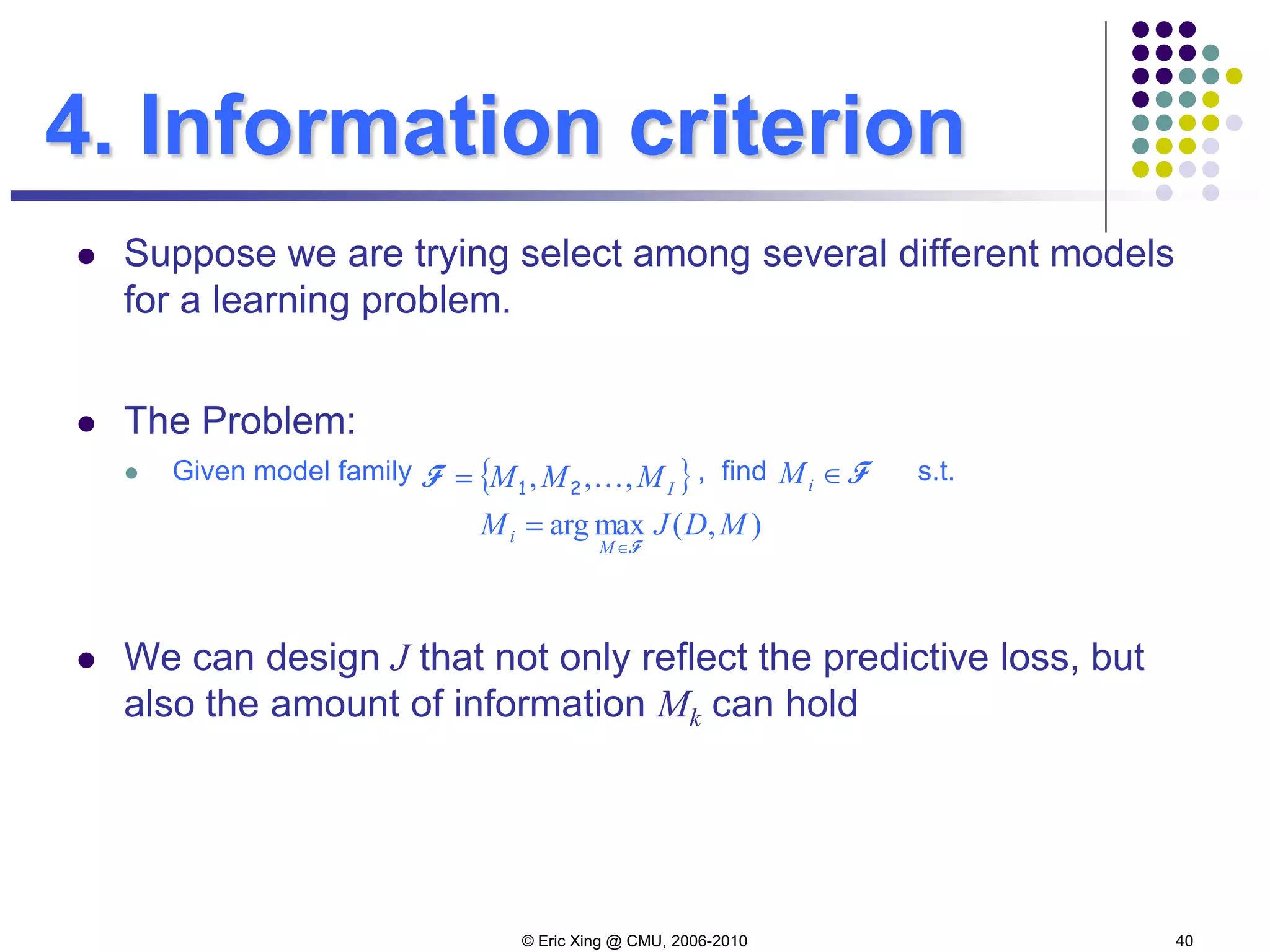
4. Information criterion
 Suppose we are trying select among several different models
for a learning problem.
 The Problem:
 Given model family , find s.t.
 We can design J that not only reflect the predictive loss, but
also the amount of information Mk can hold
{ }IMMM ,,, 21=F F∈iM
),(maxarg MDJM
M
i
F∈
=
© Eric Xing @ CMU, 2006-2010 41
Model Selection via Information
Criteria
 Let f(x) denote the truth, the underlying distribution of the data
 Let g(x,θ) denote the model family we are evaluating
 f(x) does not necessarily reside in the model family
 θML(y) denote the MLE of model parameter from data y
 Among early attempts to move beyond Fisher's Maliximum
Likelihood framework, Akaike proposed the following
information criterion:
which is, of course, intractable (because f(x) is unknown)
( )[ ])(|( yxgfDE MLy θ
© Eric Xing @ CMU, 2006-2010 42
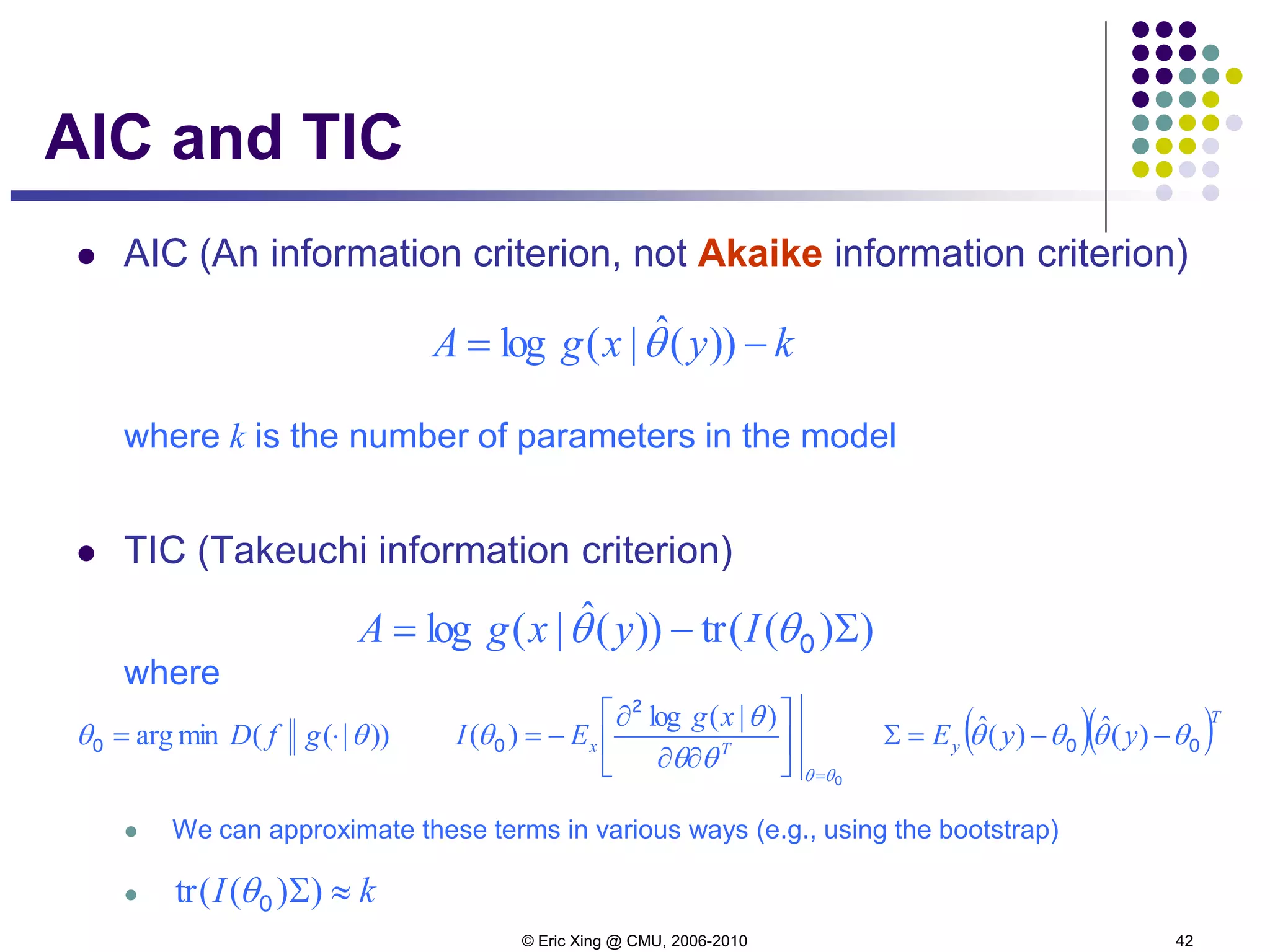
AIC and TIC
 AIC (An information criterion, not Akaike information criterion)
where k is the number of parameters in the model
 TIC (Takeuchi information criterion)
where
 We can approximate these terms in various ways (e.g., using the bootstrap)

kyxgA −= ))(ˆ|(log θ
))((tr))(ˆ|(log Σ−= 0θθ IyxgA
))|((minarg θθ ⋅= gfD0 ( )( )T
y yyE 00 θθθθ −−=Σ )(ˆ)(ˆ
0
2
0
θθ
θθ
θ
θ
=






∂∂
∂
−=
)|(log
)( Tx
xg
EI
kI ≈Σ))((tr 0θ
© Eric Xing @ CMU, 2006-2010 43
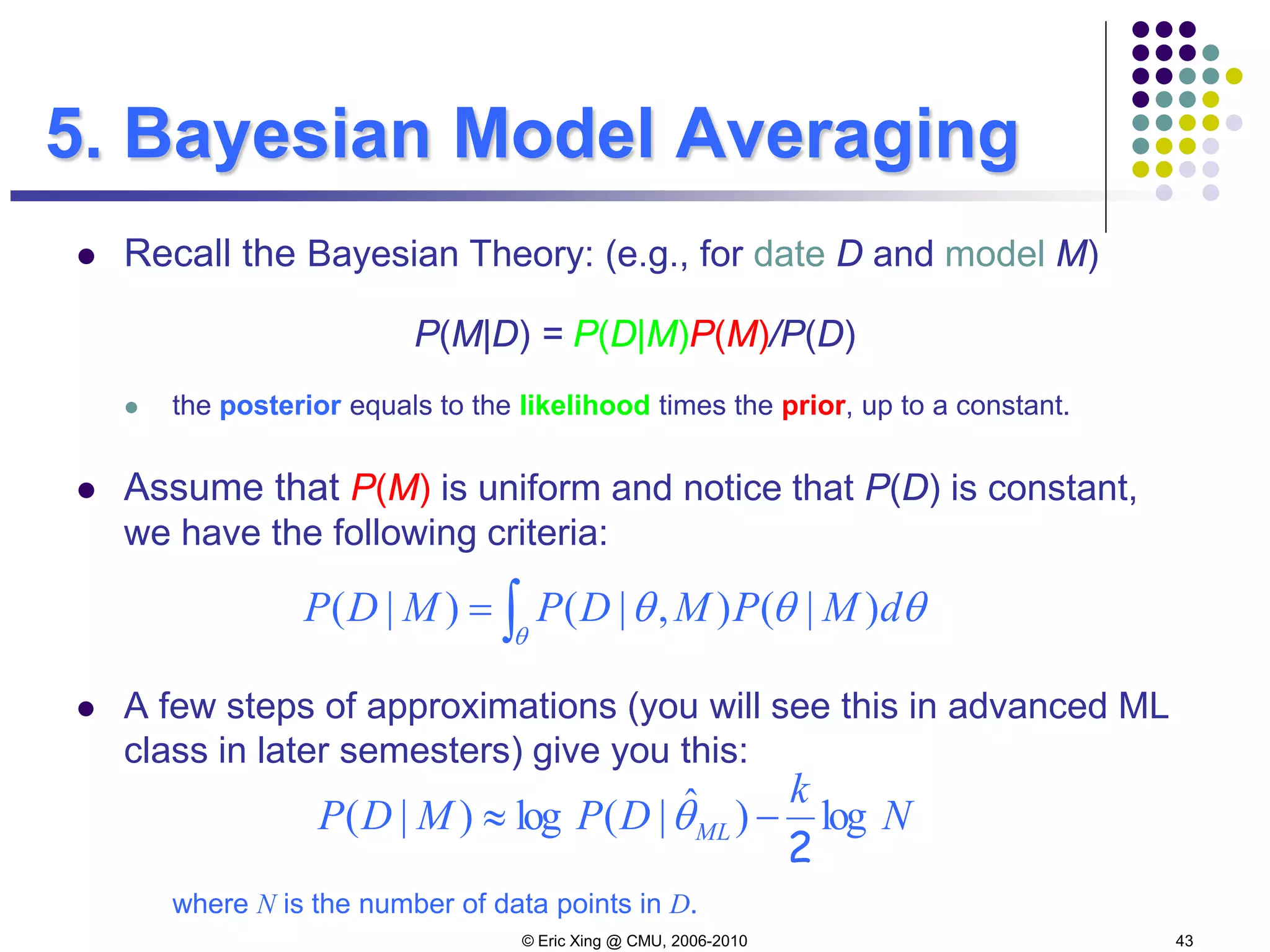
5. Bayesian Model Averaging
 Recall the Bayesian Theory: (e.g., for date D and model M)
P(M|D) = P(D|M)P(M)/P(D)
 the posterior equals to the likelihood times the prior, up to a constant.
 Assume that P(M) is uniform and notice that P(D) is constant,
we have the following criteria:
 A few steps of approximations (you will see this in advanced ML
class in later semesters) give you this:
where N is the number of data points in D.
∫=
θ
θθθ dMPMDPMDP )|(),|()|(
N
k
DPMDP ML log)ˆ|(log)|(
2
−≈ θ
© Eric Xing @ CMU, 2006-2010 44
Summary
 Structural risk minimization
 Bias-variance decomposition
 The battle against overfitting:
 Cross validation
 Regularization
 Feature selection
 Model selection --- Occam's razor
 Model averaging
 The Bayesian-frequentist debate
 Bayesian learning (weight models by their posterior probabilities)

Lecture6 xing

  • 1.
    © Eric Xing@ CMU, 2006-2010 1 Machine Learning Overfitting and Model Selection Eric Xing Lecture 6, August 13, 2010 Reading:
  • 2.
    © Eric Xing@ CMU, 2006-2010 2 Outline  Overfitting  kNN  Regression  Bias-variance decomposition  Generalization Theory and Structural Risk Minimization  The battle against overfitting: each learning algorithm has some "free knobs" that one can "tune" (i.e., heck) to make the algorithm generalizes better to test data. But is there a more principled way?  Cross validation  Regularization  Feature selection  Model selection --- Occam's razor  Model averaging
  • 3.
    © Eric Xing@ CMU, 2006-2010 3 Overfitting: kNN
  • 4.
    © Eric Xing@ CMU, 2006-2010 4 Another example:  Regression
  • 5.
    © Eric Xing@ CMU, 2006-2010 5 Overfitting, con'd  The models:  Test errors:
  • 6.
    © Eric Xing@ CMU, 2006-2010 6 What is a good model? Low Robustness Robust Model Low quality /High Robustness Model built Known Data New Data LEGEND
  • 7.
    © Eric Xing@ CMU, 2006-2010 7 Bias-variance decomposition  Now let's look more closely into two sources of errors in an functional approximator:  Let h(x) = E[t|x] be the optimal predictor, and y(x) our actual predictor:  expected loss = (bias)2 + variance + noise ( )[ ] [ ]( ) [ ]( )[ ]222 );();()();()();( DxyEDxyExhDxyExhDxyE DDDD −+−=−
  • 8.
    © Eric Xing@ CMU, 2006-2010 8 Four Pillars for SLT  Consistency (guarantees generalization)  Under what conditions will a model be consistent ?  Model convergence speed (a measure for generalization)  How does generalization capacity improve when sample size L grows?  Generalization capacity control  How to control in an efficient way model generalization starting with the only given information we have: our sample data?  A strategy for good learning algorithms  Is there a strategy that guarantees, measures and controls our learning model generalization capacity ?
  • 9.
    © Eric Xing@ CMU, 2006-2010 10 %error number of training examples Test error Training error %error number of training examples Test error Training error Consistent training?
  • 10.
    © Eric Xing@ CMU, 2006-2010 11  Q : Under which conditions will a learning model be consistent?  A : A model will be consistent if and only if the function h that defines the model comes from a family of functions H with finite VC dimension d  A finite VC dimension d not only guarantees a generalization capacity (consistency), but to pick h in a family H with finite VC dimension d is the only way to build a model that generalizes. Vapnik main theorem
  • 11.
    © Eric Xing@ CMU, 2006-2010 12 Model convergence speed (generalization capacity)  Q : What is the nature of model error difference between learning data (sample) and test data, for a sample of finite size m?  A : This difference is no greater than a limit that only depends on the ratio between VC dimension d of model functions family H, and sample size m, i.e., d/m This statement is a new theorem that belongs to Kolmogorov- Smirnov way for results, i.e., theorems that do not depend on data’s underlying probability law.
  • 12.
    © Eric Xing@ CMU, 2006-2010 13 Sample size L Confidence Interval Test data error Learning sample error % error Model convergence speed
  • 13.
    © Eric Xing@ CMU, 2006-2010 14 How to control model generalization capacity Risk Expectation = Empirical Risk + Confidence Interval  To minimize Empirical Risk alone will not always give a good generalization capacity: one will want to minimize the sum of Empirical Risk and Confidence Interval  What is important is not the numerical value of the Vapnik limit, most often too large to be of any practical use, it is the fact that this limit is a non decreasing function of model family function “richness”
  • 14.
    © Eric Xing@ CMU, 2006-2010 15  With probability 1-δ, the following inequality is true:  where w0 is the parameter w value that minimizes Empirical Risk: Empirical Risk Minimization
  • 15.
    © Eric Xing@ CMU, 2006-2010 16 Structural Risk Minimization  Which hypothesis space should we choose?  Bias / variance tradeoff  SRM: choose H to minimize bound on true error! unfortunately a somewhat loose bound...
  • 16.
    © Eric Xing@ CMU, 2006-2010 17 SRM strategy (1)  With probability 1-δ,  When m/d is small (d too large), second term of equation becomes large  SRM basic idea for strategy is to minimize simultaneously both terms standing on the right of above majoring equation for ε(h)  To do this, one has to make d a controlled parameter
  • 17.
    © Eric Xing@ CMU, 2006-2010 18 SRM strategy (2)  Let us consider a sequence H1 < H2 < .. < Hn of model family functions, with respective growing VC dimensions d1 < d2 < .. < dn  For each family Hi of our sequence, the inequality is valid  That is, for each subset, we must be able either to compute d, or to get a bound on d itself.  SRM then consists of finding that subset of functions which minimizes the bound on the actual risk.
  • 18.
    © Eric Xing@ CMU, 2006-2010 19 SRM : find i such that expected risk ε(h) becomes minimum, for a specific d*=di, relating to a specific family Hi of our sequence; build model using h from Hi Empirical Risk Risk Model Complexity Total Risk Confidence interval In h/L Best Model h* SRM strategy (3)
  • 19.
    © Eric Xing@ CMU, 2006-2010 20 Putting SRM into action: linear models case (1)  There are many SRM-based strategies to build models:  In the case of linear models y = wTx + b, one wants to make ||w|| a controlled parameter: let us call HC the linear model function family satisfying the constraint: ||w|| < C Vapnik Major theorem: When C decreases, d(HC) decreases ||x|| < R
  • 20.
    © Eric Xing@ CMU, 2006-2010 21 Putting SRM into action: linear models case (2)  To control ||w||, one can envision two routes to model:  Regularization/Ridge Regression, ie min. over w and b RG(w,b) = S{(yi-<w|xi> - b)² |i=1,..,L} + λ ||w||²  Support Vector Machines (SVM), ie solve directly an optimization problem (classif. SVM, separable data) Minimize ||w||², with (yi= +/-1) and yi(<w|xi> + b) >=1 for all i=1,..,L
  • 21.
    © Eric Xing@ CMU, 2006-2010 22 Regularized Regression  Recall linear regression:  Regularized LR:  L2-regularized LR:  L1-regularized LR:
  • 22.
    © Eric Xing@ CMU, 2006-2010 23 Bias-variance tradeoff  λ is a "regularization" terms in LR, the smaller the λ, is more complex the model (why?)  Simple (highly regularized) models have low variance but high bias.  Complex models have low bias but high variance.  You are inspecting an empirical average over 100 training set.  The actual ED can not be computed
  • 23.
    © Eric Xing@ CMU, 2006-2010 24 Bias2+variance vs regularizer  Bias2+variance predicts (shape of) test error quite well.  However, bias and variance cannot be computed since it relies on knowing the true distribution of x and t (and hence h(x) = E[t|x]).
  • 24.
    © Eric Xing@ CMU, 2006-2010 25 The battle against overfitting
  • 25.
    © Eric Xing@ CMU, 2006-2010 26 Model Selection  Suppose we are trying select among several different models for a learning problem.  Examples: 1. polynomial regression  Model selection: we wish to automatically and objectively decide if k should be, say, 0, 1, . . . , or 10. 2. locally weighted regression,  Model selection: we want to automatically choose the bandwidth parameter τ. 3. Mixture models and hidden Markov model,  Model selection: we want to decide the number of hidden states  The Problem:  Given model family , find s.t. )();( k k xxxgxh θθθθθ ++++= 2 210 { }IMMM ,,, 21=F F∈iM ),(maxarg MDJM M i F∈ =
  • 26.
    © Eric Xing@ CMU, 2006-2010 27 1. Cross Validation  We are given training data D and test data Dtest, and we would like to fit this data with a model pi(x;θ) from the family F (e.g, an LR), which is indexed by i and parameterized by θ.  K-fold cross-validation (CV)  Set aside αN samples of D (where N = |D|). This is known as the held-out data and will be used to evaluate different values of i.  For each candidate model i, fit the optimal hypothesis pi(x;θ∗) to the remaining (1−α)N samples in D (i.e., hold i fixed and find the best θ).  Evaluate each model pi(x|θ∗) on the held-out data using some pre-specified risk function.  Repeat the above K times, choosing a different held-out data set each time, and the scores are averaged for each model pi(.) over all held-out data set. This gives an estimate of the risk curve of models over different i.  For the model with the lowest risk, say pi*(.), we use all of D to find the parameter values for pi*(x;θ∗).
  • 27.
    © Eric Xing@ CMU, 2006-2010 28 Example:  When α=1/N, the algorithm is known as Leave-One-Out- Cross-Validation (LOOCV) MSELOOCV(M2)=0.962MSELOOCV(M1)=2.12
  • 28.
    © Eric Xing@ CMU, 2006-2010 29 Practical issues for CV  How to decide the values for K and α  Commonly used K = 10 and α = 0.1.  when data sets are small relative to the number of models that are being evaluated, we need to decrease α and increase K  K needs to be large for the variance to be small enough, but this makes it time- consuming.  Bias-variance trade-off  Small α usually lead to low bias. In principle, LOOCV provides an almost unbiased estimate of the generalization ability of a classifier, especially when the number of the available training samples is severely limited; but it can also have high variance.  Large α can reduce variance, but will lead to under-use of data, and causing high- bias.  One important point is that the test data Dtest is never used in CV, because doing so would result in overly (indeed dishonest) optimistic accuracy rates during the testing phase.
  • 29.
    © Eric Xing@ CMU, 2006-2010 30 2. Regularization  Maximum-likelihood estimates are not always the best (James and Stein showed a counter example in the early 60's)  Alternative: we "regularize" the likelihood objective (also known as penalized likelihood, shrinkage, smoothing, etc.), by adding to it a penalty term: where λ>0 and ||θ|| might be the L1 or L2 norm.  The choice of norm has an effect  using the L2 norm pulls directly towards the origin,  while using the L1 norm pulls towards the coordinate axes, i.e it tries to set some of the coordinates to 0.  This second approach can be useful in a feature-selection setting. [ ]θλθθ θ += );(maxargˆ shrinkage Dl
  • 30.
    © Eric Xing@ CMU, 2006-2010 31 Recall Bayesian and Frequentist  Frequentist interpretation of probability  Probabilities are objective properties of the real world, and refer to limiting relative frequencies (e.g., number of times I have observed heads). Hence one cannot write P(Katrina could have been prevented|D), since the event will never repeat.  Parameters of models are fixed, unknown constants. Hence one cannot write P(θ|D) since θ does not have a probability distribution. Instead one can only write P(D|θ).  One computes point estimates of parameters using various estimators, θ*= f(D), which are designed to have various desirable qualities when averaged over future data D (assumed to be drawn from the “true” distribution).  Bayesian interpretation of probability  Probability describes degrees of belief, not limiting frequencies.  Parameters of models are hidden variables, so one can compute P(θ|D) or P(f(θ)|D) for some function f.  One estimates parameters by computing P(θ|D) using Bayes rule: )( )()|( )( Dp pDp Dθp θθ =
  • 31.
    © Eric Xing@ CMU, 2006-2010 32 Bayesian interpretation of regulation  Regularized Linear Regression  Recall that using squared error as the cost function results in the LMS estimate  And assume iid data and Gaussian noise, LMS is equivalent to MLE of θ  Now assume that vector θ follows a normal prior with 0-mean and a diagonal covariance matrix  What is the posterior distribution of θ? ∑= −−= n i i T iynl 1 2 2 2 11 2 1 )(log)( xθ σσπ θ ),(~ IN 2 0 τθ ( ) ( ) { }2 1 2 2 22 2 2 1 2 τθ/(θCxθy σ πσθpD|θp D,θpDθp T n i i T n n/ −×       −−== ∝ ∑= − expexp)()( )()(
  • 32.
    © Eric Xing@ CMU, 2006-2010 33 Bayesian interpretation of regulation, con'd  The posterior distribution of θ  This leads to a now objective  This is L2 regularized LR! --- a MAP estimation of θ  What about L1 regularized LR! (homework)  How to choose λ.  cross-validation! θλθ θ τ θ σ θ += −−−= ∑∑ == );( 2 11 )( 2 1 2 1 );( 1 2 21 2 2 Dl yDl K k k n i i T iMAP x ( ) { }2 1 2 2 2 2 1 τθ/θxθy σ Dθp T n i i T n −×       −−∝ ∑= expexp)(
  • 33.
    © Eric Xing@ CMU, 2006-2010 34 3. Feature Selection  Imagine that you have a supervised learning problem where the number of features d is very large (perhaps d >>#samples), but you suspect that there is only a small number of features that are "relevant" to the learning task.  VC-theory can tell you that this scenario is likely to lead to high generalization error – the learned model will potentially overfit unless the training set is fairly large.  So lets get rid of useless parameters!
  • 34.
    © Eric Xing@ CMU, 2006-2010 35 How to score features  How do you know which features can be pruned?  Given labeled data, we can compute some simple score S(i) that measures how informative each feature xi is about the class labels y.  Ranking criteria:  Mutual Information: score each feature by its mutual information with respect to the class labels  Bayes error:  Redundancy (Markov-blank score) …  We need estimate the relevant p()'s from data, e.g., using MLE ∑ ∑∈ ∈ = },{ },{ )()( ),( log),(),( 10 10ix y i i ii ypxp yxp yxpyxMI
  • 35.
    © Eric Xing@ CMU, 2006-2010 36 Feature Ranking  Bayes error of each gene  information gain for each genes with respect to the given partition  KL of each removal gene w.r.t. to its MB
  • 36.
    © Eric Xing@ CMU, 2006-2010 37 Feature selection schemes  Given n features, there are 2n possible feature subsets (why?)  Thus feature selection can be posed as a model selection problem over 2n possible models.  For large values of n, it's usually too expensive to explicitly enumerate over and compare all 2n models. Some heuristic search procedure is used to find a good feature subset.  Three general approaches:  Filter: i.e., direct feature ranking, but taking no consideration of the subsequent learning algorithm  add (from empty set) or remove (from the full set) features one by one based on S(i)  Cheap, but is subject to local optimality and may be unrobust under different classifiers  Wrapper: determine the (inclusion or removal of) features based on performance under the learning algorithms to be used. See next slide  Simultaneous learning and feature selection.  E.x. L1 regularized LR, Bayesian feature selection (will not cover in this class), etc.
  • 37.
    © Eric Xing@ CMU, 2006-2010 38 Case study [Xing et al, 2001]  The case:  7130 genes from a microarray dataset  72 samples  47 type I Leukemias (called ALL) and 25 type II Leukemias (called AML)  Three classifier:  kNN  Gaussian classifier  Logistic regression
  • 38.
    © Eric Xing@ CMU, 2006-2010 39 Regularization vs. Feature Selection  Explicit feature selection often outperform regularization regressionFeatureSelection
  • 39.
    © Eric Xing@ CMU, 2006-2010 40 4. Information criterion  Suppose we are trying select among several different models for a learning problem.  The Problem:  Given model family , find s.t.  We can design J that not only reflect the predictive loss, but also the amount of information Mk can hold { }IMMM ,,, 21=F F∈iM ),(maxarg MDJM M i F∈ =
  • 40.
    © Eric Xing@ CMU, 2006-2010 41 Model Selection via Information Criteria  Let f(x) denote the truth, the underlying distribution of the data  Let g(x,θ) denote the model family we are evaluating  f(x) does not necessarily reside in the model family  θML(y) denote the MLE of model parameter from data y  Among early attempts to move beyond Fisher's Maliximum Likelihood framework, Akaike proposed the following information criterion: which is, of course, intractable (because f(x) is unknown) ( )[ ])(|( yxgfDE MLy θ
  • 41.
    © Eric Xing@ CMU, 2006-2010 42 AIC and TIC  AIC (An information criterion, not Akaike information criterion) where k is the number of parameters in the model  TIC (Takeuchi information criterion) where  We can approximate these terms in various ways (e.g., using the bootstrap)  kyxgA −= ))(ˆ|(log θ ))((tr))(ˆ|(log Σ−= 0θθ IyxgA ))|((minarg θθ ⋅= gfD0 ( )( )T y yyE 00 θθθθ −−=Σ )(ˆ)(ˆ 0 2 0 θθ θθ θ θ =       ∂∂ ∂ −= )|(log )( Tx xg EI kI ≈Σ))((tr 0θ
  • 42.
    © Eric Xing@ CMU, 2006-2010 43 5. Bayesian Model Averaging  Recall the Bayesian Theory: (e.g., for date D and model M) P(M|D) = P(D|M)P(M)/P(D)  the posterior equals to the likelihood times the prior, up to a constant.  Assume that P(M) is uniform and notice that P(D) is constant, we have the following criteria:  A few steps of approximations (you will see this in advanced ML class in later semesters) give you this: where N is the number of data points in D. ∫= θ θθθ dMPMDPMDP )|(),|()|( N k DPMDP ML log)ˆ|(log)|( 2 −≈ θ
  • 43.
    © Eric Xing@ CMU, 2006-2010 44 Summary  Structural risk minimization  Bias-variance decomposition  The battle against overfitting:  Cross validation  Regularization  Feature selection  Model selection --- Occam's razor  Model averaging  The Bayesian-frequentist debate  Bayesian learning (weight models by their posterior probabilities)