Decision Tree
&
Random Forest Algorithm
Priagung Khusumanegara
Chonnam National Univeristy
Outline
 Introduction
 Example of Decision Tree
 Principles of Decision Tree
– Entropy
– Information gain
 Random Forest
2
The problem
 Given a set of training cases/objects and their attribute
values, try to determine the target attribute value of new
examples.
– Classification
– Prediction
3
Key Requirements
 Attribute-value description: object or case must be
expressible in terms of a fixed collection of properties or
attributes (e.g., hot, mild, cold).
 Predefined classes (target values): the target
function has discrete output values (bollean or
multiclass)
 Sufficient data: enough training cases should be
provided to learn the model.
4
A simple example
5
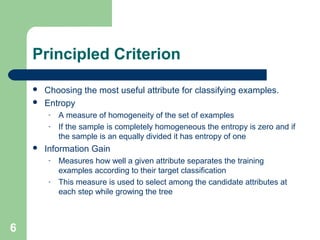
Principled Criterion
 Choosing the most useful attribute for classifying examples.
 Entropy
- A measure of homogeneity of the set of examples
- If the sample is completely homogeneous the entropy is zero and if
the sample is an equally divided it has entropy of one
 Information Gain
- Measures how well a given attribute separates the training
examples according to their target classification
- This measure is used to select among the candidate attributes at
each step while growing the tree
6
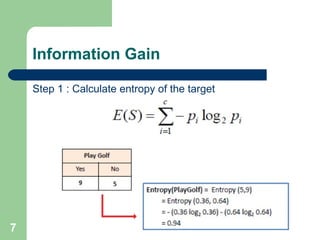
Information Gain
Step 1 : Calculate entropy of the target
7
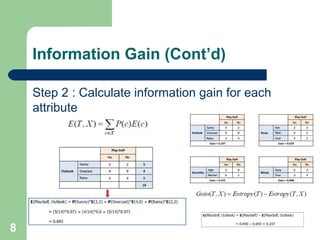
Information Gain (Cont’d)
Step 2 : Calculate information gain for each
attribute
8
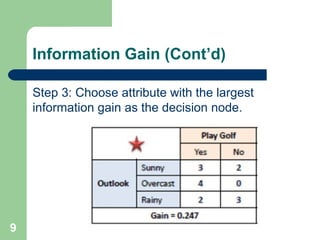
Information Gain (Cont’d)
Step 3: Choose attribute with the largest
information gain as the decision node.
9
Information Gain (Cont’d)
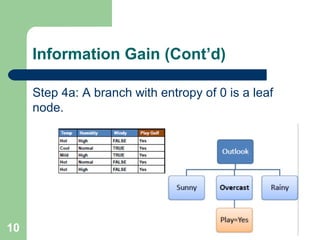
Step 4a: A branch with entropy of 0 is a leaf
node.
10
Information Gain (Cont’d)
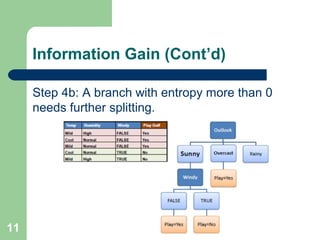
Step 4b: A branch with entropy more than 0
needs further splitting.
11
Information Gain (Cont’d)
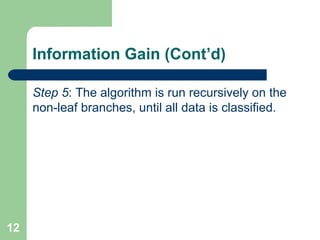
Step 5: The algorithm is run recursively on the
non-leaf branches, until all data is classified.
12
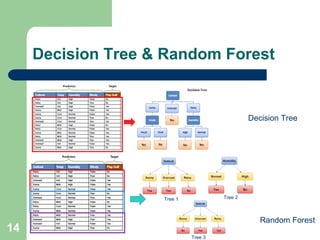
Random Forest
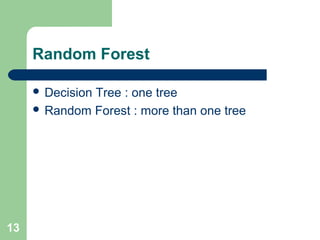
 Decision Tree : one tree
 Random Forest : more than one tree
13
Decision Tree & Random Forest
14
Decision Tree
Random Forest
Tree 1 Tree 2
Tree 3
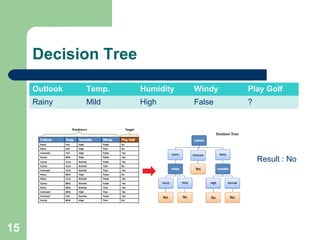
Decision Tree
Outlook Temp. Humidity Windy Play Golf
Rainy Mild High False ?
15
Result : No
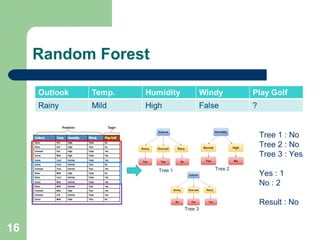
Random Forest
16
Tree 1 Tree 2
Tree 3
Tree 1 : No
Tree 2 : No
Tree 3 : Yes
Yes : 1
No : 2
Result : No
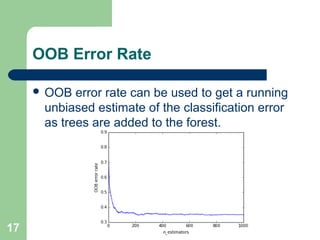
OOB Error Rate
 OOB error rate can be used to get a running
unbiased estimate of the classification error
as trees are added to the forest.
17

Decision tree and random forest

  • 1.
    Decision Tree & Random ForestAlgorithm Priagung Khusumanegara Chonnam National Univeristy
  • 2.
    Outline  Introduction  Exampleof Decision Tree  Principles of Decision Tree – Entropy – Information gain  Random Forest 2
  • 3.
    The problem  Givena set of training cases/objects and their attribute values, try to determine the target attribute value of new examples. – Classification – Prediction 3
  • 4.
    Key Requirements  Attribute-valuedescription: object or case must be expressible in terms of a fixed collection of properties or attributes (e.g., hot, mild, cold).  Predefined classes (target values): the target function has discrete output values (bollean or multiclass)  Sufficient data: enough training cases should be provided to learn the model. 4
  • 5.
  • 6.
    Principled Criterion  Choosingthe most useful attribute for classifying examples.  Entropy - A measure of homogeneity of the set of examples - If the sample is completely homogeneous the entropy is zero and if the sample is an equally divided it has entropy of one  Information Gain - Measures how well a given attribute separates the training examples according to their target classification - This measure is used to select among the candidate attributes at each step while growing the tree 6
  • 7.
    Information Gain Step 1: Calculate entropy of the target 7
  • 8.
    Information Gain (Cont’d) Step2 : Calculate information gain for each attribute 8
  • 9.
    Information Gain (Cont’d) Step3: Choose attribute with the largest information gain as the decision node. 9
  • 10.
    Information Gain (Cont’d) Step4a: A branch with entropy of 0 is a leaf node. 10
  • 11.
    Information Gain (Cont’d) Step4b: A branch with entropy more than 0 needs further splitting. 11
  • 12.
    Information Gain (Cont’d) Step5: The algorithm is run recursively on the non-leaf branches, until all data is classified. 12
  • 13.
    Random Forest  DecisionTree : one tree  Random Forest : more than one tree 13
  • 14.
    Decision Tree &Random Forest 14 Decision Tree Random Forest Tree 1 Tree 2 Tree 3
  • 15.
    Decision Tree Outlook Temp.Humidity Windy Play Golf Rainy Mild High False ? 15 Result : No
  • 16.
    Random Forest 16 Tree 1Tree 2 Tree 3 Tree 1 : No Tree 2 : No Tree 3 : Yes Yes : 1 No : 2 Result : No
  • 17.
    OOB Error Rate OOB error rate can be used to get a running unbiased estimate of the classification error as trees are added to the forest. 17