Applications to teaching
 
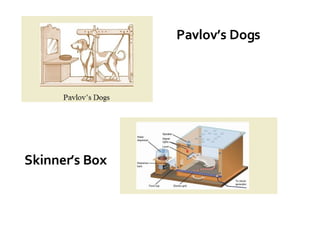
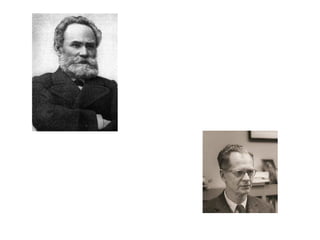
Pavlov’s Dogs Skinner’s Box
 
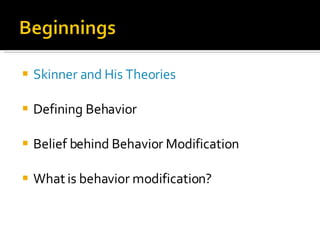
Skinner and His Theories Defining Behavior  Belief behind Behavior Modification What is behavior modification?
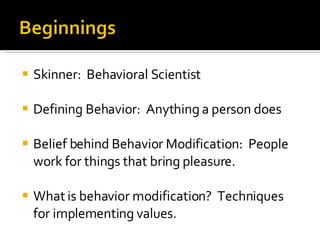
Skinner:  Behavioral Scientist Defining Behavior:  Anything a person does Belief behind Behavior Modification:  People work for things that bring pleasure. What is behavior modification?  Techniques for implementing values.
 
Over 99% of teaching professionals believe in a positive classroom environment 97% believe that there should be more positive comments than negative  Less than 10% of teachers dispense more approving comments than disapproval
Words:  positive comments defined as specified solutions to specific problems Expressions:  Facial expressions of an approving or disapproving nature
The most effective behavior management technique is the easiest to implement--"catching 'em being good". Research shows us that the quickest and most effective way to promote the display of appropriate behaviors is to reward them (e.g., touch, a smile, a "thank you", praise, points, food,...whatever would be reinforcing to those youngsters). We all like to have our efforts acknowledged, and will show more of that behavior if it brings us rewards. It's human nature to show behaviors that bring benefits to us. It is also human nature to like and want to please people who recognize our efforts.  Source.
Behavioral techniques can be used to implement any and all values Cause and Effect are always present; sometimes teachers unwittingly reinforce a wrong behavior
A person has not learned A person has learned correct associations A person has learned incorrect associations
Subject matter should be geared to students at their level Must be presented in logical sequences Must be appropriate feedback concerning correct and incorrect responses There should be contingent rewards given for successive approximations towards defined goals.
The basic premise of reinforcement teaching is to arrange the stimuli of the external world to shape the behavior of the students.
arrange the stimuli  to shape the behavior
If a student knows what is expected And wants to do it She probably will.
Approval Withhold Approval Disapproval Threat of disapproval Ignore
Contingencies, in both approving and disapproving ways, can include: Words (spoken and written) Expressions (facial-bodily) Closeness (nearness-touching) Activities and privileges (social-individual) Things (tokens, materials, food, playthings, money)
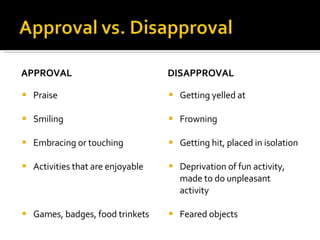
APPROVAL Praise Smiling Embracing or touching Activities that are enjoyable Games, badges, food trinkets DISAPPROVAL Getting yelled at Frowning Getting hit, placed in isolation Deprivation of fun activity, made to do unpleasant activity Feared objects
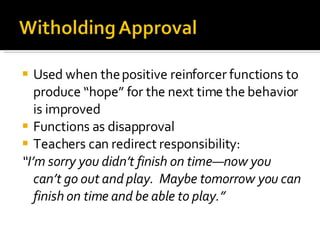
Used when the positive reinforcer functions to produce “hope” for the next time the behavior is improved Functions as disapproval Teachers can redirect responsibility: “ I’m sorry you didn’t finish on time—now you can’t go out and play.  Maybe tomorrow you can finish on time and be able to play.”
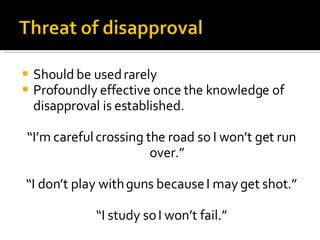
Should be used rarely Profoundly effective once the knowledge of disapproval is established. “ I’m careful crossing the road so I won’t get run over.” “ I don’t play with guns because I may get shot.” “ I study so I won’t fail.”
Ignore
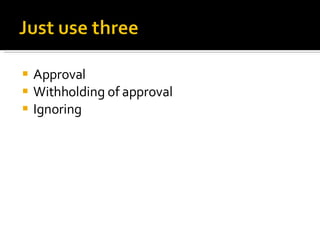
Approval Withholding of approval Ignoring
Children who are completely negatively motivated are: Tense, unenthusiastic, fearful, quiet, shy, passive
Many teachers leave the profession because they can’t control their classes. Effective discipline ensues from direct cause-and-effect relationships We discipline those we love—to provide each child with behaviors necessary for individual productivity
Payoff:  that which keeps behaviors alive For specific inappropriate behavior, find the payoff.  Eliminate it if possible. Behavior that is unrewarded will extinguish One significant result of eliminating payoffs is that the undesired behavior will initially get worse.
Elementary:  words, contact, expressions Middle school, high school:  group activities, peer and group approval High school, college:  material things, individual activities

Behavior Modification

  • 1.
  • 2.
  • 3.
  • 4.
  • 5.
    Skinner and HisTheories Defining Behavior Belief behind Behavior Modification What is behavior modification?
  • 6.
    Skinner: BehavioralScientist Defining Behavior: Anything a person does Belief behind Behavior Modification: People work for things that bring pleasure. What is behavior modification? Techniques for implementing values.
  • 7.
  • 8.
    Over 99% ofteaching professionals believe in a positive classroom environment 97% believe that there should be more positive comments than negative Less than 10% of teachers dispense more approving comments than disapproval
  • 9.
    Words: positivecomments defined as specified solutions to specific problems Expressions: Facial expressions of an approving or disapproving nature
  • 10.
    The most effectivebehavior management technique is the easiest to implement--"catching 'em being good". Research shows us that the quickest and most effective way to promote the display of appropriate behaviors is to reward them (e.g., touch, a smile, a "thank you", praise, points, food,...whatever would be reinforcing to those youngsters). We all like to have our efforts acknowledged, and will show more of that behavior if it brings us rewards. It's human nature to show behaviors that bring benefits to us. It is also human nature to like and want to please people who recognize our efforts. Source.
  • 11.
    Behavioral techniques canbe used to implement any and all values Cause and Effect are always present; sometimes teachers unwittingly reinforce a wrong behavior
  • 12.
    A person hasnot learned A person has learned correct associations A person has learned incorrect associations
  • 13.
    Subject matter shouldbe geared to students at their level Must be presented in logical sequences Must be appropriate feedback concerning correct and incorrect responses There should be contingent rewards given for successive approximations towards defined goals.
  • 14.
    The basic premiseof reinforcement teaching is to arrange the stimuli of the external world to shape the behavior of the students.
  • 15.
    arrange the stimuli to shape the behavior
  • 16.
    If a studentknows what is expected And wants to do it She probably will.
  • 17.
    Approval Withhold ApprovalDisapproval Threat of disapproval Ignore
  • 18.
    Contingencies, in bothapproving and disapproving ways, can include: Words (spoken and written) Expressions (facial-bodily) Closeness (nearness-touching) Activities and privileges (social-individual) Things (tokens, materials, food, playthings, money)
  • 19.
    APPROVAL Praise SmilingEmbracing or touching Activities that are enjoyable Games, badges, food trinkets DISAPPROVAL Getting yelled at Frowning Getting hit, placed in isolation Deprivation of fun activity, made to do unpleasant activity Feared objects
  • 20.
    Used when thepositive reinforcer functions to produce “hope” for the next time the behavior is improved Functions as disapproval Teachers can redirect responsibility: “ I’m sorry you didn’t finish on time—now you can’t go out and play. Maybe tomorrow you can finish on time and be able to play.”
  • 21.
    Should be usedrarely Profoundly effective once the knowledge of disapproval is established. “ I’m careful crossing the road so I won’t get run over.” “ I don’t play with guns because I may get shot.” “ I study so I won’t fail.”
  • 22.
  • 23.
    Approval Withholding ofapproval Ignoring
  • 24.
    Children who arecompletely negatively motivated are: Tense, unenthusiastic, fearful, quiet, shy, passive
  • 25.
    Many teachers leavethe profession because they can’t control their classes. Effective discipline ensues from direct cause-and-effect relationships We discipline those we love—to provide each child with behaviors necessary for individual productivity
  • 26.
    Payoff: thatwhich keeps behaviors alive For specific inappropriate behavior, find the payoff. Eliminate it if possible. Behavior that is unrewarded will extinguish One significant result of eliminating payoffs is that the undesired behavior will initially get worse.
  • 27.
    Elementary: words,contact, expressions Middle school, high school: group activities, peer and group approval High school, college: material things, individual activities