JOSHUA J. BATALLA IP
Cognitive
Therapy
Theory of Personality
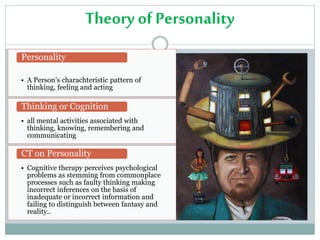
• A Person’s charachteristic pattern of
thinking, feeling and acting
Personality
• all mental activities associated with
thinking, knowing, remembering and
communicating
Thinking or Cognition
• Cognitive therapy perceives psychological
problems as stemming from commonplace
processes such as faulty thinking making
incorrect inferences on the basis of
inadequate or incorrect information and
failing to distinguish between fantasy and
reality..
CT on Personality
July 18, 1921 Providence, Rhode Island
 “Tim”
 His parents were Jewish Immigrant
 His family suffered the loss of first two children.
 At age 7, Broke his arm and developed acutely
serious bone infection which required surgery
 He missed being promoted into
Second grade
 Bad case of whooping cough, chronic
Childhood asthma
 Interest in Nature
SignificantChildhood Events
Event:
His mother was too emotional
Broke his arm; developed serious bone
infection
Interest in Nature
Repercussions:
He became sensitive to others with
strong Emotions
He developed blood and injury phobia
Became his primary motivation in
entering medical school
Piqued his interest in knowing “ what
makes people tick; what makes them
happy or sad and confident or insecure
Cognitive Therapy at Present
 Short Term Approach
 Most number of research published
 Cured Thousands for Depressions and other
psychological disorder
 Scientific
 Active
 Present Focus
 Learning Focus
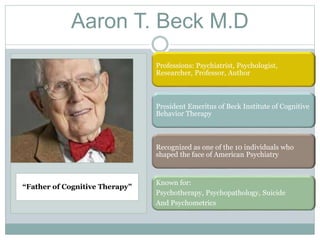
Aaron T. Beck M.D
“Father of Cognitive Therapy”
Professions: Psychiatrist, Psychologist,
Researcher, Professor, Author
President Emeritus of Beck Institute of Cognitive
Behavior Therapy
Recognized as one of the 10 individuals who
shaped the face of American Psychiatry
Known for:
Psychotherapy, Psychopathology, Suicide
And Psychometrics
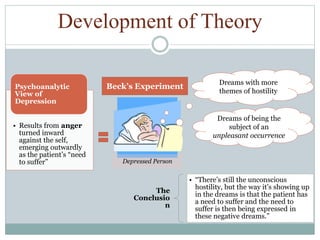
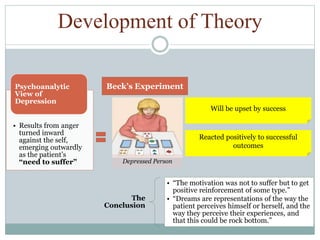
Development of Theory
• Results from anger
turned inward
against the self,
emerging outwardly
as the patient’s “need
to suffer”
Psychoanalytic
View of
Depression
Beck’s Experiment
The
Conclusio
n
• “There’s still the unconscious
hostility, but the way it’s showing up
in the dreams is that the patient has
a need to suffer and the need to
suffer is then being expressed in
these negative dreams.”
Depressed Person
Dreams with more
themes of hostility
Dreams of being the
subject of an
unpleasant occurrence
Development of Theory
• Results from anger
turned inward
against the self,
emerging outwardly
as the patient’s
“need to suffer”
Psychoanalytic
View of
Depression
Beck’s Experiment
The
Conclusion
• “The motivation was not to suffer but to get
positive reinforcement of some type.”
• “Dreams are representations of the way the
patient perceives himself or herself, and the
way they perceive their experiences, and
that this could be rock bottom.”
Depressed Person
Will be upset by success
Reacted positively to successful
outcomes
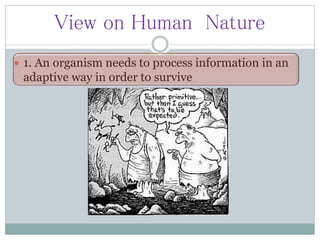
View on Human Nature
 1. An organism needs to process information in an
adaptive way in order to survive
View on Human Nature
2. Psychological distress is the ultimate consequence of the interaction of
the innate, biological, developmental and environmental factors.
Biological Psychological Social
Mentally Healthy / Psychopathology
View on Human Nature
 3. It is our cognitions,
which include our
thoughts, beliefs and the
manner in which we
perceive a situation, that
are the basis for what we
believe, how we act and
how we feel.
Action
Thoughts
Emotion
Vision
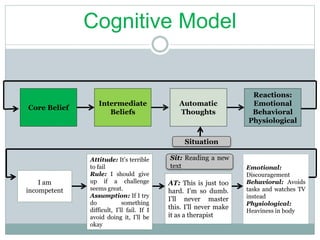
Cognitive Model
Core Belief
Intermediate
Beliefs
Automatic
Thoughts
Reactions:
Emotional
Behavioral
Physiological
Situation
I am
incompetent
Attitude: It’s terrible
to fail
Rule: I should give
up if a challenge
seems great.
Assumption: If I try
do something
difficult, I’ll fail. If I
avoid doing it, I’ll be
okay
Sit: Reading a new
text
AT: This is just too
hard. I’m so dumb.
I’ll never master
this. I’ll never make
it as a therapist
Emotional:
Discouragement
Behavioral: Avoids
tasks and watches TV
instead
Physiological:
Heaviness in body
View on Human Nature
 4. The Cognitive model proposes that dysfunctional
thinking ( which influences the patient’s mood and
behavior) is common to all psychological
disturbances
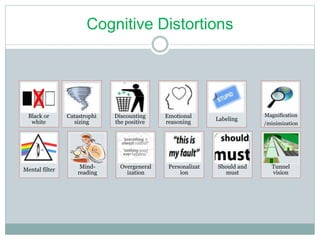
Cognitive Distortions
Black or
white
Catastrophi
sizing
Discounting
the positive
Emotional
reasoning
Labeling
Magnification
/minimization
Mental filter
Mind-
reading
Overgeneral
ization
Personalizat
ion
Should and
must
Tunnel
vision
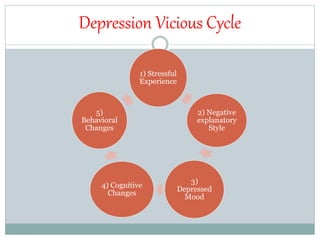
Depression Vicious Cycle
1) Stressful
Experience
2) Negative
explanatory
Style
3)
Depressed
Mood
4) Cognitive
Changes
5)
Behavioral
Changes
Therapeutic Approach
1) Building a strong therapeutic Alliance
Empathy
Caring
Optimism
Essential Techniques
Therapeutic Approach
• Sample use of Three-Question Technique:
2. Socratic Questioning
Essential Techniques
Therapeutic Approach
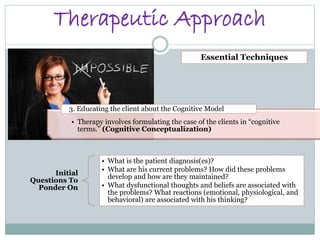
• Therapy involves formulating the case of the clients in “cognitive
terms.” (Cognitive Conceptualization)
3. Educating the client about the Cognitive Model
Essential Techniques
Initial
Questions To
Ponder On
• What is the patient diagnosis(es)?
• What are his current problems? How did these problems
develop and how are they maintained?
• What dysfunctional thoughts and beliefs are associated with
the problems? What reactions (emotional, physiological, and
behavioral) are associated with his thinking?
Therapeutic Approach
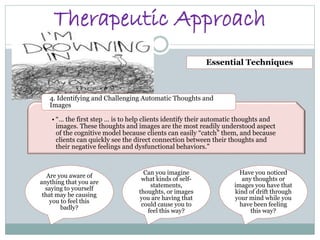
• “… the first step … is to help clients identify their automatic thoughts and
images. These thoughts and images are the most readily understood aspect
of the cognitive model because clients can easily “catch” them, and because
clients can quickly see the direct connection between their thoughts and
their negative feelings and dysfunctional behaviors.”
4. Identifying and Challenging Automatic Thoughts and
Images
Essential Techniques
Are you aware of
anything that you are
saying to yourself
that may be causing
you to feel this
badly?
Can you imagine
what kinds of self-
statements,
thoughts, or images
you are having that
could cause you to
feel this way?
Have you noticed
any thoughts or
images you have that
kind of drift through
your mind while you
have been feeling
this way?
Therapeutic Approach
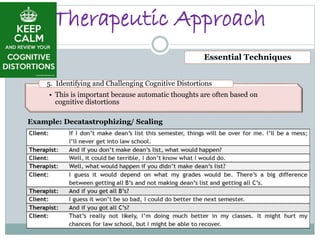
• This is important because automatic thoughts are often based on
cognitive distortions
5. Identifying and Challenging Cognitive Distortions
Essential Techniques
Example: Decatastrophizing/ Scaling
Therapeutic Approach
6. Identifying and Challenging Intermediate Beliefs
7. Identifying and Challenging Core Beliefs
8. Homework
Essential Techniques
Commonly Used Techniques
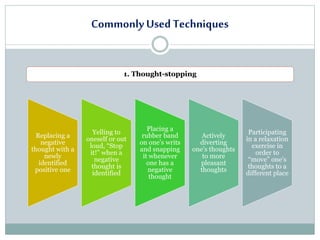
1. Thought-stopping
Replacing a
negative
thought with a
newly
identified
positive one
Yelling to
oneself or out
loud, “Stop
it!” when a
negative
thought is
identified
Placing a
rubber band
on one’s writs
and snapping
it whenever
one has a
negative
thought
Actively
diverting
one’s thoughts
to more
pleasant
thoughts
Participating
in a relaxation
exercise in
order to
“move” one’s
thoughts to a
different place
Commonly Used Techniques
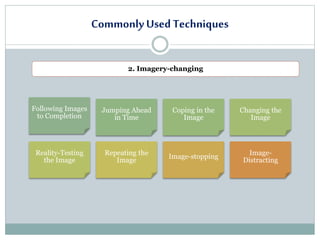
2. Imagery-changing
Following Images
to Completion
Jumping Ahead
in Time
Coping in the
Image
Changing the
Image
Reality-Testing
the Image
Repeating the
Image
Image-stopping
Image-
Distracting
Commonly Used Techniques
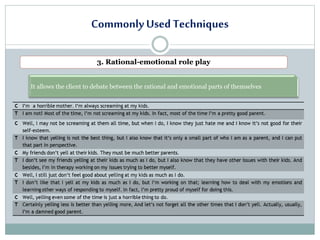
3. Rational-emotional role play
It allows the client to debate between the rational and emotional parts of themselves
Commonly Used Techniques
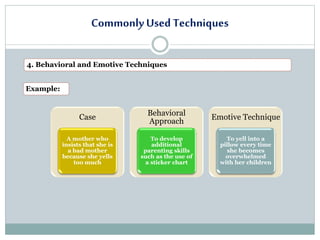
4. Behavioral and Emotive Techniques
Example:
Case
A mother who
insists that she is
a bad mother
because she yells
too much
Behavioral
Approach
To develop
additional
parenting skills
such as the use of
a sticker chart
Emotive Technique
To yell into a
pillow every time
she becomes
overwhelmed
with her children
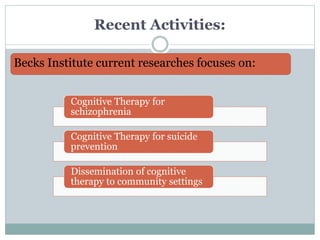
Recent Activities:
Becks Institute current researches focuses on:
Cognitive Therapy for
schizophrenia
Cognitive Therapy for suicide
prevention
Dissemination of cognitive
therapy to community settings
References:
 David G. Myers Psychology 10th Edition
 Theory and Practice of Counseling and
Psychotherapy – Gerald Corey
 Cognitive Therapy – Gale
 Neukrug, Edward. Counselling theory and practice.
Brooks/Cole Cengage Learning: Belmont. CA. 2011
 Annual Reviews Conversations: A Conversation with
Aaron T. Beck
Thank You!

Cognitive behavioral therapy

  • 1.
    JOSHUA J. BATALLAIP Cognitive Therapy
  • 2.
    Theory of Personality •A Person’s charachteristic pattern of thinking, feeling and acting Personality • all mental activities associated with thinking, knowing, remembering and communicating Thinking or Cognition • Cognitive therapy perceives psychological problems as stemming from commonplace processes such as faulty thinking making incorrect inferences on the basis of inadequate or incorrect information and failing to distinguish between fantasy and reality.. CT on Personality
  • 3.
    July 18, 1921Providence, Rhode Island  “Tim”  His parents were Jewish Immigrant  His family suffered the loss of first two children.  At age 7, Broke his arm and developed acutely serious bone infection which required surgery  He missed being promoted into Second grade  Bad case of whooping cough, chronic Childhood asthma  Interest in Nature
  • 4.
    SignificantChildhood Events Event: His motherwas too emotional Broke his arm; developed serious bone infection Interest in Nature Repercussions: He became sensitive to others with strong Emotions He developed blood and injury phobia Became his primary motivation in entering medical school Piqued his interest in knowing “ what makes people tick; what makes them happy or sad and confident or insecure
  • 5.
    Cognitive Therapy atPresent  Short Term Approach  Most number of research published  Cured Thousands for Depressions and other psychological disorder  Scientific  Active  Present Focus  Learning Focus
  • 6.
    Aaron T. BeckM.D “Father of Cognitive Therapy” Professions: Psychiatrist, Psychologist, Researcher, Professor, Author President Emeritus of Beck Institute of Cognitive Behavior Therapy Recognized as one of the 10 individuals who shaped the face of American Psychiatry Known for: Psychotherapy, Psychopathology, Suicide And Psychometrics
  • 7.
    Development of Theory •Results from anger turned inward against the self, emerging outwardly as the patient’s “need to suffer” Psychoanalytic View of Depression Beck’s Experiment The Conclusio n • “There’s still the unconscious hostility, but the way it’s showing up in the dreams is that the patient has a need to suffer and the need to suffer is then being expressed in these negative dreams.” Depressed Person Dreams with more themes of hostility Dreams of being the subject of an unpleasant occurrence
  • 8.
    Development of Theory •Results from anger turned inward against the self, emerging outwardly as the patient’s “need to suffer” Psychoanalytic View of Depression Beck’s Experiment The Conclusion • “The motivation was not to suffer but to get positive reinforcement of some type.” • “Dreams are representations of the way the patient perceives himself or herself, and the way they perceive their experiences, and that this could be rock bottom.” Depressed Person Will be upset by success Reacted positively to successful outcomes
  • 9.
    View on HumanNature  1. An organism needs to process information in an adaptive way in order to survive
  • 10.
    View on HumanNature 2. Psychological distress is the ultimate consequence of the interaction of the innate, biological, developmental and environmental factors. Biological Psychological Social Mentally Healthy / Psychopathology
  • 11.
    View on HumanNature  3. It is our cognitions, which include our thoughts, beliefs and the manner in which we perceive a situation, that are the basis for what we believe, how we act and how we feel. Action Thoughts Emotion Vision
  • 12.
    Cognitive Model Core Belief Intermediate Beliefs Automatic Thoughts Reactions: Emotional Behavioral Physiological Situation Iam incompetent Attitude: It’s terrible to fail Rule: I should give up if a challenge seems great. Assumption: If I try do something difficult, I’ll fail. If I avoid doing it, I’ll be okay Sit: Reading a new text AT: This is just too hard. I’m so dumb. I’ll never master this. I’ll never make it as a therapist Emotional: Discouragement Behavioral: Avoids tasks and watches TV instead Physiological: Heaviness in body
  • 13.
    View on HumanNature  4. The Cognitive model proposes that dysfunctional thinking ( which influences the patient’s mood and behavior) is common to all psychological disturbances
  • 14.
    Cognitive Distortions Black or white Catastrophi sizing Discounting thepositive Emotional reasoning Labeling Magnification /minimization Mental filter Mind- reading Overgeneral ization Personalizat ion Should and must Tunnel vision
  • 15.
    Depression Vicious Cycle 1)Stressful Experience 2) Negative explanatory Style 3) Depressed Mood 4) Cognitive Changes 5) Behavioral Changes
  • 16.
    Therapeutic Approach 1) Buildinga strong therapeutic Alliance Empathy Caring Optimism Essential Techniques
  • 17.
    Therapeutic Approach • Sampleuse of Three-Question Technique: 2. Socratic Questioning Essential Techniques
  • 18.
    Therapeutic Approach • Therapyinvolves formulating the case of the clients in “cognitive terms.” (Cognitive Conceptualization) 3. Educating the client about the Cognitive Model Essential Techniques Initial Questions To Ponder On • What is the patient diagnosis(es)? • What are his current problems? How did these problems develop and how are they maintained? • What dysfunctional thoughts and beliefs are associated with the problems? What reactions (emotional, physiological, and behavioral) are associated with his thinking?
  • 19.
    Therapeutic Approach • “…the first step … is to help clients identify their automatic thoughts and images. These thoughts and images are the most readily understood aspect of the cognitive model because clients can easily “catch” them, and because clients can quickly see the direct connection between their thoughts and their negative feelings and dysfunctional behaviors.” 4. Identifying and Challenging Automatic Thoughts and Images Essential Techniques Are you aware of anything that you are saying to yourself that may be causing you to feel this badly? Can you imagine what kinds of self- statements, thoughts, or images you are having that could cause you to feel this way? Have you noticed any thoughts or images you have that kind of drift through your mind while you have been feeling this way?
  • 20.
    Therapeutic Approach • Thisis important because automatic thoughts are often based on cognitive distortions 5. Identifying and Challenging Cognitive Distortions Essential Techniques Example: Decatastrophizing/ Scaling
  • 21.
    Therapeutic Approach 6. Identifyingand Challenging Intermediate Beliefs 7. Identifying and Challenging Core Beliefs 8. Homework Essential Techniques
  • 22.
    Commonly Used Techniques 1.Thought-stopping Replacing a negative thought with a newly identified positive one Yelling to oneself or out loud, “Stop it!” when a negative thought is identified Placing a rubber band on one’s writs and snapping it whenever one has a negative thought Actively diverting one’s thoughts to more pleasant thoughts Participating in a relaxation exercise in order to “move” one’s thoughts to a different place
  • 23.
    Commonly Used Techniques 2.Imagery-changing Following Images to Completion Jumping Ahead in Time Coping in the Image Changing the Image Reality-Testing the Image Repeating the Image Image-stopping Image- Distracting
  • 24.
    Commonly Used Techniques 3.Rational-emotional role play It allows the client to debate between the rational and emotional parts of themselves
  • 25.
    Commonly Used Techniques 4.Behavioral and Emotive Techniques Example: Case A mother who insists that she is a bad mother because she yells too much Behavioral Approach To develop additional parenting skills such as the use of a sticker chart Emotive Technique To yell into a pillow every time she becomes overwhelmed with her children
  • 26.
    Recent Activities: Becks Institutecurrent researches focuses on: Cognitive Therapy for schizophrenia Cognitive Therapy for suicide prevention Dissemination of cognitive therapy to community settings
  • 27.
    References:  David G.Myers Psychology 10th Edition  Theory and Practice of Counseling and Psychotherapy – Gerald Corey  Cognitive Therapy – Gale  Neukrug, Edward. Counselling theory and practice. Brooks/Cole Cengage Learning: Belmont. CA. 2011  Annual Reviews Conversations: A Conversation with Aaron T. Beck Thank You!

Editor's Notes

  • #2 ** Introduction Brief As you saw in the previous reports: Traditional Behavior therapy has broadened and largely moved in the direction of cognitive behavior therapy. ** CBT – Rational Emotive Therapy Cognitive Therapy Cognitive Behavior Modification **Theory and Practice of Counseling and Psychotherapy – Gerald Corey Cognitive Behavior Therapy, which combines both cognitive and behavioral principles and methods in a short-term treatment approach, has generated more empirical research than any other psychotherapy model Selling!!!
  • #3 Personality **David G Meyers Chapter 13 personality A Person’s charachteristic pattern of thinking, feeling and acting Theory Role of cognitive therapy **David G Meyers Chapter 9 Thinking and Language Thinking or cognition , refers to all mental activities associated with thinking, knowing, remembering and communicating. Cognitive psychologist studies these activities including the logical and sometimes the illogical ways in which we create concepts, solve problems, make decisions and form judgement. Emotions ** David G Myers Psychology Chapter 12 Theories of Emotion * James Lange Theory *Schachter-Singer Theory Cognition and Emotion **David G Meyers Chapter 16 Social Psychology Attitudes are feelings often influenced by our beliefs Role of cognitive therapy Cognitive therapy perceives psychological problems as stemming from commonplace processes such as faulty thinking making incorrect inferences on the basis of inadequate or incorrect information and failing to distinguish between fantasy and reality..
  • #6 **Theory and Practice of Counseling and Psychotherapy – Gerald Corey Cognitive Behavior Therapy, which combines both cognitive and behavioral principles and methods in a short-term treatment approach, has generated more empirical research than any other psychotherapy model All of the cognitive behavioral approaches share the same basic characteristics and assumptions of traditional behavior therapy. A collaborative relationship between client and therapist The premise that psychological distress is largely a function of disturbances in cognitive processes A focus in changing the cognitions to produced desired changes in affect and behavior Generally time – limited and educational treatment focusing on specific and structured target problems Active, Directive, Time-limited, present centered, problem oriented, collaborative, structured, empirical, make use of homework and require explicit identification of problems and situations in which they occur Cognitive therapy is an insight-focused therapy that emphasizes recognizing and changing negative thoughts and maladaptive beliefs, thus it is a psychological education model of therapy. Cognitive therapy is based on the theoretical rationale that the way people feel and behave is determined by how they perceive and structure their experience
  • #7 **Theory and Practice of Counseling and Psychotherapy – Gerald Corey Family Dynamics Significant Childhood Events Educational Background and experience Marriage and family Psychotherapy Psychopathology Suicide Psychometrics
  • #8 **Theory and Practice of Counseling and Psychotherapy – Gerald Corey Beck attempted to validate freud’s theory of depression but his research resulted in his parting company with freud’s motivational model and the explanation of depression as self- directed anger. ** interview with Aaron T. Beck
  • #10 Emotions ** David G Myers Psychology Chapter 12 Theories of Emotion * James Lange Theory *Schachter-Singer Theory Cognition and Emotion **David G Meyers Chapter 16 Social Psychology Attitudes are feelings often influenced by our beliefs Theory and Practice of Counseling and Psychotherapy – Gerald Corey Neukrug
  • #11 Biopsychosocial approach
  • #14 3.1
  • #16 **Theory and Practice of Counseling and Psychotherapy – Gerald Corey Cognitive therapy initially gained recognition as an approach to treating depression, but extensive research has also been devoted to the study and treatment of anxiety disorders. **David G Meyers Chapter 14 Psychological Disorder Social Cognitive Theory Explanatory Style Depression Vicious Cycle **David G Meyers Chapter 15 Therapy ,646 Cognitive Therapies
  • #17 Essential Techniques 1. Building a Strong Therapeutic Alliance Being Collaborative The counselor is expected to be an expert in terms of collecting appropriate data and using them in therapy. It involves testing the hypothesized specific underlying assumptions that trigger the patient’s emotional pain and motivational difficulties (Collaborative Enterprise or Collaborative Empiricism) Demonstrating empathy, caring and optimism Adapting one’s therapeutic style
  • #27 Romans 12:1 I beseech you therefore, brethren, by the mercies of God , that ye present your bodies a living sacrifice, holy , acceptable to God, which is your reasonable service