COUNSELLING SKILLS
Presented by:
Shalini
Verbal Communication
•
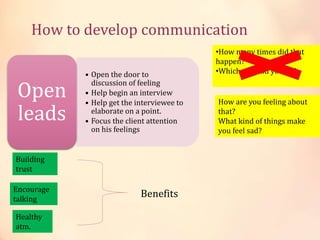
How to develop communication
• Open the door to
discussion of feeling
• Help begin an interview
• Help get the interviewee to
elaborate on a point.
• Focus the client attention
on his feelings
Open
leads
Building
trust
Encourage
talking
Healthy
atm.
•How many times did that
happen?
•Which way did you go?
How are you feeling about
that?
What kind of things make
you feel sad?
Benefits
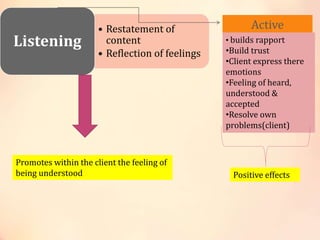
• Restatement of
content
• Reflection of feelings
Listening
Promotes within the client the feeling of
being understood
Active
• builds rapport
•Build trust
•Client express there
emotions
•Feeling of heard,
understood &
accepted
•Resolve own
problems(client)
Positive effects
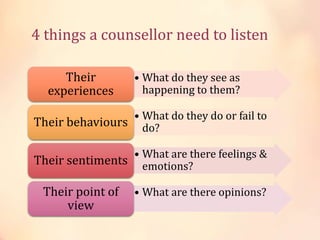
4 things a counsellor need to listen
• What do they see as
happening to them?
Their
experiences
• What do they do or fail to
do?Their behaviours
• What are there feelings &
emotions?Their sentiments
• What are there opinions?Their point of
view
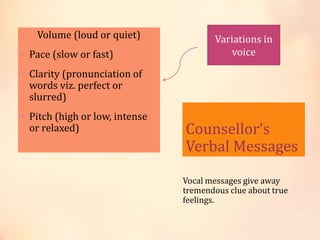
Counsellor’s
Verbal Messages
• Volume (loud or quiet)
• Pace (slow or fast)
• Clarity (pronunciation of
words viz. perfect or
slurred)
• Pitch (high or low, intense
or relaxed)
Vocal messages give away
tremendous clue about true
feelings.
Variations in
voice
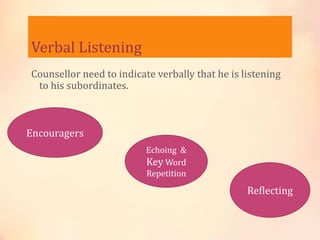
Verbal Listening
Counsellor need to indicate verbally that he is listening
to his subordinates.
Encouragers
Echoing &
Key Word
Repetition
Reflecting
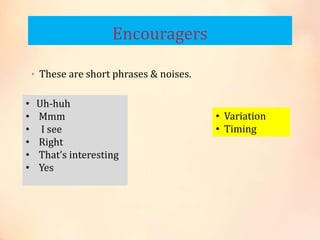
Encouragers
• These are short phrases & noises.
• Uh-huh
• Mmm
• I see
• Right
• That’s interesting
• Yes
• Variation
• Timing
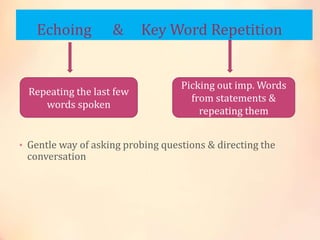
Echoing & Key Word Repetition
• Gentle way of asking probing questions & directing the
conversation
Repeating the last few
words spoken
Picking out imp. Words
from statements &
repeating them
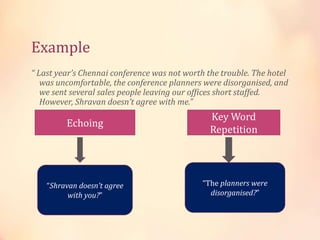
Example
“ Last year’s Chennai conference was not worth the trouble. The hotel
was uncomfortable, the conference planners were disorganised, and
we sent several sales people leaving our offices short staffed.
However, Shravan doesn’t agree with me.”
Echoing
Key Word
Repetition
“Shravan doesn’t agree
with you?”
“The planners were
disorganised?”
Reflecting
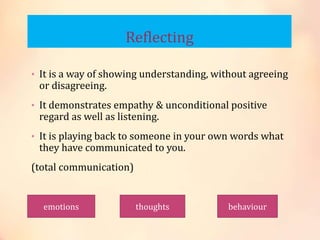
• It is a way of showing understanding, without agreeing
or disagreeing.
• It demonstrates empathy & unconditional positive
regard as well as listening.
• It is playing back to someone in your own words what
they have communicated to you.
(total communication)
emotions thoughts behaviour
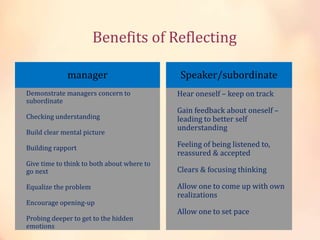
Benefits of Reflecting
manager
• Demonstrate managers concern to
subordinate
• Checking understanding
• Build clear mental picture
• Building rapport
• Give time to think to both about where to
go next
• Equalize the problem
• Encourage opening-up
• Probing deeper to get to the hidden
emotions
Speaker/subordinate
• Hear oneself – keep on track
• Gain feedback about oneself –
leading to better self
understanding
• Feeling of being listened to,
reassured & accepted
• Clears & focusing thinking
• Allow one to come up with own
realizations
• Allow one to set pace
Silence or Passive listening
•
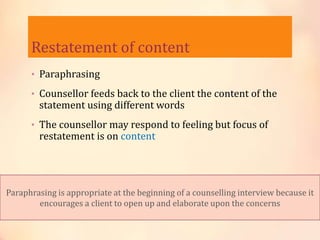
Restatement of content
• Paraphrasing
• Counsellor feeds back to the client the content of the
statement using different words
• The counsellor may respond to feeling but focus of
restatement is on content
Paraphrasing is appropriate at the beginning of a counselling interview because it
encourages a client to open up and elaborate upon the concerns
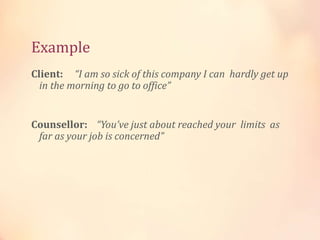
Example
Client: “I am so sick of this company I can hardly get up
in the morning to go to office”
Counsellor: “You’ve just about reached your limits as
far as your job is concerned”
Reflection of feelings
• Respond by paraphrasing the content but focus is on
the feeling which the client has expressed.
• Understanding the client from there internal frame of
reference
• Identify the feeling by listening not only to what the
client says but also to how the client says it.
Example
Client: “My mom & dad fight constantly. I never know
what to expect when dad comes home from work.”
Counsellor: “it must be pretty scary for you to live with
such uncertainty.”
Summarisation of content
• It enables the counsellor to condense & crystallize the
essence of the client’s statement
• A summary can cover an entire phase of the session or
even a total interview
Summarisation of feeling & emotions
• Overriding feelings/emotions of the client
The counsellor’s verbal
Encouragement to disclose

Counselling skills

  • 1.
  • 2.
  • 3.
    How to developcommunication • Open the door to discussion of feeling • Help begin an interview • Help get the interviewee to elaborate on a point. • Focus the client attention on his feelings Open leads Building trust Encourage talking Healthy atm. •How many times did that happen? •Which way did you go? How are you feeling about that? What kind of things make you feel sad? Benefits
  • 4.
    • Restatement of content •Reflection of feelings Listening Promotes within the client the feeling of being understood Active • builds rapport •Build trust •Client express there emotions •Feeling of heard, understood & accepted •Resolve own problems(client) Positive effects
  • 5.
    4 things acounsellor need to listen • What do they see as happening to them? Their experiences • What do they do or fail to do?Their behaviours • What are there feelings & emotions?Their sentiments • What are there opinions?Their point of view
  • 6.
    Counsellor’s Verbal Messages • Volume(loud or quiet) • Pace (slow or fast) • Clarity (pronunciation of words viz. perfect or slurred) • Pitch (high or low, intense or relaxed) Vocal messages give away tremendous clue about true feelings. Variations in voice
  • 7.
    Verbal Listening Counsellor needto indicate verbally that he is listening to his subordinates. Encouragers Echoing & Key Word Repetition Reflecting
  • 8.
    Encouragers • These areshort phrases & noises. • Uh-huh • Mmm • I see • Right • That’s interesting • Yes • Variation • Timing
  • 9.
    Echoing & KeyWord Repetition • Gentle way of asking probing questions & directing the conversation Repeating the last few words spoken Picking out imp. Words from statements & repeating them
  • 10.
    Example “ Last year’sChennai conference was not worth the trouble. The hotel was uncomfortable, the conference planners were disorganised, and we sent several sales people leaving our offices short staffed. However, Shravan doesn’t agree with me.” Echoing Key Word Repetition “Shravan doesn’t agree with you?” “The planners were disorganised?”
  • 11.
    Reflecting • It isa way of showing understanding, without agreeing or disagreeing. • It demonstrates empathy & unconditional positive regard as well as listening. • It is playing back to someone in your own words what they have communicated to you. (total communication) emotions thoughts behaviour
  • 12.
    Benefits of Reflecting manager •Demonstrate managers concern to subordinate • Checking understanding • Build clear mental picture • Building rapport • Give time to think to both about where to go next • Equalize the problem • Encourage opening-up • Probing deeper to get to the hidden emotions Speaker/subordinate • Hear oneself – keep on track • Gain feedback about oneself – leading to better self understanding • Feeling of being listened to, reassured & accepted • Clears & focusing thinking • Allow one to come up with own realizations • Allow one to set pace
  • 13.
    Silence or Passivelistening •
  • 14.
    Restatement of content •Paraphrasing • Counsellor feeds back to the client the content of the statement using different words • The counsellor may respond to feeling but focus of restatement is on content Paraphrasing is appropriate at the beginning of a counselling interview because it encourages a client to open up and elaborate upon the concerns
  • 15.
    Example Client: “I amso sick of this company I can hardly get up in the morning to go to office” Counsellor: “You’ve just about reached your limits as far as your job is concerned”
  • 16.
    Reflection of feelings •Respond by paraphrasing the content but focus is on the feeling which the client has expressed. • Understanding the client from there internal frame of reference • Identify the feeling by listening not only to what the client says but also to how the client says it.
  • 17.
    Example Client: “My mom& dad fight constantly. I never know what to expect when dad comes home from work.” Counsellor: “it must be pretty scary for you to live with such uncertainty.”
  • 18.
    Summarisation of content •It enables the counsellor to condense & crystallize the essence of the client’s statement • A summary can cover an entire phase of the session or even a total interview
  • 19.
    Summarisation of feeling& emotions • Overriding feelings/emotions of the client
  • 20.

Editor's Notes

  • #5 Counsellor need to feedback the content & feelings that the client has communicated