Medieval era
   Presentation I
Overview

• Spans 900 to 1500

• Early half of era consisted of monophonic chants,
  laude, and songs

• Later part of the era consisted of polyphonic mass
  movements, mass cycels, motets, and secular songs
Chant
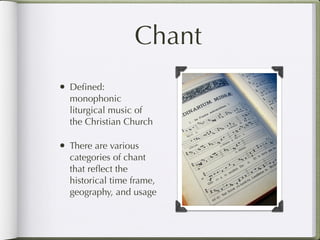
• Defined:
  monophonic
  liturgical music of
  the Christian Church

• There are various
  categories of chant
  that reflect the
  historical time frame,
  geography, and usage
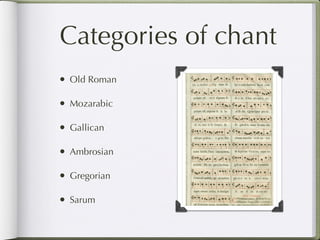
Categories of chant
• Old Roman

• Mozarabic

• Gallican

• Ambrosian

• Gregorian

• Sarum
• Old Roman: 7th through 9th centuries

• Mozarabic: 7th-9th but sung by Christians in Spain under Muslim
   rule

• Gallican: chants composed in Gaul before the 10th century

• Ambrosian: named after St. Ambrose - chant centered in Milan
   (Italy) during the 12th and 13th centuries

• Gregorian: label given to liturgical chant sanctioned by the
   Roman Catholic Church

• Sarum: Gregorian chants that were modified and used throughout
   the British Isles between 13th and 16th Ccenturies
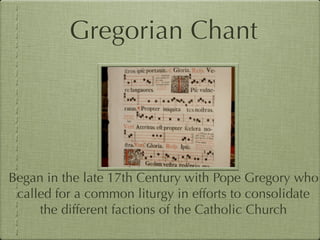
Gregorian Chant


Began in the late 17th Century with Pope Gregory who
 called for a common liturgy in efforts to consolidate
     the different factions of the Catholic Church
Best known chants
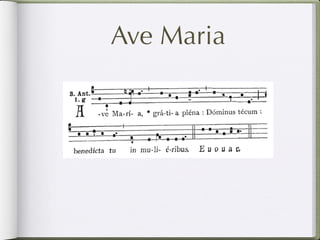
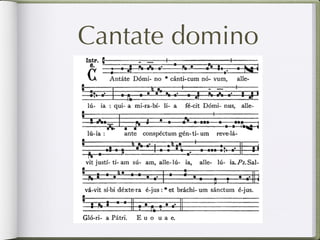
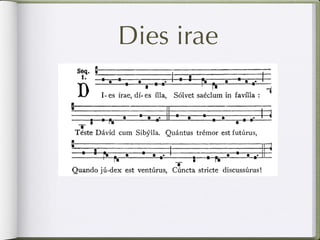
• Ave Maria (1679)           • Pange lingua (957)

• Cantate Domino (826)       • Salve regina (279, 276)

• Dies irae (1810)           • Vicimae paschali laudes
                                 (780)
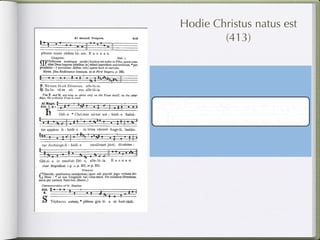
• Hodie Christus natus est
   (413)

• Magnificat anima mea
   (207-212)
                             ✤   this list taken from Dennis Schrock’s
                                 Choral Repertoire (2009)
• O magnum mysterium (382)
Characteristics of
        chant
• syllabic or melismatic?

• does it have musical
  structure or is it
  through-composed?
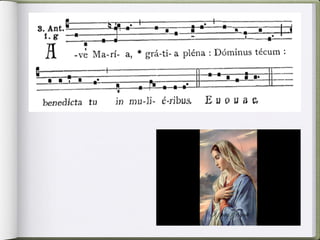
Ave Maria
Cantate domino
Dies irae
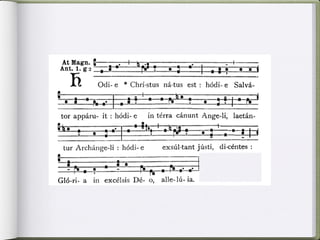
Hodie Christus natus est
        (413)
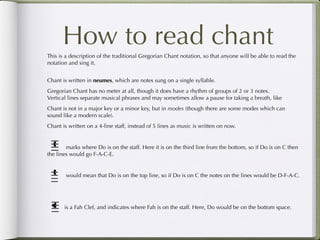
How to read chant
This is a description of the traditional Gregorian Chant notation, so that anyone will be able to read the
notation and sing it.


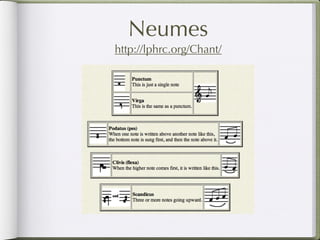
Chant is written in neumes, which are notes sung on a single syllable.
Gregorian Chant has no meter at all, though it does have a rhythm of groups of 2 or 3 notes.
Vertical lines separate musical phrases and may sometimes allow a pause for taking a breath, like
Chant is not in a major key or a minor key, but in modes (though there are some modes which can
sound like a modern scale).
Chant is written on a 4-line staff, instead of 5 lines as music is written on now.


        marks where Do is on the staff. Here it is on the third line from the bottom, so if Do is on C then
the lines would go F-A-C-E.


        would mean that Do is on the top line, so if Do is on C the notes on the lines would be D-F-A-C.


       is a Fah Clef, and indicates where Fah is on the staff. Here, Do would be on the bottom space.
Neumes
http://lphrc.org/Chant/
Assignment:
 Transcribing chant
• On the next slide, you will find the “Hodie Christus
  natus est” chant.

• Transcribe the piece into modern notation, carefully
  aligning text with notes.

• Extra points for putting it into sibelius.

• Due: TUESDAY, FEBRUARY 7, 2012 (place in my
  box)
Medieval chant

Medieval chant

  • 1.
    Medieval era Presentation I
  • 2.
    Overview • Spans 900to 1500 • Early half of era consisted of monophonic chants, laude, and songs • Later part of the era consisted of polyphonic mass movements, mass cycels, motets, and secular songs
  • 3.
    Chant • Defined: monophonic liturgical music of the Christian Church • There are various categories of chant that reflect the historical time frame, geography, and usage
  • 4.
    Categories of chant •Old Roman • Mozarabic • Gallican • Ambrosian • Gregorian • Sarum
  • 5.
    • Old Roman:7th through 9th centuries • Mozarabic: 7th-9th but sung by Christians in Spain under Muslim rule • Gallican: chants composed in Gaul before the 10th century • Ambrosian: named after St. Ambrose - chant centered in Milan (Italy) during the 12th and 13th centuries • Gregorian: label given to liturgical chant sanctioned by the Roman Catholic Church • Sarum: Gregorian chants that were modified and used throughout the British Isles between 13th and 16th Ccenturies
  • 6.
    Gregorian Chant Began inthe late 17th Century with Pope Gregory who called for a common liturgy in efforts to consolidate the different factions of the Catholic Church
  • 7.
    Best known chants •Ave Maria (1679) • Pange lingua (957) • Cantate Domino (826) • Salve regina (279, 276) • Dies irae (1810) • Vicimae paschali laudes (780) • Hodie Christus natus est (413) • Magnificat anima mea (207-212) ✤ this list taken from Dennis Schrock’s Choral Repertoire (2009) • O magnum mysterium (382)
  • 8.
    Characteristics of chant • syllabic or melismatic? • does it have musical structure or is it through-composed?
  • 9.
  • 11.
  • 12.
  • 13.
  • 14.
    How to readchant This is a description of the traditional Gregorian Chant notation, so that anyone will be able to read the notation and sing it. Chant is written in neumes, which are notes sung on a single syllable. Gregorian Chant has no meter at all, though it does have a rhythm of groups of 2 or 3 notes. Vertical lines separate musical phrases and may sometimes allow a pause for taking a breath, like Chant is not in a major key or a minor key, but in modes (though there are some modes which can sound like a modern scale). Chant is written on a 4-line staff, instead of 5 lines as music is written on now. marks where Do is on the staff. Here it is on the third line from the bottom, so if Do is on C then the lines would go F-A-C-E. would mean that Do is on the top line, so if Do is on C the notes on the lines would be D-F-A-C. is a Fah Clef, and indicates where Fah is on the staff. Here, Do would be on the bottom space.
  • 15.
  • 16.
    Assignment: Transcribing chant •On the next slide, you will find the “Hodie Christus natus est” chant. • Transcribe the piece into modern notation, carefully aligning text with notes. • Extra points for putting it into sibelius. • Due: TUESDAY, FEBRUARY 7, 2012 (place in my box)