








Behavior Management
Prepared by: Imtiaz Ahmad Anwar
Insides:
 What is behavior management?
 Techniques of behavior management.
 Extinction.
• Classroom application of Extinction.
• Positive reinforcement.
• Intrinsic and Extrinsic Reinforcement.
• Classroom application.
• Counter Conditioning .
• Classroom Applications of Counter Conditioning.
Insides:
• Social Imitation.
• Classroom Applications.
• Behavior Management in a Nutshell.
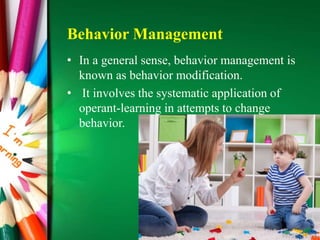
Behavior Management
• In a general sense, behavior management is
known as behavior modification.
• It involves the systematic application of
operant-learning in attempts to change
behavior.
Techniques of behavior management.
There are four techniques of behavior management.
1) Extinction
2) Positive Reinforcement
3) Counterconditioning
4) Social Imitation
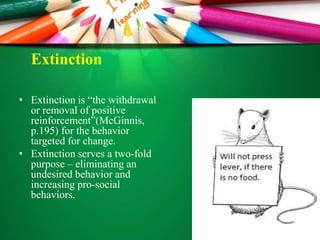
Extinction
• Extinction is “the withdrawal
or removal of positive
reinforcement”(McGinnis,
p.195) for the behavior
targeted for change.
• Extinction serves a two-fold
purpose – eliminating an
undesired behavior and
increasing pro-social
behaviors.
Classroom Application.
• Extinction is quite fruitful in
classroom.
• It is useful in respect to
maintain classroom
discipline.
• For example, if a student
creates disturbance in class,
after identifying the
reinforcement, and
withdrawing that
reinforcement, the undesired
behavior can be
extinguished easily.
Classroom Application.
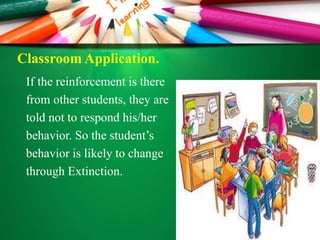
If the reinforcement is there
from other students, they are
told not to respond his/her
behavior. So the student’s
behavior is likely to change
through Extinction.
Positive reinforcement
• Positive reinforcement is a very powerful and effective tool
to help shape and change behavior. Positive reinforcement works
by presenting a motivating item to the student after the desired
behavior is exhibited, making the behavior more likely to happen
in the future.
• Whenever teachers praise a student, give a high mark, grant a
special privilege, a smile, pay particular attention, or ask an
interested question, they may be reinforcing a student behavior.
Give something to increase desired behavior
• Somethings like rewards, or things we will generally work to get.
Specifically, we can say that positive reinforcement has occurred
when three conditions have been met:
1. A consequence is presented dependent on a behavior.
2. The behavior becomes more likely to occur.
3. The behavior becomes more likely to occur because the
consequence is presented dependent on the behavior.
Intrinsic and Extrinsic Reinforcement
• Intrinsic motivation refers to motivation that occurs internally or
from within.it occurs be it is personally rewarding, performing an
activity for its own sake rather than the desire for some external
reward.
• Example:
Participating in a sport because you find the activity enjoyable
OR
Playing a game you find it enjoyable
• Extrinsic motivation refers to external sources of
reinforcement. It occurs when students are motivated to
perform a behavior or engage in activity to earn a
reward or avoid punishment.
• Example:
Studying because you want to get a good grade
OR
Participating in a sport to win reward
In classroom management, the main purpose is to foster
self-control through intrinsic motivation and extrinsic.
• For example, if a child says the words please or thank you to
another child, a teacher can say to the child, “Wow, I like the way
you are using your manners and saying thank you to your friend”.
By reinforcing the positive behavior the child was exhibiting, a
child is more likely to repeat the behavior. Also, children around
that child will hear the teacher give the child praise for the
specific action and will know the teacher is happy to hear those
kind words. In turn, the child will be more likely to behave in that
positive manner. Children like to get attention and it is important
to provide students with positive attention rather than negative. If
a child knows they will receive attention from the teacher for a
certain behavior, a child is more likely to repeat it whether it is
good or bad.
Counter Conditioning
• In Counter conditioning, a particular response to a certain
stimulus is replaced by a new response.
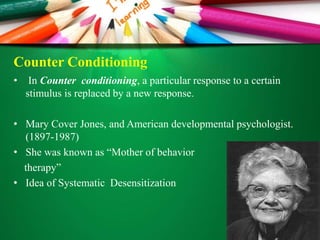
• Mary Cover Jones, and American developmental psychologist.
(1897-1987)
• She was known as “Mother of behavior
therapy”
• Idea of Systematic Desensitization
Classroom Applications of Counter Conditioning
• Examples
– Fatigue Method
– Threshold Method
– Incompatible Stimuli Method
Social Imitation
• Learning through imitation
• It emphasizes that learning occurs through observing others and it
is also called observational learning
• For example wearing dress ,ties shoes at parties
• In Pakistan Muslims wear particular dress on Eid and on Friday
• People stand for national anthem
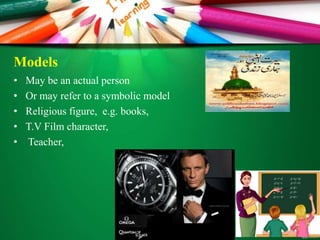
Models
• May be an actual person
• Or may refer to a symbolic model
• Religious figure, e.g. books,
• T.V Film character,
• Teacher,
Classroom Applications
In class teacher should create heterogeneous grouping
From different social background
Should create homogeneous grouping
Role Playing
Instructor<----------->Student
Behavior Management in a Nutshell
• What does behavior management involve?
• What does extinction involve?
• What does counter conditioning involve?
• Why the deliberate use of social imitation?
• How misbehavior can be used to reinforce desired behavior?
Question & Answer Session:
Behavior management presentation1

Behavior management presentation1

  • 1.
  • 2.
    Insides:  What isbehavior management?  Techniques of behavior management.  Extinction. • Classroom application of Extinction. • Positive reinforcement. • Intrinsic and Extrinsic Reinforcement. • Classroom application. • Counter Conditioning . • Classroom Applications of Counter Conditioning.
  • 3.
    Insides: • Social Imitation. •Classroom Applications. • Classroom Applications. • Behavior Management in a Nutshell.
  • 4.
    Behavior Management • Ina general sense, behavior management is known as behavior modification. • It involves the systematic application of operant-learning in attempts to change behavior.
  • 5.
    Techniques of behaviormanagement. There are four techniques of behavior management. 1) Extinction 2) Positive Reinforcement 3) Counterconditioning 4) Social Imitation
  • 6.
    Extinction • Extinction is“the withdrawal or removal of positive reinforcement”(McGinnis, p.195) for the behavior targeted for change. • Extinction serves a two-fold purpose – eliminating an undesired behavior and increasing pro-social behaviors.
  • 7.
    Classroom Application. • Extinctionis quite fruitful in classroom. • It is useful in respect to maintain classroom discipline. • For example, if a student creates disturbance in class, after identifying the reinforcement, and withdrawing that reinforcement, the undesired behavior can be extinguished easily.
  • 8.
    Classroom Application. If thereinforcement is there from other students, they are told not to respond his/her behavior. So the student’s behavior is likely to change through Extinction.
  • 9.
    Positive reinforcement • Positivereinforcement is a very powerful and effective tool to help shape and change behavior. Positive reinforcement works by presenting a motivating item to the student after the desired behavior is exhibited, making the behavior more likely to happen in the future. • Whenever teachers praise a student, give a high mark, grant a special privilege, a smile, pay particular attention, or ask an interested question, they may be reinforcing a student behavior.
  • 10.
    Give something toincrease desired behavior • Somethings like rewards, or things we will generally work to get. Specifically, we can say that positive reinforcement has occurred when three conditions have been met: 1. A consequence is presented dependent on a behavior. 2. The behavior becomes more likely to occur. 3. The behavior becomes more likely to occur because the consequence is presented dependent on the behavior.
  • 11.
    Intrinsic and ExtrinsicReinforcement • Intrinsic motivation refers to motivation that occurs internally or from within.it occurs be it is personally rewarding, performing an activity for its own sake rather than the desire for some external reward. • Example: Participating in a sport because you find the activity enjoyable OR Playing a game you find it enjoyable
  • 12.
    • Extrinsic motivationrefers to external sources of reinforcement. It occurs when students are motivated to perform a behavior or engage in activity to earn a reward or avoid punishment. • Example: Studying because you want to get a good grade OR Participating in a sport to win reward
  • 13.
    In classroom management,the main purpose is to foster self-control through intrinsic motivation and extrinsic. • For example, if a child says the words please or thank you to another child, a teacher can say to the child, “Wow, I like the way you are using your manners and saying thank you to your friend”. By reinforcing the positive behavior the child was exhibiting, a child is more likely to repeat the behavior. Also, children around that child will hear the teacher give the child praise for the specific action and will know the teacher is happy to hear those kind words. In turn, the child will be more likely to behave in that positive manner. Children like to get attention and it is important to provide students with positive attention rather than negative. If a child knows they will receive attention from the teacher for a certain behavior, a child is more likely to repeat it whether it is good or bad.
  • 14.
    Counter Conditioning • InCounter conditioning, a particular response to a certain stimulus is replaced by a new response. • Mary Cover Jones, and American developmental psychologist. (1897-1987) • She was known as “Mother of behavior therapy” • Idea of Systematic Desensitization
  • 15.
    Classroom Applications ofCounter Conditioning • Examples – Fatigue Method – Threshold Method – Incompatible Stimuli Method
  • 16.
    Social Imitation • Learningthrough imitation • It emphasizes that learning occurs through observing others and it is also called observational learning • For example wearing dress ,ties shoes at parties • In Pakistan Muslims wear particular dress on Eid and on Friday • People stand for national anthem
  • 20.
    Models • May bean actual person • Or may refer to a symbolic model • Religious figure, e.g. books, • T.V Film character, • Teacher,
  • 26.
    Classroom Applications In classteacher should create heterogeneous grouping From different social background Should create homogeneous grouping Role Playing Instructor<----------->Student
  • 27.
    Behavior Management ina Nutshell • What does behavior management involve? • What does extinction involve? • What does counter conditioning involve? • Why the deliberate use of social imitation? • How misbehavior can be used to reinforce desired behavior?
  • 28.