BEHAVIOR AND ITS
MODIFICATION
TECHNIQUES

Presented by: Rangarajan MSW 1st year
Shift II
Introduction
• Aims to understand self and others
• To determine how and why people behave the

way they do and to plan for solution in case of
problems
• Is a complicated phenomenon influenced by
many factors
• A collection of activities influenced by culture,
attitude, emotions, values, ethics, authority,
rapport, hypnosis, persuasion and coercion (coer-sion)
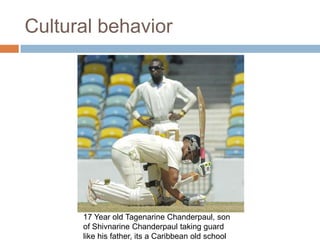
Cultural behavior

17 Year old Tagenarine Chanderpaul, son
of Shivnarine Chanderpaul taking guard
like his father, its a Caribbean old school
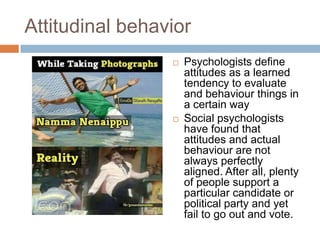
Attitudinal behavior




Psychologists define
attitudes as a learned
tendency to evaluate
and behaviour things in
a certain way
Social psychologists
have found that
attitudes and actual
behaviour are not
always perfectly
aligned. After all, plenty
of people support a
particular candidate or
political party and yet
fail to go out and vote.
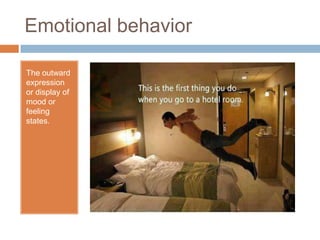
Emotional behavior
The outward
expression
or display of
mood or
feeling
states.
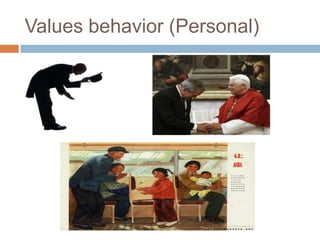
Values behavior (Personal)
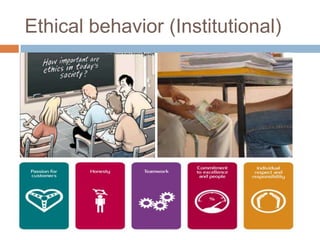
Ethical behavior (Institutional)
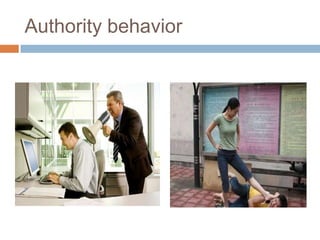
Authority behavior
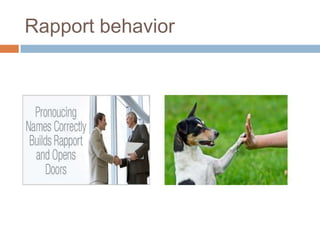
Rapport behavior
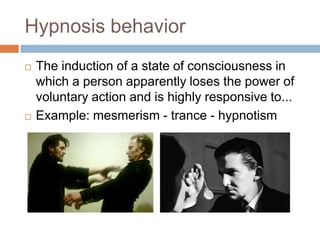
Hypnosis behavior




The induction of a state of consciousness in
which a person apparently loses the power of
voluntary action and is highly responsive to...
Example: mesmerism - trance - hypnotism
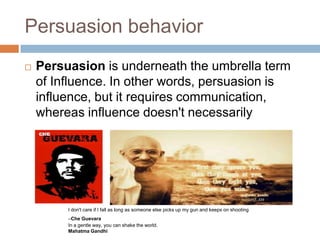
Persuasion behavior


Persuasion is underneath the umbrella term
of Influence. In other words, persuasion is
influence, but it requires communication,
whereas influence doesn't necessarily

I don't care if I fall as long as someone else picks up my gun and keeps on shooting
–Che Guevara
In a gentle way, you can shake the world.
Mahatma Gandhi
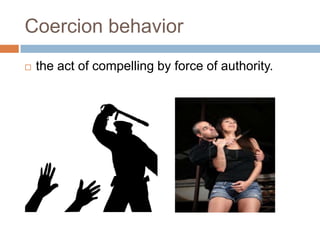
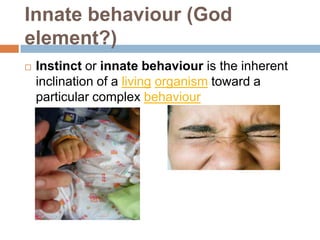
Coercion behavior


the act of compelling by force of authority.
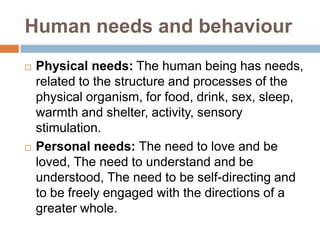
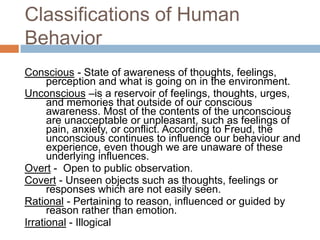
Innate behaviour (God
element?)


Instinct or innate behaviour is the inherent
inclination of a living organism toward a
particular complex behaviour
Human needs and behaviour




Physical needs: The human being has needs,
related to the structure and processes of the
physical organism, for food, drink, sex, sleep,
warmth and shelter, activity, sensory
stimulation.
Personal needs: The need to love and be
loved, The need to understand and be
understood, The need to be self-directing and
to be freely engaged with the directions of a
greater whole.
Classifications of Human
Behavior
Conscious - State of awareness of thoughts, feelings,
perception and what is going on in the environment.
Unconscious –is a reservoir of feelings, thoughts, urges,
and memories that outside of our conscious
awareness. Most of the contents of the unconscious
are unacceptable or unpleasant, such as feelings of
pain, anxiety, or conflict. According to Freud, the
unconscious continues to influence our behaviour and
experience, even though we are unaware of these
underlying influences.
Overt - Open to public observation.
Covert - Unseen objects such as thoughts, feelings or
responses which are not easily seen.
Rational - Pertaining to reason, influenced or guided by
reason rather than emotion.
Irrational - Illogical
Cont.
•
•

•
•

Voluntary - Intentional
Involuntary – Doing something against your will,
action made without intent or carried out despite
an attempt to prevent them
(disorders)
Simple – ex. What you see is what you get.
Complex - compound complicated behavior. ex.
Drinking alcohol and using drugs
Psychoanalytic Theory

•

•

•

•

This theory explained that human behavior is motivated by an inner
force called the human mind. This theory was introduced by
SIGMUND FREUD
SIGMUND FREUD (1856-1939) was an Austrian physician who
worked as an neurologist. Early in his career, he used hypnosis to
treat people with physical and emotional problem. From his work
with these patients, he began to conceptualize a theory of human
behavior
Freud theorized that people have two (2) basic instincts –
SEXUAL and AGGRESSION. These two (2) basic instincts are not
always socially acceptable. When people exhibit behavior that is
nor acceptable, they often experience punishment, guilt and anxiety
Freud’s theory describes a conflict between a person’s instinctual
needs for gratification and the demands of society for socialization.
For Freud, a person’s core tendency is to maximize instinctual
gratification while minimizing punishment and guilt
•

Addresses the relationship among inner experience, behavior, social
roles & functioning. This theory proposes that conflicts among
unconscious motivating factors affect behavior
Description of Human Behavior

•

•

•

•
•

•
•

Human behavior is motivated
Motivation – driving force behind all action of an
organism
Human behavior has multiple causes
- Influenced by culture
Human behavior can be adaptive and maladaptive
o
Human are social beings
o
Any person depend upon each other for
survival
o
People need interaction
People play an integral part in creating their
experience
Human lives are continuous process of change
Every person is different yet the same
Individual is a unique person
Theoretical approaches about the factors that
cause, maintain, alter behavior, and mental
process:
1.

PSYCHODYNAMIC APPROACH
Is based on the belief that childhood experiences greatly influence the
development of late personality traits and psychological problems. It also
stresses the influence of unconscious fears, desires and motivations on
thoughts and behavior.

2.

HUMANISTIC APPROACH
Emphasizes that each individual has great freedom in directing his/her
future, a large capacity for personal growth, a considerable amount of
intrinsic worth & enormous potential for self-fulfillment.

3.

BEHAVIORAL APPROACH
Studies how organism learn new behavior or modify existing ones,
depending on whether events in their environment reward or punish these
behavior.

4.

COGNITIVE APPROACH
Examines how we process, store, and use information, and how this
information influences what we attend to, perceive, learn, remember believe
and feel.

5.

BIOLOGICAL APPROACH
Focuses on how genes, hormones & nervous system interact with the
environment to influence learning, personality, memory, motivation, emotions
at coping techniques.
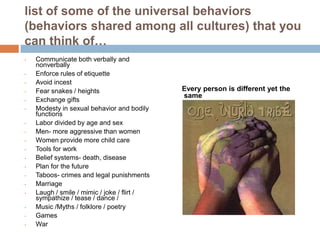
list of some of the universal behaviors
(behaviors shared among all cultures) that you
can think of…
•
•
•
•
•
•
•

•
•
•
•
•
•
•
•
•
•
•

Communicate both verbally and
nonverbally
Enforce rules of etiquette
Avoid incest
Fear snakes / heights
Exchange gifts
Modesty in sexual behavior and bodily
functions
Labor divided by age and sex
Men- more aggressive than women
Women provide more child care
Tools for work
Belief systems- death, disease
Plan for the future
Taboos- crimes and legal punishments
Marriage
Laugh / smile / mimic / joke / flirt /
sympathize / tease / dance /
Music /Myths / folklore / poetry
Games
War

Every person is different yet the
same
What ultimately shapes our behavior?

•

Genetics and Evolutionary Psychology

•

Parents

•

Gender

•

Culture

•

Social environment
Environmental Influence
•

what traits does environment influence?
• Values
• Manners
• Faith / religion
• Politics
• Social views
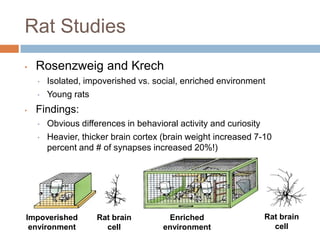
Rat Studies
•

Rosenzweig and Krech
•
•

•

Isolated, impoverished vs. social, enriched environment
Young rats

Findings:
•
•

Obvious differences in behavioral activity and curiosity
Heavier, thicker brain cortex (brain weight increased 7-10
percent and # of synapses increased 20%!)

Impoverished
environment

Rat brain
cell

Enriched
environment

Rat brain
cell
Social modification techniques


Behaviour modification has been successfully used to
treat anxiety, obsessive-compulsive disorder (OCD) and
enuresis (bed-wetting). Some methods of behaviour
modification require preparation and attention, where
others are just common sense. Find out what you can
do to shake your nasty habit today.
Techniques:
Positive Reinforcement


Some of us want to know, “What do I get out of this?”
Positive reinforcement answers this question. This
practice involves the addition of a gratifying experience
in reaction to something someone has done. Many
adults respond to praise and recognition. Treat yourself
to a night out every time you avoid the behaviour you
are trying to modify.
Negative Reinforcement


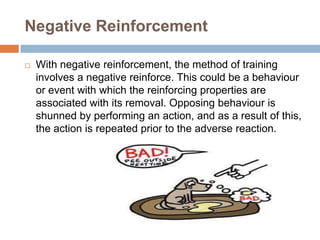
With negative reinforcement, the method of training
involves a negative reinforce. This could be a behaviour
or event with which the reinforcing properties are
associated with its removal. Opposing behaviour is
shunned by performing an action, and as a result of this,
the action is repeated prior to the adverse reaction.
Punishment


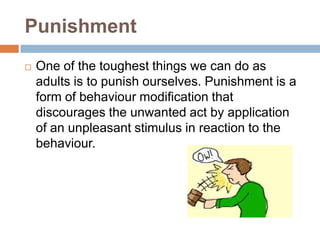
One of the toughest things we can do as
adults is to punish ourselves. Punishment is a
form of behaviour modification that
discourages the unwanted act by application
of an unpleasant stimulus in reaction to the
behaviour.
Emotional Freedom Technique
(EFT)


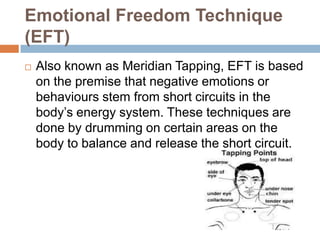
Also known as Meridian Tapping, EFT is based
on the premise that negative emotions or
behaviours stem from short circuits in the
body’s energy system. These techniques are
done by drumming on certain areas on the
body to balance and release the short circuit.
Neuro-Linguistic Programming
(NLP)


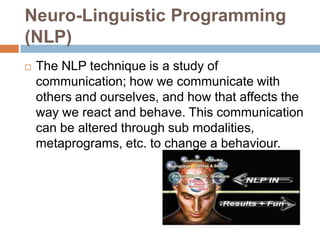
The NLP technique is a study of
communication; how we communicate with
others and ourselves, and how that affects the
way we react and behave. This communication
can be altered through sub modalities,
metaprograms, etc. to change a behaviour.
Meditation


Meditation has been used for centuries to help
the brain make physiological changes for the
better. Not only does it improve brain function
and memory, it enables “whole brain
synchronization”, a process that allows the left
brain portion to interact and be in focus with
the right brain hemisphere. Meditation is one
of the best behaviour modification systems in
existence. It alleviates anxiety and depression,
causing a remarkable improvement in a
person’s sense of well-being.
Don’t Give it Attention !


You can modify a behaviour through ignoring
the act. By ignoring the behaviour you will
often reduce its tendency for appearing again.
Don’t give someone attention who is engaging
in a behaviour that needs stopped.
Cognitive Behavioural Therapy
(CBT)


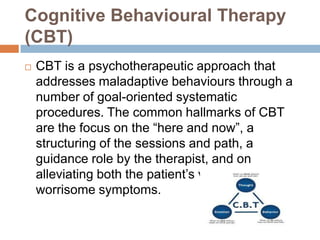
CBT is a psychotherapeutic approach that
addresses maladaptive behaviours through a
number of goal-oriented systematic
procedures. The common hallmarks of CBT
are the focus on the “here and now”, a
structuring of the sessions and path, a
guidance role by the therapist, and on
alleviating both the patient’s vulnerability and
worrisome symptoms.
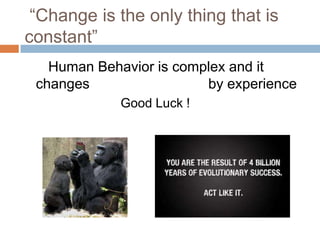
“Change is the only thing that is
constant”
Human Behavior is complex and it
changes
by experience
Good Luck !
Thanks for the time and patience !

Behavior and its modification techniques

  • 1.
    BEHAVIOR AND ITS MODIFICATION TECHNIQUES Presentedby: Rangarajan MSW 1st year Shift II
  • 2.
    Introduction • Aims tounderstand self and others • To determine how and why people behave the way they do and to plan for solution in case of problems • Is a complicated phenomenon influenced by many factors • A collection of activities influenced by culture, attitude, emotions, values, ethics, authority, rapport, hypnosis, persuasion and coercion (coer-sion)
  • 3.
    Cultural behavior 17 Yearold Tagenarine Chanderpaul, son of Shivnarine Chanderpaul taking guard like his father, its a Caribbean old school
  • 4.
    Attitudinal behavior   Psychologists define attitudesas a learned tendency to evaluate and behaviour things in a certain way Social psychologists have found that attitudes and actual behaviour are not always perfectly aligned. After all, plenty of people support a particular candidate or political party and yet fail to go out and vote.
  • 5.
    Emotional behavior The outward expression ordisplay of mood or feeling states.
  • 6.
  • 7.
  • 8.
  • 9.
  • 10.
    Hypnosis behavior   The inductionof a state of consciousness in which a person apparently loses the power of voluntary action and is highly responsive to... Example: mesmerism - trance - hypnotism
  • 11.
    Persuasion behavior  Persuasion isunderneath the umbrella term of Influence. In other words, persuasion is influence, but it requires communication, whereas influence doesn't necessarily I don't care if I fall as long as someone else picks up my gun and keeps on shooting –Che Guevara In a gentle way, you can shake the world. Mahatma Gandhi
  • 12.
    Coercion behavior  the actof compelling by force of authority.
  • 13.
    Innate behaviour (God element?)  Instinctor innate behaviour is the inherent inclination of a living organism toward a particular complex behaviour
  • 14.
    Human needs andbehaviour   Physical needs: The human being has needs, related to the structure and processes of the physical organism, for food, drink, sex, sleep, warmth and shelter, activity, sensory stimulation. Personal needs: The need to love and be loved, The need to understand and be understood, The need to be self-directing and to be freely engaged with the directions of a greater whole.
  • 15.
    Classifications of Human Behavior Conscious- State of awareness of thoughts, feelings, perception and what is going on in the environment. Unconscious –is a reservoir of feelings, thoughts, urges, and memories that outside of our conscious awareness. Most of the contents of the unconscious are unacceptable or unpleasant, such as feelings of pain, anxiety, or conflict. According to Freud, the unconscious continues to influence our behaviour and experience, even though we are unaware of these underlying influences. Overt - Open to public observation. Covert - Unseen objects such as thoughts, feelings or responses which are not easily seen. Rational - Pertaining to reason, influenced or guided by reason rather than emotion. Irrational - Illogical
  • 16.
    Cont. • • • • Voluntary - Intentional Involuntary– Doing something against your will, action made without intent or carried out despite an attempt to prevent them (disorders) Simple – ex. What you see is what you get. Complex - compound complicated behavior. ex. Drinking alcohol and using drugs
  • 17.
    Psychoanalytic Theory • • • • This theoryexplained that human behavior is motivated by an inner force called the human mind. This theory was introduced by SIGMUND FREUD SIGMUND FREUD (1856-1939) was an Austrian physician who worked as an neurologist. Early in his career, he used hypnosis to treat people with physical and emotional problem. From his work with these patients, he began to conceptualize a theory of human behavior Freud theorized that people have two (2) basic instincts – SEXUAL and AGGRESSION. These two (2) basic instincts are not always socially acceptable. When people exhibit behavior that is nor acceptable, they often experience punishment, guilt and anxiety Freud’s theory describes a conflict between a person’s instinctual needs for gratification and the demands of society for socialization. For Freud, a person’s core tendency is to maximize instinctual gratification while minimizing punishment and guilt • Addresses the relationship among inner experience, behavior, social roles & functioning. This theory proposes that conflicts among unconscious motivating factors affect behavior
  • 18.
    Description of HumanBehavior • • • • • • • Human behavior is motivated Motivation – driving force behind all action of an organism Human behavior has multiple causes - Influenced by culture Human behavior can be adaptive and maladaptive o Human are social beings o Any person depend upon each other for survival o People need interaction People play an integral part in creating their experience Human lives are continuous process of change Every person is different yet the same Individual is a unique person
  • 19.
    Theoretical approaches aboutthe factors that cause, maintain, alter behavior, and mental process: 1. PSYCHODYNAMIC APPROACH Is based on the belief that childhood experiences greatly influence the development of late personality traits and psychological problems. It also stresses the influence of unconscious fears, desires and motivations on thoughts and behavior. 2. HUMANISTIC APPROACH Emphasizes that each individual has great freedom in directing his/her future, a large capacity for personal growth, a considerable amount of intrinsic worth & enormous potential for self-fulfillment. 3. BEHAVIORAL APPROACH Studies how organism learn new behavior or modify existing ones, depending on whether events in their environment reward or punish these behavior. 4. COGNITIVE APPROACH Examines how we process, store, and use information, and how this information influences what we attend to, perceive, learn, remember believe and feel. 5. BIOLOGICAL APPROACH Focuses on how genes, hormones & nervous system interact with the environment to influence learning, personality, memory, motivation, emotions at coping techniques.
  • 20.
    list of someof the universal behaviors (behaviors shared among all cultures) that you can think of… • • • • • • • • • • • • • • • • • • Communicate both verbally and nonverbally Enforce rules of etiquette Avoid incest Fear snakes / heights Exchange gifts Modesty in sexual behavior and bodily functions Labor divided by age and sex Men- more aggressive than women Women provide more child care Tools for work Belief systems- death, disease Plan for the future Taboos- crimes and legal punishments Marriage Laugh / smile / mimic / joke / flirt / sympathize / tease / dance / Music /Myths / folklore / poetry Games War Every person is different yet the same
  • 21.
    What ultimately shapesour behavior? • Genetics and Evolutionary Psychology • Parents • Gender • Culture • Social environment
  • 22.
    Environmental Influence • what traitsdoes environment influence? • Values • Manners • Faith / religion • Politics • Social views
  • 23.
    Rat Studies • Rosenzweig andKrech • • • Isolated, impoverished vs. social, enriched environment Young rats Findings: • • Obvious differences in behavioral activity and curiosity Heavier, thicker brain cortex (brain weight increased 7-10 percent and # of synapses increased 20%!) Impoverished environment Rat brain cell Enriched environment Rat brain cell
  • 24.
    Social modification techniques  Behaviourmodification has been successfully used to treat anxiety, obsessive-compulsive disorder (OCD) and enuresis (bed-wetting). Some methods of behaviour modification require preparation and attention, where others are just common sense. Find out what you can do to shake your nasty habit today.
  • 25.
    Techniques: Positive Reinforcement  Some ofus want to know, “What do I get out of this?” Positive reinforcement answers this question. This practice involves the addition of a gratifying experience in reaction to something someone has done. Many adults respond to praise and recognition. Treat yourself to a night out every time you avoid the behaviour you are trying to modify.
  • 26.
    Negative Reinforcement  With negativereinforcement, the method of training involves a negative reinforce. This could be a behaviour or event with which the reinforcing properties are associated with its removal. Opposing behaviour is shunned by performing an action, and as a result of this, the action is repeated prior to the adverse reaction.
  • 27.
    Punishment  One of thetoughest things we can do as adults is to punish ourselves. Punishment is a form of behaviour modification that discourages the unwanted act by application of an unpleasant stimulus in reaction to the behaviour.
  • 28.
    Emotional Freedom Technique (EFT)  Alsoknown as Meridian Tapping, EFT is based on the premise that negative emotions or behaviours stem from short circuits in the body’s energy system. These techniques are done by drumming on certain areas on the body to balance and release the short circuit.
  • 29.
    Neuro-Linguistic Programming (NLP)  The NLPtechnique is a study of communication; how we communicate with others and ourselves, and how that affects the way we react and behave. This communication can be altered through sub modalities, metaprograms, etc. to change a behaviour.
  • 30.
    Meditation  Meditation has beenused for centuries to help the brain make physiological changes for the better. Not only does it improve brain function and memory, it enables “whole brain synchronization”, a process that allows the left brain portion to interact and be in focus with the right brain hemisphere. Meditation is one of the best behaviour modification systems in existence. It alleviates anxiety and depression, causing a remarkable improvement in a person’s sense of well-being.
  • 31.
    Don’t Give itAttention !  You can modify a behaviour through ignoring the act. By ignoring the behaviour you will often reduce its tendency for appearing again. Don’t give someone attention who is engaging in a behaviour that needs stopped.
  • 32.
    Cognitive Behavioural Therapy (CBT)  CBTis a psychotherapeutic approach that addresses maladaptive behaviours through a number of goal-oriented systematic procedures. The common hallmarks of CBT are the focus on the “here and now”, a structuring of the sessions and path, a guidance role by the therapist, and on alleviating both the patient’s vulnerability and worrisome symptoms.
  • 33.
    “Change is theonly thing that is constant” Human Behavior is complex and it changes by experience Good Luck !
  • 34.
    Thanks for thetime and patience !