Aamir Ali
B.ED(1.5 Year)
The Islamia University Of Bahawalpur.
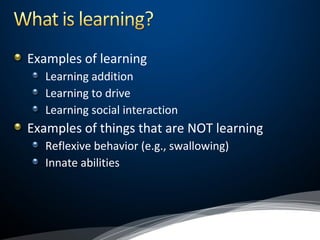
Examples of learning
Learning addition
Learning to drive
Learning social interaction
Examples of things that are NOT learning
Reflexive behavior (e.g., swallowing)
Innate abilities
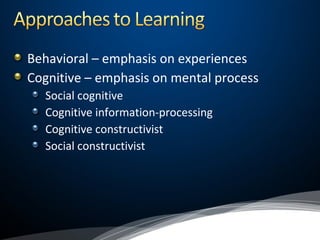
Behavioral – emphasis on experiences
Cognitive – emphasis on mental process
Social cognitive
Cognitive information-processing
Cognitive constructivist
Social constructivist
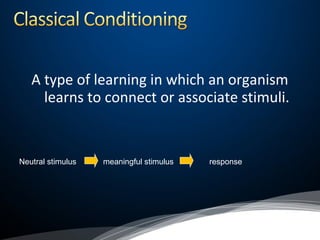
A type of learning in which an organism
learns to connect or associate stimuli.
Neutral stimulus meaningful stimulus response
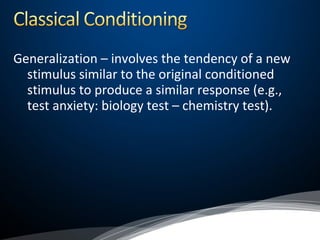
Generalization – involves the tendency of a new
stimulus similar to the original conditioned
stimulus to produce a similar response (e.g.,
test anxiety: biology test – chemistry test).
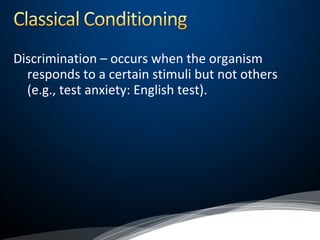
Discrimination – occurs when the organism
responds to a certain stimuli but not others
(e.g., test anxiety: English test).
Extinction – involves weakening of the
conditioned response in the absence of the
unconditioned stimulus (e.g., good grades on
test = fading of test anxiety).
Good at explaining how neutral stimuli becomes
associated with unlearned, involuntary responses.
Good at understanding students’ anxieties and
fears.
Not as effective at explaining voluntary behaviors.
Get into groups of 3-4 people.
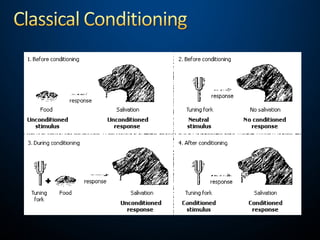
Determine an example of classical conditioning.
Each group will present their example in the form of a
skit to the rest of the class.
The class will try to identify the following:
Unconditioned stimulus
Conditioned stimulus
Unconditioned response
Conditioned response
A form of learning in which the consequences of
behavior produce changes in the probability that
the behavior will occur.
Example: When John made good grades
[behavior] his parents gave him money
[consequence] so he continued to make good
grades [future behavior].
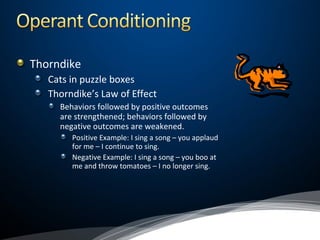
Thorndike
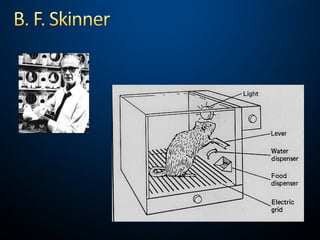
Cats in puzzle boxes
Thorndike’s Law of Effect
Behaviors followed by positive outcomes
are strengthened; behaviors followed by
negative outcomes are weakened.
Positive Example: I sing a song – you applaud
for me – I continue to sing.
Negative Example: I sing a song – you boo at
me and throw tomatoes – I no longer sing.
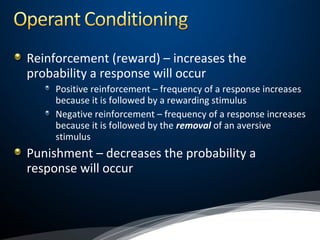
Reinforcement (reward) – increases the
probability a response will occur
Positive reinforcement – frequency of a response increases
because it is followed by a rewarding stimulus
Negative reinforcement – frequency of a response increases
because it is followed by the removal of an aversive
stimulus
Punishment – decreases the probability a
response will occur
My son scores a goal in soccer [behavior]; I praise
him [consequence]; He continues to try to score
goals [future behavior].
Student begins using the adverb “well” correctly
[behavior]; She receives extra time in the reading
area [consequence]; Student continues to use
“well” appropriately [future behavior].
Student comes to class on time [behavior]; Teacher
stops writing student’s name on the board
[consequence]; Student continues to come to class on
time [future behavior].
Student completes homework after school [behavior];
Parents stop nagging at student to complete
homework [consequence]; Student increasingly
completes homework after school [future behavior].
Student is caught cheating [behavior]; Student is
placed in ISS [consequence]; Student does not
cheat again [future behavior].
Two students are disruptive during class
[behavior]; Students are reprimanded by the
teacher [consequence]; Students become silent
during class [future behavior].
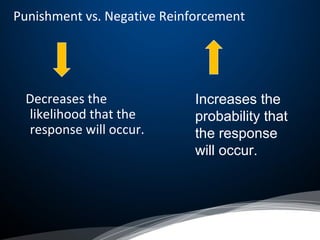
Punishment vs. Negative Reinforcement
Decreases the
likelihood that the
response will occur.
Increases the
probability that
the response
will occur.
Get into groups of 3-4 people.
Determine an example of
positive reinforcement
negative reinforcement
punishment
Each group will present their examples to the rest of
the class.
The class will try to identify each of the above as well
as identify the behavior, consequence and future
behavior.
Applies operant conditioning to change human
behavior. It increases desirable behavior while
decreasing undesirable behavior.
Choose effective reinforcers
Tailored for individuals
Natural ones – praise and privilege
Premack principle – a high probability activity can
serve as a reinforcer for a low probability activity
Example: If you complete the assignment, you may have 5
extra minutes at recess.
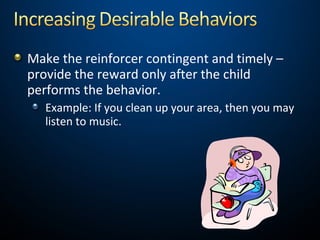
Make the reinforcer contingent and timely –
provide the reward only after the child
performs the behavior.
Example: If you clean up your area, then you may
listen to music.
Use the best schedule of reinforcement
Fixed-ratio schedule
A behavior is reinforced after a set number of responses
Variable-ratio schedule
A behavior is reinforced after an average number of times, but on an
unpredictable basis
Fixed-interval schedule
First appropriate response after a fixed amount of time is reinforced
Variable-interval schedule
A response is reinforced after a variable amount of time has elapsed
Consider contracting – putting reinforcement
contingencies in writing.
Using prompts and shaping
Prompt – an added stimulus or cue that is given just before a
response and increases the likelihood that the response will
occur. (e.g., peace and quiet)
Shaping – teaching new behaviors by reinforcing successive
approximations to a specified target behavior (e.g., tennis ball
activity)
Use differential reinforcement – reinforce
behavior that is more appropriate (e.g., reinforce
a student for raising hand to answer rather than
blurting out answer)
Terminate reinforcement (extinction) – withdraw
positive reinforcement from inappropriate
behavior and reward the appropriate behavior
(e.g., “thank you for sitting in your seat so quietly”
Remove desirable stimuli
Time-out
Response cost
Present aversive stimuli
Example: Lack of sharing – parental verbal
disappointment
Divide into four groups of six people. Each group will consider one of the following
students' undesirable behaviors. Each group will determine strategies for
decreasing the behaviors listed. What is the best strategy for each? Report back to
the class your strategies for decreasing the behavior.
1) Andrew, who likes to utter profanities every now and then;
2) Sandy, who tells you to quit bugging her when you ask her questions;
3) Matt, who likes to mess up other students' papers;
4) Rebecca, who frequently talks with other students around her while you are
explaining or demonstrating something.
IN CLASS ACTIVITY
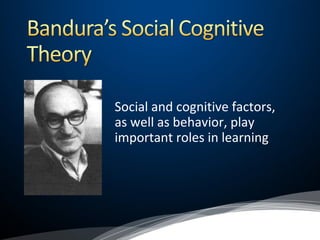
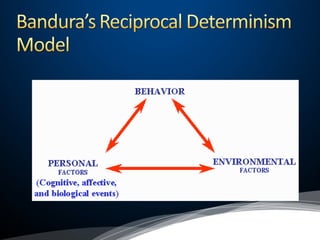
Social and cognitive factors,
as well as behavior, play
important roles in learning
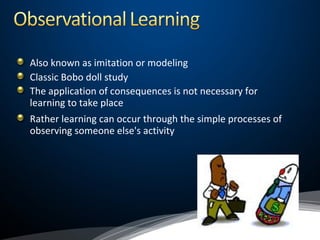
Also known as imitation or modeling
Classic Bobo doll study
The application of consequences is not necessary for
learning to take place
Rather learning can occur through the simple processes of
observing someone else's activity
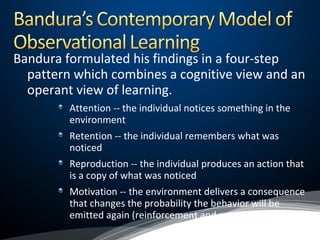
Bandura formulated his findings in a four-step
pattern which combines a cognitive view and an
operant view of learning.
Attention -- the individual notices something in the
environment
Retention -- the individual remembers what was
noticed
Reproduction -- the individual produces an action that
is a copy of what was noticed
Motivation -- the environment delivers a consequence
that changes the probability the behavior will be
emitted again (reinforcement and punishment)
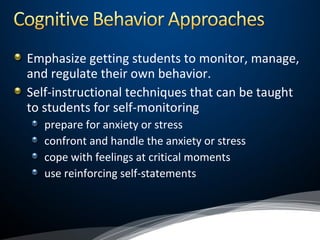
Emphasize getting students to monitor, manage,
and regulate their own behavior.
Self-instructional techniques that can be taught
to students for self-monitoring
prepare for anxiety or stress
confront and handle the anxiety or stress
cope with feelings at critical moments
use reinforcing self-statements
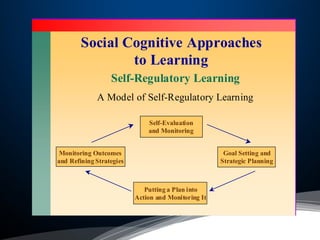
Social Cognitive Approaches
to Learning
Self-Regulatory Learning
A Model of Self-Regulatory Learning
Self-Evaluation
and Monitoring
Putting a Plan into
Action and Monitoring It
Goal Setting and
Strategic Planning
Monitoring Outcomes
and Refining Strategies

Behavioral approaches to learning(b.ed)aamir_ali

  • 1.
    Aamir Ali B.ED(1.5 Year) TheIslamia University Of Bahawalpur.
  • 2.
    Examples of learning Learningaddition Learning to drive Learning social interaction Examples of things that are NOT learning Reflexive behavior (e.g., swallowing) Innate abilities
  • 3.
    Behavioral – emphasison experiences Cognitive – emphasis on mental process Social cognitive Cognitive information-processing Cognitive constructivist Social constructivist
  • 4.
    A type oflearning in which an organism learns to connect or associate stimuli. Neutral stimulus meaningful stimulus response
  • 7.
    Generalization – involvesthe tendency of a new stimulus similar to the original conditioned stimulus to produce a similar response (e.g., test anxiety: biology test – chemistry test).
  • 8.
    Discrimination – occurswhen the organism responds to a certain stimuli but not others (e.g., test anxiety: English test).
  • 9.
    Extinction – involvesweakening of the conditioned response in the absence of the unconditioned stimulus (e.g., good grades on test = fading of test anxiety).
  • 10.
    Good at explaininghow neutral stimuli becomes associated with unlearned, involuntary responses. Good at understanding students’ anxieties and fears. Not as effective at explaining voluntary behaviors.
  • 11.
    Get into groupsof 3-4 people. Determine an example of classical conditioning. Each group will present their example in the form of a skit to the rest of the class. The class will try to identify the following: Unconditioned stimulus Conditioned stimulus Unconditioned response Conditioned response
  • 12.
    A form oflearning in which the consequences of behavior produce changes in the probability that the behavior will occur. Example: When John made good grades [behavior] his parents gave him money [consequence] so he continued to make good grades [future behavior].
  • 13.
    Thorndike Cats in puzzleboxes Thorndike’s Law of Effect Behaviors followed by positive outcomes are strengthened; behaviors followed by negative outcomes are weakened. Positive Example: I sing a song – you applaud for me – I continue to sing. Negative Example: I sing a song – you boo at me and throw tomatoes – I no longer sing.
  • 15.
    Reinforcement (reward) –increases the probability a response will occur Positive reinforcement – frequency of a response increases because it is followed by a rewarding stimulus Negative reinforcement – frequency of a response increases because it is followed by the removal of an aversive stimulus Punishment – decreases the probability a response will occur
  • 16.
    My son scoresa goal in soccer [behavior]; I praise him [consequence]; He continues to try to score goals [future behavior]. Student begins using the adverb “well” correctly [behavior]; She receives extra time in the reading area [consequence]; Student continues to use “well” appropriately [future behavior].
  • 17.
    Student comes toclass on time [behavior]; Teacher stops writing student’s name on the board [consequence]; Student continues to come to class on time [future behavior]. Student completes homework after school [behavior]; Parents stop nagging at student to complete homework [consequence]; Student increasingly completes homework after school [future behavior].
  • 18.
    Student is caughtcheating [behavior]; Student is placed in ISS [consequence]; Student does not cheat again [future behavior]. Two students are disruptive during class [behavior]; Students are reprimanded by the teacher [consequence]; Students become silent during class [future behavior].
  • 19.
    Punishment vs. NegativeReinforcement Decreases the likelihood that the response will occur. Increases the probability that the response will occur.
  • 20.
    Get into groupsof 3-4 people. Determine an example of positive reinforcement negative reinforcement punishment Each group will present their examples to the rest of the class. The class will try to identify each of the above as well as identify the behavior, consequence and future behavior.
  • 21.
    Applies operant conditioningto change human behavior. It increases desirable behavior while decreasing undesirable behavior.
  • 22.
    Choose effective reinforcers Tailoredfor individuals Natural ones – praise and privilege Premack principle – a high probability activity can serve as a reinforcer for a low probability activity Example: If you complete the assignment, you may have 5 extra minutes at recess.
  • 23.
    Make the reinforcercontingent and timely – provide the reward only after the child performs the behavior. Example: If you clean up your area, then you may listen to music.
  • 24.
    Use the bestschedule of reinforcement Fixed-ratio schedule A behavior is reinforced after a set number of responses Variable-ratio schedule A behavior is reinforced after an average number of times, but on an unpredictable basis Fixed-interval schedule First appropriate response after a fixed amount of time is reinforced Variable-interval schedule A response is reinforced after a variable amount of time has elapsed
  • 25.
    Consider contracting –putting reinforcement contingencies in writing. Using prompts and shaping Prompt – an added stimulus or cue that is given just before a response and increases the likelihood that the response will occur. (e.g., peace and quiet) Shaping – teaching new behaviors by reinforcing successive approximations to a specified target behavior (e.g., tennis ball activity)
  • 26.
    Use differential reinforcement– reinforce behavior that is more appropriate (e.g., reinforce a student for raising hand to answer rather than blurting out answer) Terminate reinforcement (extinction) – withdraw positive reinforcement from inappropriate behavior and reward the appropriate behavior (e.g., “thank you for sitting in your seat so quietly”
  • 27.
    Remove desirable stimuli Time-out Responsecost Present aversive stimuli Example: Lack of sharing – parental verbal disappointment
  • 28.
    Divide into fourgroups of six people. Each group will consider one of the following students' undesirable behaviors. Each group will determine strategies for decreasing the behaviors listed. What is the best strategy for each? Report back to the class your strategies for decreasing the behavior. 1) Andrew, who likes to utter profanities every now and then; 2) Sandy, who tells you to quit bugging her when you ask her questions; 3) Matt, who likes to mess up other students' papers; 4) Rebecca, who frequently talks with other students around her while you are explaining or demonstrating something. IN CLASS ACTIVITY
  • 30.
    Social and cognitivefactors, as well as behavior, play important roles in learning
  • 32.
    Also known asimitation or modeling Classic Bobo doll study The application of consequences is not necessary for learning to take place Rather learning can occur through the simple processes of observing someone else's activity
  • 33.
    Bandura formulated hisfindings in a four-step pattern which combines a cognitive view and an operant view of learning. Attention -- the individual notices something in the environment Retention -- the individual remembers what was noticed Reproduction -- the individual produces an action that is a copy of what was noticed Motivation -- the environment delivers a consequence that changes the probability the behavior will be emitted again (reinforcement and punishment)
  • 34.
    Emphasize getting studentsto monitor, manage, and regulate their own behavior. Self-instructional techniques that can be taught to students for self-monitoring prepare for anxiety or stress confront and handle the anxiety or stress cope with feelings at critical moments use reinforcing self-statements
  • 35.
    Social Cognitive Approaches toLearning Self-Regulatory Learning A Model of Self-Regulatory Learning Self-Evaluation and Monitoring Putting a Plan into Action and Monitoring It Goal Setting and Strategic Planning Monitoring Outcomes and Refining Strategies