DE-ESCALATION
   TECHNIQUES
    Mary Witteried, LCPC
        Therapist II
Montgomery County Crisis Ctr.
GOALS OF THIS TRAINING
 Learn  ways to try to keep situations from
  becoming dangerous
 Know how to control yourself in dangerous
  situations
 Know when and how to de-escalate highly
  charged situations
 Learning safe options when managing
  agitated clients.
CONCEPTS TO KEEP IN MIND

 De-escalation   techniques are ABNORMAL
 We are driven to freeze, fight or flee when
  scared. However, in de-escalation, we can
  do none of these.
 Reasoning with an enraged person is NOT
  possible.
 The FIRST and MOST IMPORTANT
  objective is to reduce the level of arousal so
  that discussion becomes possible.
WAYS THAT HELP KEEP
SITUATIONS FROM ESCALATING
 Take a deep breath…It will help you calm down.
 Appear calm, centered and self-assured even
  though you don’t feel it. Anxiety can make the
  client feel anxious and unsafe which can
  escalate aggression.
 Use a calm, low monotonous tone of voice
  (normal tendency is to have a high-pitched, tight
  voice when scared)
 If you have time, remove necktie, scarf, hanging
  jewelry, religious or political symbols before you
  see the client (not in front of him or her).
WAYS THAT HELP KEEP
SITUATIONS FROM ESCALATING
 Move   the situation outside or to another
  room, if possible. It makes it less likely other
  clients will get involved or become an
  audience for the agitated client to play to.
 This also creates a quieter environment and
  may help in de-escalating the client,
  especially mentally ill.
CONTROL OF SELF

 Take   a deep breath…this will calm you
 Do not be defensive…even if the comments
  or insults are directed at you.
 Be aware of any resources available for
  backup.
 Be very respectful even when firmly setting
  limits or calling for help.
 Give the client plenty of room to move and
  significant space between you and him.
ENVIRONMENT

 Do not see client when alone.
 Be sure co-worker’s know if you are seeing
  someone with history of violence.
 Do not allow the client to get between you and
  the door.
 If the client comes to the office already agitated
  do not take them into your office. See them in a
  neutral, larger space, if possible.
ENVIRONMENT

 Be aware of items in your office that can be
  used as a weapon. If possible, keep them
  out of the reach of the client.
 Review the safety protocols for your office.
PHYSICAL STANCE

 Never    turn your back for any reason.
 Always be at the same eye level.

 Allow extra physical space between you…
  about four times your usual distance and on
  nondominant side of client.
 Do not maintain constant eye contact. Allow
  client to break his/her gaze and look away.
PHYSICAL STANCE

 Do not point or shake your finger at the client.
 Do not touch…even if some touching is
  generally culturally appropriate and usual in your
  setting.
 Keep your hands OUT of your pockets, up and
  available to protect yourself.
 Stand with one foot slightly in front of the other
  with your weight evenly distributed.
THE DE-ESCALATION
DISCUSSION
 Remember there is no content except trying to
  calmly bring the level of arousal down to a safer
  place. Use simple, clear language.
 Do not get loud or try to yell over a screaming
  person. Wait until he/she takes a breath…then
  talk.
 Address the client by name, it helps to ground
  them.
 Respond selectively: Answer only informational
  questions, no matter how rudely asked (e.g.
  “Why do I have to fill out these g-d forms?”). DO
  NOT answer abusive questions (e.g. “Why are
  all the staff assholes?”).
THE DE-ESCALATION
DISCUSSION
 Explain limits and rules in an authoritative, firm,
  but always respectful tone.
 Give choices where possible in which both
  alternatives are safe ones (e.g. “Would you like
  to continue our meeting calmly or would you
  prefer to stop now and talk later or come back
  tomorrow when things can be more relaxed.”)
 Empathize with feelings but not with the
  behavior (e.g. “I understand that you have every
  right to feel angry, but it is not okay for you to
  threaten me or others.”).
THE DE-ESCALATION
DISCUSSION
 Do not solicit how a person is feeling or interpret
  feelings in an analytic way. Instead talk about
  how you know the client wants to be in control;
  ask how you can help the client do this.
 Do not argue or try to convince.
 Wherever possible, tap into the client’s cognitive
  mode: DO NOT ask, “Tell me how you feel.”
  INSTEAD ask, “Help me to understand what you
  are saying to me.” People are not attacking you
  or themselves while they are teaching you what
  they want you to know.
THE DE-ESCALATION
DISCUSSION
 Suggest    alternative behaviors where
  appropriate (e.g. “Would you like to take a
  break and have a cup of coffee [tepid and in
  a paper cup] or some water?”)
 Give the consequences of inappropriate
  behavior without threats or anger.
 Represent external controls (rules) as
  institutional rather than personal.
THE DE-ESCALATION
DISCUSSION
   Trust your instincts! If you assess or feel that
    de-escalation is not working…STOP! Tell the
    person to leave, escort him/her to the door, call
    for help or leave yourself and call police.

   There is nothing magical about talking someone
    down. You are transferring your sense of calm,
    respectfulness, clear limit setting to the agitated
    person in the hope that he/she actually wishes to
    respond positively to your respectful attention.
REMEMBER


 DO NOT TRY TO BE A HERO!!!
 Do not try de-escalation when a person has a
  gun or other serious weapon. In that case,
  simply cooperate.
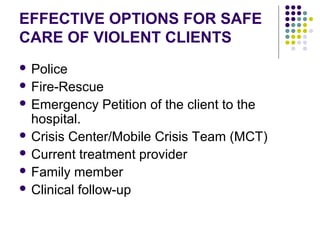
EFFECTIVE OPTIONS FOR SAFE
CARE OF VIOLENT CLIENTS
 Police
 Fire-Rescue
 Emergency   Petition of the client to the
  hospital.
 Crisis Center/Mobile Crisis Team (MCT)
 Current treatment provider
 Family member
 Clinical follow-up
MONTGOMERY COUNTY
CRISIS CENTER

 HOURS:    24 hours a day, 7 days a week

 PHONE   #: 240-777-4000

 ADDRESS:      1301 Piccard Dr.
        Rockville, MD 20850

De escalation techniques

  • 1.
    DE-ESCALATION TECHNIQUES Mary Witteried, LCPC Therapist II Montgomery County Crisis Ctr.
  • 2.
    GOALS OF THISTRAINING  Learn ways to try to keep situations from becoming dangerous  Know how to control yourself in dangerous situations  Know when and how to de-escalate highly charged situations  Learning safe options when managing agitated clients.
  • 3.
    CONCEPTS TO KEEPIN MIND  De-escalation techniques are ABNORMAL  We are driven to freeze, fight or flee when scared. However, in de-escalation, we can do none of these.  Reasoning with an enraged person is NOT possible.  The FIRST and MOST IMPORTANT objective is to reduce the level of arousal so that discussion becomes possible.
  • 4.
    WAYS THAT HELPKEEP SITUATIONS FROM ESCALATING  Take a deep breath…It will help you calm down.  Appear calm, centered and self-assured even though you don’t feel it. Anxiety can make the client feel anxious and unsafe which can escalate aggression.  Use a calm, low monotonous tone of voice (normal tendency is to have a high-pitched, tight voice when scared)  If you have time, remove necktie, scarf, hanging jewelry, religious or political symbols before you see the client (not in front of him or her).
  • 5.
    WAYS THAT HELPKEEP SITUATIONS FROM ESCALATING  Move the situation outside or to another room, if possible. It makes it less likely other clients will get involved or become an audience for the agitated client to play to.  This also creates a quieter environment and may help in de-escalating the client, especially mentally ill.
  • 6.
    CONTROL OF SELF Take a deep breath…this will calm you  Do not be defensive…even if the comments or insults are directed at you.  Be aware of any resources available for backup.  Be very respectful even when firmly setting limits or calling for help.  Give the client plenty of room to move and significant space between you and him.
  • 7.
    ENVIRONMENT  Do notsee client when alone.  Be sure co-worker’s know if you are seeing someone with history of violence.  Do not allow the client to get between you and the door.  If the client comes to the office already agitated do not take them into your office. See them in a neutral, larger space, if possible.
  • 8.
    ENVIRONMENT  Be awareof items in your office that can be used as a weapon. If possible, keep them out of the reach of the client.  Review the safety protocols for your office.
  • 9.
    PHYSICAL STANCE  Never turn your back for any reason.  Always be at the same eye level.  Allow extra physical space between you… about four times your usual distance and on nondominant side of client.  Do not maintain constant eye contact. Allow client to break his/her gaze and look away.
  • 10.
    PHYSICAL STANCE  Donot point or shake your finger at the client.  Do not touch…even if some touching is generally culturally appropriate and usual in your setting.  Keep your hands OUT of your pockets, up and available to protect yourself.  Stand with one foot slightly in front of the other with your weight evenly distributed.
  • 11.
    THE DE-ESCALATION DISCUSSION  Rememberthere is no content except trying to calmly bring the level of arousal down to a safer place. Use simple, clear language.  Do not get loud or try to yell over a screaming person. Wait until he/she takes a breath…then talk.  Address the client by name, it helps to ground them.  Respond selectively: Answer only informational questions, no matter how rudely asked (e.g. “Why do I have to fill out these g-d forms?”). DO NOT answer abusive questions (e.g. “Why are all the staff assholes?”).
  • 12.
    THE DE-ESCALATION DISCUSSION  Explainlimits and rules in an authoritative, firm, but always respectful tone.  Give choices where possible in which both alternatives are safe ones (e.g. “Would you like to continue our meeting calmly or would you prefer to stop now and talk later or come back tomorrow when things can be more relaxed.”)  Empathize with feelings but not with the behavior (e.g. “I understand that you have every right to feel angry, but it is not okay for you to threaten me or others.”).
  • 13.
    THE DE-ESCALATION DISCUSSION  Donot solicit how a person is feeling or interpret feelings in an analytic way. Instead talk about how you know the client wants to be in control; ask how you can help the client do this.  Do not argue or try to convince.  Wherever possible, tap into the client’s cognitive mode: DO NOT ask, “Tell me how you feel.” INSTEAD ask, “Help me to understand what you are saying to me.” People are not attacking you or themselves while they are teaching you what they want you to know.
  • 14.
    THE DE-ESCALATION DISCUSSION  Suggest alternative behaviors where appropriate (e.g. “Would you like to take a break and have a cup of coffee [tepid and in a paper cup] or some water?”)  Give the consequences of inappropriate behavior without threats or anger.  Represent external controls (rules) as institutional rather than personal.
  • 15.
    THE DE-ESCALATION DISCUSSION  Trust your instincts! If you assess or feel that de-escalation is not working…STOP! Tell the person to leave, escort him/her to the door, call for help or leave yourself and call police.  There is nothing magical about talking someone down. You are transferring your sense of calm, respectfulness, clear limit setting to the agitated person in the hope that he/she actually wishes to respond positively to your respectful attention.
  • 16.
    REMEMBER  DO NOTTRY TO BE A HERO!!!  Do not try de-escalation when a person has a gun or other serious weapon. In that case, simply cooperate.
  • 17.
    EFFECTIVE OPTIONS FORSAFE CARE OF VIOLENT CLIENTS  Police  Fire-Rescue  Emergency Petition of the client to the hospital.  Crisis Center/Mobile Crisis Team (MCT)  Current treatment provider  Family member  Clinical follow-up
  • 18.
    MONTGOMERY COUNTY CRISIS CENTER HOURS: 24 hours a day, 7 days a week  PHONE #: 240-777-4000  ADDRESS: 1301 Piccard Dr.  Rockville, MD 20850