Classroom Management
Describe the importance of classroom management
and its impact on academic learning time. Describe
differences in the approach to classroom
management from a behavioral, cognitive, and
humanistic perspective. Name and describe three
general categories of the events of classroom
management from a behavioral perspective, giving
examples of specific teacher activities for each
category.

Developed by W. Huitt, 1999
Classroom Management


Primary purpose is to gain control of the
classroom

Good classroom management results in
high levels of student engaged time
Classroom Management

Brophy (1983) states there are 3 general
principles for good classroom management:
    • Willingness of the teacher to accept
    responsibility for classroom control
    • Long-term, solution-oriented approaches to
    problems (rather than short-term, desist/
    control responses


Brophy, J. (1983). Effective classroom management. The School
Administrator, 40(7), 33-36.
Classroom Management

Brophy (1983) states there are 3 general
principles for good classroom management:
    • Check to see if symptomatic behavior is
    caused by underlying personal problems
    (impulsivity, lack of awareness, home
    problems, etc.)


Brophy, J. (1983). Effective classroom management. The School
Administrator, 40(7), 33-36.
Classroom Management

Brophy (1983) also cites 3 theoretical
orientations to classroom management:
  • Self-concept/personal adjustment -- the
  teacher encourages discouraged students,
  builds self-esteem by arranging for and
  calling attention to success, improving peer
  relationships, etc.
Classroom Management

Brophy (1983) also cites 3 theoretical
orientations to classroom management:
  • Insight (cognitive) -- teacher spends time
  with problem students individually, getting
  to know them personally, attempting to
  instruct and inform them
Classroom Management

Brophy (1983) also cites 3 theoretical
orientations to classroom management:
  • Behavioristic -- teacher offers incentives,
  negotiates contracts, calls attention to and
  reinforces desirable behavior
Classroom Management

This presentation will focus on the
application of principles from behaviorial
psychology, especially the application of
consequences to modify behavior.
Behavioristic Approach

There are 3 major categories of actions to
take in establishing a behaviorally-oriented
classroom management program:

  • Structuring/Selecting and Arranging
  Activities
  • Monitor Student Behavior
  • Reinforce Positive Behavior/
  Redirect Inappropriate Behavior
Behavioristic Approach

Structuring/Selecting and Arranging Activities
 • Establish rules and procedures early
Establishing Rules

General Recommendations
 • Select 4 or 5 rules that you will use to set
 guidelines and limits for behavior in your
 classroom.
 • State the rules in terms of positive
 expectations of behavior you want to see. Be
 careful about stating rules in the form of
 "Don't.”
Establishing Rules

General Recommendations
 • Think about specific examples of behavior
 that would demonstrate each rule.
 • Post the rules in your classroom.
 • Teach the rules just as you would academic
 content using the discussed previously.
Establishing Rules

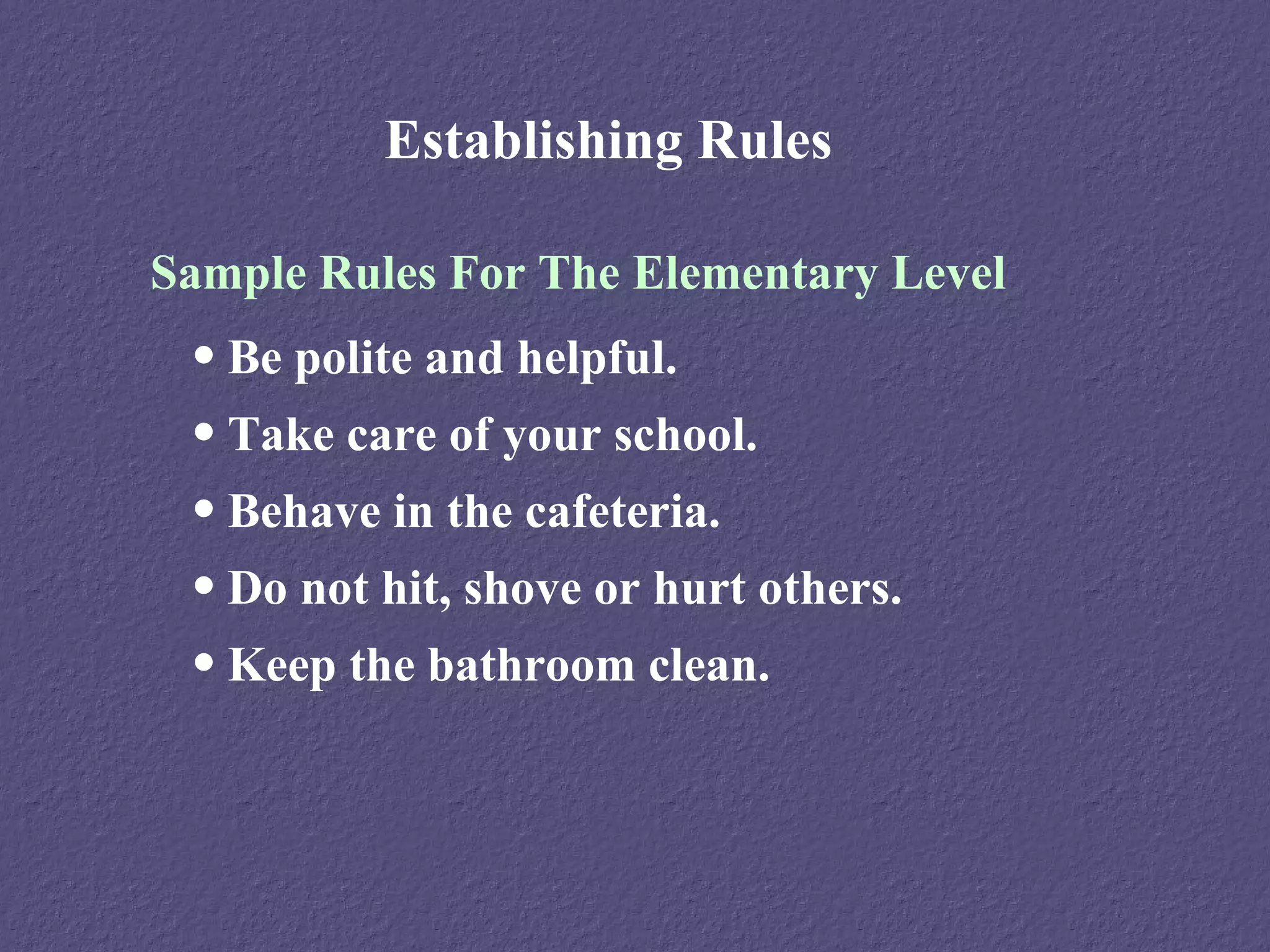
Sample Rules For The Elementary Level
 • Be polite and helpful.
 • Take care of your school.
 • Behave in the cafeteria.
 • Do not hit, shove or hurt others.
 • Keep the bathroom clean.
Establishing Rules

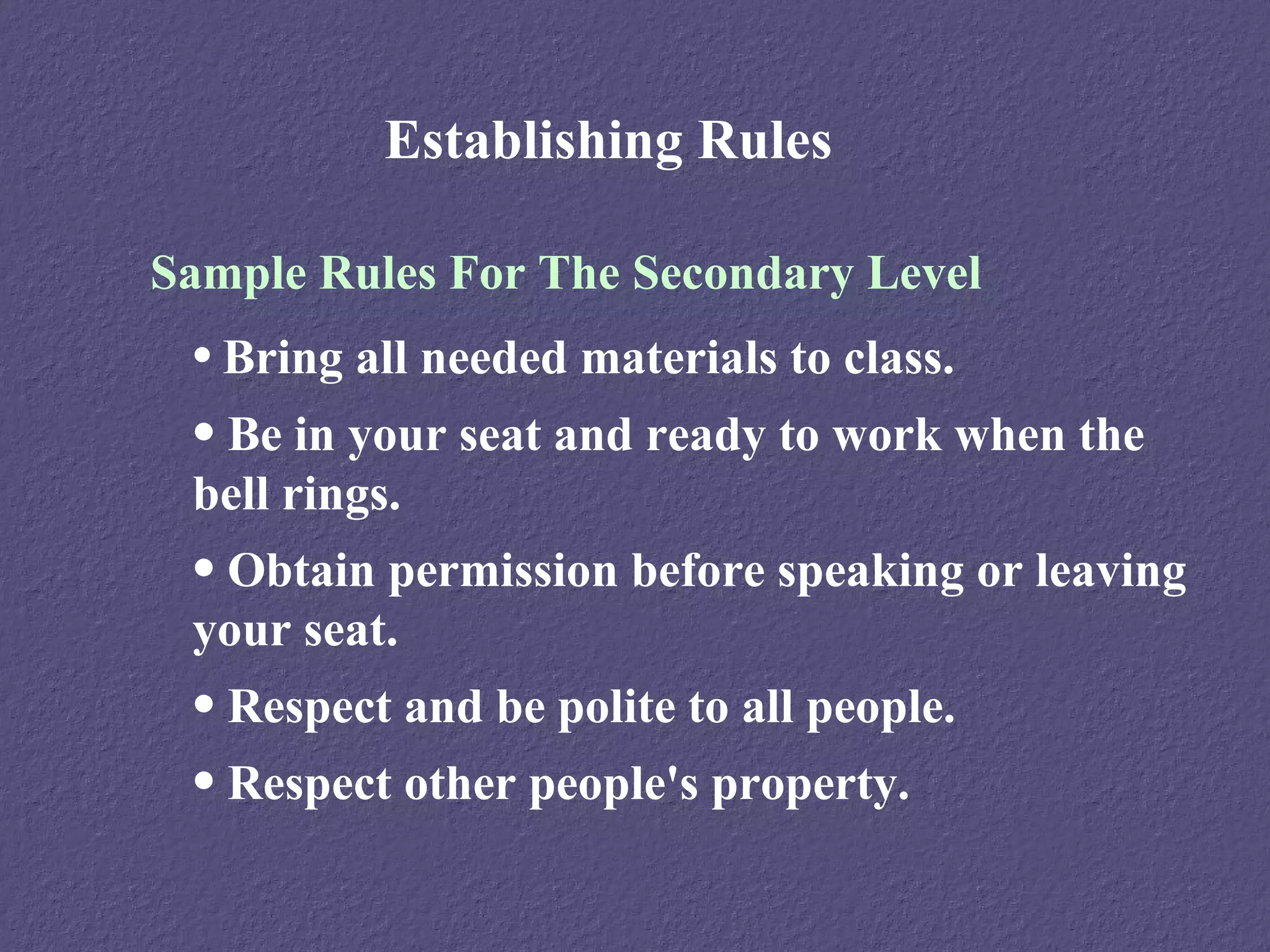
Sample Rules For The Secondary Level
 • Bring all needed materials to class.
 • Be in your seat and ready to work when the
 bell rings.
 • Obtain permission before speaking or leaving
 your seat.
 • Respect and be polite to all people.
 • Respect other people's property.
Establishing Rules

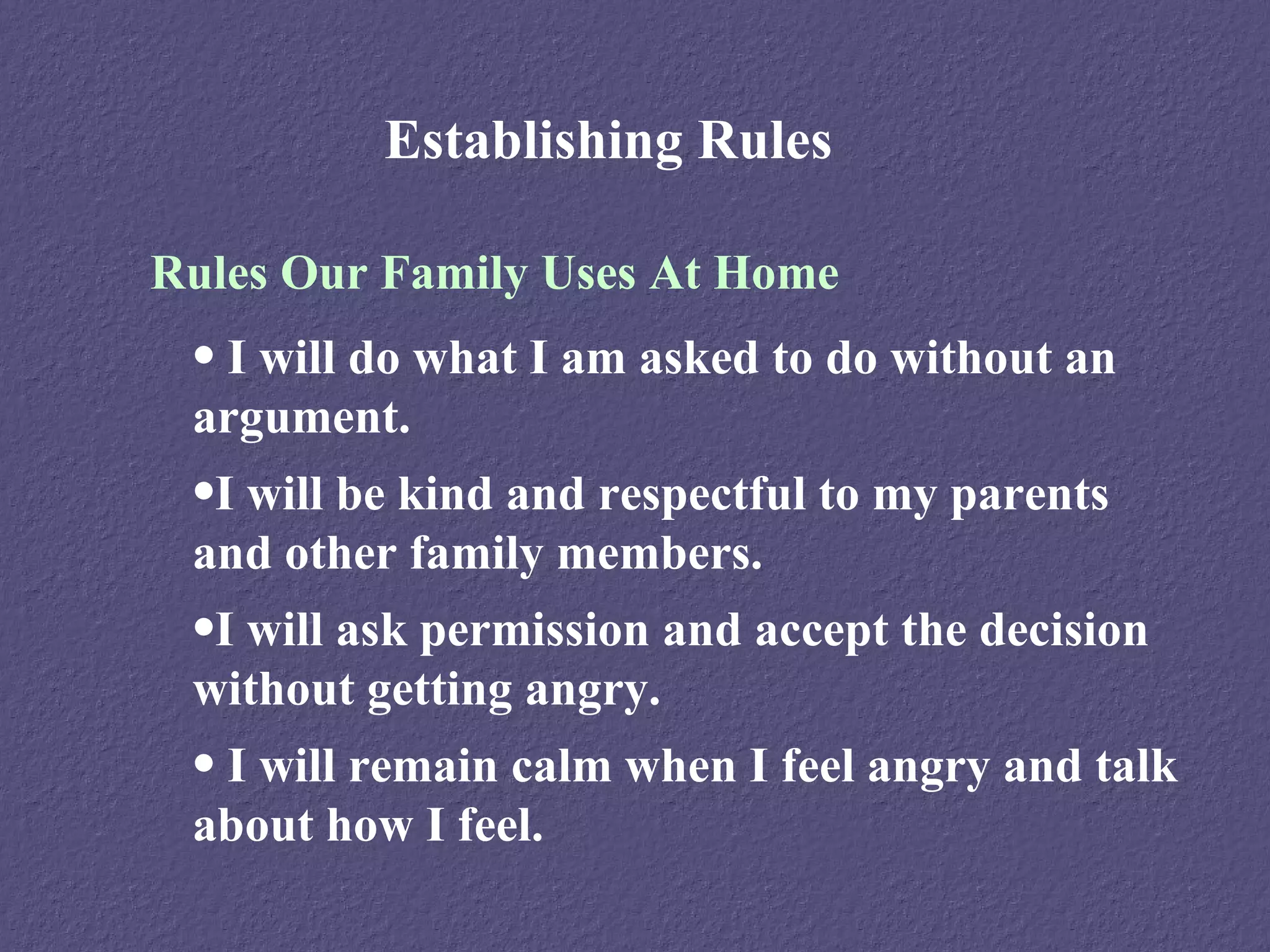
Rules Our Family Uses At Home
 • I will do what I am asked to do without an
 argument.
 •I will be kind and respectful to my parents
 and other family members.
 •I will ask permission and accept the decision
 without getting angry.
 • I will remain calm when I feel angry and talk
 about how I feel.
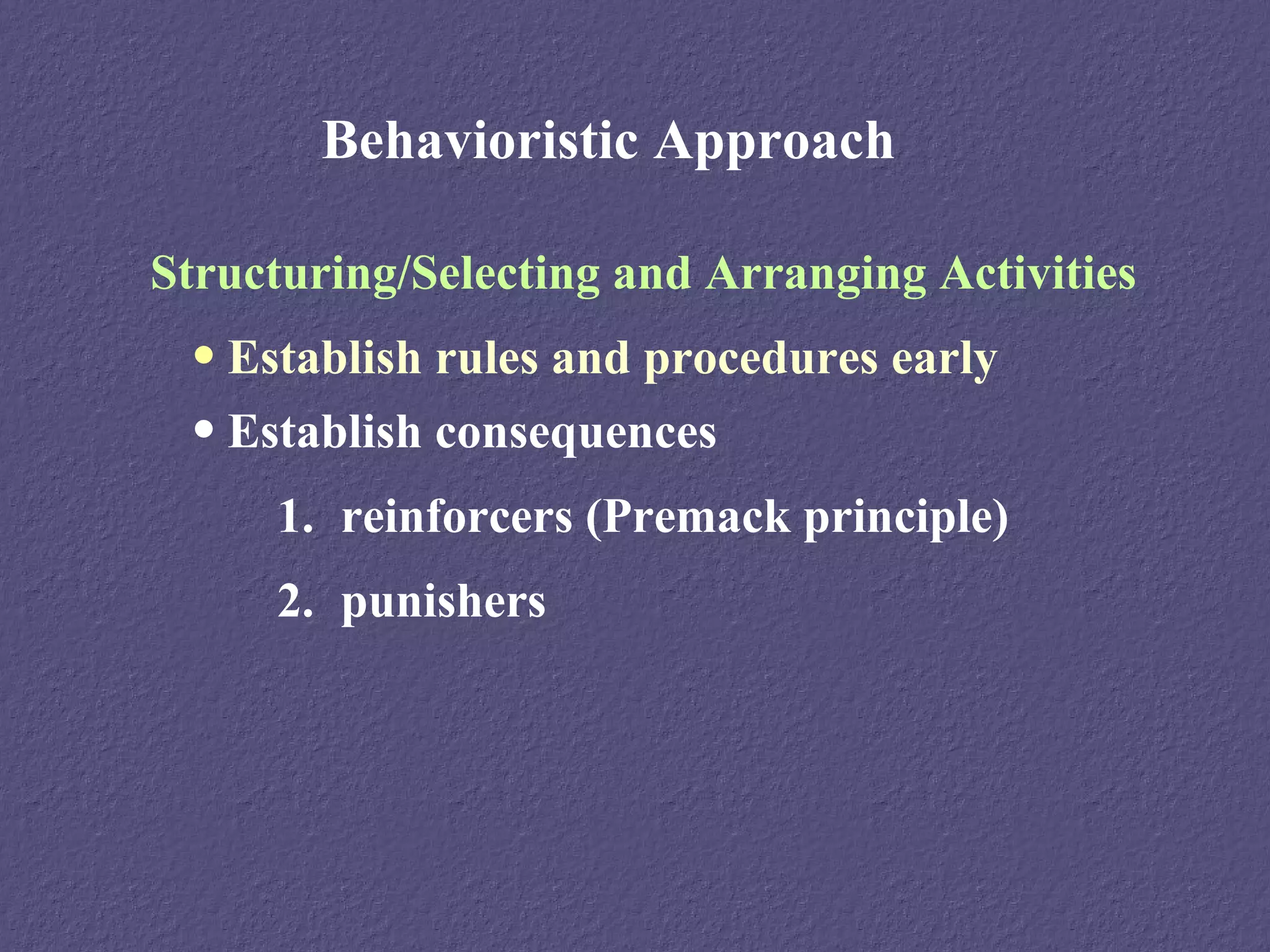
Behavioristic Approach

Structuring/Selecting and Arranging Activities
 • Establish rules and procedures early
 • Establish consequences
     1. reinforcers (Premack principle)
     2. punishers
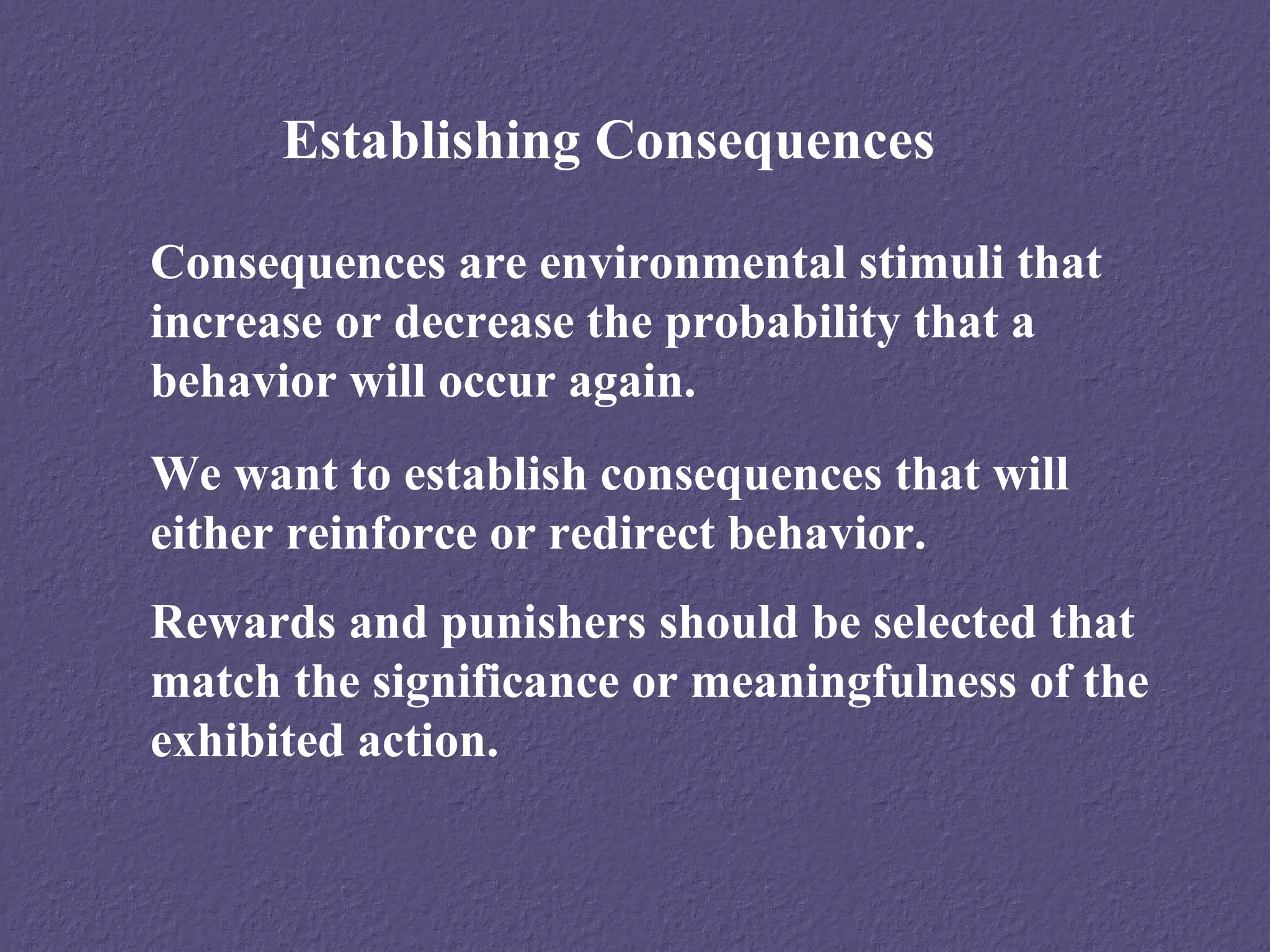
Establishing Consequences

Consequences are environmental stimuli that
increase or decrease the probability that a
behavior will occur again.
We want to establish consequences that will
either reinforce or redirect behavior.
Rewards and punishers should be selected that
match the significance or meaningfulness of the
exhibited action.
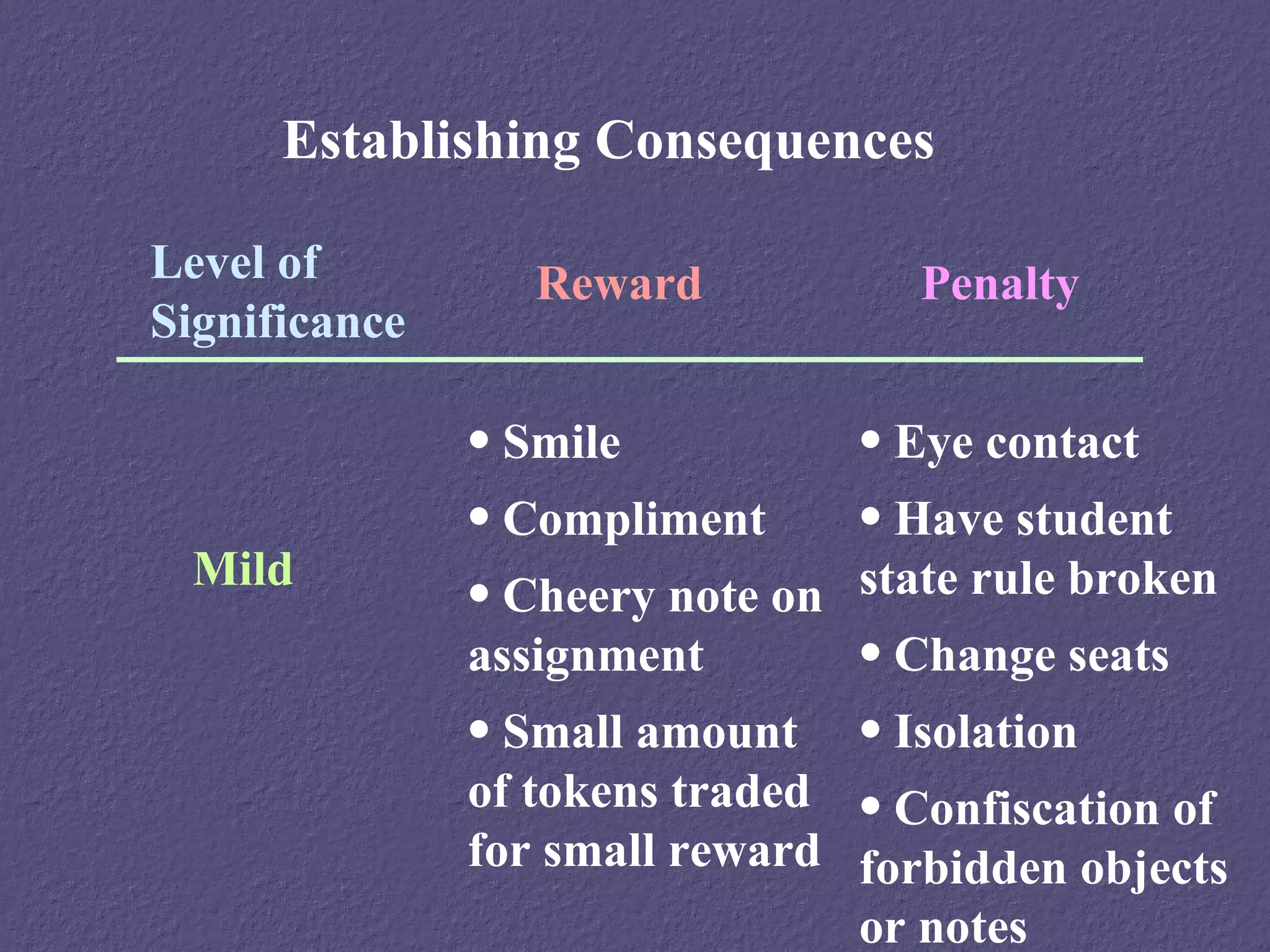
Establishing Consequences

Level of          Reward           Penalty
Significance

               • Smile          • Eye contact
               • Compliment     • Have student
 Mild          • Cheery note on state rule broken
               assignment       • Change seats
               • Small amount • Isolation
               of tokens traded • Confiscation of
               for small reward forbidden objects
                                or notes
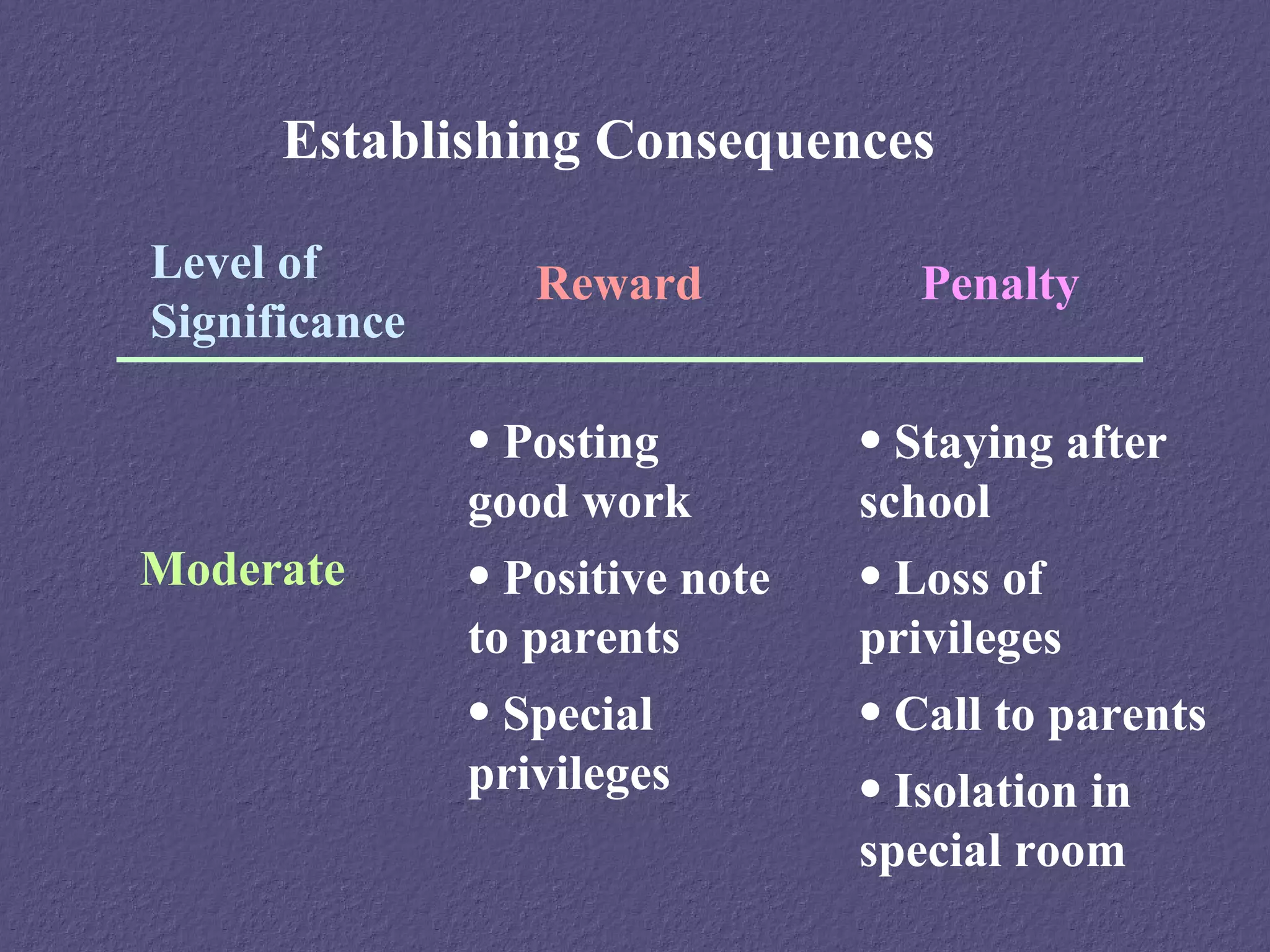
Establishing Consequences

Level of          Reward            Penalty
Significance

               • Posting         • Staying after
               good work         school
Moderate       • Positive note   • Loss of
               to parents        privileges
               • Special         • Call to parents
               privileges        • Isolation in
                                 special room
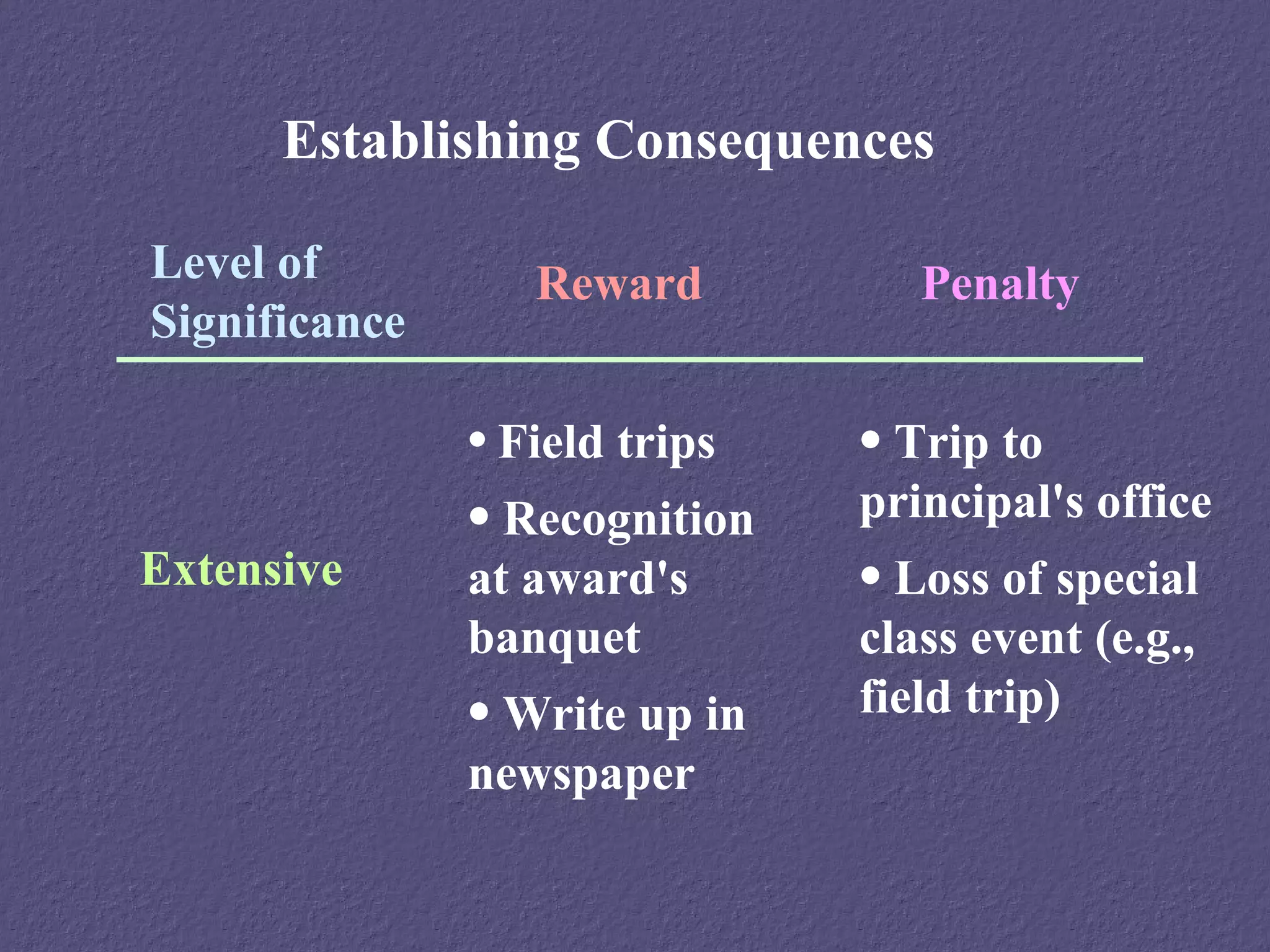
Establishing Consequences

Level of          Reward          Penalty
Significance

               • Field trips   • Trip to
               • Recognition   principal's office
Extensive      at award's      • Loss of special
               banquet         class event (e.g.,
               • Write up in   field trip)
               newspaper
Establishing Consequences

The most important aspect of delivering
consequences is the consistency of delivery.

Especially in terms of punishers, any
inconsistency might actually increase rather
than decrease the probability that the
behavior will occur again.
Behavioristic Approach

Structuring/Selecting and Arranging Activities
 • Establish rules and procedures early
 • Establish consequences
     1. reinforcers (Premack principle)
     2. punishers
 • Establish method of delivering reinforcers
   1. Token reinforcement programs
   2. Contingency contract programs
Behavioristic Approach

Structuring/Selecting and Arranging Activities
 • State expectations clearly
 • Focus on positive expectations
 • Practice "positive" behavior
 • Establish group cohesiveness and responsibility
 • Establish cues
 • Model appropriate behavior
Behavioristic Approach

Monitor Student Behavior
 • Physical layout: ability to see all students
 • Teacher movement: move around the room
 • Group focus: keep students involved
 • Overlapping: ability to supervise several
 activities at once
Behavioristic Approach

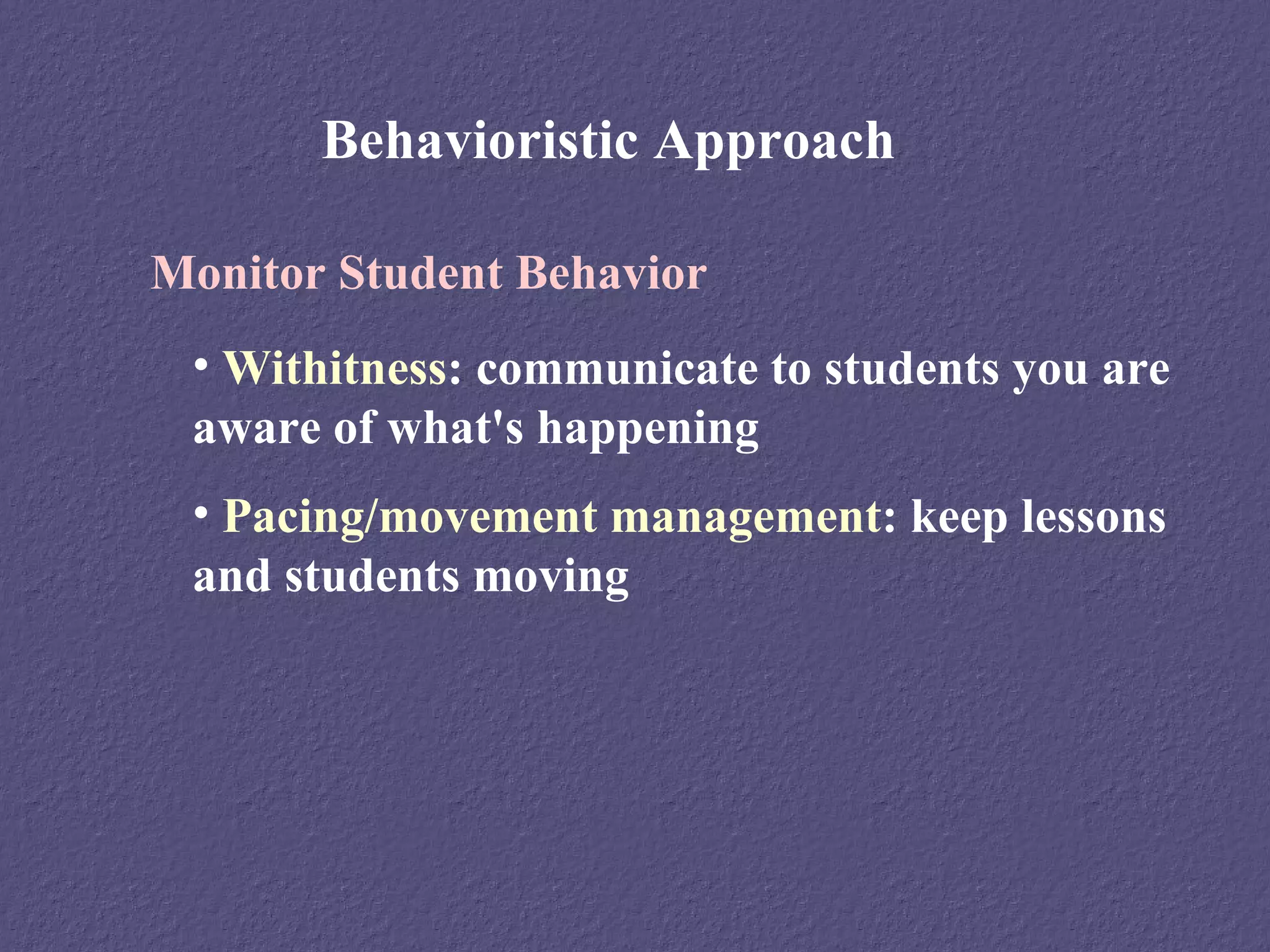
Monitor Student Behavior
 • Withitness: communicate to students you are
 aware of what's happening
 • Pacing/movement management: keep lessons
 and students moving
Behavioristic Approach

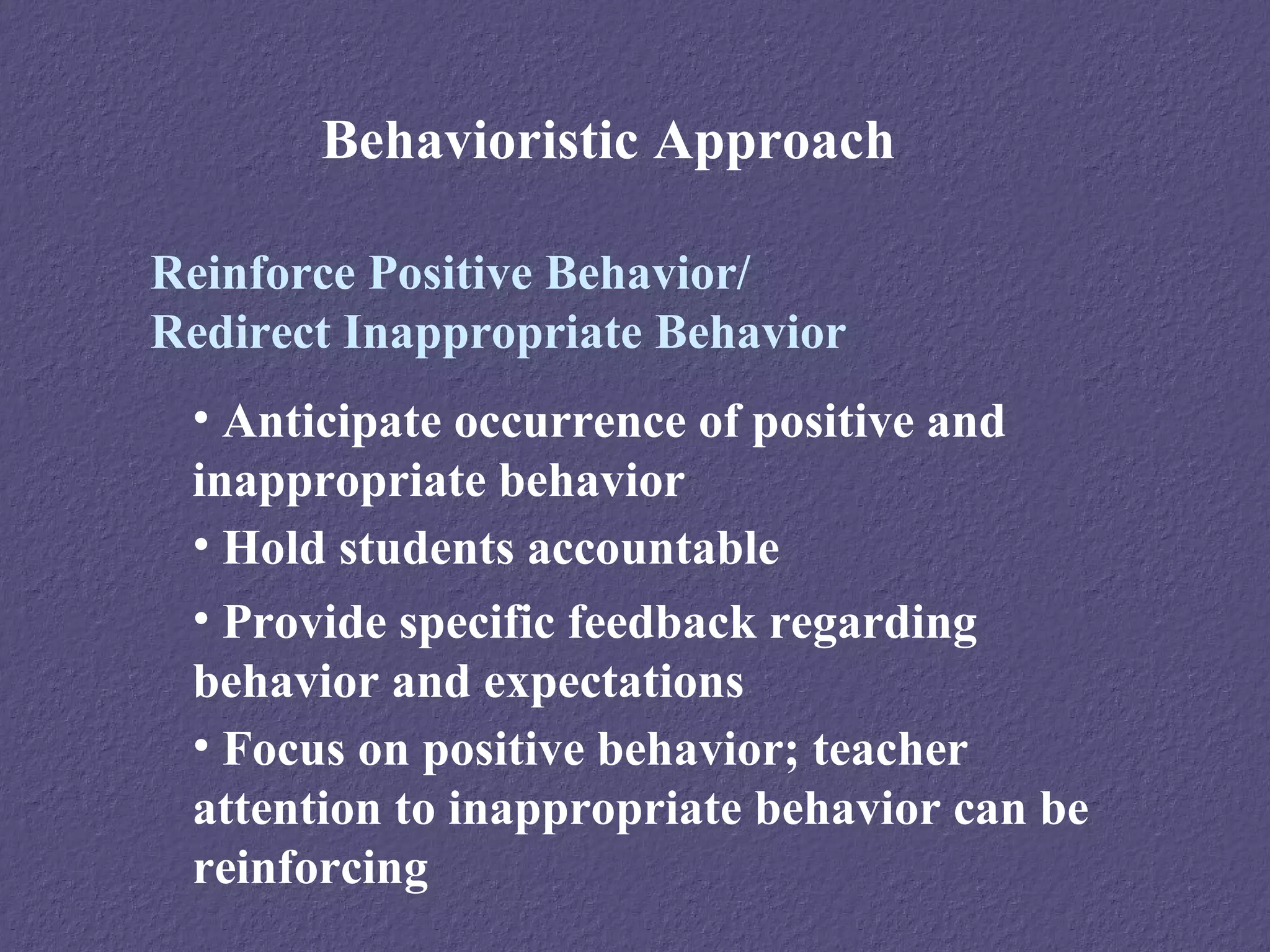
Reinforce Positive Behavior/
Redirect Inappropriate Behavior
 • Anticipate occurrence of positive and
 inappropriate behavior
 • Hold students accountable
 • Provide specific feedback regarding
 behavior and expectations
 • Focus on positive behavior; teacher
 attention to inappropriate behavior can be
 reinforcing
Behavioristic Approach

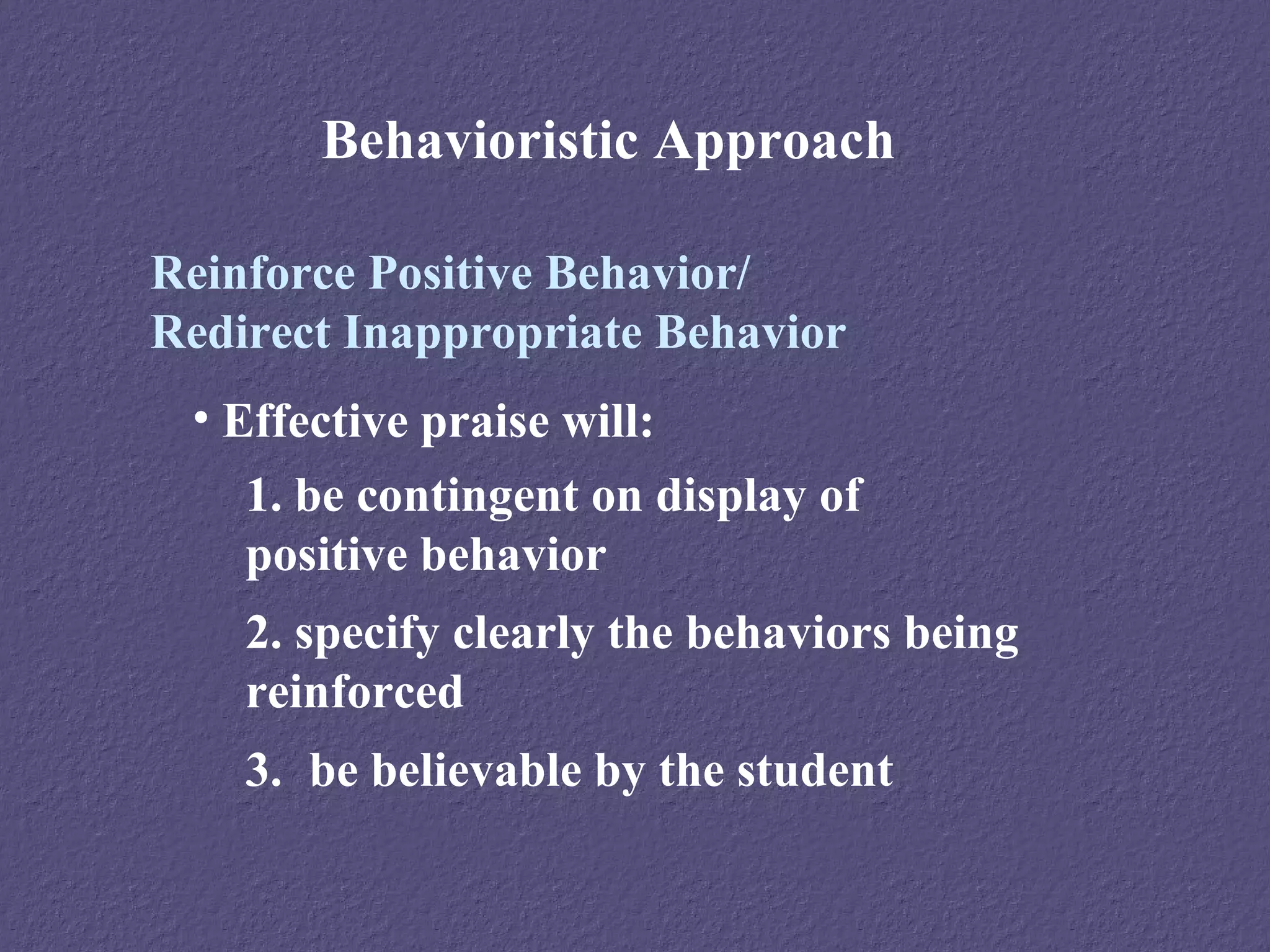
Reinforce Positive Behavior/
Redirect Inappropriate Behavior
 • Effective praise will:
    1. be contingent on display of
    positive behavior
    2. specify clearly the behaviors being
    reinforced
    3. be believable by the student
Behavioristic Approach

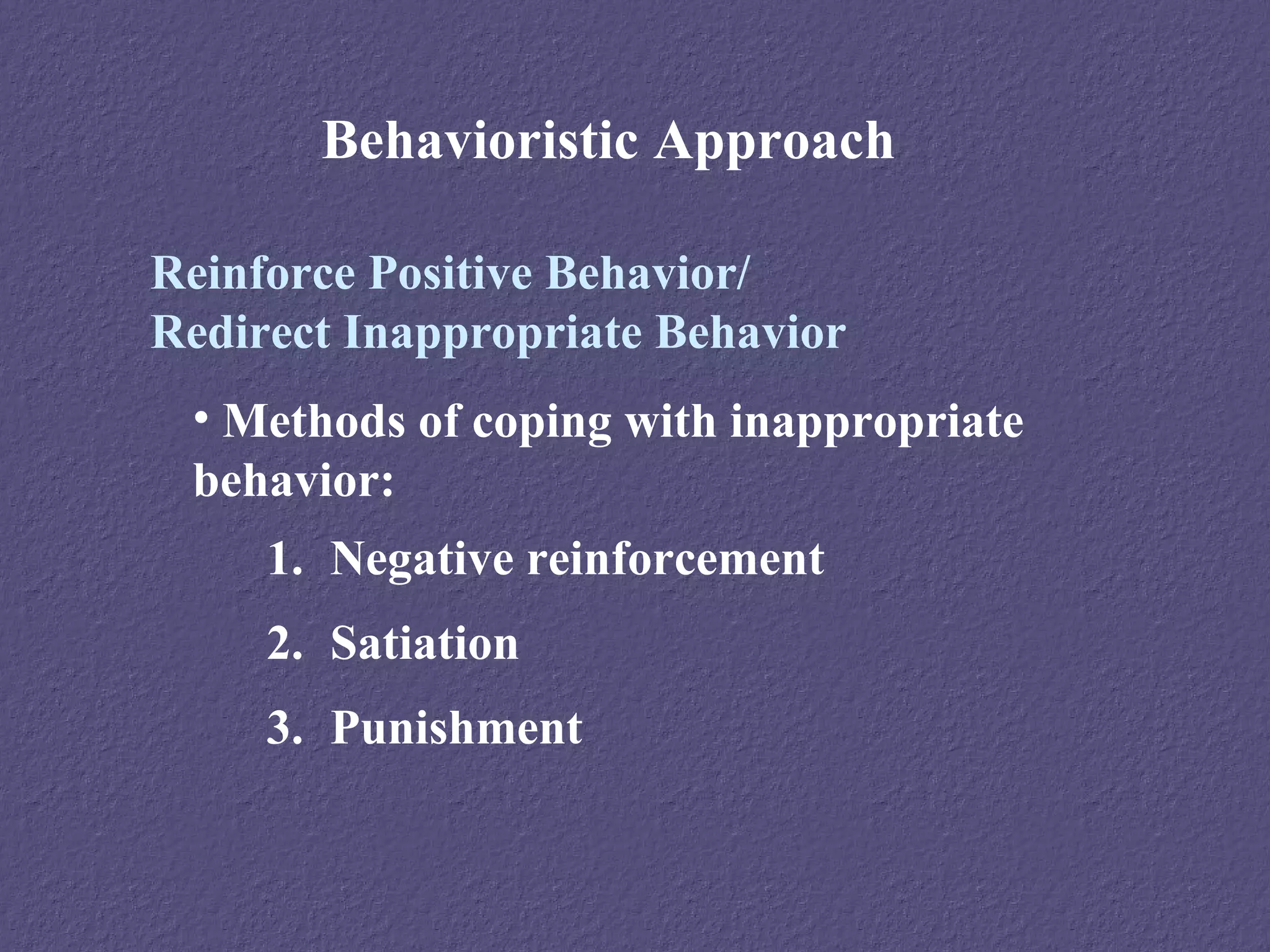
Reinforce Positive Behavior/
Redirect Inappropriate Behavior
 • Methods of coping with inappropriate
 behavior:
     1. Negative reinforcement
     2. Satiation
     3. Punishment
Behavioristic Approach

While there are viable alternatives to the
behavioristic approach to classroom
management, it is clearly the most often used
in public schools today.

Remember that the long-term goal of any
classroom management program is self-
management.

Manage

  • 1.
    Classroom Management Describe theimportance of classroom management and its impact on academic learning time. Describe differences in the approach to classroom management from a behavioral, cognitive, and humanistic perspective. Name and describe three general categories of the events of classroom management from a behavioral perspective, giving examples of specific teacher activities for each category. Developed by W. Huitt, 1999
  • 2.
    Classroom Management Primary purposeis to gain control of the classroom Good classroom management results in high levels of student engaged time
  • 3.
    Classroom Management Brophy (1983)states there are 3 general principles for good classroom management: • Willingness of the teacher to accept responsibility for classroom control • Long-term, solution-oriented approaches to problems (rather than short-term, desist/ control responses Brophy, J. (1983). Effective classroom management. The School Administrator, 40(7), 33-36.
  • 4.
    Classroom Management Brophy (1983)states there are 3 general principles for good classroom management: • Check to see if symptomatic behavior is caused by underlying personal problems (impulsivity, lack of awareness, home problems, etc.) Brophy, J. (1983). Effective classroom management. The School Administrator, 40(7), 33-36.
  • 5.
    Classroom Management Brophy (1983)also cites 3 theoretical orientations to classroom management: • Self-concept/personal adjustment -- the teacher encourages discouraged students, builds self-esteem by arranging for and calling attention to success, improving peer relationships, etc.
  • 6.
    Classroom Management Brophy (1983)also cites 3 theoretical orientations to classroom management: • Insight (cognitive) -- teacher spends time with problem students individually, getting to know them personally, attempting to instruct and inform them
  • 7.
    Classroom Management Brophy (1983)also cites 3 theoretical orientations to classroom management: • Behavioristic -- teacher offers incentives, negotiates contracts, calls attention to and reinforces desirable behavior
  • 8.
    Classroom Management This presentationwill focus on the application of principles from behaviorial psychology, especially the application of consequences to modify behavior.
  • 9.
    Behavioristic Approach There are3 major categories of actions to take in establishing a behaviorally-oriented classroom management program: • Structuring/Selecting and Arranging Activities • Monitor Student Behavior • Reinforce Positive Behavior/ Redirect Inappropriate Behavior
  • 10.
    Behavioristic Approach Structuring/Selecting andArranging Activities • Establish rules and procedures early
  • 11.
    Establishing Rules General Recommendations • Select 4 or 5 rules that you will use to set guidelines and limits for behavior in your classroom. • State the rules in terms of positive expectations of behavior you want to see. Be careful about stating rules in the form of "Don't.”
  • 12.
    Establishing Rules General Recommendations • Think about specific examples of behavior that would demonstrate each rule. • Post the rules in your classroom. • Teach the rules just as you would academic content using the discussed previously.
  • 13.
    Establishing Rules Sample RulesFor The Elementary Level • Be polite and helpful. • Take care of your school. • Behave in the cafeteria. • Do not hit, shove or hurt others. • Keep the bathroom clean.
  • 14.
    Establishing Rules Sample RulesFor The Secondary Level • Bring all needed materials to class. • Be in your seat and ready to work when the bell rings. • Obtain permission before speaking or leaving your seat. • Respect and be polite to all people. • Respect other people's property.
  • 15.
    Establishing Rules Rules OurFamily Uses At Home • I will do what I am asked to do without an argument. •I will be kind and respectful to my parents and other family members. •I will ask permission and accept the decision without getting angry. • I will remain calm when I feel angry and talk about how I feel.
  • 16.
    Behavioristic Approach Structuring/Selecting andArranging Activities • Establish rules and procedures early • Establish consequences 1. reinforcers (Premack principle) 2. punishers
  • 17.
    Establishing Consequences Consequences areenvironmental stimuli that increase or decrease the probability that a behavior will occur again. We want to establish consequences that will either reinforce or redirect behavior. Rewards and punishers should be selected that match the significance or meaningfulness of the exhibited action.
  • 18.
    Establishing Consequences Level of Reward Penalty Significance • Smile • Eye contact • Compliment • Have student Mild • Cheery note on state rule broken assignment • Change seats • Small amount • Isolation of tokens traded • Confiscation of for small reward forbidden objects or notes
  • 19.
    Establishing Consequences Level of Reward Penalty Significance • Posting • Staying after good work school Moderate • Positive note • Loss of to parents privileges • Special • Call to parents privileges • Isolation in special room
  • 20.
    Establishing Consequences Level of Reward Penalty Significance • Field trips • Trip to • Recognition principal's office Extensive at award's • Loss of special banquet class event (e.g., • Write up in field trip) newspaper
  • 21.
    Establishing Consequences The mostimportant aspect of delivering consequences is the consistency of delivery. Especially in terms of punishers, any inconsistency might actually increase rather than decrease the probability that the behavior will occur again.
  • 22.
    Behavioristic Approach Structuring/Selecting andArranging Activities • Establish rules and procedures early • Establish consequences 1. reinforcers (Premack principle) 2. punishers • Establish method of delivering reinforcers 1. Token reinforcement programs 2. Contingency contract programs
  • 23.
    Behavioristic Approach Structuring/Selecting andArranging Activities • State expectations clearly • Focus on positive expectations • Practice "positive" behavior • Establish group cohesiveness and responsibility • Establish cues • Model appropriate behavior
  • 24.
    Behavioristic Approach Monitor StudentBehavior • Physical layout: ability to see all students • Teacher movement: move around the room • Group focus: keep students involved • Overlapping: ability to supervise several activities at once
  • 25.
    Behavioristic Approach Monitor StudentBehavior • Withitness: communicate to students you are aware of what's happening • Pacing/movement management: keep lessons and students moving
  • 26.
    Behavioristic Approach Reinforce PositiveBehavior/ Redirect Inappropriate Behavior • Anticipate occurrence of positive and inappropriate behavior • Hold students accountable • Provide specific feedback regarding behavior and expectations • Focus on positive behavior; teacher attention to inappropriate behavior can be reinforcing
  • 27.
    Behavioristic Approach Reinforce PositiveBehavior/ Redirect Inappropriate Behavior • Effective praise will: 1. be contingent on display of positive behavior 2. specify clearly the behaviors being reinforced 3. be believable by the student
  • 28.
    Behavioristic Approach Reinforce PositiveBehavior/ Redirect Inappropriate Behavior • Methods of coping with inappropriate behavior: 1. Negative reinforcement 2. Satiation 3. Punishment
  • 29.
    Behavioristic Approach While thereare viable alternatives to the behavioristic approach to classroom management, it is clearly the most often used in public schools today. Remember that the long-term goal of any classroom management program is self- management.