Classroom
Management
Rationale
Good classroom management is a key
factor in teachers’ professional life. It
helps to maintain congenial and
positive learning environment in the
class. It also helps to set standard
procedures and rules to carry out in
day-to-day teaching effectively and
smoothly. This subsequently helps
the students to learn skills which they
need in the adult world.
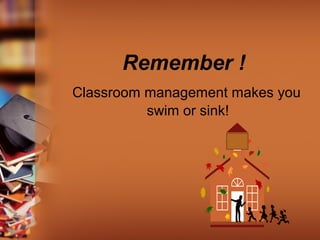
Remember !
Classroom management makes you
swim or sink!
Gardening and Knitting-an analogy !
Gardening:
Good teaching is like gardening. The most
important part of the activity is preparation
of the soil so that plants can grow.

Knitting:
If you don’t get the very first row right, later in
the pattern, you have to go back, rip out all
the yarn, and start over again…
What is Classroom Management?

“The actions taken by the teachers to create
and maintain a learning environment
conducive for successful instruction.”
Evertson & Weinstein
2006
What is your classroom management
profile?

Activity 1.1
Authoritarian Style
The authoritarian teacher places firm limits and
controls on the students. Students will often
have assigned seats for the entire term. The
desks are usually in straight rows and there are
no deviations. Students must be in their seats at
the beginning of class and they frequently
remain there throughout the period. This teacher
rarely gives hall passes or recognizes excused
absences.
Authoritative Style
• The authoritative teacher places limits and controls
on the students but simultaneously encourages
independence. This teacher often explains the
reasons behind the rules and decisions. If a
student is disruptive, the teacher offers a polite,
but firm, reprimand. This teacher sometimes
metes out discipline, but only after careful
consideration of the circumstances.
• The authoritative teacher is also open to
considerable verbal interaction, including critical
debates. The students know that they can interrupt
the teacher if they have a relevant question or
comment. This environment offers the students the
opportunity to learn and practice communication
skills.
Laissez-Faire Style
The laissez-faire teacher places few
demand or controls on the students.
"Do your own thing" describes this
classroom. This teacher accepts the
student's impulses and actions and is
less likely to monitor the behavior.
Indifferent Style
• The indifferent teacher is not very
involved in the classroom. This teacher
places few demands, if any, on the
students and appears generally
uninterested. The indifferent teacher just
doesn't want to impose on the students. As
such, he/she often feels that class
preparation is not worth the effort. Things
like field trips and special projects are out
of the question. This teacher simply won't
take the necessary preparation time.
Sometimes, he/she will use the same
materials, year after year.
Kids ! You Just Can’t beat
them!
“Survival of the fittest!”
When there is no organization,
strong start dominating the weak.
Your Classroom Management
starts before the first day of the
school !

Be Proactive!
Activity 1.2
Make a list of things to do before school
starts.
 Room Environment
 Find out about
 Students Prep
 Getting Organized
 Procedures For
Components of
Classroom Management
Good classroom management has
three basic and necessary
components:
 Rules and Procedure
 Consequences
 Relationships
Rules & Procedures
Rules
Facilitate best learning environment
Classroom rules should be set
cooperatively. Establish a few general rules
of classroom conduct.
Rules need to be established as a result of
a meaningful classroom discussion.
Minimum rules with maximum consistency
is the BEST guideline.
(Video)
Procedures
Procedures are usually unwritten, but have
been practiced enough so students know
them. It helps students to know what to do
when.
Procedures need to be clearly stated,
modeled, and practiced until ALL the
students know them and become
automatic.
(Video)
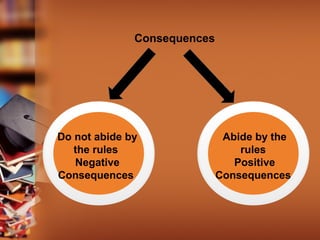
Consequences

Do not abide by
the rules
Negative
Consequences

Abide by the
rules
Positive
Consequences
Disciplinary Interventions
• The most effective deterrent of
inappropriate behavior is good instruction!
• After that comes physical presence.
• A friendly reminder.
• A firm reminder – in private
• “Go to the office!!!!” should not be the first
response unless the offense is totally
reprehensible, dangerous, thoroughly
disruptive and against a hard and fast
school rule.
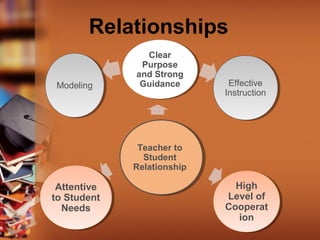
Relationships
Modeling

Clear
Purpose
and Strong
Guidance

Effective
Instruction

Teacher to
Student
Relationship

Attentive
to Student
Needs

High
Level of
Cooperat
ion
Case Study
Activity 1.3
 Pick a case from the basket
 Read it and identify the reason of
mismanagement
 Discuss and suggest measures to
improve the situation
Action/Strategies for good classroom
Management
•
•
•
•
•
•

Use assertive body language
Use appropriate tone of voice
Persisting until the appropriate behavior occurs
Establishing clear learning goals
Providing flexible learning goals
Talking informally with students before, during
and after class about their interests
• Greeting students outside of school
• Be innovative while setting your class
cont……
• Allow and encourage ALL students to be
part of classroom discussions
• Provide appropriate “wait time.”
• Emphasize right parts of wrong answers
• Encourage collaboration
• Restate or rephrase the question
• Give hints or clues
• Provide the answer and ask for elaboration
• Use humor
• Develop a set of written expectations you
can live with and enforce.
cont…..
 Be consistent. Be consistent. Be
consistent.
 Be patient with yourself and with your
students.
 Make parents your allies. Call early and
often. Use the word "concerned."
 When communicating a concern, be
specific and descriptive.
 Don't talk too much. Use the first 15
minutes of class for lectures or
presentations, then get the kids working.
 Break the class period into two or three
different activities. Be sure each activity
segues smoothly into the next.
 Make eye contact by scanning the entire
class while you speak.
What to do ………….??
 Teacher, I’m Finished. Now What Do I Do?
Quiet Choices
 Control the noise element
Class Volume Control
Clapping in Pattern
 Make all the students attentive all the time
Wisdom Jar
 Reduce tiredness
Brain Break
Reflection
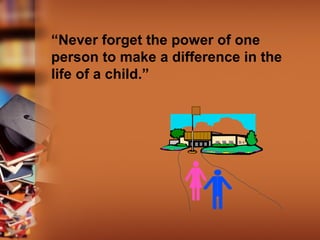
“Never forget the power of one
person to make a difference in the
life of a child.”

Classroom management

  • 1.
  • 2.
    Rationale Good classroom managementis a key factor in teachers’ professional life. It helps to maintain congenial and positive learning environment in the class. It also helps to set standard procedures and rules to carry out in day-to-day teaching effectively and smoothly. This subsequently helps the students to learn skills which they need in the adult world.
  • 3.
    Remember ! Classroom managementmakes you swim or sink!
  • 4.
  • 5.
    Gardening: Good teaching islike gardening. The most important part of the activity is preparation of the soil so that plants can grow. Knitting: If you don’t get the very first row right, later in the pattern, you have to go back, rip out all the yarn, and start over again…
  • 6.
    What is ClassroomManagement? “The actions taken by the teachers to create and maintain a learning environment conducive for successful instruction.” Evertson & Weinstein 2006
  • 7.
    What is yourclassroom management profile? Activity 1.1
  • 8.
    Authoritarian Style The authoritarianteacher places firm limits and controls on the students. Students will often have assigned seats for the entire term. The desks are usually in straight rows and there are no deviations. Students must be in their seats at the beginning of class and they frequently remain there throughout the period. This teacher rarely gives hall passes or recognizes excused absences.
  • 9.
    Authoritative Style • Theauthoritative teacher places limits and controls on the students but simultaneously encourages independence. This teacher often explains the reasons behind the rules and decisions. If a student is disruptive, the teacher offers a polite, but firm, reprimand. This teacher sometimes metes out discipline, but only after careful consideration of the circumstances. • The authoritative teacher is also open to considerable verbal interaction, including critical debates. The students know that they can interrupt the teacher if they have a relevant question or comment. This environment offers the students the opportunity to learn and practice communication skills.
  • 10.
    Laissez-Faire Style The laissez-faireteacher places few demand or controls on the students. "Do your own thing" describes this classroom. This teacher accepts the student's impulses and actions and is less likely to monitor the behavior.
  • 11.
    Indifferent Style • Theindifferent teacher is not very involved in the classroom. This teacher places few demands, if any, on the students and appears generally uninterested. The indifferent teacher just doesn't want to impose on the students. As such, he/she often feels that class preparation is not worth the effort. Things like field trips and special projects are out of the question. This teacher simply won't take the necessary preparation time. Sometimes, he/she will use the same materials, year after year.
  • 12.
    Kids ! YouJust Can’t beat them! “Survival of the fittest!” When there is no organization, strong start dominating the weak.
  • 13.
    Your Classroom Management startsbefore the first day of the school ! Be Proactive!
  • 14.
    Activity 1.2 Make alist of things to do before school starts.  Room Environment  Find out about  Students Prep  Getting Organized  Procedures For
  • 15.
    Components of Classroom Management Goodclassroom management has three basic and necessary components:  Rules and Procedure  Consequences  Relationships
  • 16.
  • 17.
    Rules Facilitate best learningenvironment Classroom rules should be set cooperatively. Establish a few general rules of classroom conduct. Rules need to be established as a result of a meaningful classroom discussion. Minimum rules with maximum consistency is the BEST guideline. (Video)
  • 18.
    Procedures Procedures are usuallyunwritten, but have been practiced enough so students know them. It helps students to know what to do when. Procedures need to be clearly stated, modeled, and practiced until ALL the students know them and become automatic. (Video)
  • 19.
    Consequences Do not abideby the rules Negative Consequences Abide by the rules Positive Consequences
  • 20.
    Disciplinary Interventions • Themost effective deterrent of inappropriate behavior is good instruction! • After that comes physical presence. • A friendly reminder. • A firm reminder – in private • “Go to the office!!!!” should not be the first response unless the offense is totally reprehensible, dangerous, thoroughly disruptive and against a hard and fast school rule.
  • 21.
  • 22.
    Case Study Activity 1.3 Pick a case from the basket  Read it and identify the reason of mismanagement  Discuss and suggest measures to improve the situation
  • 23.
    Action/Strategies for goodclassroom Management • • • • • • Use assertive body language Use appropriate tone of voice Persisting until the appropriate behavior occurs Establishing clear learning goals Providing flexible learning goals Talking informally with students before, during and after class about their interests • Greeting students outside of school • Be innovative while setting your class cont……
  • 24.
    • Allow andencourage ALL students to be part of classroom discussions • Provide appropriate “wait time.” • Emphasize right parts of wrong answers • Encourage collaboration • Restate or rephrase the question • Give hints or clues • Provide the answer and ask for elaboration • Use humor • Develop a set of written expectations you can live with and enforce. cont…..
  • 25.
     Be consistent.Be consistent. Be consistent.  Be patient with yourself and with your students.  Make parents your allies. Call early and often. Use the word "concerned."  When communicating a concern, be specific and descriptive.  Don't talk too much. Use the first 15 minutes of class for lectures or presentations, then get the kids working.  Break the class period into two or three different activities. Be sure each activity segues smoothly into the next.  Make eye contact by scanning the entire class while you speak.
  • 26.
    What to do………….??  Teacher, I’m Finished. Now What Do I Do? Quiet Choices  Control the noise element Class Volume Control Clapping in Pattern  Make all the students attentive all the time Wisdom Jar  Reduce tiredness Brain Break
  • 27.
  • 28.
    “Never forget thepower of one person to make a difference in the life of a child.”

Editor's Notes

  • #18 The importance of establishing classroom rules during the first day and the first week can’t be emphasized enough. If we treat classroom rules and standard procedures lightly and don’t understand their importance at the beginning of the year …
  • #21 Misbehavior is frequently a call for attention – ours or the other students’ If we focus on good behavior, the misbehavior often ceases.
  • #22 Positive relationships may just happen, but they can also be developed Positive recognition and reinforcement develop positive behavior and build the relationship