
COGNITION
The mental action or process
of acquiring knowledge and
understanding through
thought, experiences and the
senses.
COGNITION
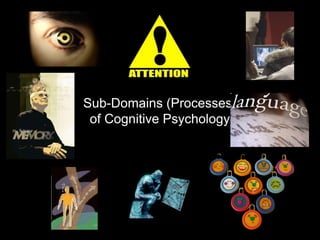
Sub-Domains (Processes)
of Cognitive Psychology
Cognitive Psych Principles
Mental processes guide
behaviour
The mind can be studied
scientifically
Cognitive processes are influenced
By social and cultural factors
The Mysterious
Workings of the
Teenage Brain
Video
The mind can be studied
scientifically
Learning that has persisted over time –
Information that has been stored
and in many cases recalled.
3 Basic Stages of the
Memory Process
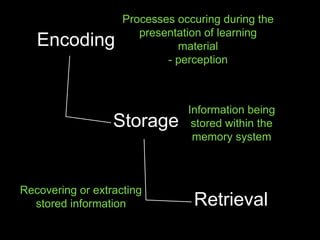
Encoding
Storage
Retrieval
Processes occuring during the
presentation of learning
material
- perception
Information being
stored within the
memory system
Recovering or extracting
stored information
Think of something you have had to
remember.
1. How did you put it into your memory?
(Encoding)
2. How did you maintain it in your memory?
(Storage)
3. How did you recover it from your memory when
needed? (Retrieval)
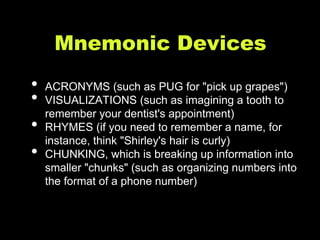
• ACRONYMS (such as PUG for "pick up grapes")
• VISUALIZATIONS (such as imagining a tooth to
remember your dentist's appointment)
• RHYMES (if you need to remember a name, for
instance, think "Shirley's hair is curly)
• CHUNKING, which is breaking up information into
smaller "chunks" (such as organizing numbers into
the format of a phone number)
Mnemonic Devices
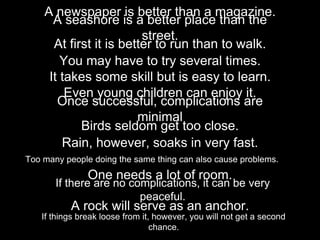
A newspaper is better than a magazine.
A seashore is a better place than the
street.
At first it is better to run than to walk.
You may have to try several times.
It takes some skill but is easy to learn.
Even young children can enjoy it.
Once successful, complications are
minimal
Birds seldom get too close.
Rain, however, soaks in very fast.
Too many people doing the same thing can also cause problems.
One needs a lot of room.
If there are no complications, it can be very
peaceful.
A rock will serve as an anchor.
If things break loose from it, however, you will not get a second
chance.
CONTEXT
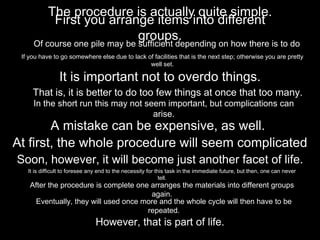
The procedure is actually quite simple.
First you arrange items into different
groups.
Of course one pile may be sufficient depending on how there is to do
If you have to go somewhere else due to lack of facilities that is the next step; otherwise you are pretty
well set.
It is important not to overdo things.
That is, it is better to do too few things at once that too many.
In the short run this may not seem important, but complications can
arise.
A mistake can be expensive, as well.
At first, the whole procedure will seem complicated
Soon, however, it will become just another facet of life.
It is difficult to foresee any end to the necessity for this task in the immediate future, but then, one can never
tell.
After the procedure is complete one arranges the materials into different groups
again.
Eventually, they will used once more and the whole cycle will then have to be
repeated.
However, that is part of life.
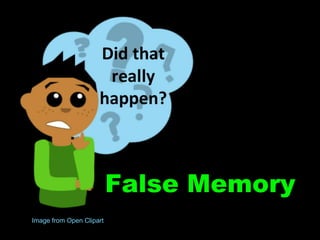
False Memory
Image from Open Clipart

Cognitive Processes and Memory

  • 1.
  • 2.
    The mental actionor process of acquiring knowledge and understanding through thought, experiences and the senses. COGNITION
  • 3.
  • 4.
    Cognitive Psych Principles Mentalprocesses guide behaviour The mind can be studied scientifically Cognitive processes are influenced By social and cultural factors
  • 5.
    The Mysterious Workings ofthe Teenage Brain Video The mind can be studied scientifically
  • 7.
    Learning that haspersisted over time – Information that has been stored and in many cases recalled.
  • 8.
    3 Basic Stagesof the Memory Process
  • 9.
    Encoding Storage Retrieval Processes occuring duringthe presentation of learning material - perception Information being stored within the memory system Recovering or extracting stored information
  • 10.
    Think of somethingyou have had to remember. 1. How did you put it into your memory? (Encoding) 2. How did you maintain it in your memory? (Storage) 3. How did you recover it from your memory when needed? (Retrieval)
  • 11.
    • ACRONYMS (suchas PUG for "pick up grapes") • VISUALIZATIONS (such as imagining a tooth to remember your dentist's appointment) • RHYMES (if you need to remember a name, for instance, think "Shirley's hair is curly) • CHUNKING, which is breaking up information into smaller "chunks" (such as organizing numbers into the format of a phone number) Mnemonic Devices
  • 12.
    A newspaper isbetter than a magazine. A seashore is a better place than the street. At first it is better to run than to walk. You may have to try several times. It takes some skill but is easy to learn. Even young children can enjoy it. Once successful, complications are minimal Birds seldom get too close. Rain, however, soaks in very fast. Too many people doing the same thing can also cause problems. One needs a lot of room. If there are no complications, it can be very peaceful. A rock will serve as an anchor. If things break loose from it, however, you will not get a second chance.
  • 13.
  • 14.
    The procedure isactually quite simple. First you arrange items into different groups. Of course one pile may be sufficient depending on how there is to do If you have to go somewhere else due to lack of facilities that is the next step; otherwise you are pretty well set. It is important not to overdo things. That is, it is better to do too few things at once that too many. In the short run this may not seem important, but complications can arise. A mistake can be expensive, as well. At first, the whole procedure will seem complicated Soon, however, it will become just another facet of life. It is difficult to foresee any end to the necessity for this task in the immediate future, but then, one can never tell. After the procedure is complete one arranges the materials into different groups again. Eventually, they will used once more and the whole cycle will then have to be repeated. However, that is part of life.
  • 15.

Editor's Notes

  • #10 E= transforming sensory information into a meaningful memory (Visual, Acoustic, Semantic) OTTFFSSENT S= creating biological trace of encoded info in memory (maintenance, elaborative, organizational) R= using the stored info
  • #13 Context and memory activity
  • #14 The situation in which a person first had the experience being remembered. Knowing context adds meaning to material that might otherwise appear unrelated. Context makes organization of learning possible. Environmental context State-dependent & mood dependent context
  • #15 Context and memory activity