English Vowel Triangle
            Fall 2012
How many vowel sounds
    do you think are in
standard American English?
How many vowel sounds
    do you think are in
standard American English?

          22 !
English Pure Vowels - Guess
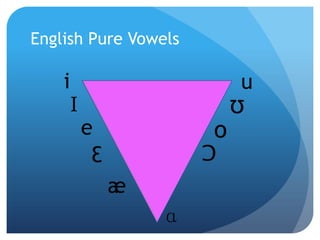
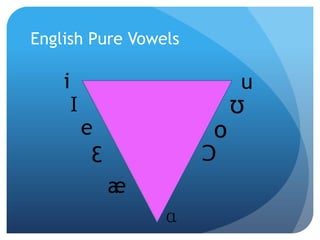
English Pure Vowels

    i                        u
        I                    Ʊ
            e            o
             Ɛ           Ɔ
                 æ
                     ɑ
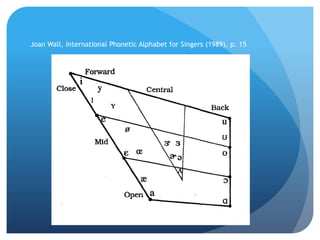
Joan Wall, International Phonetic Alphabet for Singers (1989), p. 15


Its approximate present form came from Daniel Jones of
University College. London. and is known as the Vowel
Diagram. It was developed by superimposing X-ray
images of the position of the tongue when articulating
various vowels. The Vowel Diagram indicates the
position of the high point of the tongue during the
articulation of each vowel.
 Forward vowels:    [i]    beet
                      [ɪ]    bit
                     [e]    chaotic
                     [ɛ]    bet
                     [æ]    bat
                     [a]    bright ah (mostly used in diphthongs)
  Back vowels:      [u]     boot
                    [ʊ]     book
                    [o]     obey (pure [o] seldom used)
                    [ɔ]     saw
                    [ɑ]     father
  Central vowels:   [ʌ] up         (stressed 'uh')
                    [ə] about       (unstressed 'uh,' schwa)
                    [ɝ] herd       (stressed, r-colored vowel)
                    [ɜ] herd        (NOT r-colored)
                    [ɚ] butter      (unstressed, r-colored vowel)
  Diphthongs:       [eɪ] bait
  [difθɔŋ]          [oʊ] boat
                    [aɪ] bite
                    [aʊ] ouch
                    [ɔɪ] boy
                    [ju] use
We begin with vowels because they are harder to
comprehend and execute than consonants!


Remember: a pure vowel = one sound

But in English we have diphthongs too!!


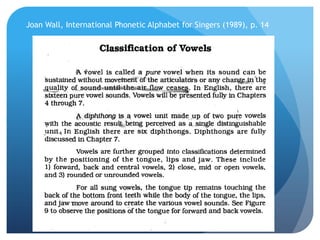
A pure vowel sound consists of only one distinct vowel
sound; a diphthong is a distinct vowel until made up of
two pure vowel sounds.
Joan Wall, International Phonetic Alphabet for Singers (1989), p. 14
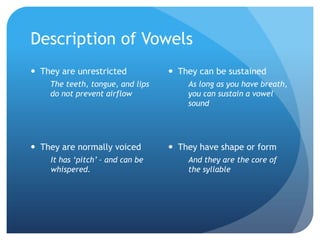
Description of Vowels
 They are unrestricted            They can be sustained
    The teeth, tongue, and lips       As long as you have breath,
    do not prevent airflow            you can sustain a vowel
                                      sound


 They are normally voiced         They have shape or form
    It has ‘pitch’ – and can be       And they are the core of
    whispered.                        the syllable
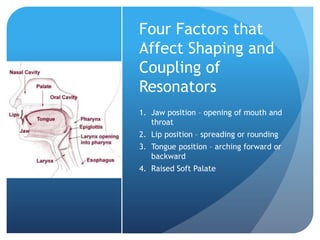
Four Factors that
Affect Shaping and
Coupling of
Resonators
1. Jaw position – opening of mouth and
   throat
2. Lip position – spreading or rounding
3. Tongue position – arching forward or
   backward
4. Raised Soft Palate
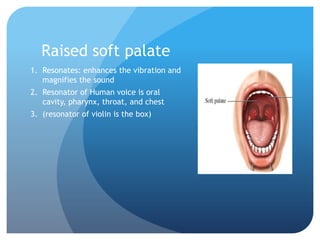
Raised soft palate
1. Resonates: enhances the vibration and
   magnifies the sound
2. Resonator of Human voice is oral
   cavity, pharynx, throat, and chest
3. (resonator of violin is the box)
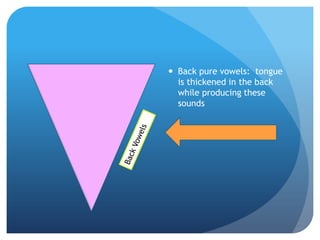
 Back pure vowels: tongue
  is thickened in the back
  while producing these
  sounds
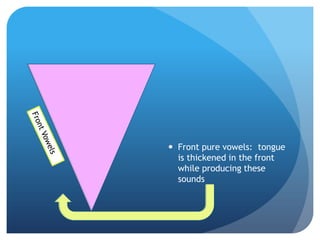
 Front pure vowels: tongue
  is thickened in the front
  while producing these
  sounds
English Pure Vowels

    i                        u
        I                    Ʊ
            e            o
             Ɛ           Ɔ
                 æ
                     ɑ
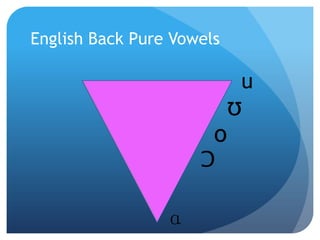
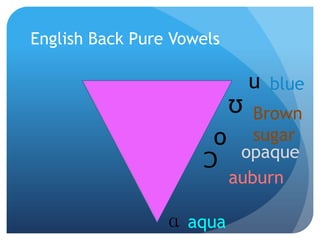
English Back Pure Vowels

                           u
                           Ʊ
                       o
                     Ɔ

                 ɑ
English Back Pure Vowels

                           u blue
                       Ʊ Brown
                      o sugar
                        opaque
                     Ɔ
                       auburn

                 ɑ aqua
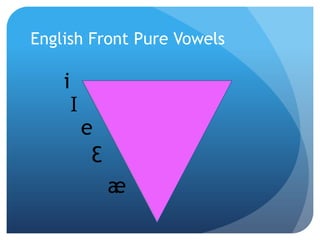
English Front Pure Vowels

    i
        I
            e
             Ɛ
                 æ
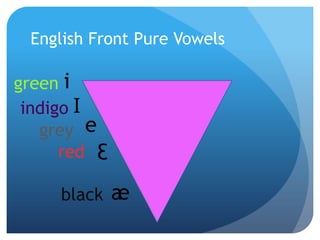
English Front Pure Vowels

green i
 indigo I
   grey e
      red Ɛ

     black    æ
Things to note from the reading:
Feel/hear the difference in similar words:
pin [pɪn] and pen [pɛn] or marry [mærɪ] and merry [mɛrɪ]

Look to pages 14 and 15 for a discussion on how the vowel triangle
was created. Cool right?

Okay, so I still pronounce alveolar not quite right. Look to page
16 to help me out! [ˌ ˌæl viəlɚ]

Also, get = [gɛt] not [gɪt]

Fun practice (from pg 17):
[i]     [ɪ]      [eɪ]      [ɛ]      [æ]
beet    bit      bait    bet       bat
meet mitt        mate    met       mat
Dean din         dane    den       Dan
[i]                              Potential Problems
                                      Diphthongs created by adding a
                                       schwa [ə]: feel, meal, yield
   Spellings:
                                        Feel = [fil] not [fiəl]
     1.   Quay
                                        Meal = [mil] not [miəl]
     2.   She
                                        Yield = [jild] not [jiəld]
     3.   Breathe
                                     (this problem usually occurs when
     4.   Green                      an [i] is followed by an “l”)
     5.   Conceive
     6.   People         Practice phrases:
     7.   Key                He shall speak peace unto the heathen
     8.   believe            Free to be me, God, I really am free.
                             Beautiful dreamer, wake unto me


English Pure Front Vowels
[I]

   Spellings:                           Potential Problems
     1.   indigo                           Substitution of [i]: been,
     2.   Busy                              beautiful, pretty, eternal
     3.   behold                           Vowel reduction: When this
                                            sound is unstressed,
                                            sometimes American singers
 Practice phrases:                         turn it into a schwa [Ə]
   Because I have been given much, I      Before “ng” “m” or “n”, an
    too must give                           “i” is almost always
                                            pronounced [I], as in bring,
   That her iniquity is pardoned           simple, and thin.
   Sure on this shining night              Sometimes the [I] becomes
                                            over nasalized.

English Pure Front Vowels
[e]
  [e] rarely appears in English by        Potential Problems
  itself. It is almost always part
  of the diphthong [eɪ]                     Creating triphthongs where
                                             you only want diphthongs
   Examples for [e]: chaotic,                wait = [weɪt] not [wɛeɪt]
    vacation, fatality
                                              sail = [seɪl] not [seɪəl]
   Examples for [eɪ]:                        male = [meɪl] not [meɪəl]
     1.   aim
     2.   Came
     3.   bay
     4.   made
                                      Practice phrases:
     5.   ate                           Embraceable You
     6.   Ale                           I‟ll Build a Stairway to Paradise
     7.   sail                          Who Cares?
English Pure Front Vowels
[ɛ]                             Potential Problems
                                      Substitution of [ɪ] for [ɛ]
                                      Substitution of [ɝ] for [ɛ]
   Examples:
                                       (as in ‟Amuhrica‟)
     1.   red                         Insertion of [ə] between [ɛ] and [l]
     2.   death                        (as in [wɛəl] for ‟well‟)
     3.   twenty                      Substitution of [eɪ] for [ɛ]
                                        (as in [heɪd] for head,
     4.   head
                                         or [leɪg] for leg)
     5.   get
     6.   treasure
     7.   guess
                         Practice phrases:
                             Let‟s Kiss and Make Up
                             The Best of Everything
                             Heaven on Earth [hɛvən ɑn ɝθ]


English Pure Front Vowels
[æ]                                    Potential Problems
                                            The insertion of a schwa [ə]
                                             after [æ] before a final
   Examples:                                consonant. As in [hæət] for
     1.   add                                „hat‟
     2.   lamb                              Nasalizing [æ] when it
                                             proceeds m, n, or ng. (This
     3.   sang                               is my main problem!)
     4.   Pan
     5.   plaid
     6.   black          Practice phrases:
     7.   Sad                Sam and Delilah
                             Little Jazz Bird
                             Fascinating Rhythm


English Pure Front Vowels
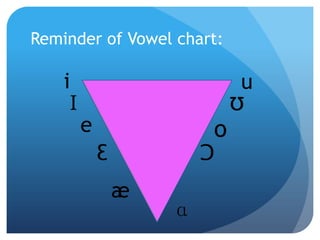
Reminder of Vowel chart:

    i                        u
     I                       Ʊ
         e               o
             Ɛ           Ɔ
                 æ
                     ɑ
[u]

   Spellings:                           Potential Problems
     1.   grew                                (see p. 56 in book)
     2.   you                                 Nasal
     3.   too                                 Insufficient lip rounding
     4.   to                                  Insertion [kul] vs. [kuəl]
     5.   two
     6.   blue

                    Practice phrases:
                       Were you there when they crucified my Lord?
                       I love you, truly.
                       In a sentimental mood.

English Pure Back Vowels
[ʊ]

   Spellings:                         Potential Problems
    1.   sugar                           Substitution (diphthong)
    2.   took                              [ə,   u]
    3.   could


                   Practice phrases:
                      The crooked straight.
                      My faith looks up to Thee.
                       Man is made for the woman and the woman for
                         the man.
English Pure Back Vowels
[o]

   Spellings:                          Potential Problems
     1.   Violet                          Substitution (diphthong)
     2.   Opaque
                         Practice phrases:
                            For the Lord God omnipotent reigneth
                            Come, every soul by sin oppressed.
                            Memory, hither come and tune your merry
                             notes.

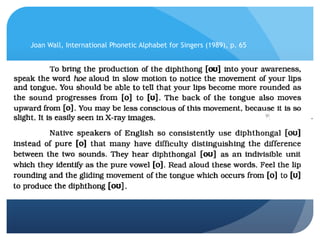
    In American English, the sound [o] is only used in
    unstressed, rhythmically short syllables.
         “Soul” and “notes” do not contain the [o] sound because they
          only have one syllable, and therefore, are stressed.
English Pure Back Vowels
Joan Wall, International Phonetic Alphabet for Singers (1989), p. 65
[Ɔ]

   Spellings:                           Potential Problems
     1.   Auburn                           Insertion of diphthong
     2.   Moss                             Inadequate mouth opening
     3.   Fall
     4.   Awkward

                        Practice phrases:
                            That they may offer unto the Lord an offering in
                             righteousness
                            I saw the cross of Jesus
                            Autumn leaves are now falling


English Pure Back Vowels
[ɑ]
                        Potential Problems
                            Insufficient lowering of jaw
   Spellings:
                            Spreading lips, as in a grin
     1.   aqua
                            Retracting the body of tongue
     2.   got
                            Substitution of briɡht [a] for back [ɑ]


                        Practice phrases:
                            Sing alleluia to the Lord
                            Stir thy church, O God, our Father
                            Tis the season to be jolly, fa la la la la . . . . .


English Pure Back Vowels
Vowel Reduction

  Vowel reduction: This sound is typically a schwa [ə],
   although there are other vowels that can be unstressed or
   reduced. A reduced vowel is a vowel that can only occur in
   unstressed syllables, like schwa, and an unstressed vowel is
   a vowel that can be stressed but is not. Before “ng”, “I”
   {I} is pronounced [I], as in bring, sing, and think
  Typical spellings for vowel reduction of [I] is -ly, -y, -ies,
   and –ing.
    Any words with these suffixes have reduced vowels
[ʌ]
 This sound occurs only in stressed syllables. This includes those
  instances where “un” is a prefix emphasizing negation of the root word

 Spellings: above, us, plum, fuzzy, undone, blood, trouble

 Potential problems: substitution of [ɑ] ̤ fuzzy/fozie, was, love, one, son

 PRACTICE PHRASES
   Unto us a Son is given
   What wondrous love is this
   I wonder as I wander out under the sky

   Above = [Ə.bʌv]
  
[Ə]
   This sound occurs only in unstressed syllables. This includes those instances where “un”
    is a prefix emphasizing negation of the root word

   Spellings: magenta, angel, evil, a, of the, cotton, passion, upon

   The sound only occurs in unstressed syllables or words

   Because in singing every syllable must have a vowel sound, [Ə] is used in singing certain
    syllables which are spoken without a vowels sound, as in little and people

 The schwa is a variable, weakly-defined sound. Other sounds in unstressed
               ɪ
  syllables: [ ] happiness, prepare, remember, receive, rejoice

 PRACTICE PHRASES
       Unto us a Son is given
       Hark! The herald angels sing
       When I think upon the maidens
Angel and Evil
 Angel:

 Evil:
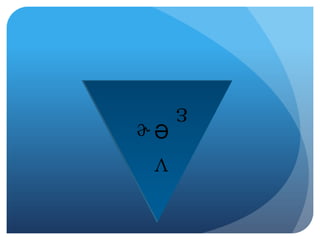
ɛ
ɚƏ
 ʌ
[3]
 Spellings: bird, purple, ever, counselor, forward, earth, journey,
  timbre, martyr

 Potential problems: Some authorities avoid this sound,
  preferring [ʌ] in stressed syllables and [Ə] in unstressed
  syllables: Bud-bird; but-Bert

 Bird = [b3d] vs. bud = [bʌd]

 Bert = [b3t] vs. but [bʌt]

 Practice phrases:
   Wonderful Counselor, the everlasting Father
   Let all the world in every corner sing
   I wonder as I wander out under the sky
[3]
 Spellings: bird, purple, earth, journey, service, word, purse

             [bɜrd] [pɜrpl] [ɜrθ]    [jɜrni]   [sɜrvɪs]   [wɜrd] [pɜrs]

 This sound only appears in stressed syllables!

 This sound is called the “r-less” ur. It is preferred by many
  singing teachers, and they substitute the sound often instead
  of [ɝ].

 The main difference between an “r-colored” ur [ɝ] and an “r-less” ur
  [ɜ] is that the [ɝ] is produced with the tip of the tongue raised and
  suspended in the center of the mouth and the [ɜ] is produced with
  the tip of the tongue down behind the bottom front teeth.

 Southerners sometimes even drop the r‟s out of words:
  Bird = [b3d] Herd = [hɜd] Learn = [lɜn] (look to board)
[ɚ]
 Spellings:    giver altar murder actor summer
                [gɪvɚ] [ɔltɚ] [mɝdɚ] [æktɚ] [sʌmɚ]

 This sound only appears in unstressed syllables!

 Although the unstressed ur [ɚ] has the same sound as the
  stressed ur [ɝ], it is more lax and shorter in duration, and
  used only in unstressed syllables. Sometimes it is called a
  hooked schwa.

 Some voice teachers will have you transcribe like this
  (kenning):
  giver altar murder actor          summer
  [gɪvər] [ɔltər] [mɜrdər] [æktər] [sʌmər]

English vowels 2012 plc

  • 1.
  • 2.
    How many vowelsounds do you think are in standard American English?
  • 3.
    How many vowelsounds do you think are in standard American English? 22 !
  • 4.
  • 5.
    English Pure Vowels i u I Ʊ e o Ɛ Ɔ æ ɑ
  • 6.
    Joan Wall, InternationalPhonetic Alphabet for Singers (1989), p. 15
  • 7.
    Joan Wall, InternationalPhonetic Alphabet for Singers (1989), p. 15 Its approximate present form came from Daniel Jones of University College. London. and is known as the Vowel Diagram. It was developed by superimposing X-ray images of the position of the tongue when articulating various vowels. The Vowel Diagram indicates the position of the high point of the tongue during the articulation of each vowel.
  • 8.
     Forward vowels: [i] beet [ɪ] bit [e] chaotic [ɛ] bet [æ] bat [a] bright ah (mostly used in diphthongs) Back vowels: [u] boot [ʊ] book [o] obey (pure [o] seldom used) [ɔ] saw [ɑ] father Central vowels: [ʌ] up (stressed 'uh') [ə] about (unstressed 'uh,' schwa) [ɝ] herd (stressed, r-colored vowel) [ɜ] herd (NOT r-colored) [ɚ] butter (unstressed, r-colored vowel) Diphthongs: [eɪ] bait [difθɔŋ] [oʊ] boat [aɪ] bite [aʊ] ouch [ɔɪ] boy [ju] use
  • 9.
    We begin withvowels because they are harder to comprehend and execute than consonants! Remember: a pure vowel = one sound But in English we have diphthongs too!! A pure vowel sound consists of only one distinct vowel sound; a diphthong is a distinct vowel until made up of two pure vowel sounds.
  • 10.
    Joan Wall, InternationalPhonetic Alphabet for Singers (1989), p. 14
  • 11.
    Description of Vowels They are unrestricted  They can be sustained The teeth, tongue, and lips As long as you have breath, do not prevent airflow you can sustain a vowel sound  They are normally voiced  They have shape or form It has ‘pitch’ – and can be And they are the core of whispered. the syllable
  • 12.
    Four Factors that AffectShaping and Coupling of Resonators 1. Jaw position – opening of mouth and throat 2. Lip position – spreading or rounding 3. Tongue position – arching forward or backward 4. Raised Soft Palate
  • 13.
    Raised soft palate 1.Resonates: enhances the vibration and magnifies the sound 2. Resonator of Human voice is oral cavity, pharynx, throat, and chest 3. (resonator of violin is the box)
  • 14.
     Back purevowels: tongue is thickened in the back while producing these sounds
  • 15.
     Front purevowels: tongue is thickened in the front while producing these sounds
  • 16.
    English Pure Vowels i u I Ʊ e o Ɛ Ɔ æ ɑ
  • 17.
    English Back PureVowels u Ʊ o Ɔ ɑ
  • 18.
    English Back PureVowels u blue Ʊ Brown o sugar opaque Ɔ auburn ɑ aqua
  • 19.
    English Front PureVowels i I e Ɛ æ
  • 20.
    English Front PureVowels green i indigo I grey e red Ɛ black æ
  • 21.
    Things to notefrom the reading: Feel/hear the difference in similar words: pin [pɪn] and pen [pɛn] or marry [mærɪ] and merry [mɛrɪ] Look to pages 14 and 15 for a discussion on how the vowel triangle was created. Cool right? Okay, so I still pronounce alveolar not quite right. Look to page 16 to help me out! [ˌ ˌæl viəlɚ] Also, get = [gɛt] not [gɪt] Fun practice (from pg 17): [i] [ɪ] [eɪ] [ɛ] [æ] beet bit bait bet bat meet mitt mate met mat Dean din dane den Dan
  • 22.
    [i]  Potential Problems  Diphthongs created by adding a schwa [ə]: feel, meal, yield  Spellings: Feel = [fil] not [fiəl] 1. Quay Meal = [mil] not [miəl] 2. She Yield = [jild] not [jiəld] 3. Breathe (this problem usually occurs when 4. Green an [i] is followed by an “l”) 5. Conceive 6. People  Practice phrases: 7. Key  He shall speak peace unto the heathen 8. believe  Free to be me, God, I really am free.  Beautiful dreamer, wake unto me English Pure Front Vowels
  • 23.
    [I] Spellings:  Potential Problems 1. indigo  Substitution of [i]: been, 2. Busy beautiful, pretty, eternal 3. behold  Vowel reduction: When this sound is unstressed, sometimes American singers  Practice phrases: turn it into a schwa [Ə]  Because I have been given much, I  Before “ng” “m” or “n”, an too must give “i” is almost always pronounced [I], as in bring,  That her iniquity is pardoned simple, and thin.  Sure on this shining night Sometimes the [I] becomes over nasalized. English Pure Front Vowels
  • 24.
    [e] [e]rarely appears in English by  Potential Problems itself. It is almost always part of the diphthong [eɪ]  Creating triphthongs where you only want diphthongs  Examples for [e]: chaotic, wait = [weɪt] not [wɛeɪt] vacation, fatality sail = [seɪl] not [seɪəl]  Examples for [eɪ]: male = [meɪl] not [meɪəl] 1. aim 2. Came 3. bay 4. made  Practice phrases: 5. ate  Embraceable You 6. Ale  I‟ll Build a Stairway to Paradise 7. sail  Who Cares? English Pure Front Vowels
  • 25.
    [ɛ]  Potential Problems  Substitution of [ɪ] for [ɛ]  Substitution of [ɝ] for [ɛ]  Examples: (as in ‟Amuhrica‟) 1. red  Insertion of [ə] between [ɛ] and [l] 2. death (as in [wɛəl] for ‟well‟) 3. twenty  Substitution of [eɪ] for [ɛ] (as in [heɪd] for head, 4. head or [leɪg] for leg) 5. get 6. treasure 7. guess  Practice phrases:  Let‟s Kiss and Make Up  The Best of Everything  Heaven on Earth [hɛvən ɑn ɝθ] English Pure Front Vowels
  • 26.
    [æ]  Potential Problems  The insertion of a schwa [ə] after [æ] before a final  Examples: consonant. As in [hæət] for 1. add „hat‟ 2. lamb  Nasalizing [æ] when it proceeds m, n, or ng. (This 3. sang is my main problem!) 4. Pan 5. plaid 6. black  Practice phrases: 7. Sad  Sam and Delilah  Little Jazz Bird  Fascinating Rhythm English Pure Front Vowels
  • 27.
    Reminder of Vowelchart: i u I Ʊ e o Ɛ Ɔ æ ɑ
  • 28.
    [u] Spellings:  Potential Problems 1. grew  (see p. 56 in book) 2. you  Nasal 3. too  Insufficient lip rounding 4. to  Insertion [kul] vs. [kuəl] 5. two 6. blue  Practice phrases:  Were you there when they crucified my Lord?  I love you, truly.  In a sentimental mood. English Pure Back Vowels
  • 29.
    [ʊ] Spellings:  Potential Problems 1. sugar  Substitution (diphthong) 2. took [ə, u] 3. could  Practice phrases:  The crooked straight.  My faith looks up to Thee.  Man is made for the woman and the woman for the man. English Pure Back Vowels
  • 30.
    [o] Spellings:  Potential Problems 1. Violet  Substitution (diphthong) 2. Opaque  Practice phrases:  For the Lord God omnipotent reigneth  Come, every soul by sin oppressed.  Memory, hither come and tune your merry notes. In American English, the sound [o] is only used in unstressed, rhythmically short syllables.  “Soul” and “notes” do not contain the [o] sound because they only have one syllable, and therefore, are stressed. English Pure Back Vowels
  • 31.
    Joan Wall, InternationalPhonetic Alphabet for Singers (1989), p. 65
  • 32.
    [Ɔ] Spellings:  Potential Problems 1. Auburn  Insertion of diphthong 2. Moss  Inadequate mouth opening 3. Fall 4. Awkward  Practice phrases:  That they may offer unto the Lord an offering in righteousness  I saw the cross of Jesus  Autumn leaves are now falling English Pure Back Vowels
  • 33.
    [ɑ]  Potential Problems  Insufficient lowering of jaw  Spellings:  Spreading lips, as in a grin 1. aqua  Retracting the body of tongue 2. got  Substitution of briɡht [a] for back [ɑ]  Practice phrases:  Sing alleluia to the Lord  Stir thy church, O God, our Father  Tis the season to be jolly, fa la la la la . . . . . English Pure Back Vowels
  • 34.
    Vowel Reduction Vowel reduction: This sound is typically a schwa [ə], although there are other vowels that can be unstressed or reduced. A reduced vowel is a vowel that can only occur in unstressed syllables, like schwa, and an unstressed vowel is a vowel that can be stressed but is not. Before “ng”, “I” {I} is pronounced [I], as in bring, sing, and think  Typical spellings for vowel reduction of [I] is -ly, -y, -ies, and –ing.  Any words with these suffixes have reduced vowels
  • 35.
    [ʌ]  This soundoccurs only in stressed syllables. This includes those instances where “un” is a prefix emphasizing negation of the root word  Spellings: above, us, plum, fuzzy, undone, blood, trouble  Potential problems: substitution of [ɑ] ̤ fuzzy/fozie, was, love, one, son  PRACTICE PHRASES  Unto us a Son is given  What wondrous love is this  I wonder as I wander out under the sky  Above = [Ə.bʌv] 
  • 36.
    [Ə]  This sound occurs only in unstressed syllables. This includes those instances where “un” is a prefix emphasizing negation of the root word  Spellings: magenta, angel, evil, a, of the, cotton, passion, upon  The sound only occurs in unstressed syllables or words  Because in singing every syllable must have a vowel sound, [Ə] is used in singing certain syllables which are spoken without a vowels sound, as in little and people  The schwa is a variable, weakly-defined sound. Other sounds in unstressed ɪ syllables: [ ] happiness, prepare, remember, receive, rejoice  PRACTICE PHRASES  Unto us a Son is given  Hark! The herald angels sing  When I think upon the maidens
  • 37.
    Angel and Evil Angel:  Evil:
  • 38.
  • 39.
    [3]  Spellings: bird,purple, ever, counselor, forward, earth, journey, timbre, martyr  Potential problems: Some authorities avoid this sound, preferring [ʌ] in stressed syllables and [Ə] in unstressed syllables: Bud-bird; but-Bert  Bird = [b3d] vs. bud = [bʌd]  Bert = [b3t] vs. but [bʌt]  Practice phrases:  Wonderful Counselor, the everlasting Father  Let all the world in every corner sing  I wonder as I wander out under the sky
  • 40.
    [3]  Spellings: bird,purple, earth, journey, service, word, purse [bɜrd] [pɜrpl] [ɜrθ] [jɜrni] [sɜrvɪs] [wɜrd] [pɜrs]  This sound only appears in stressed syllables!  This sound is called the “r-less” ur. It is preferred by many singing teachers, and they substitute the sound often instead of [ɝ].  The main difference between an “r-colored” ur [ɝ] and an “r-less” ur [ɜ] is that the [ɝ] is produced with the tip of the tongue raised and suspended in the center of the mouth and the [ɜ] is produced with the tip of the tongue down behind the bottom front teeth.  Southerners sometimes even drop the r‟s out of words: Bird = [b3d] Herd = [hɜd] Learn = [lɜn] (look to board)
  • 41.
    [ɚ]  Spellings: giver altar murder actor summer [gɪvɚ] [ɔltɚ] [mɝdɚ] [æktɚ] [sʌmɚ]  This sound only appears in unstressed syllables!  Although the unstressed ur [ɚ] has the same sound as the stressed ur [ɝ], it is more lax and shorter in duration, and used only in unstressed syllables. Sometimes it is called a hooked schwa.  Some voice teachers will have you transcribe like this (kenning): giver altar murder actor summer [gɪvər] [ɔltər] [mɜrdər] [æktər] [sʌmər]