Behavior Technician
Training Basics
Keith E Lyons, RBT, MSW 2016
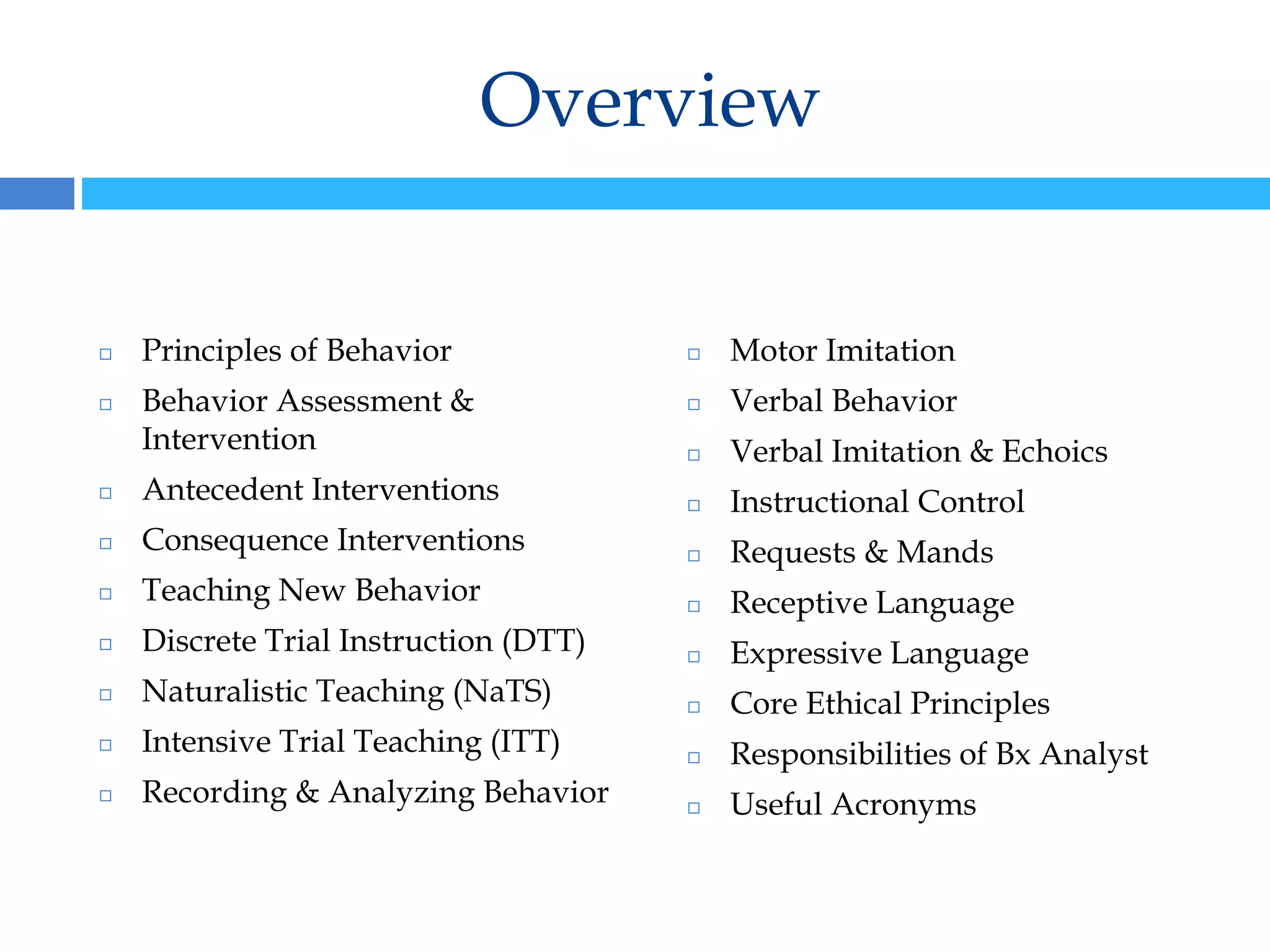
Overview
â—» Principles of Behavior
â—» Behavior Assessment &
Intervention
â—» Antecedent Interventions
â—» Consequence Interventions
â—» Teaching New Behavior
â—» Discrete Trial Instruction (DTT)
â—» Naturalistic Teaching (NaTS)
â—» Intensive Trial Teaching (ITT)
â—» Recording & Analyzing Behavior
â—» Motor Imitation
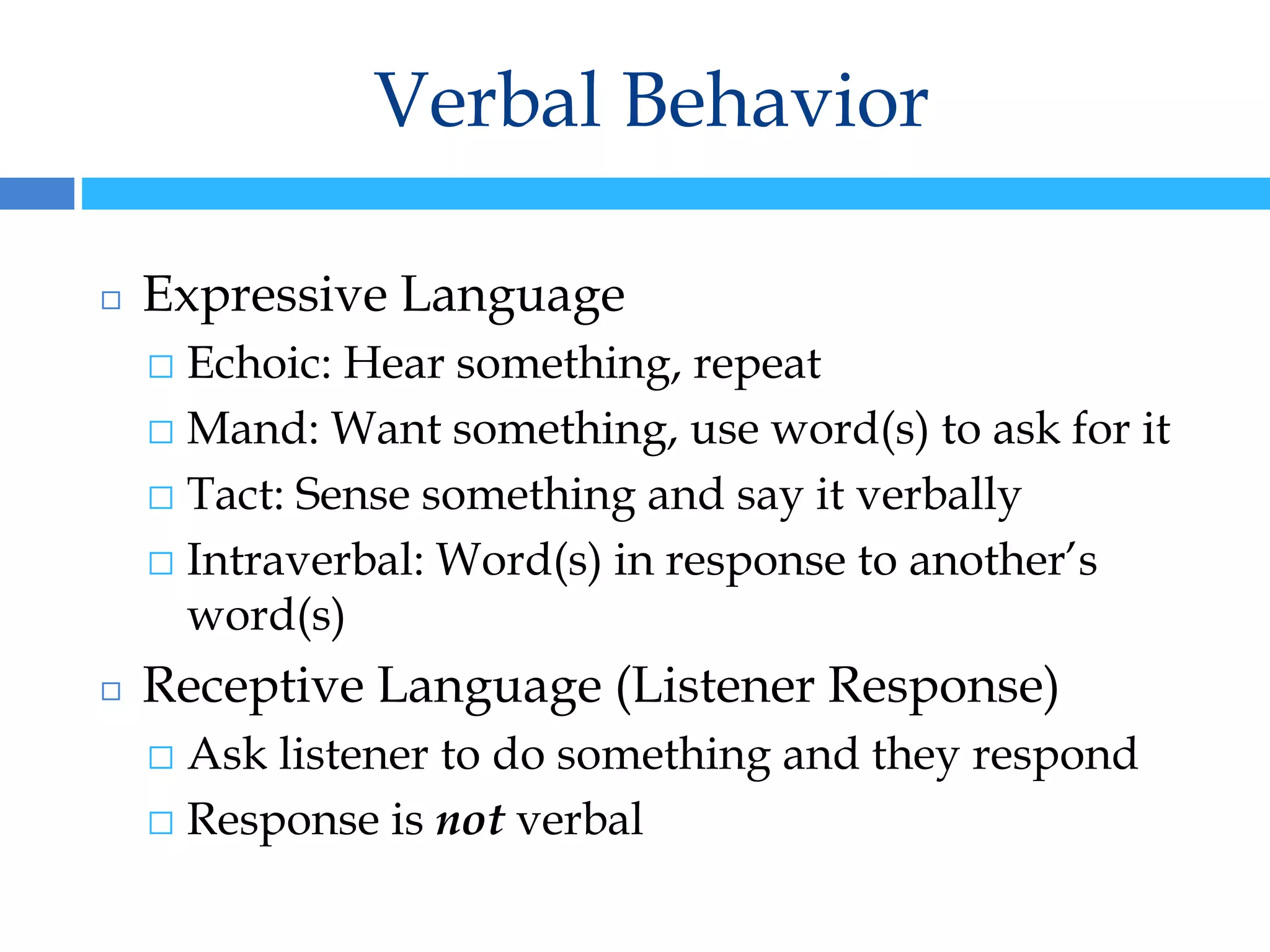
â—» Verbal Behavior
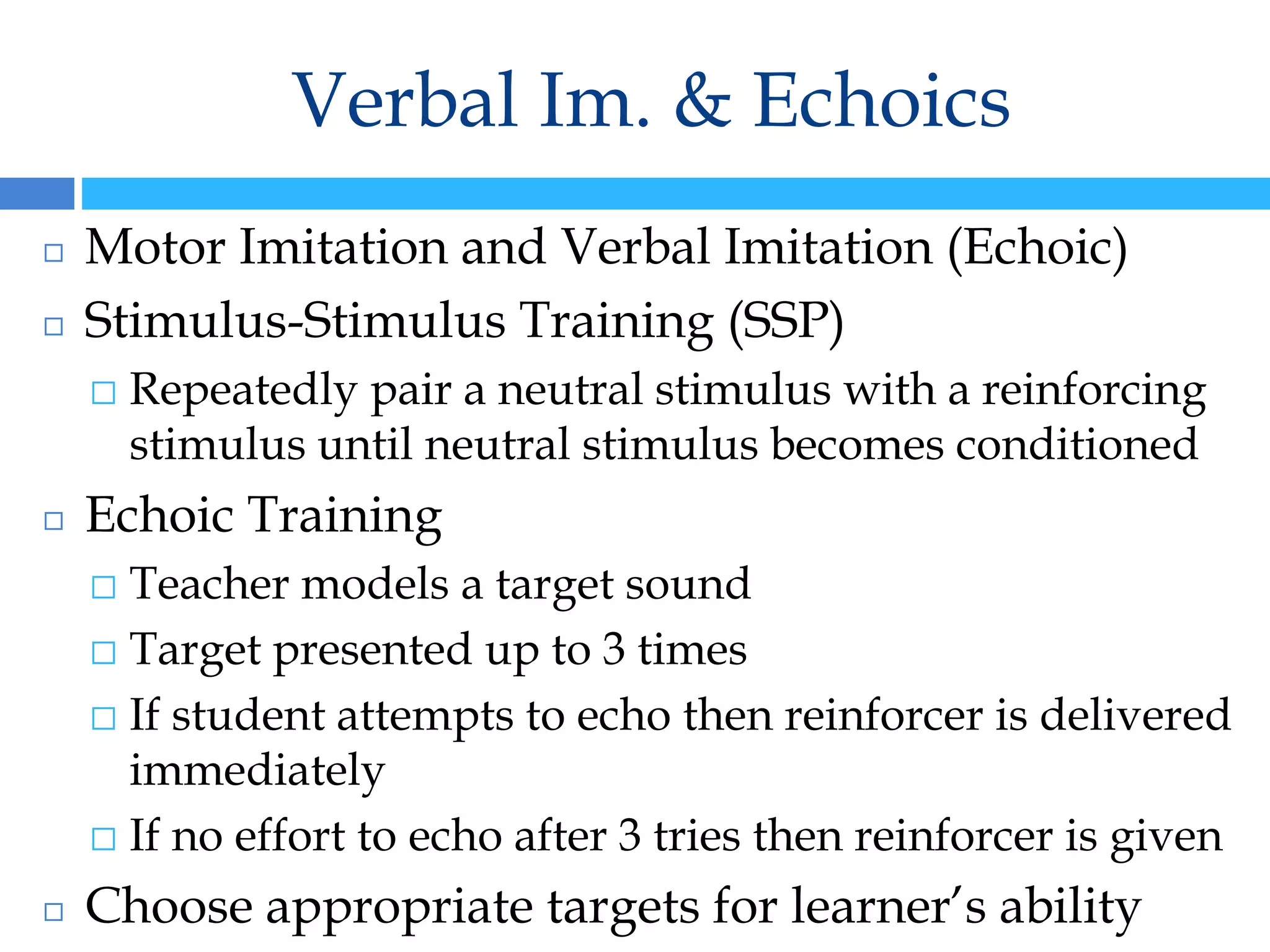
â—» Verbal Imitation & Echoics
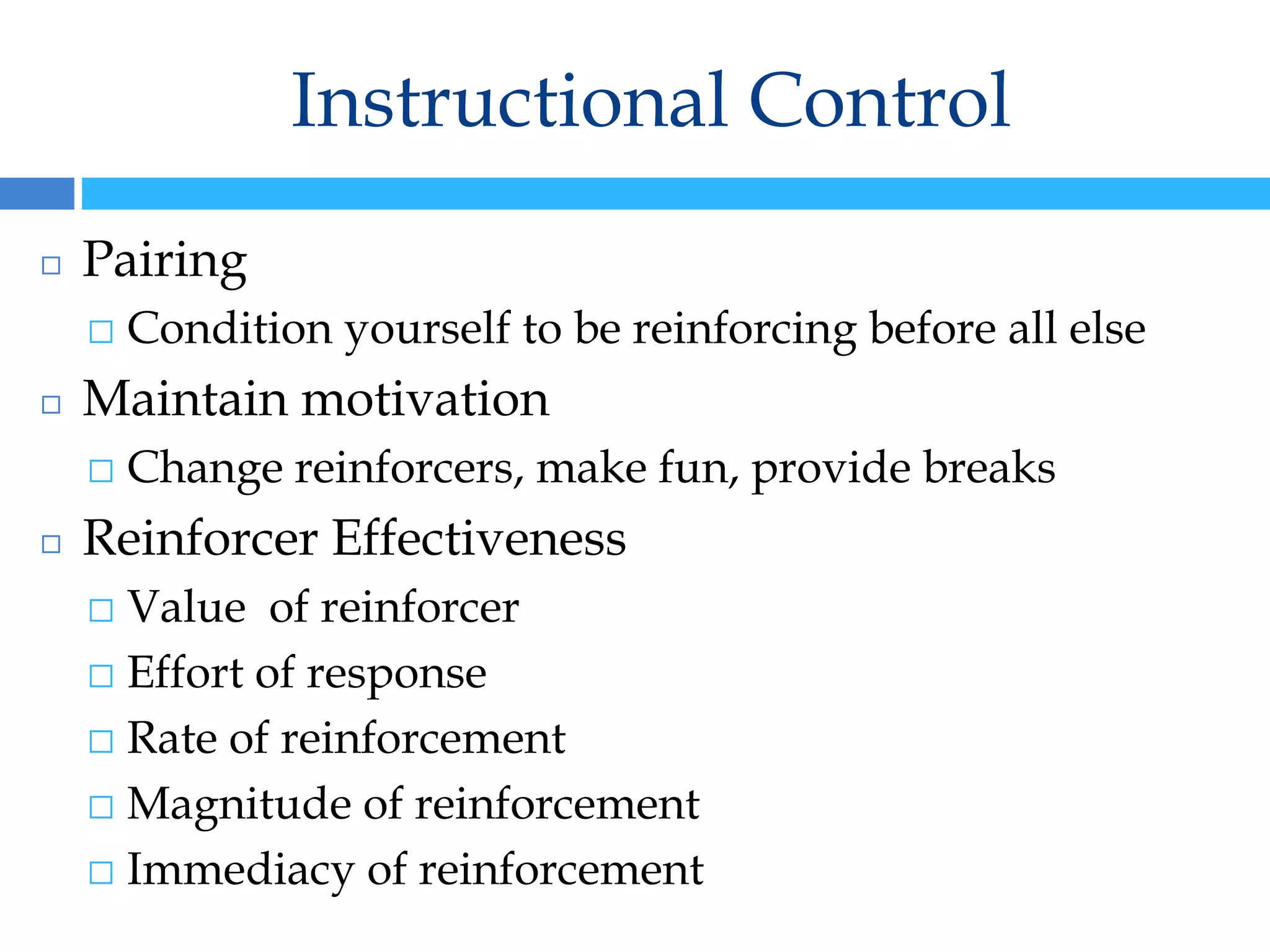
â—» Instructional Control
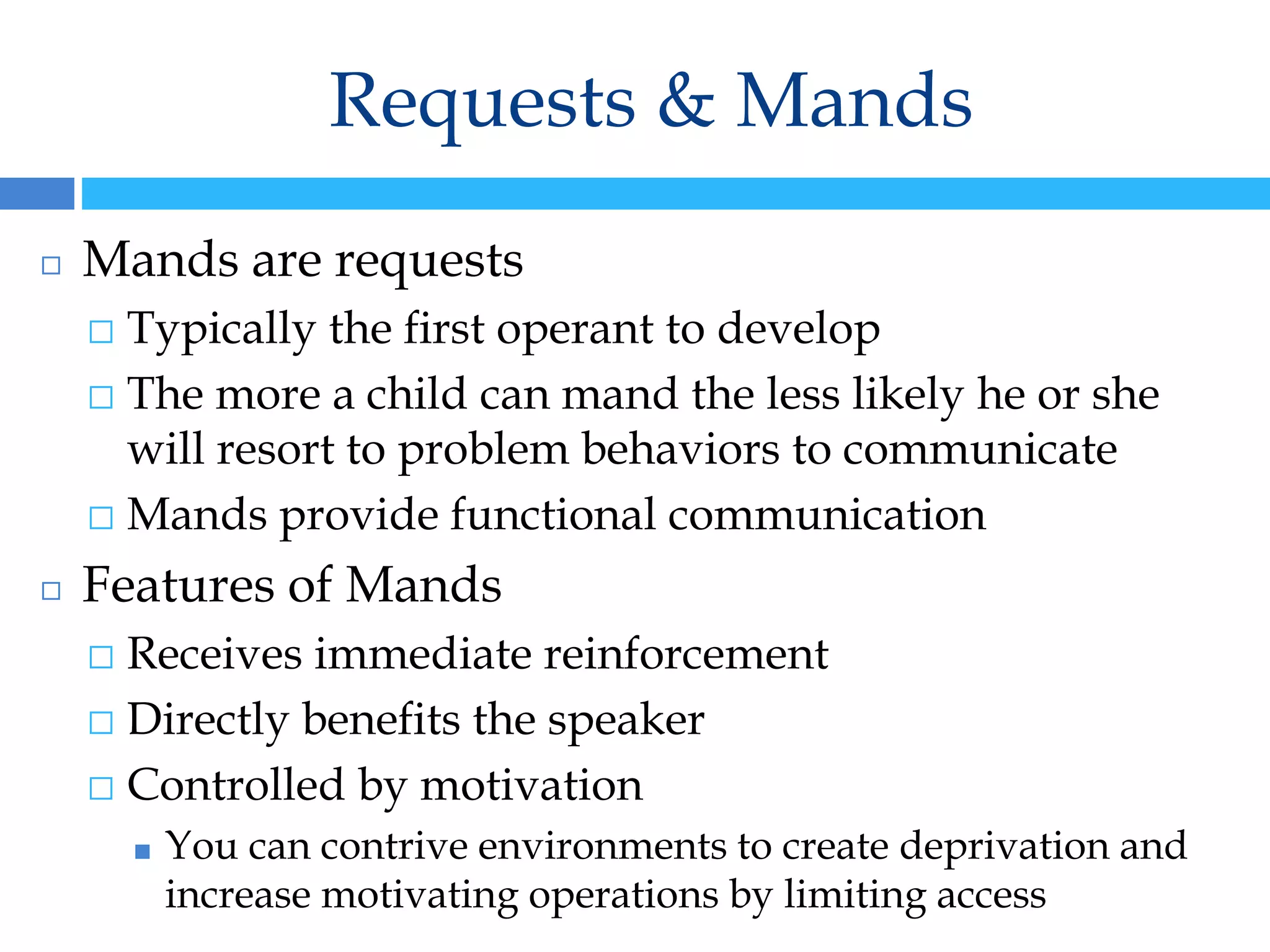
â—» Requests & Mands
â—» Receptive Language
â—» Expressive Language
â—» Core Ethical Principles
â—» Responsibilities of Bx Analyst
â—» Useful Acronyms
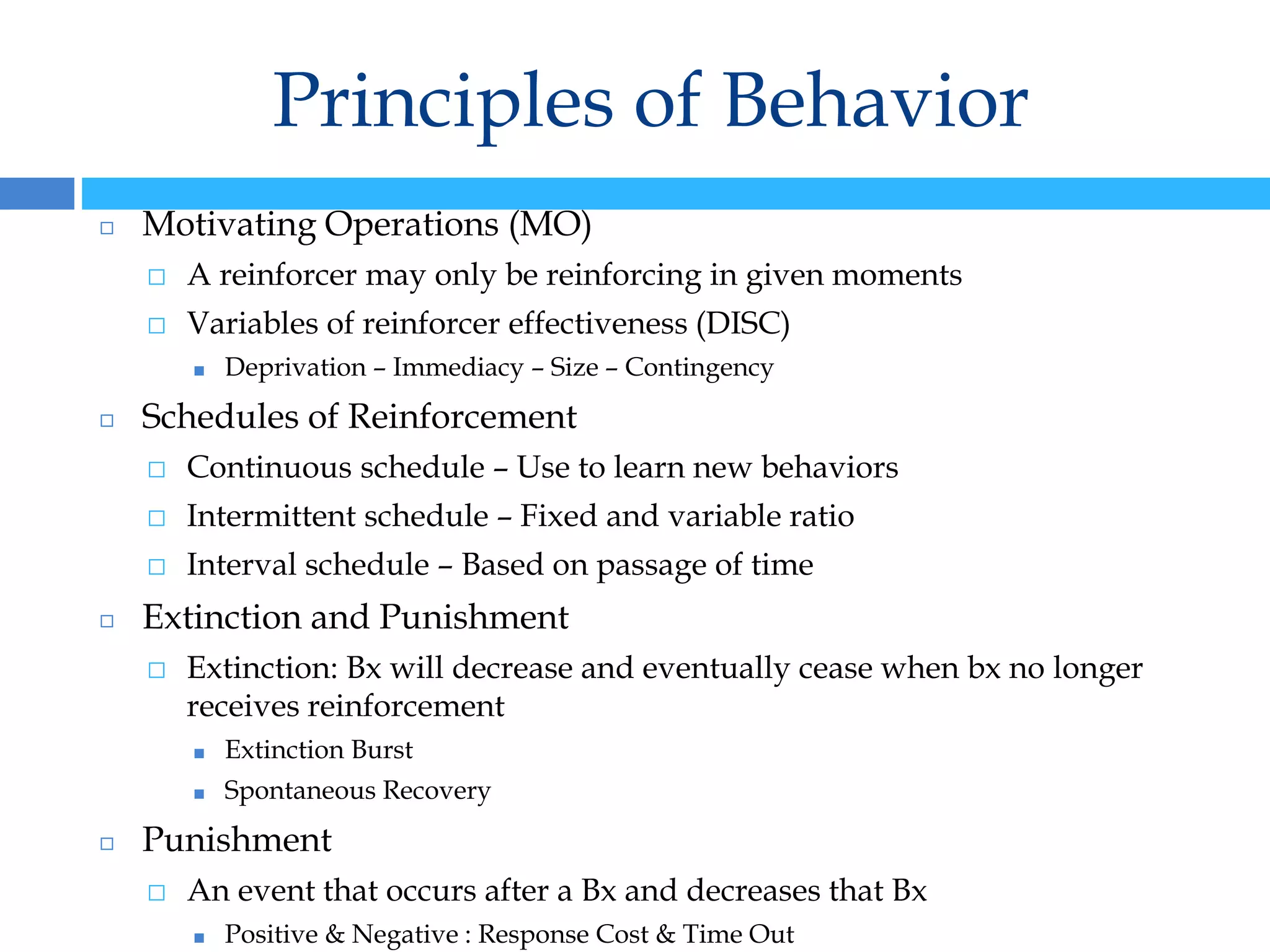
Principles of Behavior
â—» Motivating Operations (MO)
⬜ A reinforcer may only be reinforcing in given moments
⬜ Variables of reinforcer effectiveness (DISC)
■ Deprivation – Immediacy – Size – Contingency
â—» Schedules of Reinforcement
⬜ Continuous schedule – Use to learn new behaviors
⬜ Intermittent schedule – Fixed and variable ratio
⬜ Interval schedule – Based on passage of time
â—» Extinction and Punishment
⬜ Extinction: Bx will decrease and eventually cease when bx no longer
receives reinforcement
â–  Extinction Burst
â–  Spontaneous Recovery
â—» Punishment
⬜ An event that occurs after a Bx and decreases that Bx
â–  Positive & Negative : Response Cost & Time Out
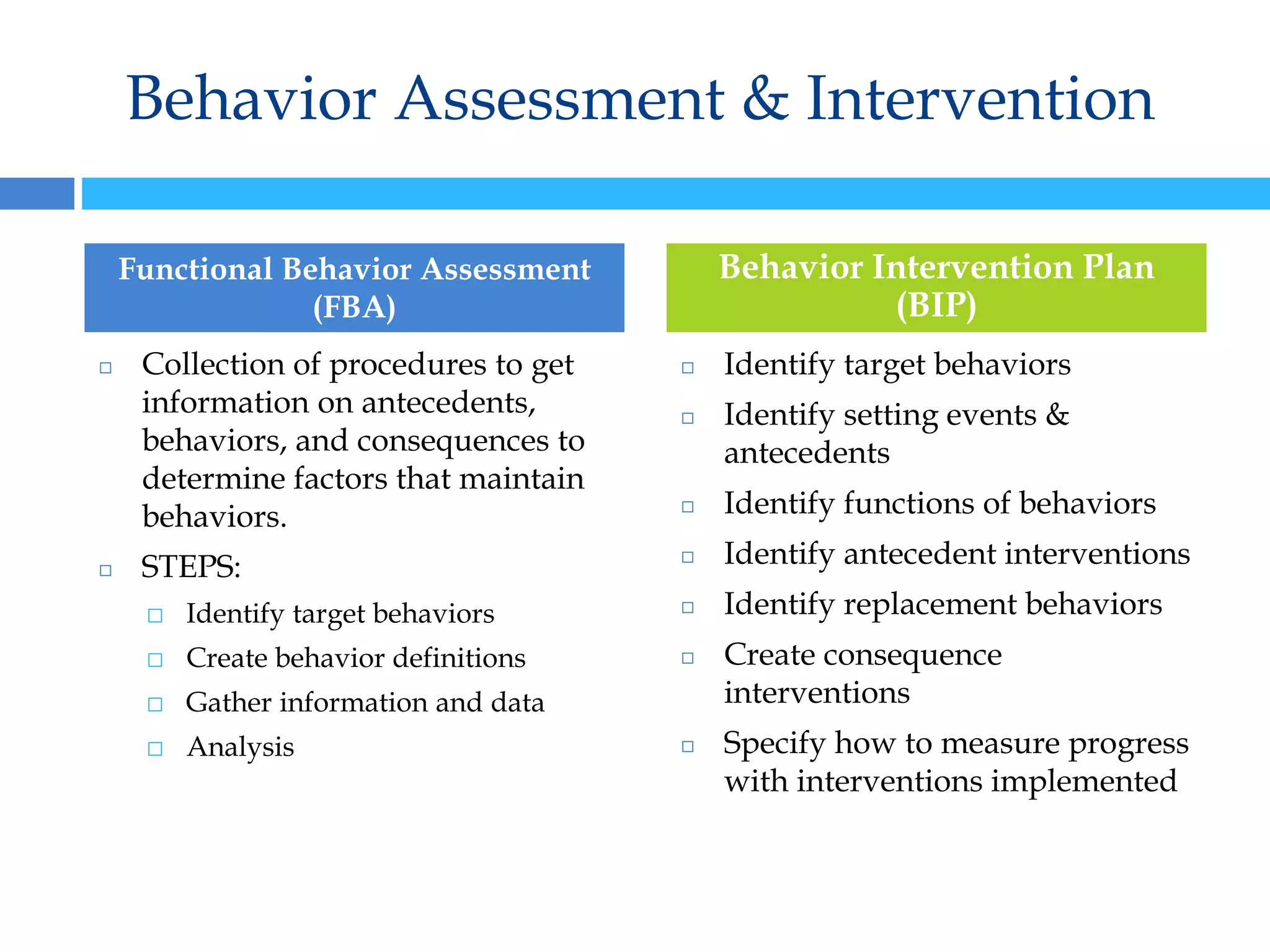
Behavior Assessment & Intervention
â—» Collection of procedures to get
information on antecedents,
behaviors, and consequences to
determine factors that maintain
behaviors.
â—» STEPS:
⬜ Identify target behaviors
⬜ Create behavior definitions
⬜ Gather information and data
⬜ Analysis
â—» Identify target behaviors
â—» Identify setting events &
antecedents
â—» Identify functions of behaviors
â—» Identify antecedent interventions
â—» Identify replacement behaviors
â—» Create consequence
interventions
â—» Specify how to measure progress
with interventions implemented
Functional Behavior Assessment
(FBA)
Behavior Intervention Plan
(BIP)
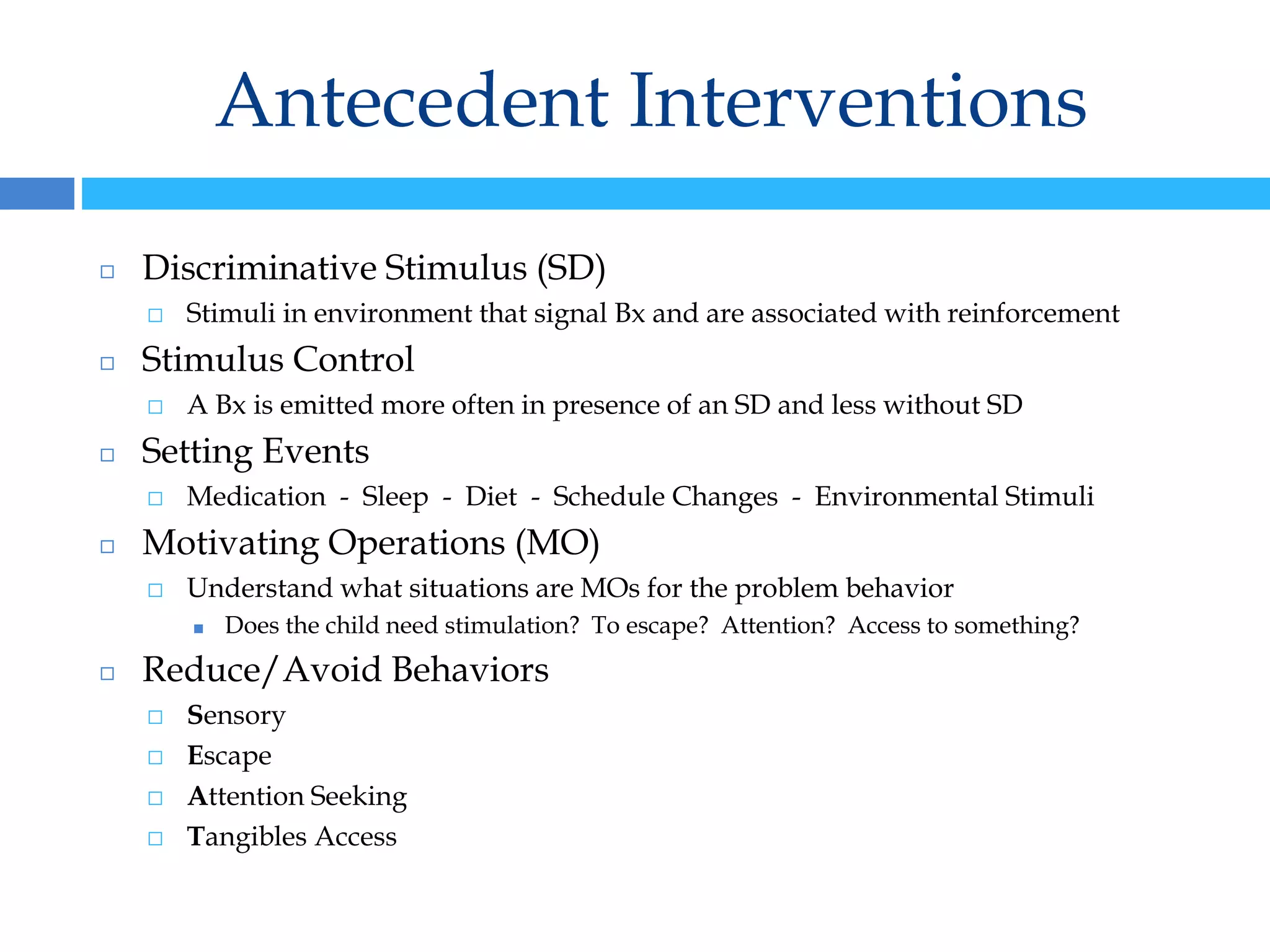
Antecedent Interventions
â—» Discriminative Stimulus (SD)
⬜ Stimuli in environment that signal Bx and are associated with reinforcement
â—» Stimulus Control
⬜ A Bx is emitted more often in presence of an SD and less without SD
â—» Setting Events
⬜ Medication - Sleep - Diet - Schedule Changes - Environmental Stimuli
â—» Motivating Operations (MO)
⬜ Understand what situations are MOs for the problem behavior
â–  Does the child need stimulation? To escape? Attention? Access to something?
â—» Reduce/Avoid Behaviors
⬜ Sensory
⬜ Escape
⬜ Attention Seeking
⬜ Tangibles Access
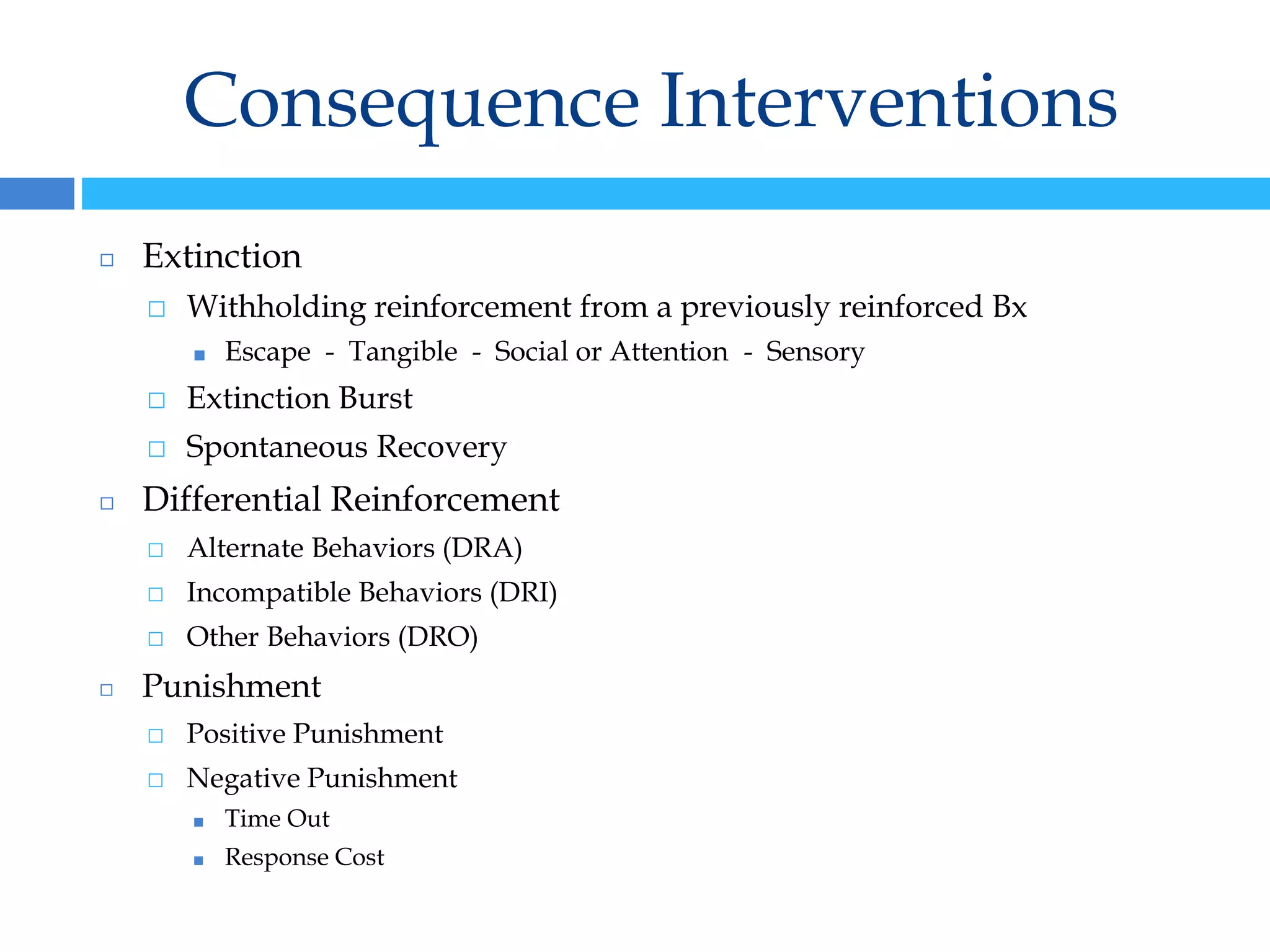
Consequence Interventions
â—» Extinction
⬜ Withholding reinforcement from a previously reinforced Bx
â–  Escape - Tangible - Social or Attention - Sensory
⬜ Extinction Burst
⬜ Spontaneous Recovery
â—» Differential Reinforcement
⬜ Alternate Behaviors (DRA)
⬜ Incompatible Behaviors (DRI)
⬜ Other Behaviors (DRO)
â—» Punishment
⬜ Positive Punishment
⬜ Negative Punishment
â–  Time Out
â–  Response Cost
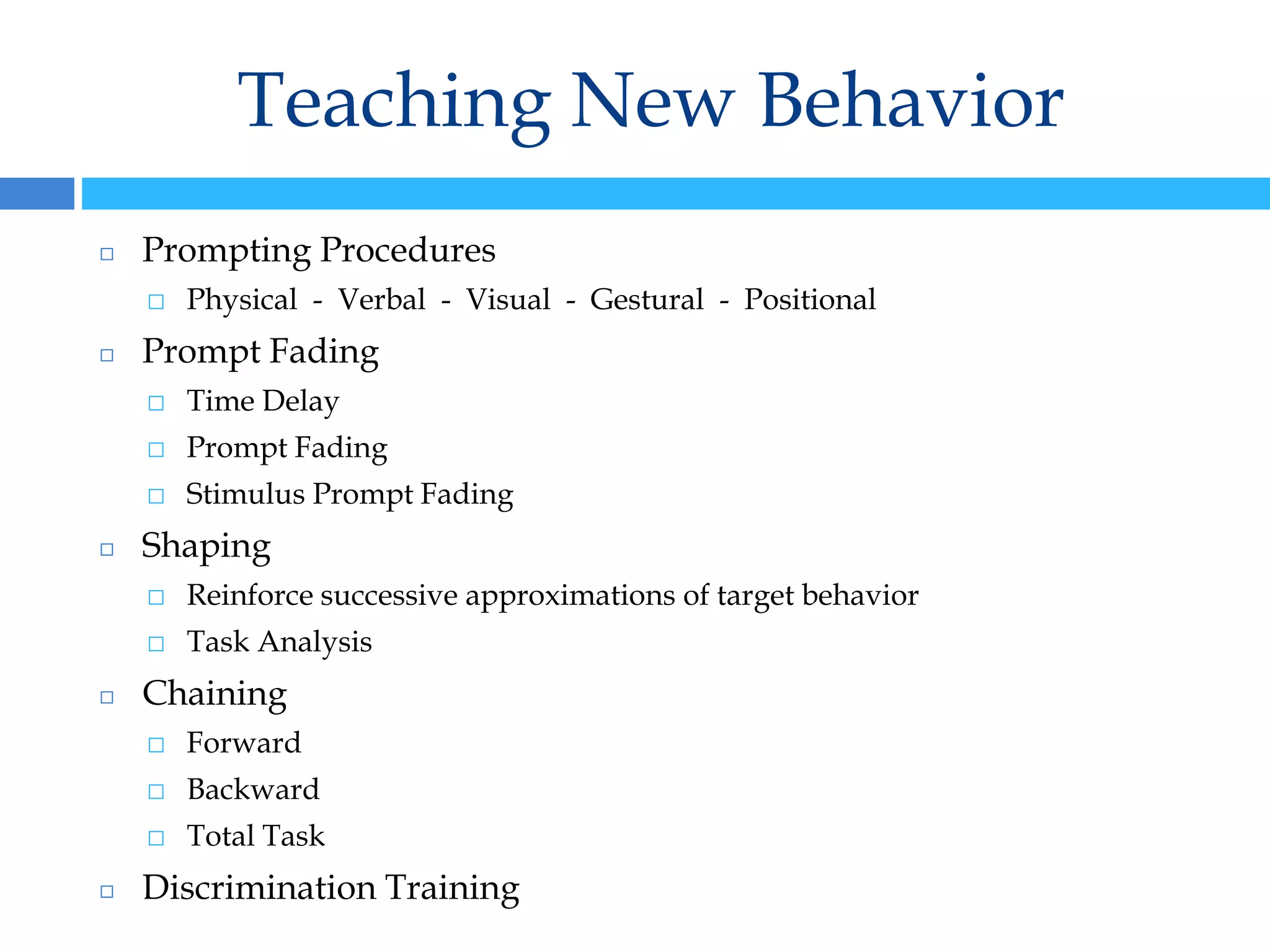
Teaching New Behavior
â—» Prompting Procedures
⬜ Physical - Verbal - Visual - Gestural - Positional
â—» Prompt Fading
⬜ Time Delay
⬜ Prompt Fading
⬜ Stimulus Prompt Fading
â—» Shaping
⬜ Reinforce successive approximations of target behavior
⬜ Task Analysis
â—» Chaining
⬜ Forward
⬜ Backward
⬜ Total Task
â—» Discrimination Training
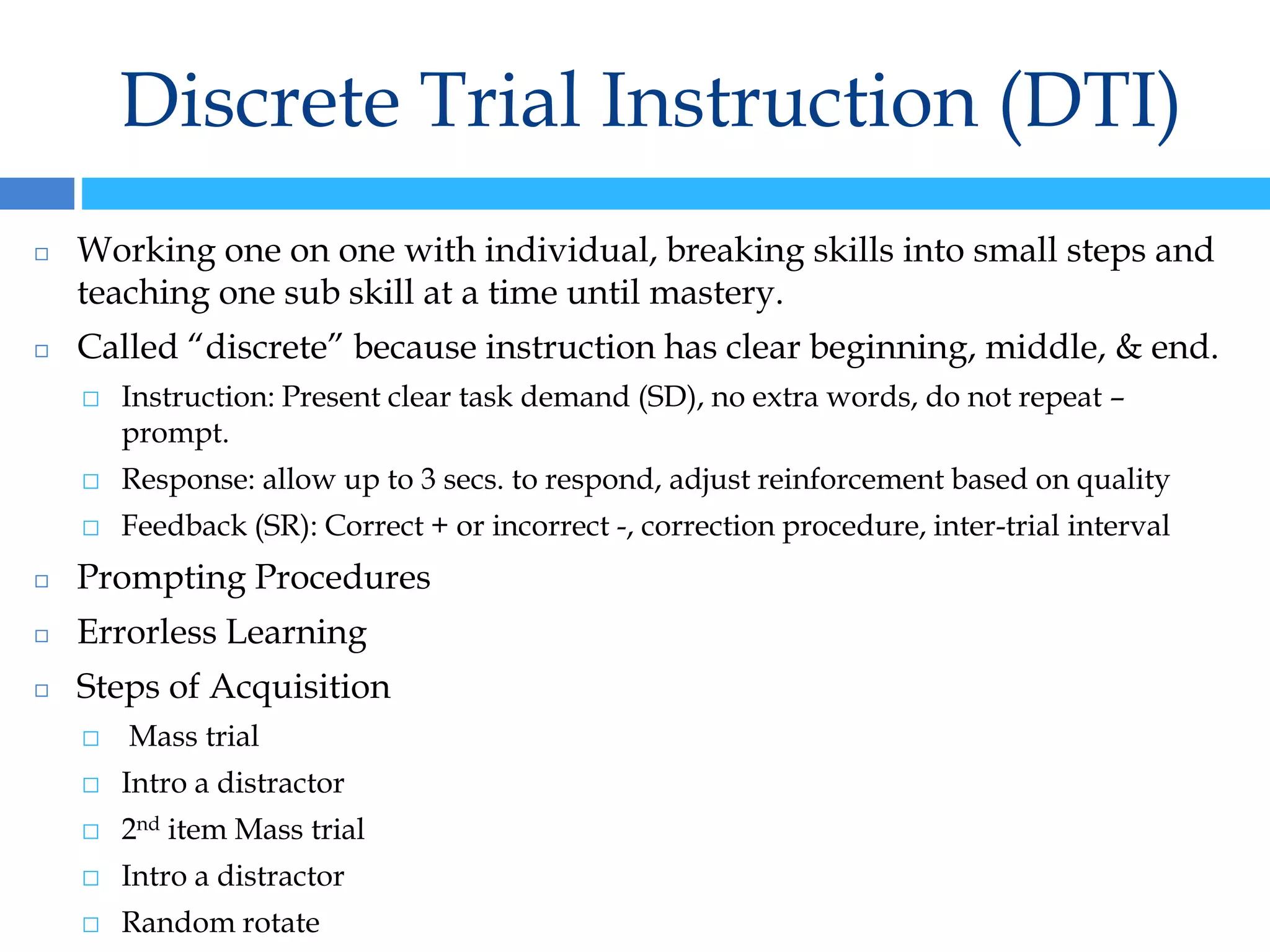
Discrete Trial Instruction (DTI)
â—» Working one on one with individual, breaking skills into small steps and
teaching one sub skill at a time until mastery.
◻ Called “discrete” because instruction has clear beginning, middle, & end.
⬜ Instruction: Present clear task demand (SD), no extra words, do not repeat –
prompt.
⬜ Response: allow up to 3 secs. to respond, adjust reinforcement based on quality
⬜ Feedback (SR): Correct + or incorrect -, correction procedure, inter-trial interval
â—» Prompting Procedures
â—» Errorless Learning
â—» Steps of Acquisition
⬜ Mass trial
⬜ Intro a distractor
⬜ 2nd item Mass trial
⬜ Intro a distractor
⬜ Random rotate
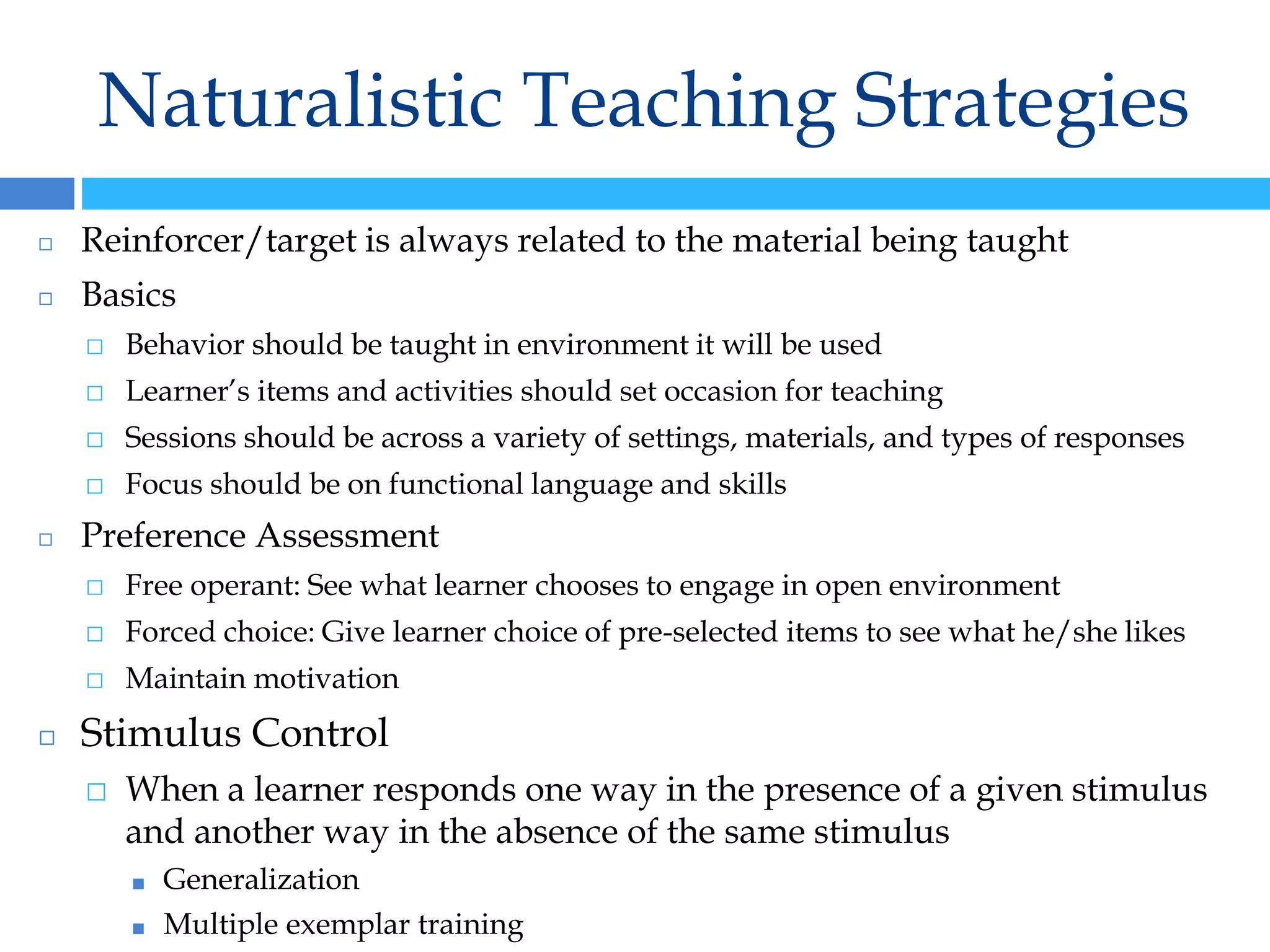
Naturalistic Teaching Strategies
â—» Reinforcer/target is always related to the material being taught
â—» Basics
⬜ Behavior should be taught in environment it will be used
⬜ Learner’s items and activities should set occasion for teaching
⬜ Sessions should be across a variety of settings, materials, and types of responses
⬜ Focus should be on functional language and skills
â—» Preference Assessment
⬜ Free operant: See what learner chooses to engage in open environment
⬜ Forced choice: Give learner choice of pre-selected items to see what he/she likes
⬜ Maintain motivation
â—» Stimulus Control
⬜ When a learner responds one way in the presence of a given stimulus
and another way in the absence of the same stimulus
â–  Generalization
â–  Multiple exemplar training
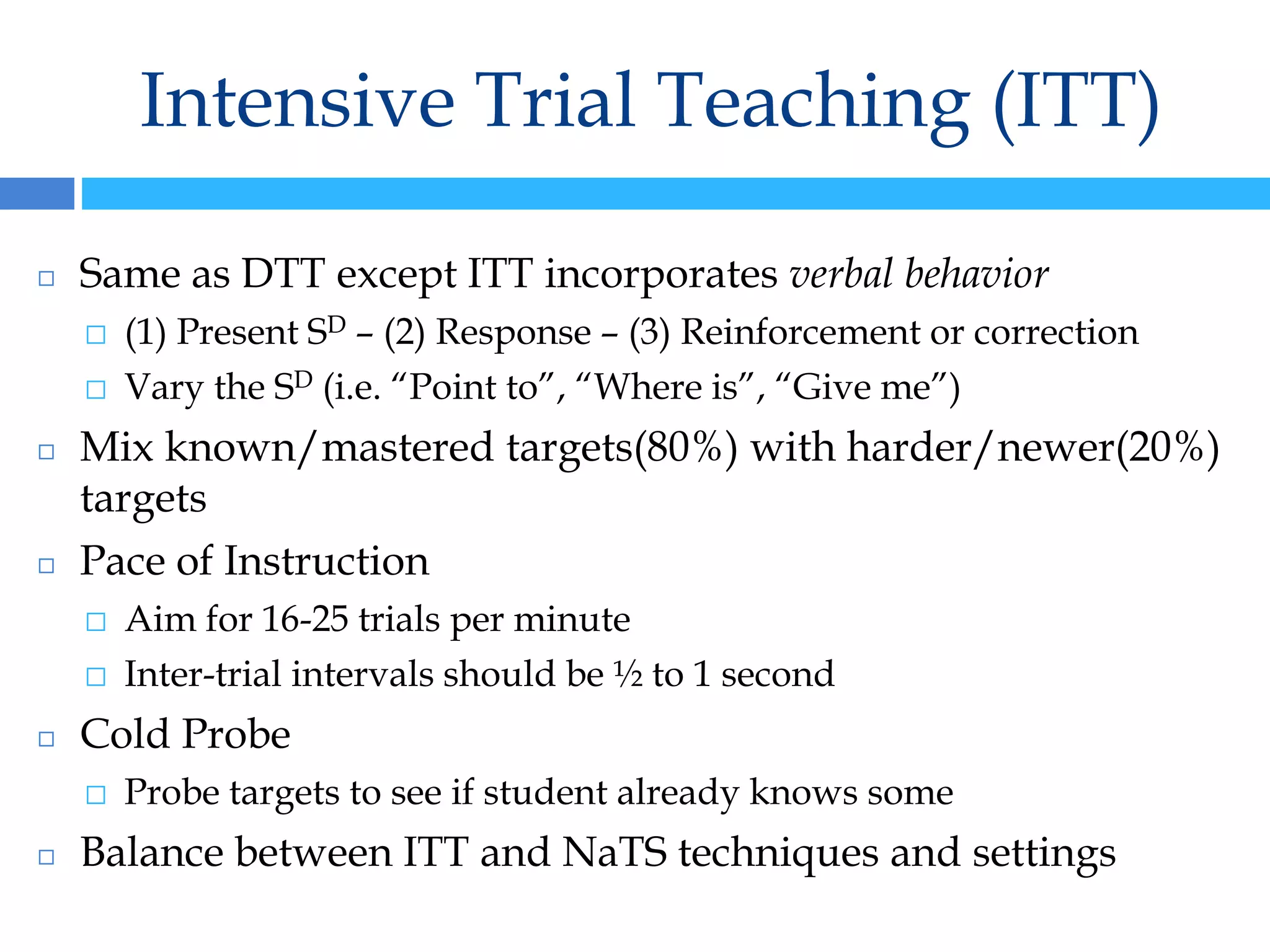
Intensive Trial Teaching (ITT)
â—» Same as DTT except ITT incorporates verbal behavior
⬜ (1) Present SD – (2) Response – (3) Reinforcement or correction
⬜ Vary the SD (i.e. “Point to”, “Where is”, “Give me”)
â—» Mix known/mastered targets(80%) with harder/newer(20%)
targets
â—» Pace of Instruction
⬜ Aim for 16-25 trials per minute
⬜ Inter-trial intervals should be ½ to 1 second
â—» Cold Probe
⬜ Probe targets to see if student already knows some
â—» Balance between ITT and NaTS techniques and settings
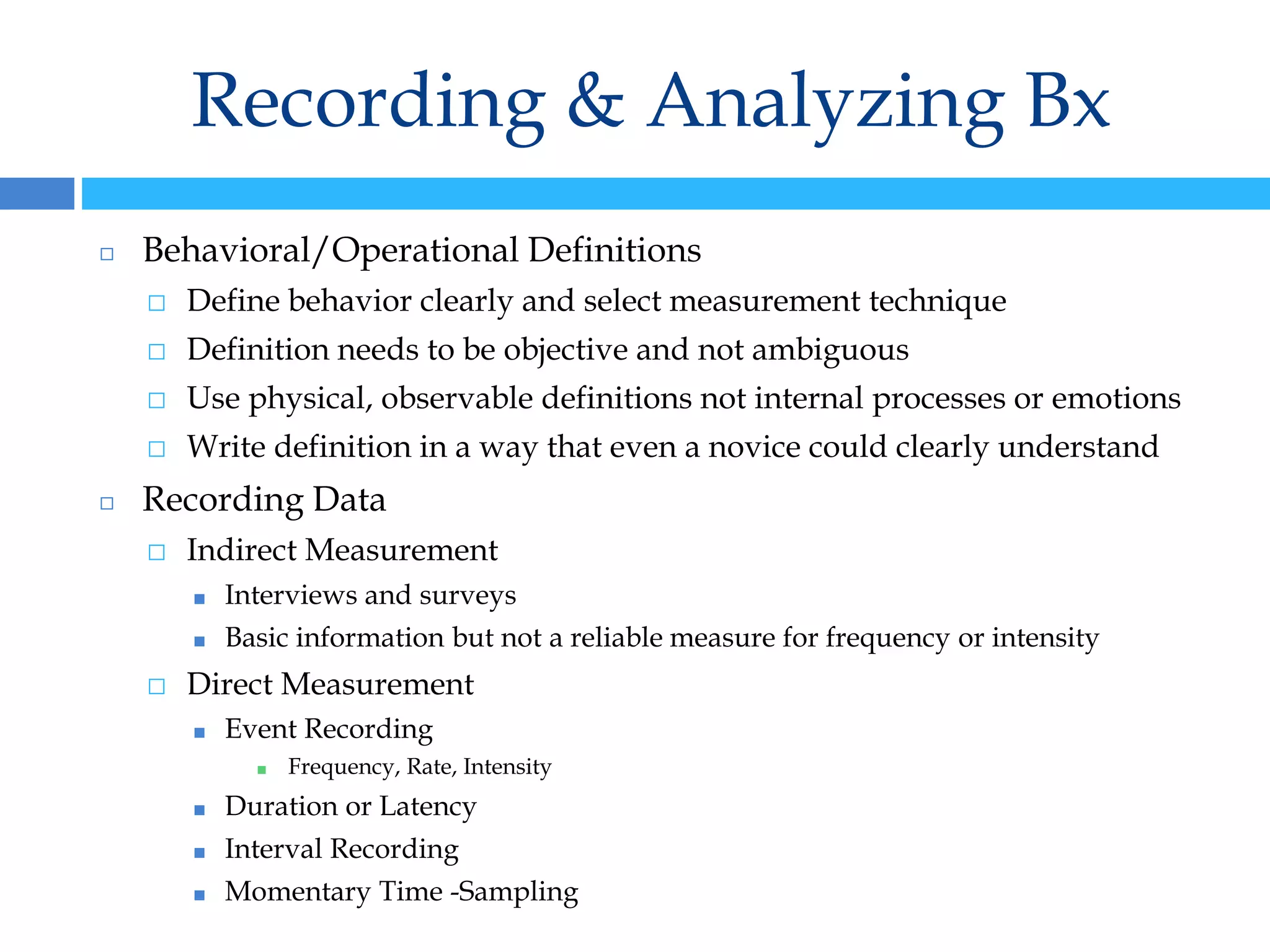
Recording & Analyzing Bx
â—» Behavioral/Operational Definitions
⬜ Define behavior clearly and select measurement technique
⬜ Definition needs to be objective and not ambiguous
⬜ Use physical, observable definitions not internal processes or emotions
⬜ Write definition in a way that even a novice could clearly understand
â—» Recording Data
⬜ Indirect Measurement
â–  Interviews and surveys
â–  Basic information but not a reliable measure for frequency or intensity
⬜ Direct Measurement
â–  Event Recording
â–  Frequency, Rate, Intensity
â–  Duration or Latency
â–  Interval Recording
â–  Momentary Time -Sampling
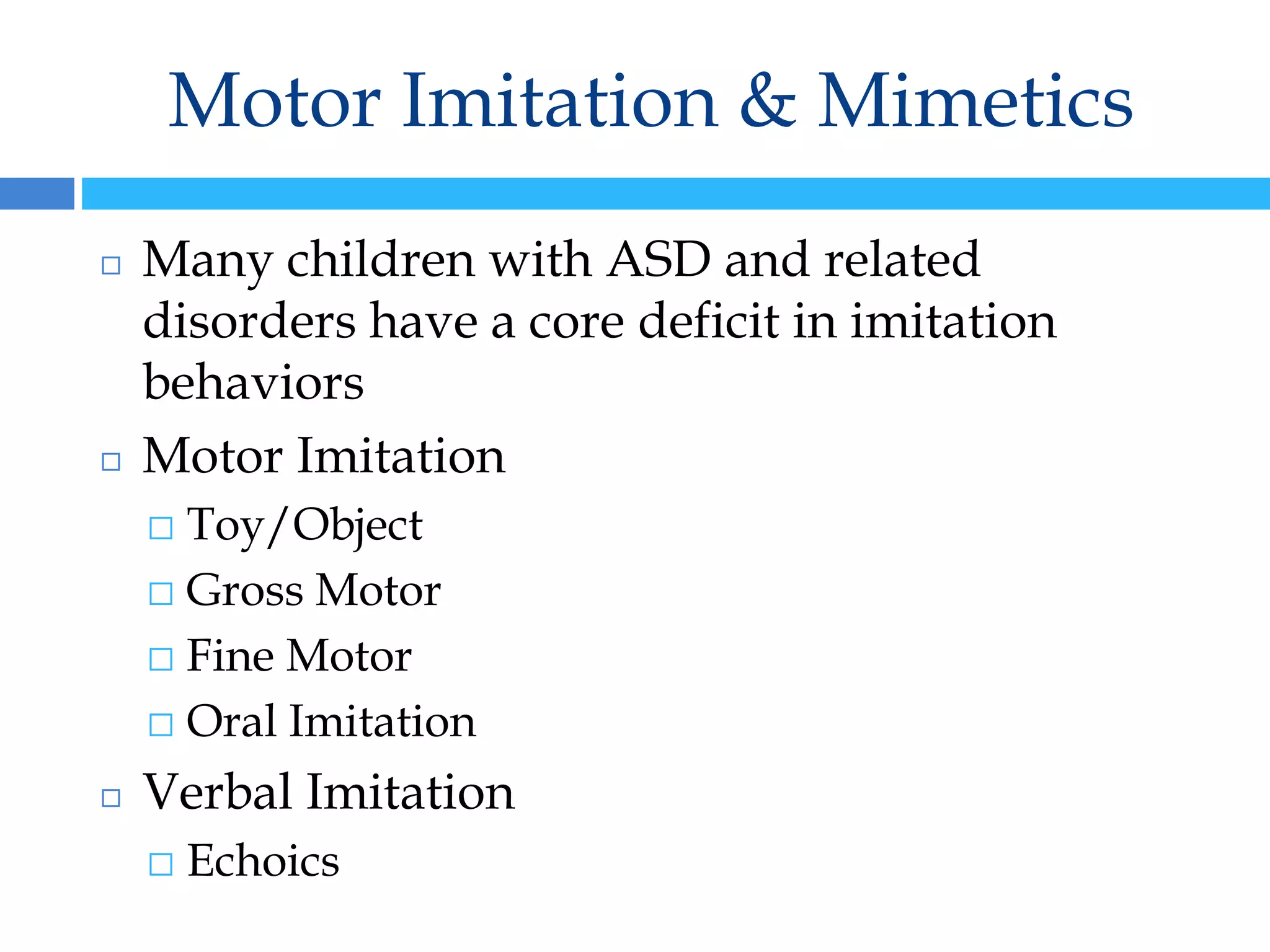
Motor Imitation & Mimetics
â—» Many children with ASD and related
disorders have a core deficit in imitation
behaviors
â—» Motor Imitation
⬜ Toy/Object
⬜ Gross Motor
⬜ Fine Motor
⬜ Oral Imitation
â—» Verbal Imitation
⬜ Echoics
Verbal Behavior
â—» Expressive Language
⬜ Echoic: Hear something, repeat
⬜ Mand: Want something, use word(s) to ask for it
⬜ Tact: Sense something and say it verbally
⬜ Intraverbal: Word(s) in response to another’s
word(s)
â—» Receptive Language (Listener Response)
⬜ Ask listener to do something and they respond
⬜ Response is not verbal
Verbal Im. & Echoics
â—» Motor Imitation and Verbal Imitation (Echoic)
â—» Stimulus-Stimulus Training (SSP)
⬜ Repeatedly pair a neutral stimulus with a reinforcing
stimulus until neutral stimulus becomes conditioned
â—» Echoic Training
⬜ Teacher models a target sound
⬜ Target presented up to 3 times
⬜ If student attempts to echo then reinforcer is delivered
immediately
⬜ If no effort to echo after 3 tries then reinforcer is given
◻ Choose appropriate targets for learner’s ability
Instructional Control
â—» Pairing
⬜ Condition yourself to be reinforcing before all else
â—» Maintain motivation
⬜ Change reinforcers, make fun, provide breaks
â—» Reinforcer Effectiveness
⬜ Value of reinforcer
⬜ Effort of response
⬜ Rate of reinforcement
⬜ Magnitude of reinforcement
⬜ Immediacy of reinforcement
PAIRING
Requests & Mands
â—» Mands are requests
⬜ Typically the first operant to develop
⬜ The more a child can mand the less likely he or she
will resort to problem behaviors to communicate
⬜ Mands provide functional communication
â—» Features of Mands
⬜ Receives immediate reinforcement
⬜ Directly benefits the speaker
⬜ Controlled by motivation
â–  You can contrive environments to create deprivation and
increase motivating operations by limiting access
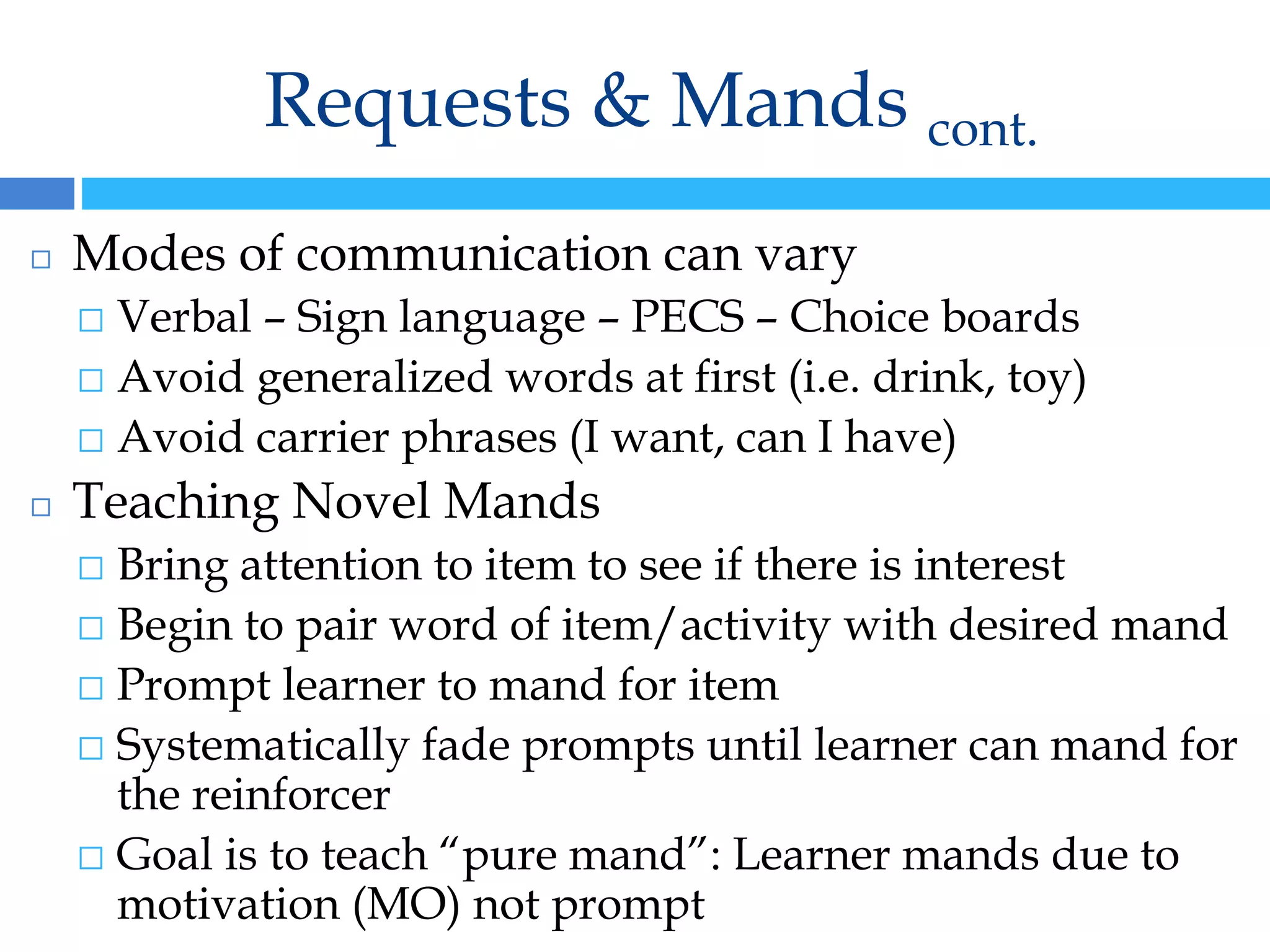
Requests & Mands cont.
â—» Modes of communication can vary
⬜ Verbal – Sign language – PECS – Choice boards
⬜ Avoid generalized words at first (i.e. drink, toy)
⬜ Avoid carrier phrases (I want, can I have)
â—» Teaching Novel Mands
⬜ Bring attention to item to see if there is interest
⬜ Begin to pair word of item/activity with desired mand
⬜ Prompt learner to mand for item
⬜ Systematically fade prompts until learner can mand for
the reinforcer
⬜ Goal is to teach “pure mand”: Learner mands due to
motivation (MO) not prompt
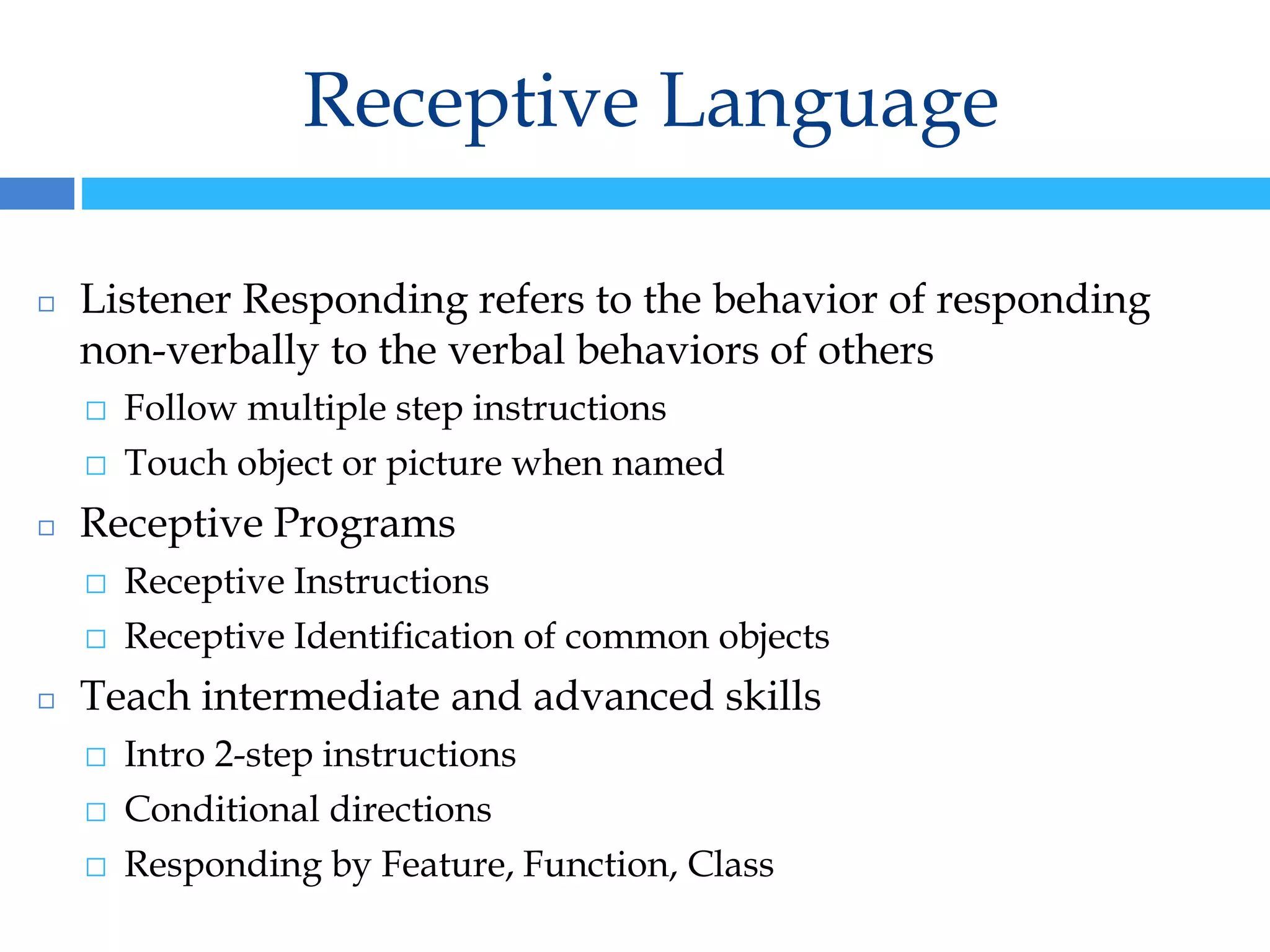
Receptive Language
â—» Listener Responding refers to the behavior of responding
non-verbally to the verbal behaviors of others
⬜ Follow multiple step instructions
⬜ Touch object or picture when named
â—» Receptive Programs
⬜ Receptive Instructions
⬜ Receptive Identification of common objects
â—» Teach intermediate and advanced skills
⬜ Intro 2-step instructions
⬜ Conditional directions
⬜ Responding by Feature, Function, Class
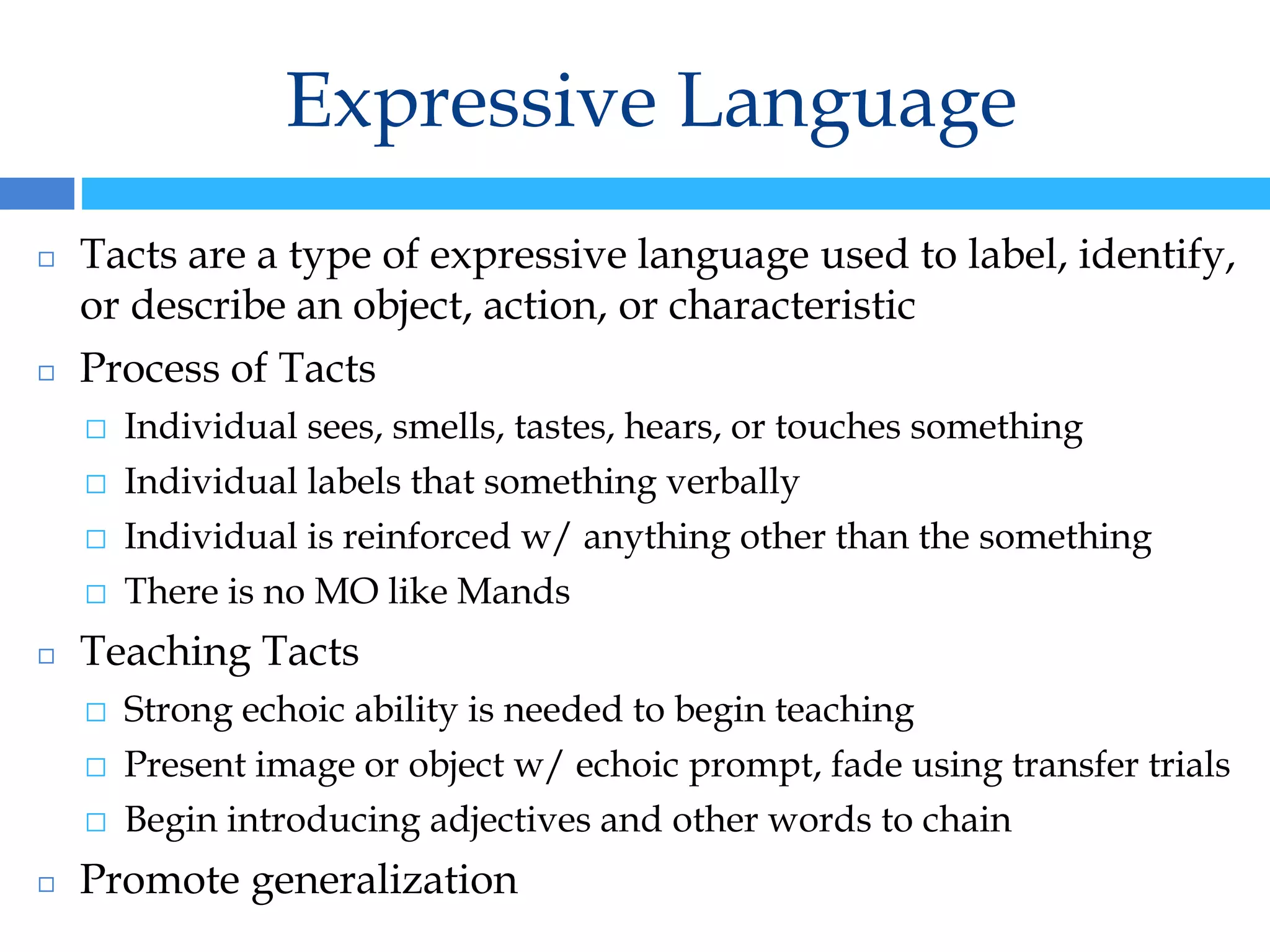
Expressive Language
â—» Tacts are a type of expressive language used to label, identify,
or describe an object, action, or characteristic
â—» Process of Tacts
⬜ Individual sees, smells, tastes, hears, or touches something
⬜ Individual labels that something verbally
⬜ Individual is reinforced w/ anything other than the something
⬜ There is no MO like Mands
â—» Teaching Tacts
⬜ Strong echoic ability is needed to begin teaching
⬜ Present image or object w/ echoic prompt, fade using transfer trials
⬜ Begin introducing adjectives and other words to chain
â—» Promote generalization
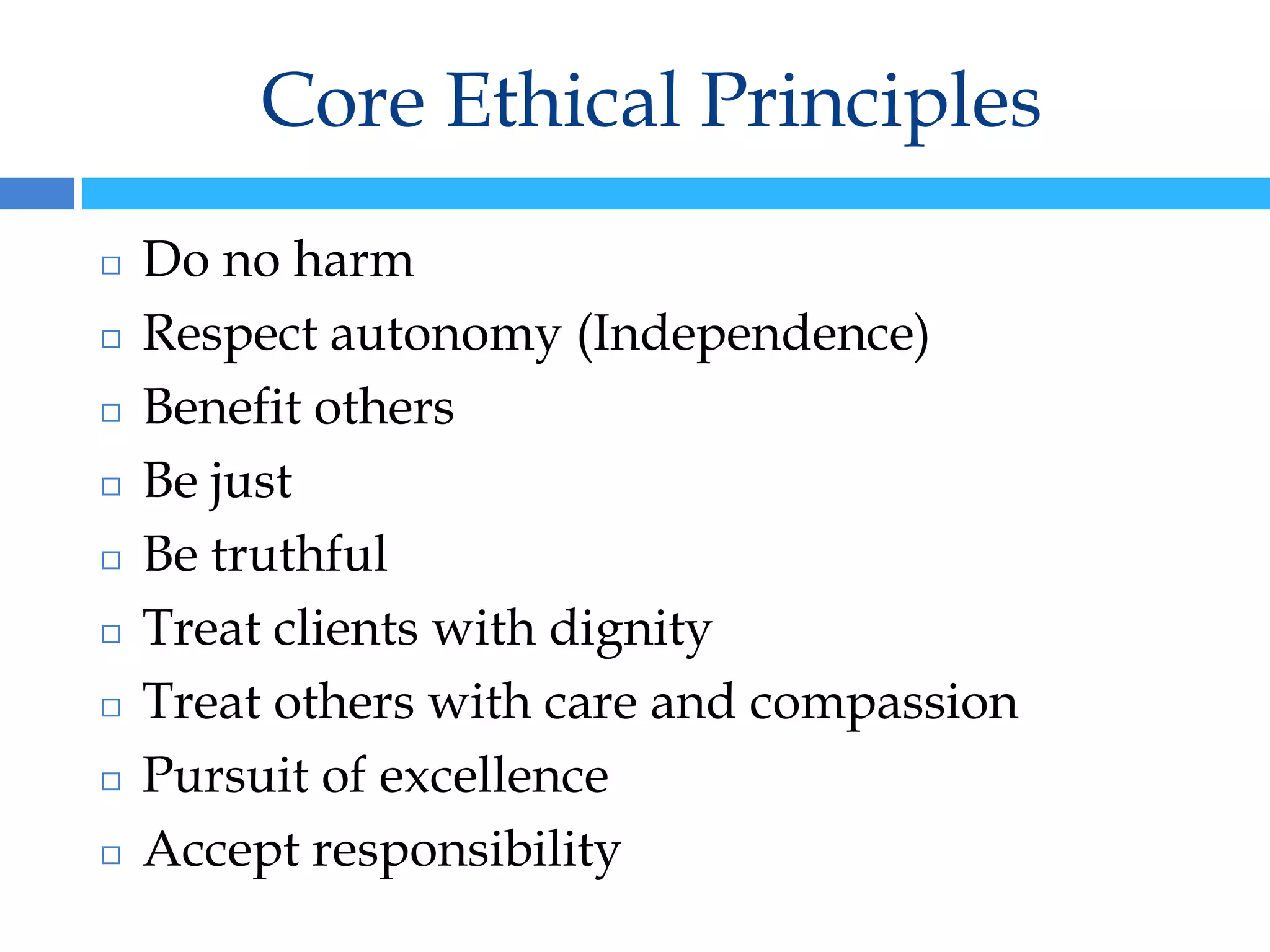
Core Ethical Principles
â—» Do no harm
â—» Respect autonomy (Independence)
â—» Benefit others
â—» Be just
â—» Be truthful
â—» Treat clients with dignity
â—» Treat others with care and compassion
â—» Pursuit of excellence
â—» Accept responsibility
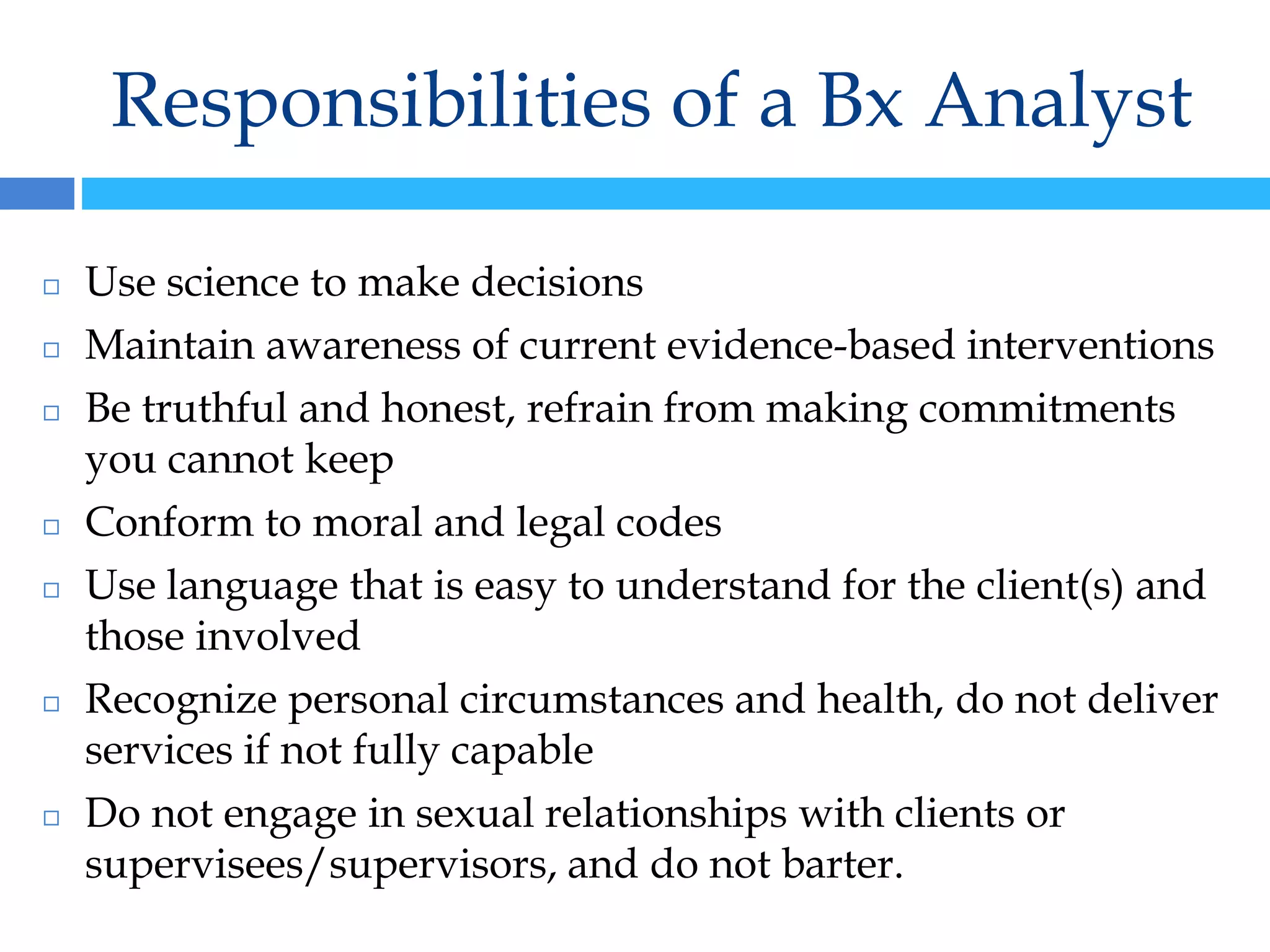
Responsibilities of a Bx Analyst
â—» Use science to make decisions
â—» Maintain awareness of current evidence-based interventions
â—» Be truthful and honest, refrain from making commitments
you cannot keep
â—» Conform to moral and legal codes
â—» Use language that is easy to understand for the client(s) and
those involved
â—» Recognize personal circumstances and health, do not deliver
services if not fully capable
â—» Do not engage in sexual relationships with clients or
supervisees/supervisors, and do not barter.

RBT Power Point

  • 1.
  • 2.
    Overview â—» Principles ofBehavior â—» Behavior Assessment & Intervention â—» Antecedent Interventions â—» Consequence Interventions â—» Teaching New Behavior â—» Discrete Trial Instruction (DTT) â—» Naturalistic Teaching (NaTS) â—» Intensive Trial Teaching (ITT) â—» Recording & Analyzing Behavior â—» Motor Imitation â—» Verbal Behavior â—» Verbal Imitation & Echoics â—» Instructional Control â—» Requests & Mands â—» Receptive Language â—» Expressive Language â—» Core Ethical Principles â—» Responsibilities of Bx Analyst â—» Useful Acronyms
  • 3.
    Principles of Behavior ◻Motivating Operations (MO) ⬜ A reinforcer may only be reinforcing in given moments ⬜ Variables of reinforcer effectiveness (DISC) ■ Deprivation – Immediacy – Size – Contingency ◻ Schedules of Reinforcement ⬜ Continuous schedule – Use to learn new behaviors ⬜ Intermittent schedule – Fixed and variable ratio ⬜ Interval schedule – Based on passage of time ◻ Extinction and Punishment ⬜ Extinction: Bx will decrease and eventually cease when bx no longer receives reinforcement ■ Extinction Burst ■ Spontaneous Recovery ◻ Punishment ⬜ An event that occurs after a Bx and decreases that Bx ■ Positive & Negative : Response Cost & Time Out
  • 4.
    Behavior Assessment &Intervention ◻ Collection of procedures to get information on antecedents, behaviors, and consequences to determine factors that maintain behaviors. ◻ STEPS: ⬜ Identify target behaviors ⬜ Create behavior definitions ⬜ Gather information and data ⬜ Analysis ◻ Identify target behaviors ◻ Identify setting events & antecedents ◻ Identify functions of behaviors ◻ Identify antecedent interventions ◻ Identify replacement behaviors ◻ Create consequence interventions ◻ Specify how to measure progress with interventions implemented Functional Behavior Assessment (FBA) Behavior Intervention Plan (BIP)
  • 5.
    Antecedent Interventions ◻ DiscriminativeStimulus (SD) ⬜ Stimuli in environment that signal Bx and are associated with reinforcement ◻ Stimulus Control ⬜ A Bx is emitted more often in presence of an SD and less without SD ◻ Setting Events ⬜ Medication - Sleep - Diet - Schedule Changes - Environmental Stimuli ◻ Motivating Operations (MO) ⬜ Understand what situations are MOs for the problem behavior ■ Does the child need stimulation? To escape? Attention? Access to something? ◻ Reduce/Avoid Behaviors ⬜ Sensory ⬜ Escape ⬜ Attention Seeking ⬜ Tangibles Access
  • 6.
    Consequence Interventions ◻ Extinction ⬜Withholding reinforcement from a previously reinforced Bx ■ Escape - Tangible - Social or Attention - Sensory ⬜ Extinction Burst ⬜ Spontaneous Recovery ◻ Differential Reinforcement ⬜ Alternate Behaviors (DRA) ⬜ Incompatible Behaviors (DRI) ⬜ Other Behaviors (DRO) ◻ Punishment ⬜ Positive Punishment ⬜ Negative Punishment ■ Time Out ■ Response Cost
  • 7.
    Teaching New Behavior ◻Prompting Procedures ⬜ Physical - Verbal - Visual - Gestural - Positional ◻ Prompt Fading ⬜ Time Delay ⬜ Prompt Fading ⬜ Stimulus Prompt Fading ◻ Shaping ⬜ Reinforce successive approximations of target behavior ⬜ Task Analysis ◻ Chaining ⬜ Forward ⬜ Backward ⬜ Total Task ◻ Discrimination Training
  • 8.
    Discrete Trial Instruction(DTI) ◻ Working one on one with individual, breaking skills into small steps and teaching one sub skill at a time until mastery. ◻ Called “discrete” because instruction has clear beginning, middle, & end. ⬜ Instruction: Present clear task demand (SD), no extra words, do not repeat – prompt. ⬜ Response: allow up to 3 secs. to respond, adjust reinforcement based on quality ⬜ Feedback (SR): Correct + or incorrect -, correction procedure, inter-trial interval ◻ Prompting Procedures ◻ Errorless Learning ◻ Steps of Acquisition ⬜ Mass trial ⬜ Intro a distractor ⬜ 2nd item Mass trial ⬜ Intro a distractor ⬜ Random rotate
  • 9.
    Naturalistic Teaching Strategies ◻Reinforcer/target is always related to the material being taught ◻ Basics ⬜ Behavior should be taught in environment it will be used ⬜ Learner’s items and activities should set occasion for teaching ⬜ Sessions should be across a variety of settings, materials, and types of responses ⬜ Focus should be on functional language and skills ◻ Preference Assessment ⬜ Free operant: See what learner chooses to engage in open environment ⬜ Forced choice: Give learner choice of pre-selected items to see what he/she likes ⬜ Maintain motivation ◻ Stimulus Control ⬜ When a learner responds one way in the presence of a given stimulus and another way in the absence of the same stimulus ■ Generalization ■ Multiple exemplar training
  • 10.
    Intensive Trial Teaching(ITT) ◻ Same as DTT except ITT incorporates verbal behavior ⬜ (1) Present SD – (2) Response – (3) Reinforcement or correction ⬜ Vary the SD (i.e. “Point to”, “Where is”, “Give me”) ◻ Mix known/mastered targets(80%) with harder/newer(20%) targets ◻ Pace of Instruction ⬜ Aim for 16-25 trials per minute ⬜ Inter-trial intervals should be ½ to 1 second ◻ Cold Probe ⬜ Probe targets to see if student already knows some ◻ Balance between ITT and NaTS techniques and settings
  • 11.
    Recording & AnalyzingBx ◻ Behavioral/Operational Definitions ⬜ Define behavior clearly and select measurement technique ⬜ Definition needs to be objective and not ambiguous ⬜ Use physical, observable definitions not internal processes or emotions ⬜ Write definition in a way that even a novice could clearly understand ◻ Recording Data ⬜ Indirect Measurement ■ Interviews and surveys ■ Basic information but not a reliable measure for frequency or intensity ⬜ Direct Measurement ■ Event Recording ■ Frequency, Rate, Intensity ■ Duration or Latency ■ Interval Recording ■ Momentary Time -Sampling
  • 12.
    Motor Imitation &Mimetics ◻ Many children with ASD and related disorders have a core deficit in imitation behaviors ◻ Motor Imitation ⬜ Toy/Object ⬜ Gross Motor ⬜ Fine Motor ⬜ Oral Imitation ◻ Verbal Imitation ⬜ Echoics
  • 13.
    Verbal Behavior ◻ ExpressiveLanguage ⬜ Echoic: Hear something, repeat ⬜ Mand: Want something, use word(s) to ask for it ⬜ Tact: Sense something and say it verbally ⬜ Intraverbal: Word(s) in response to another’s word(s) ◻ Receptive Language (Listener Response) ⬜ Ask listener to do something and they respond ⬜ Response is not verbal
  • 14.
    Verbal Im. &Echoics ◻ Motor Imitation and Verbal Imitation (Echoic) ◻ Stimulus-Stimulus Training (SSP) ⬜ Repeatedly pair a neutral stimulus with a reinforcing stimulus until neutral stimulus becomes conditioned ◻ Echoic Training ⬜ Teacher models a target sound ⬜ Target presented up to 3 times ⬜ If student attempts to echo then reinforcer is delivered immediately ⬜ If no effort to echo after 3 tries then reinforcer is given ◻ Choose appropriate targets for learner’s ability
  • 15.
    Instructional Control ◻ Pairing ⬜Condition yourself to be reinforcing before all else ◻ Maintain motivation ⬜ Change reinforcers, make fun, provide breaks ◻ Reinforcer Effectiveness ⬜ Value of reinforcer ⬜ Effort of response ⬜ Rate of reinforcement ⬜ Magnitude of reinforcement ⬜ Immediacy of reinforcement
  • 16.
  • 17.
    Requests & Mands ◻Mands are requests ⬜ Typically the first operant to develop ⬜ The more a child can mand the less likely he or she will resort to problem behaviors to communicate ⬜ Mands provide functional communication ◻ Features of Mands ⬜ Receives immediate reinforcement ⬜ Directly benefits the speaker ⬜ Controlled by motivation ■ You can contrive environments to create deprivation and increase motivating operations by limiting access
  • 18.
    Requests & Mandscont. ◻ Modes of communication can vary ⬜ Verbal – Sign language – PECS – Choice boards ⬜ Avoid generalized words at first (i.e. drink, toy) ⬜ Avoid carrier phrases (I want, can I have) ◻ Teaching Novel Mands ⬜ Bring attention to item to see if there is interest ⬜ Begin to pair word of item/activity with desired mand ⬜ Prompt learner to mand for item ⬜ Systematically fade prompts until learner can mand for the reinforcer ⬜ Goal is to teach “pure mand”: Learner mands due to motivation (MO) not prompt
  • 19.
    Receptive Language ◻ ListenerResponding refers to the behavior of responding non-verbally to the verbal behaviors of others ⬜ Follow multiple step instructions ⬜ Touch object or picture when named ◻ Receptive Programs ⬜ Receptive Instructions ⬜ Receptive Identification of common objects ◻ Teach intermediate and advanced skills ⬜ Intro 2-step instructions ⬜ Conditional directions ⬜ Responding by Feature, Function, Class
  • 20.
    Expressive Language ◻ Tactsare a type of expressive language used to label, identify, or describe an object, action, or characteristic ◻ Process of Tacts ⬜ Individual sees, smells, tastes, hears, or touches something ⬜ Individual labels that something verbally ⬜ Individual is reinforced w/ anything other than the something ⬜ There is no MO like Mands ◻ Teaching Tacts ⬜ Strong echoic ability is needed to begin teaching ⬜ Present image or object w/ echoic prompt, fade using transfer trials ⬜ Begin introducing adjectives and other words to chain ◻ Promote generalization
  • 21.
    Core Ethical Principles â—»Do no harm â—» Respect autonomy (Independence) â—» Benefit others â—» Be just â—» Be truthful â—» Treat clients with dignity â—» Treat others with care and compassion â—» Pursuit of excellence â—» Accept responsibility
  • 22.
    Responsibilities of aBx Analyst â—» Use science to make decisions â—» Maintain awareness of current evidence-based interventions â—» Be truthful and honest, refrain from making commitments you cannot keep â—» Conform to moral and legal codes â—» Use language that is easy to understand for the client(s) and those involved â—» Recognize personal circumstances and health, do not deliver services if not fully capable â—» Do not engage in sexual relationships with clients or supervisees/supervisors, and do not barter.