Behaviour Modification
By: Anju
Gautam
What is a Behaviour?
 “The actions or reactions of a person in
response to external or internal stimuli;
conduct; manners or deportment, especially
good manners; general course of life;
treatment of others; manner of action; the
activity of an organism, especially as
measurable for its effects; response to
stimulus; the functioning, response or activity
of an object or substance.”
Root Causes of Behaviour
Differences
 Individual differences
 Differences in family patterns
 Impairment/disabilities
 Environmental factors
 Psychological factors
Activity: Influences in
Behaviour
1. What contribution did your family make to your behaviour?
2. What role should you play as a teacher to help develop
acceptable behaviour?
3. Discuss your findings with a friend.
Behaviour modification Principle
 Systematic application
of learning principles
and techniques to
assess and improve
individuals covert and
overt behaviors in
order to help them
function more fully in
society
Characteristics of Behavior
Modification
 Emphasized defining and measuring behavior
 Treatment focuses greatly on the environment.
 Methods and rationales can be described
precisely.
 Most techniques are based on research on
learning
 Emphasizes scientific method
 Accountability is placed on everyone involved
Misconceptions about Behavior
Modification
 Rewards and reinforcement are
nothing more than bribes.
 It is drug
 It only changes symptoms not
underlying problems.
 Can be applied to simple, but not
complex problems
 Behavior analysts are cold non-
empathetic people.
 Behavior modifiers deal only with
observable behavior.
 Behavior modification is outdated
Areas Of Application:
•Parenting
•Educational institutions
•Clinical settings
•Self Management
•Medical and Health care
•Business, Government and Industry
Identification of Behavior
Modification
Behavior modification principles and practices are used to assist individuals with
developing new, desirable behaviors while eliminating behaviors that are no
longer useful. The techniques used are based on a branch of psychology
called behavioral theory. Behavioral theory is based on two areas of study
that took place in the 20th century. Classical conditioning--developed by
Ivan P. Pavlov--focused on stimulus-response patterns. Operant
conditioning--developed by B. F. Skinner--added positive and negative
reinforcement practices to the stimulus-response model.
Stages of Behavior
Modification
 Behavior modification is based on two types of theories. One involves
antecedents i.e. events which occur before a particular behavior is
demonstrated and the other is observable behavior i.e. those events that
occur after a particular behavior has been occurred. A behavior modification
technique is applicable only after a series of changes. An inappropriate
behavior is observed, identified, targeted, and stopped. Meanwhile, a new,
appropriate behavior must be identified, developed, strengthened, and
maintained.
Techniques Of Behaviour
Modification
 There are five categories of activities that can be
addressed with behavior modification techniques
 Develop a new behavior
 Strengthen a behavior
 Maintain an established behavior
 Stop inappropriate behavior, stop , stop….
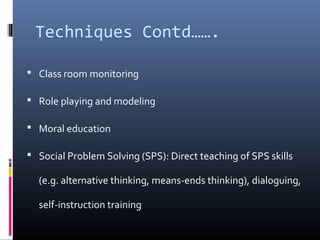
Techniques Contd…….
 Class room monitoring
 Role playing and modeling
 Moral education
 Social Problem Solving (SPS): Direct teaching of SPS skills
(e.g. alternative thinking, means-ends thinking), dialoguing,
self-instruction training
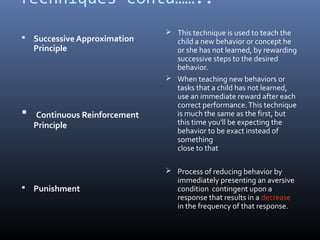
Techniques contd……..
 Successive Approximation
Principle
 Continuous Reinforcement
Principle
 Punishment
 This technique is used to teach the
child a new behavior or concept he
or she has not learned, by rewarding
successive steps to the desired
behavior.
 When teaching new behaviors or
tasks that a child has not learned,
use an immediate reward after each
correct performance.This technique
is much the same as the first, but
this time you'll be expecting the
behavior to be exact instead of
something
close to that
 Process of reducing behavior by
immediately presenting an aversive
condition contingent upon a
response that results in a decrease
in the frequency of that response.
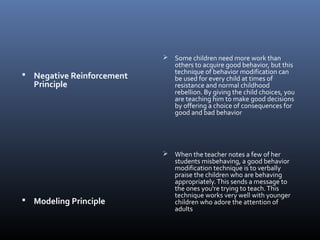
 Negative Reinforcement
Principle
 Modeling Principle
 Some children need more work than
others to acquire good behavior, but this
technique of behavior modification can
be used for every child at times of
resistance and normal childhood
rebellion. By giving the child choices, you
are teaching him to make good decisions
by offering a choice of consequences for
good and bad behavior
 When the teacher notes a few of her
students misbehaving, a good behavior
modification technique is to verbally
praise the children who are behaving
appropriately.This sends a message to
the ones you're trying to teach.This
technique works very well with younger
children who adore the attention of
adults
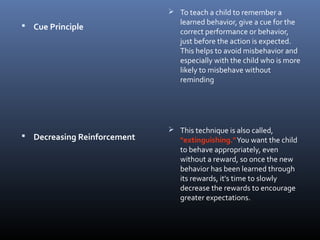
 Cue Principle
 Decreasing Reinforcement
 To teach a child to remember a
learned behavior, give a cue for the
correct performance or behavior,
just before the action is expected.
This helps to avoid misbehavior and
especially with the child who is more
likely to misbehave without
reminding
 This technique is also called,
"extinguishing."You want the child
to behave appropriately, even
without a reward, so once the new
behavior has been learned through
its rewards, it's time to slowly
decrease the rewards to encourage
greater expectations.
 Avoidance Principle
 Extinction
 To teach a child to avoid a certain
type of situation, simultaneously
present to the child the situation to
be avoided and some aversive
condition (or its representation).
 The principle of extinction works by
removing or changing what happens
after the behavior takes place. In
effect, the incentive or reward that
motivates a person to carry out a
certain behavior is taken away.
When this happens over and over
again, the motivation to indulge in a
certain behavior begins to fade or
extinct……
 Systematic Desensitization
(Fear Reduction Principle)
 Biofeedback
 Systematic desensitization is a behavior
modification practice used to eliminate
fears or undesirable emotions. An
example of this practice would be
removing a person's fear of public
speaking. Speaking in front of a small
group of friends or family might be a first
step.The person then gradually works up
to speaking in front of a larger group of
strangers or associates.
 Biofeedback is a method that provides
immediate feedback on a person's
physiological state, be it heart rate,
breathing rate or blood pressure.
Feedback is provided by a mechanical
device that lets the person know when a
particular symptom is present.
Shaping the behaviour
 Shaping behavior is the aspect of behavior analysis that is the
“teaching of behaviors that are not in the student’s existing
repertoire?. It involves clearly defining a behavioral objective with a
target behavior, delivering or withholding reinforcement at the
appropriate time, and thus, being able to shape the student into
“gradual successive approximations of the target behavior
Maintaining Discipline in the
Classroom
 Specify a clear and concrete set of
classroom rules. In some cases,
involve the students in the
formulation of rules, so that they
have a sense of ownership.
 Specify a clear set of consequences
for rule violations – 3 change plan
(warning, warning, consequence)
 Ignore the behaviour
 Positive re- inforcement
 Be Assertive
 Consultation with therapists

Behaviour modification ppt 1

  • 1.
  • 2.
    What is aBehaviour?  “The actions or reactions of a person in response to external or internal stimuli; conduct; manners or deportment, especially good manners; general course of life; treatment of others; manner of action; the activity of an organism, especially as measurable for its effects; response to stimulus; the functioning, response or activity of an object or substance.”
  • 3.
    Root Causes ofBehaviour Differences  Individual differences  Differences in family patterns  Impairment/disabilities  Environmental factors  Psychological factors
  • 4.
    Activity: Influences in Behaviour 1.What contribution did your family make to your behaviour? 2. What role should you play as a teacher to help develop acceptable behaviour? 3. Discuss your findings with a friend.
  • 5.
    Behaviour modification Principle Systematic application of learning principles and techniques to assess and improve individuals covert and overt behaviors in order to help them function more fully in society
  • 6.
    Characteristics of Behavior Modification Emphasized defining and measuring behavior  Treatment focuses greatly on the environment.  Methods and rationales can be described precisely.  Most techniques are based on research on learning  Emphasizes scientific method  Accountability is placed on everyone involved
  • 7.
    Misconceptions about Behavior Modification Rewards and reinforcement are nothing more than bribes.  It is drug  It only changes symptoms not underlying problems.  Can be applied to simple, but not complex problems  Behavior analysts are cold non- empathetic people.  Behavior modifiers deal only with observable behavior.  Behavior modification is outdated
  • 8.
    Areas Of Application: •Parenting •Educationalinstitutions •Clinical settings •Self Management •Medical and Health care •Business, Government and Industry
  • 9.
    Identification of Behavior Modification Behaviormodification principles and practices are used to assist individuals with developing new, desirable behaviors while eliminating behaviors that are no longer useful. The techniques used are based on a branch of psychology called behavioral theory. Behavioral theory is based on two areas of study that took place in the 20th century. Classical conditioning--developed by Ivan P. Pavlov--focused on stimulus-response patterns. Operant conditioning--developed by B. F. Skinner--added positive and negative reinforcement practices to the stimulus-response model.
  • 10.
    Stages of Behavior Modification Behavior modification is based on two types of theories. One involves antecedents i.e. events which occur before a particular behavior is demonstrated and the other is observable behavior i.e. those events that occur after a particular behavior has been occurred. A behavior modification technique is applicable only after a series of changes. An inappropriate behavior is observed, identified, targeted, and stopped. Meanwhile, a new, appropriate behavior must be identified, developed, strengthened, and maintained.
  • 11.
    Techniques Of Behaviour Modification There are five categories of activities that can be addressed with behavior modification techniques  Develop a new behavior  Strengthen a behavior  Maintain an established behavior  Stop inappropriate behavior, stop , stop….
  • 12.
    Techniques Contd…….  Classroom monitoring  Role playing and modeling  Moral education  Social Problem Solving (SPS): Direct teaching of SPS skills (e.g. alternative thinking, means-ends thinking), dialoguing, self-instruction training
  • 13.
    Techniques contd……..  SuccessiveApproximation Principle  Continuous Reinforcement Principle  Punishment  This technique is used to teach the child a new behavior or concept he or she has not learned, by rewarding successive steps to the desired behavior.  When teaching new behaviors or tasks that a child has not learned, use an immediate reward after each correct performance.This technique is much the same as the first, but this time you'll be expecting the behavior to be exact instead of something close to that  Process of reducing behavior by immediately presenting an aversive condition contingent upon a response that results in a decrease in the frequency of that response.
  • 14.
     Negative Reinforcement Principle Modeling Principle  Some children need more work than others to acquire good behavior, but this technique of behavior modification can be used for every child at times of resistance and normal childhood rebellion. By giving the child choices, you are teaching him to make good decisions by offering a choice of consequences for good and bad behavior  When the teacher notes a few of her students misbehaving, a good behavior modification technique is to verbally praise the children who are behaving appropriately.This sends a message to the ones you're trying to teach.This technique works very well with younger children who adore the attention of adults
  • 15.
     Cue Principle Decreasing Reinforcement  To teach a child to remember a learned behavior, give a cue for the correct performance or behavior, just before the action is expected. This helps to avoid misbehavior and especially with the child who is more likely to misbehave without reminding  This technique is also called, "extinguishing."You want the child to behave appropriately, even without a reward, so once the new behavior has been learned through its rewards, it's time to slowly decrease the rewards to encourage greater expectations.
  • 16.
     Avoidance Principle Extinction  To teach a child to avoid a certain type of situation, simultaneously present to the child the situation to be avoided and some aversive condition (or its representation).  The principle of extinction works by removing or changing what happens after the behavior takes place. In effect, the incentive or reward that motivates a person to carry out a certain behavior is taken away. When this happens over and over again, the motivation to indulge in a certain behavior begins to fade or extinct……
  • 17.
     Systematic Desensitization (FearReduction Principle)  Biofeedback  Systematic desensitization is a behavior modification practice used to eliminate fears or undesirable emotions. An example of this practice would be removing a person's fear of public speaking. Speaking in front of a small group of friends or family might be a first step.The person then gradually works up to speaking in front of a larger group of strangers or associates.  Biofeedback is a method that provides immediate feedback on a person's physiological state, be it heart rate, breathing rate or blood pressure. Feedback is provided by a mechanical device that lets the person know when a particular symptom is present.
  • 18.
    Shaping the behaviour Shaping behavior is the aspect of behavior analysis that is the “teaching of behaviors that are not in the student’s existing repertoire?. It involves clearly defining a behavioral objective with a target behavior, delivering or withholding reinforcement at the appropriate time, and thus, being able to shape the student into “gradual successive approximations of the target behavior
  • 19.
    Maintaining Discipline inthe Classroom  Specify a clear and concrete set of classroom rules. In some cases, involve the students in the formulation of rules, so that they have a sense of ownership.  Specify a clear set of consequences for rule violations – 3 change plan (warning, warning, consequence)  Ignore the behaviour  Positive re- inforcement  Be Assertive  Consultation with therapists