Main assumption
• Psychologicalproblems arise because the way
we think. Ellis identified the following types of
irrational thinking;
3.
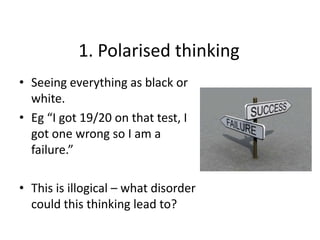
1. Polarised thinking
•Seeing everything as black or
white.
• Eg “I got 19/20 on that test, I
got one wrong so I am a
failure.”
• This is illogical – what disorder
could this thinking lead to?
4.
2. Over generalisation
•We come to a general
conclusion based on one single
event.
• Eg “I crashed my car that one
time, it will happen again.”
• “I failed one test, I will
definitely fail that subject.”
5.
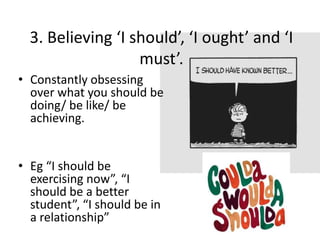
3. Believing ‘Ishould’, ‘I ought’ and ‘I
must’.
• Constantly obsessing
over what you should be
doing/ be like/ be
achieving.
• Eg “I should be
exercising now”, “I
should be a better
student”, “I should be in
a relationship”
6.
4. Catastrophising
• Makinga mountain out of a
molehil
• “I forgot to post that letter, this
is the worst thing I have ever
done”.
• “That date went badly, I will
never get married”.
7.
How does depressionoccur?
• 1. Errors in logic
• Depressed people draw illogical conclusions
about themselves and their lives, this leads
them to becoming unhappy.
• “Mary blanked me yesterday, she must hate
me, I must be an awful person”
8.
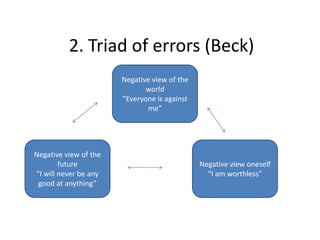
2. Triad oferrors (Beck)
Negative view of the
world
“Everyone is against
me”
Negative view of the
future Negative view oneself
“I will never be any “I am worthless”
good at anything”
9.
Evaluate the cognitiveapproach
• STRENGTH – supported by research evidence
• Eg Gustafson found that many people with
mental disorders such as anxiety and
depression did suffer from maladaptive
thinking patterns
10.
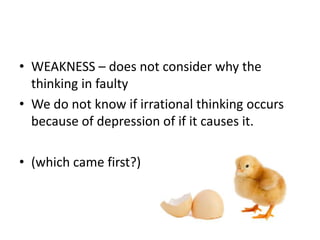
• WEAKNESS –does not consider why the
thinking in faulty
• We do not know if irrational thinking occurs
because of depression of if it causes it.
• (which came first?)
11.
• WEAKNESS and/or STRENGTH The
responsibility is on the individual
• W- blames the individual
• S-...
12.
Cognitive treatments
• CognitiveBehaviour Therapy
• A type of therapy that combines cognitive and
behavioural aspects
• The AIM: To challenge .............................and
encourage the client to see things differently
13.
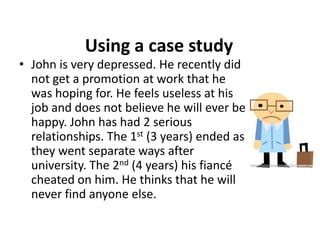
Using a casestudy
• John is very depressed. He recently did
not get a promotion at work that he
was hoping for. He feels useless at his
job and does not believe he will ever be
happy. John has had 2 serious
relationships. The 1st (3 years) ended as
they went separate ways after
university. The 2nd (4 years) his fiancé
cheated on him. He thinks that he will
never find anyone else.
14.
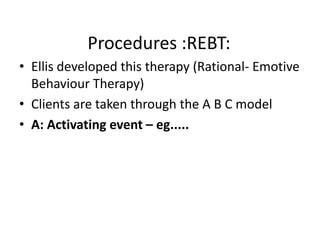
Procedures :REBT:
• Ellisdeveloped this therapy (Rational- Emotive
Behaviour Therapy)
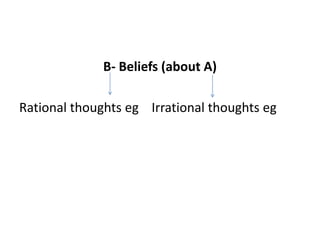
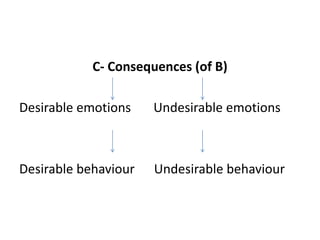
• Clients are taken through the A B C model
• A: Activating event – eg.....
Beck’s cognitive therapy
•The client must monitor situations where they
have negative thoughts (as in the triad)
• The therapist will challenge these negative
thoughts in question and answer sessions
• Why does this help? What would we say to
John?
• STRENGTH -appealing to clients – less
threatening than other therapies such as
.......................and provides clients with self help
strategies
20.
• STRENGTH -CBT has been successfully used
for treating depression. How does it compare
to drugs?
• Hollon: ................................................
• Fava: 25% relapse .................................
80% relapse .................................
21.
• STRENGTH- Ethics-there is an equal
relationship between client and therapist –
they work together. What type of therapy is
this better than?



![Anxiety disorders unit intervention[2]](https://cdn.slidesharecdn.com/ss_thumbnails/anxietydisordersunitintervention2-111028091300-phpapp02-thumbnail.jpg?width=640&height=640&fit=bounds)


![Guide making a_short_film[1]](https://cdn.slidesharecdn.com/ss_thumbnails/guidemakingashortfilm1-120627095958-phpapp01-thumbnail.jpg?width=640&height=640&fit=bounds)
![Cut films activity_4[1]](https://cdn.slidesharecdn.com/ss_thumbnails/cutfilmsactivity41-120627095511-phpapp01-thumbnail.jpg?width=640&height=640&fit=bounds)


![PERI-PROSTHETIC FRACTURE NAIL-PLATE CONSTRUCT [NPC].pptx](https://cdn.slidesharecdn.com/ss_thumbnails/drarunkumardrmohamedashrafperiprostheticfrasturenail-plateconstructnpc-260209164459-7e9d15a1-thumbnail.jpg?width=640&height=640&fit=bounds)


